
AnimaliaNot Evaluatedsynonymspecies
Pelagia benovici

Pelagia benovici

Piraino, Aglieri, Scorrano & Boero, 2014

GBIF:7739497

0countries
0year

PROFILE

Species Profile

ABOUT

Descriptions(5)

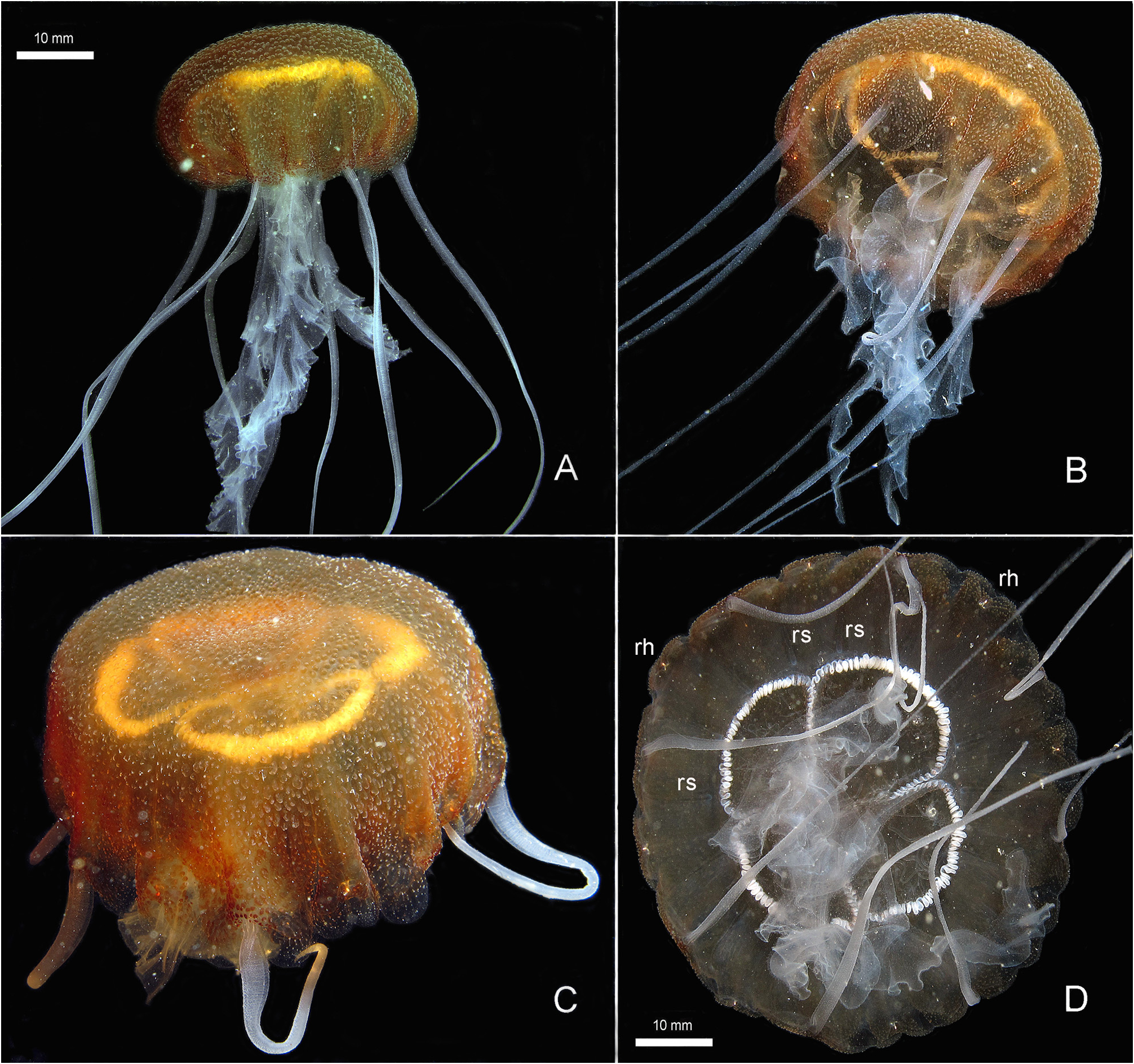
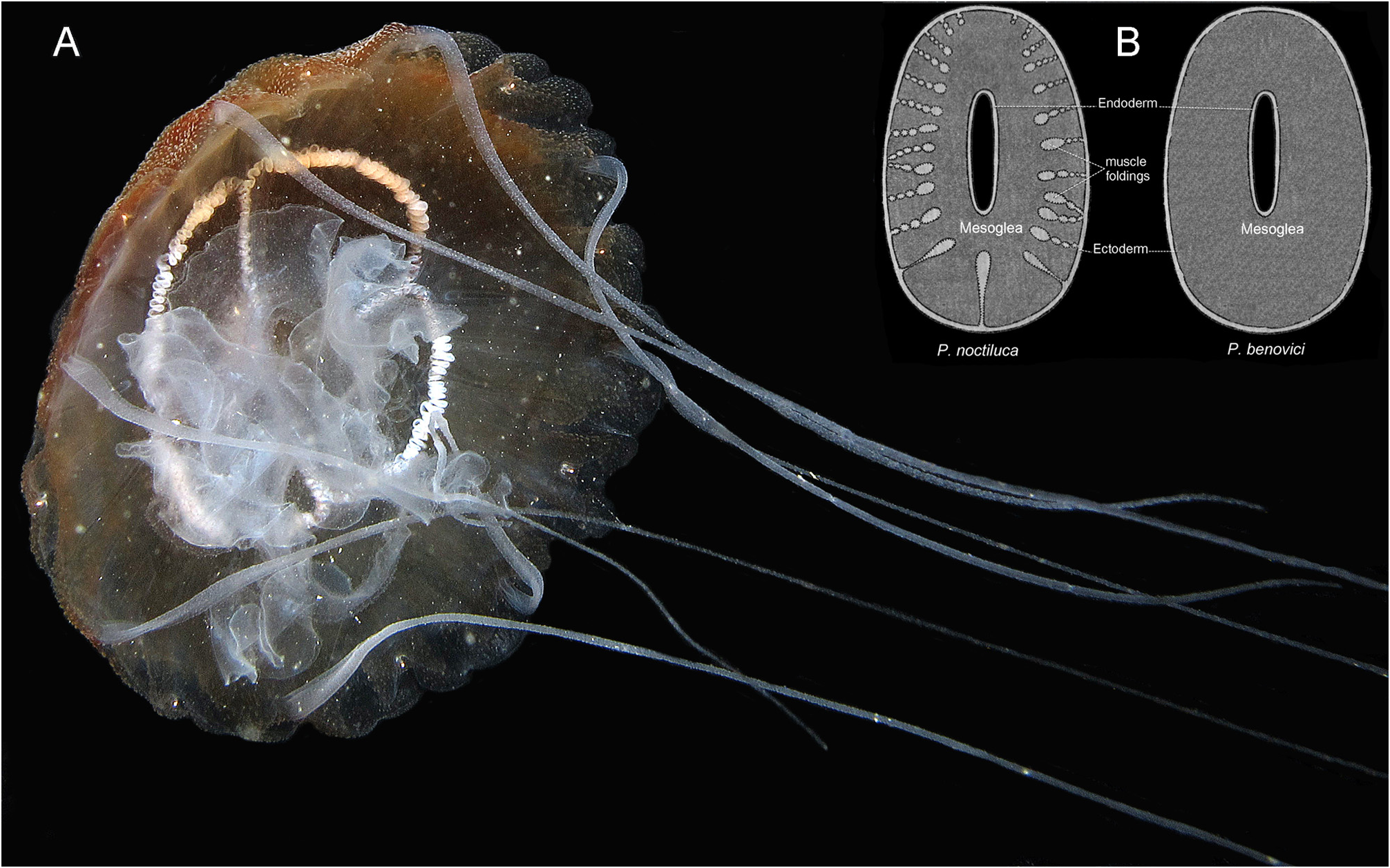
Description (based on holotype and paratype). Preserved medusa almost flat, with thin transparent mesogleal jelly. Live specimens hemispherical during active swimming strokes (Fig. 2 A). Exumbrella yellow-ochre in colour, homogeneously covered by prominent cnidocyst warts of various shapes, from rounded to oval to pointed, with whitish refringent tip of wart. Sixteen marginal lappets, rectangular, with rounded corners (Figs. 2 B – D, 3 A). Eight adradial, hollow, white and transparent tentacles, up to three times the diameter of umbrella in length. Large tentacle bases laterally compressed to ovoid, with medio-peripheral main axis, distally tapering into cylindrical shape (Figs. 2 A – D, 3 A). Absence of longitudinal muscular foldings in tentacle mesoglea (Fig. 3 B). Eight marginal sensory organs (Fig. 2 D), lacking ocelli, each located in a shallow pit formed by ectodermal outgrowth of the umbrellar margin and by overlapping sides of marginal lappets (Fig. 4 A). Well-developed coronal muscle on subumbrellar surface. Simple radial septa terminating between sense organs and tentacles, dividing the gastrovascular sinus into 8 tentacular and 8 rhopalial separate pouches, tentacular pouches slightly larger than rhopalial ones (Fig. 4 B). Stomach without gastric septa, with bundles of gastric filaments arranged in interradial groups, originating at the transition between stomach and gastrovascular sinus (Fig. 4 C). Four interradial, elongated milky white, ribbon-like gonochoric gonads (holotype: male; paratype: female), horse-shoe shaped, convex; ribbon protrudes out of subumbrellar surface at periphery of gastric pouches; each ribbon spans two tentacular and one intermediate rhopaliar pouch (Figs. 2 D, 3 A, 4 B – D). Manubrium whitish, transparent, ≤ 1.5 times the diameter of umbrella in length, with very short oral tube and long delicate oral arms with frilled edges (Figs. 2 A, B, D), covered by colourless cnidocyst warts (Fig. 4 C). Perradial subumbrellar surfaces between gonads covered by brownish cnidocyst warts, smaller than exumbrellar warts (Fig. 4 B, C), also scattered over the gonad foldings (Fig. 4 D, 5 A, B). Cnidome (Fig. 5 C – F). At least 3 cnidocyst types: holotrichous O-isorhizas (spherical, length 7 – 11 µm; width 7 – 11 µm), microbasic euryteles (ovoid, length 9 – 11 µm; width 4 – 5 µm), and a third larger type, provisionally identified by light microscopy as heterotrichous microbasic birhopaloid II type (ovoid, length 16 – 24 µm; width 14 – 17 µm).
Pelagia benovici sp. nov. (Cnidaria, Scyphozoa): a new jellyfish in the Mediterranean Sea
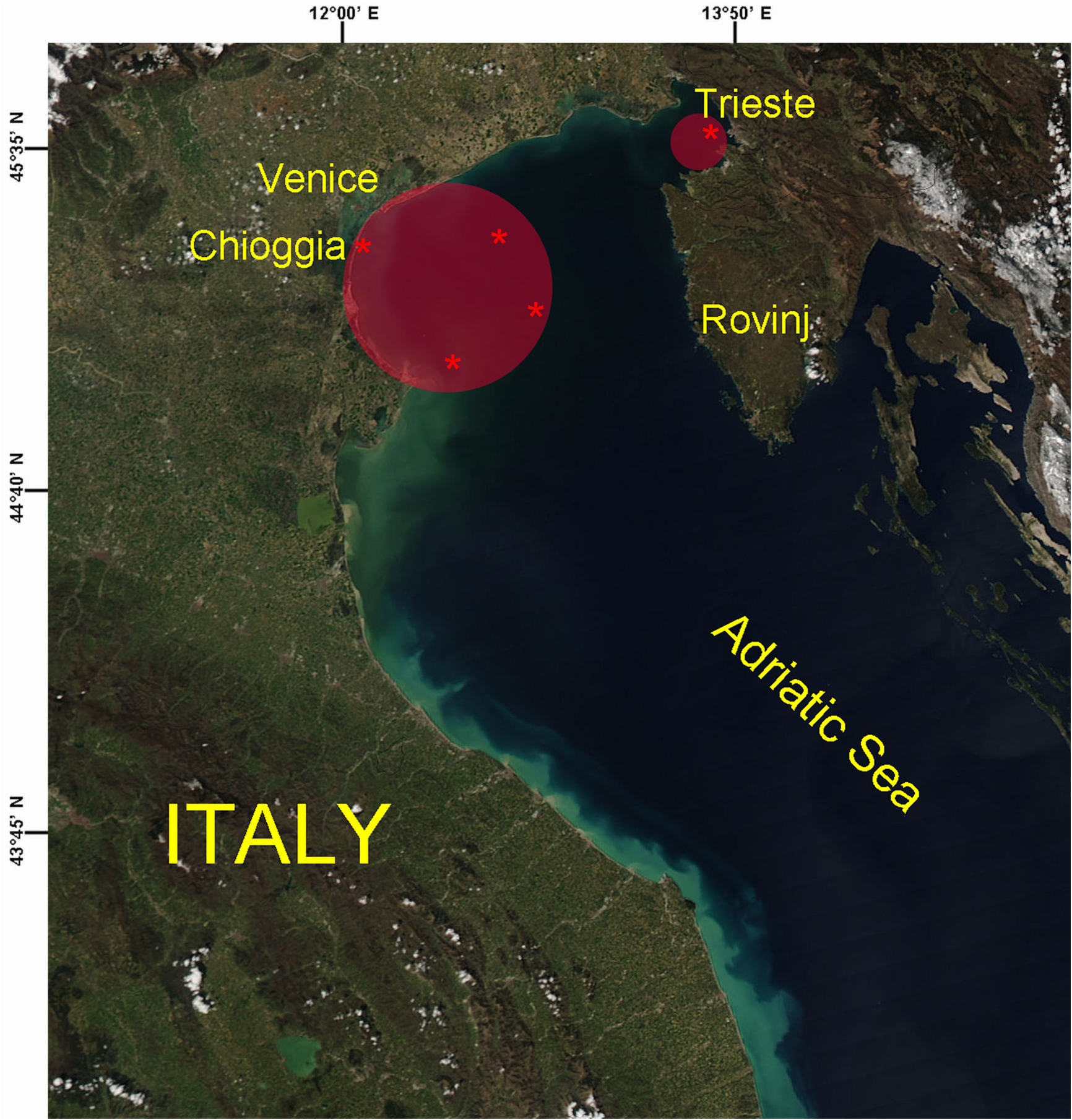
Discussion and systematic remarks. Within the order Semaestomeae, four families are widely recognized (see Kramp 1961; Russell 1970; Bayha & Dawson 2010) — Pelagiidae, Cyaneidae, Ulmariidae and Drymonematidae — and a fifth family, Phacellophoridae, has been proposed by Straehler-Pohl et al. (2011). The Pelagiidae are easily recognized by emergence of the tentacles at the umbrella margin, the absence of branched pouches of the gastrovascular sinus, and the absence of a ring canal. Pelagiidae contains three genera (Gershwin & Collins 2002) — Chrysaora, Pelagia, and Sanderia — of which one, Chrysaora, was recently revised by Morandini and Marques (2010). Pelagiid jellyfish bearing eight marginal tentacles and eight rhopalia, as the new jellyfish described here, belong either to Chrysaora or to the monospecific Pelagia. These two genera are easily distinguished by a number of morphological characters. Namely, Pelagia have conspicuous exumbrellar cnidocyst warts, shallow rhopaliar pits, 16 marginal lappets, and radial septa terminating between rhopalia and tentacles. By contrast, Chrysaora jellyfish have radial septa terminating proximate to the base of the tentacle and a higher number of marginal lappets (32 – 48 [but see C. colorata below]); additional anatomical features are distinctive characters species within Chrysaora, such as the occurrence of quadralinga and a heavy manubrium in C. colorata and C. achlyos (Gershwin & Collins 2002). So far, C. colorata is the only known Chrysaora species with 8 marginal tentacles, but it is distinguished by its outer morphology (large size and star-shaped exumbrellar marks) from the three nominal Pelagia species, the well-known P. noctiluca (Forskål 1775), P. panopyra Péron & Lesueur 1809, and P. flaveola Eschscholtz 1829 (Gershwin and Collins 2002; Cornelius 2013). A striking difference also resides in life history, in the direct metamorphosis planula-ephyra in Pelagia, whereas Chrysaora species have a polypoid stage. A thorough analysis of the older literature (Maas 1903; Mayer 1910; Krasinska 1914; Menon 1930; Kramp 1961; Russell 1964, 1970) revealed the morphological features therefore clearly indicate that the new species must be ascribed to the genus Pelagia, and the molecular analysis confirmed its distinctiveness from P. noctiluca, with the complication that phylogenetic analyses of 28 S suggest incomplete lineage sorting of this more slowly evolving nuclear marker, amplification of paralogues, or hybridization between P. benovici and P. noctiluca. Each of these three processes could be responsible for the conflict between gene and species trees. So far, besides P. noctiluca, all other nominal species of this genus are considered doubtful (Kramp 1961; Gul & Morandini 2013; Cornelius 2013). Indeed, no nominal species of Pelagia can be referred to the presently described material (Tab. 2), and Pelagia benovici sp. nov. is described here as a new species by a combination of morphological features, notably: • densely distributed and irregularly shaped (rounded to arrow-pointed) exumbrellar cnidocyst warts (Fig. 7); • milky white (same colour both in female and male specimens) horse-shoe shaped, outwardly convex gonads (Fig. 7), protruding out of the subumbrellar surface; • club-shaped cnidocyst warts on gonadal ribbons (Fig. 4 D); • white transparent colour of tentacles, manubrium and oral arms (Fig. 8), tentacles without longitudinal muscular folds (Fig. 3 B). The findings of sexually mature specimens at sites several hundreds of kilometers apart indicate the possibility of an established population spreading in the North Adriatic. Gershwin & Collins (2002) remarked that pelagiid systematics was oddly neglected, in spite of the conspicuous sizes, distinctive morphologies, and painful stings of these jellyfish. The same authors predicted that new pelagiids likely would be discovered, and P. benovici seems a point in case. Native or introduced? The first alien jellyfish in the Mediterranean Sea, Cassiopea andromeda, was found near Cyprus at the beginning of the 20 th century (Maas 1903). Since then, three non-native jellyfish species have been recorded in the Mediterranean Sea: Phyllorhiza punctata and Rhopilema nomadica (Galil 1990), and Marivagia stellata Galil and Gershwin 2010 (Galil et al. 2010). R. nomadica and M. stellata also were new to science. When M. stellata was described as a new species from the Israeli Mediterranean coast, Galil et al. (2010) cautiously considered it as a non-native species and a probable Lessepsian immigrant, assuming that a native, coastal conspicuous jellyfish, markedly different from all known scyphozoans of the Mediterranean Sea, would hardly have escaped attention until the 21 st century. Recently, the finding of M. stellata off the coast of Kerala, India (Galil et al. 2013) corroborated this hypothesis and established this species as the fourth Erythrean alien jellyfish species introduced in the Mediterranean Sea through the Suez Canal. Similarly, given the number of marine biological stations in the Adriatic Sea, the long history of investigations on gelatinous zooplankton in the area, and the increasing attention on jellyfish blooms in recent years, it is highly unlikely that P. benovici remained unnoticed until 2013, when a large population of mature jellyfish suddenly appeared and then persisted in a restricted area. The North Adriatic Sea, particularly the Gulf of Venice, is a major hotspot for introduction of alien species by shipping- and aquaculture-mediated in Europe (Occhipinti et al. 2011; Galil 2012) and an increase in shipping related invasions has been noted recently (Galil 2009). Re-discovery of rare jellyfish (e. g. Rhizostoma luteum in the Gibraltar Strait or the native Drymonema dalmatinum in the Adriatic Sea) after almost a century-long absence (Bayha & Dawson 2010 for a review; Prieto et al. 2013) suggests some scyphozoans might remain undetected for a very long time and re-appear suddenly, perhaps linked to the presence of an asexually reproducing polyp stage in the life cycle (Boero et al. 2008). However, this is unlikely to be the case for P. benovici. The genus Pelagia is thought to lack a polyp stage, although this needs to be confirmed for P. benovici. By its currently restricted distribution in the Gulf of Venice (Fig. 1), its conspicuous bloom, and each medusa’s unignorable size, P. benovici seems most likely to be another alien species introduced by human activities into the Mediterranean Sea. Most probably, P. benovici was transported as viable jellyfish in the ballast waters of ships coming from the native area of this species, where it remains still undetected. This is the third case of a new species discovered in the Mediterranean but native to different seas, after the Erythrean immigrants Alpheus migrans (Decapoda) Lewinson and Holthuis 1978, and the rhizostome jellyfish Marivagia stellata. The life cycle of P. benovici still remains unknown, but this new taxon looks like an invasive species with the potential to form large blooms. It may have potential to spread across the Adriatic and neighbouring seas, raising the need for research efforts on mechanisms driving bioinvasions and on the impact of outbreak-forming species, as Boero (2013) recently advocated.
Pelagia benovici sp. nov. (Cnidaria, Scyphozoa): a new jellyfish in the Mediterranean Sea
Etymology. The species is named after the late Prof. Adam Benovic, who dedicated his life to the study of gelatinous plankton, especially in the Adriatic Sea.
Pelagia benovici sp. nov. (Cnidaria, Scyphozoa): a new jellyfish in the Mediterranean Sea
Holotype: male specimen (adult), collected from Gulf of Venice (Chioggia), November 2013, 46 mm bell diameter. Deposited in the Collection of the Museum of Adriatic Zoology Giuseppe Olivi (Palazzo Grassi, Chioggia, University of Padova). Accession number: CN 54 CH. Paratype I: female specimen (adult), Gulf of Venice (Chioggia), November 2013, 50 mm bell diameter. Deposited in the Collection of the Museum of Adriatic Zoology Giuseppe Olivi (Palazzo Grassi, Chioggia, University of Padova). Accession number: CN 55 CH. Other material: 10 specimens. Gulf of Venice (Chioggia), November 2013 32 – 45 mm (range of bell diameter). Deposited in the Collection of Marine Invertebrates at the Laboratory of Zoology and Marine Biology of the University of Salento (Lecce). Accession numbers: UNIS _ SCY _ 001 – 10. Five specimens photographed in the field, but not collected, by Mr. Fabrizio Marcuzzo at Punta Sottile, Muggia (Trieste) on December 5 th, 2013
Pelagia benovici sp. nov. (Cnidaria, Scyphozoa): a new jellyfish in the Mediterranean Sea
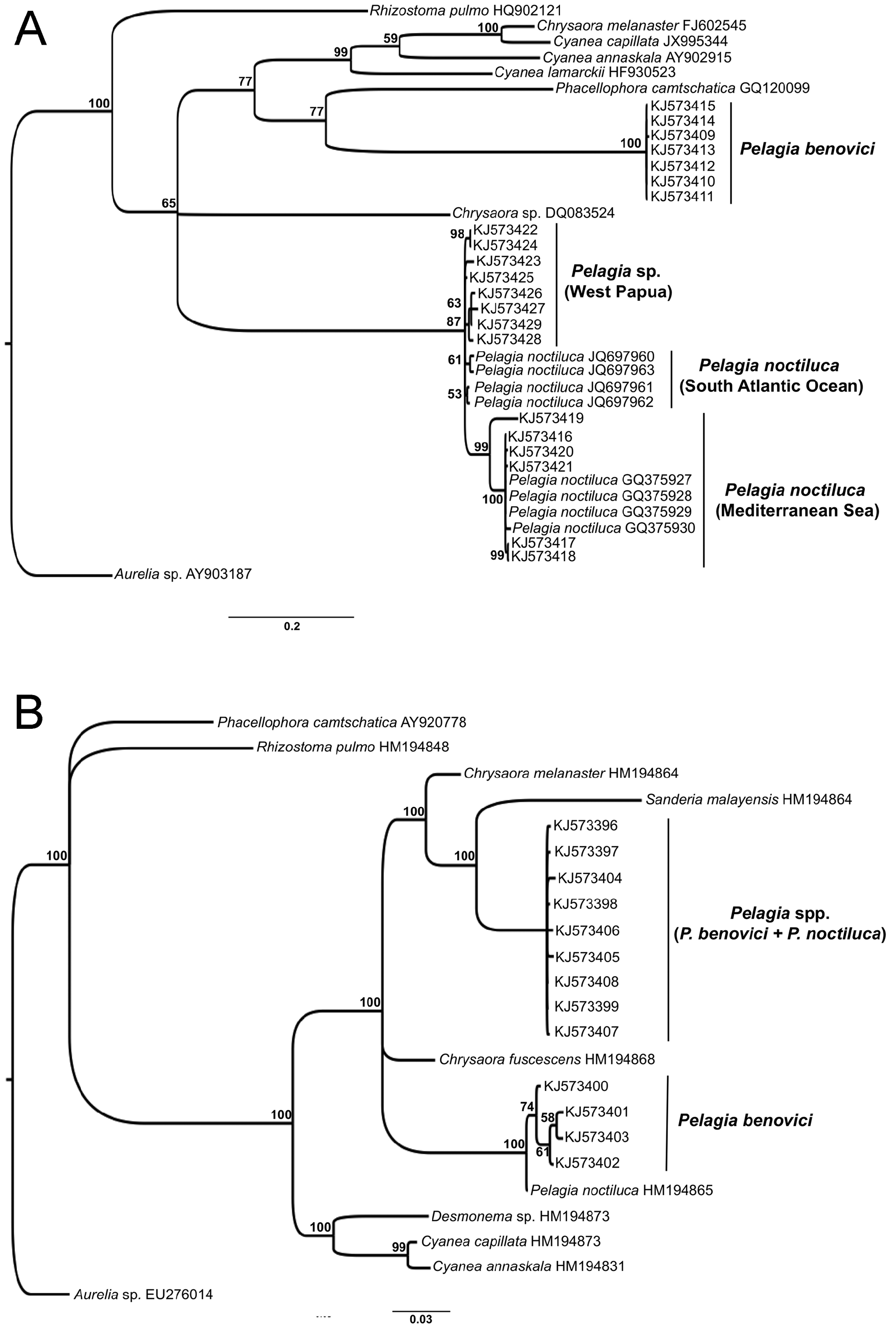
Type locality. Gulf of Venice, Adriatic Sea, Mediterranean Sea. Molecular analysis. Seven COI sequences from P. benovici specimens were identical to each other (mean within-species pairwise K 2 P distance = 0.001, S. E. = 0.001), and significantly dissimilar from the 14 P. noctiluca sequences from Mediterranean Sea and South Atlantic Ocean specimens (mean between-species pairwise K 2 P distance = 0.362, S. E. = 0.040) and from 8 P. cf. panopyra sequences (mean between-species pairwise K 2 P distance = 0.342, S. E. = 0.038). (Table 1). Unrooted NJ and ML trees had the same topology (data not shown) including consistently distinct P. noctiluca and P. benovici clades. The COI Bayesian tree (Fig. 6 A) also shows consistent separation of P. benovici sp. nov. from any of its morphologically closest relatives, P. noctiluca and P. cf. panopyra. Bayesian phylogenetic analysis of 28 S (Fig. 6 B) consistently showed the same topology as the NJ and ML analyses of 28 S (not shown), including monophyly of the Pelagiidae, with all representatives of Pelagia, Chrysaora and Sanderia that were considered. However, this tree does not show reciprocal monophyly of Pelagia benovici sp. nov. and P. noctiluca; 28 S sequences from medusae that were distinguished morphologically as different species occur together in two distinct clades. * Sequences downloaded from GenBank; n / a: not available.
Pelagia benovici sp. nov. (Cnidaria, Scyphozoa): a new jellyfish in the Mediterranean Sea

Export occurrence data

Darwin Core Archive (ZIP)

GEOGRAPHY

Distribution Map

Occurrence Map

Loading map…

Tiles © GBIF Maps API | Map powered by MapLibre GL

REGIONS

Geographic Distribution(6)

GR
IT
introduced
Italian part of the Adriatic Sea(IT)
introduced
Italian part of the Ionian Sea(IT)
introduced
Italian part of the Adriatic Sea(IT)
introduced
Italian part of the Ionian Sea(IT)
introduced

DATA

Occurrence Datasets

Loading datasets…

CLASSIFICATION

Taxonomic Classification Tree

MULTIMEDIA

Media Files(8)

FIGURE 1. Map of sampling sites (stars) and observed distributional range (circles) of Pelagia benovici sp. nov. in the North Adriatic Sea.
Imageimage/png© Piraino, Stefano;Aglieri, Giorgio;Martell, Luis;Mazzoldi, Carlotta;Melli, Valentina;Milisenda, Giacomo;Scorrano, Simonetta;Boero, FerdinandoPelagia benovici sp. nov. (Cnidaria, Scyphozoa): a new jellyfish in the Mediterranean Sea

FIGURE 2. Pelagia benovici sp. nov. (A) Lateral view. (B) Sublateral view. (C) Aboral view, with prominent exumbrellar cnidocyst warts. (D) Oral view, showing the distinctive horse-shoe shaped white gonads, and overall subumbrellar morphology. rh: rhopalia, rs: radial septa (for clarity, only few labels added).
Imageimage/png© Piraino, Stefano;Aglieri, Giorgio;Martell, Luis;Mazzoldi, Carlotta;Melli, Valentina;Milisenda, Giacomo;Scorrano, Simonetta;Boero, FerdinandoPelagia benovici sp. nov. (Cnidaria, Scyphozoa): a new jellyfish in the Mediterranean Sea

FIGURE 3. Pelagia benovici sp. nov. (A) Oral view with extended marginal tentacles. (B) Sections of tentacles bases showing occurrence of longitudinal muscular foldings in the tentacles of P. noctiluca (left) compared with absence from P. benovici tentacles (right). Drawings after Krasinska, 1914 (modified).

Imageimage/png© Piraino, Stefano;Aglieri, Giorgio;Martell, Luis;Mazzoldi, Carlotta;Melli, Valentina;Milisenda, Giacomo;Scorrano, Simonetta;Boero, FerdinandoPelagia benovici sp. nov. (Cnidaria, Scyphozoa): a new jellyfish in the Mediterranean Sea

FIGURE 4. Pelagia benovici sp. nov. (A) Rhopaliar pit (rp). (B) Portion of gastrovascular sinus showing radial septa (rs), subumbrellar perradial warts (sw), tentacular (tp) and rhopaliar (rhp) pouches, rhopalia (rh), and rounded marginal lappets. (C) Gastric filaments (gf), horse-shoe shaped gonads (g), and oral arm (oa) covered by transparent warts. (D) Enlargement of ribbon-like gonad (g) covered by cnidocyst warts (nw) bordering the stomach wall with emergent gastric filaments (gf).

Imageimage/png© Piraino, Stefano;Aglieri, Giorgio;Martell, Luis;Mazzoldi, Carlotta;Melli, Valentina;Milisenda, Giacomo;Scorrano, Simonetta;Boero, FerdinandoPelagia benovici sp. nov. (Cnidaria, Scyphozoa): a new jellyfish in the Mediterranean Sea

FIGURE 5. Pelagia benovici sp. nov. (A–B) Cnidocyst warts (or cnidocyst clubs) of different sizes scattered over the subumbrellar gonads. Oocytes (oo) of different sizes and maturity are shown. (C) Discharged microbasic eurytele (eu). (D) Discharged holotrichous isorhiza (is) and microbasic eurytele (eu). (E) Discharged holotrichous isorhiza (o-is). (F) Microbasic eurytele (eu) and third type of cnidocyst (birh), provisionally identified as heterotrichous microbasic birhopaloid II type (sensu Ostman 2000).
Imageimage/png© Piraino, Stefano;Aglieri, Giorgio;Martell, Luis;Mazzoldi, Carlotta;Melli, Valentina;Milisenda, Giacomo;Scorrano, Simonetta;Boero, FerdinandoPelagia benovici sp. nov. (Cnidaria, Scyphozoa): a new jellyfish in the Mediterranean Sea

FIGURE 6. (A) Bayesian Markov chain Monte Carlo COI gene tree. Pelagia benovici sp. nov. sequences group together as a single distinct clade. (B) Bayesian Markov chain Monte Carlo tree (28S sequences). Pelagia benovici sp. nov. sequences group appear in each of two clades with P. noctiluca sequences, suggesting incomplete lineage sorting of this more slowly evolving nuclear marker, amplification of paralogues, or interspecific hybridization. The tree supports the monophyly of Pelagiidae. In both panels, numbers at nodes indicate posterior probabilities, and the scale indicates the number of substitutions per site.

Imageimage/png© Piraino, Stefano;Aglieri, Giorgio;Martell, Luis;Mazzoldi, Carlotta;Melli, Valentina;Milisenda, Giacomo;Scorrano, Simonetta;Boero, FerdinandoPelagia benovici sp. nov. (Cnidaria, Scyphozoa): a new jellyfish in the Mediterranean Sea

IMAGES

Gallery(8)

See Gallery

Occurrences with images

CITATIONS

References(6)

  • 1

    Bayha, K. M.; Collins, A. G.; Gaffney, P. M. (2017). Multigene phylogeny of the scyphozoan jellyfish family Pelagiidae reveals that the common U.S. Atlantic sea nettle comprises two distinct species (Chrysaora quinquecirrha and C. chesapeakei). <em>PeerJ.</em> 5: e3863.

    additional sourceWRiMSDOI: 10.7717/peerj.3863
  • 2

    Bayha, K. M.; Collins, A. G.; Gaffney, P. M. (2017). Multigene phylogeny of the scyphozoan jellyfish family Pelagiidae reveals that the common U.S. Atlantic sea nettle comprises two distinct species (Chrysaora quinquecirrha and C. chesapeakei). <em>PeerJ.</em> 5: e3863.

    additional sourceWorld Register of Marine SpeciesDOI: 10.7717/peerj.3863
  • 3

    Marchini, A., J. Ferrario, A. Sfriso & A. Occhipinti-Ambrogi. (2015). Current status and trends of biological invasions in the Lagoon of Venice, a hotspot of marine NIS introductions in the Mediterranean Sea. <em>Biological Invasions.</em> 17:2943–2962.

    additional sourceWRiMSDOI: 10.1007/s10530-015-0922-3
  • 4

    Marchini, A., J. Ferrario, A. Sfriso & A. Occhipinti-Ambrogi. (2015). Current status and trends of biological invasions in the Lagoon of Venice, a hotspot of marine NIS introductions in the Mediterranean Sea. <em>Biological Invasions.</em> 17:2943–2962.

    additional sourceWorld Register of Marine SpeciesDOI: 10.1007/s10530-015-0922-3
  • 5

    Piraino, S.; Aglieri, G.; Martell, L.; Mazzoldi, C.; Melli, V.; Milisenda, G.; Scorrano, S.; Boero, F. (2014). <i>Pelagia benovici</i> sp. nov. (Cnidaria, Scyphozoa): a new jellyfish in the Mediterranean Sea. <em>Zootaxa.</em> 3794(3): 455-468.

    original descriptionWRiMS
  • Source Information

    GBIF Backbone Taxonomy

    GBIF Backbone Taxonomy

    checklist

    The GBIF Backbone Taxonomy is a single, synthetic management classification with the goal of covering all names GBIF is dealing with. It's the taxonomic backbone that allows GBIF to integrate name based information from different resources, no matter if these are occurrence datasets, species pages, names from nomenclators or external sources like EOL, Genbank or IUCN. This backbone allows taxonomic search, browse and reporting operations across all those resources in a consistent way and to provide means to crosswalk names from one source to another.

    It is updated regulary through an automated process in which the Catalogue of Life acts as a starting point also providing the complete higher classification above families. Additional scientific names only found in other authoritative nomenclatural and taxonomic datasets are then merged into the tree, thus extending the original catalogue and broadening the backbones name coverage. The GBIF Backbone taxonomy also includes identifiers for Operational Taxonomic Units (OTUs) drawn from the barcoding resources iBOL and UNITE.

    International Barcode of Life project (iBOL), Barcode Index Numbers (BINs). BINs are connected to a taxon name and its classification by taking into account all names applied to the BIN and picking names with at least 80% consensus. If there is no consensus of name at the species level, the selection process is repeated moving up the major Linnaean ranks until consensus is achieved.

    UNITE - Unified system for the DNA based fungal species, Species Hypotheses (SHs). SHs are connected to a taxon name and its classification based on the determination of the RefS (reference sequence) if present or the RepS (representative sequence). In the latter case, if there is no match in the UNITE taxonomy, the lowest rank with 100% consensus within the SH will be used.

    The GBIF Backbone Taxonomy is available for download at https://hosted-datasets.gbif.org/datasets/backbone/ in different formats together with an archive of all previous versions.

    The following 105 sources have been used to assemble the GBIF backbone with number of names given in brackets:

    • Catalogue of Life Checklist - 4766428 names
    • International Barcode of Life project (iBOL) Barcode Index Numbers (BINs) - 635951 names
    • UNITE - Unified system for the DNA based fungal species linked to the classification - 611208 names
    • The Paleobiology Database - 212054 names
    • World Register of Marine Species - 188857 names
    • The Interim Register of Marine and Nonmarine Genera - 183894 names
    • The World Checklist of Vascular Plants (WCVP) - 131891 names
    • GBIF Backbone Taxonomy - 114350 names
    • TAXREF - 109374 names
    • The Leipzig catalogue of vascular plants - 75380 names
    • ZooBank - 73549 names
    • Integrated Taxonomic Information System (ITIS) - 68377 names
    • Plazi.org taxonomic treatments database - 61346 names
    • Genome Taxonomy Database r207 - 60545 names
    • International Plant Names Index - 52329 names
    • Fauna Europaea - 45077 names
    • The National Checklist of Taiwan (Catalogue of Life in Taiwan, TaiCoL) - 36193 names
    • Dyntaxa. Svensk taxonomisk databas - 35892 names
    • The Plant List with literature - 32692 names
    • United Kingdom Species Inventory (UKSI) - 29643 names
    • Artsnavnebasen - 29208 names
    • The IUCN Red List of Threatened Species - 21221 names
    • Afromoths, online database of Afrotropical moth species (Lepidoptera) - 13961 names
    • Brazilian Flora 2020 project - Projeto Flora do Brasil 2020 - 13829 names
    • Prokaryotic Nomenclature Up-to-Date (PNU) - 10079 names
    • Checklist Dutch Species Register - Nederlands Soortenregister - 8814 names
    • ICTV Master Species List (MSL) - 7852 names
    • Cockroach Species File - 6020 names
    • GRIN Taxonomy - 5882 names
    • Taxon list of fungi and fungal-like organisms from Germany compiled by the DGfM - 4570 names
    • Catalogue of Afrotropical Bees - 3623 names
    • Catalogue of Tenebrionidae (Coleoptera) of North America - 3327 names
    • Checklist of Beetles (Coleoptera) of Canada and Alaska. Second Edition. - 3312 names
    • Systema Dipterorum - 2850 names
    • Catalogue of the Pterophoroidea of the World - 2807 names
    • The Clements Checklist - 2675 names
    • Taxon list of Hymenoptera from Germany compiled in the context of the GBOL project - 2496 names
    • IOC World Bird List, v13.2 - 2366 names
    • Official Lists and Indexes of Names in Zoology - 2310 names
    • National checklist of all species occurring in Denmark - 1922 names
    • Myriatrix - 1876 names
    • Database of Vascular Plants of Canada (VASCAN) - 1822 names
    • Taxon list of vascular plants from Bavaria, Germany compiled in the context of the BFL project - 1771 names
    • Orthoptera Species File - 1742 names
    • A list of the terrestrial fungi, flora and fauna of Madeira and Selvagens archipelagos - 1602 names
    • Aphid Species File - 1565 names
    • World Spider Catalog - 1561 names
    • Taxon list of Jurassic Pisces of the Tethys Palaeo-Environment compiled at the SNSB-JME - 1270 names
    • Backbone Family Classification Patch - 1143 names
    • GBIF Algae Classification - 1100 names
    • International Cichorieae Network (ICN): Cichorieae Portal - 975 names
    • Psocodea Species File - 803 names
    • New Zealand Marine Macroalgae Species Checklist - 787 names
    • Annotated checklist of endemic species from the Western Balkans - 754 names
    • Taxon list of animals with German names (worldwide) compiled at the SMNS - 503 names
    • Catalogue of the Alucitoidea of the World - 472 names
    • Lygaeoidea Species File - 462 names
    • Catálogo de Plantas y Líquenes de Colombia - 422 names
    • GBIF Backbone Patch - 317 names
    • Phasmida Species File - 259 names
    • Cortinariaceae fetched from the Index Fungorum API - 234 names
    • Coreoidea Species File - 233 names
    • GTDB supplement - 139 names
    • Mantodea Species File - 119 names
    • Endemic species in Taiwan - 93 names
    • Taxon list of Araneae from Germany compiled in the context of the GBOL project - 88 names
    • Species of Hominidae - 78 names
    • Taxon list of Sternorrhyncha from Germany compiled in the context of the GBOL project - 77 names
    • Taxon list of mosses from Germany compiled in the context of the GBOL project - 75 names
    • Mammal Species of the World - 73 names
    • Plecoptera Species File - 71 names
    • Species Fungorum Plus - 64 names
    • Catalogue of the type specimens of Cosmopterigidae (Lepidoptera: Gelechioidea) from research collections of the Zoological Institute, Russian Academy of Sciences - 47 names
    • Species named after famous people - 41 names
    • Dermaptera Species File - 36 names
    • Taxon list of Trichoptera from Germany compiled in the context of the GBOL project - 34 names
    • True Fruit Flies (Diptera, Tephritidae) of the Afrotropical Region - 33 names
    • Range and Regularities in the Distribution of Earthworms of the Earthworms of the USSR Fauna. Perel, 1979 - 32 names
    • Taxon list of Diplura from Germany compiled in the context of the GBOL project - 30 names
    • Lista de referencia de especies de aves de Colombia - 2022 - 24 names
    • Taxon list of Auchenorrhyncha from Germany compiled in the context of the GBOL project - 20 names
    • Catalogue of the type specimens of Polycestinae (Coleoptera: Buprestidae) from research collections of the Zoological Institute, Russian Academy of Sciences - 19 names
    • Taxon list of Thysanoptera from Germany compiled in the context of the GBOL project - 19 names
    • Lista de especies de vertebrados registrados en jurisdicción del Departamento del Huila - 18 names
    • Taxon list of Microcoryphia (Archaeognatha) from Germany compiled in the context of the GBOL project - 15 names
    • Catalogue of the type specimens of Bufonidae and Megophryidae (Amphibia: Anura) from research collections of the Zoological Institute, Russian Academy of Sciences - 12 names
    • Grylloblattodea Species File - 11 names
    • Coleorrhyncha Species File - 9 names
    • Taxon list of liverworts from Germany compiled in the context of the GBOL project - 9 names
    • Embioptera Species File - 7 names
    • Taxon list of Pisces and Cyclostoma from Germany compiled in the context of the GBOL project - 6 names
    • Taxon list of Pteridophyta from Germany compiled in the context of the GBOL project - 6 names
    • Taxon list of Siphonaptera from Germany compiled in the context of the GBOL project - 5 names
    • The Earthworms of the Fauna of Russia. Perel, 1997 - 5 names
    • Taxon list of Zygentoma from Germany compiled in the context of the GBOL project - 4 names
    • Asiloid Flies: new taxa of Diptera: Apioceridae, Asilidae, and Mydidae - 3 names
    • Taxon list of Protura from Germany compiled in the context of the GBOL project - 3 names
    • Taxon list of hornworts from Germany compiled in the context of the GBOL project - 2 names
    • Chrysididae Species File - 1 names
    • Taxon list of Dermaptera from Germany compiled in the context of the GBOL project - 1 names
    • Taxon list of Diplopoda from Germany in the context of the GBOL project - 1 names
    • Taxon list of Orthoptera (Grashoppers) from Germany compiled at the SNSB - 1 names
    • Taxon list of Pscoptera from Germany compiled in the context of the GBOL project - 1 names
    • Taxon list of Pseudoscorpiones from Germany compiled in the context of the GBOL project - 1 names
    • Taxon list of Raphidioptera from Germany compiled in the context of the GBOL project - 1 names

    GBIF Secretariat (2023). GBIF Backbone Taxonomy. Checklist dataset https://doi.org/10.15468/39omei accessed via GBIF.org on 2026-06-16.

    CC BYPublished 8/28/2023View dataset
    GBIF Usage Key
    7739497
    Dataset Key
    d7dddbf4-2cf0-4f39-9b2a-bb099caae36c
    Origin
    source
    Backbone Key
    7739497
    Taxon ID
    gbif:7739497
    Last Crawled
    8/22/2023
    Last Interpreted
    8/22/2023