AnimaliaNot EvaluatedacceptedfamilyAcceptedRestricted
Anguidae

Anguidae

kopparödlor(+45)

GBIF:9198

0countries
0datasets

0

Descendants

0

Synonyms

0

Children

0

Species

0

Genera

PROFILE

Species Profile

Characteristics

Extant 122.46 to 0.0 Ma

ABOUT

Descriptions(10)

une vertèbre (MMSL- 00.002.0218.81 / 5; Fig. 21 A), une vertèbre (MMSL- 00.002.0218.81 / 11; Fig. 21 B), une vertèbre (MMSL- 00.002.0218.81 / 12; Fig. 21 C).
Révision des données sédimentologiques et biostratigraphiques des gisements à vertébrés des sables de l’Orléanais, à Beaugency, Tavers et Le Bardon (Miocène Moyen; Loiret, France)
Description. Caudal vertebra: The caudal vertebrae (Fig. 16 A-E) are elongate and narrow. Both pre- and postzygapophyses are small; thus, there is a typical tendency toward the elongation of the centra in caudal vertebrae and a relative reduction of all processes. The cotyle and condyle are dorsoventrally depressed. The neural canal is a tunnel-like structure here. The haemapophyses are fused to the posterior portion of the centrum, but, unfortunately, their ends are broken off. Only the bases of the anteroventrally oriented transverse processes (pleurapophyses) are preserved, being dorsoventrally slightly flattened. They are pierced by a foramen. The distal portions are, however, broken off. The neural spine is posterodorsally oriented, rather slim and pointed. The transverse autotomic split is present.
Amphibian and reptilian fauna from the early Miocene of Echzell, Germany
Fig. 16
Amphibian and reptilian fauna from the early Miocene of Echzell, Germany
Material. Four caudal vertebrae HLMD-Ez 1981 - 1984, 73 osteoderms HLMD-Ez 1985 - 1987 (figured ones), HLMD-Ez 1988 (the remaining osteoderms).
Amphibian and reptilian fauna from the early Miocene of Echzell, Germany
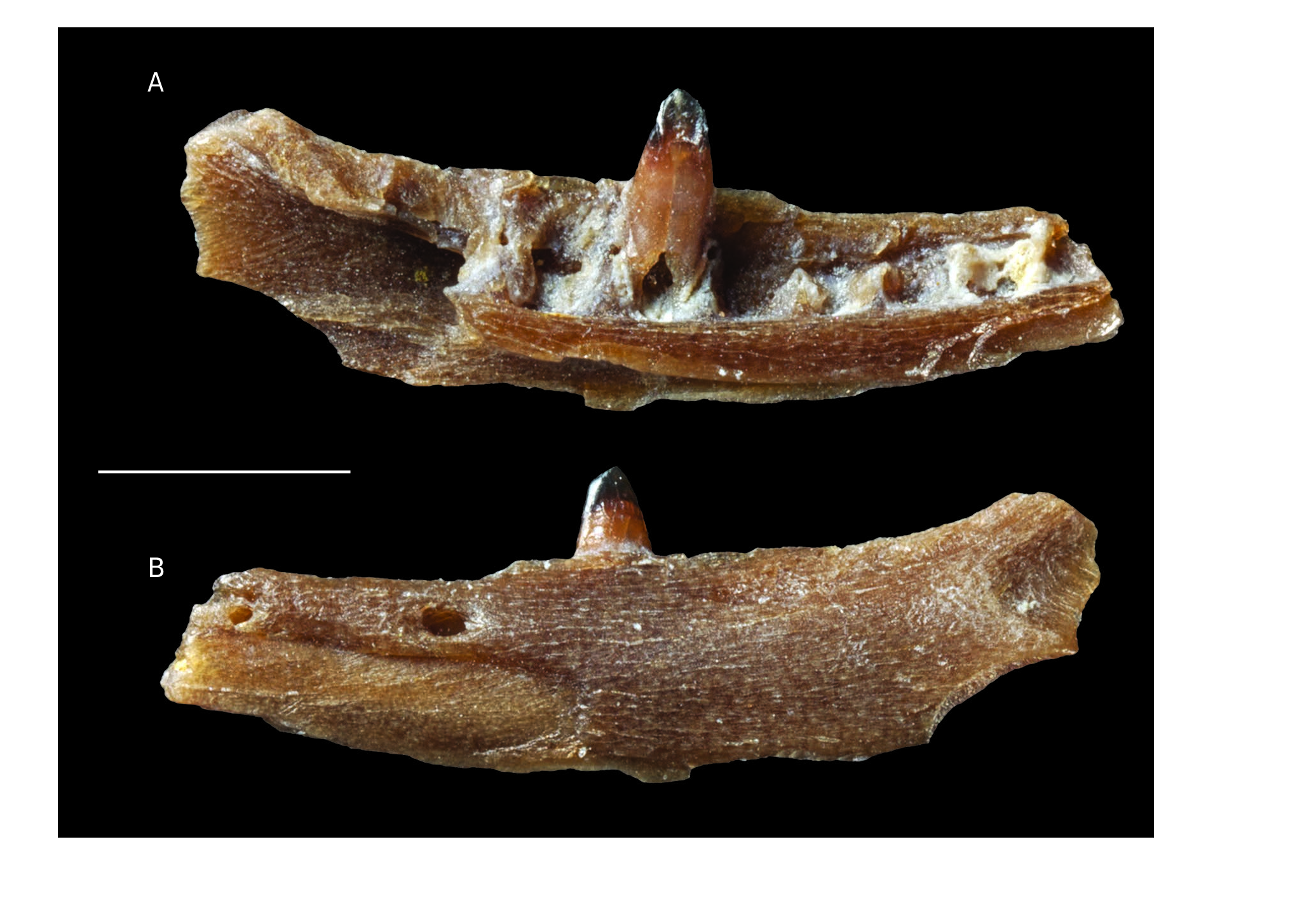
DESCRIPTION This small dentary (L: 2.9 mm) carries eight rather widely spaced tooth positions, but only one tooth is preserved. In medial view, the subdental shelf and the dental row are slightly concave. The subdental shelf forms a narrow, rounded surface overhanging the sulcus Meckeli. This fossa is rather narrow and faces mostly ventrally, mainly towards the anterior end of the bone. The dentition is subpleurodont (sensu Camp 1923; Hoffstetter 1954), that is the teeth tend to be attached to a single plane and the subdental table, as defined byRage & Augé (2010) becomes an inclined surface. Hence tooth bases are attached to a moderately inclined or concave surface. Moreover, this type of implantation is often associated with a poor development or absence of the sulcus dentalis and subdental shelf; effectively the dentary from Montchenot has no sulcus dentalis and a poorly developed, rounded subdental shelf. The lateral surface is gently convex, smooth and preserves only two labial (mental) foramina. The base of the single preserved tooth is not covered by cementum, except for two small anterior and posterior deposits. It is somewhat expanded, so that the mesial side of the tooth base comes near the dorsal margin of the subdental shelf. The tooth shaft slightly bends posteriorly and it steadily tapers dorsally towards the crown. The apex is rather rounded, with an incipient central bulb and two slight lateral shoulders. The tooth base is excavated by a central replacement pit. The tooth projects about onehalf of its height above the parapet of the dentary. There are no striae on the apex of the tooth but they could have been obliterated by weathering.
The lizard (Reptilia, Squamata) assemblage from the Paleocene of Montchenot (Paris Basin, MP 6)
COMPARISONS AND DISCUSSION Dentary MNHN. F. MTC 241 is referred to an anguimorph lizard because it shows the following combination of characters: 1) Sulcus Meckeli faces ventrally in anterior portion of dentary (Estes et al. 1988); 2) narrow and rounded subdental shelf; 3) teeth subpleurodont; 4) absence of sulcus dentalis; 5) crescentis or boat shaped tooth row (Estes 1964); and 6) teeth unicuspid, without lateral cups, not closely spaced (Camp 1923). Some of these characters are regarded as anguimorphan synapomorphies (e. g. character 1, Estes et al. 1988), however several of them are not clear synapomorphies as they are subject to important variability among anguimorph taxa and often they are not unique to anguimorphs (Evans 2008). For example, the narrowness and reduction of the subdental shelf are very different among anguimorph lizards: from a well developed subdental shelf in Xenosaurus to a near absence in Varanus (see other examples in Bochaton et al. 2016). Conflicting characters that are often cited as anguimorphan synapomorphies are clearly absent in the dentary from Montchenot: tooth apex pointed and tooth replacement alternate or distally displaced replacement pit on tooth bases (McDowell & Bogert (1954). Pointed, canine like teeth indicative of predaceous habits are common in anguimorph lizards but rounded tooth apex occasionally provided with a cutting edge (Estes 1964) has sometimes been regarded as an anguid synapomorphy (Estes et al 1988). Alternate tooth replacement is a clear feature of some extant and fossil anguimorph taxa, e. g. Varanus, Lanthanotus, Heloderma, Saniwa, Palaeovaranus (Ex Necrosaurus). Otherwise, tooth replacement shows important intra-individual and intraspecific variability among anguid taxa. In some anguids the variability appears along the tooth row: in the genera Gerrhonotus and Diploglossus, the first tooth bases have a central replacement pit while the others bear a distally displaced replacement pit. The same variability is also evident in the genus Pseudopus (Anguinae, see figures in Klembara 2012; Klembara et al. 2010, 2014). The presence of these two characters (rounded apex and tooth replacement) may be indicative of anguid affinities but the evidence is at best feeble and further comparisons with more complete material should be carried out. Many purported terrestrial Anguimorpha have been described from the Mesozoic fossil record in Europe, Asia and North America (e. g. Hoffstetter 1967; Alifanov 2000; Evans 1994; Evans et al. 2006; Fernandez et al. 2015). In particular, the Cretaceous record includes fossils that bear some resemblances to extant terrestrial anguimorphan families (e. g.? Xenosauridae, Pérez-García et al 2015; Anguidae, Blain et al. 2010; Helodermatidae, Nydam 2000, 2013; Platynotan, Norell et al. 2007; Mo et al. 2012; Varanoidea, Houssaye et al. 2013). In contrast, fossils attributed to anguimorphan lizards in the early European Paleocene are far more scanty. Lizard extinctions across the K / T boundary may explain this poor record (Longrich et al. 2012) but it may also reflect the paucity of fossil lizards described so far in the European Paleocene (table 1). Among them, the incomplete dentary referred to Anguimorpha indet. found in the late Paleocene of Rivecourt (Smith et al. 2014, fig. 7) bears some resemblances with the dentary from Montchenot: teeth subpleurodont, rounded subdental shelf, teeth apparently with a central replacement pit but all these features are plesiomorphic within Anguimorpha. Another possibility could be an attribution to another anguimorphan lizard, a pan-shinisaur whose osteoderms are present in the locality. However, except for its anguimorphan relationships, nothing in the morphology of this dentary (particularly its size) is consistent with such an attribution.
The lizard (Reptilia, Squamata) assemblage from the Paleocene of Montchenot (Paris Basin, MP 6)
MATERIAL EXAMINED. — MNHN. F. MTC 241 (Fig. 8). The incomplete left dentary represents the middle and posterior parts of the bone and its ventral margin is broken.
The lizard (Reptilia, Squamata) assemblage from the Paleocene of Montchenot (Paris Basin, MP 6)
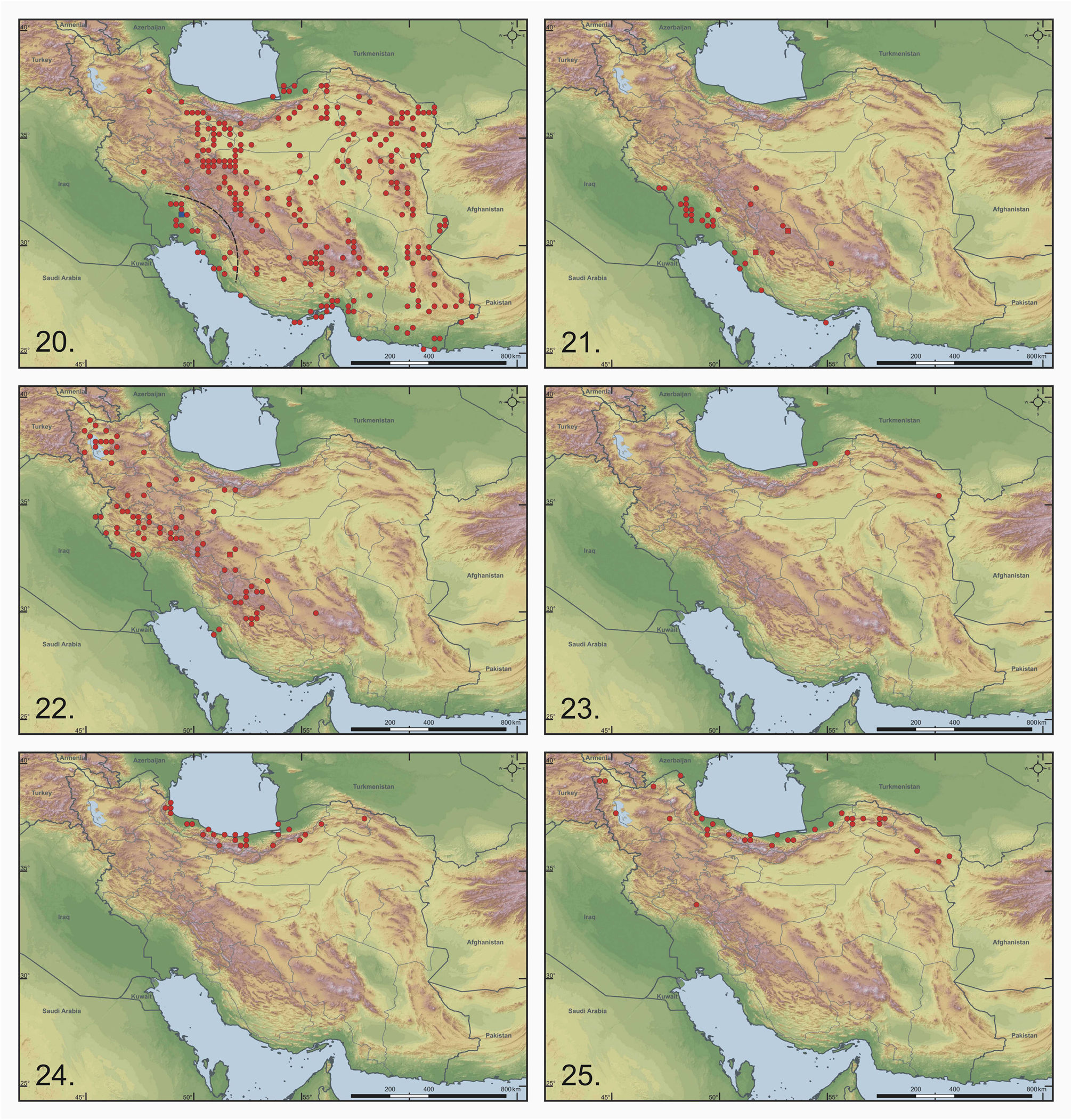
TYPE LOCALITY. “ Abasien ” [= Kuban’ region, S Russia] and “ Mingrelien ” [= region in W Georgia]. DISTRIBUTION. E Europe and European Russia through E Balkans, N Turkey and Transcaucasia to N Iran. DISTRIBUTION IN IRAN. Fig. 24. Along the Caspian coast, the distribution stretches eastwards up to the central Kopet Dagh. No record from the Caspian coast is more than 60 km inland from the shoreline; the species is there limited to the foothills and northern slopes of the Alborz. HABITAT. Deciduous Hyrcanian forests in the Alborz, in or on the leaf litter on the ground, under stones and logs. REMARKS. Anguis colchica was assigned the status of full species by Gvoždík et al. (2010). In the same publication the Iranian populations were attributed to the subspecies A. c. orientalis Anderson.
Annotated checklist and distribution of the lizards of Iran

FAMILY ANGUIDAE Gray 1825, 201

(2 genera, 3 species, 1 endemic species)

Abronia Gray 1838, 389 (2 species, 1 endemic species) Abronia montecristoi Hidalgo 1983, 6

Abronia salvadorensis (E) Hidalgo 1983, 1

Mesaspis Cope 1877, 96 (1 species)

Mesaspis moreletii (Bocourt 1871, 102). It seems that slight external morphological differences occur in some Honduran populations of this nominal form.

A checklist of the amphibians and reptiles of Honduras, with additions, comments on taxonomy, some recent taxonomic decisions, and areas of further studies neededMagnoliaPress via PlaziNo known copyright restrictions apply. See Agosti, D., Egloff, W., 2009. Taxonomic information exchange and copyright: the Plazi approach. BMC Research Notes 2009, 2:53 for further explanation.
Ophiodes intermedius Boulenger, 1894 Ophiodes vertebralis (Bocourt, 1881) Ophiodes fragilis Peters, 1877
Checklist of lizards and amphisbaenians of Argentina: an update

Export occurrence data

Darwin Core Archive (ZIP)

GEOGRAPHY

Distribution Map

Occurrence Map

Loading map…

Tiles © GBIF Maps API | Map powered by MapLibre GL

REGIONS

Geographic Distribution(3)

DK
not evaluated
NO
SE

DATA

Occurrence Datasets

Loading datasets…

Common names used for this species across different languages and regions. Available in 26 languages and 7 countries. 2 preferred.

SEkopparödlorsweNOstålormernobengAlligator LizardsengengAlligator LizardsengengAnguid Lizardseng+41 more

Vernacular (common) names are the everyday names used for a species in different languages and regions. A single species may have dozens of common names worldwide. This taxon has names in 26 languages. 2 names preferred.

engAlligator Lizards
eng
Source: Integrated Taxonomic Information System (ITIS)Source taxon #102124497
engAlligator Lizards
eng
Source: Catalogue of LifeSource taxon #304166655
engAnguid Lizards
eng
Source: Catalogue of LifeSource taxon #304166655
engAnguid Lizards
eng
Source: Integrated Taxonomic Information System (ITIS)Source taxon #102124497
engAnguids
eng
Source: Integrated Taxonomic Information System (ITIS)Source taxon #102124497
engAnguids
eng
Source: Catalogue of LifeSource taxon #304166655
FRAnguidés
fraFRfra
fraAnguidés
fra
Source: Catalogue of LifeSource taxon #304166655
turCamkertenkelegiller
tur
Source: Catalogue of LifeSource taxon #304166655
engGalliwasps
eng
Source: Catalogue of LifeSource taxon #304166655
engGalliwasps
eng
Source: Integrated Taxonomic Information System (ITIS)Source taxon #102124497
engGlass Lizards
eng
Source: Catalogue of LifeSource taxon #304166655
engGlass Lizards
eng
Source: Integrated Taxonomic Information System (ITIS)Source taxon #102124497
engGlass and Alligator Lizards
eng
Source: Catalogue of LifeSource taxon #304166655
nldHazelwormen
nld
Source: Catalogue of LifeSource taxon #304166655
spaLagartos de Cristal
spa
Source: Catalogue of LifeSource taxon #304166655
itaOrbettini e lucertole alligatore
ita
Source: Catalogue of LifeSource taxon #304166655
fraOrvets et Lézards alligator
fra
Source: Catalogue of LifeSource taxon #304166655
polPadalcowate
pol
Source: Catalogue of LifeSource taxon #304166655
hrvPuzaši
hrv
Source: Catalogue of LifeSource taxon #304166655
deuSchleichen
deu
Source: Catalogue of LifeSource taxon #304166655
slkSlepúchovité
slk
Source: Catalogue of LifeSource taxon #304166655
danStålorme
dan
Source: Catalogue of LifeSource taxon #304166655
DKStålorme
danDK
Source: National Checklist of all species occurring in DenmarkSource taxon #307207409
estVaskuslased
est
Source: Catalogue of LifeSource taxon #304166655
BEhazelwormen
nldBE
Source: Belgian Species ListSource taxon #100485760
swekopparödlor
swe
Source: Catalogue of LifeSource taxon #304166655
GBlateral fold lizards
engGBeng
englateral fold lizards
eng
Source: Catalogue of LifeSource taxon #304166655
hunlábatlangyíkfélék
hun
Source: Catalogue of LifeSource taxon #304166655
slvslepci
slv
Source: Catalogue of LifeSource taxon #304166655
cesslepýšovití
ces
Source: Catalogue of LifeSource taxon #304166655
nobstålormer
nob
Source: Catalogue of LifeSource taxon #304166655
FIvaskitsat
finFI
Source: The FinBIF checklist of Finnish speciesSource taxon #257959045
finvaskitsat
fin
Source: Catalogue of LifeSource taxon #304166655
belВераценніцавыя
bel
Source: Catalogue of LifeSource taxon #304166655
rusВеретеницевые
rus
Source: Catalogue of LifeSource taxon #304166655
ukrВеретільницеві
ukr
Source: Catalogue of LifeSource taxon #304166655
ukrВеретінницеві
ukr
Source: List of reptile species found in the territory of the Slobozhanskyi National Nature ParkSource taxon #168235868
bulСлепоци
bul
Source: Catalogue of LifeSource taxon #304166655
srpслепићи
srp
Source: Catalogue of LifeSource taxon #304166655
hebקמטניים
heb
Source: Catalogue of LifeSource taxon #304166655
jpnアシナシトカゲ科
jpn
Source: Catalogue of LifeSource taxon #304166655
zho蛇蜥科
zho
Source: Catalogue of LifeSource taxon #304166655
SEkopparödlor
swepreferredSE
Source: Dyntaxa. Svensk taxonomisk databasSource taxon #159939649
NOstålormer
nobpreferredNO

CLASSIFICATION

Taxonomic Classification Tree

RELATED

Related Name Usages(20)

Matching names from other GBIF-indexed checklists and datasets.

MULTIMEDIA

Media Files(4)

FIG. 21. — Vertèbres présacrées d’Anguidae indet.de la FSMO (MN5) du site «Les Pavés» (Loiret, France): A, MMSL-00.002.0218.81/5,en vues: antérieure (A1), postérieure (A2), latérale g. (A3), dorsale (A4), et ventrale (A5); B, MMSL-00.002.0218.81/11, en vues: antérieure (B1), postérieure (B2), latérale g. (B3), dorsale (B4), et ventrale (B5); C, MMSL-00.002.0218.81/12, en vues: antérieure (C1), postérieure (C2), latérale d. (C3), dorsale (C4), et ventrale (C5). Échelle: 2 mm. Auteur des photographies: B. Mennecart.

Imageimage/png© Perthuis, Adrien de;Mennecart, Bastien;Barrier, Pascal;Chenot, Élise;Falconnet, Jocelyn;Gagnaison, Jean-Claude;Georgalis, Georgios L.;Gilbert, Charlène;Guevel, Bruno;Langevin, Dominique;Lapparent de Broin, France;Lemierre, Alfred;Maubert, François;Ossó, Àlex;Potel, Sébastien;Thivaiou, Danae;Tissier, Jérémy;Toullec, Renaud;Xerri, Serge F. B.;Gagnaison, CyrilRévision des données sédimentologiques et biostratigraphiques des gisements à vertébrés des sables de l’Orléanais, à Beaugency, Tavers et Le Bardon (Miocène Moyen; Loiret, France)

Figure 16. Anguidae indet. from the Echzell locality. Caudal vertebra HLMD-Ez 1981 in (A) anterior, (B) posterior, (C) lateral, (D) dorsal and (E) ventral views. Osteoderms HLMD-Ez 1985 (G), HLMD-Ez 1986 (E) and HLMD-Ez 1987 (I) in (F, H, I) external and (G) internal views.

Imageimage/png© Vasilyan, Davit;Cernansky, Andrej;Szyndlar, Zbigniew;Moers, ThomasAmphibian and reptilian fauna from the early Miocene of Echzell, Germany

FIG. 8. — Anguimorpha,?Anguidae, incomplete left dentary, MNHN.F.MTC241: A, lingual view; B, labial view. Scale bar: 1 mm.

Imageimage/png© Augé, Marc Louis;Dion, Michaël;Phélizon, AlainThe lizard (Reptilia, Squamata) assemblage from the Paleocene of Montchenot (Paris Basin, MP 6)

FIGURES 20–25. 20. Trapelus agilis. Blue square denotes the type locality for T. a. khuzistanensis, dashed line delimits approximate boundary between this and the nominotypical subspecies. 21. Trapelus persicus. 22. Trapelus ruderatus. 23. Trapelus sanguinolentus. 24. Anguis colchica. 25. Pseudopus apodus.

Imageimage/png© Šmíd, Jiří;Moravec, Jiří;Kodym, Petr;Kratochvíl, Lukáš;Yousefkhani, Seyyed Saeed Hosseinian;Rastegar-Pouyani, Eskandar;Frynta, DanielAnnotated checklist and distribution of the lizards of Iran

IMAGES

Gallery(4)

See Gallery

Occurrences with images

CITATIONS

References(8)

  • 1

    Banks, R. C., R. W. McDiarmid, and A. L. Gardner, 1987: Checklist of Vertebrates of the United States, the U.S. Territories, and Canada. Resource Publication, no. 166. 79.

    Integrated Taxonomic Information System (ITIS)
  • 2

    Benton, M.J. (ed). (1993). The Fossil Record 2. Chapman & Hall, London, 845 pp.

    extant flag sourceThe Interim Register of Marine and Nonmarine Genera
  • 3

    Benton, M.J. (ed). (1993). The Fossil Record 2. Chapman & Hall, London, 845 pp.

    habitat flag sourceThe Interim Register of Marine and Nonmarine Genera
  • 4

    Flores-Villela, Oscar / McCoy, C. J., ed., 1993: Herpetofauna Mexicana: Lista anotada de las especies de anfibios y reptiles de México, cambios taxonómicos recientes, y nuevas especies. Carnegie Museum of Natural History Special Publication, no. 17. iv + 73.

    Integrated Taxonomic Information System (ITIS)
  • 5

    Gärdenfors, Hall, Hallingbäck, Hansson & Hedström (2003) Djur, svampar och växter i Sverige 2003. Förteckning över antal arter per familj.

    Dyntaxa. Svensk taxonomisk databas
  • Source Information

    GBIF Backbone Taxonomy

    GBIF Backbone Taxonomy

    checklist

    The GBIF Backbone Taxonomy is a single, synthetic management classification with the goal of covering all names GBIF is dealing with. It's the taxonomic backbone that allows GBIF to integrate name based information from different resources, no matter if these are occurrence datasets, species pages, names from nomenclators or external sources like EOL, Genbank or IUCN. This backbone allows taxonomic search, browse and reporting operations across all those resources in a consistent way and to provide means to crosswalk names from one source to another.

    It is updated regulary through an automated process in which the Catalogue of Life acts as a starting point also providing the complete higher classification above families. Additional scientific names only found in other authoritative nomenclatural and taxonomic datasets are then merged into the tree, thus extending the original catalogue and broadening the backbones name coverage. The GBIF Backbone taxonomy also includes identifiers for Operational Taxonomic Units (OTUs) drawn from the barcoding resources iBOL and UNITE.

    International Barcode of Life project (iBOL), Barcode Index Numbers (BINs). BINs are connected to a taxon name and its classification by taking into account all names applied to the BIN and picking names with at least 80% consensus. If there is no consensus of name at the species level, the selection process is repeated moving up the major Linnaean ranks until consensus is achieved.

    UNITE - Unified system for the DNA based fungal species, Species Hypotheses (SHs). SHs are connected to a taxon name and its classification based on the determination of the RefS (reference sequence) if present or the RepS (representative sequence). In the latter case, if there is no match in the UNITE taxonomy, the lowest rank with 100% consensus within the SH will be used.

    The GBIF Backbone Taxonomy is available for download at https://hosted-datasets.gbif.org/datasets/backbone/ in different formats together with an archive of all previous versions.

    The following 105 sources have been used to assemble the GBIF backbone with number of names given in brackets:

    • Catalogue of Life Checklist - 4766428 names
    • International Barcode of Life project (iBOL) Barcode Index Numbers (BINs) - 635951 names
    • UNITE - Unified system for the DNA based fungal species linked to the classification - 611208 names
    • The Paleobiology Database - 212054 names
    • World Register of Marine Species - 188857 names
    • The Interim Register of Marine and Nonmarine Genera - 183894 names
    • The World Checklist of Vascular Plants (WCVP) - 131891 names
    • GBIF Backbone Taxonomy - 114350 names
    • TAXREF - 109374 names
    • The Leipzig catalogue of vascular plants - 75380 names
    • ZooBank - 73549 names
    • Integrated Taxonomic Information System (ITIS) - 68377 names
    • Plazi.org taxonomic treatments database - 61346 names
    • Genome Taxonomy Database r207 - 60545 names
    • International Plant Names Index - 52329 names
    • Fauna Europaea - 45077 names
    • The National Checklist of Taiwan (Catalogue of Life in Taiwan, TaiCoL) - 36193 names
    • Dyntaxa. Svensk taxonomisk databas - 35892 names
    • The Plant List with literature - 32692 names
    • United Kingdom Species Inventory (UKSI) - 29643 names
    • Artsnavnebasen - 29208 names
    • The IUCN Red List of Threatened Species - 21221 names
    • Afromoths, online database of Afrotropical moth species (Lepidoptera) - 13961 names
    • Brazilian Flora 2020 project - Projeto Flora do Brasil 2020 - 13829 names
    • Prokaryotic Nomenclature Up-to-Date (PNU) - 10079 names
    • Checklist Dutch Species Register - Nederlands Soortenregister - 8814 names
    • ICTV Master Species List (MSL) - 7852 names
    • Cockroach Species File - 6020 names
    • GRIN Taxonomy - 5882 names
    • Taxon list of fungi and fungal-like organisms from Germany compiled by the DGfM - 4570 names
    • Catalogue of Afrotropical Bees - 3623 names
    • Catalogue of Tenebrionidae (Coleoptera) of North America - 3327 names
    • Checklist of Beetles (Coleoptera) of Canada and Alaska. Second Edition. - 3312 names
    • Systema Dipterorum - 2850 names
    • Catalogue of the Pterophoroidea of the World - 2807 names
    • The Clements Checklist - 2675 names
    • Taxon list of Hymenoptera from Germany compiled in the context of the GBOL project - 2496 names
    • IOC World Bird List, v13.2 - 2366 names
    • Official Lists and Indexes of Names in Zoology - 2310 names
    • National checklist of all species occurring in Denmark - 1922 names
    • Myriatrix - 1876 names
    • Database of Vascular Plants of Canada (VASCAN) - 1822 names
    • Taxon list of vascular plants from Bavaria, Germany compiled in the context of the BFL project - 1771 names
    • Orthoptera Species File - 1742 names
    • A list of the terrestrial fungi, flora and fauna of Madeira and Selvagens archipelagos - 1602 names
    • Aphid Species File - 1565 names
    • World Spider Catalog - 1561 names
    • Taxon list of Jurassic Pisces of the Tethys Palaeo-Environment compiled at the SNSB-JME - 1270 names
    • Backbone Family Classification Patch - 1143 names
    • GBIF Algae Classification - 1100 names
    • International Cichorieae Network (ICN): Cichorieae Portal - 975 names
    • Psocodea Species File - 803 names
    • New Zealand Marine Macroalgae Species Checklist - 787 names
    • Annotated checklist of endemic species from the Western Balkans - 754 names
    • Taxon list of animals with German names (worldwide) compiled at the SMNS - 503 names
    • Catalogue of the Alucitoidea of the World - 472 names
    • Lygaeoidea Species File - 462 names
    • Catálogo de Plantas y Líquenes de Colombia - 422 names
    • GBIF Backbone Patch - 317 names
    • Phasmida Species File - 259 names
    • Cortinariaceae fetched from the Index Fungorum API - 234 names
    • Coreoidea Species File - 233 names
    • GTDB supplement - 139 names
    • Mantodea Species File - 119 names
    • Endemic species in Taiwan - 93 names
    • Taxon list of Araneae from Germany compiled in the context of the GBOL project - 88 names
    • Species of Hominidae - 78 names
    • Taxon list of Sternorrhyncha from Germany compiled in the context of the GBOL project - 77 names
    • Taxon list of mosses from Germany compiled in the context of the GBOL project - 75 names
    • Mammal Species of the World - 73 names
    • Plecoptera Species File - 71 names
    • Species Fungorum Plus - 64 names
    • Catalogue of the type specimens of Cosmopterigidae (Lepidoptera: Gelechioidea) from research collections of the Zoological Institute, Russian Academy of Sciences - 47 names
    • Species named after famous people - 41 names
    • Dermaptera Species File - 36 names
    • Taxon list of Trichoptera from Germany compiled in the context of the GBOL project - 34 names
    • True Fruit Flies (Diptera, Tephritidae) of the Afrotropical Region - 33 names
    • Range and Regularities in the Distribution of Earthworms of the Earthworms of the USSR Fauna. Perel, 1979 - 32 names
    • Taxon list of Diplura from Germany compiled in the context of the GBOL project - 30 names
    • Lista de referencia de especies de aves de Colombia - 2022 - 24 names
    • Taxon list of Auchenorrhyncha from Germany compiled in the context of the GBOL project - 20 names
    • Catalogue of the type specimens of Polycestinae (Coleoptera: Buprestidae) from research collections of the Zoological Institute, Russian Academy of Sciences - 19 names
    • Taxon list of Thysanoptera from Germany compiled in the context of the GBOL project - 19 names
    • Lista de especies de vertebrados registrados en jurisdicción del Departamento del Huila - 18 names
    • Taxon list of Microcoryphia (Archaeognatha) from Germany compiled in the context of the GBOL project - 15 names
    • Catalogue of the type specimens of Bufonidae and Megophryidae (Amphibia: Anura) from research collections of the Zoological Institute, Russian Academy of Sciences - 12 names
    • Grylloblattodea Species File - 11 names
    • Coleorrhyncha Species File - 9 names
    • Taxon list of liverworts from Germany compiled in the context of the GBOL project - 9 names
    • Embioptera Species File - 7 names
    • Taxon list of Pisces and Cyclostoma from Germany compiled in the context of the GBOL project - 6 names
    • Taxon list of Pteridophyta from Germany compiled in the context of the GBOL project - 6 names
    • Taxon list of Siphonaptera from Germany compiled in the context of the GBOL project - 5 names
    • The Earthworms of the Fauna of Russia. Perel, 1997 - 5 names
    • Taxon list of Zygentoma from Germany compiled in the context of the GBOL project - 4 names
    • Asiloid Flies: new taxa of Diptera: Apioceridae, Asilidae, and Mydidae - 3 names
    • Taxon list of Protura from Germany compiled in the context of the GBOL project - 3 names
    • Taxon list of hornworts from Germany compiled in the context of the GBOL project - 2 names
    • Chrysididae Species File - 1 names
    • Taxon list of Dermaptera from Germany compiled in the context of the GBOL project - 1 names
    • Taxon list of Diplopoda from Germany in the context of the GBOL project - 1 names
    • Taxon list of Orthoptera (Grashoppers) from Germany compiled at the SNSB - 1 names
    • Taxon list of Pscoptera from Germany compiled in the context of the GBOL project - 1 names
    • Taxon list of Pseudoscorpiones from Germany compiled in the context of the GBOL project - 1 names
    • Taxon list of Raphidioptera from Germany compiled in the context of the GBOL project - 1 names

    GBIF Secretariat (2023). GBIF Backbone Taxonomy. Checklist dataset https://doi.org/10.15468/39omei accessed via GBIF.org on 2026-06-14.

    CC BYPublished 8/28/2023View dataset
    GBIF Usage Key
    9198
    Dataset Key
    d7dddbf4-2cf0-4f39-9b2a-bb099caae36c
    Origin
    source
    Backbone Key
    9198
    Taxon ID
    gbif:9198
    Last Crawled
    8/22/2023
    Last Interpreted
    8/22/2023