
Cionidae
pelarsjöpungar(+6)
GBIF:9281
0
Descendants
0
Children
0
Species
0
Genera
PROFILE
Species Profile
Habitat
ABOUT
Descriptions(1)
Cionidae
Ciona antarctica Hartmeyer, 1911 (Figure 10)
Hartmeyer, 1911: 471 pl. 52 fig.5. Monniot & Monniot 1983: 47 fig. 9A, B; 1994:15.
Station: 55.
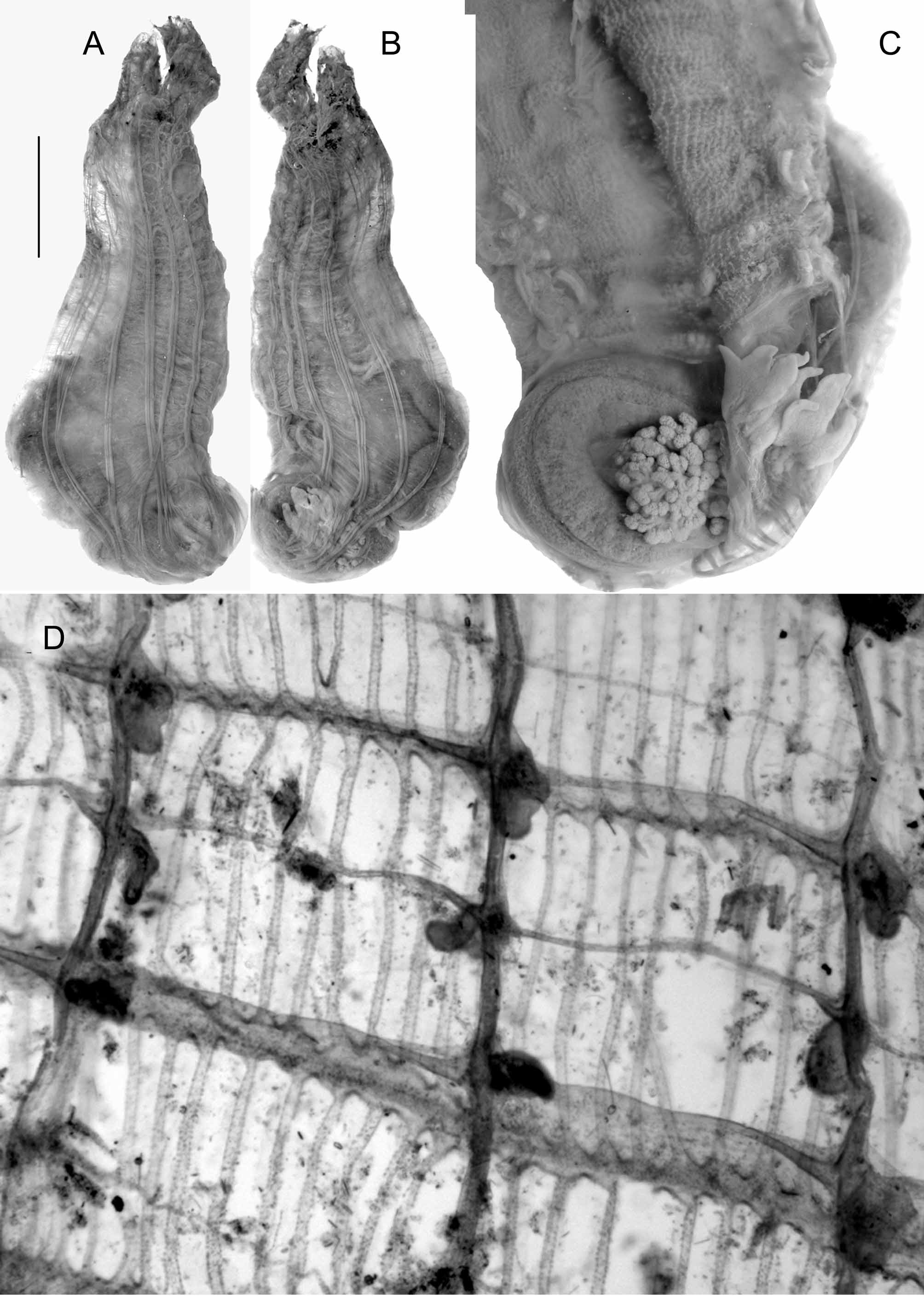
The single specimen collected 9 cm in length and 3.5 cm in width has a transparent tunic. The basal part of the tunic is thicker, somewhat cartilaginous with superficial vascular ampullae. Both siphons are terminal, close to each other (Fig. 10 A, B). The body is contracted by 6 strong longitudinal muscular ribbons on each side (Fig. 10 A, B). There are 12 long oral tentacles. The dorsal tubercle opens in a C on the right. The peripharyngeal band has 2 blades. The rapheal languets are narrow and long. The branchial sac has finger-like papillae at the crossings of the longitudinal, transverse and parastigmatic vessels (Fig. 10 D). The digestive loop is located in totality under the branchial sac. The stomach is internally thinly plicated. The anus is multilobate. The gonads are included inside the gut loop (Fig. 10 C). On each side, between the gut and the body wall, in the posterior part of the body, a large organ protrudes, made of thick lobed lamellae of unknown function (Fig. 10 C).
No close hit in BOLD (best: 80.32% for C. intestinalis) for the sequence of specimen P1 CIO 80 (BOLD: ASCAN030-10).
The CEAMARC specimens correspond to previous descriptions. However, C. antarctica was rarely collected and only in two opposite areas of the Antarctic continent: the Antarctic Peninsula and Terre Adélie down to 500 m.
Tylobranchion speciosum Herdman, 1886 (Figure 11)
Herdman, 1886: 157. Monniot & Monniot 1983: 50 and synonymy; 1994:15. Tatian et al. 1998: 149. Tatian et al. 2005: 210. Primo & Vazquez 2007: 1795.
Stations (events when several trawling operations per station): 11(424)-62.
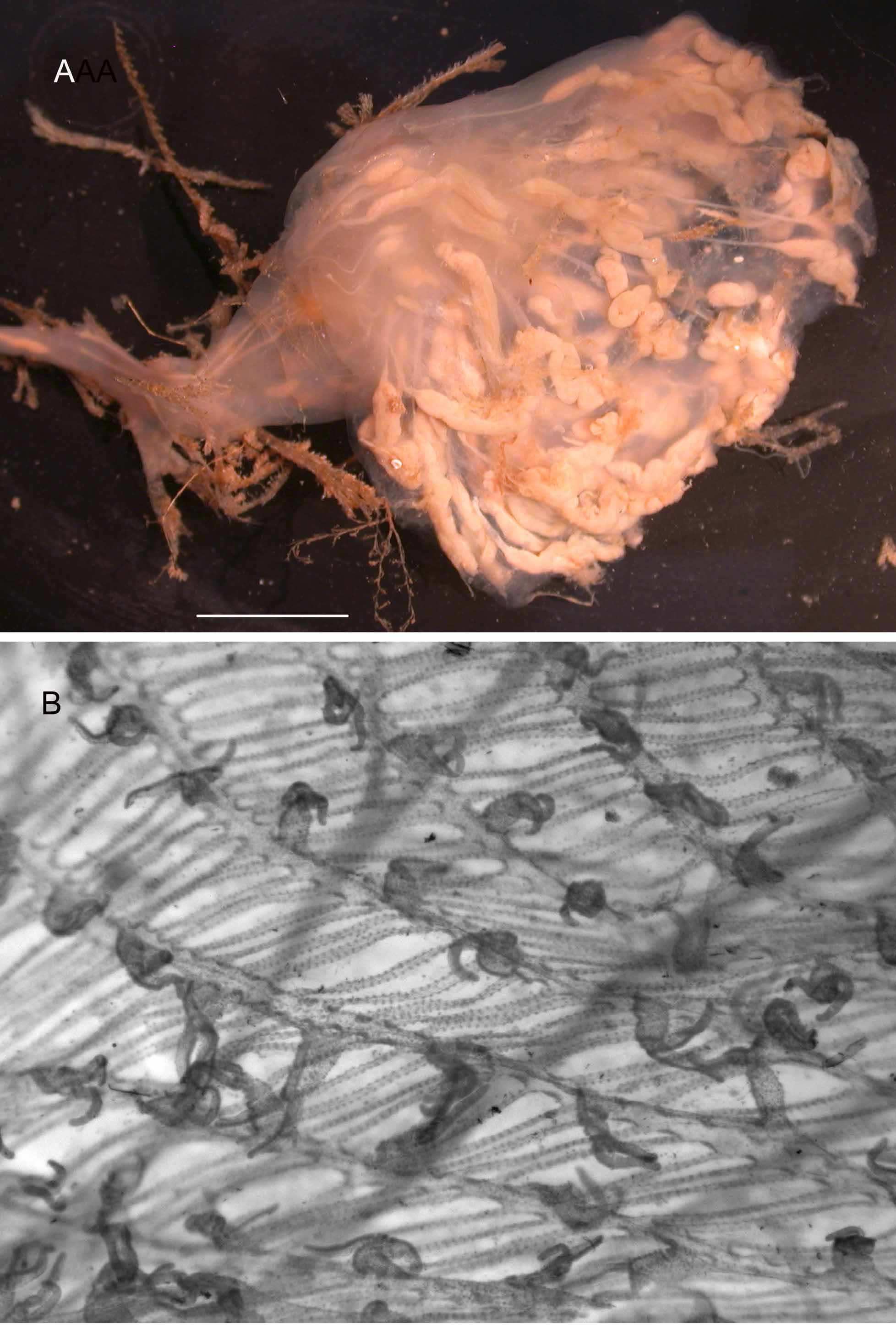
Most of the material is damaged. One colony is intact, triangular with an expanded upper part containing the thoraces of the zooids narrowing progressively to a thin peduncle (Fig. 11 A). The tunic, when fixed, is perfectly transparent and colourless. All siphon rims are damaged. The branchial sac is wide with 15 to 17 rows of numerous stigmata. Long bifid papillae arise from the transverse vessels (Fig. 11 B). The stigmata rows have no parastigmatic vessels. The stomach wall has an average of 8 folds. The rectum is particularly wide along the whole thorax length. The gonads are located immediately under the gut loop and sometimes overlapping it. They are composed of numerous testis vesicles and a central ovary. The post-abdomens extend the whole length of the colony.
No close hit in BOLD (best: 79.9%) for the sequence of specimen P1 TYL 27 (BOLD: ASCAN021-10).
T. speciosum is eurybathic and widely distributed in the Antarctic and Sub-Antarctic areas.
Export occurrence data
Darwin Core Archive (ZIP)
GEOGRAPHY
Distribution Map
REGIONS
Geographic Distribution(3)
DATA
Occurrence Datasets
Common names used for this species across different languages and regions. Available in 3 languages and 1 country. 1 preferred.
Vernacular (common) names are the everyday names used for a species in different languages and regions. A single species may have dozens of common names worldwide. This taxon has names in 3 languages. 1 name preferred.
CLASSIFICATION
Taxonomic Classification Tree

RELATED
Related Name Usages(20)
Matching names from other GBIF-indexed checklists and datasets.
MULTIMEDIA
Media Files(2)
FIGURE 10. Ciona Antarctica: A, B, both sides of the body removed from the tunic, scale bar = 2 cm; C, detail of the gonad and parietal organ; D, part of the branchial sac.
IMAGES
Gallery(2)
Occurrences with images
CITATIONS
References(12)
Buizer, D.A.G. (1983)
Gärdenfors, Hall, Hallingbäck, Hansson & Hedström (2003) Djur, svampar och växter i Sverige 2003. Förteckning över antal arter per familj.
Hayward, P.J. & J.S. Ryland (Eds.). (1990). The marine fauna of the British Isles and North-West Europe: 1. Introduction and protozoans to arthropods. <em>Clarendon Press: Oxford, UK.</em> 627 pp.
Hayward, P.J. & J.S. Ryland (Eds.). (1990). The marine fauna of the British Isles and North-West Europe: 1. Introduction and protozoans to arthropods. <em>Clarendon Press: Oxford, UK.</em> 627 pp.
Monniot, C. (2001). Ascidiacea & Sorberacea. <em>In: Costello, M.J. et al. (Ed.) (2001). European register of marine species: a check-list of the marine species in Europe and a bibliography of guides to their identification. Collection Patrimoines Naturels.</em> 50: pp. 352-355.