

Anura
Frogs And Toads(+45)
GBIF:952
0
Descendants
0
Children
0
Species
0
Genera
0
Families
PROFILE
Species Profile
Characteristics
ABOUT
Descriptions(33)
A KEY FOR IDENTIFICATION OF LARVAE OF 30 ANURAN SPECIES FROM INDIA
1. A. Without nostrils; without jaw sheath; spiracle ventral, oral disc with a fold on the lower labium with no keratinized structures and papillae ............................................................. 2 [ MICROHYLIDAE]
B. With nostrils; with jaw sheaths; spiracle sinistral, oral disc with keratinized structures and papillae ............................................................................................................................................................ 4
2. A. One medial vent and a medial spiracle; large lateral eyes with a transparent body ........................................................................................................................................ 3 [ Microhyla]
B. Dorsal side speckled with reddish-brown melanophores; small lateral eyes with a translucent body diffused with many melanophores ......................................................................... Uperodon systoma
3. A. Dorsal side with a diamond marking due to congregation at the centre of the abdomen; caudal fin with melanophores spread uniformly ................................................................. Microhyla berdmorei
B. Dorsum with uniformly spread tiny melanophores; caudal fin with melanophores concentrated at the distal end of the fin .............................................................................. Microhyla nilphamariensis
4. A. Oral disc multi-lobed and without labial tooth rows; dorsal fin originating posterior to body tail junction ...................................................................................................... Nyctibatrachus cf. poocha
B. Oral disc either emarginated or not emarginated with labial tooth rows .......................................... 5
5. A. Eyes lateral or near lateral; mouth anteroventral; origin of ventral fin anterior to body tail junction. ............................................................................................................................................................ 6
B. Eyes dorsal or dorsolateral; mouth ventral or anteroventral; origin of tail at body-tail junction or posterior to it ...................................................................................................................................... 9
6. A. Eyes near lateral; vent tube opening medial; both fins of equal height; marginal papillae on oral disc with wide dorsal gap; single row of marginal papillae; upper jaw sheath broadly rounded with a long trapezoidal lateral process ................................................................................... Hyla annectans
B. Eyes lateral; vent tube opening dextral; ventral fin taller than dorsal; marginal papillae on oral disc with wide dorsal gap and narrow ventral gap; marginal papillae in single row on anterior labium and double row on posterior labium; jaw sheath arch-shaped ........................................... 7 [ Polypedates]
7. A. Opening of nostril circular or oval with elevated or depressed rim; pre-narial arena with an arched medial ridge and many secondary lateral papillae or a simple arched medial ridge; infralabial papillae pointed with rugose margin; lingual papillae smooth ........................ Polypedates maculatus
B. Opening of nostril reniform with elevated rim; pre-narial arena with arched medial ridge and many secondary lateral papillae; infralabial papillae dilated; lingual papillae pustulated ........................... 8
8. A. two lingual papillae; LTRF A5(4)(1)/P3(1) ....................................... Polypedates cf. megacephalus
B. Four lingual papillae; A4(3)/P3 ...................................................................... Polypedates teraiensis
9. A. Eyes dorsal placed back on dorsum; oral disc large and ventral; tail muscle wide in dorsal view; origin of tail posterior to body-tail junction ..................................................................................... 10
B. Eyes dorsolateral placed on dorsum near anterior end of body; oral disc small to moderate and positioned ventrally or anteroventrally; tail muscle wide or narrow in dorsal view; origin of tail at body-tail junction or posterior to it .................................................................................................. 11
10. A. No cutaneous granular glands on body; no suction organ formed by gastrozymous muscle; vent tube opening medial; LTRF A2/P3(1) ................................................ Nasikabatrachus sahyadrensis
B. Cutaneous granular glands on body; suction organ formed by gastrozymous muscle; vent tube opening dextral; LTRF A8(5)/P3(1) ................................................................... Amolops assamensis
11. A. Cutaneous granular glands on body ............................................................................................... 12
B. No cutaneous granular glands on body .......................................................................................... 15
12. A. Large tadpole; supracaudal gland present ................................................................ 13 [ Clinotarsus]
B. Moderate sized tadpole; no supracaudal gland; LTRF A2(1)/P3(1) ........................... 14 [ Hylarana]
13. A. Ocellus on caudal musculature; LTRF A6(4)/P7(1) .......................................... Clinotarsus alticola
B. No ocellus on caudal musculature; LTRF A8(6)/P7(1) ...................................... Clinotarsus curtipes
14. A. Nostrils located midway between eye and snout; internal nares narrowly separated; BRA papillae abundant; straw colored body with few melanophores ....................................... Hylarana flavescens
B. Nostrils located midway between eye and snout; internal nares moderately separated; BRA papillae not abundant; body straw colored but with many melanophores .................................. Hylarana doni
15. A. Vent tube opening medial .............................................................................................................. 16
B. Vent tube opening dextral .............................................................................................................. 19
16. A. Upper jaw sheath broadly rounded with long trapezoidal lateral process; caudal musculature strong with low dorsal and ventral fin ................................................................................... 17 [ BUFONIDAE]
B. Jaw sheath with elongated, thick middle portion and thin lateral processes; caudal musculature strong with low dorsal and ventral fin ............................................................... Indirana cf. beddomii
17. A. Centripetal wall of spiracle totally fused to body wall with distal end free; broadly rounded tail. 18
B. Centripetal wall of spiracle partly formed; rounded tail ........................ Duttaphrynus melanostictus
18. A. Shape of narial opening oval or round; both caudal fins of equal height; jaw sheath moderately keratinized; median ridge bifid; BRA pustules few .................................. Duttaphrynus himalayanus
B. Shape of narial opening reniform; dorsal fin taller; jaw sheath weakly keratinized; median ridge trifid; no BRA pustules ................................................................................................ Bufotes latastii
19. A. External naso-lacrimal groove present ........................................................................................... 20
B. No external naso-lacrimal groove .................................................................................................. 21
20. A. Narial opening elevated; nostrils close to eye; oral disc with wide dorsal gap and narrow ventral gap; few BRA and BFA pustules; LTRF A5(4)/A3(1) ............................... Zhangixalus smaragdinus
B. Nostrils midway between eye and snout; oral disc with wide dorsal gap; abundant BRA and numerous BFA pustules; LTRF A6(4)/3(1) .................................... Rhacophorus pseudomalabaricus
21. A. Oral disc located ventrally ............................................................................................................. 22
B. Oral disc located anteroventrally .................................................................................................... 24
22. A. Nostril opening oval or round; both fins of equal height; marginal papillae on oral disc with narrow dorsal and ventral gaps; submarginal papillae on both labia; upper jaw sheath inverted ‘V’ shaped with a medial protrusion; no pre-narial medial ridge; LTRF A5(4)/P6(6) ........ Leptobrachium smithi
B. Nostril opening reniform; marginal papillae on oral disc with a wide gap on the upper labium; submarginal papillae at lateral commissures and lower labium of oral disc; jaw sheaths strongly keratinized; upper jaw sheath arch shaped ............................................................................. 23 [ Paa]
23. A. Snout broadly rounded; widest part of body at middle of abdomen; broadly rounded tail tip; simple arched pre-medial ridge; LTRF A6(4)/P3(1) ...................................................................... Paa vicina
B. Snout rounded; widest part of body at the back of abdomen; rounded tail tip; single Spre-medial ridge; LTRF 5(4)/3(1) ........................................................................................................ Paa minica
24. A. Nostril opening depressed; marginal papillae uniseriate on upper labium and biseriate on lower labium; shape of upper jaw sheath inverted ‘V’ shaped with a medial protrusion ....... 25 [ Chirixalus]
B. Opening of the nostril elevated ...................................................................................................... 26
25. A. Infra-labial papillae dilated ............................................................................ Chirixalus dudwaensis
B. Infra-labial papillae pointed .................................................................................... Chirixalus simus
26. A. Infra-labial papillae dilated ............................................................................................................ 27
B. Infra-labial papillae shape bifurcated or compressed ............................................... 28 [ Minervarya]
27. A. Widest part of body is at the back of abdomen; no submarginal papillae; jaw sheath strongly keratinized; jaw sheath arch-shaped with medial protrusion; LTRF A1/P2. Euphlyctis cyanophlyctis
B. Widest part of body at the middle of abdomen; submarginal papillae at lateral commissures of oral disc; jaw sheath weakly keratinized; jaw sheath arch-shaped with medial protrusion; LTRF A2(1)/P3 ........................................................................................................................ Sphaerotheca breviceps
28. A. Nostril midway between eye and snout; tail tip pointed; submarginal papillae on lateral commissures of oral disc; jaw sheath weakly keratinized; upper jaw sheath broadly rounded with a short lateral process and a medial protrusion; LTRF A2(1)/P3(1); internal nares narrowly separated; BRA pustules abundant; two lingual papillae ....................................................... Minervarya pierrei
B. Nostril close to eye ......................................................................................................................... 29
29. A. Nostril close to eye; tail tip pointed; submarginal papillae on lateral commissures of oral disc; jaw sheath weakly keratinized; upper jaw sheath arch-shaped with medial protrusion; LTRF A2(1)/P3; internal nares widely separated; BRA pustules few; two lingual papillae ........... Minervarya kalinga
B. Nostril close to eye; tail tip rounded; submarginal papillae on lateral commissures of oral disc; jaw sheath keratinization moderate; upper jaw sheath arch-shaped with medial protrusion; LTRF A2(1)/P3; internal nares moderately separated; BRA pustules abundant; four lingual papillae ........... ............................................................................................................................. Minervarya sengupti
Export occurrence data
Darwin Core Archive (ZIP)
GEOGRAPHY
Distribution Map
REGIONS
Geographic Distribution(4)
DATA
Occurrence Datasets
Common names used for this species across different languages and regions. Available in 9 languages and 7 countries. 8 preferred.
Vernacular (common) names are the everyday names used for a species in different languages and regions. A single species may have dozens of common names worldwide. This taxon has names in 9 languages. 8 names preferred.

HIERARCHY
Child Taxa(50)
RELATED
Related Name Usages(20)
Matching names from other GBIF-indexed checklists and datasets.
MULTIMEDIA
Media Files(7)
FIG. 3. — Cranial elements of indeterminate anurans: A-D, right maxilla morphotype A MNHN.F.IBC1989a and 1989b respectively in labial (A, B) and lingual (C, D) views; E-G, right maxilla morphotype B in labial (E, F) views (MNHN.F.IBC1991a, b) and lingual (G) view (MNHN.F.IBC1991a); H, I, left maxilla morphotype C (MNHN.F.IBC2063) in labial (H) and lingual (I) views; J, K, right angulosplenial morphotype A (MNHN.F.IBC1988) in dorsal (J) and ventral (K) views; L, M, right angulosplenial morphotype B in dorsal (L) and ventral (M) views. Abbreviations: cc, coronoid crest; cd, crista dentalis; dpr, depression; emc, extern mandibular crest; lh, lamina horizontalis; obm, orbital margin; or, ornamentation; pfr, frontal process; ppa, pars palatina; prcd, coronoid process; prp, processus palatinus; pzm, zygomaticomaxillaris process; rvg, recessus vaginiformis; scm, sulcus pro cartilagine Meckeli. Scale bars: 1 mm. Photos: Alfred Lemierre.

FIG. 18. — Humérus de Pelophylax sp. de la FSMO (MN5) du site «Les Pavés» (Loiret, France): A, humérus g. d’un individu mâle MMSL-00.002.0218/3/1/A, en vues: ventrale (A1), latérale (A2), dorsale (A3) et médiale (A4); B, humérus g. d’un individu femelle MMSL-00.002.0218/3/1/B, en vues: ventrale (B1), latérale (B2), dorsale (B3) et médiale (B4). Échelle: 0,5 cm. Auteur des photographies: Adrien de Perthuis.

FIGURE 23. Reptiles from Hambach: right squamosal (IPB-HaH 2340) of Chamaeleo aff. andrusovi in lateral (A) and medial (B) views; left frontal (IPB-HaR 2171) of Pseudopus cf. pannonicus in dorsal (C) and ventral (D) views. Scale bars equal 1 mm.

FIG. 9. — Albanerpetontid remains from Angeac-Charente: A, B, left dentary of Albanerpetontidae indet. (ANG M-101) in lingual (A) and dorsal (B) views; C, premaxillary of Albanerpetontidae indet. (ANG M-102) in ventrolingual view; D, E, left maxillary of Albanerpetontidae indet. (ANG M-51) in labial (D) and lingual (E) views; F, G, dentary fragment of Albanerpetontidae indet. (ANG M-35) in labial view showing foramina discussed in the text (F) and lingual (G) view; H, distal end of a left humerus of Albanerpetontidae indet. (ANG M-36) in ventral view; I-K, dorsal vertebra of Albanerpetontidae indet. (ANG M-103) in dorsal (I), anterior (J) and lateral (K) views. Scale bars: A-E, H-K, 400 µm; F, G, 1 mm.
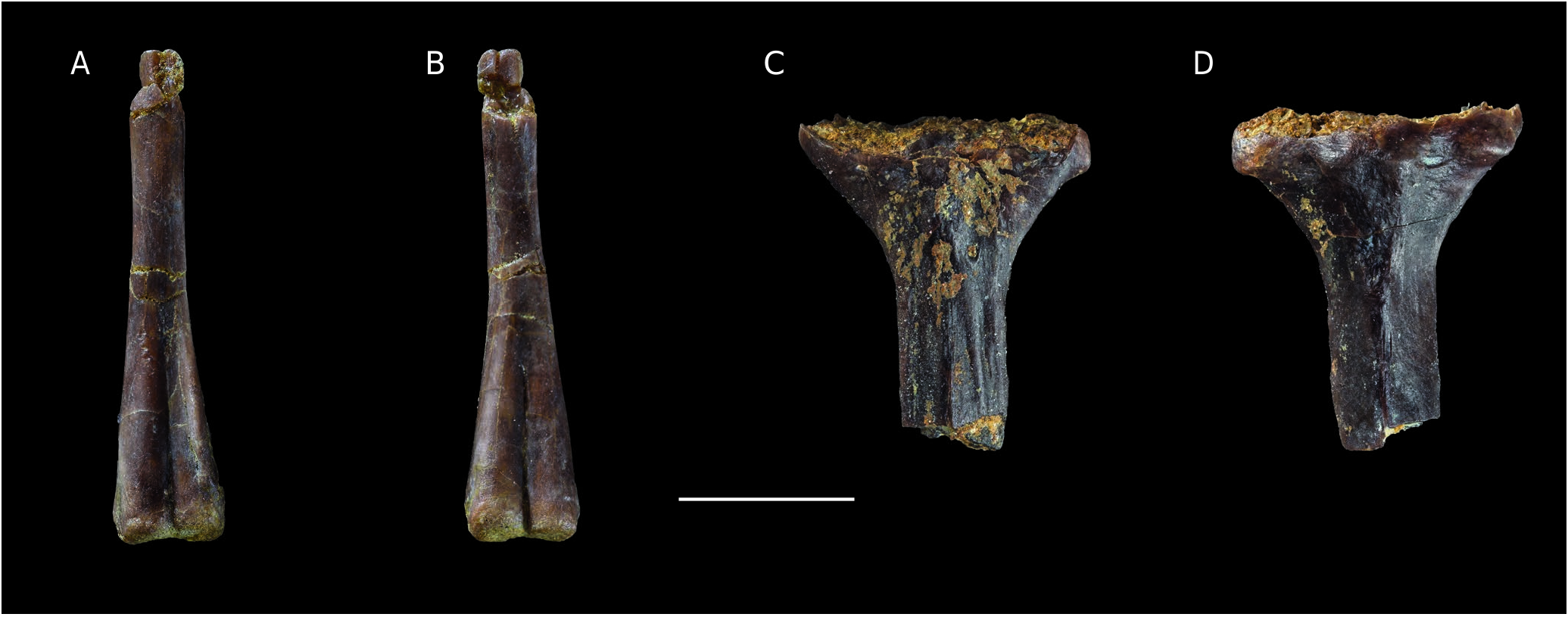
FIG. 10. — Anuran remains from Angeac-Charente:A, B, right tibiofibular of Anura indet.(ANG M-63) in anterior (A) and posterior (B) views; C, D, urostyle of Anura indet. (ANG M- 64) in dorsal (C) and ventral (D) views. Scale bar represents: A, B, 5 mm; C, D, 2 mm.

FIG. 1. — Anura. Sherullah, late Miocene, photos, A-D: A,? Discoglossinae (? Alytidae), right humerus AFG 1650, ventral view; B-D, “Ranidae”, B, right humerus AFG 1653, ventral view; C, right coracoid AFG 1652, inner face; D, right ilium AFG 1655, lateral view; Hadji Rona, early Pliocene; E, Anura indet. sp. C, sacral vertebra AFG 1680, dorsal view. Scale bars: 2 mm.
IMAGES
Gallery(7)
Occurrences with images
CITATIONS
References(14)
Banks, R. C., R. W. McDiarmid, and A. L. Gardner, 1987: Checklist of Vertebrates of the United States, the U.S. Territories, and Canada. Resource Publication, no. 166. 79.
Blackburn & Wake (2011) Class Amphibia Gray, 182. In: Zhang, Z.-Q. (Ed.) Animal biodiversity: An outline of higher-level classification and survey of taxonomic richness
Blackburn, D. C.; Wake, D. B. (2011). Class Amphibia Gray, 1825. In Zhang, Z.-Q. (Ed.) Animal biodiversity: An outline of higher-level classification and survey of taxonomic richness. <em>Zootaxa.</em> 3148(1): 39-55.
Dubois (2004) The higher nomenclature of recent amphibians
Dubois (2004) The higher nomenclature of recent amphibians