
AnimaliaNot EvaluatedacceptedorderAccepted
Caudata

Caudata

salamandere(+23)

GBIF:953

0countries
0datasets

0

Descendants

0

Synonyms

0

Children

0

Species

0

Genera

0

Families

PROFILE

Species Profile

Characteristics

Extant 242.0 to 0.0 Ma

ABOUT

Descriptions(8)

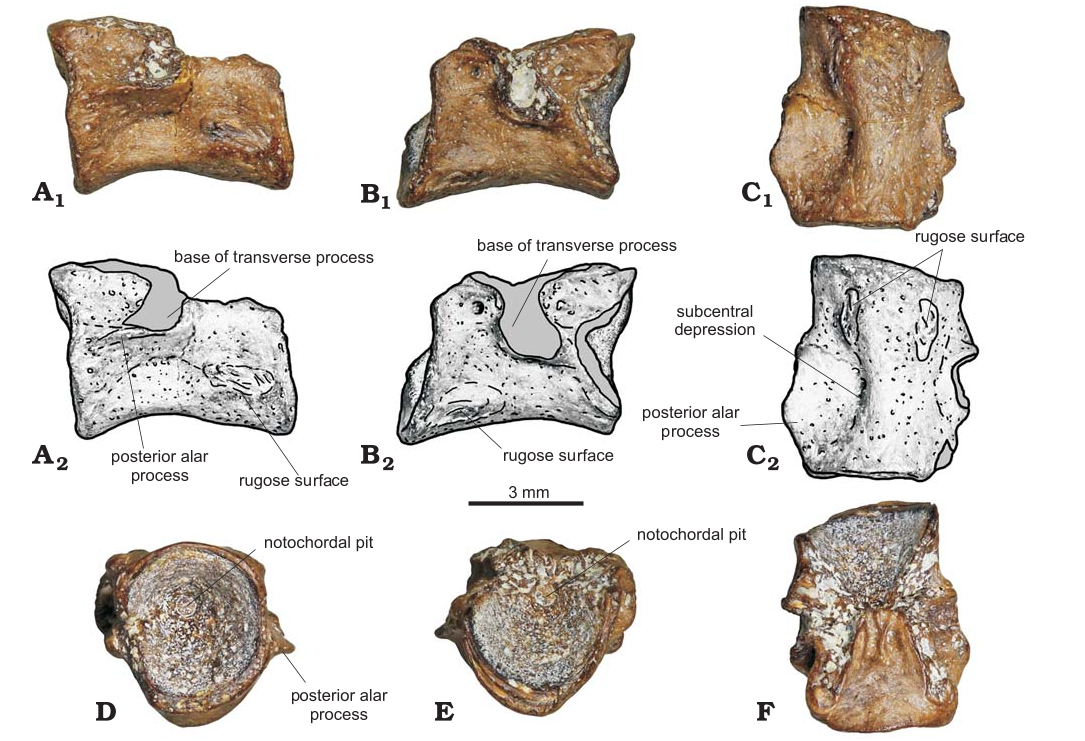
Material. — LMCCE 1 / 4, fragmentary trunk vertebra (Fig. 1). Shestakovo locality (Shestakovo 1 local site), bluff on right (i. e., east) side of Kiya River, 1.5 km downstream from Shestakovo village, Kemerovo Region, Western Siberia, Russia. Coarsegrained sand and sandstone of the Ilek Formation. Early Cretaceous or Aptian – Albian in age. For more details on the Shestakovo locality and its vertebrate assemblage, see Averianov et al. (2006: 361, fig. 1); Skutschas (2014: 89, fig. 1). Description. — LMCCE 1 / 4 is an incomplete trunk vertebral centrum that lacks the anterodorsal portion of the anterior cotyle (Fig. 1). It is large (relative to trunk vertebrae of the possible cryptobranchoid Kiyatriton leshchinskiyi from the same locality, see Skutschas 2014: fig. 4), with a ventral midline length of about 5.5 mm. LMCCE 1 / 4 is heavily ossified vertebra (= heavily built) that appears to have an endochondral component. The lateral and ventral surfaces of the centrum Fig. 1 A – C) are roughened and indented by scattered, small, rounded and oval pits (= pitted texture). These numerous pits are not densely situated and do not form a net-like texture. In lateral view, the centrum is relatively short anteroposteriorly and deep (ratio of ventral midline length vs. maximum height is about 1.3) and its ventral surface is broadly concave dorsally. The centrum is amphicoelous and both cotyles are deeply concave. The posterior cotyle is intact and nearly circular in posterior outline, with the ventral portion slightly narrower than the dorsal (Fig. 1 D); the anterior cotyle is missing its dorsal portion, but it probably had a similar outline (Fig. 1 E, F). Both cotyles retain a modest-sized notochordal pit. That pit is located slightly above the dorsoventral midpoint of posterior cotyle and it likely was in about the same location in the anterior cotyle. The inner walls of both cotyles are lined with a thin layer of calcified cartilage. The ventral surface lacks a subcentral keel. Instead, the ventral surface is moderately broad, shallowly convex from side-to-side and bracketed on either side by a shallow subcentral depression. Those depressions are perforated by small and nearly equal-sized subcentral foramina (not visible in figure); there are three foramina in the right subcentral depression and two in the left. Anteroventral to each subcentral depression, there is an anteroposteriorly elongate patch having a weakly rugose surface and bearing along its posterior portion a low, but distinct tubercle (=? anterior basapophysis). Bases of transverse processes (= rib-bearers) are present higher up and midway along the lateral sides of the centrum, but those bases are too damaged to determine whether the transverse processes were bicipital or unicipital. As best shown on the left side, the anterior and posterior bases of the transverse process are perforated by a small canal. Best preserved on the right side, the posterior alar process is an anteroposteriorly short flange that extends posteriorly from the base of the lower part of the transverse process.
A relict stem salamander: evidence from the Early Cretaceous of Siberia
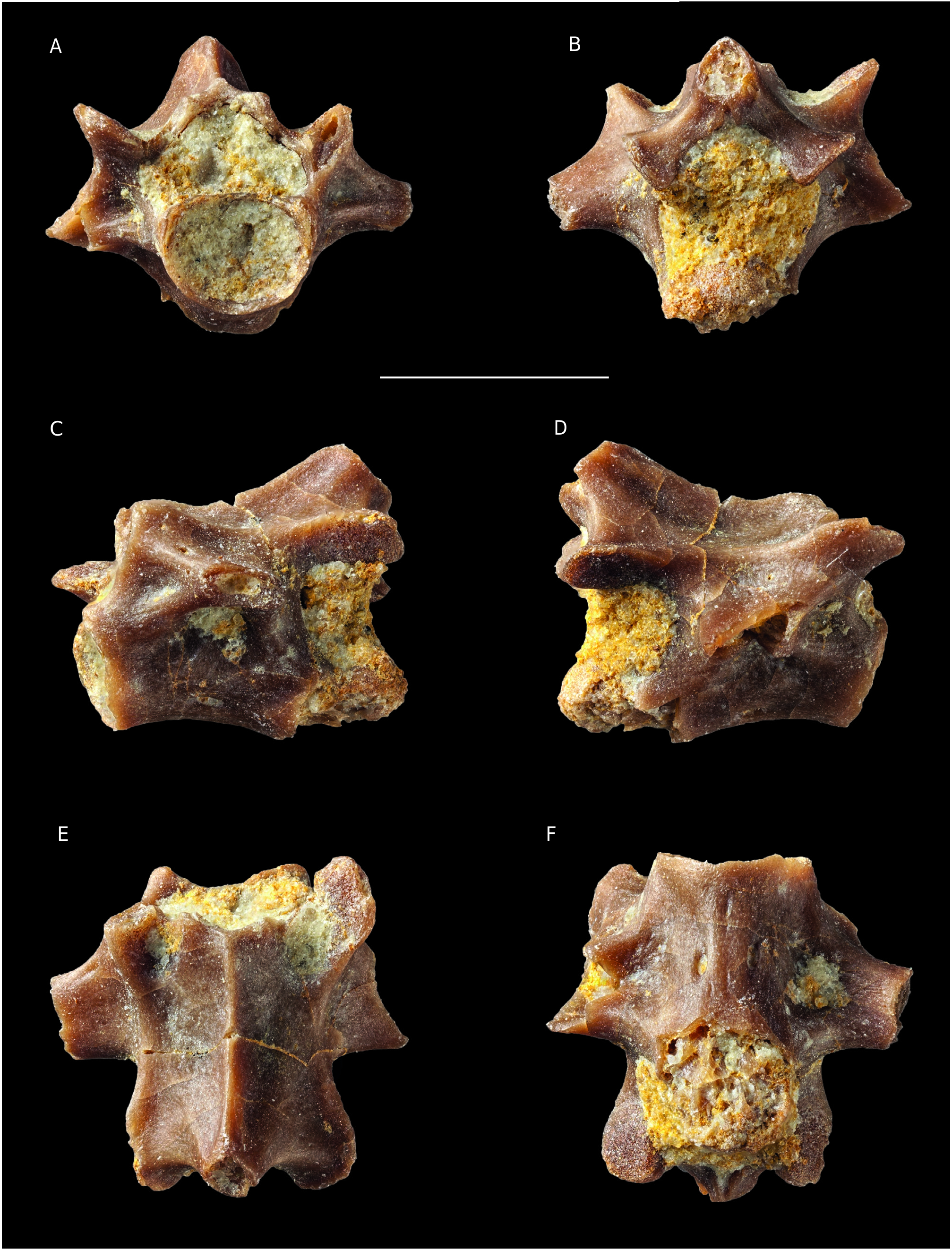
(Fig. 11) DESCRIPTION Among the microvertebrates from Angeac-Charente, a specimen could be referred to Caudata. Indeed, the vertebra ANG M- 71 (Fig. 11) is anteroposteriorly elongated, with a broad, almost circular cotyle (Fig. 11 A) and with well-defined pre – and postzygapophyses. The posterior part of the centrum is abraded, but the vertebra is clearly procoelous. Two small subcentral foramina are present on the ventral face (Fig. 11 F). The general shape, presence of transverse processes extending posterolaterally, and broad vertebral cotyle are reminiscent of Caudata (Rage et al. 1993). In Caudata, the trunk vertebrae are, however, commonly opisthocoelous or amphicoelous and the procoelous condition is rare (see Estes 1981; Rage et al. 1993; Alloul et al. 2018 for examples of procoelous caudates). On the contrary, the procoelous condition is common within Squamata, to which this vertebra could be alternatively referred. Moreover, anterior basapophyses, which are present in many caudate groups (Estes 1981), are not discernable, and the presence or absence of a notochordal pit, which is usually observed on caudate vertebrae (Alloul et al. 2018), cannot be inferred because of the abraded condyle. However, the left transverse process (= rib-bearer), although broken, has an expanded head (Fig. 11 C, E, F), indicating that it may be bilobed as in salamanders, and a ridge extending between the transverse process and the condyle seems to be present, as in Caudata (Alloul et al. 2018), but the preservation is too poor to reach a conclusion. Thus, this vertebra is tentively referred to Caudata?, although an assignment to Squamata cannot be excluded.
Vertebrate paleobiodiversity of the Early Cretaceous (Berriasian) Angeac-Charente Lagerstätte (southwestern France): implications for continental faunal turnover at the J / K boundary
DISCUSSION Ŋe small size and slenderness of these specimens are likely not consistent with the above-described vertebra.
A new early Late Oligocene (MP 26) continental vertebrate fauna from Saint-Privat-des-Vieux (Alès Basin, Gard, Southern France)
MATERIAL EXAMINED. — One radius (SPV 711), one femur (SPV 712), and one incomplete humerus (SPV 713).
A new early Late Oligocene (MP 26) continental vertebrate fauna from Saint-Privat-des-Vieux (Alès Basin, Gard, Southern France)

ORDER CAUDATA Fischer 1813, 58

(1 family, 5 genera, 7 subgenera, 38 species, 24 endemic species). Dubois & Raffaëlli (2012) argued for using Urodela for this order. Fouquette & Dubois (2014) continued the arguments of Dubois & Raffaëlli (2012). A.M.C. Duméril (1805, 91) had used the French vernacular Urodèles for this order. Fischer used Caudati as apparently an equivalent of Urodeli of Duméril. As the CODE does not regulate order names it comes down to a matter of choice, thus I continue to use Caudata for the salamander order, in part, because Fischer used Caudati before he used Urodeli.

A checklist of the amphibians and reptiles of Honduras, with additions, comments on taxonomy, some recent taxonomic decisions, and areas of further studies neededMagnoliaPress via PlaziNo known copyright restrictions apply. See Agosti, D., Egloff, W., 2009. Taxonomic information exchange and copyright: the Plazi approach. BMC Research Notes 2009, 2:53 for further explanation.
A recent paper on the Salamandridae family taxonomy (Dubois and Raffaëlli 2009) proposed a number of systematic changes, many of which above and below the species level. Concerning species of European newts and salamanders, the proposed changes include treating six taxa as new species: Lissotriton graecus, L. meridionalis, L. maltzani, Salamandra aurorae, S. almanzoris and S. longirostris. Dubois and Raffaëlli (2009) elevated L. v. graecus and L. v. meridionalis to species level, based on the results of Babik et al. (2005). They interpret these results as suggesting that if L. montandoni (Carpathian Newt) is recognised as a distinct species, Lissotriton vulgaris (Smooth Newt) as traditionally understood is paraphyletic. In fact, this seems to be a misinterpretation of Babik et al. ’ s (2005) results - the latter authors convincingly argue that the paraphyly of the mitochondrial haplotypes of vulgaris is caused by repeated introgression of vulgaris mitochondrial lineages into montandoni, resulting in the replacement of the original montandoni mtDNA by vulgaris mtDNA. Conclusively, L. vulgaris mtDNA is paraphyletic in relation to L. montandoni mtDNA, but this is probably not true for the species themselves. Indeed, even while both graecus and meridionalis (in addition to several other Anatolian and Caucasian subspecies) are distinct in molecular (mtDNA: Babik et al. 2005, nuclear DNA: Kalezić 1983; Kalezić and Tucić 1984) and morphological (Schmidtler and Franzen 2004) features (however, mainly based on male secondary sexual characters - Raxworthy 1990, but see Pellarini and Lapini 2000), Babik et al. (2005) revealed high levels of mtDNA introgression in contact zones between several subspecies / lineages, including both graecus and meridionalis, and a general lack of concordance between subspecies limits, defined on the basis of mtDNA and morphological data. Although L. v. meridionalis is represented by a single clade in peninsular Italy (albeit represented by only two samples), Istrian and Slovenian populations which have been attributed to this taxon based on morphology and allozymes (Schmidtler and Franzen 2004), seem to belong to L. v. vulgaris according to mtDNA data (Babik et al. 2005). Concerning L. v. graecus, the current northern parts of its distributional range seems to be introgressed by populations related to L. v. vulgaris, while Corfu represents a relictual lineage and sampling is lacking from central parts of southern Greece. Thus, despite a high level of mtDNA divergence and evidence of ancient diversification events between some subspecies in L. vulgaris (Babik et al. 2005), the available data do not allow drawing definite conclusions on these taxa. We therefore refrain from accepting graecus and meridionalis as full species until additional data on contact zones and wider geographical sampling of these taxa are presented. The Algarve clade of Bosca’s Newt (Lissotriton boscai) found by Martínez-Solano et al. (2006) might deserve species rank, the name maltzani apparently being available for it (Montori et al. 2005), as already mentioned by Speybroeck and Crochet (2007). However, more sampling in (possible) transition zones and the study of nuclear genes and morphology seems required, prior to any new arrangement. The distinct clade found by Herrero (1991) also deserves further attention. Quoting Martínez-Solano et al. (2006): “ (…) new data from independent sources are needed to clarify the taxonomic status of these two divergent lineages, and morphological and molecular studies including data on variation in nuclear markers will be particularly helpful in this respect. Variation in populations within L. boscai has been already studied from morphological and genetic perspectives, but previous studies have failed to include representatives of all the clades identified in our study (…). ”. As no additional evidence seems to have been presented in the mean time, we agree with this. As such, we consider Dubois and Raffaëlli’s (2009) proposal to accept Lissotriton maltzani to be premature.
A tentative species list of the European herpetofauna (Amphibia and Reptilia) — an update
The more difficult case of Salamandra (salamandra) longirostris seems primarily to depend on where to draw the line based on mtDNA sequence divergence between allopatric taxa. Steinfartz et al. (2000) note 6,3 % mtDNA divergence (control region sequences) between this taxon, S. s. morenica and S. s. crespoi versus all other subspecies of S. salamandra, but group longirostris together with morenica and crespoi. Corresponding divergence times were tentatively estimated at approximately 2 – 4 mya. Using a different mitochondrial gene (cytochrome b), García-París et al. (1998) found a basal position of longirostris in relation to all other Iberian lineages (including morenica and crespoi) and a 5.1 % – 5.7 % sequence divergence between longirostris and the main clade. According to these authors, S. (s.) longirostris became isolated from other Salamandra taxa either by the Betic Strait in the Miocene, or during the Pliocene formation of the Guadalquivir river valley. Under this second (favoured) hypothesis, longirostris would have split 2.5 – 5.3 mya. In yet another study, Escoriza et al. (2006) place longirostris close to S. inframaculata orientalis, but admit that this sister taxon relationship may very well be an artefact. Additionally, we note that Dubois and Raffaëlli (2009) claim a close relationship between longirostris and S. algira, whereas this is in clear contrast to the findings of other authors (e. g. Steinfartz et al. 2000; Donaire Barroso and Bogaerts 2003). Donaire Barroso et al. (2009) provided some additional data on the distinctiveness of the longirostris colour pattern. Although longirostris may well deserve full species rank, conflicting phylogenetic trees prompt us to maintain it as a subspecies until conclusive evidence is provided. Following Schmidtler (2004), Speybroeck and Crochet (2007) and the online database “ Amphibian Species of the World 5.3 ” have accepted that Triturus Rafinesque 1815 is a nomen nudum and thus nomenclaturally unavailable. However, this was clearly a mistake: as demonstrated by Dubois and Raffaëlli (2009), Triturus Rafinesque 1815 was a neonym (nomen novum) for Triton Laurenti 1768 and thus an available nomen. This means that authorship for this taxon remains 1815 and not 1820. We note that the rejection of the works of de la Cepède (International Commission on Zoological Nomenclature 2005) lead to attribution of some names to Bonnaterre, 1789. This was already adopted by Speybroeck and Crochet (2007) for e. g. the Southern Spectacled Salamander (Salamandrina terdigitata). As pointed out by Dubois and Raffaëlli (2009), this also holds true for Salamandra salamandra terrestris. Referral to the latter taxon by means of junior synonyms like europaea Bedriaga, 1883 seems therefore unwarranted. Finally, we are reluctant to accept Dubois and Raffaëlli’s (2009) new subspecific arrangement of the Alpine Newt (Ichthyosaura alpestris), because we believe that mtDNA data alone are not sufficient for revising intraspecific systematics, and any proposal for changes seems currently premature. The same applies to Sotiropoulos et al. (2007): we are not (yet) convinced that the subspecies inexpectata should be abandoned. As a side comment, both Sotiropoulos et al. (2007 - mtDNA) and Canestrelli et al. (2006 a - allozymes and mtDNA) uncovered a level of genetic divergence between peninsular Italian and continental European Ichthyosaura which is more typical of interspecific divergence than intraspecific variation in Caudata. Lack of clear concordance between mtDNA clades and morphology, and absence of supporting evidence for the most basal lineages in Sotiropoulos et al. (2007) prevent us from adopting any systematic changes here, but we anticipate future splits when additional data will become available. Two species in the genus Salamandrina - the Southern Spectacled Salamander S. terdigitata and the Northern Spectacled Salamander S. perspicillata - have been recognised in recent years, based on both mtDNA and nuclear markers (Mattoccia et al. 2005; Canestrelli et al. 2006 b), apparently separated by the Volturno river. However, only a restricted number of samples was used and morphological data was lacking. Romano et al. (2009) presented evidence of morphological divergence between the species, based on body size and dorsal colouration differences. New localities and additional samples revealed a contact zone south of the Volturno River in northern Campania, where both species occur syntopically in several locations, but they remain distinct in terms of (at least) mtDNA. Arntzen et al. (2007) found a high level of allozyme differentiation between Triturus carnifex carnifex (Italian Crested Newt) and T. c. macedonicus (Macedonian Crested Newt) (Nei’s genetic distance = 0.19, similar to the divergence between T. marmoratus and T. pygmaeus) suggesting a long (> 5 million years) separate evolution. As a consequence, they elevated the latter to species rank as Triturus macedonicus. Even more recently, Espregueira Themudo et al. (2009) elevated the European Southern Crested Newt to species rank as Triturus arntzeni (Arntzen’s Crested Newt). Forthcoming papers will have to delimit the geographical range of arntzeni and karelinii, as different sources of information give contrasting results (Olgun et al. in prep.; Wielstra et al. in prep.). As a consequence, it is unclear at present whether karelinii s. s. occurs in the area considered in our paper. Carretero et al. (2009) issued an updated ‘ lista patrón’ of the Spanish herpetofauna, as first released by Montori et al. (2005). In conflict with the rules of the International Code of Zoological Nomenclature, they reject Ichthyosaura (containing the species alpestris) on grounds of confusion with the prehistorical taxon Ichthyosaurus. As stated in the introduction, we firmly believe that the Code should be followed consistently, thus we advocate the use of this name over e. g. Mesotriton. Frost (2009) attributes the name Ichthyosaura to Latreille in Sonnini de Manoncourt and Latreille, 1801. Dubois (2008) advocated attribution of nomina to the author name (s) as cited in the original publication. In this case, the book is authored by C. S. Sonnini and P. A. Latreille. As pointed out by Dubois and Raffaëlli (2009), the relevant part of this 4 - volume work contains no specification on whether it was written by either author or both. In this part, singular (‘ je’ = I) and plural (‘ nous’ = we) are mixed up, while the part dealing with Proteus tritonius is written in plural. As Ichthyosaura was based on the latter taxon, we attribute this name to Sonnini and Latreille, 1801, as does Schmidtler (2009). The latter also pointed out that the name is of female gender, therefore requiring accordingly inflected subspecies names (e. g. apuana, inexpectata, serdara, …), regardless of their validity. As discussed in Speybroeck and Crochet (2007) and in contrast to a number of recent papers (e. g. Carranza et al. 2008 a; van der Meijden et al. 2009), we extend the use of the genus name Speleomantes for the European cave salamanders. Nascetti et al. (1996) found a huge genetic distance between the Californian Hydromantes shastae and the Sardinian Speleomantes genei (Gené’s Cave Salamander; D Nei 3.38) and S. imperialis (Scented Cave Salamander; D Nei 3.92), and all available studies resolve the European species as a monophyletic clade. Wake et al. (2005) proposed the genus name Atylodes for Speleomantes genei, which can be used at genus or subgenus level (Crochet 2007). Vieites et al. (2007) proposed to use Atylodes, Speleomantes and Hydromantes at the genus level. However, van der Meijden et al. (2009) could not find a strongly supported (basal) position for genei. Consequently, using Atylodes as a valid taxon may render Speleomantes paraphyletic. We thus refrain from using this name at any level. Carranza et al. (2008) elevated the Sette Fratelli Cave Salamander from southeastern Sardinia to species rank as Speleomantes sarrabusensis. The still unnamed “ subspecies B ” of Speleomantes genei was shown to be more widespread (van der Meijden et al. 2009) than previously assumed (Lanza et al. 2005). Van der Meijden et al. (2009) confirmed that the genetic distance between the A and B genei taxa is of a magnitude that could warrant treatment of both taxa as separate species. Furthermore, their easternmost sample of Speleomantes imperialis (Lago Omodeo area) appeared quite distinct from their other imperialis samples. Taxonomic consequences, however, remain premature, pending more range-wide sampling, including samples of the central parts of the species’ range. On the other hand, the results of van der Meijden et al. (2009) confirmed that the current systematics of the italicus - ambrosii group (Italian and Ambrosi’s Cave Salamander) is probably inadequate: in their phylogenetic tree, specimens of S. ambrosii ambrosii are more closely related to specimens of S. italicus than to specimens of S. ambrosii bianchii. Based on extensive introgression in contact zones (Lanza et al. 2005), it might be better to treat ambrosii as a subspecies of italicus. However, we refrain from proposing any formal change for the time being.
A tentative species list of the European herpetofauna (Amphibia and Reptilia) — an update
Bolitoglossa C. Duméril, Bibron, & A. Duméril, 1854 (23) The generic classification for the nominal genus Bolitoglossa follows Parra-Olea, García-París and Wake (2004). We are inclined to recognize all the subgenera (Bolitoglossa, Eladinea, Magnadigita, Mayamandra, Nanotriton, Oaxakia, and Pachymandra) proposed for the major clades within this taxon as valid genera as will be the inevitable result of their recognition as monophyletic groups. Subgenus Bolitoglossa C. Duméril, Bibron, & A. Duméril, 1854 (2) Bolitoglossa lignicolor (W. Peters, 1873) (133) Bolitoglossa striatula (Noble, 1918) (138) Subgenus Eladinea Miranda Ribeiro, 1937 (20) Bolitoglossa bramei Wake, Savage, & Hanken, 2007 Bolitoglossa cerroensis (Taylor, 1952) (130) Bolitoglossa colonnea (Dunn, 1924) (131) Bolitoglossa compacta Wake, Brame, & Duellman, 1973 (131) Bolitoglossa diminuta Robinson, 1976 (132) Bolitoglossa epimela Wake & Brame, 1963 (132) Bolitoglossa gomezi Wake, Savage, & Hanken, 2007 Bolitoglossa gracilis Bolaños, Robinson & Wake, 1987 (133) Bolitoglossa marmorea (Tanner & Brame, 1961) (839) Bolitoglossa minutula Wake, Brame, & Duellman, 1973 (134) Bolitoglossa nigrescens (Taylor, 1949) (135) Bolitoglossa obscura Hanken, Wake, & Savage, 2005 Bolitoglossa pesrubra (Taylor, 1952) (136) Bolitoglossa robinsoni Bolaños & Wake, 2009 Bolitoglossa robusta (Cope, 1894) (136) Bolitoglossa schizodactyla Wake & Brame, 1966 (137) Bolitoglossa sombra Hanken, Wake, & Savage, 2005 Bolitoglossa sooyorum Vial, 1963 (137) Bolitoglossa subpalmata (Boulenger, 1896) (139) Bolitoglossa tica García-París, Parra-Olea & Wake, 2008 Subgenus Pachymandra Parra-Olea, García-París & Wake, 2004 (1) Bolitoglossa alvaradoi Taylor, 1954 (129) Nototriton Wake & Elias, 1983 (7) Nototriton abscondens (Taylor, 1948) (141) Nototriton gamezi García-París & Wake, 2000 (142) Nototriton guanacaste Good & Wake, 1993 (142) Nototriton major Good & Wake, 1993 (143) Nototriton picadoi (Stejneger, 1911) (144) Nototriton richardi (Taylor, 1949) (144) Nototriton tapanti Good & Wake, 1993 (145) Oedipina Keferstein, 1868 (14) Oedipina alfaroi Dunn, 1921 (150) Oedipina alleni Taylor, 1954 (149) Oedipina altura Brame, 1968 (151) Oedipina carablanca Brame, 1968 (149) Oedipina collaris (Stejneger, 1907) (151) Oedipina cyclocauda Taylor, 1952 (152) Oedipina gracilis Taylor, 1952 (153) Oedipina grandis Brame & Duellman, 1970 (153) Oedipina pacificensis Taylor, 1952 (154) Oedipina paucidentata Brame, 1968 (154) Oedipina poelzi Brame, 1963 (155) Oedipina pseudouniformis Brame, 1968 (156) Oedipina savagei García-París & Wake, 2000 (150) Oedipina uniformis Keferstein, 1868 (156)
A checklist of the Amphibians and Reptiles of Costa Rica: Additions and nomenclatural revisions

Export occurrence data

Darwin Core Archive (ZIP)

GEOGRAPHY

Distribution Map

Occurrence Map

Loading map…

Tiles © GBIF Maps API | Map powered by MapLibre GL

REGIONS

Geographic Distribution(4)

DK
not evaluated
NO
SE
Vermont-US(US)

DATA

Occurrence Datasets

Loading datasets…

Common names used for this species across different languages and regions. Available in 7 languages and 5 countries. 2 preferred.

NOsalamanderenobSEstjärtgroddjursweDKHalepadderdanUSSalamanderengUSSalamandereng+19 more

Vernacular (common) names are the everyday names used for a species in different languages and regions. A single species may have dozens of common names worldwide. This taxon has names in 7 languages. 2 names preferred.

DKHalepadder
danDK
Source: National Checklist of all species occurring in DenmarkSource taxon #307207381
USSalamander
engUS
Source: Martha's Vineyard species checklistSource taxon #206230098
USSalamander
engUS
Source: Checklist of Vermont SpeciesSource taxon #160796780
engSalamanders
eng
Source: Martha's Vineyard species checklistSource taxon #206230098
engSalamanders
eng
Source: Catalogue of LifeSource taxon #299398300
engSalamanders
eng
Source: Integrated Taxonomic Information System (ITIS)Source taxon #102084090
engSalamanders
eng
Source: Checklist of Vermont SpeciesSource taxon #160796780
engSalamanders
eng
Source: Catalogue of LifeSource taxon #273203274
engsalamander
eng
Source: The Paleobiology DatabaseSource taxon #121449762
engsalamander
eng
Source: The Paleobiology DatabaseSource taxon #137371732
porsalamandra
por
Source: Integrated Taxonomic Information System (ITIS)Source taxon #102084090
porsalamandra
por
Source: Catalogue of LifeSource taxon #273203274
porsalamandra
por
Source: Catalogue of LifeSource taxon #299398300
frasalamandres
fra
Source: Integrated Taxonomic Information System (ITIS)Source taxon #102084090
frasalamandres
fra
Source: Catalogue of LifeSource taxon #299398300
frasalamandres
fra
Source: Catalogue of LifeSource taxon #273203274
FIsalamanterieläimet
finFI
Source: The FinBIF checklist of Finnish speciesSource taxon #257959070
NOsalamandere
nobpreferredNO
SEstjärtgroddjur
swepreferredSE
Source: Dyntaxa. Svensk taxonomisk databasSource taxon #159940571
engSalamanders, Sirens And Newts
eng
Source: Checklist of Vermont SpeciesSource taxon #160796780
engSalamanders, Sirens And Newts
eng
Source: Martha's Vineyard species checklistSource taxon #206230098
engSalamanders, Sirens and Newts
eng
Source: United Kingdom Species Inventory (UKSI)Source taxon #180186404
NOhaleamfibier
nobNO
NOhalepadder
nobNO

CLASSIFICATION

Taxonomic Classification Tree

NOMENCLATURE

Synonyms(1)

RELATED

Related Name Usages(20)

Matching names from other GBIF-indexed checklists and datasets.

MULTIMEDIA

Media Files(2)

Fig.1. Fragmentary trunk vertebral centrum (LMCCE 1/4) of stem salamander Caudata, gen.et sp. indet. from the Shestakovo locality, Lower Cretaceous Aptian–Albian), Ilek Formation, Western Siberia, Russia; in right lateral (A), left lateral (B), ventral (C, anterior towards top), posterior (D), anterior (E), and dorsal (F, anterior towards top) views. Photographs (A1–C1, D–F) and interpretive drawings (A2–C2).
Imageimage/png© Skutschas, Pavel P.A relict stem salamander: evidence from the Early Cretaceous of Siberia

FIG. 11. — Vertebra of Caudata indet. from Angeac-Charente: A-F, (ANG M-71) in anterior (A), posterior (B), left lateral (C), right lateral (D), dorsal (E) and ventral (F) views. Scale bar: 2 mm.

Imageimage/png© Allain, Ronan;Vullo, Romain;Rozada, Lee;Anquetin, Jérémy;Bourgeais, Renaud;Goedert, Jean;Lasseron, Maxime;Martin, Jeremy E.;Pérez-García, Adán;Fabrègues, Claire Peyre De;Royo-Torres, Rafael;Augier, Dominique;Bailly, GillesVertebrate paleobiodiversity of the Early Cretaceous (Berriasian) Angeac-Charente Lagerstätte (southwestern France): implications for continental faunal turnover at the J / K boundary

IMAGES

Gallery(2)

See Gallery

Occurrences with images

CITATIONS

References(8)

  • 1

    American Museum of Natural History (2026) Amphibian Species of the World 6.2, an Online Reference

    Dyntaxa. Svensk taxonomisk databas
  • 2

    Banks, R. C., R. W. McDiarmid, and A. L. Gardner, 1987: Checklist of Vertebrates of the United States, the U.S. Territories, and Canada. Resource Publication, no. 166. 79.

    Integrated Taxonomic Information System (ITIS)
  • 3

    Flores-Villela, Oscar / McCoy, C. J., ed., 1993: Herpetofauna Mexicana: Lista anotada de las especies de anfibios y reptiles de México, cambios taxonómicos recientes, y nuevas especies. Carnegie Museum of Natural History Special Publication, no. 17. iv + 73.

    Integrated Taxonomic Information System (ITIS)
  • 4

    Parker, S.P. (ed). (1982). Synopsis and Classification of Living Organisms. McGraw-Hill, New York. 2 volumes.

    basis of recordThe Interim Register of Marine and Nonmarine Genera
  • 5

    Ruggiero, M. A., D. P. Gordon, T. M. Orrell, N. Bailly, T. Bourgoin, R. C. Brusca, et al., 2015: Correction: A Higher Level Classification of All Living Organisms. PLoS ONE vol. 10, no. 6, e0130114.

    Integrated Taxonomic Information System (ITIS)
  • Source Information

    GBIF Backbone Taxonomy

    GBIF Backbone Taxonomy

    checklist

    The GBIF Backbone Taxonomy is a single, synthetic management classification with the goal of covering all names GBIF is dealing with. It's the taxonomic backbone that allows GBIF to integrate name based information from different resources, no matter if these are occurrence datasets, species pages, names from nomenclators or external sources like EOL, Genbank or IUCN. This backbone allows taxonomic search, browse and reporting operations across all those resources in a consistent way and to provide means to crosswalk names from one source to another.

    It is updated regulary through an automated process in which the Catalogue of Life acts as a starting point also providing the complete higher classification above families. Additional scientific names only found in other authoritative nomenclatural and taxonomic datasets are then merged into the tree, thus extending the original catalogue and broadening the backbones name coverage. The GBIF Backbone taxonomy also includes identifiers for Operational Taxonomic Units (OTUs) drawn from the barcoding resources iBOL and UNITE.

    International Barcode of Life project (iBOL), Barcode Index Numbers (BINs). BINs are connected to a taxon name and its classification by taking into account all names applied to the BIN and picking names with at least 80% consensus. If there is no consensus of name at the species level, the selection process is repeated moving up the major Linnaean ranks until consensus is achieved.

    UNITE - Unified system for the DNA based fungal species, Species Hypotheses (SHs). SHs are connected to a taxon name and its classification based on the determination of the RefS (reference sequence) if present or the RepS (representative sequence). In the latter case, if there is no match in the UNITE taxonomy, the lowest rank with 100% consensus within the SH will be used.

    The GBIF Backbone Taxonomy is available for download at https://hosted-datasets.gbif.org/datasets/backbone/ in different formats together with an archive of all previous versions.

    The following 105 sources have been used to assemble the GBIF backbone with number of names given in brackets:

    • Catalogue of Life Checklist - 4766428 names
    • International Barcode of Life project (iBOL) Barcode Index Numbers (BINs) - 635951 names
    • UNITE - Unified system for the DNA based fungal species linked to the classification - 611208 names
    • The Paleobiology Database - 212054 names
    • World Register of Marine Species - 188857 names
    • The Interim Register of Marine and Nonmarine Genera - 183894 names
    • The World Checklist of Vascular Plants (WCVP) - 131891 names
    • GBIF Backbone Taxonomy - 114350 names
    • TAXREF - 109374 names
    • The Leipzig catalogue of vascular plants - 75380 names
    • ZooBank - 73549 names
    • Integrated Taxonomic Information System (ITIS) - 68377 names
    • Plazi.org taxonomic treatments database - 61346 names
    • Genome Taxonomy Database r207 - 60545 names
    • International Plant Names Index - 52329 names
    • Fauna Europaea - 45077 names
    • The National Checklist of Taiwan (Catalogue of Life in Taiwan, TaiCoL) - 36193 names
    • Dyntaxa. Svensk taxonomisk databas - 35892 names
    • The Plant List with literature - 32692 names
    • United Kingdom Species Inventory (UKSI) - 29643 names
    • Artsnavnebasen - 29208 names
    • The IUCN Red List of Threatened Species - 21221 names
    • Afromoths, online database of Afrotropical moth species (Lepidoptera) - 13961 names
    • Brazilian Flora 2020 project - Projeto Flora do Brasil 2020 - 13829 names
    • Prokaryotic Nomenclature Up-to-Date (PNU) - 10079 names
    • Checklist Dutch Species Register - Nederlands Soortenregister - 8814 names
    • ICTV Master Species List (MSL) - 7852 names
    • Cockroach Species File - 6020 names
    • GRIN Taxonomy - 5882 names
    • Taxon list of fungi and fungal-like organisms from Germany compiled by the DGfM - 4570 names
    • Catalogue of Afrotropical Bees - 3623 names
    • Catalogue of Tenebrionidae (Coleoptera) of North America - 3327 names
    • Checklist of Beetles (Coleoptera) of Canada and Alaska. Second Edition. - 3312 names
    • Systema Dipterorum - 2850 names
    • Catalogue of the Pterophoroidea of the World - 2807 names
    • The Clements Checklist - 2675 names
    • Taxon list of Hymenoptera from Germany compiled in the context of the GBOL project - 2496 names
    • IOC World Bird List, v13.2 - 2366 names
    • Official Lists and Indexes of Names in Zoology - 2310 names
    • National checklist of all species occurring in Denmark - 1922 names
    • Myriatrix - 1876 names
    • Database of Vascular Plants of Canada (VASCAN) - 1822 names
    • Taxon list of vascular plants from Bavaria, Germany compiled in the context of the BFL project - 1771 names
    • Orthoptera Species File - 1742 names
    • A list of the terrestrial fungi, flora and fauna of Madeira and Selvagens archipelagos - 1602 names
    • Aphid Species File - 1565 names
    • World Spider Catalog - 1561 names
    • Taxon list of Jurassic Pisces of the Tethys Palaeo-Environment compiled at the SNSB-JME - 1270 names
    • Backbone Family Classification Patch - 1143 names
    • GBIF Algae Classification - 1100 names
    • International Cichorieae Network (ICN): Cichorieae Portal - 975 names
    • Psocodea Species File - 803 names
    • New Zealand Marine Macroalgae Species Checklist - 787 names
    • Annotated checklist of endemic species from the Western Balkans - 754 names
    • Taxon list of animals with German names (worldwide) compiled at the SMNS - 503 names
    • Catalogue of the Alucitoidea of the World - 472 names
    • Lygaeoidea Species File - 462 names
    • Catálogo de Plantas y Líquenes de Colombia - 422 names
    • GBIF Backbone Patch - 317 names
    • Phasmida Species File - 259 names
    • Cortinariaceae fetched from the Index Fungorum API - 234 names
    • Coreoidea Species File - 233 names
    • GTDB supplement - 139 names
    • Mantodea Species File - 119 names
    • Endemic species in Taiwan - 93 names
    • Taxon list of Araneae from Germany compiled in the context of the GBOL project - 88 names
    • Species of Hominidae - 78 names
    • Taxon list of Sternorrhyncha from Germany compiled in the context of the GBOL project - 77 names
    • Taxon list of mosses from Germany compiled in the context of the GBOL project - 75 names
    • Mammal Species of the World - 73 names
    • Plecoptera Species File - 71 names
    • Species Fungorum Plus - 64 names
    • Catalogue of the type specimens of Cosmopterigidae (Lepidoptera: Gelechioidea) from research collections of the Zoological Institute, Russian Academy of Sciences - 47 names
    • Species named after famous people - 41 names
    • Dermaptera Species File - 36 names
    • Taxon list of Trichoptera from Germany compiled in the context of the GBOL project - 34 names
    • True Fruit Flies (Diptera, Tephritidae) of the Afrotropical Region - 33 names
    • Range and Regularities in the Distribution of Earthworms of the Earthworms of the USSR Fauna. Perel, 1979 - 32 names
    • Taxon list of Diplura from Germany compiled in the context of the GBOL project - 30 names
    • Lista de referencia de especies de aves de Colombia - 2022 - 24 names
    • Taxon list of Auchenorrhyncha from Germany compiled in the context of the GBOL project - 20 names
    • Catalogue of the type specimens of Polycestinae (Coleoptera: Buprestidae) from research collections of the Zoological Institute, Russian Academy of Sciences - 19 names
    • Taxon list of Thysanoptera from Germany compiled in the context of the GBOL project - 19 names
    • Lista de especies de vertebrados registrados en jurisdicción del Departamento del Huila - 18 names
    • Taxon list of Microcoryphia (Archaeognatha) from Germany compiled in the context of the GBOL project - 15 names
    • Catalogue of the type specimens of Bufonidae and Megophryidae (Amphibia: Anura) from research collections of the Zoological Institute, Russian Academy of Sciences - 12 names
    • Grylloblattodea Species File - 11 names
    • Coleorrhyncha Species File - 9 names
    • Taxon list of liverworts from Germany compiled in the context of the GBOL project - 9 names
    • Embioptera Species File - 7 names
    • Taxon list of Pisces and Cyclostoma from Germany compiled in the context of the GBOL project - 6 names
    • Taxon list of Pteridophyta from Germany compiled in the context of the GBOL project - 6 names
    • Taxon list of Siphonaptera from Germany compiled in the context of the GBOL project - 5 names
    • The Earthworms of the Fauna of Russia. Perel, 1997 - 5 names
    • Taxon list of Zygentoma from Germany compiled in the context of the GBOL project - 4 names
    • Asiloid Flies: new taxa of Diptera: Apioceridae, Asilidae, and Mydidae - 3 names
    • Taxon list of Protura from Germany compiled in the context of the GBOL project - 3 names
    • Taxon list of hornworts from Germany compiled in the context of the GBOL project - 2 names
    • Chrysididae Species File - 1 names
    • Taxon list of Dermaptera from Germany compiled in the context of the GBOL project - 1 names
    • Taxon list of Diplopoda from Germany in the context of the GBOL project - 1 names
    • Taxon list of Orthoptera (Grashoppers) from Germany compiled at the SNSB - 1 names
    • Taxon list of Pscoptera from Germany compiled in the context of the GBOL project - 1 names
    • Taxon list of Pseudoscorpiones from Germany compiled in the context of the GBOL project - 1 names
    • Taxon list of Raphidioptera from Germany compiled in the context of the GBOL project - 1 names

    GBIF Secretariat (2023). GBIF Backbone Taxonomy. Checklist dataset https://doi.org/10.15468/39omei accessed via GBIF.org on 2026-06-14.

    CC BYPublished 8/28/2023View dataset
    GBIF Usage Key
    953
    Dataset Key
    d7dddbf4-2cf0-4f39-9b2a-bb099caae36c
    Origin
    source
    Backbone Key
    953
    Taxon ID
    gbif:953
    Last Crawled
    8/22/2023
    Last Interpreted
    8/22/2023