AnimaliaNear ThreatenedacceptedspeciesAcceptedRestricted
Allobates algorei

Allobates algorei

Spotted Nurse Frog(+4)·Barrio-Amorós & Santos, 2009

GBIF:10849606

0countries
0datasets
0year

0

Descendants

0

Children

PROFILE

Species Profile

Characteristics

Extant

ABOUT

Descriptions(7)

Distribution: Region 1. Cordillera Oriental de Colombia (Acevedo et al. 2019) and extreme southwestern piedmont of the Venezuelan Andes, on both northern and southern sides of the Táchira depression. Selected references: Barrio-Amorós and García Porta (2003); Barrio-Amorós and Santos (2009).
Catalogue of the amphibians of Venezuela: Illustrated and annotated species list, distribution, and conservation
Holotype: EBRG 5560. Type locality: Río Negro, Municipio Córdoba, Estado Táchira, Venezuela, “ 07 ° 34.723 ’ N, 72 ° 10.739 ’ W, ” elevation 482 m. ”
Catalogue of the amphibians of Venezuela: Illustrated and annotated species list, distribution, and conservation
In terms of conservation status, A. algorei is included in the category of Least Concern (LC) (IUCN, 2012). However, despite this range extension, the conservation status of this species deserves to be reassessed due to: i) the individuals reported in this work are infected by Batrachochytrium dendrobatidis (Acevedo et al., 2016), and ii) a remarkable deterioration of the natural habitat in Colombia, where the representative primary forests and riparian vegetation of the region have been reduced rapidly during recent years by activities associated with the expansion of cane crops, wood extraction, and livestock. Many of these problems are present similarly in the localities reported in Venezuela, especially between the cities of San Cristóbal and El Piñal (Estado Táchira). Additional surveys investing 150 person-hours of sampling effort in the lower area of the Tamá National Natural Park (Colombia) and the buffer zone of the park did not detect other populations of this species.
First record and conservation status of Allobates algorei (Anura: Aromobatidae) in Colombia
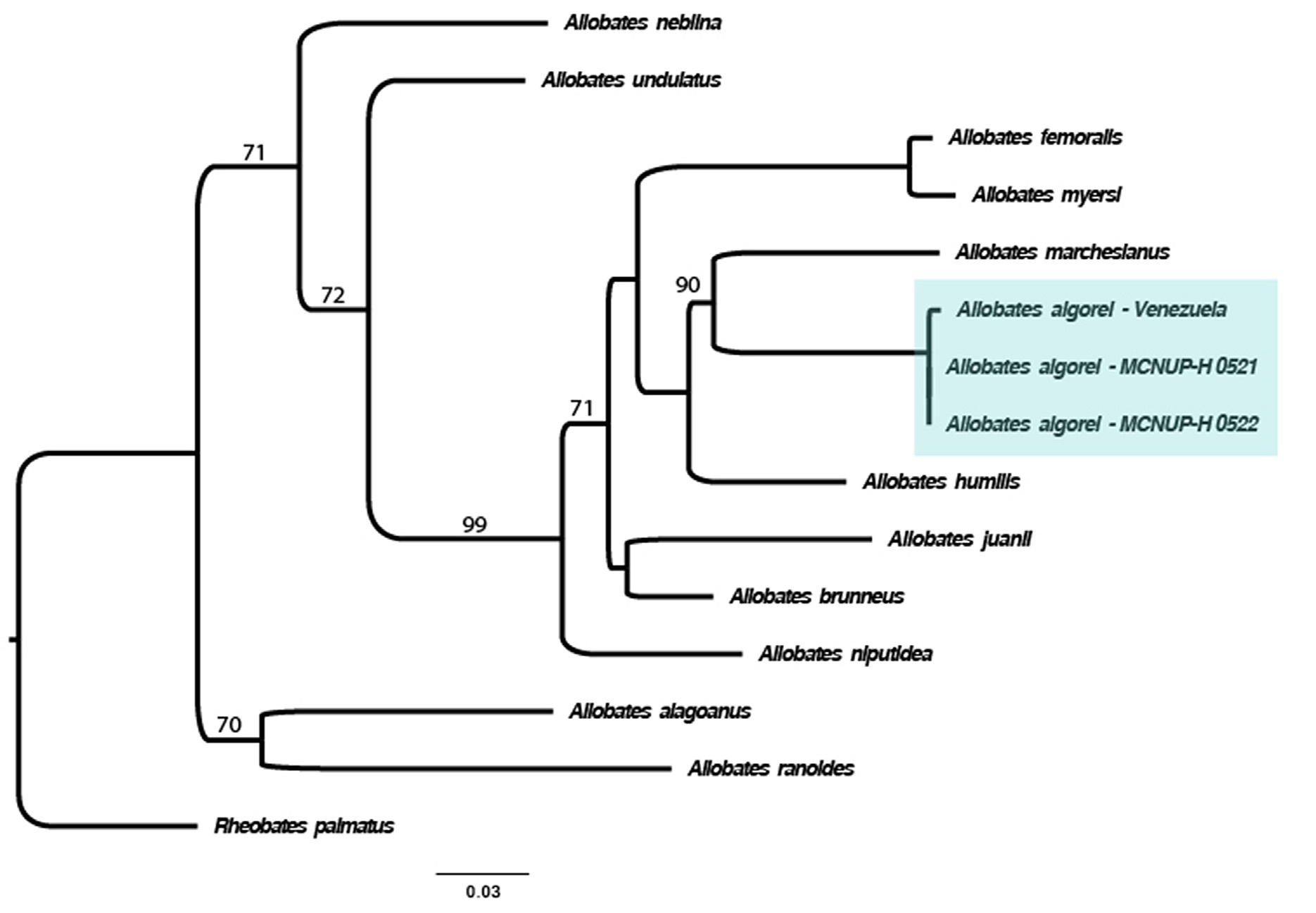
For the taxonomic identification we made morphological comparisons with the original species description (Barrio- Amorós & Santos, 2009) and genetic identification by sequencing two fragments of partial genes 16 s and CO 1 of each specimen. We used the pairs of primers 16 sar (5 ′ - CGC CTG TTT ATC AAA AAC AT- 3 ′) and 16 sbr (5 ′ - CTC CGG TTT GAA CTC AGA TC- 3 ′), and the standard barcoding fragment dgLCO 1490 (5 ′ - GGT CAA CAA ATC ATA AAG AYA TYG G) and dgHCO 2198 (5 ′ - TAA ACT TCA GGG TGA CCA AAR AAY CA). The sequences were aligned and edited with BioEdit (Hall, 1999), including the sequences available for A. algorei (Genbank accession number: HQ 290950; voucher number: TNHCFS 5551) corresponding to the type locality (Táchira: road from San Cristobal to Río Negro), and the addition of other Allobates species distributed in Colombia and Venezuela. A phylogenetic tree reconstruction was carried out with Maximum Likelihood analyses in IQ-TREE (Nguyen et al., 2015), using the TIM 2 + F + G 4 model of evolution, and to estimate branch supports we used the ultrafast bootstrap method (Minh et al., 2013). The pairwise genetic distances between species were calculated following the Maximum Composite Likelihood method (Tamura & Kumar, 2004) using MEGA 7.0 (Kumar et al., 2016). Genbank accession number of specimens reported in this work are: 16 s (MK 369818 - 19) and CO 1 (MK 369820 - 21). Allobates algorei can be easily distinguished from similar species by the following characteristics (Barrio-Amorós & Santos, 2009): (1) fingers slightly expanded and round; (2) finger fringes absent; (3) toe webbing absent; (4) toes are slightly expanded, about 1.4 times wider than distal end of adjacent phalanx (Figure 2 A); (5) metatarsal fold absent; (6) skin of dorsum from smooth to slightly granular; (7) dorsal pattern irregularly spotted; (8) lateral stripe diffuse obliquely; (9) dorsolateral stripe absent; (10) belly from spotless to pale yellow in males and immaculate in females; (11) snout is subacuminate in profile (Figure 2 B); and (12) small size with adult males larger than adult females: mean SVL for adult males 20.8 ± 0.6 mm (n = 12) and mean SVL for adult females 18.6 ± 0.6 mm (n = 2). Males are slightly larger than reported by Barrio-Amorós & Santos (2009) (Figure 1). Frogs of A. algorei reported in this study were often calling under rocks in the margin of the river, into the forest and near of crops indicating reproductive activity. The advertisement call (not recorded) has a pattern similar to that described by Barrio-Amorós & Santos (2009), with a single-note call at a constant rate and approximately 2 – 3 notes per second.
First record and conservation status of Allobates algorei (Anura: Aromobatidae) in Colombia
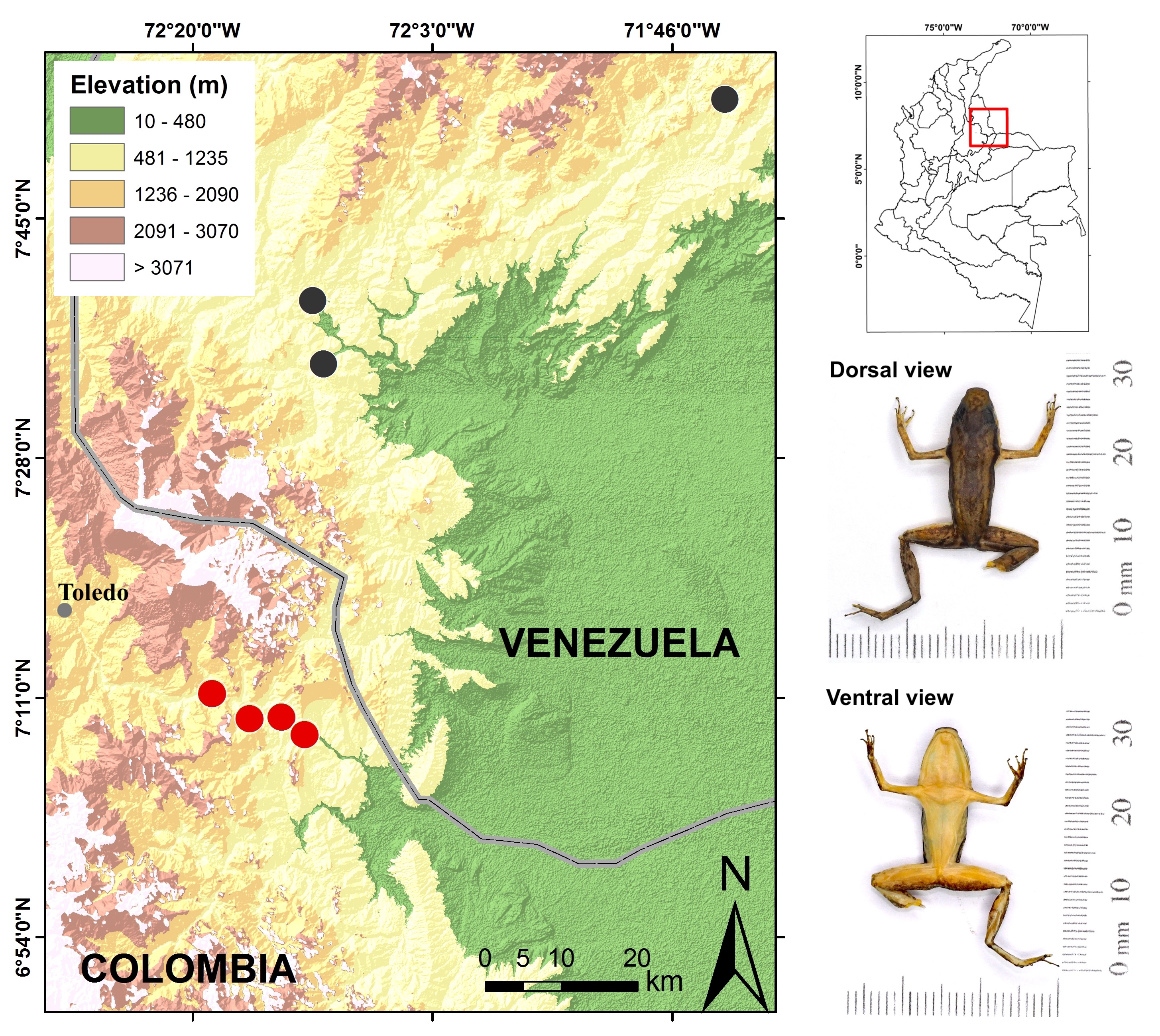
Our phylogenetic reconstruction (Figure 3) and the close genetic distance between the samples of Colombia and Venezuela (0.4 %), confirm the conspecificity of our samples with A. algorei and represents the first record of this species in Colombia, extending the species’ distribution by ca. 50 km SSW from the type locality (Río Negro, Córdoba municipality, Táchira state, Venezuela; Figure 1).
First record and conservation status of Allobates algorei (Anura: Aromobatidae) in Colombia
was previously known from three sites in Táchira state in Venezuela (400 – 1000 m a. s. l.; Barrio-Amorós & Santos, 2009), near the western border with Colombia. The presence of this species in the Cordillera Oriental in Colombia was previously suggested but unconfirmed (Barrio- Amorós & Santos, 2009). Here, we report Allobates algorei detected in four sites along an elevational gradient at Toledo municipality in the buffer zone of Parque Nacional Natural Tamá, Norte de Santander department, Colombia (Figure 1). The specific localities were: vereda San Antonio, Margua river at 646 m a. s. l. (7 ° 9 ’ 26,994 ” N, 72 ° 13 ’ 45,446 ” W); 724 m a. s. l. (7 ° 9 ’ 46,314 ” N, 72 ° 15 ’ 31,71 ” W), and 887 m a. s. l., (7 ° 8 ’ 38,692 ” N, 72 ° 11 ’ 59,183 ” W); and vereda Campo Hermoso, Talco river at 1185 m a. s. l. (7 ° 11 ’ 32,578 ” N, 72 ° 18 ’ 35,256 ” W).
First record and conservation status of Allobates algorei (Anura: Aromobatidae) in Colombia
We found twelve males, two females, and five metamorphs of A. algorei during fieldwork (May and June 2010) from 10: 00 to 14: 00 h. Four specimens (1 adult male, and 3 metamorphs) were collected and deposited in the Museo de Ciencias Naturales of the Universidad de Pamplona, Colombia (MCNUP-H 0521 – 0524). Individuals were detected on the floor of riparian Sub-Andean forest associated with large cattle grazing areas.
First record and conservation status of Allobates algorei (Anura: Aromobatidae) in Colombia

Export occurrence data

Darwin Core Archive (ZIP)

GEOGRAPHY

Distribution Map

Occurrence Map

Loading map…

Tiles © GBIF Maps API | Map powered by MapLibre GL

REGIONS

Geographic Distribution(2)

Global
near threatened
VE
nativeleast concern

DATA

Occurrence Datasets

Loading datasets…

Common names used for this species across different languages and regions. Available in 2 languages. 1 preferred.

engSpotted Nurse FrogengspaSapito Niñera MoteadospaspaSapito niera moteadospaengSpotted Nurse FrogengspaSapito Niñera Moteadospa

Vernacular (common) names are the everyday names used for a species in different languages and regions. A single species may have dozens of common names worldwide. This taxon has names in 2 languages. 1 name preferred.

spaSapito Niñera Moteado
spa
Source: Catalogue of LifeSource taxon #299414664
spaSapito niera moteado
spa
Source: Catalogue of LifeSource taxon #299414664
engSpotted Nurse Frog
eng
Source: Catalogue of LifeSource taxon #299414664
engSpotted Nurse Frog
engpreferred
Source: The IUCN Red List of Threatened SpeciesSource taxon #176682204
spaSapito Niñera Moteado
spa
Source: The IUCN Red List of Threatened SpeciesSource taxon #176682204

CLASSIFICATION

Taxonomic Classification Tree

HIERARCHY

Child Taxa(1)

MULTIMEDIA

Media Files(3)

FIGURE 1. Map of new (red dots) and old (black dots) records of A. algorei. Dorsal and ventral view of the Colombian specimen (MCNUP-H 0521).

Imageimage/png© Acevedo, Aldemar A.;Armesto, Orlando;Meza-Joya, Fabio LeonardoFirst record and conservation status of Allobates algorei (Anura: Aromobatidae) in Colombia

FIGURE 2. Illustration of the morphological characteristics of A. algorei (MCNUP-H 0521). (A) plantar view of the right foot and (B) lateral view of the head. Illustration: O. Armesto.

Imageimage/png© Acevedo, Aldemar A.;Armesto, Orlando;Meza-Joya, Fabio LeonardoFirst record and conservation status of Allobates algorei (Anura: Aromobatidae) in Colombia

FIGURE 3. Phylogenetic relationships for some Allobates species in North of South America. The numbers at the nodes indicate maximum likelihood ultrafast-bootstrap values.

Imageimage/png© Acevedo, Aldemar A.;Armesto, Orlando;Meza-Joya, Fabio LeonardoFirst record and conservation status of Allobates algorei (Anura: Aromobatidae) in Colombia

IMAGES

Gallery(3)

See Gallery

Occurrences with images

Source Information

GBIF Backbone Taxonomy

GBIF Backbone Taxonomy

checklist

The GBIF Backbone Taxonomy is a single, synthetic management classification with the goal of covering all names GBIF is dealing with. It's the taxonomic backbone that allows GBIF to integrate name based information from different resources, no matter if these are occurrence datasets, species pages, names from nomenclators or external sources like EOL, Genbank or IUCN. This backbone allows taxonomic search, browse and reporting operations across all those resources in a consistent way and to provide means to crosswalk names from one source to another.

It is updated regulary through an automated process in which the Catalogue of Life acts as a starting point also providing the complete higher classification above families. Additional scientific names only found in other authoritative nomenclatural and taxonomic datasets are then merged into the tree, thus extending the original catalogue and broadening the backbones name coverage. The GBIF Backbone taxonomy also includes identifiers for Operational Taxonomic Units (OTUs) drawn from the barcoding resources iBOL and UNITE.

International Barcode of Life project (iBOL), Barcode Index Numbers (BINs). BINs are connected to a taxon name and its classification by taking into account all names applied to the BIN and picking names with at least 80% consensus. If there is no consensus of name at the species level, the selection process is repeated moving up the major Linnaean ranks until consensus is achieved.

UNITE - Unified system for the DNA based fungal species, Species Hypotheses (SHs). SHs are connected to a taxon name and its classification based on the determination of the RefS (reference sequence) if present or the RepS (representative sequence). In the latter case, if there is no match in the UNITE taxonomy, the lowest rank with 100% consensus within the SH will be used.

The GBIF Backbone Taxonomy is available for download at https://hosted-datasets.gbif.org/datasets/backbone/ in different formats together with an archive of all previous versions.

The following 105 sources have been used to assemble the GBIF backbone with number of names given in brackets:

  • Catalogue of Life Checklist - 4766428 names
  • International Barcode of Life project (iBOL) Barcode Index Numbers (BINs) - 635951 names
  • UNITE - Unified system for the DNA based fungal species linked to the classification - 611208 names
  • The Paleobiology Database - 212054 names
  • World Register of Marine Species - 188857 names
  • The Interim Register of Marine and Nonmarine Genera - 183894 names
  • The World Checklist of Vascular Plants (WCVP) - 131891 names
  • GBIF Backbone Taxonomy - 114350 names
  • TAXREF - 109374 names
  • The Leipzig catalogue of vascular plants - 75380 names
  • ZooBank - 73549 names
  • Integrated Taxonomic Information System (ITIS) - 68377 names
  • Plazi.org taxonomic treatments database - 61346 names
  • Genome Taxonomy Database r207 - 60545 names
  • International Plant Names Index - 52329 names
  • Fauna Europaea - 45077 names
  • The National Checklist of Taiwan (Catalogue of Life in Taiwan, TaiCoL) - 36193 names
  • Dyntaxa. Svensk taxonomisk databas - 35892 names
  • The Plant List with literature - 32692 names
  • United Kingdom Species Inventory (UKSI) - 29643 names
  • Artsnavnebasen - 29208 names
  • The IUCN Red List of Threatened Species - 21221 names
  • Afromoths, online database of Afrotropical moth species (Lepidoptera) - 13961 names
  • Brazilian Flora 2020 project - Projeto Flora do Brasil 2020 - 13829 names
  • Prokaryotic Nomenclature Up-to-Date (PNU) - 10079 names
  • Checklist Dutch Species Register - Nederlands Soortenregister - 8814 names
  • ICTV Master Species List (MSL) - 7852 names
  • Cockroach Species File - 6020 names
  • GRIN Taxonomy - 5882 names
  • Taxon list of fungi and fungal-like organisms from Germany compiled by the DGfM - 4570 names
  • Catalogue of Afrotropical Bees - 3623 names
  • Catalogue of Tenebrionidae (Coleoptera) of North America - 3327 names
  • Checklist of Beetles (Coleoptera) of Canada and Alaska. Second Edition. - 3312 names
  • Systema Dipterorum - 2850 names
  • Catalogue of the Pterophoroidea of the World - 2807 names
  • The Clements Checklist - 2675 names
  • Taxon list of Hymenoptera from Germany compiled in the context of the GBOL project - 2496 names
  • IOC World Bird List, v13.2 - 2366 names
  • Official Lists and Indexes of Names in Zoology - 2310 names
  • National checklist of all species occurring in Denmark - 1922 names
  • Myriatrix - 1876 names
  • Database of Vascular Plants of Canada (VASCAN) - 1822 names
  • Taxon list of vascular plants from Bavaria, Germany compiled in the context of the BFL project - 1771 names
  • Orthoptera Species File - 1742 names
  • A list of the terrestrial fungi, flora and fauna of Madeira and Selvagens archipelagos - 1602 names
  • Aphid Species File - 1565 names
  • World Spider Catalog - 1561 names
  • Taxon list of Jurassic Pisces of the Tethys Palaeo-Environment compiled at the SNSB-JME - 1270 names
  • Backbone Family Classification Patch - 1143 names
  • GBIF Algae Classification - 1100 names
  • International Cichorieae Network (ICN): Cichorieae Portal - 975 names
  • Psocodea Species File - 803 names
  • New Zealand Marine Macroalgae Species Checklist - 787 names
  • Annotated checklist of endemic species from the Western Balkans - 754 names
  • Taxon list of animals with German names (worldwide) compiled at the SMNS - 503 names
  • Catalogue of the Alucitoidea of the World - 472 names
  • Lygaeoidea Species File - 462 names
  • Catálogo de Plantas y Líquenes de Colombia - 422 names
  • GBIF Backbone Patch - 317 names
  • Phasmida Species File - 259 names
  • Cortinariaceae fetched from the Index Fungorum API - 234 names
  • Coreoidea Species File - 233 names
  • GTDB supplement - 139 names
  • Mantodea Species File - 119 names
  • Endemic species in Taiwan - 93 names
  • Taxon list of Araneae from Germany compiled in the context of the GBOL project - 88 names
  • Species of Hominidae - 78 names
  • Taxon list of Sternorrhyncha from Germany compiled in the context of the GBOL project - 77 names
  • Taxon list of mosses from Germany compiled in the context of the GBOL project - 75 names
  • Mammal Species of the World - 73 names
  • Plecoptera Species File - 71 names
  • Species Fungorum Plus - 64 names
  • Catalogue of the type specimens of Cosmopterigidae (Lepidoptera: Gelechioidea) from research collections of the Zoological Institute, Russian Academy of Sciences - 47 names
  • Species named after famous people - 41 names
  • Dermaptera Species File - 36 names
  • Taxon list of Trichoptera from Germany compiled in the context of the GBOL project - 34 names
  • True Fruit Flies (Diptera, Tephritidae) of the Afrotropical Region - 33 names
  • Range and Regularities in the Distribution of Earthworms of the Earthworms of the USSR Fauna. Perel, 1979 - 32 names
  • Taxon list of Diplura from Germany compiled in the context of the GBOL project - 30 names
  • Lista de referencia de especies de aves de Colombia - 2022 - 24 names
  • Taxon list of Auchenorrhyncha from Germany compiled in the context of the GBOL project - 20 names
  • Catalogue of the type specimens of Polycestinae (Coleoptera: Buprestidae) from research collections of the Zoological Institute, Russian Academy of Sciences - 19 names
  • Taxon list of Thysanoptera from Germany compiled in the context of the GBOL project - 19 names
  • Lista de especies de vertebrados registrados en jurisdicción del Departamento del Huila - 18 names
  • Taxon list of Microcoryphia (Archaeognatha) from Germany compiled in the context of the GBOL project - 15 names
  • Catalogue of the type specimens of Bufonidae and Megophryidae (Amphibia: Anura) from research collections of the Zoological Institute, Russian Academy of Sciences - 12 names
  • Grylloblattodea Species File - 11 names
  • Coleorrhyncha Species File - 9 names
  • Taxon list of liverworts from Germany compiled in the context of the GBOL project - 9 names
  • Embioptera Species File - 7 names
  • Taxon list of Pisces and Cyclostoma from Germany compiled in the context of the GBOL project - 6 names
  • Taxon list of Pteridophyta from Germany compiled in the context of the GBOL project - 6 names
  • Taxon list of Siphonaptera from Germany compiled in the context of the GBOL project - 5 names
  • The Earthworms of the Fauna of Russia. Perel, 1997 - 5 names
  • Taxon list of Zygentoma from Germany compiled in the context of the GBOL project - 4 names
  • Asiloid Flies: new taxa of Diptera: Apioceridae, Asilidae, and Mydidae - 3 names
  • Taxon list of Protura from Germany compiled in the context of the GBOL project - 3 names
  • Taxon list of hornworts from Germany compiled in the context of the GBOL project - 2 names
  • Chrysididae Species File - 1 names
  • Taxon list of Dermaptera from Germany compiled in the context of the GBOL project - 1 names
  • Taxon list of Diplopoda from Germany in the context of the GBOL project - 1 names
  • Taxon list of Orthoptera (Grashoppers) from Germany compiled at the SNSB - 1 names
  • Taxon list of Pscoptera from Germany compiled in the context of the GBOL project - 1 names
  • Taxon list of Pseudoscorpiones from Germany compiled in the context of the GBOL project - 1 names
  • Taxon list of Raphidioptera from Germany compiled in the context of the GBOL project - 1 names

GBIF Secretariat (2023). GBIF Backbone Taxonomy. Checklist dataset https://doi.org/10.15468/39omei accessed via GBIF.org on 2026-06-14.

CC BYPublished 8/28/2023View dataset
GBIF Usage Key
10849606
Dataset Key
d7dddbf4-2cf0-4f39-9b2a-bb099caae36c
Origin
source
Backbone Key
10849606
Taxon ID
gbif:10849606
Last Crawled
8/22/2023
Last Interpreted
8/22/2023