

Charinus
Simon, 1892
GBIF:2181419
0
Descendants
0
Synonyms
0
Children
0
Species
PROFILE
Species Profile
Characteristics
ABOUT
Descriptions(27)
Identification key to Brazilian Charinus species (update from de Souza et al., 2024)
1. Lateral eyes developed (e.g. Fig. 4)....................................................................... 2
- Lateral eyes reduced (e.g. Fig.10A from Giupponi & Miranda, 2016)............................................ 7
2. Patella of the pedipalp with three dorsal spines.............................................................. 3
- Patella of the pedipalp with four or more dorsal spines....................................................... 23
3. Patella of the pedipalp with two ventral spines.............................................................. 4
- Patella of the pedipalp with three ventral spines............................................................. 5
4. Median eyes present................................................................................... 6
- Median eyes absent................................................................................... 18
5. Distitibia IV with 16 trichobothria; femur of the pedipalp with four or five dorsal and four or five ventral spines................................................................................................... C. diamantinus
- Distitibia IV with 18 trichobothria; femur of the pedipalp with three dorsal and three ventral spines............. C. acaraje
6. Basitibia of leg IV divided in two pseudo-articles................................................... C. brescoviti
- Basitibia of leg IV divided in four pseudo-articles........................................................... 17
7. Distitibia IV with 16 trichobothria (e.g. Fig.3A from Giupponi & Miranda, 2016).................................. 8
- Distitibia IV with 18 trichobothria (e.g. Fig.17).............................................................. 9
8. Claw on the cheliceral with four denticles................................................................. 10
- Claw on the cheliceral with five or more denticles.......................................................... 11
9. Median eyes present; eight setae on the anterior margin of the carapace; femur of the pedipalp with four or five dorsal and five ventral spines............................................................................... C. caatingae
- Median eyes absent; ten setae on the anterior margin of the carapace; femur of the pedipalp with three dorsal and three ventral spines..................................................................................... C. eleonorae
10. Median eyes present; three pseudo-articles of the basitibia IV......................................... C. orientalis
- Median eyes absent; two pseudo-articles of the basitibia IV............................................ C. bonaldoi
11. Basitibia of leg IV divided in two pseudo-articles........................................................... 12
- Basitibia of leg IV divided in three or four pseudo-articles.................................................... 13
12. Femur of the pedipalp with four ventral spines...................................................... C. ricardoi
- Femur of the pedipalp with three ventral spines................................................... C. monasticus
13. Basitibia IV with three pseudo-articles................................................................... 14
- Basitibia IV with four pseudo-articles.................................................................... 15
14. Tibia of leg I with 21 articles and tarsus I with 37 articles; median eyes absent; claw on the cheliceral with seven denticles; tritosternum reduced (Fig.10C from Giupponi & Miranda, 2016)......................................... C. ferreus
- Tibia of leg I with 23 articles and tarsus I with 42 articles; median eyes present; claw on the cheliceral with six denticles; tritosternum short (Fig.8C from Giupponi & Miranda, 2016)............................................ C. carajas
15. Median eyes present and reduced (e.g. Fig.2-3 from Vasconcelos & Ferreira, 2017)................................ 16
- Median eyes absent; patella of the pedipalp with three dorsal and two ventral spines; claw on the cheliceral with ten denticles.......................................................................................... C. troglobius
16. Median ocular tubercle present but reduced; median eyes reduced exhibiting dark pigmentation; pedipalp patella with six or seven dorsal spines and Pd-IV two-thirds length of Pd-III............................................... C. taboa
- Median ocular tubercle absent; median eyes reduced unpigmented; pedipalp patella with five or six dorsal spines and Pd-IV one-fifth length of Pd-III....................................................................... C. spelaeus
17. Femur of the pedipalp with four ventral spines; distitibia IV with 16 trichobothria; claw on the cheliceral with four or five denticles........................................................................................ C. una
- Femur of the pedipalp with five or more ventral spines; distitibia IV with 18 trichobothria; claw on the cheliceral with more than six denticles.................................................................................... 44
18. Bifid tooth with dorsal cusp larger than ventral cusp (1a>b).................................................. 19
- Bifid tooth with ventral cusp larger than dorsal cusp (1a 19. Sucker-like female gonopods (e.g. Fig.55A from Miranda et al., 2021).................................. C. carvalhoi - Cushion-like female gonopods (e.g. Fig.70A from Miranda et al., 2021)......................................... 20 20. Base of female gonopod sclerotized...................................................................... 21 - Base of female gonopod unsclerotized.................................................................... 22 21. Femur of the pedipalp with three dorsal and three ventral spines........................................ C. vulgaris - Femur of the pedipalp with four dorsal and four ventral spines........................................ C. perquerens 22. Pedipalp tarsus with two dorsal spines, small basal spine, one-quarter length of distal spine; basal trichobothria, bf, bc and sbf equidistant; Tibia of leg I with 21 articles............................................................. C. guto - Pedipalp tarsus with two dorsal spines, proximal spine one-third length of distal spine; distitibia trichobothrium bc situated closer to sbf than to bf; the number of articles in the tarsus can vary from 36 to 38........................ C. magalhaesi 23. Patella of the pedipalp with four dorsal spines.............................................................. 24 - Patella of the pedipalp with five or more dorsal spines....................................................... 27 24. Femur of the pedipalp with four dorsal and three or four ventral spines.......................................... 25 - Femur of the pedipalp with five dorsal and five ventral spines........................................... C. carioca 25. Cheliceral claw with eight denticles; femur of the pedipalp with three ventral spines; distitibia IV with 14 trichobothria.............................................................................................. C. alagoanus - Cheliceral claw with ten or eleven denticles; femur of the pedipalp with four ventral spines; distitibia IV with 18 trichobothria .................................................................................................. 26 26. Frontal process triangular, clearly visible in dorsal view; cheliceral claw with ten denticles............... C. tocantinensis - Frontal process subtriangular, not visible in dorsal view; cheliceral claw with eleven denticles............... C. imperialis 27. Pedipalp femur with three ventral spines.......................................................... C. montanus - Pedipalp femur with more than three ventral spines......................................................... 28 28. Patella of the pedipalp with five dorsal and three ventral spines................................................ 29 - Patella of the pedipalp with different number of dorsal and ventral spines........................................ 32 29. Patella of the pedipalp with five dorsal and three ventral spines; tritosternum projects anteriorly, tetra- and pentasternum display small platelets, each adorned with an arrow on both sides.............................................. C. schirchii - Patella of the pedipalp with five dorsal and three ventral spines; tritosternum projects anteriorly, tetra- and pentasternum forming single convex platelet (e.g. Fig.44B from Miranda et al., 2021)......................................... 30 30. Distitibia of leg IV with 16 trichobothria; tibia and tarsus of leg I can vary between 23 to 31 and 41 to 44 respectively............................................................................................... C. brasilianus - Distitibia of leg IV with 18 trichobothria; tibia and tarsus of leg I with 23 and 41 articles respectively................. 31 31. Cheliceral claw with eight denticles; pedipalp femur with four dorsal and four ventral spines.................. C. renneri - Cheliceral claw with ten or eleven denticles; pedipalp femur with three or four dorsal and four or five ventral spines... C. iuiu 32. Distitibia IV with 16 trichobothria....................................................................... 33 - Distitibia IV with 18 trichobothria....................................................................... 34 33. Cheliceral claw with seven denticles............................................................ C. sooretama - Cheliceral claw with nine denticles................................................................. C. souzai 34. Cheliceral claw with up to nine denticles.................................................................. 35 - Cheliceral claw with ten or more denticles................................................................ 39 35. Femur of the pedipalp with six ventral spines....................................................... C. mysticus - Femur of the pedipalp with four or five ventral spines....................................................... 36 36. Patella of the pedipalp with five dorsal spines; cheliceral claw with nine denticles................................. 37 - Patella of the pedipalp with six or seven dorsal spines; cheliceral claw with eight denticles.......................... 38 37. Patella of the pedipalp with four ventral spines..................................................... C. cearensis - Patella of the pedipalp with five ventral spines...................................................... C. euclidesi 38. Trichobothria positioned medially on the last pseudo-article of the basitibia of leg IV....................... C. asturius - Trichobothria positioned proximally on the last pseudo-article of the basitibia of leg IV................... C. santanensis 39. Carapace anterior margin with six setae (e.g. Fig. 4)......................................................... 40 - Carapace anterior margin with eight setae (Fig.47C from Miranda et al., 2021)............................. C. apiaca 40. Cheliceral claw with 10 to 12 denticles; patella of the pedipalp with up to five ventral spines........................ 41 - Cheliceral claw with 13 denticles; patella of the pedipalp with six ventral spines............................ C. carinae 41. Patella of the pedipalp with five dorsal spines....................................................... C. jibaossu - Patella of the pedipalp with six dorsal spines............................................................... 42 42. Femur of the pedipalp with four dorsal spines; cheliceral claw with 11 denticles............................... C. puri - Femur of the pedipalp with five or six dorsal spines; cheliceral claw with 10 denticles.............................. 43 43. Pedipalp coxa, rounded dorsal carina containing five setae; pedipalp patella with four or five ventral spines....... C. ruschii - Pedipalp coxa, rounded dorsal carina containing seven setae; pedipalp patella with three or four ventral spines.... C. goitaca 44. Femur of the pedipalp with five ventral spines; median eyes poorly developed, situated on a flattened tubercle (Fig. 2 from Vasconcelos et al., 2013)....................................................................... C. potiguar - Femur of the pedipalp with five or six ventral spines; The median eyes are prominent, positioned on a well-developed median ocular tubercle (Fig.5)................................................................. C. giganteus sp. nov.
Key to the Brazilian species of Charinus
The key presented in this study is an adapted version of the one created by Miranda et al. (2021), with certain modifications and the inclusion of additional characters.
1. Lateral eyes developed (e.g., fig. 2)....................................................................... 2
- Lateral eyes reduced (e.g., Vasconcelos & Ferreira 2016: fig. 3)................................................. 7
2. Patella of the pedipalp with three dorsal spines.............................................................. 3
- Patella of the pedipalp with four or more dorsal spines....................................................... 23
3. Patella of the pedipalp with two ventral spines.............................................................. 4
- Patella of the pedipalp with three ventral spines............................................................. 5
4. Median eyes present.................................................................................. 6
- Median eyes absent.................................................................................. 18
5. Femur of the pedipalp with four or five dorsal and four or five ventral spines (Miranda et al. 2021: fig. 57 E–F).................................................................................................. C. diamantinus
- Femur of the pedipalp with three dorsal and three ventral spines (Pinto-da-Rocha et al. 2002: fig. 9)............. C. acaraje
6. Basitibia of leg IV divided in two pseudo-articles................................................... C. brescoviti
- Basitibia of leg IV divided in four pseudo-articles........................................................... 17
7. Distitibia IV with sc and sf series each with five trichobothria.................................................. 8
- Distitibia IV with sc and sf series each with six trichobothria.................................................. 9
8. Claw on the cheliceral with four denticles (e.g., Giupponi & Miranda 2016: fig. 2F)............................... 10
- Claw on the cheliceral with five or more denticles.......................................................... 11
9. Median eyes present; eight setae on the anterior margin of the carapace (Vasconcelos & Ferreira 2016: fig. 3)...................................................................................................... C. caatingae
- Median eyes absent; ten setae on the anterior margin of the carapace (Baptista & Giupponi, 2003: figs. 1, 2)... C. eleonorae
10. Median eyes present (Giupponi & Miranda 2016: fig. 9A); three pseudo-articles of the basitibia IV.......... C. orientalis
- Median eyes absent (Giupponi & Miranda 2016: fig. 6A); two pseudo-articles of the basitibia IV............. C. bonaldoi
11. Basitibia of leg IV divided in two pseudo-articles.......................................................... 12
- Basitibia of leg IV divided in three or four pseudo-articles................................................... 13
12. Femur of the pedipalp with four ventral spines (Giupponi & Miranda 2016: fig 5E)......................... C. ricardoi
- Femur of the pedipalp with three ventral spines (Miranda et al. 2021: fig. 69F)......................... C. monasticus
13. Basitibia IV with three pseudo-articles................................................................... 14
- Basitibia IV with four pseudo-articles.................................................................... 15
14. Tibia of leg I with 21 articles and tarsus I with 37 articles; claw on the cheliceral with seven denticles (Giupponi & Miranda 2016: fig. 2G)................................................................................. C. ferreus
- Tibia of leg I with 23 articles and tarsus I with 42 articles; claw on the cheliceral with six denticles (Giupponi & Miranda 2016: fig. 2E)...................................................................................... C. carajas
15. Median eyes present and reduced....................................................................... 16
- Median eyes absent; patella of the pedipalp with three dorsal and two ventral spines; claw on the cheliceral with ten denticles (Baptista & Giupponi 2002: figs. 1, 6, 8)........................................................ C. troglobius
16. Median ocular tubercle present but reduced; median eyes reduced exhibiting dark pigmentation (Vasconcelos et al. 2016: figs. 1–3); pedipalp patella with six or seven dorsal spines and Pd-IV two-thirds length of Pd-III (Vasconcelos et al. 2016: fig. 6).............................................................................................. C. taboa
- Median ocular tubercle absent; median eyes reduced unpigmented (Vasconcelos & Ferreira 2017: figs. 1–3); pedipalp patella with five or six dorsal spines and Pd-IV one-fifth length of Pd-III (Vasconcelos & Ferreira 2017: fig. 11)........ C. spelaeus
17. Femur of the pedipalp with four ventral spines (Miranda et al. 2021: fig. 78F); claw on the cheliceral with four or five denticles........................................................................................ C. una
- Femur of the pedipalp with five ventral spines (Vasconcelos et al., 2013: fig. 3); claw on the cheliceral with nine to thirteen denticles (Vasconcelos et al., 2013: fig. 6)........................................................ C. potiguar
18. Bifid tooth with dorsal cusp larger than ventral cusp (1a>b) (e.g., fig. 7)......................................... 19
- Bifid tooth with ventral cusp larger than dorsal cusp (1a 19. Sucker-like female gonopods (e.g., Miranda et al. 2021: fig. 7E)....................................... C. carvalhoi - Cushion-like female gonopods (e.g., Miranda & Giupponi 2011: fig. 8)......................................... 20 20. Base of female gonopod sclerotized..................................................................... 21 - Base of female gonopod unsclerotized................................................................... 22 21. Femur of the pedipalp with three dorsal and three ventral spines (Miranda & Giupponi 2011: figs. 4–5)......... C. vulgaris - Femur of the pedipalp with four dorsal and four ventral spines (Miranda et al. 2021: fig. 32 E–F)........... C. perquerens 22. Pedipalp tarsus with two dorsal spines, proximal spine 1/2 length of distal spine (Giupponi & Miranda 2016: fig. 7D); tetrasternum and pentasternum rounded (Giupponi & Miranda 2016: fig. 7B); basal trichobothria, bf, bc and sbf equidistant (Giupponi & Miranda 2016: fig. 3D)................................................................. C. guto - Pedipalp tarsus with two dorsal spines, proximal spine 1/3 length of distal spine (Miranda et al. 2021: fig. 30E); tetrasternum and pentasternum flattened (Miranda et al. 2021: fig. 30B); distitibia trichobothrium bc situated closer to sbf than to bf (e.g., Pinto-da-Rocha et al. 2002: fig. 4)............................................................. C. magalhaesi 23. Patella of the pedipalp with four dorsal spines............................................................. 24 - Patella of the pedipalp with five or more dorsal spines....................................................... 27 24. Femur of the pedipalp with four dorsal and three or four ventral spines......................................... 25 - Femur of the pedipalp with five dorsal and five ventral spines (Miranda et al. 2021: fig. 52 E–F).............. C. carioca 25. Cheliceral claw with eight denticles (Miranda et al. 2021: fig. 10G); femur of the pedipalp with three ventral spines (Miranda et al. 2021: fig. 44F); distitibia IV with 14 trichobothria............................................ C. alagoanus - Cheliceral claw with ten or eleven denticles; femur of the pedipalp with four ventral spines; distitibia IV with 18 trichobothria .................................................................................................. 26 26. Frontal process triangular, clearly visible in dorsal view (fig. 8); cheliceral claw with ten denticles (fig. 7)............................................................................................... C. tocantinensis sp. nov. - Frontal process subtriangular, not visible in dorsal view (Miranda et al. 2021: fig. 66 A, C); cheliceral claw with eleven denticles.................................................................................. C. imperialis 27. Femur of the pedipalp with three ventral spines................................................... C. montanus - Femur of the pedipalp with more than three ventral spines................................................... 28 28. Patella of the pedipalp with five dorsal and three ventral spines............................................... 29 - Patella of the pedipalp with different number of dorsal and ventral spines........................................ 32 29. Femur of the pedipalp with five dorsal spines; tetra- and pentasternum display small platelets (e.g., Miranda et al. 2016: fig. 1B)........................................................................................ C. schirchii - Femur of the pedipalp with three or four dorsal spines (females of C. brasilianus may have five dorsal spines); tetra- and pentasternum forming single convex platelet (e.g., Miranda et al. 2021: fig. 44B).................................. 30 30. Distitibia IV with sc and sf series each with five trichobothria........................................ C. brasilianus - Distitibia IV with sc and sf series each with six trichobothria................................................. 31 31. Cheliceral claw with eight denticles (Miranda et al. 2021: fig. 10I); sucker-like gonopods sclerotized basally (Miranda et al. 2021: fig. 6A)................................................................................. C. renneri - Cheliceral claw with ten or eleven denticles (Vasconcelos & Ferreira 2016: fig. 15); sucker-like gonopods unsclerotized basally (Vasconcelos & Ferreira 2016: fig. 21)............................................................... C. iuiu 32. Distitibia IV with 16 trichobothria, sc and sf series each with five trichobothria................................... 33 - Distitibia IV with 18 trichobothria, sc and sf series each with six trichobothria.................................... 34 33. Cheliceral claw with seven denticles............................................................ C. sooretama - Cheliceral claw with nine denticles................................................................ C. souzai 34. Cheliceral claw with up to nine denticles................................................................. 35 - Cheliceral claw with ten or more denticles................................................................ 39 35. Femur of the pedipalp with six ventral spines (Giupponi & Kury, 2002: fig. 6)........................... C. mysticus - Femur of the pedipalp with four or five ventral spines....................................................... 36 36. Patella of the pedipalp with five dorsal spines; cheliceral claw with nine denticles................................. 37 - Patella of the pedipalp with six or seven dorsal spines; cheliceral claw with eight denticles.......................... 38 37. Patella of the pedipalp with four ventral spines (Miranda et al. 2021: fig. 54F)........................... C. cearensis - Patella of the pedipalp with five ventral spines (Miranda et al. 2021: fig. 62C)........................... C. euclidesi 38. Basitibia of leg IV with trichobothria on the last pseudo-article located medially (Pinto-da-Rocha et al. 2002: fig. 4)................................................................................................... C. asturius - Basitibia of leg IV with trichobothria on the last pseudo-article located proximally....................... C. santanensis 39. Carapace anterior margin with six setae (e.g., Vasconcelos & Ferreira 2017: fig. 3)................................ 40 - Carapace anterior margin with eight setae (Miranda et al. 2021: fig. 47C).................................. C. apiaca 40. Cheliceral claw with 10 to 12 denticles; patella of the pedipalp with up to five ventral spines........................ 41 - Cheliceral claw with 13 denticles; patella of the pedipalp with six ventral spines (Miranda et al. 2021: fig. 49F)... C. carinae 41. Patella of the pedipalp with five dorsal spines; marked secondary sexual dimorphism in the length of the pedipalps (pedipalps are larger in males than females) (Vasconcelos et al. 2014: figs. 5–8)................................... C. jibaossu - Patella of the pedipalp with five dorsal spines; no marked sexual dimorphism in pedipalp length...................... 42 42. Femur of the pedipalp with four dorsal spines (Miranda et al. 2021: fig. 71D); cheliceral claw with 11 denticles..... C. puri - Femur of the pedipalp with five or six dorsal spines; cheliceral claw with 10 denticles.............................. 43 43. Carapace dark ocher (Miranda et al. 2016: fig. 1A); pedipalp coxa, rounded dorsal carina containing five setae... C. ruschii - Carapace light ocher (Miranda et al. 2021: fig. 64A); pedipalp coxa, rounded dorsal carina containing seven setae..................................................................................................... C. goitaca
Key to the identification of the species of Charinus in eastern South America
1. Leg IV distitibia with four trichobothria in frontal and caudal series; leg IV basitibia with three pseudo-articles ............................................................................. C. alagoanus sp. nov. (Figs 44–46)
– Leg IV distitibia with five or six trichobothria frontal and caudal series; leg IV basitibia with two or four pseudo-articles ........................................................................................................................... 2
2. Leg IV distitibia with five trichobothria in frontal and caudal series ............................................... 3
– Leg IV distitibia with six trichobothria in frontal and caudal series .............................................. 12
3. Median eyes absent............................................................................................................................ 4
– Median eyes present .......................................................................................................................... 5
4. Tibia of leg I with 21 articles; leg I tarsus with 37 articles; leg IV basitibia with two pseudoarticles........................................................................................ C. monasticus sp. nov. (Figs 69–70)
– Tibia of leg I with 23 articles; leg I tarsus with 41 articles; leg IV basitibia with four pseudoarticles............................................................................... C. troglobious Baptista & Giupponi, 2002
5. Pedipalp femur with three dorsal spines; pedipalp patella with two ventral spines ............................ ............................................................................................................... C. una sp. nov. (Figs 78–79)
– Pedipalp femur with more than three dorsal spines; pedipalp patella with more than two ventral spines ................................................................................................................................................. 6
6. Median and lateral eyes reduced........................................................................................................ 7
– Median and lateral eyes unmodified.................................................................................................. 8
7. Median ocular tubercle present but reduced; reduced median eyes with dark pigmentation; pedipalp patella dorsal spine IV two-thirds length of dorsal spine III ............................................................... .............................................................................. C. taboa Vasconcelos, Giupponi & Ferreira, 2016
– Median ocular tubercle absent, reduced eyes situated directly on tegument; reduced median eyes unpigmented; pedipalp patella dorsal spine IV one-fifth length of dorsal spine III ............................ .......................................................................................... C. spelaeus Vasconcelos & Ferreira, 2017
8. Cheliceral basal segment with long (distinct) tooth adjacent to bifid tooth ........................................ ..................................................................................... C. sooretama sp. nov. (Figs 7E–F, 9C–D, 75)
– Cheliceral basal segment with short (indistinct) tooth adjacent to bifid tooth .................................. 9
9. Base of female gonopod unsclerotized ................... C. euclidesi sp. nov. (Figs 6C–D, 9A–B, 61–63)
– Base of female gonopod sclerotized................................................................................................ 10
10. Pedipalp tibia with two ventral spines ..................................... C. diamantinus sp. nov. (Figs 57–60)
– Pedipalp tibia with one ventral spine................................................................................................11
11. Curved carina present between ocular triads and lateral margin of carapace; cheliceral claw with nine teeth............................................................................................ C. souzai sp. nov. (Figs 76–77)
– Curved carina absent between ocular triads and lateral margin of carapace (Fig. 48A–B); cheliceral claw with six or seven teeth..................................... C. brasilianus Weygoldt, 1972 (Figs 8C–D, 48)
12. Leg I tarsus with 28 articles.................................................................. C. montanus Weygoldt, 1972
– Leg I tarsus with 41 articles............................................................................................................. 13
13. Carapace anterior margin with eight or ten setae ............................................................................ 14
– Carapace anterior margin with six setae.......................................................................................... 16
14. Carapace anterior margin with ten setae; median ocular tubercle absent; pedipalp patella with spine between ventral spine I and distal margin .......................... C. eleonorae Baptista & Giupponi, 2003
– Carapace anterior margin with eight setae; median ocular tubercle present; pedipalp patella with setiferous tubercles between ventral spine I and distal margin ....................................................... 15
15. Pedipalp tarsus with two dorsal spines (Fig. 47D) ...................... C. apiaca sp. nov. (Figs 5A–B, 47)
– Pedipalp tarsus with three dorsal spines ......................... C. caatingae Vasconcelos & Ferreira, 2016
16. Carapace anterior margin projected anteriorly ............ C. santanensis Vasconcelos & Ferreira, 2017
– Carapace anterior margin rounded................................................................................................... 17
17. Leg I tarsus, first article equal in length to subsequent three articles.................................................. ......................................................................... C. jibaossu Vasconcelos, Giupponi & Ferreira, 2014
– Leg I tarsus, first article equal in length to all subsequent articles ................................................. 18
18. Pedipalp tarsus with three dorsal spines .......................................................................................... 19
– Pedipalp tarsus with two dorsal spines ............................................................................................ 23
19. Cheliceral claw with four teeth.................................................. C. mysticus Giupponi & Kury, 2002
– Cheliceral claw with 9–13 teeth ...................................................................................................... 20
20. Pedipalp coxa, rounded dorsal carina containing seven setae ......................................................... 21
– Pedipalp coxa, rounded dorsal carina containing two or five setae................................................. 22
21. Pedipalp patella with six ventral spines (Fig. 49F); cheliceral claw with 13 teeth ............................. .................................................................................. C. carinae sp. nov. (Figs 3A–B, 4A–B, 49–51)
– Pedipalp patella with three or four ventral spines; cheliceral claw with ten teeth............................... .......................................................................................................... C. goitaca sp. nov. (Figs 64–65)
22. Pedipalp coxa, rounded dorsal carina containing five setae; pedipalp patella with six dorsal spines .................... C. ruschii Miranda, Milleri-Pinto, Gonçalves-Souza, Giupponi & Scharff, 2016
– Pedipalp coxa, rounded dorsal carina containing two setae; pedipalp patella with four dorsal spines ..................................................................................... C. carioca sp. nov. (Figs 6E–F, 52–53)
23. Pedipalp coxa, rounded dorsal carina containing no setae .............................................................. 24
– Pedipalp coxa, rounded dorsal carina containing setae ................................................................... 26
24. Pedipalp patella with three dorsal spines............................................................................................. .................................. C. acaraje Pinto-da-Rocha, Machado & Weygoldt, 2002 (Figs 7A–B, 8A–B)
– Pedipalp patella with five dorsal spines........................................................................................... 25
25. Pedipalp femur with four dorsal spines ..................... C. renneri sp. nov. (Figs 6A–B, 10I–J, 73–74)
– Pedipalp femur with five dorsal spines..... C. asturius Pinto-da-Rocha, Machado & Weygoldt, 2002
26. Pedipalp femur with five dorsal spines......................................... C. cearensis sp. nov. (Figs 54–56)
– Pedipalp femur with four dorsal spines ........................................................................................... 27
27. Pedipalp femur with five ventral spines........................................................................................... 28
– Pedipalp femur with four ventral spines.......................................................................................... 29
28. Pedipalp femur with secondary row of dorsal spines; pedipalp patella, distance from ventral spine I to distal margin half length of spine ...................................................... C. puri sp. nov. (Figs 71–72)
– Pedipalp femur without secondary row of dorsal spines; pedipalp patella, distance from ventral spine I to distal margin greater than length of spine ............... C. iuiu Vasconcelos & Ferreira, 2016
29. Cheliceral claw with up to 13 teeth; median and lateral eyes reduced................................................ ......................................................................... C. potiguar Vasconcelos, Giupponi & Ferreira, 2013
– Cheliceral claw with 11 teeth; median and lateral eyes unmodified.................................................... ..................................................................................................... C. imperialis sp. nov. (Figs 66–68)
Key to the Charinus species of the bengalensis group:
1. Basitiba IV divided into two pseudo-articles (Weygoldt et al. 2002: fig 12) ……………………2 – Basitiba IV divided into three pseudo-articles (Delle Cave et al. 2009: fig. 3) …………………3 – Basitiba IV divided into four pseudo-articles (Weygoldt 2006: fig. 30) …………………………4
2. Reduced lateral and median eyes, standard size legs, pedipalps held horizontally ………………………………………………………… C. socotranus Weygoldt, Pohl & Polak, 2002
– No median and lateral eyes, elongate legs, pedipalps turned upwards ………………………… ………………………………………………… C. stygochthobius Weygoldt & Van Damme, 2004
3. Female genitalia with curved, rigid finger-like appendage vestiges; genital operculum with pointed apex; eyes well developed ………………………………………… C. bengalensis (Gravely, 1911)
– Female genitalia with straight, soft finger-like appendage vestiges; genital operculum with curved apex; eyes well developed ……………………………… C. pakistanus Weygoldt, 2005
– Female genitalia with straight, soft finger-like appendage vestiges; genital operculum with straight apex; median eyes absent, vestiges of the lateral eyes ……………………… ……………………………………………… C. omanensis Delle Cave, Gardner & Weygoldt, 2009
4. Eyes well developed; female genital operculum with a steep ventral flexure at about two thirds of its length; tibia I with 23 and tarsus I with 41 articles ………… C. africanus Hansen, 1921
– Median eyes, tubercle and lateral eyes present and prominent (Fig. 4B), frontal border of carapace projected anteriorly (Fig. 4B), frontal process rhomboid (Fig. 4E), femur with five dorsal and ventral spines; tibia I with 21 and tarsus I with 37 articles …… C. ioanniticus (Kritscher, 1959)
– Median eyes extremely reduced and tubercle absent and lateral eyes extremely reduced (Fig. 4A), frontal border of carapace rounded (Fig. 4A), frontal process acute (Fig. 4C), femur with four dorsal and ventral spines; tibia I with 21 and tarsus I with 37 articles ……………… C israelensis sp. nov.
Key to the species groups of Charinus:
1. Female with thin, finger-like gonopods (Weygoldt 2005: figs 4, 8) …………………………………… …………………………………………………………… C. bengalensis species group (next key)
– Female with rounded, cushion-like gonopods (Weygoldt 2006: figs 1–10) …………………………… ……………………………………………………………………… C. australianus species group–
– Female with sucker-like gonopods (Vasconcelos et al. 2014: figs 17–18) …………………………… …………………………………………………………………… C. brasilianus species group
Charinus Simon, 1892
Type species.
Phrynus australianus L. Koch, 1867, by original designation.
Taxonomic remarks.
Weygoldt (2000a) defined Charinus based on the armature of the pedipalp: with three large dorsal spines on the tibia of which the first one is the largest and the others decrease proximally in length; spine 1 sometimes followed distally by one to three spinelets, pedipalp basitarsus with two spines of which the distal spine is largest. Charinus also differs from the closely related Sarax in lacking ventral sac covers (Rahmadi and Kojima 2010). The genus currently includes more than 70 species (Vasconcelos and Ferreira 2017) but is in need of revision (Weygoldt 2000a, b). Nonetheless, the new species aligns well with the current genus diagnosis and is placed here until such revision has been carried out.
Key to the species of the genus Charinus in the Dominican Republic
1. Tritosternum barely reaches the base of the pedipalp coxae, pedipalp femur ventrally with 3 spines, lateral eyes well developed.................................................................................................... 2
- Tritosternum surpasses the base of the pedipalp coxae, pedipalp femur ventrally with 2 spines, lateral eyes less developed................................................................................................. C. magua
2. Leg I with 33 tarsal articles, pedipalp patella dorsally with 3 spines.................................. C. dominicanus
- Leg I with 37 tarsal articles, pedipalp patella dorsally with 3–4 spines................................... C. bahoruco
Key to the Brazilian species of Charinus (adapted from Miranda & Giupponi (2011) and Giupponi & Miranda (2016))
List of the described Brazilian species of Charinus: C. brasilianus Weygoldt, 1972; C. montanus Weygoldt, 1972; C. asturius Pinto-da-Rocha, Machado & Weygoldt, 2002; C. acaraje Pinto-da-Rocha, Machado & Weygoldt, 2002; C. mysticus Giupponi & Kury, 2002; C. troglobius Baptista & Giupponi, 2002; C. eleonorae Baptista & Giupponi, 2003; C. vulgaris Miranda & Giupponi, 2011; C. potiguar Vasconcelos, Giupponi & Ferreira, 2013; C. jibaossu Vasconcelos, Giupponi & Ferreira, 2014; C. caatingae Vasconcelos & Ferreira, 2016; C. iuiu Vasconcelos & Ferreira, 2016; C. brescoviti Giupponi & Miranda, 2016; C. ricardoi Giupponi & Miranda, 2016; C. bonaldoi Giupponi & Miranda, 2016; C. guto Giupponi & Miranda, 2016; C. carajas Giupponi & Miranda, 2016; C. orientalis Giupponi & Miranda, 2016; C. ferreus Giupponi & Miranda, 2016; C. bichuetteae Giupponi & Miranda, 2016; C. taboa Vasconcelos, Giupponi & Ferreira, 2016; and C. ruschii Miranda et al. 2016. C. schirchii (Mello- Leitão, 1931) is presently a species inquirenda, so it is not considered in the identification key and distribution map (Fig. 31) (Pinto-da-Rocha et al. 2002).
1 Basitibia of leg IV divided in 2 or 3 pseudoarticles; cushion-like female gonopods..................................2
- Basitibia of leg IV divided in 4 pseudoarticles; sucker-like female gonopods.....................................10
2 Median eyes present...................................................................................3
- Median eyes absent................................................................................... 5
3 Basitibia of leg IV divided in 2 pseudoarticles..................................................... C. brescoviti
- Basitibia of leg IV divided in 3 pseudoarticles...............................................................4
4 Femur of the pedipalp with 4 dorsal spines; leg IV with trichobothrium bc closer to sbf than to bf............... C. carajas
- Femur of the pedipalp with 3 dorsal spines; leg IV with trichobothrium bc equidistant to sbf and bf.......... C. orientalis
5 Basitibia of leg IV divided in 2 pseudoarticles...............................................................6
- Basitibia of leg IV divided in 3 pseudoarticles.............................................................. 8
6. Leg IV with trichobothrium bc equidistant to sbf and bf............................................... C. ricardoi
- Leg IV with trichobothrium bc closer to sbf than to bf........................................................7
7 Lateral eyes developed; femur of the pedipalp with 2 dorsal and 2 ventral spines........................ C. bichuetteae
- Lateral eyes slightly reduced; femur of the pedipalp with 3 dorsal and 3 ventral spines...................... C. bonaldoi
8 Lateral eyes developed; distitibia of leg IV with 11 distal trichobothria....................................... C. guto
- Lateral eyes reduced; distitibia of leg IV with 13 distal trichobothria..............................................9
9 Femur of pedipalp with 3 ventral spines; cuticle thin................................................... C. ferreus
- Femur of pedipalp with 2 ventral spines; cuticle well-sclerotized....................................... C. vulgaris
10 Median eyes absent.......................................................................... C. troglobius
- Median eyes present................................................................................. 11
11 Tetrasternum and pentasternum wider than long............................................................12
- Tetrasternum and pentasternum rounded..................................................................13
12 Median eyes developed; distitibia of leg IV with 15 distal trichobothria.................................. C. montanus
- Median eyes reduced; distitibia of leg IV with 13 distal trichobothria................................ C. spelaeus sp. n.
13 Distitibia of leg IV with 13 distal trichobothria............................................................. 14
- Distitibia of leg IV with 15 distal trichobothria............................................................. 15
14 Lateral and median eyes developed with high tubercle.............................................. C. brasilianus
- Lateral and median eyes reduced with low tubercle.................................................... C. taboa
15 Median eyes tubercle indistinct................................................................. C. eleonorae
- Median eyes tubercle distinct...........................................................................16
16 Patella of the pedipalp with 2 ventral spines............................................................... 17
- Patella of the pedipalp with 3 or more ventral spines....................................................... 18
17 Lateral eyes with pigmentation................................................................... C. acaraje
- Lateral eyes without pigmentation............................................................... C. potiguar
18 Distitarsus of the pedipalp with 3 spines (at least in males)................................................... 19
- Distitarsus of the pedipalp with 2 spines.................................................................. 22
19 Lateral eyes reduced.......................................................................... C. caatingae
- Lateral eyes developed................................................................................ 20
20 Patella of the pedipalp with 3 ventral spines......................................................... C. jibaossu
- Patella of the pedipalp with 4 or more ventral spines....................................................... 21
21 Frontal process with acute apex................................................................... C. ruschii
- Frontal process with thickened apex............................................................... C. mysticus
22 Chelicera claw with 8 denticles; pedipalps densely setose................................................. C. iuiu
- Chelicera claw with 10 denticles; pedipalps moderately setose.................................................23
23 Trichobothrium positioned medially on the last pseudoarticle of basitibia IV............................. .. C. asturius
- Trichobothrium positioned proximally on the last pseudoarticle of basitibia IV..................... C. santanensis sp. n.
Taxon classification Animalia Amblypygi Charinidae
Charinus Simon, 1892
Type-species.
Phrynus australianus L. Koch, 1867, by original designation.
Charinus Simon, 1892
Identification key for the Charinus species from Northern South America (modified from Jocque and Giupponi, 2012)
1 Basitibia of the fourth leg divided into 4 articles (tibia with five) and carapace with or without median eye tubercle........ 2 - Basitibia divided into 3 articles.......................................................................... 4 - Basitibia divided into 2 articles (tibia with three)........................................................... 7 2 Female gonopods with small vestigial claws....................................................... C. koepckei - Female gonopods without small vestigial claws.............................................................. 3 3 3 and 5 spines on the upper side of the femur and tibia (respectively), 3 and 2 spines on the lower side of the femur and the tibia
(respectively). Animal occurs in the Galapagos Islands.............................................. C. insularis - 5 and 7 spines on the upper side of the femur and tibia (respectively), 5 and 4 spines on the lower side of the femur and the tibia
(respectively). Animal occurs in the Guianas...................................................... C. gertschi 4 Total body length maximum 6.0 mm...................................................................... 5 - Total body length exceeding 8.0 mm...................................................................... 6 5 Meso- and meta-sternum are flattened plates................................................... C. pardillalensis - Meso- and meta-sternum in the shape of a small granule............................................. C. camachoi 6 Pedipalpal femur with 2 dorsal and 2 ventral spines and distitibia of leg IV with 16 trichobothria.............. C. bordoni - Pedipalpal femur with 3 dorsal and 3 ventral spines and distitibia of leg IV with 15 trichobothria............ C. tronchoni - Pedipalpal femur with 3 dorsal and 2 ventral spines and distitibia of leg IV with 16 or 17 trichobothria........ C. vulgaris 7 Carapace without median eye tubercle............................................................ C. quinteroi - Carapace with a small median eye tubercle................................................................. 8 8 Color dark brown, distitibial spine of pedipalp about 1/4 the size of the medial spine basitibia, distitibia of leg IV with 2 + 16
trichobothria................................................................................ C. platnicki - Color light brown, distitibial spine of pedipalp about 2/3 the size of the medial spine, basitibia of leg IV with just 1 trichoboth-
ria.................................................................................................. 9 9 Pedipalp distitibia dorsally densely hairy; Pedipalp tibia with 4 spines in its dorsal side and a setiferous tubercle; First femoral spine on pedipalp just 1.3 times longer than the second one....................................... C. sillami sp. nov. - Pedipalp distitibia dorsally sparcely hairy; Pedipalp tibia dorsally with 5 spines; First femoral spine on pedipalp 2 times longer than the second one......................................................................... C. bromeliaea
Key to the Brazilian species of Charinus (modified version of that present by Miranda & Giupponi (2011))
1 Median eyes absent.................................................................................. 2
- Median eyes present................................................................................... 3
2 Female gonopods conical with an apical sucker-like prehensile structure; basitibia of leg IV with four pseudoarticles (Bahia: Carinhanha, Serra do Ramalho, Zé do Bastos Cave)................................................ C. troglobius
- Female gonopods rounded, cushion-like with an apical sharp edge partially covering the atrium of the seminal receptacle; basitibia of leg IV with three pseudoarticles (Rondônia: Porto Velho)..................................... C. vulgaris
3 Second and third sternal sclerites flattened and twice as wide as long (Espírito Santo: Domingos Martins)...... C. montanus
- Second and third sternal sclerites convex and rounded........................................................ 4
4 Distitibia of the leg IV with 16 trichobothria (Espírito Santo: Serra)................................... C. brasilianus
- Distitibia of the leg IV with 18 trichobothria................................................................ 5
5 Patella of the pedipalp with 2 ventral spines.................................................................6
- Patella of the pedipalp with 3 or more ventral spines.......................................................... 7
6 Lateral eyes triads with pigmentation (Bahia: Santa Luzia, Gruta Pedra do Sin Cave)....................... C. acaraje
- Lateral eyes triads without pigmentation (Rio Grande do Norte: Felipe Guerra, Buraco Redondo Cave).......... C. potiguar
7 Median eyes tubercle indistinct (Minas Gerais: Itacarambi, Olhos d’Água Cave).......................... C. eleonorae
- Median eyes tubercle distinct........................................................................... 8
8 Lateral eyes underdeveloped (Bahia: Várzea Nova: Fazenda Jurema Cave).......................... C. caatingae sp. n.
- Lateral eyes developed................................................................................ 9
9 Patella of the pedipalp with 3 ventral spines............................................................... 10
- Patella of the pedipalp with 4 or 5 ventral spines........................................................... 11
10 Femur of the pedipalp with 3 or 4 dorsal spines (Bahia: Iuiu: Lapa do Baixão Cave)....................... C. iuiu sp. n
- Femur of the pedipalp with 5 or 6 dorsal spines (Minas Gerais: Arcos: Gruta da Cazanga)..................... C. jibaossu
11 Tarsus of the pedipalp with 3 dorsal spines (Bahia: Gentio do Ouro, Encantados Cave)...................... C. mysticus
- Tarsus of the pedipalp with 2 dorsal spines (São Paulo: Ilha Bela)....................................... C. asturius
Key to the Brazilian species of Charinus:
1 Median eyes absent.................................................................................... 2
- Median eye present.................................................................................... 3
2 Conical gonopods with an apical sucker-like prehensile structure; basitibia IV with four psudoarticles; distitibia IV with 16 trichobotria (BA: Carinhanha, Serra do Ramalho caves)............................................. C. troglobius
- Rounded, cushion-like gonopods with an apical sharp edge partially covering the atrium of the seminal receptacle; basitibia IV with three pseudoarticles; distitibia IV with 16 or 17 trichobotria (RO: Porto Velho).................... C. vulgaris sp. n.
3 Second and third sternal sclerites flattened and double wide as long (ES: Serra).......................... C. montanus
- Second and third sternal sclerites convex and more or less rounded.............................................. 4
4 Median eyes tubercle indistinct (MG: Itacarambi, Olhos d’Água Cave).................................. C. eleonorae
- Median eyes tubercle distinct (ES: São Domingos)........................................................... 5
5 Distitibia of leg IV with 16 trichobothria........................................................ C. brasilianus
- Distitibia IV with 18 trichoboria.......................................................................... 6
6 Frontal process of carapace weak (BA: Santa Luzia, Pedra do Sino Cave)................................. C. acaraje
- Frontal process of carapace strong, large and triangular........................................................ 7
7 Median eye tubercle high (SP: Ilhabela)............................................................ C. asturius
- Median eye tubercle low (BA: Gentil do Ouro, Encantados Cave)....................................... C. mysticus New records for Brazilian Charinus . Two juvenile specimens of Charinus were found in two Brazilian States: Charinus sp. 1 from Tocantins (Porto Nacional, Luzimangue) and Charinus sp. 2 from Ceará (Gruta Ubajara) (Fig. 13). They could not be identified at species level, but we will try to capture adult individuals in future expeditions.
Export occurrence data
Darwin Core Archive (ZIP)
GEOGRAPHY
Distribution Map
REGIONS
Geographic Distribution(1)
DATA
Occurrence Datasets
CLASSIFICATION
Taxonomic Classification Tree

RELATED
Related Name Usages(20)
Matching names from other GBIF-indexed checklists and datasets.
MULTIMEDIA
Media Files(50)
FIGURES 1–3. 1. Karst in the north-central region of the São Francisco Craton (the Jacaré river is visible); 2. External environment of Brejões I cave; 3. Inner portion of cave.

FIGURES 4–7. Charinus giganteus sp. nov. 4. Carapace (ISLA 126451). 5. Frontal process, dorsofrontal view (ISLA 126453). 6. Sternum (ISLA 126451). 7. Habitus (ISLA 126461). Scale bars: 0.5 mm.

FIGURES 8–11. Charinus giganteus sp. nov. 8. Female gonopods in dorsal view (ISLA 126462). 9. Female gonopods in posterior view (ISLA 126462). 10. Male gonopods in dorsal view (ISLA 126452). 11. Male gonopods in retrolateral view (ISLA 126452). Scale bars: 0.2 mm.

FIGURES 17–18. Charinus giganteus sp. nov. (ISLA 126460) 17. Trichobothria on the left distitibia IV. 18. Distal part of tibia I and proximal part of tarsus I. Scale bars: 0.1 mm (Figs. 17, 18).
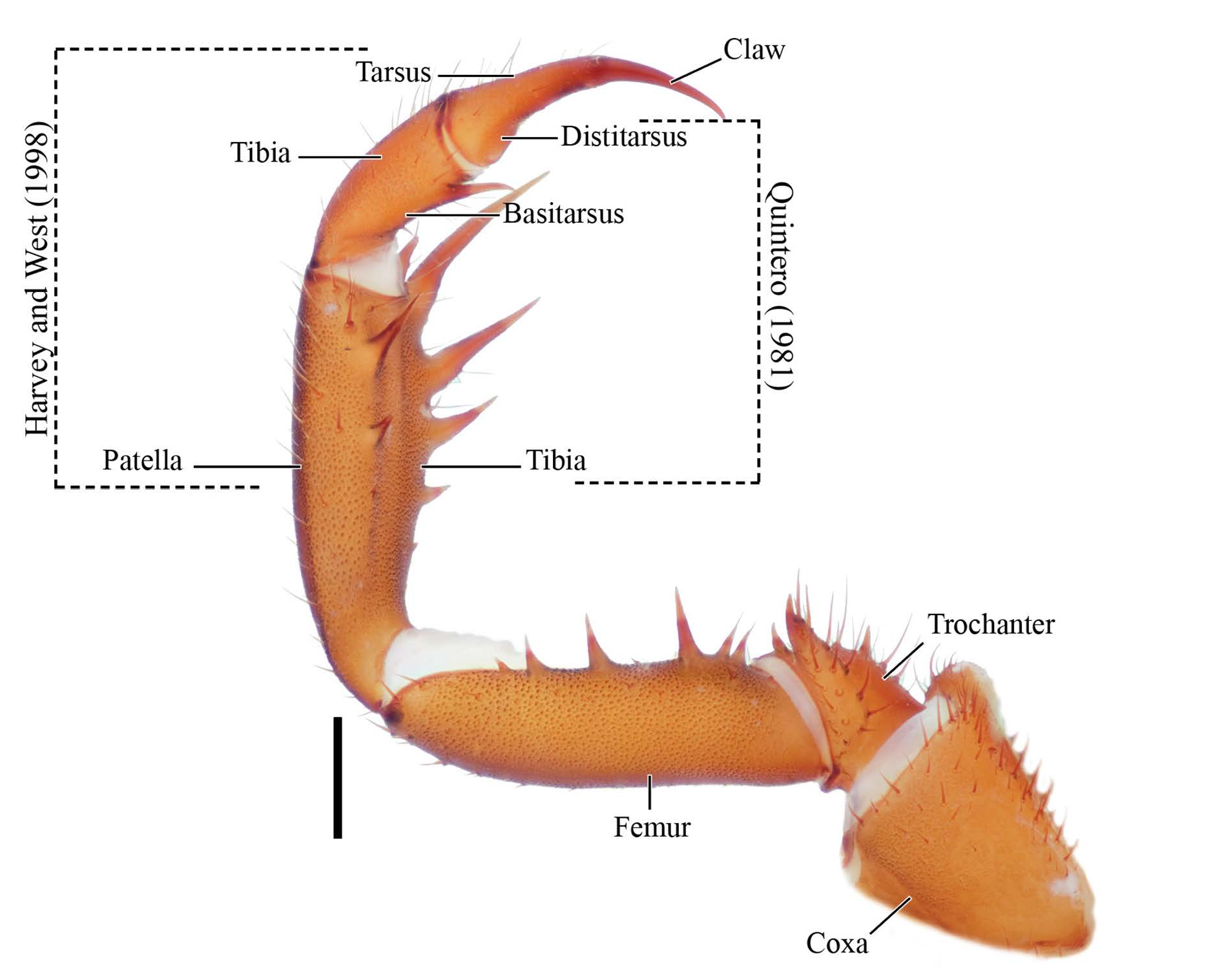
Fig. 2. Charinus insularis Banks, 1902 (RBINS), dextral pedipalp, ventral view, illustrating nomenclature for pedipalp segments. Scale bar: 1 mm.

Fig. 3. Charinidae Quintero, 1986, pedipalp femur, prolateral and dorsal views. A–B. Charinus carinae sp. nov. (MNRJ 9293). C–D. Charinus gertschi Goodnight & Goodnight, 1946 (AMCC [LP 10076]). E–F. Sarax bispinosus (Nair, 1934) (AMCC [LP 12298]). G–H. Sarax willeyi Gravely, 1915 (SMF). Scale bars: A–D, G–H = 1 mm; E–F = 0.5 mm.
IMAGES
Gallery(50)
Occurrences with images
CITATIONS
References(9)
Ann. Soc. Ent. France, 61
Brands, S. J. (compiler). (1989-2005). Systema Naturae 2000. Amsterdam, The Netherlands (2006 version). Originally available online at http://sn2000.taxonomy.nl/; for current information, refer http://taxonomicon.taxonomy.nl/ProjectDescription.aspx .
Hallan, J. (2000-2017). Biology Catalog (2012 version), http://bug.tamu.edu/research/collection/hallan/ (as at 2012).
Miranda, Gustavo Silva de, Alessandro P. L. Giupponi, Lorenzo Prendini, and Nikolaj Scharff, 2021: Systematic revision of the pantropical whip spider family Charinidae Quintero, 1986 (Arachnida, Amblypygi). European Journal of Taxonomy, vol. 772. 1-409.
Neave, S. A. and successors. (1939-2004). Nomenclator Zoologicus, vols. 1-10 online. [developed by uBio, hosted online at MBLWHOI Library]. Previously at http://ubio.org/NomenclatorZoologicus/ (URL no longer current).