AnimaliaNot EvaluatedacceptedspeciesAccepted
Charinus acaraje

Charinus acaraje

Pinto-da-Rocha, Machado & Weygoldt, 2002

GBIF:2181455

0countries
0year

PROFILE

Species Profile

Characteristics

VIDA_LIVRE_INDIVIDUAL

ABOUT

Descriptions(8)

Natural history Species with secondary sexual dimorphism, i. e., males exhibit longer pedipalps and larger body size.
Systematic revision of the pantropical whip spider family Charinidae Quintero, 1986 (Arachnida, Amblypygi)
Figs 7 A – B, 8 A – B, 43; Table 4
Systematic revision of the pantropical whip spider family Charinidae Quintero, 1986 (Arachnida, Amblypygi)
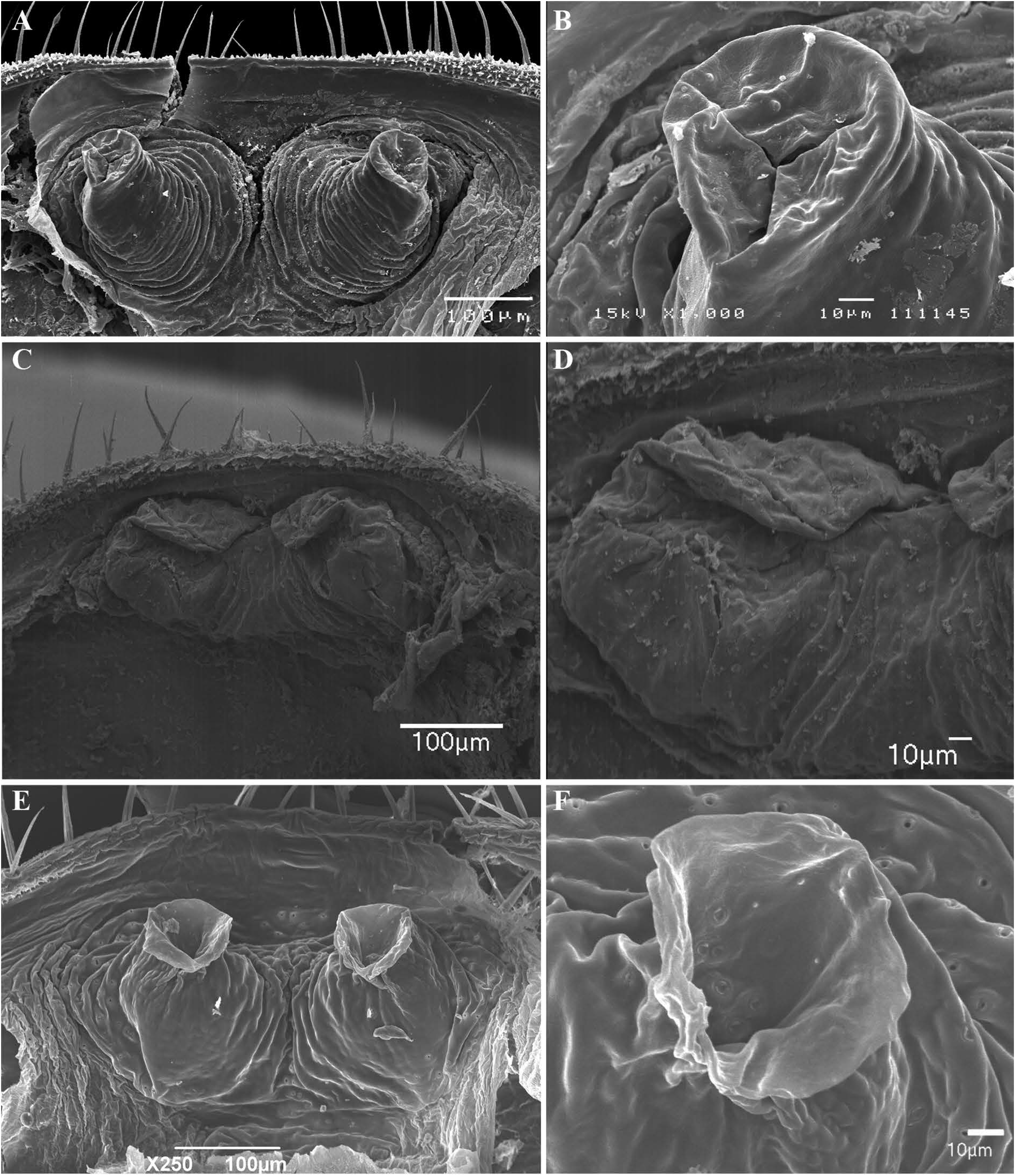
Supplementary description Only the male was previously known. A description of the female and supplementary description of the male are presented below. CARAPACE. Curved carina between ocular triads and carapace margin, closer to margin, with small transverse projection medially; anterior margin rounded, with six anterior setae; frontal process large, subtriangular, not visible in dorsal view. Median eyes and median ocular tubercle present; median ocular tubercle shallow, slightly higher than carapace surface, with pair of small setae. Lateral eyes well developed, pale, small seta posterior to each lateral ocular triad; lenses directed anteriorly and dorsally. STERNUM. Tritosternum rounded posteriorly and projected anteriorly into large, blunt tubercle, surpassing base of pedipalp coxae, with typical setation; medial platelet (tetrasternum) with single convex platelet, with pair of large setae anteriorly, and several small setae posteriorly; third platelet (pentasternum) with single convex platelet, smaller than medial platelet, with two setae anteriorly and some setae posteriorly; metasternum with one or two anterior setae in membranous region and two or three setae posteriorly. OPISTHOSOMA. Ventral sacs and ventral sac cover absent. GENITALIA. Female gonopod with posterior margin of genital operculum slightly convex, several setae on surface and along margin (Fig. 7 A – B); small sclerotized region at base of gonopods, not connected to each other; gonopods sucker-like with large disc and small openings (Fig. 7 A – B). Male gonopod with spine-like projections over apex of fistula, LoD, and LoL 2 (Fig. 8 A – B). CHELICERAE. Small, flat tooth in retrolateral row of basal segment. Prolateral surface with transverse row of six small setae, from ventral to dorsal. Three setae, retrolateral, retromedial, and prolateral along dorsodistal margin, near membranous region of claw. Claw with eight teeth and row of setae on retrolateral surface from base to near apex (dorsal side). PEDIPALPS. Coxal dorsal carina with one or two small setae encircled by round carina and three setae on anterior margin. Femur with three dorsal spines in primary series; two distinct setiferous tubercles proximal to first dorsal spine; three ventral spines; large spine between ventral spine 1 and proximal margin. Patella with three dorsal spines; setiferous tubercle distal to spine I, about one fourth length of spine I; three ventral spines decreasing in size; setiferous tubercle between spine I and distal margin. Tibia with two dorsal spines; ventral spine in distal half of tibia; prominent setiferous tubercle near base of ventral spine; three long setae between spine and distal margin. Tarsus with two dorsal spines, distal spine half length of tarsus and proximal spine one-third length of distal spine. Ventral row of brush with 32 – 34 setae. LEGS. Tibia of leg I with 23 articles; tarsus I with 41 articles. Leg IV basitibia with four pseudoarticles; trichobothrium bt situated in proximal third; distal apex of basitibial pseudo-articles with dark, denticulate projection; distitibia trichobothrium bc situated closer to sbf than to bf; sf and sc series each with six trichobothria; distitarsus with distinct white annulus distally on first article. Measurements See Table 4.
Systematic revision of the pantropical whip spider family Charinidae Quintero, 1986 (Arachnida, Amblypygi)
Diagnosis This species may be separated from other Charinus in eastern South America by means of the following combination of characters: two setae, prolateral and retrolateral, on dorsal surface of chelicerae; cheliceral claw with eight teeth and with complete row of setae on retrolateral surface; pedipalp femur with three dorsal spines and three ventral spines; leg IV distitibia sc and sf series each with six trichobothria. This species resembles C. una sp. nov., but differs in the larger size, six trichobothria in the sc and sf series, and eight teeth on the cheliceral claw.
Systematic revision of the pantropical whip spider family Charinidae Quintero, 1986 (Arachnida, Amblypygi)
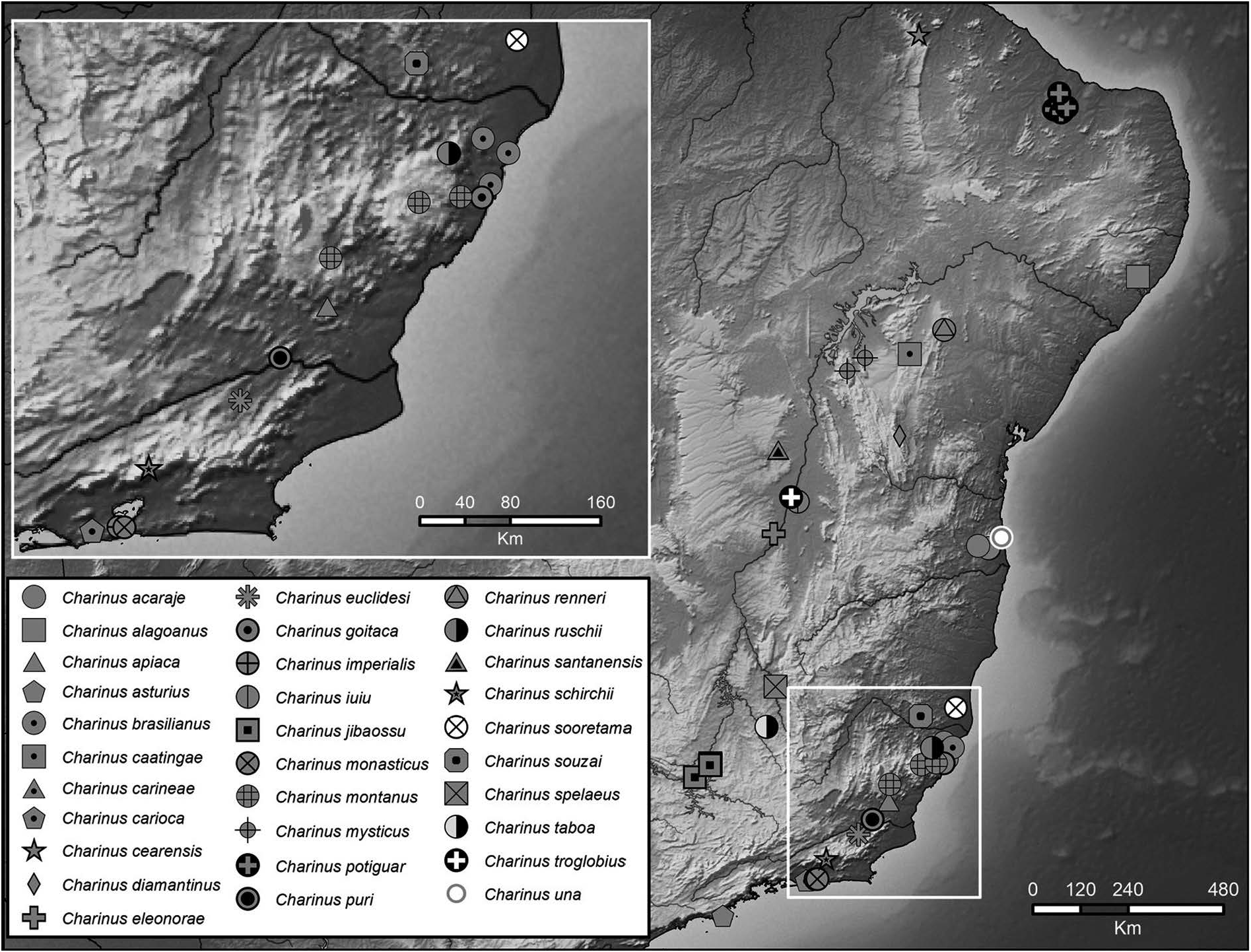
Distribution Known from inside and outside caves in southern Bahia, Brazil.
Systematic revision of the pantropical whip spider family Charinidae Quintero, 1986 (Arachnida, Amblypygi)
Etymology Noun in apposition referring to ‘ acarajé ’, a famous dish in Bahia, the state in which the type locality is located (Pinto-da-Rocha et al. 2002).
Systematic revision of the pantropical whip spider family Charinidae Quintero, 1986 (Arachnida, Amblypygi)
Type material Holotype BRAZIL • ♂; Bahia, Santa Luzia, Gruta da Pedra do Sino; 15 ° 26 ′ 15.22 ″ S, 39 ° 18 ′ 45.04 ″ W; 14 Oct. 1997; B. S. Santos leg.; MZSP 1829. Additional material BRAZIL • 4 ♀♀, 3 ♂♂, 2 nymphae; Bahia, Santa Luzia, Gruta do Lapão; 15 ° 25 ′ 44 ″ S, 39 ° 20 ′ 02 ″ W; 3 Nov. 2002; A. P. L. Giupponi and R. C. Baptista leg.; new record; MNRJ 9297 • 1 ♀; Bahia, Camacã, Reserva Particular do Patrimônio Natural da Serra Bonita; 15 ° 23 ′ 02.63 ″ S, 39 ° 33 ′ 46.68 ″ W; 11 – 15 Jun. 2009; V. Dill, A. Chagas Jr, D. Pedroso, A. P. L. Giupponi, A. Kury leg.; new record; MNRJ 9125.
Systematic revision of the pantropical whip spider family Charinidae Quintero, 1986 (Arachnida, Amblypygi)
Diagnosis. A cavernicolous species with elongate pedipalps and legs. It is distinguished from most other species by the fact that femoral spine F 1 is not situated close to the trochanter ± femur articulation; it is situated at about 26 % of the femur length away from the articulation. It is further distinguished from most other species by its inconspicuous and small frontal process and by its extreme elongation of the antenniform legs; individual tibial articles may be up to 1.3 mm long, and by the fact that there are only ® ve, instead of six, frontal setae. Description. Carapace 1.4 times wider than long, ® nely granulated, with the typical sculpture, anterior margin rounded, with ® ve strong frontal setae, one directly in front of the median eye tubercle and two on each side, and some smaller setae; frontal process (® gure 8) small, directed downwards and slightly posteriorly, not visible from above; median eye tubercle well developed though small and ¯ at, with one seta at its posterior margin, lateral eyes also small but with lenses and normal pigmentation; a strong seta at the posterior margin of each triad, three more similar setae in oblique row between anterior margin and lateral eyes. Chelicera: smooth, with the typical charinid dentition, all teeth strongly worn, upper or distal tooth with only a small notch between both cusps, internal surface proximally with a Sshaped row of seven ® ne setae and a few more setae that merge with the ventral fringe hairs. Pedipalp (® gure 9): trochanter with a dorsal row of seven (three large) setae, an anterior row of up to 10 (six large) setae and a strong spine in about the centre of the row, and another, larger spine directly above the ventral apophysis. Femur asymmetric, with four dorsal spines on the right and three dorsal spines on the left pedipalp; spine F 1 not directly distal of trochanter ± femur joint, instead about 26 % of the femur length away from that articulation, preceded on the right femur by a curved row of four small setae, on the left side by an irregular group of two large and two small setae; F 1 is the largest, spine length decreasing towards the distal end, femur ventral (on both sides) with ® ve spines, the three large spines FI ± FIII decrease in length distally, spine FI is preceded proximally by a smaller secondary spine, which, on the left palpus, reaches nearly the length of spine F 1, FIII is followed distally by a small spine FIV. Tibia dorsal with the three primary spines 1 ± 3, a spinelet distally of spine 1 and another small secondary spine 4 proximally of spine 3 (these latter spinelets are missing on the left pedipalp), distance between primary spines 1 ± 3 larger than basal spine diameters, tibia ventral with only two spines. Basitarsus with one ventral and two dorsal spines, Ta 2 about twice as long as Ta 1. Distitarsus with two small spines dorsally of cleaning organ, the distal one about 2.5 as large as the proximal one; pedipalp elongate, tibia 1.7 times longer than carapace. Antenniform legs: with 23 tibial articles, tarsus incomplete; elongate, individual tibial segments reach 1.3 mm, basal tarsal segments reach up to 0.8 mm. Walking legs elongate, basitibia IV divided into four articles. Trichobothria (® gure 10): each walking leg tibia carries 19 trichobothria. The seta bc is closer to sbf than to bf; the series sf and sc each with six setae. Sternum: tritosternum elongate and narrow, with two strong apical setae, three large and several smaller basal setae; tetrasternum and pentasternum small rounded tubercles with few setae; metasternum narrow, with only four setae. Male genitalia (® gures 11, 12): genital operculum with strong and long setae in the anterior and median part, posterior margin weakly rounded, nearly straight, with few setae; spermatophore organ slightly longer than wide, with little sclerotization around the bases of the posterior lobes and in the anterior-dorsa l region. Colour in alcohol. Carapace, chelicerae, pedipalps and legs light reddish brown, tergites and sternites even lighter, transparent. Etymology. A noun in reference to one of the most famous dishes of the bahian cooking, the`acarajeÂ’. Measurements (in mm). Total length 9.4, carapace length 3.75, width 5.25, distance between lateral eyes 2.5; pedipalp tibia length 6.25, spine 1 2.0, spine 2 1.7, spine 3 1.1; ® rst leg femur 16.8, tibia 27, tarsus broken; second leg femur 11.3, basitibia 6.4, distitibia 3.5, basitarsus 1.7, other tarsal articles 1.2; third leg femur 10.0, basitibia 8.3, distitibia 4.8, basitarsus 2.3, other tarsal articles 1.4; fourth leg femur 8.8, basitibia I 4.1, basitibia II 1.5, basitibia III 1.45, basitibia IV 2.1, distitibia 4.45, tarsus broken. Specimen examined. MZSP 18929 male holotype [Brasil, Gruta Pedra do Sino, Santa Luzia, BA, leg B. S. Santos at aphotic zone, 14 October 1997]. No other specimens known.
Two new species of Charinus Simon, 1892 from Brazil with biological notes (Arachnida; Amblypygi; Charinidae)

Export occurrence data

Darwin Core Archive (ZIP)

GEOGRAPHY

Distribution Map

Occurrence Map

Loading map…

Tiles © GBIF Maps API | Map powered by MapLibre GL

REGIONS

Geographic Distribution(4)

South America
South America
South America
BR
native

DATA

Occurrence Datasets

Loading datasets…

CLASSIFICATION

Taxonomic Classification Tree

MULTIMEDIA

Media Files(3)

Fig. 7. Charinus Simon, 1892, female gonopods, dorsal view (left column) and detail (right column). A–B. Charinus acaraje Pinto-da-Rocha, Machado & Weygoldt, 2002 (MNRJ 9297). C–D. Charinus palikur sp. nov. (AMCC [LP 3831]) E–F. Charinus sooretama sp. nov. (MNRJ 9245).

Imageimage/png© Miranda, Gustavo Silva de;Giupponi, Alessandro P. L.;Prendini, Lorenzo;Scharff, NikolajSystematic revision of the pantropical whip spider family Charinidae Quintero, 1986 (Arachnida, Amblypygi)

Fig. 8. Charinus Simon, 1892, male gonopods. A–B. Charinus acaraje Pinto-da-Rocha, Machado & Weygoldt, 2002 (MNRJ 9297), ventral view (A) and detail of dorsal lobe (LoD) and lateral lobe 1 (LoL1). C–D. Charinus brasilianus Weygoldt, 1972 (MNRJ 9226), posterior view (C) and detail of lateral lobes 1 and 2 (LoL1, 2), dorsal lobe (LoD) and lamina medialis (LaM) (D). E–H. Charinus carajas Giupponi & Miranda, 2016 (MZSP 29126), ventral view of gonopod (E), detail of sinistral side of gonopod (F), detail of LoL1 and LoD (G), and detail of LoL2 (H).

Imageimage/png© Miranda, Gustavo Silva de;Giupponi, Alessandro P. L.;Prendini, Lorenzo;Scharff, NikolajSystematic revision of the pantropical whip spider family Charinidae Quintero, 1986 (Arachnida, Amblypygi)

Fig. 43. Map plotting known distributions of species of Charinus Simon, 1892 in eastern South America, with inset for southeastern Brazil.

Imageimage/png© Miranda, Gustavo Silva de;Giupponi, Alessandro P. L.;Prendini, Lorenzo;Scharff, NikolajSystematic revision of the pantropical whip spider family Charinidae Quintero, 1986 (Arachnida, Amblypygi)

IMAGES

Gallery(3)

See Gallery

Occurrences with images

CITATIONS

References(2)

  • 1

    Miranda, Gustavo Silva de, Alessandro P. L. Giupponi, Lorenzo Prendini, and Nikolaj Scharff, 2021: Systematic revision of the pantropical whip spider family Charinidae Quintero, 1986 (Arachnida, Amblypygi). European Journal of Taxonomy, vol. 772. 1-409.

    Integrated Taxonomic Information System (ITIS)
  • 2

    Pinto-da-Rocha, Ricardo, Glauco Machado, and Peter Weygoldt, 2002: Two new species of Charinus Simon, 1892 from Brazil with biological notes (Arachnida; Amblypygi; Charinidae). Journal of Natural History, vol. 36, no. 1. 107-118.

    Integrated Taxonomic Information System (ITIS)
  • Source Information

    GBIF Backbone Taxonomy

    GBIF Backbone Taxonomy

    checklist

    The GBIF Backbone Taxonomy is a single, synthetic management classification with the goal of covering all names GBIF is dealing with. It's the taxonomic backbone that allows GBIF to integrate name based information from different resources, no matter if these are occurrence datasets, species pages, names from nomenclators or external sources like EOL, Genbank or IUCN. This backbone allows taxonomic search, browse and reporting operations across all those resources in a consistent way and to provide means to crosswalk names from one source to another.

    It is updated regulary through an automated process in which the Catalogue of Life acts as a starting point also providing the complete higher classification above families. Additional scientific names only found in other authoritative nomenclatural and taxonomic datasets are then merged into the tree, thus extending the original catalogue and broadening the backbones name coverage. The GBIF Backbone taxonomy also includes identifiers for Operational Taxonomic Units (OTUs) drawn from the barcoding resources iBOL and UNITE.

    International Barcode of Life project (iBOL), Barcode Index Numbers (BINs). BINs are connected to a taxon name and its classification by taking into account all names applied to the BIN and picking names with at least 80% consensus. If there is no consensus of name at the species level, the selection process is repeated moving up the major Linnaean ranks until consensus is achieved.

    UNITE - Unified system for the DNA based fungal species, Species Hypotheses (SHs). SHs are connected to a taxon name and its classification based on the determination of the RefS (reference sequence) if present or the RepS (representative sequence). In the latter case, if there is no match in the UNITE taxonomy, the lowest rank with 100% consensus within the SH will be used.

    The GBIF Backbone Taxonomy is available for download at https://hosted-datasets.gbif.org/datasets/backbone/ in different formats together with an archive of all previous versions.

    The following 105 sources have been used to assemble the GBIF backbone with number of names given in brackets:

    • Catalogue of Life Checklist - 4766428 names
    • International Barcode of Life project (iBOL) Barcode Index Numbers (BINs) - 635951 names
    • UNITE - Unified system for the DNA based fungal species linked to the classification - 611208 names
    • The Paleobiology Database - 212054 names
    • World Register of Marine Species - 188857 names
    • The Interim Register of Marine and Nonmarine Genera - 183894 names
    • The World Checklist of Vascular Plants (WCVP) - 131891 names
    • GBIF Backbone Taxonomy - 114350 names
    • TAXREF - 109374 names
    • The Leipzig catalogue of vascular plants - 75380 names
    • ZooBank - 73549 names
    • Integrated Taxonomic Information System (ITIS) - 68377 names
    • Plazi.org taxonomic treatments database - 61346 names
    • Genome Taxonomy Database r207 - 60545 names
    • International Plant Names Index - 52329 names
    • Fauna Europaea - 45077 names
    • The National Checklist of Taiwan (Catalogue of Life in Taiwan, TaiCoL) - 36193 names
    • Dyntaxa. Svensk taxonomisk databas - 35892 names
    • The Plant List with literature - 32692 names
    • United Kingdom Species Inventory (UKSI) - 29643 names
    • Artsnavnebasen - 29208 names
    • The IUCN Red List of Threatened Species - 21221 names
    • Afromoths, online database of Afrotropical moth species (Lepidoptera) - 13961 names
    • Brazilian Flora 2020 project - Projeto Flora do Brasil 2020 - 13829 names
    • Prokaryotic Nomenclature Up-to-Date (PNU) - 10079 names
    • Checklist Dutch Species Register - Nederlands Soortenregister - 8814 names
    • ICTV Master Species List (MSL) - 7852 names
    • Cockroach Species File - 6020 names
    • GRIN Taxonomy - 5882 names
    • Taxon list of fungi and fungal-like organisms from Germany compiled by the DGfM - 4570 names
    • Catalogue of Afrotropical Bees - 3623 names
    • Catalogue of Tenebrionidae (Coleoptera) of North America - 3327 names
    • Checklist of Beetles (Coleoptera) of Canada and Alaska. Second Edition. - 3312 names
    • Systema Dipterorum - 2850 names
    • Catalogue of the Pterophoroidea of the World - 2807 names
    • The Clements Checklist - 2675 names
    • Taxon list of Hymenoptera from Germany compiled in the context of the GBOL project - 2496 names
    • IOC World Bird List, v13.2 - 2366 names
    • Official Lists and Indexes of Names in Zoology - 2310 names
    • National checklist of all species occurring in Denmark - 1922 names
    • Myriatrix - 1876 names
    • Database of Vascular Plants of Canada (VASCAN) - 1822 names
    • Taxon list of vascular plants from Bavaria, Germany compiled in the context of the BFL project - 1771 names
    • Orthoptera Species File - 1742 names
    • A list of the terrestrial fungi, flora and fauna of Madeira and Selvagens archipelagos - 1602 names
    • Aphid Species File - 1565 names
    • World Spider Catalog - 1561 names
    • Taxon list of Jurassic Pisces of the Tethys Palaeo-Environment compiled at the SNSB-JME - 1270 names
    • Backbone Family Classification Patch - 1143 names
    • GBIF Algae Classification - 1100 names
    • International Cichorieae Network (ICN): Cichorieae Portal - 975 names
    • Psocodea Species File - 803 names
    • New Zealand Marine Macroalgae Species Checklist - 787 names
    • Annotated checklist of endemic species from the Western Balkans - 754 names
    • Taxon list of animals with German names (worldwide) compiled at the SMNS - 503 names
    • Catalogue of the Alucitoidea of the World - 472 names
    • Lygaeoidea Species File - 462 names
    • Catálogo de Plantas y Líquenes de Colombia - 422 names
    • GBIF Backbone Patch - 317 names
    • Phasmida Species File - 259 names
    • Cortinariaceae fetched from the Index Fungorum API - 234 names
    • Coreoidea Species File - 233 names
    • GTDB supplement - 139 names
    • Mantodea Species File - 119 names
    • Endemic species in Taiwan - 93 names
    • Taxon list of Araneae from Germany compiled in the context of the GBOL project - 88 names
    • Species of Hominidae - 78 names
    • Taxon list of Sternorrhyncha from Germany compiled in the context of the GBOL project - 77 names
    • Taxon list of mosses from Germany compiled in the context of the GBOL project - 75 names
    • Mammal Species of the World - 73 names
    • Plecoptera Species File - 71 names
    • Species Fungorum Plus - 64 names
    • Catalogue of the type specimens of Cosmopterigidae (Lepidoptera: Gelechioidea) from research collections of the Zoological Institute, Russian Academy of Sciences - 47 names
    • Species named after famous people - 41 names
    • Dermaptera Species File - 36 names
    • Taxon list of Trichoptera from Germany compiled in the context of the GBOL project - 34 names
    • True Fruit Flies (Diptera, Tephritidae) of the Afrotropical Region - 33 names
    • Range and Regularities in the Distribution of Earthworms of the Earthworms of the USSR Fauna. Perel, 1979 - 32 names
    • Taxon list of Diplura from Germany compiled in the context of the GBOL project - 30 names
    • Lista de referencia de especies de aves de Colombia - 2022 - 24 names
    • Taxon list of Auchenorrhyncha from Germany compiled in the context of the GBOL project - 20 names
    • Catalogue of the type specimens of Polycestinae (Coleoptera: Buprestidae) from research collections of the Zoological Institute, Russian Academy of Sciences - 19 names
    • Taxon list of Thysanoptera from Germany compiled in the context of the GBOL project - 19 names
    • Lista de especies de vertebrados registrados en jurisdicción del Departamento del Huila - 18 names
    • Taxon list of Microcoryphia (Archaeognatha) from Germany compiled in the context of the GBOL project - 15 names
    • Catalogue of the type specimens of Bufonidae and Megophryidae (Amphibia: Anura) from research collections of the Zoological Institute, Russian Academy of Sciences - 12 names
    • Grylloblattodea Species File - 11 names
    • Coleorrhyncha Species File - 9 names
    • Taxon list of liverworts from Germany compiled in the context of the GBOL project - 9 names
    • Embioptera Species File - 7 names
    • Taxon list of Pisces and Cyclostoma from Germany compiled in the context of the GBOL project - 6 names
    • Taxon list of Pteridophyta from Germany compiled in the context of the GBOL project - 6 names
    • Taxon list of Siphonaptera from Germany compiled in the context of the GBOL project - 5 names
    • The Earthworms of the Fauna of Russia. Perel, 1997 - 5 names
    • Taxon list of Zygentoma from Germany compiled in the context of the GBOL project - 4 names
    • Asiloid Flies: new taxa of Diptera: Apioceridae, Asilidae, and Mydidae - 3 names
    • Taxon list of Protura from Germany compiled in the context of the GBOL project - 3 names
    • Taxon list of hornworts from Germany compiled in the context of the GBOL project - 2 names
    • Chrysididae Species File - 1 names
    • Taxon list of Dermaptera from Germany compiled in the context of the GBOL project - 1 names
    • Taxon list of Diplopoda from Germany in the context of the GBOL project - 1 names
    • Taxon list of Orthoptera (Grashoppers) from Germany compiled at the SNSB - 1 names
    • Taxon list of Pscoptera from Germany compiled in the context of the GBOL project - 1 names
    • Taxon list of Pseudoscorpiones from Germany compiled in the context of the GBOL project - 1 names
    • Taxon list of Raphidioptera from Germany compiled in the context of the GBOL project - 1 names

    GBIF Secretariat (2023). GBIF Backbone Taxonomy. Checklist dataset https://doi.org/10.15468/39omei accessed via GBIF.org on 2026-06-14.

    CC BYPublished 8/28/2023View dataset
    GBIF Usage Key
    2181455
    Dataset Key
    d7dddbf4-2cf0-4f39-9b2a-bb099caae36c
    Origin
    source
    Backbone Key
    2181455
    Taxon ID
    gbif:2181455
    Last Crawled
    8/22/2023
    Last Interpreted
    8/22/2023