

Cupressopathes
Šepetėliniai koralai·Opresko, 2001
GBIF:2258461
© Amjad F, Ahusan M, Amir H, de Villiers N, Gress E, Mah C, Naeem S, Rico-Seijo N, Samaai T, Afzal M, Woodall L, Stefanoudis P
0
Descendants
0
Children
0
Species
PROFILE
Species Profile
Habitat
Characteristics
ABOUT
Descriptions(7)
Columnar, monopodial or very sparsely branched colonies, with a thick bottle-brush appearance (Fig. 124). Colony height ~ 84 cm. Same morphotype reported from the Seychelles (Fassbender et al. 2021).
Export occurrence data
Darwin Core Archive (ZIP)
Common names used for this species across different languages and regions.
Vernacular (common) names are the everyday names used for a species in different languages and regions. A single species may have dozens of common names worldwide.
CLASSIFICATION
Taxonomic Classification Tree

RELATED
Related Name Usages(18)
Matching names from other GBIF-indexed checklists and datasets.
MULTIMEDIA
Media Files(4)
https://arpha.pensoft.net//showfigure.php?filename=big_962904.jpg

https://arpha.pensoft.net//showfigure.php?filename=big_962905.jpg
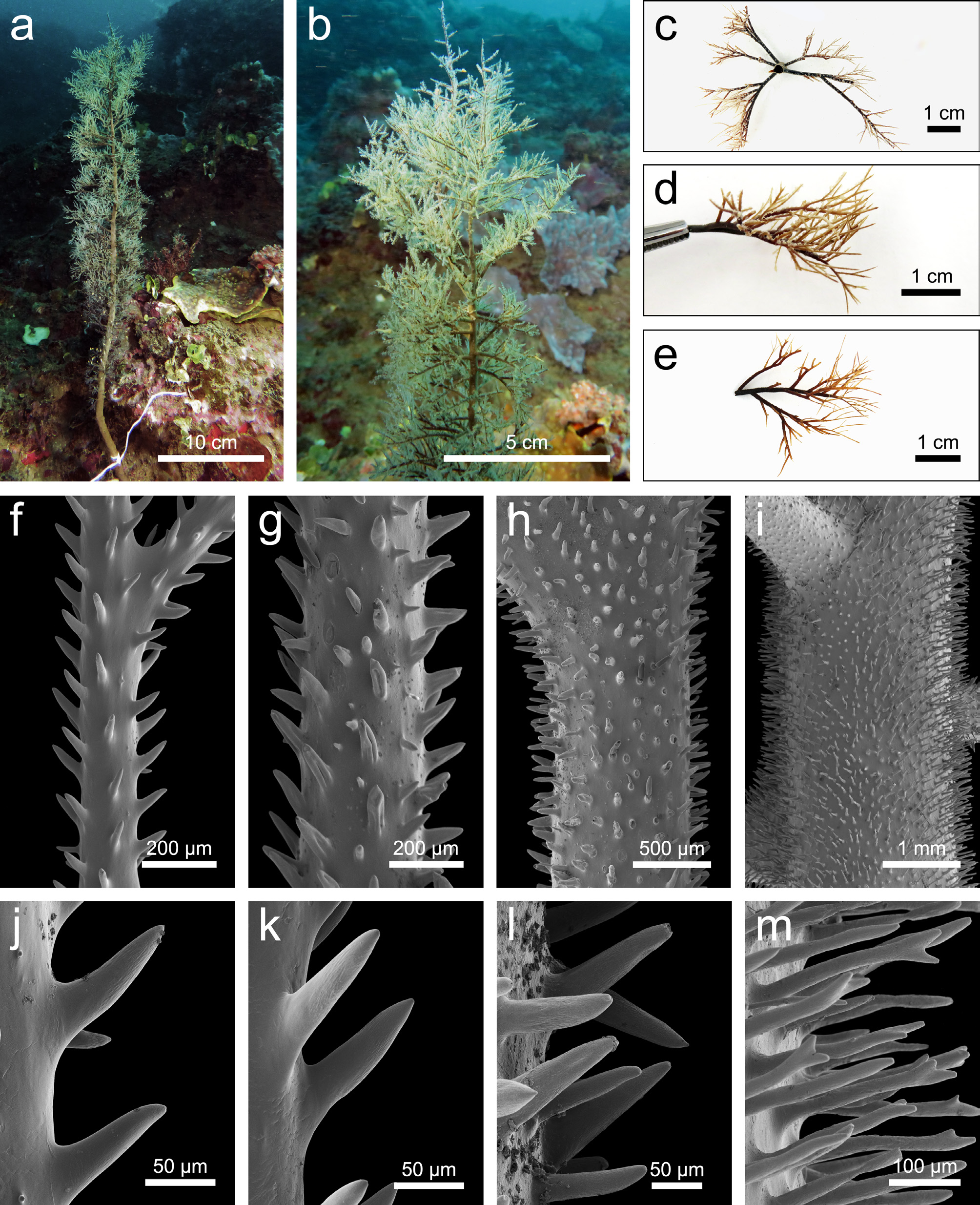
FIGURE 32. Cupressopathes sp. 2, INV.131340. (a) In situ picture of the entire colony showing the asymmetry in the cylindrical shape. (b) Close-up view of the distal part of the colony where a branch is growing. (c) Cross section showing the irregular arrangement of the primary pinnules. (d) Lateral view of the pinnulation on a primary pinnule. (e) Top view of the pinnulation of a primary pinnule. (f) Section of subpinnule 0.15 mm in diameter, polypar side is on the right. (g) Section of secondary pinnule 0.34 mm in diameter, polypar side is on the right. (h) Section of primary pinnule 0.85 mm in diameter. (i) Section of branch 2.2 mm in diameter. (j) Polypar spine of subpinnule. (k) Abpolypar spine of subpinnule. (l) Polypar spine of primary pinnule. (m) Needle-like and bifid spines of a branch.

FIGURE 31. Cupressopathes sp. 1, INV.131365. (a) In situ picture of the whole colony. (b) Detailed view of the pinnulation on a distal branch. (c) Cross section of a pinnulated branch showing the arrangement in irregular rows. (d) Lateral view of the scarce subpinnulation of a primary pinnule. (e) Section of subpinnule 0.1 mm in diameter, polypar side is on the right. (f) Section of primary pinnule 0.22 mm in diameter, polypar side is on the right. (g) Section of distal branch 0.27 mm in diameter. (h) Section of branch 1.10 mm in diameter. (i) Abpolypar spine of a subpinnule. (j) Polypar spine of subpinnule. (k) Tall, acicular needle-like spines occurring on thick branches. (l) Bifid spines occurring on a branch.
IMAGES
Gallery(4)
Occurrences with images
CITATIONS
References(12)
CoL 2006
Hallan, J. (2000-2017). Biology Catalog (2012 version), http://bug.tamu.edu/research/collection/hallan/ (as at 2012).
Neave, S. A. and successors. (1939-2004). Nomenclator Zoologicus, vols. 1-10 online. [developed by uBio, hosted online at MBLWHOI Library]. Previously at http://ubio.org/NomenclatorZoologicus/ (URL no longer current).
Neave, S. A. and successors. (1939-2004). Nomenclator Zoologicus, vols. 1-10 online. [developed by uBio, hosted online at MBLWHOI Library]. Previously at http://ubio.org/NomenclatorZoologicus/ (URL no longer current).
Opresko, D.M. 2001. Revision of the Antipatharia (Cnidaria: Anthozoa). Part I. Establishment of a new family, Myriopathidae. Zool. Med. Leiden 75 (17): 343-370