
AnimaliaNot EvaluatedacceptedspeciesAccepted
Blackfordia virginica

Blackfordia virginica

Franjerokje(+16)·Mayer, 1910

GBIF:2268682

0countries
0datasets
0year

0

Descendants

0

Synonyms

0

Children

PROFILE

Species Profile

ABOUT

Descriptions(12)

Black Sea
DAISIE - Inventory of alien invasive species in Europe
Brackish habitats (AA level 1)
DAISIE - Inventory of alien invasive species in Europe
Caspian Sea
DAISIE - Inventory of alien invasive species in Europe
Northern America
DAISIE - Inventory of alien invasive species in Europe
Western Atlantic Ocean
DAISIE - Inventory of alien invasive species in Europe
Zoobenthos
DAISIE - Inventory of alien invasive species in Europe
Distribution in South America: medusa — Atlantic Ocean, Brazil to Argentina, from 7.68 ° S to 8.24 ° S, from 25 ° S to 26.50 ° S, and at the Río de la Plata Estuary (Paranaguá 1963; Migotto et al. 2002; Genzano et al. 2006, 2008 a; Nogueira Jr. & Oliveira, 2006; Bardi & Marques 2009; Silveira & Morandini 2011; Nogueira Jr. 2012; Freire et al. 2014; Nogueira Jr. et al. 2015 a). Habitat: medusa — species considered a bioinvader (Genzano et al. 2006; Freire et al. 2014), commonly reported “ within estuarine areas of temperate and tropical regions ” (Bardi & Marques 2009: 47).
Census of Cnidaria (Medusozoa) and Ctenophora from South American marine waters
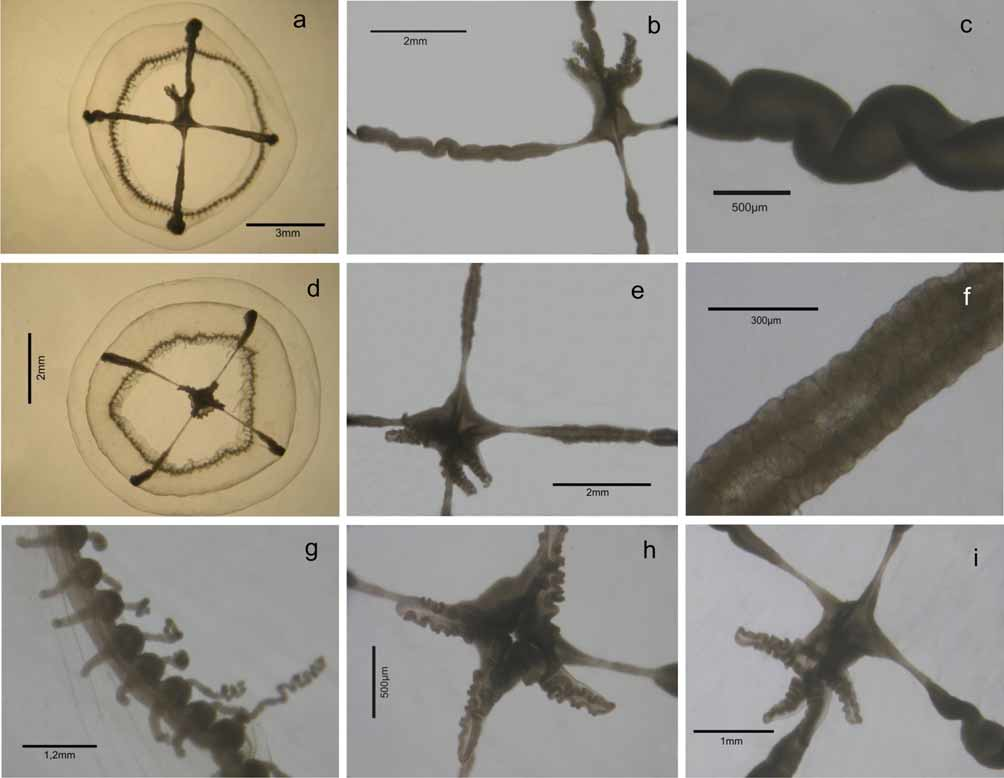
Description. Medusa — Umbrella hemispherical, diameter 4.1 – 14 mm, height 2.7 – 7.3 mm, with rounded apex. Mesoglea thick at apex, mesoglea height 0.8 – 2.8 mm, becoming thinner at umbrellar margin. Height of subumbrellar cavity almost half of umbrellar height. Velum thin, maximum opening 3 / 4 of diameter of umbrellar margin. Umbrellar margin with 50 – 142 filiform tentacles, each tentacular base with rounded bulb and finger-shaped projection towards mesoglea. One marginal vesicular statocyst between adjacent tentacles. Manubrium quadratic in cross section, length 0.4 – 1.4 mm. Mouth with four perradial, elongated, curved and crenulated lips. Four radial canals, one circular canal. Gonads beginning close to manubrium and extending ca. 2 / 3 of length of radial canals. Mature female gonads linear and granulated, with visible eggs. Proximal part (close to manubrium) of male gonads linear, medium and distal part sinuous and homogeneous. Polyp — description of polyp stages can be found in Naumov (1969).
The invasive hydromedusae Blackfordia virginica Mayer, 1910 (Cnidaria: Blackfordiidae) in southern Brazil, with comments on taxonomy and distribution of the genus Blackfordia
The occurrence and distribution of B. virginica also seem to be associated with episodes of abundance peaks (see Table 3). Monitoring of the four estuaries in southern Brazil where the species was found has been underway since 2007, and only three episodic events of abundance peaks occurred, always during summer. After these episodes, abundances decline drastically but, at least in São Francisco do Sul harbor (Babitonga Bay), the population seems to be well established (we collected males, females, and juveniles during summer and winter). The same pattern was observed in the Paranaguá Bay, a port region in which B. virginica also seems to be well established (Nogueira Jr. & Oliveira 2006). The presence of a small number of B. virginica in the Cananéia-Iguape estuarine complex and in Guaratuba Bay may indicate recent dispersal from adjacent regions. Indeed, in southern South America, B. virginica was recorded in the La Plata estuary in a plankton study based on a long series of samples from 1983 to 2000 (Genzano et al. 2006). The species was first recorded in February 2000 in large numbers (more than 5.000 specimens, almost 30 ind / m 3). Additional taxonomic study of this invasive medusa species is warranted, as well as investigations to improve understanding of its population dynamics and ecophysiological tolerances.
The invasive hydromedusae Blackfordia virginica Mayer, 1910 (Cnidaria: Blackfordiidae) in southern Brazil, with comments on taxonomy and distribution of the genus Blackfordia
Remarks. According to the original description in Mayer (1910: 278), Blackfordia virginica is distinguished from B. manhattensis “ by the dense-black entodermal pigment-granules adjacent to the lithocysts ”. However, some specimens nominally considered to be B. virginica may not have pigments in the vesicles of the medusae (cf. Kramp, 1958: 343; 1961: 181; 1968: 85 for materials from the Ganges estuary, India; Norfolk Harbour, USA; Black Sea, Bulgaria). Moore (1987: 290) observed that only some of the specimens of B. virginica from the Mira estuary in Portugal had black pigment in these vesicles, which suggests that this feature could be polymorphic and unreliable as a taxonomic character. The 284 medusae that we studied did not have black pigment in their vesicles. Variation of the character may be related to its ontogeny, because in smaller medusae there is “ … no black pigment in the entoderm of the bell-rim. This black pigment begins to develop when the medusa has 16 tentacles and the bell is hemispherical and 1.7 mm in diameter ” (Mayer 1910: 277). We conclude that either (a) this character is polymorphic (although not present in Brazilian populations) and therefore the two nominal species are conspecific, or (b) many records attributed to B. virginica actually represent B. manhattensis. Other characters used to separate the species, including number of statocysts and gonadal morphology, are also polymorphic or variable (Table 2) and of no taxonomic significance. The number of statocysts between adjacent tentacles may range from 1 to 3 (B. virginica, after Mayer 1910; Moore 1987; one in our specimens), 2 to 3 (B. manhattensis), and only 1 (B. polytentaculata). Another incorrect generalization used to separate species of Blackfordia is gonad shape and its relation to the sex of the specimen. Mayer (1910: 277) described the morphology of the gonads of B. virginica as “ linear, extending from radial corners of stomach over somewhat more than half the length of the radial-canals ” and differentiated the sexes by noting that “ the eggs of the female protrude from the surface of the ectoderm and are cast off one by one ” (see also Mayer 1910, pl. 36, figs. 3 – 5, pl. 37 fig. 6). We believe that Mayer was not precise in interpreting the different gonadal morphologies between the sexes. Female specimens of B. virginica from Brazil have linear and granulated gonads, while male specimens have only the proximal portion of the gonad linear, and the medial and distal portion sinuous. In this respect, it is possible that Mayer’s (1910) description is representative of fertile (Mayer’s illustration at pl. 36, fig. 5) and infertile (Mayer’s illustration at pl. 36, fig. 3) female gonads. Still concerning gonadal morphology, Mayer (1910: 27, pl. 36, fig. 2) noted that the gonads of B. manhattensis were “ found in the middle parts of the radial-canals and are irregularly flexed, sinusoidally, from one side to the other of the canal ”, again not differentiating the sex of the specimens. We conclude that this morphology likely corresponds to the male gonads of B. virginica. The gonads of the third species of the genus, B. polytentaculata, are described as long and linear, similar to the female gonads of B. virginica, but again there is no information on the sexes of the specimens described. In addition to the morphological similarity between B. manhattensis and B. virginica, their geographic distributions also suggest the need for taxonomic caution (Figure 3). The two species have geographically proximate distributions on the northeastern coast of the USA (type localities of the species are in the state of New Jersey for B. manhattensis and the state of Virginia for B. virginica). Although the two species inhabit the same biogeographic area, records of B. manhattensis are mainly restricted to its type locality. There are only two studies reporting B. manhattensis from China, although they include no description, illustrations, or designations of voucher specimens (Zhang 1979; Yanyu et al. 1991). Blackfordia virginica by contrast is widely distributed and considered an invasive species. 1961), Moore (1987), and this study. * — refers to the original description. The validity of both Blackfordia manhattensis and B. virginica has been questioned by some authors (e. g., Kramp 1959, 1961; Calder 1971; Moore 1987). Recent studies including both of the names relied on Mayer’s (1910) account for records of B. manhattensis (e. g., Bouillon et al. 1988; Bouillon & Boero 2000). Taxonomic uncertainty about whether the two are conspecific raises nomenclatural issues. Notably, B. manhattensis is the type species of Blackfordia (Mayer 1910: 277), yet the name is far less well-known than B. virginica. Moore (1987: 290) assumed the synonymy of both species, and acting as First Reviser assigned precedence to the more widely known name B. virginica. The type species of the genus remains B. manhattensis (a junior subjective synonym of B. virginica). Another taxonomic issue needing attention is that no type material apparently exists for either species. Abiotic factors and the distribution of Blackfordia virginica. While Blackfordia virginica has been reported over a wide geographic area, it is mainly restricted to scattered records within estuarine areas of temperate and tropical regions (Figure 3). Indeed, in spite of extensive plankton surveys in neritic waters of southern Brazil, the species was never recorded there (Tronolone 2008; in a review of the distribution of Brazilian Medusozoa see Migotto et al. 2002 and Marques et al. 2003). We found the species only in estuaries and especially those with ports. The species has never been recorded in much-surveyed São Sebastião harbor (cf. Tronolone 2001), where salinities are always above 32 (e. g., Migotto et al. 2001).
The invasive hydromedusae Blackfordia virginica Mayer, 1910 (Cnidaria: Blackfordiidae) in southern Brazil, with comments on taxonomy and distribution of the genus Blackfordia
Distribution. Medusa — USA: Chesapeake Bay and San Francisco Bay (Calder 1971; Mills & Sommer 1995; Mills & Rees 2000, 2007); Mexico: coastal lagoons in Chiapas and in Gulf of Mexico (Álvarez & Silva 1999; Segura-Puertas et al. 2003); Brazil: Pernambuco, estuary of the Jaboatão River (Paranaguá 1963); São Paulo, Cananéia, Cananéia channel (this study); Paraná, Paranaguá Bay (Nogueira Jr. & Oliveira 2006) and Guaratuba Bay (this study); Santa Catarina, Babitonga Bay (this study); Argentina: estuary of the La Plata River (Genzano et al. 2006); Portugal: estuary of the Mira River (Moore 1987); France: Loire estuary (Denayer 1973) Bulgaria: swamp in Mandra at the Black Sea (Valkanov 1935); Russia: Caspian Sea and brackish water regions (Logvinenco 1959; Naumov 1969); India: estuary of Ganges River and Fairway Bay (Kramp 1958; Vannucci et al. 1970; Santhakumari et al. 1999); China: Fujian coast (Chen-tsu & Chin 1962). Polyp — Bulgaria: swamps in Mandra by the Black Sea (Valkanov 1935); Russia: in brackish water regions (Naumov 1969); USA: estuary of San Francisco River (Mills & Rees 2000, 2007; Mills et al. 2007).
The invasive hydromedusae Blackfordia virginica Mayer, 1910 (Cnidaria: Blackfordiidae) in southern Brazil, with comments on taxonomy and distribution of the genus Blackfordia
Examined material. Brazil: State of São Paulo: Cananéia: Cananéia Channel: 25 º 00.129 ' S, 47 º 54.276 ' W: 1 medusa, sex undetermined, salinity 10, 24. i. 2008, 4 % formalin, coll. J. Bardi (MZUSP 006851); 1 male medusa, salinity 10, 03. i. 2008, 90 % ethanol, coll. J. Bardi (MZUSP 006852); State of Paraná: Pontal do Paraná: Paranaguá Bay: 25 º 34.578 ’ S, 48 º 26.226 ’ W: 2 female medusae, salinity 10, 31. i. 2007, 4 % formalin, coll. J. Bardi (MZUSP 006853); 25 º 33.710 ’ S, 48 º 26.151 ’ W: 1 female medusa, salinity 15, 31. i. 2007, 4 % formalin, coll. J. Bardi (MZUSP 006854); 25 º 32.453 ’ S, 48 º 31.430 ’ W: 1 female medusa, salinity 15, 01. ii. 2007, 4 % formalin, coll. J. Bardi (MZUSP 006855); Guaratuba: Guaratuba Bay: 25 º 48.731 ’ S, 48 º 36.450 ’ W: 1 female medusa, salinity 10, 17. iii. 2008, 4 % formalin, coll. J. Bardi (MZUSP 006856); 1 male medusa, salinity 10, 17. iii. 2008, 90 % ethanol, coll. J. Bardi (MZUSP 006857); State of Santa Catarina: São Francisco do Sul: Babitonga Bay: 26 º 22.458 ’ S, 48 º 44.049 ’ W: 64 medusae (female and male), salinity 15, 03. i. 2007, 4 % formalin, coll. J. Bardi (MZUSP 006858); 8 medusae (female and male), salinity 15, 03. i. 2007, 90 % ethanol, coll. J. Bardi (MZUSP 006859); 26 º 22.104 ’ S, 48 º 43.446 ’ W: 132 medusae (female and male), salinity 20, 03. i. 2007, 4 % formalin, coll. J. Bardi (MZUSP 006860); 10 medusae (female and male), salinity 20, 03. i. 2007, 90 % ethanol, coll. J. Bardi (MZUSP 006861); 26 º 22.104 ’ S, 48 º 43.446 ’ W: 5 medusae (female and male), salinity 25, 03. i. 2007, 4 % formalin, coll. J. Bardi (MZUSP 006862); 26 º 16.040 ’ S, 48 º 41.513 ’ W: 51 medusae (female and male), salinity 30, 0 3. i. 2007, 4 % formalin, coll. J. Bardi (MZUSP 006863); 26 º 22.440 ' S, 48 º 44.483 ' W: 6 medusae (female and male), salinity 15, 21. ix. 2007, 4 % formalin, coll. J. Bardi (MZUSP 006864).
The invasive hydromedusae Blackfordia virginica Mayer, 1910 (Cnidaria: Blackfordiidae) in southern Brazil, with comments on taxonomy and distribution of the genus Blackfordia

Export occurrence data

Darwin Core Archive (ZIP)

GEOGRAPHY

Distribution Map

Occurrence Map

Loading map…

Tiles © GBIF Maps API | Map powered by MapLibre GL

REGIONS

Geographic Distribution(100)

East Pacific
Western Atlantic Ocean
Mediterranean Sea
Mediterranean Sea
North Atlantic
Virginian
Gulf of Mexico
Bulgarian Exclusive Economic Zone
Ukrainian Exclusive Economic Zone
European waters (ERMS scope)
Atlantic Ocean
introduced
Russia
introduced
Bulgarian part of the Black Sea
introduced
French part of the Bay of Biscay
introduced
French part of the Bay of Biscay
introduced
Mexican part of the Gulf of Mexico
introduced
United States part of the Gulf of Mexico
introduced
United States part of the North Atlantic Ocean
introduced
United States part of the North Atlantic Ocean
introduced
United States part of the North Atlantic Ocean
introduced
United States part of the North Atlantic Ocean
introduced
United States part of the North Atlantic Ocean
introduced
United States part of the North Atlantic Ocean
introduced
United States part of the North Atlantic Ocean
introduced
Spanish part of the North Atlantic Ocean
introduced
Portuguese part of the North Atlantic Ocean
introduced
Portuguese part of the North Atlantic Ocean
introduced
Argentinean part of the Rio de La Plata
introduced
Argentinean part of the Rio de La Plata
introduced
Indian part of the Laccadive Sea
introduced
Indian part of the Laccadive Sea
introduced
Indian part of the Arabian Sea
introduced
Indian part of the Arabian Sea
introduced
Indian part of the Bay of Bengal
introduced
Indian part of the Bay of Bengal
introduced
Chinese part of the South China Sea
introduced
Brazilian part of the South Atlantic Ocean
introduced
Brazilian part of the South Atlantic Ocean
introduced
Brazilian part of the South Atlantic Ocean
introduced
Brazilian part of the South Atlantic Ocean
introduced
Brazilian part of the South Atlantic Ocean
introduced
Uruguayan part of the South Atlantic Ocean
introduced
Mexican part of the North Pacific Ocean
introduced
Mexican part of the North Pacific Ocean
introduced
United States part of the North Pacific Ocean
introduced
United States part of the North Pacific Ocean
introduced
United States part of the North Pacific Ocean
introduced
United States part of the North Pacific Ocean
introduced
United States part of the North Pacific Ocean
introduced
United States part of the North Pacific Ocean
introduced
Black Sea
introduced
Caspian Sea
introduced
Caspian Sea
introduced
Ukrainian Exclusive Economic Zone
introduced
China
introduced
Atlantic Ocean
introduced
Black Sea
introduced
Russia
introduced
Caspian Sea
introduced
China
introduced
Caspian Sea
introduced
North Atlantic Ocean
Mediterranean Sea
Gulf of Mexico
Russia
introduced
Virginian
Mediterranean Sea
European Marine Waters
Atlantic Ocean
introduced
Black Sea
introduced
Caspian Sea
introduced
Caspian Sea
introduced
China
introduced
Mediterranean Sea
United States part of the North Atlantic Ocean
introduced
United States part of the North Atlantic Ocean
introduced
Indian part of the Bay of Bengal
introduced
United States part of the North Pacific Ocean
introduced
Mexican part of the Gulf of Mexico
introduced
Indian part of the Laccadive Sea
introduced
Indian part of the Bay of Bengal
introduced
Chinese part of the South China Sea
introduced
Caspian Sea
introduced
European waters (ERMS scope)
North Atlantic
United States part of the North Atlantic Ocean
introduced
United States part of the North Atlantic Ocean
introduced
Spanish part of the North Atlantic Ocean
introduced
Portuguese part of the North Atlantic Ocean
introduced
Brazilian part of the South Atlantic Ocean
introduced
Mexican part of the North Pacific Ocean
introduced
Indian part of the Arabian Sea
introduced
Indian part of the Arabian Sea
introduced
United States part of the North Pacific Ocean
introduced
Ukrainian Exclusive Economic Zone
French part of the Bay of Biscay
introduced
United States part of the Gulf of Mexico
introduced
United States part of the North Atlantic Ocean
introduced
Indian part of the Laccadive Sea
introduced
United States part of the North Pacific Ocean
introduced

DATA

Occurrence Datasets

Loading datasets…

Common names used for this species across different languages and regions. Available in 5 languages and 2 countries. 1 preferred.

nldFranjerokjenldUSBlack sea jellyfishengnldFranjerokjenldFRMéduse de la mer NoirefrafraMéduse de la mer Noirefra+12 more

Vernacular (common) names are the everyday names used for a species in different languages and regions. A single species may have dozens of common names worldwide. This taxon has names in 5 languages. 1 name preferred.

USBlack sea jellyfish
engUSconterminous 48 United States
Source: Global Register of Introduced and Invasive Species - United States (Contiguous) (ver.2.0, 2022)Source taxon #205111118
nldFranjerokje
nld
Source: Catalogue of LifeSource taxon #299624079
FRMéduse de la mer Noire
fraFRfra
fraMéduse de la mer Noire
fra
Source: Catalogue of LifeSource taxon #299624079
deuSchwarzmeer-Qualle
deu
Source: Catalogue of LifeSource taxon #273092049
deuSchwarzmeer-Qualle
deu
Source: Catalogue of LifeSource taxon #299624079
engblack Sea jellyfish
eng
Source: Catalogue of LifeSource taxon #299624079
engblack Sea jellyfish
eng
Source: Catalogue of LifeSource taxon #273092049
jpnマメヨドクラゲ
jpn
Source: Catalogue of LifeSource taxon #273092049
jpnマメヨドクラゲ
jpn
Source: Catalogue of LifeSource taxon #299624079
nldFranjerokje
nldpreferred
Source: Checklist Dutch Species Register - Nederlands SoortenregisterSource taxon #124565997
deuSchwarzmeer-Qualle
deu
deuSchwarzmeer-Qualle
deu
Source: World Register of Marine SpeciesSource taxon #155441467
engblack Sea jellyfish
eng
Source: World Register of Marine SpeciesSource taxon #155441467
engblack Sea jellyfish
eng
jpnマメヨドクラゲ
jpn
Source: World Register of Marine SpeciesSource taxon #155441467
jpnマメヨドクラゲ
jpn

CLASSIFICATION

Taxonomic Classification Tree

HIERARCHY

Child Taxa(1)

MULTIMEDIA

Media Files(2)

FIGURE 2. Blackfordia virginica Mayer, 1910. 2, male specimen; 3, manubrium and male gonads; 4, detail of male gonad; 5, female specimen; 6, manubrium and female gonads; 7, detail of female gonad; 8, umbrellar margin; 9, manubrium and lips; 10, manubrium lateral view.

Imageimage/png© Bardi, Juliana;Marques, Antonio CarlosThe invasive hydromedusae Blackfordia virginica Mayer, 1910 (Cnidaria: Blackfordiidae) in southern Brazil, with comments on taxonomy and distribution of the genus Blackfordia

FIGURE 3. Global distribution of B. virginica, B. manhattensis and B. polytentaculata based on literature data (see references for B. virginica in the text of the distribution of the species; data for B. manhattensis from Mayer 1910, Zhang 1979; Yanyu et al. 1991; data for B. polytentaculata from Chen-tsu & Chin 1962.

Imageimage/png© Bardi, Juliana;Marques, Antonio CarlosThe invasive hydromedusae Blackfordia virginica Mayer, 1910 (Cnidaria: Blackfordiidae) in southern Brazil, with comments on taxonomy and distribution of the genus Blackfordia

IMAGES

Gallery(2)

See Gallery

Occurrences with images

CITATIONS

References(19)

  • 1

    (2023) WoRMS Editorial Board (2023). World Register of Marine Species. 2023-09-20.

    Dyntaxa. Svensk taxonomisk databas
  • 2

    Cairns, Stephen D., Dale R. Calder, Anita Brinckmann-Voss, Clovis B. Castro, Daphne G. Fautin,..., 2002: Common and Scientific Names of Aquatic Invertebrates from the United States and Canada: Cnidaria and Ctenophora, Second Edition, 2002. American Fisheries Society Special Publication 28. xi + 115.

    Integrated Taxonomic Information System (ITIS)
  • 3

    Faasse M., Melchers M. (2014). The exotic jellyfish Blackfordia virginica introduced into the Netherlands (Cnidaria: Hydrozoa). <em>Nederlandse Faunistische Mededelingen.</em> 43: 103-109.

    additional sourceWRiMS
  • 4

    Faasse M., Melchers M. (2014). The exotic jellyfish Blackfordia virginica introduced into the Netherlands (Cnidaria: Hydrozoa). <em>Nederlandse Faunistische Mededelingen.</em> 43: 103-109.

    additional sourceWorld Register of Marine Species
  • 5

    Liu, J.Y. [Ruiyu] (ed.). (2008). [Checklist of marine biota of China seas]. <em>China Science Press.</em> 1267 pp.

    additional sourceWRiMS
  • Source Information

    GBIF Backbone Taxonomy

    GBIF Backbone Taxonomy

    checklist

    The GBIF Backbone Taxonomy is a single, synthetic management classification with the goal of covering all names GBIF is dealing with. It's the taxonomic backbone that allows GBIF to integrate name based information from different resources, no matter if these are occurrence datasets, species pages, names from nomenclators or external sources like EOL, Genbank or IUCN. This backbone allows taxonomic search, browse and reporting operations across all those resources in a consistent way and to provide means to crosswalk names from one source to another.

    It is updated regulary through an automated process in which the Catalogue of Life acts as a starting point also providing the complete higher classification above families. Additional scientific names only found in other authoritative nomenclatural and taxonomic datasets are then merged into the tree, thus extending the original catalogue and broadening the backbones name coverage. The GBIF Backbone taxonomy also includes identifiers for Operational Taxonomic Units (OTUs) drawn from the barcoding resources iBOL and UNITE.

    International Barcode of Life project (iBOL), Barcode Index Numbers (BINs). BINs are connected to a taxon name and its classification by taking into account all names applied to the BIN and picking names with at least 80% consensus. If there is no consensus of name at the species level, the selection process is repeated moving up the major Linnaean ranks until consensus is achieved.

    UNITE - Unified system for the DNA based fungal species, Species Hypotheses (SHs). SHs are connected to a taxon name and its classification based on the determination of the RefS (reference sequence) if present or the RepS (representative sequence). In the latter case, if there is no match in the UNITE taxonomy, the lowest rank with 100% consensus within the SH will be used.

    The GBIF Backbone Taxonomy is available for download at https://hosted-datasets.gbif.org/datasets/backbone/ in different formats together with an archive of all previous versions.

    The following 105 sources have been used to assemble the GBIF backbone with number of names given in brackets:

    • Catalogue of Life Checklist - 4766428 names
    • International Barcode of Life project (iBOL) Barcode Index Numbers (BINs) - 635951 names
    • UNITE - Unified system for the DNA based fungal species linked to the classification - 611208 names
    • The Paleobiology Database - 212054 names
    • World Register of Marine Species - 188857 names
    • The Interim Register of Marine and Nonmarine Genera - 183894 names
    • The World Checklist of Vascular Plants (WCVP) - 131891 names
    • GBIF Backbone Taxonomy - 114350 names
    • TAXREF - 109374 names
    • The Leipzig catalogue of vascular plants - 75380 names
    • ZooBank - 73549 names
    • Integrated Taxonomic Information System (ITIS) - 68377 names
    • Plazi.org taxonomic treatments database - 61346 names
    • Genome Taxonomy Database r207 - 60545 names
    • International Plant Names Index - 52329 names
    • Fauna Europaea - 45077 names
    • The National Checklist of Taiwan (Catalogue of Life in Taiwan, TaiCoL) - 36193 names
    • Dyntaxa. Svensk taxonomisk databas - 35892 names
    • The Plant List with literature - 32692 names
    • United Kingdom Species Inventory (UKSI) - 29643 names
    • Artsnavnebasen - 29208 names
    • The IUCN Red List of Threatened Species - 21221 names
    • Afromoths, online database of Afrotropical moth species (Lepidoptera) - 13961 names
    • Brazilian Flora 2020 project - Projeto Flora do Brasil 2020 - 13829 names
    • Prokaryotic Nomenclature Up-to-Date (PNU) - 10079 names
    • Checklist Dutch Species Register - Nederlands Soortenregister - 8814 names
    • ICTV Master Species List (MSL) - 7852 names
    • Cockroach Species File - 6020 names
    • GRIN Taxonomy - 5882 names
    • Taxon list of fungi and fungal-like organisms from Germany compiled by the DGfM - 4570 names
    • Catalogue of Afrotropical Bees - 3623 names
    • Catalogue of Tenebrionidae (Coleoptera) of North America - 3327 names
    • Checklist of Beetles (Coleoptera) of Canada and Alaska. Second Edition. - 3312 names
    • Systema Dipterorum - 2850 names
    • Catalogue of the Pterophoroidea of the World - 2807 names
    • The Clements Checklist - 2675 names
    • Taxon list of Hymenoptera from Germany compiled in the context of the GBOL project - 2496 names
    • IOC World Bird List, v13.2 - 2366 names
    • Official Lists and Indexes of Names in Zoology - 2310 names
    • National checklist of all species occurring in Denmark - 1922 names
    • Myriatrix - 1876 names
    • Database of Vascular Plants of Canada (VASCAN) - 1822 names
    • Taxon list of vascular plants from Bavaria, Germany compiled in the context of the BFL project - 1771 names
    • Orthoptera Species File - 1742 names
    • A list of the terrestrial fungi, flora and fauna of Madeira and Selvagens archipelagos - 1602 names
    • Aphid Species File - 1565 names
    • World Spider Catalog - 1561 names
    • Taxon list of Jurassic Pisces of the Tethys Palaeo-Environment compiled at the SNSB-JME - 1270 names
    • Backbone Family Classification Patch - 1143 names
    • GBIF Algae Classification - 1100 names
    • International Cichorieae Network (ICN): Cichorieae Portal - 975 names
    • Psocodea Species File - 803 names
    • New Zealand Marine Macroalgae Species Checklist - 787 names
    • Annotated checklist of endemic species from the Western Balkans - 754 names
    • Taxon list of animals with German names (worldwide) compiled at the SMNS - 503 names
    • Catalogue of the Alucitoidea of the World - 472 names
    • Lygaeoidea Species File - 462 names
    • Catálogo de Plantas y Líquenes de Colombia - 422 names
    • GBIF Backbone Patch - 317 names
    • Phasmida Species File - 259 names
    • Cortinariaceae fetched from the Index Fungorum API - 234 names
    • Coreoidea Species File - 233 names
    • GTDB supplement - 139 names
    • Mantodea Species File - 119 names
    • Endemic species in Taiwan - 93 names
    • Taxon list of Araneae from Germany compiled in the context of the GBOL project - 88 names
    • Species of Hominidae - 78 names
    • Taxon list of Sternorrhyncha from Germany compiled in the context of the GBOL project - 77 names
    • Taxon list of mosses from Germany compiled in the context of the GBOL project - 75 names
    • Mammal Species of the World - 73 names
    • Plecoptera Species File - 71 names
    • Species Fungorum Plus - 64 names
    • Catalogue of the type specimens of Cosmopterigidae (Lepidoptera: Gelechioidea) from research collections of the Zoological Institute, Russian Academy of Sciences - 47 names
    • Species named after famous people - 41 names
    • Dermaptera Species File - 36 names
    • Taxon list of Trichoptera from Germany compiled in the context of the GBOL project - 34 names
    • True Fruit Flies (Diptera, Tephritidae) of the Afrotropical Region - 33 names
    • Range and Regularities in the Distribution of Earthworms of the Earthworms of the USSR Fauna. Perel, 1979 - 32 names
    • Taxon list of Diplura from Germany compiled in the context of the GBOL project - 30 names
    • Lista de referencia de especies de aves de Colombia - 2022 - 24 names
    • Taxon list of Auchenorrhyncha from Germany compiled in the context of the GBOL project - 20 names
    • Catalogue of the type specimens of Polycestinae (Coleoptera: Buprestidae) from research collections of the Zoological Institute, Russian Academy of Sciences - 19 names
    • Taxon list of Thysanoptera from Germany compiled in the context of the GBOL project - 19 names
    • Lista de especies de vertebrados registrados en jurisdicción del Departamento del Huila - 18 names
    • Taxon list of Microcoryphia (Archaeognatha) from Germany compiled in the context of the GBOL project - 15 names
    • Catalogue of the type specimens of Bufonidae and Megophryidae (Amphibia: Anura) from research collections of the Zoological Institute, Russian Academy of Sciences - 12 names
    • Grylloblattodea Species File - 11 names
    • Coleorrhyncha Species File - 9 names
    • Taxon list of liverworts from Germany compiled in the context of the GBOL project - 9 names
    • Embioptera Species File - 7 names
    • Taxon list of Pisces and Cyclostoma from Germany compiled in the context of the GBOL project - 6 names
    • Taxon list of Pteridophyta from Germany compiled in the context of the GBOL project - 6 names
    • Taxon list of Siphonaptera from Germany compiled in the context of the GBOL project - 5 names
    • The Earthworms of the Fauna of Russia. Perel, 1997 - 5 names
    • Taxon list of Zygentoma from Germany compiled in the context of the GBOL project - 4 names
    • Asiloid Flies: new taxa of Diptera: Apioceridae, Asilidae, and Mydidae - 3 names
    • Taxon list of Protura from Germany compiled in the context of the GBOL project - 3 names
    • Taxon list of hornworts from Germany compiled in the context of the GBOL project - 2 names
    • Chrysididae Species File - 1 names
    • Taxon list of Dermaptera from Germany compiled in the context of the GBOL project - 1 names
    • Taxon list of Diplopoda from Germany in the context of the GBOL project - 1 names
    • Taxon list of Orthoptera (Grashoppers) from Germany compiled at the SNSB - 1 names
    • Taxon list of Pscoptera from Germany compiled in the context of the GBOL project - 1 names
    • Taxon list of Pseudoscorpiones from Germany compiled in the context of the GBOL project - 1 names
    • Taxon list of Raphidioptera from Germany compiled in the context of the GBOL project - 1 names

    GBIF Secretariat (2023). GBIF Backbone Taxonomy. Checklist dataset https://doi.org/10.15468/39omei accessed via GBIF.org on 2026-06-18.

    CC BYPublished 8/28/2023View dataset
    GBIF Usage Key
    2268682
    Dataset Key
    d7dddbf4-2cf0-4f39-9b2a-bb099caae36c
    Origin
    source
    Backbone Key
    2268682
    Taxon ID
    gbif:2268682
    Last Crawled
    8/22/2023
    Last Interpreted
    8/22/2023