AnimaliaNot EvaluatedacceptedspeciesAccepted
Asterocarpa humilis

Asterocarpa humilis

Compass Sea Squirt(+4)·(Heller, 1878)

GBIF:2332123

0countries
0datasets
0year

0

Descendants

0

Synonyms

0

Children

PROFILE

Species Profile

ABOUT

Descriptions(3)

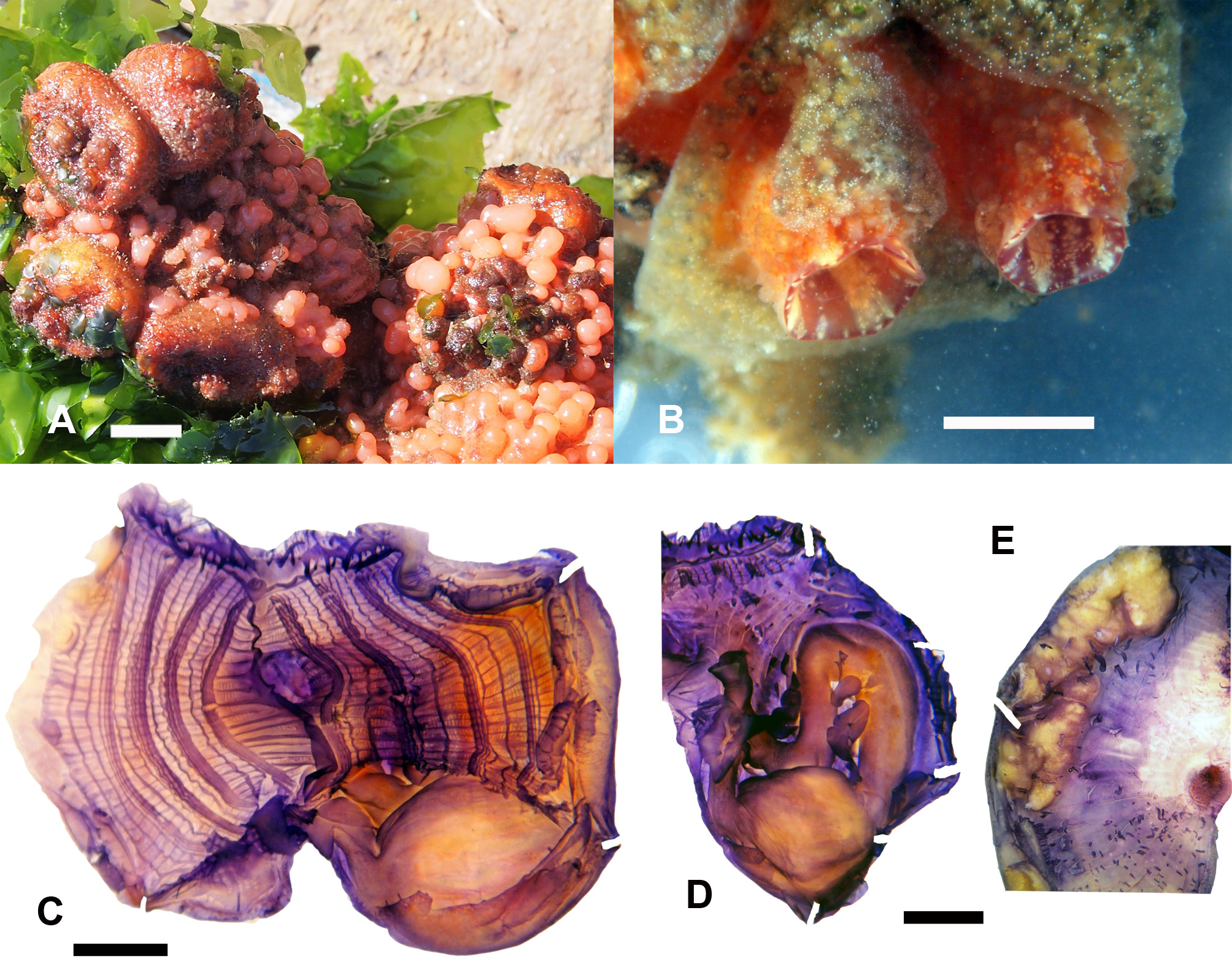
The individuals of this species reach 4 cm in length, and are typically fixed by the ventral side, with both siphons close together in the flat upper surface. The species often forms clumps on top of artificial substrates or other ascidians. The tunic is hard and vivid orange in colour. In live specimens, the siphons are quadrangular, with four broad white-yellow stripes on a reddish background. In-between the wider stripes there are other fine and incomplete whitish bands. The internal tunic of the siphons has wide and blunt siphonal spines. The mantle is muscular and strong. The inner part of the atrial siphon bears a velum with small papillae. The internal organization is typical of a styelid, with simple tentacles, simple dorsal lamina, and four branchial folds. The number of longitudinal vessels on the folds is between 8 and 11, with 2 – 4 vessels between folds (and none between the dorsal-most fold and the dorsal lamina). The digestive has an ovoid stomach and an intestine forming a rather closed primary loop and a marked secondary loop. There are endocarps in the primary and secondary loops. The gonads are characteristic of the species. On the right hand side they form an anastomosed mass of tubular gonads along the ventral midline. A few gonoduct apertures can be seen, facing different directions. On the left the gonad also forms a mass, but much smaller, anterior to the upper part of the intestinal loop.
Ascidian fauna (Tunicata, Ascidiacea) of subantarctic and temperate regions of Chile
Remarks. the species has been reported from the Juan Fernandez Islands as Cnemidocarpa robinsoni (Van Name 1945). Clarke & Castilla (2000) found it for the first time in continental Chile (Antofagasta Bay). This southern hemisphere species has been introduced into European waters (Bishop et al. 2013).
Ascidian fauna (Tunicata, Ascidiacea) of subantarctic and temperate regions of Chile
Status in U. K. – non-native. The “ compass sea squirt ” Asterocarpa humilis has been recorded at several monitoring programme sites, each year since 2014, from rapid assessment and scrape samples. It has been found on the Gutter Sound navigation buoy and mooring buoys in Ore Bay, it has also been found in both Stromness and Kirkwall marinas.
The value of regular monitoring and diverse sampling techniques to assess aquatic non-native species: a case study from Orkney

Export occurrence data

Darwin Core Archive (ZIP)

GEOGRAPHY

Distribution Map

Occurrence Map

Loading map…

Tiles © GBIF Maps API | Map powered by MapLibre GL

REGIONS

Geographic Distribution(54)

Indo-Pacific
Central Chile
New Zealand Exclusive Economic Zone
Irish part of the Irish Sea and St. George's Channel
introduced
United Kingdom part of the Irish Sea and St. George's Channel
introduced
United Kingdom part of the English Channel
introduced
French part of the Celtic Sea
introduced
United Kingdom part of the North Sea
introduced
United Kingdom part of the North Sea
introduced
United Kingdom part of the North Atlantic Ocean
introduced
Chilean part of the South Pacific Ocean
introduced
Argentinean part of the South Atlantic Ocean
uncertain
Argentinean part of the South Atlantic Ocean
uncertain
Indo-Pacific Ocean
Central Chile
United Kingdom part of the English Channel
introduced
Irish part of the Irish Sea and St. George's Channel
introduced
Chilean part of the South Pacific Ocean
introduced
French part of the Celtic Sea
introduced
United Kingdom part of the North Sea
introduced
United Kingdom part of the North Sea
introduced
United Kingdom part of the North Atlantic Ocean
introduced
Argentinean part of the South Atlantic Ocean
uncertain
Indo-Pacific
United Kingdom part of the Irish Sea and St. George's Channel
introduced
Argentinean part of the South Atlantic Ocean
uncertain
New Zealand Exclusive Economic Zone
Central Chile
Argentinian part of the South Atlantic Ocean(AR)
uncertain
Argentinian part of the South Atlantic Ocean(AR)
uncertain
Argentinian part of the South Atlantic Ocean(AR)
uncertain
Argentinian part of the South Atlantic Ocean(AR)
uncertain
Chilean part of the South Pacific Ocean(CL)
introduced
Chilean part of the South Pacific Ocean(CL)
introduced
FR
introduced
French part of the Celtic Sea(FR)
introduced
French part of the Celtic Sea(FR)
introduced
GB
introduced
British part of the Irish Sea and St. George's Channel(GB)
introduced
British part of the English Channel(GB)
introduced
British part of the North Atlantic Ocean(GB)
introduced
British part of the North Sea(GB)
introduced
British part of the North Sea(GB)
introduced
British part of the English Channel(GB)
introduced
British part of the Irish Sea and St. George's Channel(GB)
introduced
British part of the North Atlantic Ocean(GB)
introduced
British part of the North Sea(GB)
introduced
British part of the North Sea(GB)
introduced
Irish part of the Irish Sea and St. George's Channel(IE)
introduced
Irish part of the Irish Sea and St. George's Channel(IE)
introduced
New Zealand Exclusive Economic Zone(NZ)
SE
not applicable
ZA
ZA

DATA

Occurrence Datasets

Loading datasets…

Common names used for this species across different languages and regions. Available in 2 languages and 1 country. 1 preferred.

engCompass Sea SquirtengFRAscidie boussolefrafraAscidie boussolefraengCompass Sea SquirtengengLeathery Sea Squirteng

Vernacular (common) names are the everyday names used for a species in different languages and regions. A single species may have dozens of common names worldwide. This taxon has names in 2 languages. 1 name preferred.

FRAscidie boussole
fraFRfra
fraAscidie boussole
fra
Source: Catalogue of LifeSource taxon #299318869
engCompass Sea Squirt
eng
Source: Catalogue of LifeSource taxon #299318869
engLeathery Sea Squirt
eng
Source: Catalogue of LifeSource taxon #299318869
engCompass Sea Squirt
engpreferred
Source: United Kingdom Species Inventory (UKSI)Source taxon #180181045

CLASSIFICATION

Taxonomic Classification Tree

HIERARCHY

Child Taxa(1)

MULTIMEDIA

Media Files(2)

FIGURE 7. A, Ciona robusta on a buoy, note also some Asterocarpa humilis (orange-coloured). Corella eumyota. B, whole individual; C, dissected individual; D, right side of the mantle, branchial sac eliminated. Inset shows magnification of the zone of the genital openings. The specimen in C and D has been stained. Scale bars: A, 10 cm, B, 2 mm, C, D, 1 mm.

Imageimage/png© Turon, Xavier;Cañete, Juan I.;Sellanes, Javier;Rocha, Rosana M.;López-Legentil, SusannaAscidian fauna (Tunicata, Ascidiacea) of subantarctic and temperate regions of Chile

FIGURE 8. Asterocarpa humilis. A, some specimens on Pyura chilensis (orange papillae belong to P. chilensis tunic); B, close up of the siphons (a colony of Diplosoma listerianum grows on the tunic); C, dissected individual; D, close up of the digestive loop, branchial sac removed; E, gonads of the right-hand side, branchial sac removed. The specimens in C – E have been stained. Scale bars: A, 2 cm, B, 1 cm, C, 1 cm, D, E, 1 cm.

Imageimage/png© Turon, Xavier;Cañete, Juan I.;Sellanes, Javier;Rocha, Rosana M.;López-Legentil, SusannaAscidian fauna (Tunicata, Ascidiacea) of subantarctic and temperate regions of Chile

IMAGES

Gallery(2)

See Gallery

Occurrences with images

CITATIONS

References(9)

  • 1

    (2023) WoRMS Editorial Board (2023). World Register of Marine Species. 2023-09-20.

    Dyntaxa. Svensk taxonomisk databas
  • 2

    Kott, P. (1992). The Australian Ascidiacea, supplement 2. <em>Mem. Qd Mus.</em> 32(2): 621-655.

    basis of recordWorld Register of Marine Species
  • 3

    Kott, P. (1992). The Australian Ascidiacea, supplement 2. <em>Mem. Qd Mus.</em> 32(2): 621-655.

    basis of recordWRiMS
  • 4

    Kott, P.; Bradford-Grieve, J.; Esnal, G.; Murdoch, R.C. (2009). Phylum Tunicata: sea squirts, salps, appendicularians, in: Gordon, D.P. (Ed.) (2009). New Zealand inventory of biodiversity: 1. Kingdom Animalia: Radiata, Lophotrochozoa, Deuterostomia. pp. 409-430.

    additional sourceWRiMS
  • 5

    Kott, P.; Bradford-Grieve, J.; Esnal, G.; Murdoch, R.C. (2009). Phylum Tunicata: sea squirts, salps, appendicularians, in: Gordon, D.P. (Ed.) (2009). New Zealand inventory of biodiversity: 1. Kingdom Animalia: Radiata, Lophotrochozoa, Deuterostomia. pp. 409-430.

    additional sourceWorld Register of Marine Species
  • Source Information

    GBIF Backbone Taxonomy

    GBIF Backbone Taxonomy

    checklist

    The GBIF Backbone Taxonomy is a single, synthetic management classification with the goal of covering all names GBIF is dealing with. It's the taxonomic backbone that allows GBIF to integrate name based information from different resources, no matter if these are occurrence datasets, species pages, names from nomenclators or external sources like EOL, Genbank or IUCN. This backbone allows taxonomic search, browse and reporting operations across all those resources in a consistent way and to provide means to crosswalk names from one source to another.

    It is updated regulary through an automated process in which the Catalogue of Life acts as a starting point also providing the complete higher classification above families. Additional scientific names only found in other authoritative nomenclatural and taxonomic datasets are then merged into the tree, thus extending the original catalogue and broadening the backbones name coverage. The GBIF Backbone taxonomy also includes identifiers for Operational Taxonomic Units (OTUs) drawn from the barcoding resources iBOL and UNITE.

    International Barcode of Life project (iBOL), Barcode Index Numbers (BINs). BINs are connected to a taxon name and its classification by taking into account all names applied to the BIN and picking names with at least 80% consensus. If there is no consensus of name at the species level, the selection process is repeated moving up the major Linnaean ranks until consensus is achieved.

    UNITE - Unified system for the DNA based fungal species, Species Hypotheses (SHs). SHs are connected to a taxon name and its classification based on the determination of the RefS (reference sequence) if present or the RepS (representative sequence). In the latter case, if there is no match in the UNITE taxonomy, the lowest rank with 100% consensus within the SH will be used.

    The GBIF Backbone Taxonomy is available for download at https://hosted-datasets.gbif.org/datasets/backbone/ in different formats together with an archive of all previous versions.

    The following 105 sources have been used to assemble the GBIF backbone with number of names given in brackets:

    • Catalogue of Life Checklist - 4766428 names
    • International Barcode of Life project (iBOL) Barcode Index Numbers (BINs) - 635951 names
    • UNITE - Unified system for the DNA based fungal species linked to the classification - 611208 names
    • The Paleobiology Database - 212054 names
    • World Register of Marine Species - 188857 names
    • The Interim Register of Marine and Nonmarine Genera - 183894 names
    • The World Checklist of Vascular Plants (WCVP) - 131891 names
    • GBIF Backbone Taxonomy - 114350 names
    • TAXREF - 109374 names
    • The Leipzig catalogue of vascular plants - 75380 names
    • ZooBank - 73549 names
    • Integrated Taxonomic Information System (ITIS) - 68377 names
    • Plazi.org taxonomic treatments database - 61346 names
    • Genome Taxonomy Database r207 - 60545 names
    • International Plant Names Index - 52329 names
    • Fauna Europaea - 45077 names
    • The National Checklist of Taiwan (Catalogue of Life in Taiwan, TaiCoL) - 36193 names
    • Dyntaxa. Svensk taxonomisk databas - 35892 names
    • The Plant List with literature - 32692 names
    • United Kingdom Species Inventory (UKSI) - 29643 names
    • Artsnavnebasen - 29208 names
    • The IUCN Red List of Threatened Species - 21221 names
    • Afromoths, online database of Afrotropical moth species (Lepidoptera) - 13961 names
    • Brazilian Flora 2020 project - Projeto Flora do Brasil 2020 - 13829 names
    • Prokaryotic Nomenclature Up-to-Date (PNU) - 10079 names
    • Checklist Dutch Species Register - Nederlands Soortenregister - 8814 names
    • ICTV Master Species List (MSL) - 7852 names
    • Cockroach Species File - 6020 names
    • GRIN Taxonomy - 5882 names
    • Taxon list of fungi and fungal-like organisms from Germany compiled by the DGfM - 4570 names
    • Catalogue of Afrotropical Bees - 3623 names
    • Catalogue of Tenebrionidae (Coleoptera) of North America - 3327 names
    • Checklist of Beetles (Coleoptera) of Canada and Alaska. Second Edition. - 3312 names
    • Systema Dipterorum - 2850 names
    • Catalogue of the Pterophoroidea of the World - 2807 names
    • The Clements Checklist - 2675 names
    • Taxon list of Hymenoptera from Germany compiled in the context of the GBOL project - 2496 names
    • IOC World Bird List, v13.2 - 2366 names
    • Official Lists and Indexes of Names in Zoology - 2310 names
    • National checklist of all species occurring in Denmark - 1922 names
    • Myriatrix - 1876 names
    • Database of Vascular Plants of Canada (VASCAN) - 1822 names
    • Taxon list of vascular plants from Bavaria, Germany compiled in the context of the BFL project - 1771 names
    • Orthoptera Species File - 1742 names
    • A list of the terrestrial fungi, flora and fauna of Madeira and Selvagens archipelagos - 1602 names
    • Aphid Species File - 1565 names
    • World Spider Catalog - 1561 names
    • Taxon list of Jurassic Pisces of the Tethys Palaeo-Environment compiled at the SNSB-JME - 1270 names
    • Backbone Family Classification Patch - 1143 names
    • GBIF Algae Classification - 1100 names
    • International Cichorieae Network (ICN): Cichorieae Portal - 975 names
    • Psocodea Species File - 803 names
    • New Zealand Marine Macroalgae Species Checklist - 787 names
    • Annotated checklist of endemic species from the Western Balkans - 754 names
    • Taxon list of animals with German names (worldwide) compiled at the SMNS - 503 names
    • Catalogue of the Alucitoidea of the World - 472 names
    • Lygaeoidea Species File - 462 names
    • Catálogo de Plantas y Líquenes de Colombia - 422 names
    • GBIF Backbone Patch - 317 names
    • Phasmida Species File - 259 names
    • Cortinariaceae fetched from the Index Fungorum API - 234 names
    • Coreoidea Species File - 233 names
    • GTDB supplement - 139 names
    • Mantodea Species File - 119 names
    • Endemic species in Taiwan - 93 names
    • Taxon list of Araneae from Germany compiled in the context of the GBOL project - 88 names
    • Species of Hominidae - 78 names
    • Taxon list of Sternorrhyncha from Germany compiled in the context of the GBOL project - 77 names
    • Taxon list of mosses from Germany compiled in the context of the GBOL project - 75 names
    • Mammal Species of the World - 73 names
    • Plecoptera Species File - 71 names
    • Species Fungorum Plus - 64 names
    • Catalogue of the type specimens of Cosmopterigidae (Lepidoptera: Gelechioidea) from research collections of the Zoological Institute, Russian Academy of Sciences - 47 names
    • Species named after famous people - 41 names
    • Dermaptera Species File - 36 names
    • Taxon list of Trichoptera from Germany compiled in the context of the GBOL project - 34 names
    • True Fruit Flies (Diptera, Tephritidae) of the Afrotropical Region - 33 names
    • Range and Regularities in the Distribution of Earthworms of the Earthworms of the USSR Fauna. Perel, 1979 - 32 names
    • Taxon list of Diplura from Germany compiled in the context of the GBOL project - 30 names
    • Lista de referencia de especies de aves de Colombia - 2022 - 24 names
    • Taxon list of Auchenorrhyncha from Germany compiled in the context of the GBOL project - 20 names
    • Catalogue of the type specimens of Polycestinae (Coleoptera: Buprestidae) from research collections of the Zoological Institute, Russian Academy of Sciences - 19 names
    • Taxon list of Thysanoptera from Germany compiled in the context of the GBOL project - 19 names
    • Lista de especies de vertebrados registrados en jurisdicción del Departamento del Huila - 18 names
    • Taxon list of Microcoryphia (Archaeognatha) from Germany compiled in the context of the GBOL project - 15 names
    • Catalogue of the type specimens of Bufonidae and Megophryidae (Amphibia: Anura) from research collections of the Zoological Institute, Russian Academy of Sciences - 12 names
    • Grylloblattodea Species File - 11 names
    • Coleorrhyncha Species File - 9 names
    • Taxon list of liverworts from Germany compiled in the context of the GBOL project - 9 names
    • Embioptera Species File - 7 names
    • Taxon list of Pisces and Cyclostoma from Germany compiled in the context of the GBOL project - 6 names
    • Taxon list of Pteridophyta from Germany compiled in the context of the GBOL project - 6 names
    • Taxon list of Siphonaptera from Germany compiled in the context of the GBOL project - 5 names
    • The Earthworms of the Fauna of Russia. Perel, 1997 - 5 names
    • Taxon list of Zygentoma from Germany compiled in the context of the GBOL project - 4 names
    • Asiloid Flies: new taxa of Diptera: Apioceridae, Asilidae, and Mydidae - 3 names
    • Taxon list of Protura from Germany compiled in the context of the GBOL project - 3 names
    • Taxon list of hornworts from Germany compiled in the context of the GBOL project - 2 names
    • Chrysididae Species File - 1 names
    • Taxon list of Dermaptera from Germany compiled in the context of the GBOL project - 1 names
    • Taxon list of Diplopoda from Germany in the context of the GBOL project - 1 names
    • Taxon list of Orthoptera (Grashoppers) from Germany compiled at the SNSB - 1 names
    • Taxon list of Pscoptera from Germany compiled in the context of the GBOL project - 1 names
    • Taxon list of Pseudoscorpiones from Germany compiled in the context of the GBOL project - 1 names
    • Taxon list of Raphidioptera from Germany compiled in the context of the GBOL project - 1 names

    GBIF Secretariat (2023). GBIF Backbone Taxonomy. Checklist dataset https://doi.org/10.15468/39omei accessed via GBIF.org on 2026-06-14.

    CC BYPublished 8/28/2023View dataset
    GBIF Usage Key
    2332123
    Dataset Key
    d7dddbf4-2cf0-4f39-9b2a-bb099caae36c
    Origin
    source
    Backbone Key
    2332123
    Taxon ID
    gbif:2332123
    Last Crawled
    8/22/2023
    Last Interpreted
    8/22/2023