
AnimaliaNot EvaluatedacceptedfamilyAccepted
Accipitridae

Accipitridae

Aasvoëls en Arende(+99)

GBIF:2877

0countries
0datasets

0

Descendants

0

Synonyms

0

Children

0

Species

0

Genera

PROFILE

Species Profile

Characteristics

Extant 56.0 to 0.0 Ma

ABOUT

Descriptions(24)

Aquilavus sp.: une phalange distale (Coll. JR).
Nouvelles données géologiques et biostratigraphiques du gisement paléontologique à vertébrés de Mauvières, à Marcilly-sur-Maulne (Miocène inférieur et moyen; Indre-et-Loire, France)
This fossil is readily distinguished from the following similar-sized birds likely to be encountered in Pleistocene Australian fossil sites. - From Ciconiidae (Ephippiorhynchus asiaticus) by the following characters (ciconiid state in brackets): The tuberculum supracondylare dorsale is strongly projecting (little to no projection); the dorsal sulcus of the m. humerotricipitalis is narrow, just under a third of the shaft width (broad, roughly half the shaft width); the ventral sulcus of the m. humerotricipitalis is broad, twice the width of the dorsal sulcus (narrow, half the width); the epicondylus ventralis and the tuberculum supracondylare ventrale are distinctly separated from each other (continuous / overlapping); the dorsal insertion of the m. extensor metacarpi radialis is oval restricted to the dorsal facies (circular with a ventrally projecting line leading onto the cranial facies). - From Pelecanidae (Pelecanus conspicillatus) by the following characters (pelecanid state in brackets): The tuberculum supracondylare dorsale is strongly projecting (little to no projection); the origin of m. extensor digitorum communi is a small, circular pit on the dorsal facies between the tuberculum supracondylare dorsale and the epicondylus dorsalis (large, oval-shaped attachment scar); the tuberculum supracondylare ventrale is weakly projecting cranially (cranially flattened); there is no pneumatism of the distal end (pneumatic region present on cranial facies adjacent to tuberculum supracondylare ventrale); the epicondylus ventralis strongly projects ventrally (weak projection); the distal margin of the fossa brachialis is positioned distal to the tuberculum supracondylare dorsale (positioned proximal to the processus). - From Phoenicopteriformes (Phoenicopterus ruber) by the following characters (phoenicopterid state in brackets): the epicondylus ventralis projects prominently ventrally (little to no projection), the dorsal sulcus for the m. humerotricipitalis is under a third of the shaft width (half of shaft width), the ventral sulcus for the m. humerotricipitalis is twice the width of the dorsal sulcus (half the width of the dorsal sulcus), the tuberculum supracondylare ventrale is weakly projecting cranially (cranially flattened), the condylus dorsalis and condylus ventralis are separated by a distinct, deep incisura (narrow, shallow incisura). - From Ardeidae by the following characters (ardeid state in brackets): A deep fossa m. brachialis (shallow); a broad fossa m. brachialis, approximately two thirds of shaft width or more (narrow, one third of shaft width); a narrow sulcus for the dorsal belly of the m. humerotricipitalis (broad). Several features of the bone, notably its large size, are only matched by Aquila audax and Haliaeetus leucogaster in the Australian fauna. However, the combination of a narrow dorsal part of sulcus humerotricipitalis, a markedly prominent epicondylus ventralis, the dorsally inflated facies between the tuberculum supracondylare dorsale and the epicondylus dorsalis, and a distally short processus flexorius, distinguish it from all other accipitrids. As this humerus is unambiguously identifiable as that of an accipitrid and is distinguished from all known genera and species, ‘ Taphaetus’ lacertosus is confirmed as a distinct taxon. However, it requires a new genus, as Taphaetus de Vis, 1905 is a junior homonym of Taphaetus de Vis, 1891, and the latter is a junior synonym of Uroaetus Kaup, 1844 and so of Aquila Brisson, 1760. As the quadrate QM F 5508 was inaccessible at the time of this study, we instead used the descriptions and illustrations in de Vis (1905) to assess if the original identification was valid. QM F 5508 differs distinctly from quadrates of accipitrids, instead being similar to those of Ardeidae, particularly species in the genera Ardea and Egretta, by the following characters (accipitrid state in brackets): A large foramen pneumaticum caudomediale is positioned ventral to the capitulum oticum articular surface (no foramen pneumaticum, though a depressio caudomediale is present in some species); the capitulum oticum is positioned further dorsally relative to the capitulum squamosum (capitulum squamosum further dorsal); the width of the capitula and the width of the shaft are very similar, with little narrowing between the dorsal and ventral ends (shaft distinctly narrower than dorsal end); in caudal view, the condylus mandibularis medialis is positioned level with the condylus mandibularis lateralis, with both being equally visible (condylus mandibularis medialis set back rostrally, less visible than the condylus lateralis); the condylus mandibularis caudalis is prominently projecting caudally (projecting medially); the condylus mandibularis lateralis barely extends laterally from the shaft (extends prominently caudally); the condylus mandibularis medialis extends prominently medially from the shaft (little to no extension); a prominent secondary facet is present on the condylus mandibularis medialis (no secondary facet); in ventral view, the condyles project rostrally past the rostral margin of the articular surface (roughly in line with margin). The reported dorsal height of 22 mm is distinctly larger than that observed in the Australasian Bittern Botaurus poiciloptilus (~ 15 – 16 mm). While the morphology of QM F 5508 is a better match for a heron, it is much larger than compared specimens of White-faced Heron Egretta novaehollandiae and Grey Heron Ardea cinerea but could potentially be a match in size to that of the Great-billed Heron (Ardea sumatrana). As QM F 5508 is not of an accipitrid, it is not considered further here.
A new look at an old Australian raptor places “ Taphaetus ” lacertosus de Vis 1905 in the Old World vultures (Accipitridae: Aegypiinae)
The lectotype of ‘ Taphaetus’ lacertosus de Vis, 1905, a distal right humerus, QM F 5507, is identified as an accipitrid based on the presence of the following characters: The distal margin of the fossa brachialis extends distal to the tuberculum supracondylare dorsale; a distinct sulcus scapulotricipitalis; the proximal margin of the condylus dorsalis is roughly level with the ventral tip of the epicondylus ventralis; a distinct circular dorsal insertion for the m. extensor metacarpi radialis on the dorsal projection of the tuberculum supracondylare dorsale; a distinct pit for the insertion of the m. pronator superficialis ventrally adjacent to and slightly proximal to the tuberculum supracondylare ventrale; and the epicondylus ventralis is markedly ventrally prominent.
A new look at an old Australian raptor places “ Taphaetus ” lacertosus de Vis 1905 in the Old World vultures (Accipitridae: Aegypiinae)
Throughout most of Australia, the Pleistocene (2.56 Ma – 11.7 Ka) epoch was marked by arid climatic conditions, with the environment dominated by grasslands, open woodland (Sniderman et al. 2007) and desert (Hesse et al. 2004), similar to the present day. The Australian megafauna, which included at least 20 genera of large mammals, four of large birds, and three of large reptiles (Wroe et al. 2013; Johnson et al. 2021), inhabited these environments until most of them went extinct between 50 – 40 Ka (Roberts et al. 2001; van der Kaars et al. 2017). The raptor guild of the Pleistocene can be assumed to have comprised most of the living Australian species, with fossil material of Aquila audax (Latham) (Wedge- tailed Eagle) at least 500 – 200 Ka old (Baird 1991; EKM, THW unpublished data). However, two extinct species that represent potential additional diversity have been described from this epoch; Aquila brachialis (de Vis, 1889) and “ Taphaetus ” lacertosus de Vis, 1905 (Gaff 2002 unpublished thesis; Boles 2006, 2017; Worthy & Nguyen 2020).
A new look at an old Australian raptor places “ Taphaetus ” lacertosus de Vis 1905 in the Old World vultures (Accipitridae: Aegypiinae)
Falconidae (falconid state in brackets): the condylus dorsalis is thickened and rounded distally (consistently narrow and rectangular); the processus flexorius ends proximal to the condylus ventralis (equidistant). Pandionidae (state for Pandion haliaetus in brackets): a shallow fossa m. brachialis (deep); a flat epicondylus dorsalis (prominently projecting); a flat epicondylus ventralis (prominent); the fossa olecraniis shallow (deep); thesulcus scapulotricipitalis is shallow (deep). Cathartidae (cathartid state in brackets): a shallow fossa m. brachialis (deep); a lack of pneumatisation in the fossa m. brachialis (present); a flat epicondylusventralis (prominent). Sagittariidae (sagittariid state in brackets): the two fossae marking the attachment points for the lig. collaterale dorsale are positioned roughly adjacent to each other (cranial-most fossa slightly proximal to and abutting caudal fossa in sagittariids). The fossil is broadly similar to accipitrids and displays the following features: (1) The tuberculum supracondylare dorsale (Figure 11 A: PSD) is located well-proximal to the condylus dorsalis (Figure 11 A: CD) and is small, barely projecting dorsally of the shaft, but projects slightly cranially as a proximodistally elongate rugosity; (2) the dorsal face / shaft margin between the tuberculum supracondylare dorsale and the epicondylus dorsalis is mildly inflated; Two shallow scars for the m. extensor carpi radialis are present on the tuberculum supracondylare dorsale (Figure 11 C: MECR), (3) the larger palmar attachment scar on the cranial face adjacent to the dorsal margin is oval (4) and the smaller dorsal scar is located on the dorsal face of the processus. (5) In caudal view, the processus flexorius (Figure 11: PF) terminates proximal to the condylus ventralis (Figure 11 A: CV) but is prominent ventrally. (6) The sulcus scapulotricipitalis (Figure 11 B: SST) forms a shallow but broad notch roughly 2 mm wide on the caudal face. (7) The fossa olecrani (Figure 11 B: FO) is moderately deep, defining well the dorsal margin to the processus flexorius but does not create a discontinuity with the sulcus humerotricipitalis. (8) The sulcus humerotricipitalis (Figure 11 B: SHT) is very shallow, and at 5.3 mm wide extends over half of shaft width of 9.7 mm at the same point. (9) The fossa m. brachialis (Figure 11 A: FB) is shallow but distinct, with a proximodistal length of 13.8 mm extending well proximal to the tuberculum supracondylare dorsale, and a maximum dorsoventral width of 7.3 mm level with the proximal margin of the tuberculum supracondylare dorsale. In contrast, the shaft width measures 10.1 mm at the same point. Within the fossa, the impressio m. brachialis is slightly deeper. (10) The fossa is well separated (3 mm) from the dorsal margin of the shaft. (11) The epicondylus ventralis (Figure 11 A: EV) is indistinct from the ventral margin and does not project ventrally past the processus flexorius. (12) Asingle distinct, shallow insertion scar is present on the ventrodistal section of the epicondylus ventralis, with a very faint and shallow second insertion ventrally adjacent to it. These insertions serve as the attachment point for the m. flexor carpi ulnaris. (13) The tuberculum supracondylare ventrale (Figure 11 A: TSV) projects cranially but not ventrally from the shaft. (14) Ashallow insertion scar for the pronator superficialis is present just proximal to the tuberculum on the dorsal face. (15) The condylus dorsalis (Figure 11 A: CD) is 5.9 mm proximodistally long, 4.7 mm dorsoventrally wide and 8.6 mm craniocaudally deep. (16) Two small, very shallow insertion scars are present on the caudal section of the dorsal face of the condylus dorsalis by the distal margin (Figure 11 C: CDCS), directly craniocaudally adjacent to each other. (17) The condylus ventralis is 4.5 mm proximodistally long, 7.3 mm dorsoventrally wide and 5 mm craniocaudally deep. (18) The condylus dorsalis is separated by a distinct notch from and set well proximal to the distal margin of the condylus ventralis in cranial view. (19) The incisura intercondylaris (Figure 11: II) is narrow, roughly 1.1 mm wide, but distinct. (20) The processus flexorius is surpassed distally by the condylus ventralis in caudal view, and strongly projects ventrally in caudal view. (21) The ventral margin of the condylus ventralis is not separated by a notch from the processus flexorius in cranial view. Extant accipitrids differ as follows: (Trait 1) The tuberculum supracondylare dorsale projects much further dorsally in all subfamilies and species except Pernis apivorus (Perninae), Polyboroides typus (Gypaetinae, non-projecting), Aquilinae, Accipitrinae and species of Buteo (Buteoninae). (16) The insertion scars towards the caudal margin of the condylus dorsalis are both deep in all subfamilies except Elaninae and Accipitrinae, with the latter having the cranial-most insertion being shallow and the caudal-most deep.
An exceptional partial skeleton of a new basal raptor (Aves: Accipitridae) from the late Oligocene Namba formation, South Australia
Measurements (mm) Distal width 15.4, least shaft width 8.3, total depth 8.5, condylus dorsalis depth 8.3, condylus dorsalis width 5.2, condylus ventralis depth 5.1, condylus ventralis width 7.3, epicondylus ventralis depth 7.0.
An exceptional partial skeleton of a new basal raptor (Aves: Accipitridae) from the late Oligocene Namba formation, South Australia
Subfamily indet. Gen. et sp. indet.
An exceptional partial skeleton of a new basal raptor (Aves: Accipitridae) from the late Oligocene Namba formation, South Australia
Remarks The fossil can be excluded from other raptor families on the following features:
An exceptional partial skeleton of a new basal raptor (Aves: Accipitridae) from the late Oligocene Namba formation, South Australia
The fossil has the most similarities to species from the subfamily Elaninae (see SI. 2 for more detailed differential comparisons), but differs markedly in regards to the inflation of the dorsal face between the tuberculum supracondylare dorsale and the epicondylus dorsalis, the size and shape of the palmar and dorsal attachment scars for the m. extensor carpi radialis, the distinct depression in the section of dorsal face caudal to the tuberculum supracondylaris and the epicondylus dorsalis, the sulcus humerotricipitalis width, the fossa m. brachialis length, the configuration of the insertion scars on the distal epicondylus ventralis, the position of the distal margin of the condylus dorsalis relative to that of the condylus ventralis in cranial view, the ventral projection of the processus flexorius, and the connectivity of the condylus ventralis and entepicondyle in cranial view. As the Archaehierax sylvestris specimen SAMA P. 54998 lacks a preserved distal humerus, it cannot be compared to SAMA P. 58917. However, it is not believed to belong to the same species due to the significantly smaller size of SAMA P. 58917 from the humerus size predicted for SAMA P. 54998 (see comparative measurements below).
An exceptional partial skeleton of a new basal raptor (Aves: Accipitridae) from the late Oligocene Namba formation, South Australia
Locality, stratigraphy and age 31 ° 07.568 ʹ S; 140 ° 12.737 ʹ E. Site 11, Lake Pinpa, Frome Downs Station, South Australia, Namba Formation, Pinpa LF, late Oligocene. Collected by A. Camens, T. Worthy and W. Handley, 24 – 26 September 2015.
An exceptional partial skeleton of a new basal raptor (Aves: Accipitridae) from the late Oligocene Namba formation, South Australia
Material Distal right humeral fragment, preserving a relatively unworn distal end and 16.2 mm of shaft, and some associated fragments of the shaft, SAMA P. 58917.
An exceptional partial skeleton of a new basal raptor (Aves: Accipitridae) from the late Oligocene Namba formation, South Australia
Measurements (mm) Preserved length 26, DW 13.3, least SW 7.3, preserved condylus medialis depth 9.7, condylus medialis width 5.6, condylus lateralis depth 11.0, condylus lateralis width 6.1.
An exceptional partial skeleton of a new basal raptor (Aves: Accipitridae) from the late Oligocene Namba formation, South Australia
Subfamily indet. Gen. et sp. indet.
An exceptional partial skeleton of a new basal raptor (Aves: Accipitridae) from the late Oligocene Namba formation, South Australia
The femur is consistent with accipitrids and has the following morphology. (Trait 1) The linea intermuscularis caudalis (Figure 12 C: LIC) is highly distinct, running along the medial border of the caudal shaft face in a raised line, (2) but is not continuous with the tuberculum m. gastrocnemialis medialis, so there is no crista supracondylaris medialis. (3) The secondary origin point for the ligamentum collateralis lateralis is very faint and shallow, barely distinct from the surface of the bone. (4) The fovea tendineus m. tibialis cranialis is shallow. (5) The fossa poplitea (Figure 12 B: FPop) is shallow, deepening slightly towards the distal end immediately proximal to the condyles. (6) The attachment scar on the planum popliteum (Figure 12 B: PPAP) is positioned medially. (7) The impressio m. gastrocnemialis lateralis (Figure 12 D: IG) is large and shallow. (8) The epicondylus lateralis (Figure 12 A: EL) is short and very robust but has little projection from the condylus lateralis. The distal femur NMV P. 222435 is from an accipitrid which exhibits the most similarity to those of species in Buteoninae, Aegypiinae, and most of Elaninae (see SI. 2 for more detailed differential comparisons). It mainly differs from species in these subfamilies in lacking a prominent crista supracondylaris medialis, the position and shape of the attachment point on the planum popliteum, and the weak projection of the epicondylaris lateralis. As the distal femur is not a highly diagnostic section of the accipitrid skeleton, and the distal femur is not preserved in Archaehierax sylvestris specimen SAMA P. 54998, NMV P. 222435 is regarded as gen. et. sp. indet. The size difference between NMV P. 222435 and the predicted size of the distal femur of SAMA P. 54998 is greater than would be predicted from typical sexual dimorphism, which makes it unlikely the two are representatives of the same species (see comparative measurements below). Size comparisons of the three fossils The width measurements of the proximal humerus, distal humerus, distal tibiotarsus and distal femur of extant taxa were compared (see Appendix 1, Table S 2) and showed that the distal width of the humerus was between 80 % and 90 % of the proximal width of the humerus, while the distal width of the tibiotarsus was between 75 % and 110 % the distal width of the femur in extant accipitrids. If the bones of Archaehierax sylvestris had similar ratios, then it can be predicted that the width of the missing distal humerus should fall in the range 23.4 – 26.4 mm, while that of the missing distal femur should be between 15.8 and 22.0 mm broad. Based on this, both the isolated distal femur NMV P 222435 and the isolated distal humerus SAMA P. 58917 are too small to belong to an individual the size of the A. sylvestris holotype. However, sexual dimorphism is known to be considerable and common in accipitrids (Brown and Amadon 1968; Marchant and Higgins 1993) and raises the possibility that these isolated fossils may belong to a smaller sex of the onespecies if they fall within a certain size range. Field et al. (2013) devised multiple algorithms for predicting body mass from skeletal measurements, while Campbell and Marcus (1992) predicted body mass based on the femur and tibiotarsus circumference. Using these, the mass of the bird for the Archaehierax sylvestris holotype is estimated as 3.7 kg based on the length of the coracoid facies articularis humeralis, 4.6 kg by the least shaft diameter / width of the tarsometatarsus, and 3.2 kg based on tibiotarsus least shaft circumference. The mass of the bird represented by the distal femur is calculated at 2 kg based on femur shaft width / diameter, or 1.6 kg based on shaft circumference. The mass of the bird represented by the distal humerus is calculated at 1.5 kg based on shaft width / diameter, or 1.6 kg based on circumference. Assuming these predictions are accurate, the femur represents a bird 46 – 67 % smaller than the skeleton specimen, and the humerus one 60 – 67 % smaller. This would be pushing accipitrid sexual dimorphism to its extreme limits, making it unlikely that the fossils represent a single species. However, these mass predictions use different elements, limiting their comparability. Nevertheless, while considering it likely that at least two accipitrids are represented, we consider it unwise to describe the smaller as a second species when size would be the only distinguishing factor and their congeneric status cannot be assessed.
An exceptional partial skeleton of a new basal raptor (Aves: Accipitridae) from the late Oligocene Namba formation, South Australia
PCA analysis of limb measurements
An exceptional partial skeleton of a new basal raptor (Aves: Accipitridae) from the late Oligocene Namba formation, South Australia
Remarks The specimen can be excluded from the Pandionidae and Cathartidae by the presence of a single muscular attachment on the planum popliteum, and from Falconidae and Sagittariidae by the linea intermuscularis caudalis remaining level and visible on the medial margin of the caudal face.
An exceptional partial skeleton of a new basal raptor (Aves: Accipitridae) from the late Oligocene Namba formation, South Australia
Locality, stratigraphy and age 31 ° 11.237 ’ S 140 ° 13.944 ʹ E Ericmas Quarry, Lake Namba, Frome Downs Station, South Australia, Namba Formation, Ericmas LF, late Oligocene. Collected by T. Flannery, 7 / 4 / 83.
An exceptional partial skeleton of a new basal raptor (Aves: Accipitridae) from the late Oligocene Namba formation, South Australia
Material NMV P. 222435, distal left femur preserving intact distal end and 15.5 mm of shaft.
An exceptional partial skeleton of a new basal raptor (Aves: Accipitridae) from the late Oligocene Namba formation, South Australia
Description. Neither bone is diagnosable at the species level but both compare well with A. cooperi in size and shape.
The Irvingtonian Avifauna of Cumberland Bone Cave, Maryland
Remarks. See above.
The Irvingtonian Avifauna of Cumberland Bone Cave, Maryland
Material. USNM PAL 641996, pedal phalanx, entire, with the articular cotyla slightly crushed; collected in the 1990 s. USNM PAL 641983, ungual phalanx, entire; collected Sept 22, 1994.
The Irvingtonian Avifauna of Cumberland Bone Cave, Maryland
Craspedorrhynchus tubulus Buteo jamaicensis (Gmelin) Craspedorrhynchus sp. Degeeriella fulva Buteo plagiatus (Schlegel) Craspedorrhynchus sp. Buteo swainsoni Bonaparte Craspedorrhynchus sp. Haliaeetus leucocephalus (Linnaeus) Craspedorhynchus platystomus Parabuteo unicinctus Temminck Degeeriella fulva Geranospiza caerulescens nigra (Du Bus) Craspedorrhynchus genitalis Rupornis magnirostris griseocauda Ridgway Craspedorrhynchus brevicapitis
Chewing lice (Insecta: Phthiraptera) associated with vertebrates in Mexico

Family Accipitridae

Leptodon forbesi (IUCN: CR, Biodiversitas: Not included) Physaloptera losseni

Checklist of helminth parasites of threatened vertebrate species from BrazilMagnoliaPress via PlaziNo known copyright restrictions apply. See Agosti, D., Egloff, W., 2009. Taxonomic information exchange and copyright: the Plazi approach. BMC Research Notes 2009, 2:53 for further explanation.

ACCIPITRIDAE

Buteo sp.

COLEOPTERA: Trogidae

Omorgus monachus (Herbst, 1790)

UNITED STATES: Maryland: Jackson's Island, June, one specimen with the notation “ex nest buzzard” (Vaurie 1955).

Addenda to the insects found in birds’ nests from the Neotropical Region and Neotropical immigrants in the Nearctic Region, with a discussion of the probable transmission mechanism of Ornithocoris toledoi (Hemiptera: Cimicidae)MagnoliaPress via PlaziNo known copyright restrictions apply. See Agosti, D., Egloff, W., 2009. Taxonomic information exchange and copyright: the Plazi approach. BMC Research Notes 2009, 2:53 for further explanation.

Export occurrence data

Darwin Core Archive (ZIP)

GEOGRAPHY

Distribution Map

Occurrence Map

Loading map…

Tiles © GBIF Maps API | Map powered by MapLibre GL

REGIONS

Geographic Distribution(4)

DK
not evaluated
NO
SE
Vermont-US(US)

DATA

Occurrence Datasets

Loading datasets…

Common names used for this species across different languages and regions. Available in 47 languages and 5 countries.

afrAasvoëls en ArendeafrAccipitridociitaAccipitridiitacatAccipítridscatglgAcipítridosglg+95 more

Vernacular (common) names are the everyday names used for a species in different languages and regions. A single species may have dozens of common names worldwide. This taxon has names in 47 languages.

afrAasvoëls en Arende
afr
Source: Catalogue of LifeSource taxon #299354778
Accipitrid
oci
Source: Catalogue of LifeSource taxon #299354778
itaAccipitridi
ita
Source: Catalogue of LifeSource taxon #299354778
catAccipítrids
cat
Source: Catalogue of LifeSource taxon #299354778
glgAcipítridos
glg
Source: Catalogue of LifeSource taxon #299354778
porAcípitre
por
Source: Catalogue of LifeSource taxon #299354778
Akcipitredoj
epo
Source: Catalogue of LifeSource taxon #299354778
itaAstore
ita
Source: Catalogue of LifeSource taxon #299354778
turAtmacagiller
tur
Source: Catalogue of LifeSource taxon #299354778
fraAutour
fra
Source: Catalogue of LifeSource taxon #299354778
spaAzor
spa
Source: Catalogue of LifeSource taxon #299354778
Dintsu
tsn
Source: Catalogue of LifeSource taxon #299354778
engEagles
eng
Source: Catalogue of LifeSource taxon #273146843
engEagles
eng
Source: Checklist of Vermont SpeciesSource taxon #205802603
GBEagles
engGBeng
engEagles
eng
Source: Martha's Vineyard species checklistSource taxon #206230012
engEagles
eng
Source: Integrated Taxonomic Information System (ITIS)Source taxon #102085319
engEagles
eng
Source: Catalogue of LifeSource taxon #299354778
DKGlenter, ørne & høge
danDK
Source: National Checklist of all species occurring in DenmarkSource taxon #307210673
deuHabichtartige
deu
Source: Catalogue of LifeSource taxon #299354778
Hanjügern
Source: Catalogue of LifeSource taxon #299354778
estHaugaslased
est
Source: Catalogue of LifeSource taxon #299354778
islHaukaætt
isl
Source: Catalogue of LifeSource taxon #299354778
nldHavikachtige
nld
Source: Catalogue of LifeSource taxon #299354778
nldHavikachtigen
nld
Source: Catalogue of LifeSource taxon #299354778
engHawk
eng
Source: Martha's Vineyard species checklistSource taxon #206230012
engHawk
eng
Source: Checklist of Vermont SpeciesSource taxon #205802603
engHawks
eng
Source: Martha's Vineyard species checklistSource taxon #206230012
engHawks
eng
Source: Catalogue of LifeSource taxon #273146843
engHawks
eng
Source: Catalogue of LifeSource taxon #299354778
engHawks
eng
Source: Integrated Taxonomic Information System (ITIS)Source taxon #102085319
engHawks
eng
Source: Checklist of Vermont SpeciesSource taxon #205802603
USHawks, Eagles
engUS
Source: Checklist of Vermont SpeciesSource taxon #205802603
USHawks, Eagles
engUS
Source: Martha's Vineyard species checklistSource taxon #206230012
USHawks, Eagles, And Relatives
engUS
Source: Checklist of Vermont SpeciesSource taxon #205802603
USHawks, Eagles, And Relatives
engUS
Source: Martha's Vineyard species checklistSource taxon #206230012
engHawks, eagles, and relatives
eng
Source: Colaboraciones Americanas Sobre AvesSource taxon #114093022
Heafoc
Source: Catalogue of LifeSource taxon #299354778
Heykur
fao
Source: Catalogue of LifeSource taxon #299354778
Hávuhat
sme
Source: Catalogue of LifeSource taxon #299354778
hrvJastrebovi
hrv
Source: Catalogue of LifeSource taxon #299354778
polJastrzębiowate
pol
Source: Catalogue of LifeSource taxon #299354778
engKites
eng
Source: Catalogue of LifeSource taxon #299354778
USKites
engUS
Source: Checklist of Vermont SpeciesSource taxon #205802603
USKites
engUS
Source: Martha's Vineyard species checklistSource taxon #206230012
engKites
eng
Source: Catalogue of LifeSource taxon #273146843
engKites
eng
Source: Integrated Taxonomic Information System (ITIS)Source taxon #102085319
engKites, Hawks, Eagles
eng
Source: Martha's Vineyard species checklistSource taxon #206230012
engKites, Hawks, Eagles
eng
Source: Checklist of Vermont SpeciesSource taxon #205802603
engKites, Hawks, Eagles
eng
Source: IOC World Bird List, vSource taxon #165901228
Kodie
aka
Source: Catalogue of LifeSource taxon #299354778
Ntsu
tsn
Source: Catalogue of LifeSource taxon #299354778
engOld World Vultures
eng
Source: Catalogue of LifeSource taxon #299354778
afrOuwêreldse aasvoël
afr
Source: Catalogue of LifeSource taxon #299354778
azeQırğılar
aze
Source: Catalogue of LifeSource taxon #299354778
engRaptors
eng
Source: Catalogue of LifeSource taxon #299354778
Skoul
bre
Source: Catalogue of LifeSource taxon #299354778
Sparwereftige
fry
Source: Catalogue of LifeSource taxon #299354778
litVanaginiai
lit
Source: Catalogue of LifeSource taxon #299354778
fraaigles
fra
Source: Catalogue of LifeSource taxon #299354778
fraaigles
fra
Source: Integrated Taxonomic Information System (ITIS)Source taxon #102085319
fraaigles
fra
Source: Catalogue of LifeSource taxon #273146843
frabuses
fra
Source: Integrated Taxonomic Information System (ITIS)Source taxon #102085319
frabuses
fra
Source: Catalogue of LifeSource taxon #273146843
frabuses
fra
Source: Catalogue of LifeSource taxon #299354778
finhaukat
fin
Source: Catalogue of LifeSource taxon #299354778
FIhaukat
finFI
Source: The FinBIF checklist of Finnish speciesSource taxon #257959104
nobhaukefamilien
nob
Source: Catalogue of LifeSource taxon #299354778
BEhaviken en arenden
nldBE
Source: Belgian Species ListSource taxon #100482335
nldhaviken en sperwers
nld
Source: Catalogue of LifeSource taxon #299354778
enghawk
eng
Source: The Paleobiology DatabaseSource taxon #121502850
enghawks, eagles
eng
Source: Phthiraptera.myspecies.infoSource taxon #116902980
swehökar
swe
Source: Catalogue of LifeSource taxon #299354778
swehökartade rovfåglar
swe
Source: Catalogue of LifeSource taxon #299354778
swehökfåglar
swe
Source: Catalogue of LifeSource taxon #299354778
slkjastrabovité
slk
Source: Catalogue of LifeSource taxon #299354778
cesjestřábovití
ces
Source: Catalogue of LifeSource taxon #299354778
leNong
tsn
Source: Catalogue of LifeSource taxon #299354778
urley
glv
Source: Catalogue of LifeSource taxon #299354778
hunvágómadárfélék
hun
Source: Catalogue of LifeSource taxon #299354778
fraéperviers
fra
Source: Catalogue of LifeSource taxon #273146843
fraéperviers
fra
Source: Integrated Taxonomic Information System (ITIS)Source taxon #102085319
fraéperviers
fra
Source: Catalogue of LifeSource taxon #299354778
ellΑετίδες
ell
Source: Catalogue of LifeSource taxon #299354778
mkdЈастреби
mkd
Source: Catalogue of LifeSource taxon #299354778
Вӓрӓш йишвлӓ
Source: Catalogue of LifeSource taxon #299354778
Хурчка йышшисем
chv
Source: Catalogue of LifeSource taxon #299354778
Чинеругдинбур
Source: Catalogue of LifeSource taxon #299354778
belЯстрабіныя
bel
Source: Catalogue of LifeSource taxon #299354778
rusЯстребиные
rus
Source: Catalogue of LifeSource taxon #299354778
bulЯстребови
bul
Source: Catalogue of LifeSource taxon #299354778
ukrЯструбові
ukr
Source: Catalogue of LifeSource taxon #299354778
srpјастребови
srp
Source: Catalogue of LifeSource taxon #299354778
hyeՃուռակներ
hye
Source: Catalogue of LifeSource taxon #299354778
hebנציים
heb
Source: Catalogue of LifeSource taxon #299354778
fasقوشیان
fas
Source: Catalogue of LifeSource taxon #299354778
tamகழுகு
tam
Source: Catalogue of LifeSource taxon #299354778
thaอินทรี
tha
Source: Catalogue of LifeSource taxon #299354778
thaเหยี่ยว นกอินทรี อีแร้ง ฯลฯ
tha
Source: Catalogue of LifeSource taxon #299354778
jpnタカ科
jpn
Source: Catalogue of LifeSource taxon #299354778

CLASSIFICATION

Taxonomic Classification Tree

RELATED

Related Name Usages(20)

Matching names from other GBIF-indexed checklists and datasets.

MULTIMEDIA

Media Files(8)

Figure 11. Accipitrid distal right humerus SAMA P.58917 in cranial (A), caudal (B), dorsal (C) and ventral (D) view. Abbreviations: CD, condylus dorsalis; CDCS, condylus dorsalis caudal scars; CV, condylus ventralis; EV, epicondylus ventralis; FB, fossa brachialis; FO, fossa olecrani; II, incisura intercondylaris; MECR, m. extensor carpi radialis insertion scars; MFCUS, musculus flexor carpi ulnaris scars; PF, processus flexorius; PSD, tuberculum supracondylare dorsale;PSI,pronator superficialis insertion; SHT, sulcus humerotricipitalis; SST, sulcus scapulotricipitalis; TSV, tuberculum supracondylare ventrale. Scale bar 10 mm.

Imageimage/png© Mather, Ellen K.;Lee, Michael S. Y.;Camens, Aaron B.;Worthy, Trevor H.An exceptional partial skeleton of a new basal raptor (Aves: Accipitridae) from the late Oligocene Namba formation, South Australia

Figure 1. (A) Map of South Australia with general location of Frome Sub-Basin fossil sites marked with a rectangle, (B) detailed map of the study sites in the Frome Sub- Basin. Lake Pinpa Sites 11 and 12, Ericmas Quarry, and Wells Bog Site located by black squares.
Imageimage/png© Mather, Ellen K.;Lee, Michael S. Y.;Camens, Aaron B.;Worthy, Trevor H.An exceptional partial skeleton of a new basal raptor (Aves: Accipitridae) from the late Oligocene Namba formation, South Australia

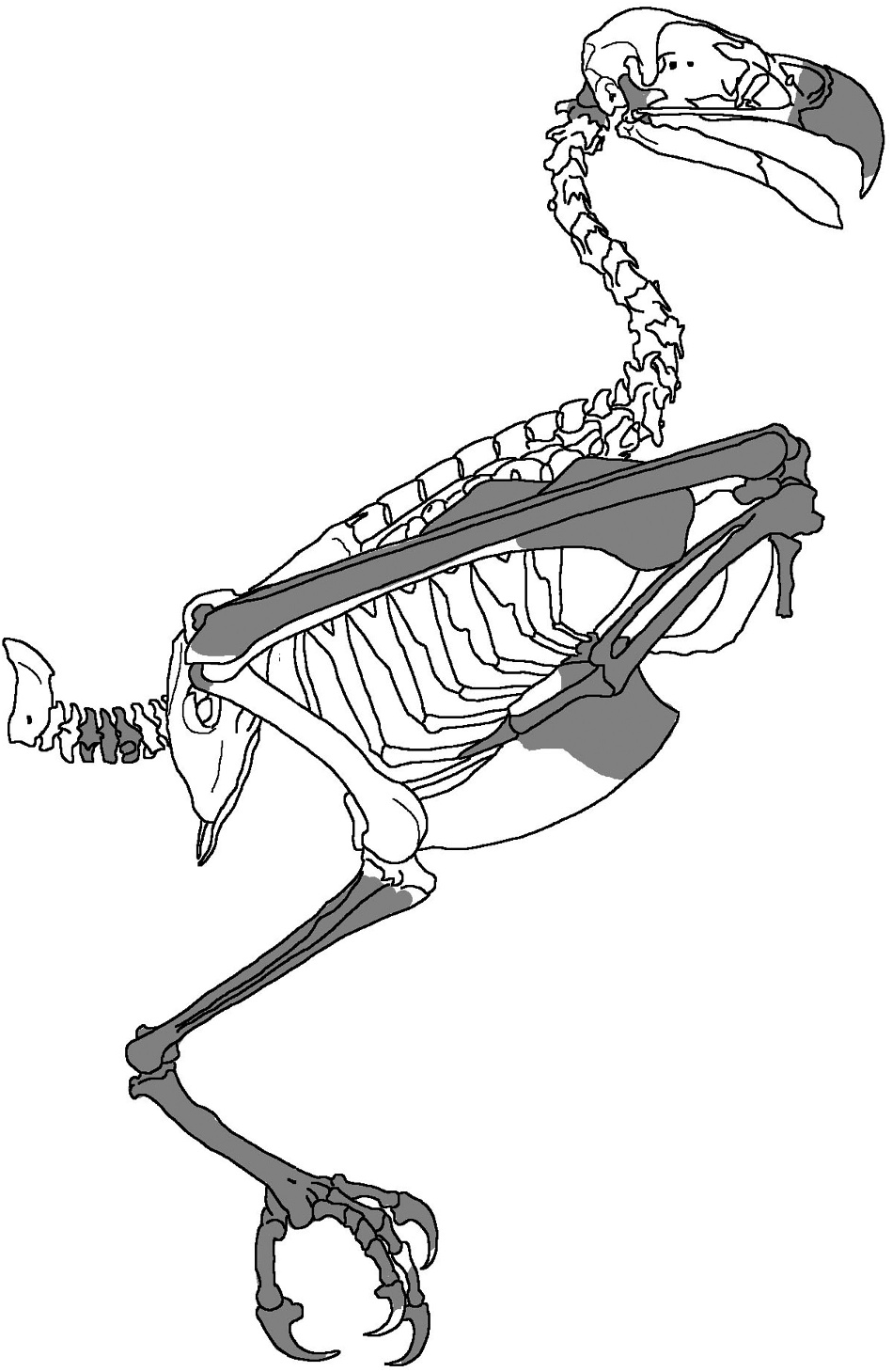
Figure 2. Exemplar accipitriform skeleton, Pandion haliaetus cristatus, derived from an illustration in Eyton (1867), showing the bones preserved in the fossil accipitrid specimen SAMA P.54998 shaded in grey. The illustrated taxon and fossil material are not identical in terms of the morphology of individual elements.

Imageimage/png© Mather, Ellen K.;Lee, Michael S. Y.;Camens, Aaron B.;Worthy, Trevor H.An exceptional partial skeleton of a new basal raptor (Aves: Accipitridae) from the late Oligocene Namba formation, South Australia

Figure 3. Archaehierax sylvestris gen. et. sp. nov. SAMA P.54998 rostrum in lateral (A) and ventral (B) view; quadrate in medial (C) and lateral (D) view; atlas vertebra in caudal (E), lateral (F) and cranial (G) view; and axis vertebra in caudal (H), lateral (I) and cranial (J) view. Specimens in A-D are coated in ammonium chloride.Abbreviations: Arc. At., arcus atlantis; CC, condylus caudalis; CM, condylus medialis; CP, condylus pterygoideus; CS, capitulum squamosum; CT, crista tomialis; FA, facies articularis; FAA, facies articularis axialis; FC, fossa condyloidea; FPB, fossa pneumaticum basiorbitale; FPC, fossa/depressio pneumaticum caudomediale; IAC, incisura caudalis arcus; IF, incisura fossae; IV, incisura ventromedialis; N, nasale; PAC, processus articularis caudalis; PM, pars maxillaris palatini; POr, processus orbitalis; POt, processus oticus. Scale bars are 10 mm.

Imageimage/png© Mather, Ellen K.;Lee, Michael S. Y.;Camens, Aaron B.;Worthy, Trevor H.An exceptional partial skeleton of a new basal raptor (Aves: Accipitridae) from the late Oligocene Namba formation, South Australia

Figure 4. Archaehierax sylvestris gen. et. sp. nov. SAMA P.54998 partial sternum in cranial (A), left lateral (B) and dorsal (C) view; right scapula in lateral (D) and medial (E) view;omal fragments of the left coracoid in medial (F) and lateral (H) view and of the right coracoid in dorsal (G) and medial (I) view. Specimens in A, B,and F-I are coated in ammonium chloride. Abbreviations: AC, apex carina; Ac, acromion; CMC, crista medialis carinae; CtS, cotyla scapularis; ColS, collum scapulae; FAC, facies articularis clavicularis; FAH, facies articularis humeralis; FoNS, foramen nervi supracoracoidei; ILA, impressio ligamenti acrocoracohumeralis; LI, labrum internum; MD, margo dorsalis; PC, pila carinae; PM, pila medialis; P. Procor., processus procoracoideus; SAC, sulcus articularis coracoideus; SE, spina externa; SMS, sulcus m. supracoracoidei; TC, tuberculum coracoideum. Scale bars are 10 mm.

Imageimage/png© Mather, Ellen K.;Lee, Michael S. Y.;Camens, Aaron B.;Worthy, Trevor H.An exceptional partial skeleton of a new basal raptor (Aves: Accipitridae) from the late Oligocene Namba formation, South Australia

Figure 12. Distal left femur NMV P.222435 depicted in cranial (A), caudal (B), medial (C) and lateral (D) view. Abbreviations: CM, condylus medialis;EL,epicondylus lateralis; FPop,fossa poplitea; IG,impressio m. gastrocnemialis lateralis;ILCC,impressio lig. cruciati cranialis; LIC, linea intermuscularis caudalis; PPAP, planum popliteum attachment point; SP, sulcus patellaris; TF, trochlea fibularis; TMGM, tuberculum muscularis gastrocnemialis medialis. Scale bar 10 mm.

Imageimage/png© Mather, Ellen K.;Lee, Michael S. Y.;Camens, Aaron B.;Worthy, Trevor H.An exceptional partial skeleton of a new basal raptor (Aves: Accipitridae) from the late Oligocene Namba formation, South Australia

IMAGES

Gallery(8)

See Gallery

Occurrences with images

CITATIONS

References(11)

  • 1

    AviList Core Team (2025) AviList: The Global Avian Checklist, v2025

    Dyntaxa. Svensk taxonomisk databas
  • 2

    Banks, R. C., R. W. McDiarmid, and A. L. Gardner, 1987: Checklist of Vertebrates of the United States, the U.S. Territories, and Canada. Resource Publication, no. 166. 79.

    Integrated Taxonomic Information System (ITIS)
  • 3

    Benton, M.J. (ed). (1993). The Fossil Record 2. Chapman & Hall, London, 845 pp.

    habitat flag sourceThe Interim Register of Marine and Nonmarine Genera
  • 4

    Benton, M.J. (ed). (1993). The Fossil Record 2. Chapman & Hall, London, 845 pp.

    extant flag sourceThe Interim Register of Marine and Nonmarine Genera
  • 5

    Bock (1994) History and nomenclature of avian family-group names

    Dyntaxa. Svensk taxonomisk databas
  • Source Information

    GBIF Backbone Taxonomy

    GBIF Backbone Taxonomy

    checklist

    The GBIF Backbone Taxonomy is a single, synthetic management classification with the goal of covering all names GBIF is dealing with. It's the taxonomic backbone that allows GBIF to integrate name based information from different resources, no matter if these are occurrence datasets, species pages, names from nomenclators or external sources like EOL, Genbank or IUCN. This backbone allows taxonomic search, browse and reporting operations across all those resources in a consistent way and to provide means to crosswalk names from one source to another.

    It is updated regulary through an automated process in which the Catalogue of Life acts as a starting point also providing the complete higher classification above families. Additional scientific names only found in other authoritative nomenclatural and taxonomic datasets are then merged into the tree, thus extending the original catalogue and broadening the backbones name coverage. The GBIF Backbone taxonomy also includes identifiers for Operational Taxonomic Units (OTUs) drawn from the barcoding resources iBOL and UNITE.

    International Barcode of Life project (iBOL), Barcode Index Numbers (BINs). BINs are connected to a taxon name and its classification by taking into account all names applied to the BIN and picking names with at least 80% consensus. If there is no consensus of name at the species level, the selection process is repeated moving up the major Linnaean ranks until consensus is achieved.

    UNITE - Unified system for the DNA based fungal species, Species Hypotheses (SHs). SHs are connected to a taxon name and its classification based on the determination of the RefS (reference sequence) if present or the RepS (representative sequence). In the latter case, if there is no match in the UNITE taxonomy, the lowest rank with 100% consensus within the SH will be used.

    The GBIF Backbone Taxonomy is available for download at https://hosted-datasets.gbif.org/datasets/backbone/ in different formats together with an archive of all previous versions.

    The following 105 sources have been used to assemble the GBIF backbone with number of names given in brackets:

    • Catalogue of Life Checklist - 4766428 names
    • International Barcode of Life project (iBOL) Barcode Index Numbers (BINs) - 635951 names
    • UNITE - Unified system for the DNA based fungal species linked to the classification - 611208 names
    • The Paleobiology Database - 212054 names
    • World Register of Marine Species - 188857 names
    • The Interim Register of Marine and Nonmarine Genera - 183894 names
    • The World Checklist of Vascular Plants (WCVP) - 131891 names
    • GBIF Backbone Taxonomy - 114350 names
    • TAXREF - 109374 names
    • The Leipzig catalogue of vascular plants - 75380 names
    • ZooBank - 73549 names
    • Integrated Taxonomic Information System (ITIS) - 68377 names
    • Plazi.org taxonomic treatments database - 61346 names
    • Genome Taxonomy Database r207 - 60545 names
    • International Plant Names Index - 52329 names
    • Fauna Europaea - 45077 names
    • The National Checklist of Taiwan (Catalogue of Life in Taiwan, TaiCoL) - 36193 names
    • Dyntaxa. Svensk taxonomisk databas - 35892 names
    • The Plant List with literature - 32692 names
    • United Kingdom Species Inventory (UKSI) - 29643 names
    • Artsnavnebasen - 29208 names
    • The IUCN Red List of Threatened Species - 21221 names
    • Afromoths, online database of Afrotropical moth species (Lepidoptera) - 13961 names
    • Brazilian Flora 2020 project - Projeto Flora do Brasil 2020 - 13829 names
    • Prokaryotic Nomenclature Up-to-Date (PNU) - 10079 names
    • Checklist Dutch Species Register - Nederlands Soortenregister - 8814 names
    • ICTV Master Species List (MSL) - 7852 names
    • Cockroach Species File - 6020 names
    • GRIN Taxonomy - 5882 names
    • Taxon list of fungi and fungal-like organisms from Germany compiled by the DGfM - 4570 names
    • Catalogue of Afrotropical Bees - 3623 names
    • Catalogue of Tenebrionidae (Coleoptera) of North America - 3327 names
    • Checklist of Beetles (Coleoptera) of Canada and Alaska. Second Edition. - 3312 names
    • Systema Dipterorum - 2850 names
    • Catalogue of the Pterophoroidea of the World - 2807 names
    • The Clements Checklist - 2675 names
    • Taxon list of Hymenoptera from Germany compiled in the context of the GBOL project - 2496 names
    • IOC World Bird List, v13.2 - 2366 names
    • Official Lists and Indexes of Names in Zoology - 2310 names
    • National checklist of all species occurring in Denmark - 1922 names
    • Myriatrix - 1876 names
    • Database of Vascular Plants of Canada (VASCAN) - 1822 names
    • Taxon list of vascular plants from Bavaria, Germany compiled in the context of the BFL project - 1771 names
    • Orthoptera Species File - 1742 names
    • A list of the terrestrial fungi, flora and fauna of Madeira and Selvagens archipelagos - 1602 names
    • Aphid Species File - 1565 names
    • World Spider Catalog - 1561 names
    • Taxon list of Jurassic Pisces of the Tethys Palaeo-Environment compiled at the SNSB-JME - 1270 names
    • Backbone Family Classification Patch - 1143 names
    • GBIF Algae Classification - 1100 names
    • International Cichorieae Network (ICN): Cichorieae Portal - 975 names
    • Psocodea Species File - 803 names
    • New Zealand Marine Macroalgae Species Checklist - 787 names
    • Annotated checklist of endemic species from the Western Balkans - 754 names
    • Taxon list of animals with German names (worldwide) compiled at the SMNS - 503 names
    • Catalogue of the Alucitoidea of the World - 472 names
    • Lygaeoidea Species File - 462 names
    • Catálogo de Plantas y Líquenes de Colombia - 422 names
    • GBIF Backbone Patch - 317 names
    • Phasmida Species File - 259 names
    • Cortinariaceae fetched from the Index Fungorum API - 234 names
    • Coreoidea Species File - 233 names
    • GTDB supplement - 139 names
    • Mantodea Species File - 119 names
    • Endemic species in Taiwan - 93 names
    • Taxon list of Araneae from Germany compiled in the context of the GBOL project - 88 names
    • Species of Hominidae - 78 names
    • Taxon list of Sternorrhyncha from Germany compiled in the context of the GBOL project - 77 names
    • Taxon list of mosses from Germany compiled in the context of the GBOL project - 75 names
    • Mammal Species of the World - 73 names
    • Plecoptera Species File - 71 names
    • Species Fungorum Plus - 64 names
    • Catalogue of the type specimens of Cosmopterigidae (Lepidoptera: Gelechioidea) from research collections of the Zoological Institute, Russian Academy of Sciences - 47 names
    • Species named after famous people - 41 names
    • Dermaptera Species File - 36 names
    • Taxon list of Trichoptera from Germany compiled in the context of the GBOL project - 34 names
    • True Fruit Flies (Diptera, Tephritidae) of the Afrotropical Region - 33 names
    • Range and Regularities in the Distribution of Earthworms of the Earthworms of the USSR Fauna. Perel, 1979 - 32 names
    • Taxon list of Diplura from Germany compiled in the context of the GBOL project - 30 names
    • Lista de referencia de especies de aves de Colombia - 2022 - 24 names
    • Taxon list of Auchenorrhyncha from Germany compiled in the context of the GBOL project - 20 names
    • Catalogue of the type specimens of Polycestinae (Coleoptera: Buprestidae) from research collections of the Zoological Institute, Russian Academy of Sciences - 19 names
    • Taxon list of Thysanoptera from Germany compiled in the context of the GBOL project - 19 names
    • Lista de especies de vertebrados registrados en jurisdicción del Departamento del Huila - 18 names
    • Taxon list of Microcoryphia (Archaeognatha) from Germany compiled in the context of the GBOL project - 15 names
    • Catalogue of the type specimens of Bufonidae and Megophryidae (Amphibia: Anura) from research collections of the Zoological Institute, Russian Academy of Sciences - 12 names
    • Grylloblattodea Species File - 11 names
    • Coleorrhyncha Species File - 9 names
    • Taxon list of liverworts from Germany compiled in the context of the GBOL project - 9 names
    • Embioptera Species File - 7 names
    • Taxon list of Pisces and Cyclostoma from Germany compiled in the context of the GBOL project - 6 names
    • Taxon list of Pteridophyta from Germany compiled in the context of the GBOL project - 6 names
    • Taxon list of Siphonaptera from Germany compiled in the context of the GBOL project - 5 names
    • The Earthworms of the Fauna of Russia. Perel, 1997 - 5 names
    • Taxon list of Zygentoma from Germany compiled in the context of the GBOL project - 4 names
    • Asiloid Flies: new taxa of Diptera: Apioceridae, Asilidae, and Mydidae - 3 names
    • Taxon list of Protura from Germany compiled in the context of the GBOL project - 3 names
    • Taxon list of hornworts from Germany compiled in the context of the GBOL project - 2 names
    • Chrysididae Species File - 1 names
    • Taxon list of Dermaptera from Germany compiled in the context of the GBOL project - 1 names
    • Taxon list of Diplopoda from Germany in the context of the GBOL project - 1 names
    • Taxon list of Orthoptera (Grashoppers) from Germany compiled at the SNSB - 1 names
    • Taxon list of Pscoptera from Germany compiled in the context of the GBOL project - 1 names
    • Taxon list of Pseudoscorpiones from Germany compiled in the context of the GBOL project - 1 names
    • Taxon list of Raphidioptera from Germany compiled in the context of the GBOL project - 1 names

    GBIF Secretariat (2023). GBIF Backbone Taxonomy. Checklist dataset https://doi.org/10.15468/39omei accessed via GBIF.org on 2026-06-14.

    CC BYPublished 8/28/2023View dataset
    GBIF Usage Key
    2877
    Dataset Key
    d7dddbf4-2cf0-4f39-9b2a-bb099caae36c
    Origin
    source
    Backbone Key
    2877
    Taxon ID
    gbif:2877
    Last Crawled
    8/22/2023
    Last Interpreted
    8/22/2023