AnimaliaNot EvaluatedacceptedspeciesAcceptedRestricted
Corallimorphus niwa

Corallimorphus niwa

Fautin, 2011

GBIF:6472329

0countries
0year

PROFILE

Species Profile

Habitat

Marine

ABOUT

Descriptions(3)

Etymology. The specific name niwa honors the New Zealand National Institute of Water and Atmospheric Research. It should be considered an arbitrary combination of letters. The gender of Corallimorphus is masculine. Differential diagnosis. Corallimorphus niwa n. sp. differs from all species known in the genus by having an approximately equal number of discal and marginal tentacles. The five species of the genus currently considered valid (Fautin 2010) fall into two groups: those of the rigidus group (consisting of C. rigidus, C. denhartogi, and C. ingens) have about twice as many marginal as discal tentacles, and those of the profundus group (consisting of C. profundus and C. pilatus) have about four times twice as many marginal as discal tentacles (Fautin et al. 2002). The bumps of mesoglea, most of which form the base of discal tentacles in C. niwa n. sp., are unknown among corallimorpharians, and the pigmentation is likewise unique, although its absence in other species may be an artifact of preservation (it is absent in some poorly-preserved specimens of C. niwa n. sp.). Knowledge of nematocysts of deep-sea corallimorpharians is incomplete because typically the condition of specimens is poor (Fautin 1984). However, there are consistent differences with those of the two species that occur in the same part of the world as C. niwa n. sp. Data for C. profundus are from Grebelny (1975, in which the species is referred to as C. antarcticus), Fautin (1984), and Riemann-Zürneck and Iken (2003): the tentacles have hoplotelic microbasic p - mastigophores and microbasic b - mastigophores longer than those recorded from C. niwa n. sp., and in the mesenterial filaments, the smaller holotrichs of C. niwa are shorter. Compared with C. rigidus, data for which are given by Fautin (1984), the holotrichs in the actinopharynx and the microbasic b - mastigophores in the mesenterial filaments of C. niwa are shorter. Oral disc / tentacles spirocysts A (28.4) 29.3 – 63.7 x 3.7 – 6.4 N = 53 n = 4 / 4 microbasic b - mastigophores B 13.7 – 24.5 x 3.9 – 5.9 N = 22 n = 3 / 4 hoplotelic microbasic p - mastigophores * C (22.5) 26.4 – 35.3 (36.2) x 5.9 – 12.7 N = 34 n = 3 / 4 hoplotelic microbasic p - mastigophores ** D 52.9 – 81.3 (88.0) x 3.7 – 4.4 (5.4) N = 23 n = 1 / 4 hoplotelic microbasic p - mastigophores *** E? Actinopharynx holotrichs D (44.0) 46.0 – 69.5 x 9.8 – 16.1 (17.1) N = 53 n = 5 / 5 Mesenterial filaments (??) microbasic b - mastigophores B 14.7 – 19.6 (21.5) x 3.9 – 5.9 N = 18 n = 3 / 5 hoplotelic microbasic p - mastigophores * D (41.1) 44.0 – 68.8 x (4.1) 4.9 – 8.0 N = 50 n = 5 / 5 holotrichs F 46.0 – 67.5 x 9.3 – 14.7 N = 6 n = 3 / 5 holotrichs * G (76.3) 81.2 – 109.6 x (14.7) 16.1 – 22.5 N = 50 n = 5 / 5 * Larger in larger animals ** Nematocysts of this type seem restricted to acrospheres. *** Nematocysts of this type seem restricted to acrospheres. Because some capsules exceed 200 µm in length, they were broken or twisted, so a photograph of the entire nematocyst could not be obtained; the basal end is pointed.
Corallimorphus niwa new species (Cnidaria: Anthozoa), New Zealand members of Corallimorphus, and redefinition of Corallimorphidae and its members

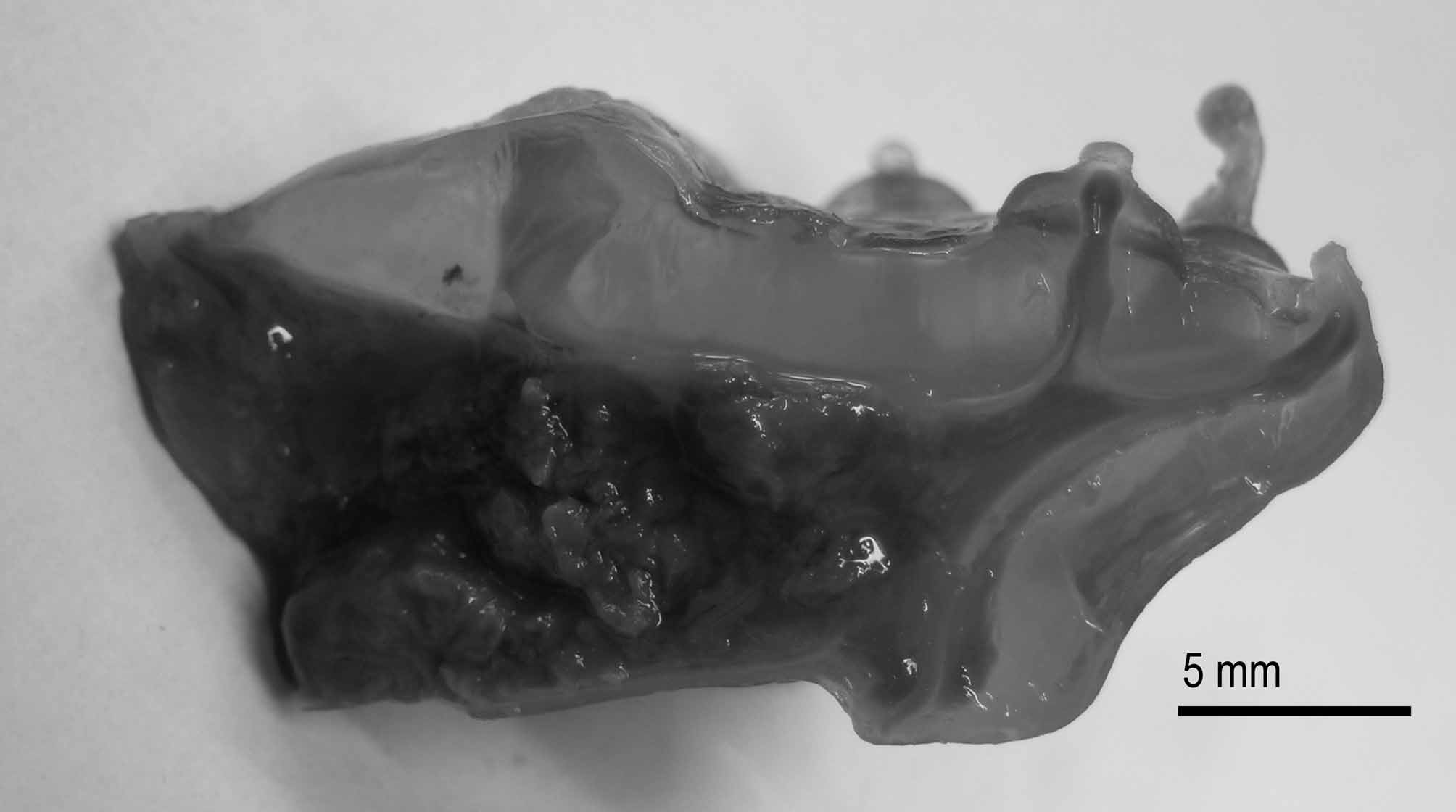
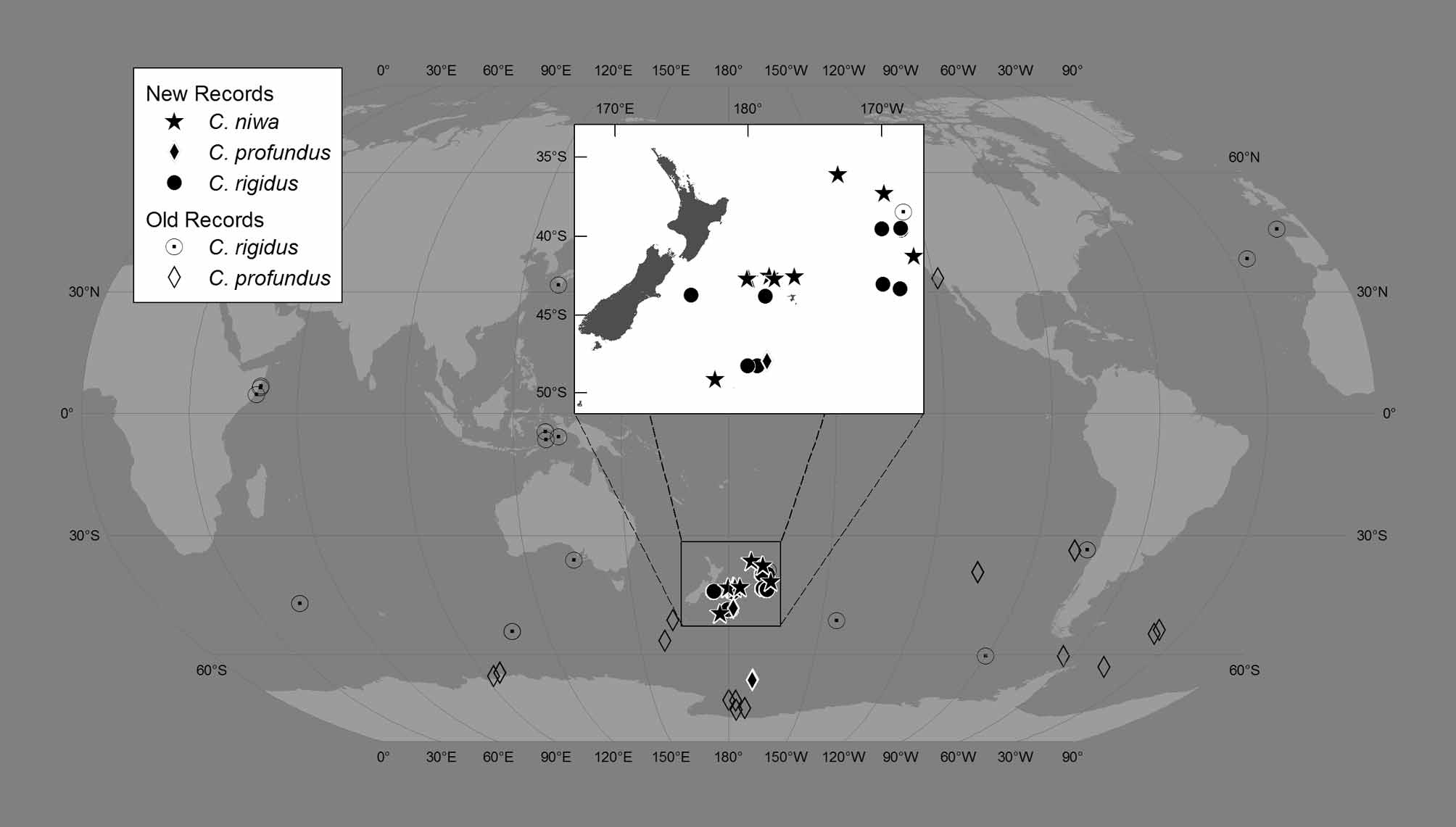
Material examined. See Table 1. Form, size, and color. Oral disc more or less circular, flat to strongly domed (Fig. 1 A), diameter 30 to 125 mm in those studied; wider than or about the same diameter as pedal disc (Fig. 1 B), which is more or less circular and flat or slightly concave. Column very short (10 – 30 mm), either straight or curved inward, so mid-column is narrower than either oral or pedal disc; typically margin overhangs pedal disc. Limbus may form a ridge as if mesoglea were bunched up by shortening of column or pulling in of pedal disc. Texture of stiff gelatin due to extraordinarily thick, hyaline mesoglea of column and oral disc (Fig. 2); pedal disc so thin that mesenterial insertions can be seen through it (Fig. 1 B). Animal 125 mm diameter (NIWA 34507: the holotype) with column and oral disc mesoglea 5 mm thick, pedal disc mesoglea 2 mm thick. Immediately after animal is collected, oral disc ectoderm brownish, rust red along mesenterial insertions; longitudinal red lines (presumably along mesenterial insertions) may be present on column. Pigment may be retained in preservation (Fig. 1 A), ectoderm may be yellowish (Fig. 1 C), or ectoderm may be entirely sloughed off. Oral disc and tentacles. Mouth central, slit-like (in holotype, mouth 18 mm long). Distal end of actinopharynx exposed, red in animals that retain pigmentation. Tentacles not contractile, short, most with acrosphere slightly greater in diameter than distal end of tentacle stalk (Fig. 1 A) (acrosphere may have detached from tentacles seeming to lack one; fragility of the stalk-acrosphere junction was noted by Fautin et al. 2002). Discal and marginal tentacles about equal in number (holotype has 56 discal, 52 marginal; paratype KUIZ 0 0 321 has 24 discal, 24 marginal; paratype NIWA 14329 has 38 discal, 38 marginal). FIGURE 1. Specimens of Corallimorphus; all except D are preserved. A, Oral disc of holotype of Corallimorphus niwa n. sp. (NIWA 34507), diameter 125 mm. B, Pedal disc of holotype of Corallimorphus niwa n. sp., diameter 100 mm. C, Paratype of Corallimorphus niwa n. sp. (ex NIWA 41750), oral disc 90 x 100 mm. D, Corallimorphus niwa n. sp. in situ. Diameter about 200 mm; location 42.64458333 º S, 177.8605833 º E; depth 1210 m. E, Corallimorphus profundus Moseley, 1877 (NIWA 41760). F, Corallimorphus rigidus Moseley, 1877 (NIWA 34571); diameter 50 mm. Discal tentacles radially and cyclically arrayed, to about 5 mm long. Most tentacles arise through very broad bump as much as 12 mm diameter, with core of endoderm visible through mesoglea (Fig. 2), giving tentacle the appearance of a nipple. Bumps more prominent in larger individuals, and within an individual along lower-order endocoels (in one individual, bumps of tentacles communicating with primary endocoels 8 – 10 mm diameter, with secondaries 8 mm, with tertiaries 5 mm). Three or four tentacles connect with each primary endocoel in largest individuals examined (e. g. holotype), highest-order endocoel with only one very small discal tentacle. Bumps diminish in size radially from mouth toward margin, and most peripheral discal tentacles lack bump. Twelve thickenings immediately around mouth ovoid, radially arrayed, lack tentacles (Fig. 1 A). Reddish radial lines on oral disc follow mesenterial insertions: 6 pairs extend from each side of mouth (along complete mesenteries, presumably), other lines extend from margin only partway to mouth; surround bumps that form base of tentacles (Fig. 1 A). Marginal tentacles very short (1 – 2 mm, each with acrosphere 1 – 1.5 mm diameter in largest individuals examined; Fig, 1 A, B, Fig. 2), may lack basal bump. Alternate ones communicate with exocoels and endocoels, the latter more orad than former. Internal anatomy. Interior poorly preserved in all specimens examined; perhaps thick mesoglea prevents penetration of preservative. Mucusy when cut. Actinopharynx with many deep longitudinal folds; ectoderm, if present, usually reddish-brown. No siphonoglyphs. Because endoderm disintegrated, nature of musculature and pattern of gametogenic mesenteries could not be determined. About 48 pairs of mesenteries, seemingly regularly arrayed. Arrangement and completeness of mesenteries could not be determined. No marginal sphincter muscle (Fig. 3). Cnidae. Cnidom spirocysts, microbasic b - mastigophores, hoplotelic microbasic p - mastigophores, holotrichs (Fig. 4). For distribution and sizes, see Table 2. This inventory may be incomplete due to poor preservation of the specimens examined. Because ectoderm is very sparse or absent on oral disc and tentacles, measurements are given for the two together. It appears, from the few samples that could be obtained from acrospheres, most of which lack ectoderm or were even entirely missing, that nematocysts of some types are confined to acrospheres. Nematocysts examined in smears of the mucusy material in the coelenteron are assumed to be from mesenterial filaments, but that could not be ascertained; the pear-shaped cnidae I refer to as holotrichs, and that are the only type of nematocyst in the actinopharynx, appeared in some smears of mesenterial filaments. Habitat. Three lines of evidence indicate the animals probably live unattached on soft sediment. An in-situ photograph (Fig. 1 D) of what is almost certainly Corallimorphus niwa n. sp., based on length and distribution of capitate tentacles, was taken in an area of muddy soft sediment. The pedal discs of all individuals examined were unattached, and showed no evidence of having been attached to anything; specimens of some other species of Corallimorphus (Fautin 1984; below) had pebbles attached to the pedal disc. The low discoidal form of the animal is hydrodynamically favorable for an unattached polyp; it is similar to that of the sea anemone Liponema, which lives unattached on soft sediments (Dunn & Bakus 1977). Type locality. Northern edge of Chatham Rise (42.5390 – 42.5433 º S, 178.3382 – 178.3400 º E), at 1404 – 1414 m. Geographic and bathymetric distribution. Corallimorphus niwa n. sp. is known only from immediately around New Zealand (Fig. 5), at depths of about 900 to 1700 m.
Corallimorphus niwa new species (Cnidaria: Anthozoa), New Zealand members of Corallimorphus, and redefinition of Corallimorphidae and its members
Material examined. See Table 3. Morphology. Color yellowish. Diameters of those examined: oral disc 20 – 50 mm, pedal disc 20 – 40 mm. Column length to ~ 25 mm. Mouth a slit; lipless. The cylindrical animal brings to mind a jester’s cap, with large acrospheres on the largest of the floppy marginal tentacles (Fig. 1 E; figure 1 in Fautin 1984). Tentacles of rare individuals with alternately dark and light rings along length (Fig. 1 E). Endocoelic marginal tentacles may be as long as a third oral disc radius (about column length); those of lower orders longer than those of higher orders. Exocoelic marginal tentacles shortest of all, of rather uniform length. The sparse discal tentacles at most half as long as the longest marginal tentacles. Discal tentacles communicating with primary endocoels arrayed in an approximate circle not far from mouth; those communicating with secondary endocoels arrayed in an approximate circle about halfway between mouth and margin. If more than 12 discal tentacles, those communicating with tertiary endocoels near margin. Ideally the ratio of marginal to discal tentacles 4: 1, but I (Fautin 1984) found it varied from 3.1 to 4.7: 1; in NIWA specimens examined, the ratio was 2.7 – 4.3: 1. Mesenterial insertions visible through oral and pedal disc as dark lines (Fig. 1 E). Some animals attached to small black stones. Cnidae. Those few that I was able to measure from NIWA specimens agreed with what is known for the species (Fautin 1984). Geographic range. This species has a nearly cosmopolitan distribution (Fig. 5), but it was previously known only to 60 º S. The depths at which these specimens were taken are within the known range of the species.
Corallimorphus niwa new species (Cnidaria: Anthozoa), New Zealand members of Corallimorphus, and redefinition of Corallimorphidae and its members

Export occurrence data

Darwin Core Archive (ZIP)

GEOGRAPHY

Distribution Map

Occurrence Map

Loading map…

Tiles © GBIF Maps API | Map powered by MapLibre GL

REGIONS

Geographic Distribution(2)

New Zealand Exclusive Economic Zone
New Zealand Exclusive Economic Zone(NZ)

DATA

Occurrence Datasets

Loading datasets…

CLASSIFICATION

Taxonomic Classification Tree

MULTIMEDIA

Media Files(4)

FIGURE 2. Longitudinally sectioned wedge of Corallimorphus niwa n. sp. illustrating hyaline mesoglea that forms bumps around each tentacle, and is thickest at base of tentacles, thin in pedal disc.

Imageimage/png© Fautin, Daphne GailCorallimorphus niwa new species (Cnidaria: Anthozoa), New Zealand members of Corallimorphus, and redefinition of Corallimorphidae and its members

FIGURE 3. Longitudinal histological section at margin of Corallimorphus niwa n. sp. through oral disc, column, and capitate marginal tentacle. Note thin endoderm (immediately above and below the letter N) and absence of marginal sphincter muscle. Most of the thin ectoderm has been sloughed off; a remnant of it (below the letter C) is on the tip of a marginal tentacle.

Imageimage/png© Fautin, Daphne GailCorallimorphus niwa new species (Cnidaria: Anthozoa), New Zealand members of Corallimorphus, and redefinition of Corallimorphidae and its members
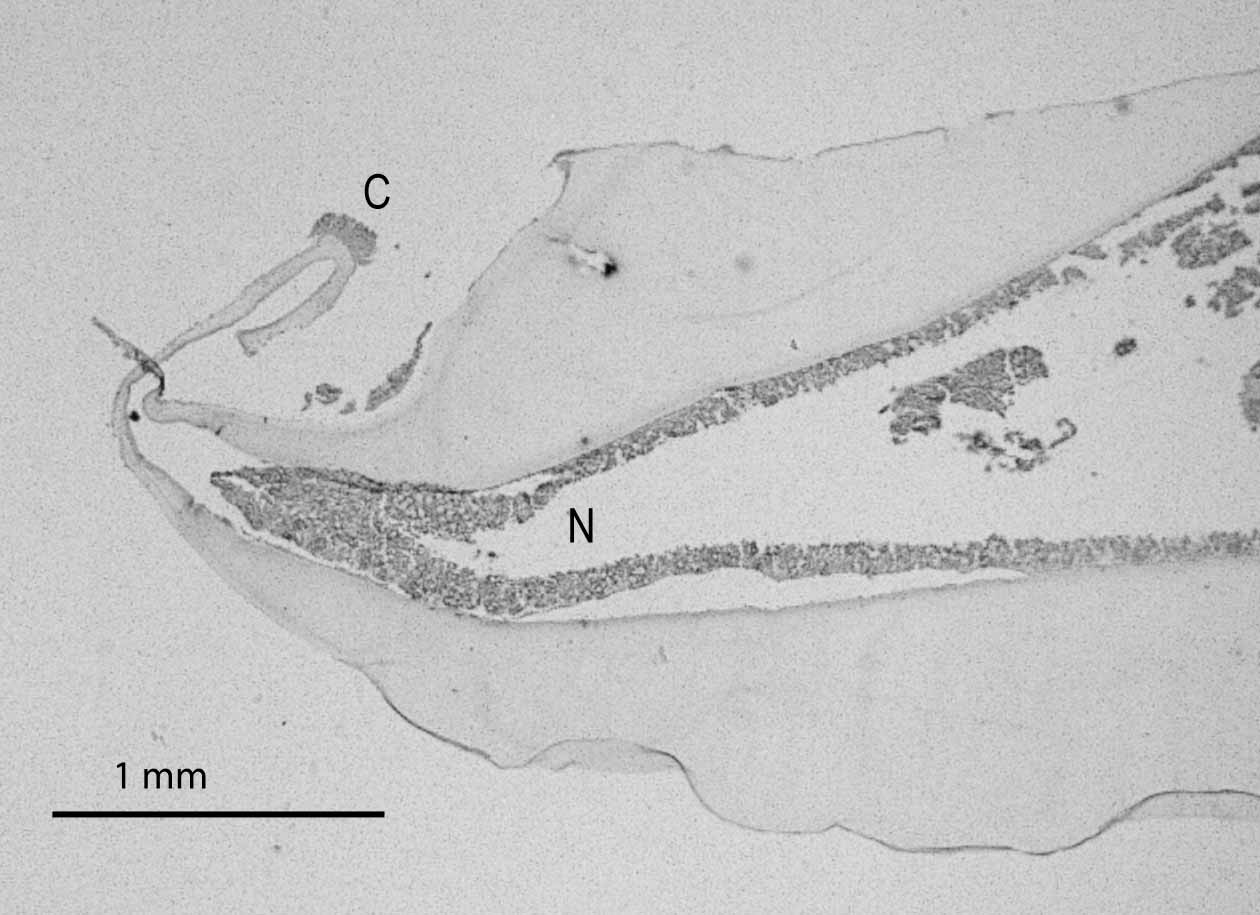
FIGURE 4. Cnidae of Corallimorphus niwa n. sp. See Table 2 for data on size range and distribution.

Imageimage/png© Fautin, Daphne GailCorallimorphus niwa new species (Cnidaria: Anthozoa), New Zealand members of Corallimorphus, and redefinition of Corallimorphidae and its members
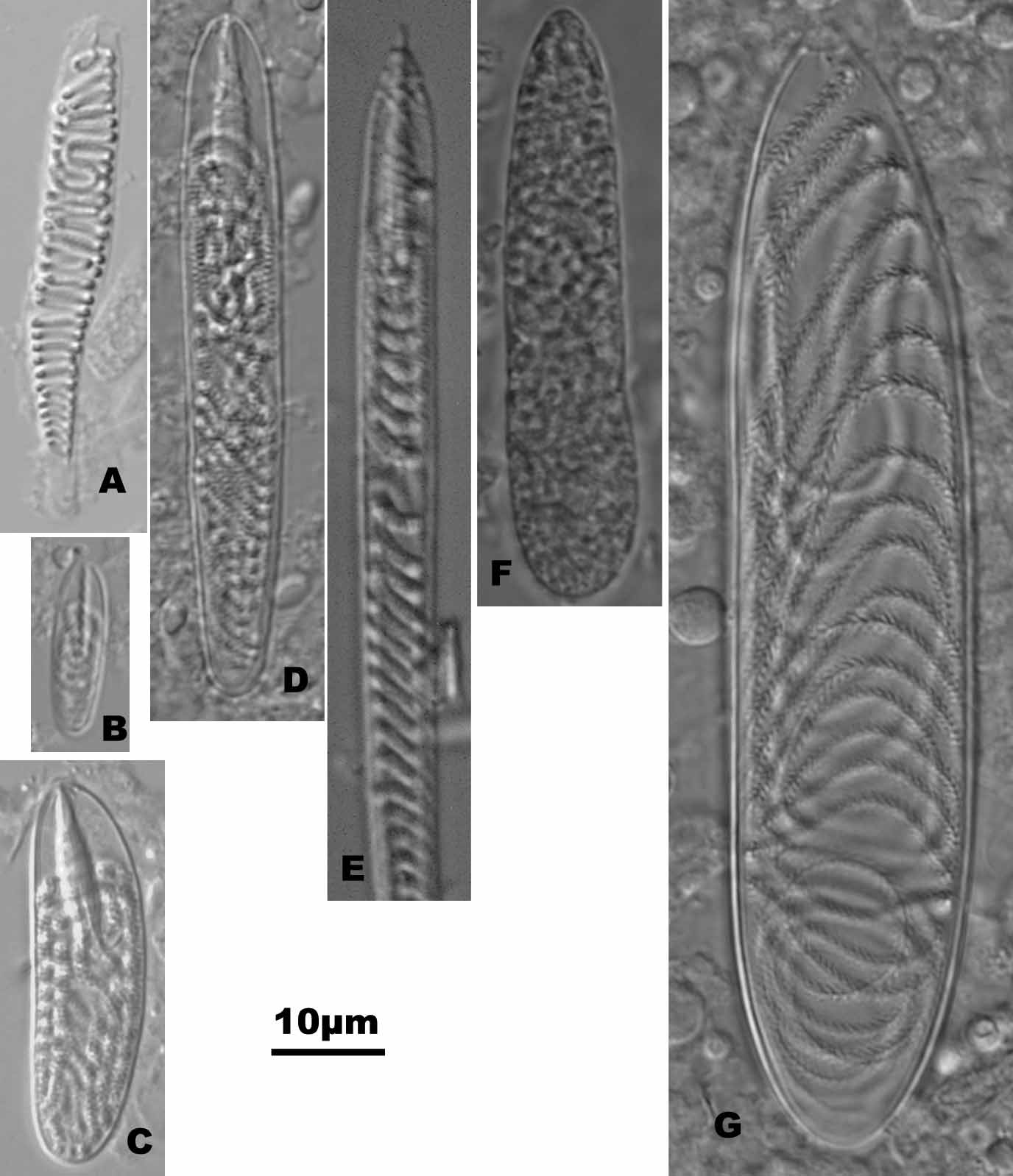
FIGURE 5. Geographic distribution of Corallimorphus niwa n. sp., C. profundus, and C. rigidus, based on published records and data presented here. Existing occurrence records are identified as “ old ” and the symbols are open; occurrence records reported for the first time here are identified as “ new ” and the symbols are filled.

Imageimage/png© Fautin, Daphne GailCorallimorphus niwa new species (Cnidaria: Anthozoa), New Zealand members of Corallimorphus, and redefinition of Corallimorphidae and its members
IMAGES

Gallery(4)

See Gallery

Occurrences with images

CITATIONS

References(1)

  • 1

    Fautin, D.G. (2011). Corallimorphus niwa new species (Cnidaria: Anthozoa), New Zealand members of Corallimorphus, and redefinition of Corallimorphidae and its members. Zootaxa, 2775: 37–49.

    original descriptionWorld Register of Marine Species
  • Source Information

    GBIF Backbone Taxonomy

    GBIF Backbone Taxonomy

    checklist

    The GBIF Backbone Taxonomy is a single, synthetic management classification with the goal of covering all names GBIF is dealing with. It's the taxonomic backbone that allows GBIF to integrate name based information from different resources, no matter if these are occurrence datasets, species pages, names from nomenclators or external sources like EOL, Genbank or IUCN. This backbone allows taxonomic search, browse and reporting operations across all those resources in a consistent way and to provide means to crosswalk names from one source to another.

    It is updated regulary through an automated process in which the Catalogue of Life acts as a starting point also providing the complete higher classification above families. Additional scientific names only found in other authoritative nomenclatural and taxonomic datasets are then merged into the tree, thus extending the original catalogue and broadening the backbones name coverage. The GBIF Backbone taxonomy also includes identifiers for Operational Taxonomic Units (OTUs) drawn from the barcoding resources iBOL and UNITE.

    International Barcode of Life project (iBOL), Barcode Index Numbers (BINs). BINs are connected to a taxon name and its classification by taking into account all names applied to the BIN and picking names with at least 80% consensus. If there is no consensus of name at the species level, the selection process is repeated moving up the major Linnaean ranks until consensus is achieved.

    UNITE - Unified system for the DNA based fungal species, Species Hypotheses (SHs). SHs are connected to a taxon name and its classification based on the determination of the RefS (reference sequence) if present or the RepS (representative sequence). In the latter case, if there is no match in the UNITE taxonomy, the lowest rank with 100% consensus within the SH will be used.

    The GBIF Backbone Taxonomy is available for download at https://hosted-datasets.gbif.org/datasets/backbone/ in different formats together with an archive of all previous versions.

    The following 105 sources have been used to assemble the GBIF backbone with number of names given in brackets:

    • Catalogue of Life Checklist - 4766428 names
    • International Barcode of Life project (iBOL) Barcode Index Numbers (BINs) - 635951 names
    • UNITE - Unified system for the DNA based fungal species linked to the classification - 611208 names
    • The Paleobiology Database - 212054 names
    • World Register of Marine Species - 188857 names
    • The Interim Register of Marine and Nonmarine Genera - 183894 names
    • The World Checklist of Vascular Plants (WCVP) - 131891 names
    • GBIF Backbone Taxonomy - 114350 names
    • TAXREF - 109374 names
    • The Leipzig catalogue of vascular plants - 75380 names
    • ZooBank - 73549 names
    • Integrated Taxonomic Information System (ITIS) - 68377 names
    • Plazi.org taxonomic treatments database - 61346 names
    • Genome Taxonomy Database r207 - 60545 names
    • International Plant Names Index - 52329 names
    • Fauna Europaea - 45077 names
    • The National Checklist of Taiwan (Catalogue of Life in Taiwan, TaiCoL) - 36193 names
    • Dyntaxa. Svensk taxonomisk databas - 35892 names
    • The Plant List with literature - 32692 names
    • United Kingdom Species Inventory (UKSI) - 29643 names
    • Artsnavnebasen - 29208 names
    • The IUCN Red List of Threatened Species - 21221 names
    • Afromoths, online database of Afrotropical moth species (Lepidoptera) - 13961 names
    • Brazilian Flora 2020 project - Projeto Flora do Brasil 2020 - 13829 names
    • Prokaryotic Nomenclature Up-to-Date (PNU) - 10079 names
    • Checklist Dutch Species Register - Nederlands Soortenregister - 8814 names
    • ICTV Master Species List (MSL) - 7852 names
    • Cockroach Species File - 6020 names
    • GRIN Taxonomy - 5882 names
    • Taxon list of fungi and fungal-like organisms from Germany compiled by the DGfM - 4570 names
    • Catalogue of Afrotropical Bees - 3623 names
    • Catalogue of Tenebrionidae (Coleoptera) of North America - 3327 names
    • Checklist of Beetles (Coleoptera) of Canada and Alaska. Second Edition. - 3312 names
    • Systema Dipterorum - 2850 names
    • Catalogue of the Pterophoroidea of the World - 2807 names
    • The Clements Checklist - 2675 names
    • Taxon list of Hymenoptera from Germany compiled in the context of the GBOL project - 2496 names
    • IOC World Bird List, v13.2 - 2366 names
    • Official Lists and Indexes of Names in Zoology - 2310 names
    • National checklist of all species occurring in Denmark - 1922 names
    • Myriatrix - 1876 names
    • Database of Vascular Plants of Canada (VASCAN) - 1822 names
    • Taxon list of vascular plants from Bavaria, Germany compiled in the context of the BFL project - 1771 names
    • Orthoptera Species File - 1742 names
    • A list of the terrestrial fungi, flora and fauna of Madeira and Selvagens archipelagos - 1602 names
    • Aphid Species File - 1565 names
    • World Spider Catalog - 1561 names
    • Taxon list of Jurassic Pisces of the Tethys Palaeo-Environment compiled at the SNSB-JME - 1270 names
    • Backbone Family Classification Patch - 1143 names
    • GBIF Algae Classification - 1100 names
    • International Cichorieae Network (ICN): Cichorieae Portal - 975 names
    • Psocodea Species File - 803 names
    • New Zealand Marine Macroalgae Species Checklist - 787 names
    • Annotated checklist of endemic species from the Western Balkans - 754 names
    • Taxon list of animals with German names (worldwide) compiled at the SMNS - 503 names
    • Catalogue of the Alucitoidea of the World - 472 names
    • Lygaeoidea Species File - 462 names
    • Catálogo de Plantas y Líquenes de Colombia - 422 names
    • GBIF Backbone Patch - 317 names
    • Phasmida Species File - 259 names
    • Cortinariaceae fetched from the Index Fungorum API - 234 names
    • Coreoidea Species File - 233 names
    • GTDB supplement - 139 names
    • Mantodea Species File - 119 names
    • Endemic species in Taiwan - 93 names
    • Taxon list of Araneae from Germany compiled in the context of the GBOL project - 88 names
    • Species of Hominidae - 78 names
    • Taxon list of Sternorrhyncha from Germany compiled in the context of the GBOL project - 77 names
    • Taxon list of mosses from Germany compiled in the context of the GBOL project - 75 names
    • Mammal Species of the World - 73 names
    • Plecoptera Species File - 71 names
    • Species Fungorum Plus - 64 names
    • Catalogue of the type specimens of Cosmopterigidae (Lepidoptera: Gelechioidea) from research collections of the Zoological Institute, Russian Academy of Sciences - 47 names
    • Species named after famous people - 41 names
    • Dermaptera Species File - 36 names
    • Taxon list of Trichoptera from Germany compiled in the context of the GBOL project - 34 names
    • True Fruit Flies (Diptera, Tephritidae) of the Afrotropical Region - 33 names
    • Range and Regularities in the Distribution of Earthworms of the Earthworms of the USSR Fauna. Perel, 1979 - 32 names
    • Taxon list of Diplura from Germany compiled in the context of the GBOL project - 30 names
    • Lista de referencia de especies de aves de Colombia - 2022 - 24 names
    • Taxon list of Auchenorrhyncha from Germany compiled in the context of the GBOL project - 20 names
    • Catalogue of the type specimens of Polycestinae (Coleoptera: Buprestidae) from research collections of the Zoological Institute, Russian Academy of Sciences - 19 names
    • Taxon list of Thysanoptera from Germany compiled in the context of the GBOL project - 19 names
    • Lista de especies de vertebrados registrados en jurisdicción del Departamento del Huila - 18 names
    • Taxon list of Microcoryphia (Archaeognatha) from Germany compiled in the context of the GBOL project - 15 names
    • Catalogue of the type specimens of Bufonidae and Megophryidae (Amphibia: Anura) from research collections of the Zoological Institute, Russian Academy of Sciences - 12 names
    • Grylloblattodea Species File - 11 names
    • Coleorrhyncha Species File - 9 names
    • Taxon list of liverworts from Germany compiled in the context of the GBOL project - 9 names
    • Embioptera Species File - 7 names
    • Taxon list of Pisces and Cyclostoma from Germany compiled in the context of the GBOL project - 6 names
    • Taxon list of Pteridophyta from Germany compiled in the context of the GBOL project - 6 names
    • Taxon list of Siphonaptera from Germany compiled in the context of the GBOL project - 5 names
    • The Earthworms of the Fauna of Russia. Perel, 1997 - 5 names
    • Taxon list of Zygentoma from Germany compiled in the context of the GBOL project - 4 names
    • Asiloid Flies: new taxa of Diptera: Apioceridae, Asilidae, and Mydidae - 3 names
    • Taxon list of Protura from Germany compiled in the context of the GBOL project - 3 names
    • Taxon list of hornworts from Germany compiled in the context of the GBOL project - 2 names
    • Chrysididae Species File - 1 names
    • Taxon list of Dermaptera from Germany compiled in the context of the GBOL project - 1 names
    • Taxon list of Diplopoda from Germany in the context of the GBOL project - 1 names
    • Taxon list of Orthoptera (Grashoppers) from Germany compiled at the SNSB - 1 names
    • Taxon list of Pscoptera from Germany compiled in the context of the GBOL project - 1 names
    • Taxon list of Pseudoscorpiones from Germany compiled in the context of the GBOL project - 1 names
    • Taxon list of Raphidioptera from Germany compiled in the context of the GBOL project - 1 names

    GBIF Secretariat (2023). GBIF Backbone Taxonomy. Checklist dataset https://doi.org/10.15468/39omei accessed via GBIF.org on 2026-06-21.

    CC BYPublished 8/28/2023View dataset
    GBIF Usage Key
    6472329
    Dataset Key
    d7dddbf4-2cf0-4f39-9b2a-bb099caae36c
    Origin
    source
    Backbone Key
    6472329
    Taxon ID
    gbif:6472329
    Last Crawled
    8/22/2023
    Last Interpreted
    8/22/2023