AnimaliaNot EvaluatedacceptedspeciesAccepted
Fimbrora calsubia

Fimbrora calsubia

ヨリフサボヤ·Monniot C. & Monniot F., 1991

GBIF:6486747

0year

PROFILE

Species Profile

Habitat

Marine

ABOUT

Descriptions(4)

Description. Individual ca. 20 cm in length including oral siphon (Fig. 2 A, B). Tunic opaque and gelatinous; blood vessels running on surface of tunic (Fig. 2 B); fine warts, each about 0.5 mm in diameter, scattered evenly over entire tunic. Body attached to substrate with its posterior end (Fig. 2 A, B). Oral siphon enlarged, ca. 10 cm in diameter; single annular muscle strand running on outer edge of oral siphon; thread-like lobes, 52 in number, tightly arranged to each other on oral-siphon edge; single groove radially arranged on edge of oral siphon between base of each lobe; muscle strand associated to each lobe, running on inner wall of oral-siphon edge from lobe base for ca. 1 cm; beneath inner surface of oral siphon, neural cords radially running from neural ganglion (Fig. 2 C). Oral aperture situated 2.5 cm anterior to neural ganglion. Atrial siphon 1.5 cm in diameter; 37 blood vessels longitudinally running on surface of atrial siphon (Fig. 2 D). Body wall attached to tunic on oral siphon, heart and renal vesicles; irregular cavity existing between tunic and body wall; inner surface of tunic covered with epithelial tissue. Neural ganglion situated between oral siphon and atrial siphon. On base of oral siphon, 105 oral tentacles present, each being ca. 8 mm in length. Peripharyngeal band made of single lamina running in a short distance posterior to oral tentacles, forming V-shape posterior to neural gland aperture (Fig. 3 A); latter being single in number, almost straight in shape (Fig. 3 A) and opening at dorsal tubercle. Pharynx connected by mesenteries to peripharyngeal epithelium; mesenteries 0.5 - 3.0 mm in diameter (Fig. 3 B). Smooth dorsal lamina running along mid-line on ventral side of pharynx (Fig. 3 A, B). Longitudinal and transverse vessels running on inner surface of pharynx (Fig. 3 C); 6 - 10 stigmata without lateral cilia per mesh (Fig. 3 C). Secondary branchial papillae present on intersections of longitudinal and transverse vessels (Fig. 3 C). Digestive tract positioned on left side of body (Fig. 4 A). Oesophagus opening to left side of dorso-posterior part of pharynx. Stomach about 1.5 cm in length, having 10 folds, surrounded with renal vesicles (Fig. 4 A); multiple crustaceans (probably copepods) found in stomach lumen (Fig. 4 B). Intestinal loop S-shaped, having primary loop and secondary loop; intestine ca. 7 cm in length, ca. 5 mm in diameter (Fig. 4 A). Anus smoothly edged, opening close to atrial siphon (Fig. 4 A). Gonad situated proximally on intestinal loop (Fig. 4 C). Ovaries surrounded with male testis (Fig. 4 C, D). Oviduct and spermiduct running along secondary loop, opening close to anus (Fig. 4 A). Eggs contained in ovaries and oviduct, up to 0.2 mm in diameter (Fig. 4 D).
Supplemental re-description of a deep-sea ascidian, Fimbrora calsubia (Ascidiacea, Enterogona), with an inference of its phylogenetic position
Figs 2, 3, 4
Supplemental re-description of a deep-sea ascidian, Fimbrora calsubia (Ascidiacea, Enterogona), with an inference of its phylogenetic position
Material examined. One individual, JAMSTEC No. 111618, collected by N. Hookabe on 26 September 2022, about 400 km off the Pacific coast of middle Honshu, Japan, 30 ° 47.05 ' N, 138 ° 44.72 ' E, at a depth of 2027 m (Fig. 1).
Supplemental re-description of a deep-sea ascidian, Fimbrora calsubia (Ascidiacea, Enterogona), with an inference of its phylogenetic position
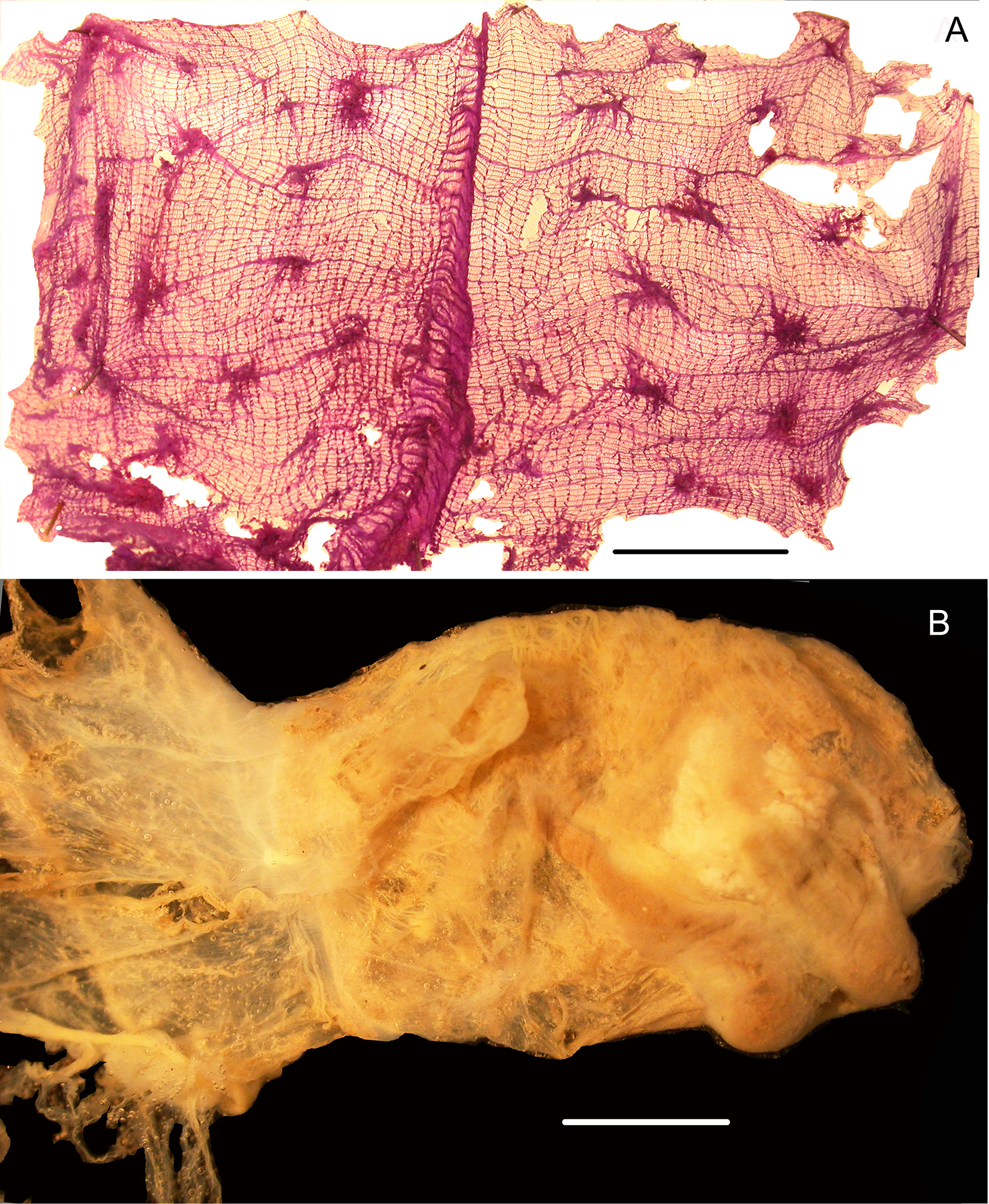
Monniot C 1993, Indonesia Stations CP 4433, 2 specimens (MNHN P 5 FIM 8); CP 4435, 3 specimens (P 5 FIM 5 – P 5 FIM 6); CP 4436, 3 specimens (P 5 FIM 7) The genus Fimbrora clearly belongs to the family Ascidiacea, exhibiting a branchial sac well developed with longitudinal vessels and true stigmata, although it may be confused with an Octacnemidae at first look. The newly collected specimens corresponded well with previous observations reported for the single species described for the genus Fimbrora calsubia, and previously collected near New Caledonia (Monniot & Monniot 1991 a) and in Indonesia (Monniot 1993). These large ascidians were attached to stones by a wide basal disk covered with dense filaments (Fig. 1 A). The tunic is transparent and thin on the oral lobes but thicker basally. The total body length reaches 15 cm. The oral aperture is a wide funnel with the free edge prolonged by numerous thread-like lobes (Fig. 1 A, B). A complex system of blood vessels can be seen through the transparent oral siphon as previously described and depicted (Monniot & Monniot 1991 a). The tunic adheres to the body wall on the oral siphon but not on the abdominal region where a large cavity appears between the abdomen and the base of the body attached to the substrate. This cavity seems empty, but this may be due to strong contraction of the specimens fixed in ethanol. On the inner side of this posterior sac-like tunic protrude some ramified opaque tissue growth with no differentiated structure (Fig. 1 B) but stainable with haemalum (Fig. 1 D); three to four of these structures are present in all specimens. The atrial siphon opens as a simple hole with a smooth rim on the dorsal side (Fig. 2 B) near the neural area, slightly on the right side. The musculature on the oral funnel comprises annular fibres at the edge of the thread-like lobes, and radial fibres crossing this ring become thinner when prolonged on the sides of the siphon. A strong sphincter surrounds the mouth aperture. Crossed muscular fibres enclose the abdominal part. Numerous short filiform tentacles arise from the mouth entrance. The neural ganglion (Fig. 1 C) and the small neural gland are enclosed together in a small “ V ” of the prepharyngeal band. From the point of this “ V ” start two rapheal crests uniting posteriorly in a single lamina that increases in height to reach the bottom of the branchial sac (Fig. 2 A). The branchial tissue is thin and flat (Fig. 2 A) and is attached to the body wall by a few, thick strong bridles. There is an average of 45 to 50 longitudinal vessels on each side. The transverse vessels are different sizes with an irregular pattern (Fig. 2 A). Ten to twelve elongated stigmata can be counted between two successive longitudinal vessels. No stained cells that would suggest the presence of ciliae appeared around the stigmata. The different parts of the gut loop formed a dense mass and were not individualized. The gonad is massive and attached to the gut and no gonoducts were observed. The morphology of this newly collected species corresponded well to previous observations and does not vary across distant geographic locations from Indonesia to New Caledonia.
Deep-sea ascidians from Papua New Guinea

Export occurrence data

Darwin Core Archive (ZIP)

Common names used for this species across different languages and regions.

jpnヨリフサボヤjpn

Vernacular (common) names are the everyday names used for a species in different languages and regions. A single species may have dozens of common names worldwide.

jpnヨリフサボヤ
jpn
Source: Catalogue of LifeSource taxon #299317796

CLASSIFICATION

Taxonomic Classification Tree

MULTIMEDIA

Media Files(6)

Figure 1. Maps showing the sampling site (red circle), south of Houei Seamount (of which the top is indicated with a red triangle). The images were generated by using GMT 6 (Wessel et al. 2019), based on grid data provided by the General Bathymetric Chart of the Oceans.

Imageimage/png© Hasegawa, Naohiro;Hookabe, Natsumi;Fujiwara, Yoshihiro;Jimi, Naoto;Kajihara, HiroshiSupplemental re-description of a deep-sea ascidian, Fimbrora calsubia (Ascidiacea, Enterogona), with an inference of its phylogenetic position

Figure 2. Fimbrora calsubia Monniot & Monniot, 1991 a, photographs showing external appearance of JAMSTEC No. 111618. A. The individual in situ (white arrow), attaching to a dead sponge (yellow arrowhead) along with a euplectellid glass sponge (yellow arrow); B. Left view in life; C. Inner surface of the oral siphon in fixed state; D. Enlarged view of atrial siphon in life.

Imageimage/png© Hasegawa, Naohiro;Hookabe, Natsumi;Fujiwara, Yoshihiro;Jimi, Naoto;Kajihara, HiroshiSupplemental re-description of a deep-sea ascidian, Fimbrora calsubia (Ascidiacea, Enterogona), with an inference of its phylogenetic position

Figure 3. Fimbrora calsubia Monniot & Monniot, 1991 a (JAMSTEC No. 111618). A. Drawing of dissected specimen, showing the shape of neural-gland aperture, peripharyngeal band and dorsal lamina; B. Photograph of dissected pharynx cut open from ventral side; C. Magnification of the rectangle on B, showing the arrangement of longitudinal vessels, transverse vessels, stigmata and secondary branchial papillae (indicated with arrows).

Imageimage/png© Hasegawa, Naohiro;Hookabe, Natsumi;Fujiwara, Yoshihiro;Jimi, Naoto;Kajihara, HiroshiSupplemental re-description of a deep-sea ascidian, Fimbrora calsubia (Ascidiacea, Enterogona), with an inference of its phylogenetic position

Figure 4. Fimbrora calsubia Monniot & Monniot, 1991 a (JAMSTEC No. 111618), photographs of fixed specimen. A. Sinistero-posterior portion of body, viewed from outside, showing alimentary canal and reproductive system; B. Cross section of stomach, showing the prey crustacean (probably a copepod); arrows indicating stomach folds; C. Gonads; D. Magnification of the rectangle on C, showing an ovary containing multiple eggs.

Imageimage/png© Hasegawa, Naohiro;Hookabe, Natsumi;Fujiwara, Yoshihiro;Jimi, Naoto;Kajihara, HiroshiSupplemental re-description of a deep-sea ascidian, Fimbrora calsubia (Ascidiacea, Enterogona), with an inference of its phylogenetic position

FIGURE 1. Fimbrora calsubia. A and B, ventral and dorsal sides of a specimen. C, neural area. D, detail of the ramified tissues of the posterior part of the abdomen stained with hemalum.

Imageimage/png© Monniot, Françoise;López-Legentil, SusannaDeep-sea ascidians from Papua New Guinea

FIGURE 2. Fimbrora calsubia. A, branchial tissue stained with haemalum. B, body without tunic showing the atrial aperture. Scale bars 1 cm.

Imageimage/png© Monniot, Françoise;López-Legentil, SusannaDeep-sea ascidians from Papua New Guinea

IMAGES

Gallery(6)

See Gallery

Occurrences with images

CITATIONS

References(2)

  • 1

    Monniot, C.; Monniot, F. (1991). Découverte d'une nouvelle lignée évolutive chez les ascidies de grande profondeur: une Ascididae carnivore. [Discovery of a new lineage among the deep sea ascidians: a carnivorous Ascidiidae]. <em>C.R. Acad. Sci. Paris.</em> 312: 383-388.

    original descriptionWorld Register of Marine Species
  • 2

    Monniot, F.; López-Legentil, S. (2017). Deep-sea ascidians from Papua New Guinea. <em>Zootaxa.</em> 4276(4): 529.

    additional sourceWorld Register of Marine SpeciesDOI: 10.11646/zootaxa.4276.4.5
  • Source Information

    GBIF Backbone Taxonomy

    GBIF Backbone Taxonomy

    checklist

    The GBIF Backbone Taxonomy is a single, synthetic management classification with the goal of covering all names GBIF is dealing with. It's the taxonomic backbone that allows GBIF to integrate name based information from different resources, no matter if these are occurrence datasets, species pages, names from nomenclators or external sources like EOL, Genbank or IUCN. This backbone allows taxonomic search, browse and reporting operations across all those resources in a consistent way and to provide means to crosswalk names from one source to another.

    It is updated regulary through an automated process in which the Catalogue of Life acts as a starting point also providing the complete higher classification above families. Additional scientific names only found in other authoritative nomenclatural and taxonomic datasets are then merged into the tree, thus extending the original catalogue and broadening the backbones name coverage. The GBIF Backbone taxonomy also includes identifiers for Operational Taxonomic Units (OTUs) drawn from the barcoding resources iBOL and UNITE.

    International Barcode of Life project (iBOL), Barcode Index Numbers (BINs). BINs are connected to a taxon name and its classification by taking into account all names applied to the BIN and picking names with at least 80% consensus. If there is no consensus of name at the species level, the selection process is repeated moving up the major Linnaean ranks until consensus is achieved.

    UNITE - Unified system for the DNA based fungal species, Species Hypotheses (SHs). SHs are connected to a taxon name and its classification based on the determination of the RefS (reference sequence) if present or the RepS (representative sequence). In the latter case, if there is no match in the UNITE taxonomy, the lowest rank with 100% consensus within the SH will be used.

    The GBIF Backbone Taxonomy is available for download at https://hosted-datasets.gbif.org/datasets/backbone/ in different formats together with an archive of all previous versions.

    The following 105 sources have been used to assemble the GBIF backbone with number of names given in brackets:

    • Catalogue of Life Checklist - 4766428 names
    • International Barcode of Life project (iBOL) Barcode Index Numbers (BINs) - 635951 names
    • UNITE - Unified system for the DNA based fungal species linked to the classification - 611208 names
    • The Paleobiology Database - 212054 names
    • World Register of Marine Species - 188857 names
    • The Interim Register of Marine and Nonmarine Genera - 183894 names
    • The World Checklist of Vascular Plants (WCVP) - 131891 names
    • GBIF Backbone Taxonomy - 114350 names
    • TAXREF - 109374 names
    • The Leipzig catalogue of vascular plants - 75380 names
    • ZooBank - 73549 names
    • Integrated Taxonomic Information System (ITIS) - 68377 names
    • Plazi.org taxonomic treatments database - 61346 names
    • Genome Taxonomy Database r207 - 60545 names
    • International Plant Names Index - 52329 names
    • Fauna Europaea - 45077 names
    • The National Checklist of Taiwan (Catalogue of Life in Taiwan, TaiCoL) - 36193 names
    • Dyntaxa. Svensk taxonomisk databas - 35892 names
    • The Plant List with literature - 32692 names
    • United Kingdom Species Inventory (UKSI) - 29643 names
    • Artsnavnebasen - 29208 names
    • The IUCN Red List of Threatened Species - 21221 names
    • Afromoths, online database of Afrotropical moth species (Lepidoptera) - 13961 names
    • Brazilian Flora 2020 project - Projeto Flora do Brasil 2020 - 13829 names
    • Prokaryotic Nomenclature Up-to-Date (PNU) - 10079 names
    • Checklist Dutch Species Register - Nederlands Soortenregister - 8814 names
    • ICTV Master Species List (MSL) - 7852 names
    • Cockroach Species File - 6020 names
    • GRIN Taxonomy - 5882 names
    • Taxon list of fungi and fungal-like organisms from Germany compiled by the DGfM - 4570 names
    • Catalogue of Afrotropical Bees - 3623 names
    • Catalogue of Tenebrionidae (Coleoptera) of North America - 3327 names
    • Checklist of Beetles (Coleoptera) of Canada and Alaska. Second Edition. - 3312 names
    • Systema Dipterorum - 2850 names
    • Catalogue of the Pterophoroidea of the World - 2807 names
    • The Clements Checklist - 2675 names
    • Taxon list of Hymenoptera from Germany compiled in the context of the GBOL project - 2496 names
    • IOC World Bird List, v13.2 - 2366 names
    • Official Lists and Indexes of Names in Zoology - 2310 names
    • National checklist of all species occurring in Denmark - 1922 names
    • Myriatrix - 1876 names
    • Database of Vascular Plants of Canada (VASCAN) - 1822 names
    • Taxon list of vascular plants from Bavaria, Germany compiled in the context of the BFL project - 1771 names
    • Orthoptera Species File - 1742 names
    • A list of the terrestrial fungi, flora and fauna of Madeira and Selvagens archipelagos - 1602 names
    • Aphid Species File - 1565 names
    • World Spider Catalog - 1561 names
    • Taxon list of Jurassic Pisces of the Tethys Palaeo-Environment compiled at the SNSB-JME - 1270 names
    • Backbone Family Classification Patch - 1143 names
    • GBIF Algae Classification - 1100 names
    • International Cichorieae Network (ICN): Cichorieae Portal - 975 names
    • Psocodea Species File - 803 names
    • New Zealand Marine Macroalgae Species Checklist - 787 names
    • Annotated checklist of endemic species from the Western Balkans - 754 names
    • Taxon list of animals with German names (worldwide) compiled at the SMNS - 503 names
    • Catalogue of the Alucitoidea of the World - 472 names
    • Lygaeoidea Species File - 462 names
    • Catálogo de Plantas y Líquenes de Colombia - 422 names
    • GBIF Backbone Patch - 317 names
    • Phasmida Species File - 259 names
    • Cortinariaceae fetched from the Index Fungorum API - 234 names
    • Coreoidea Species File - 233 names
    • GTDB supplement - 139 names
    • Mantodea Species File - 119 names
    • Endemic species in Taiwan - 93 names
    • Taxon list of Araneae from Germany compiled in the context of the GBOL project - 88 names
    • Species of Hominidae - 78 names
    • Taxon list of Sternorrhyncha from Germany compiled in the context of the GBOL project - 77 names
    • Taxon list of mosses from Germany compiled in the context of the GBOL project - 75 names
    • Mammal Species of the World - 73 names
    • Plecoptera Species File - 71 names
    • Species Fungorum Plus - 64 names
    • Catalogue of the type specimens of Cosmopterigidae (Lepidoptera: Gelechioidea) from research collections of the Zoological Institute, Russian Academy of Sciences - 47 names
    • Species named after famous people - 41 names
    • Dermaptera Species File - 36 names
    • Taxon list of Trichoptera from Germany compiled in the context of the GBOL project - 34 names
    • True Fruit Flies (Diptera, Tephritidae) of the Afrotropical Region - 33 names
    • Range and Regularities in the Distribution of Earthworms of the Earthworms of the USSR Fauna. Perel, 1979 - 32 names
    • Taxon list of Diplura from Germany compiled in the context of the GBOL project - 30 names
    • Lista de referencia de especies de aves de Colombia - 2022 - 24 names
    • Taxon list of Auchenorrhyncha from Germany compiled in the context of the GBOL project - 20 names
    • Catalogue of the type specimens of Polycestinae (Coleoptera: Buprestidae) from research collections of the Zoological Institute, Russian Academy of Sciences - 19 names
    • Taxon list of Thysanoptera from Germany compiled in the context of the GBOL project - 19 names
    • Lista de especies de vertebrados registrados en jurisdicción del Departamento del Huila - 18 names
    • Taxon list of Microcoryphia (Archaeognatha) from Germany compiled in the context of the GBOL project - 15 names
    • Catalogue of the type specimens of Bufonidae and Megophryidae (Amphibia: Anura) from research collections of the Zoological Institute, Russian Academy of Sciences - 12 names
    • Grylloblattodea Species File - 11 names
    • Coleorrhyncha Species File - 9 names
    • Taxon list of liverworts from Germany compiled in the context of the GBOL project - 9 names
    • Embioptera Species File - 7 names
    • Taxon list of Pisces and Cyclostoma from Germany compiled in the context of the GBOL project - 6 names
    • Taxon list of Pteridophyta from Germany compiled in the context of the GBOL project - 6 names
    • Taxon list of Siphonaptera from Germany compiled in the context of the GBOL project - 5 names
    • The Earthworms of the Fauna of Russia. Perel, 1997 - 5 names
    • Taxon list of Zygentoma from Germany compiled in the context of the GBOL project - 4 names
    • Asiloid Flies: new taxa of Diptera: Apioceridae, Asilidae, and Mydidae - 3 names
    • Taxon list of Protura from Germany compiled in the context of the GBOL project - 3 names
    • Taxon list of hornworts from Germany compiled in the context of the GBOL project - 2 names
    • Chrysididae Species File - 1 names
    • Taxon list of Dermaptera from Germany compiled in the context of the GBOL project - 1 names
    • Taxon list of Diplopoda from Germany in the context of the GBOL project - 1 names
    • Taxon list of Orthoptera (Grashoppers) from Germany compiled at the SNSB - 1 names
    • Taxon list of Pscoptera from Germany compiled in the context of the GBOL project - 1 names
    • Taxon list of Pseudoscorpiones from Germany compiled in the context of the GBOL project - 1 names
    • Taxon list of Raphidioptera from Germany compiled in the context of the GBOL project - 1 names

    GBIF Secretariat (2023). GBIF Backbone Taxonomy. Checklist dataset https://doi.org/10.15468/39omei accessed via GBIF.org on 2026-06-14.


    CC BYPublished 8/28/2023View dataset
    GBIF Usage Key
    6486747
    Dataset Key
    d7dddbf4-2cf0-4f39-9b2a-bb099caae36c
    Origin
    source
    Backbone Key
    6486747
    Taxon ID
    gbif:6486747
    Last Crawled
    8/22/2023
    Last Interpreted
    8/22/2023