AnimaliaNot EvaluatedacceptedspeciesAcceptedRestricted
Troglopalites stygios

Troglopalites stygios

R.S.Vargovitsh, 2012

GBIF:7474388

0countries
0year

PROFILE

Species Profile

Habitat

Terrestrial

ABOUT

Descriptions(5)

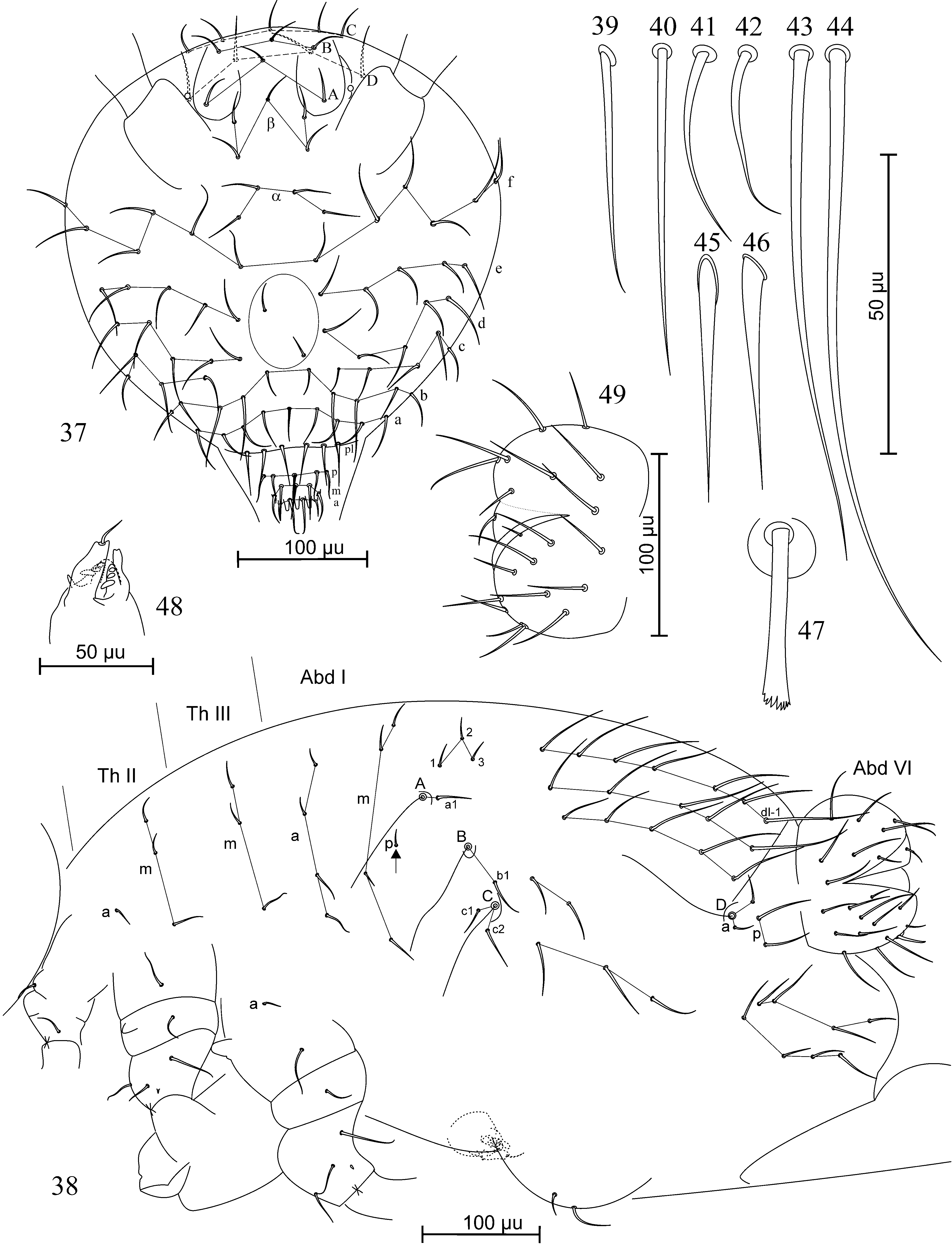
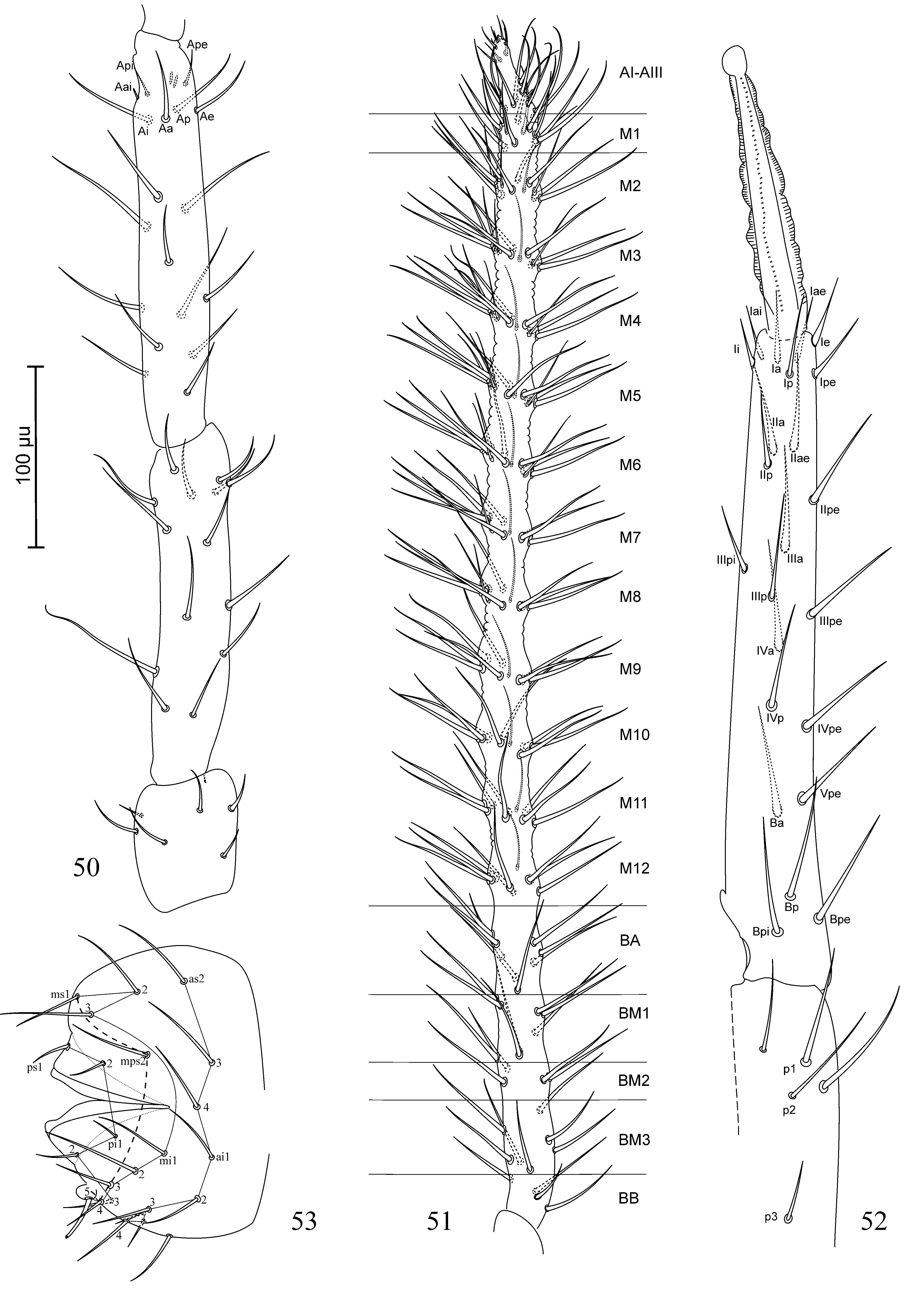
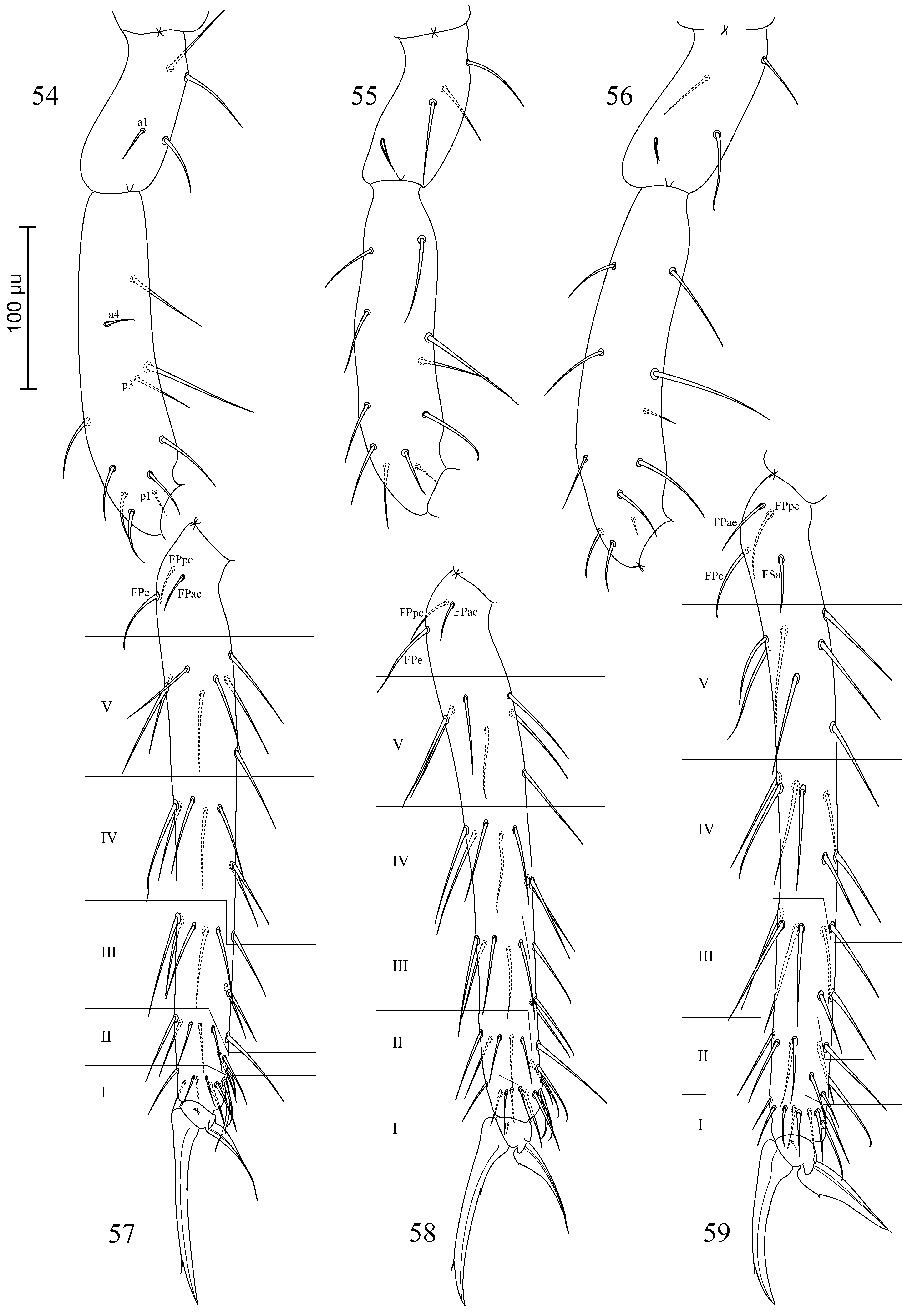
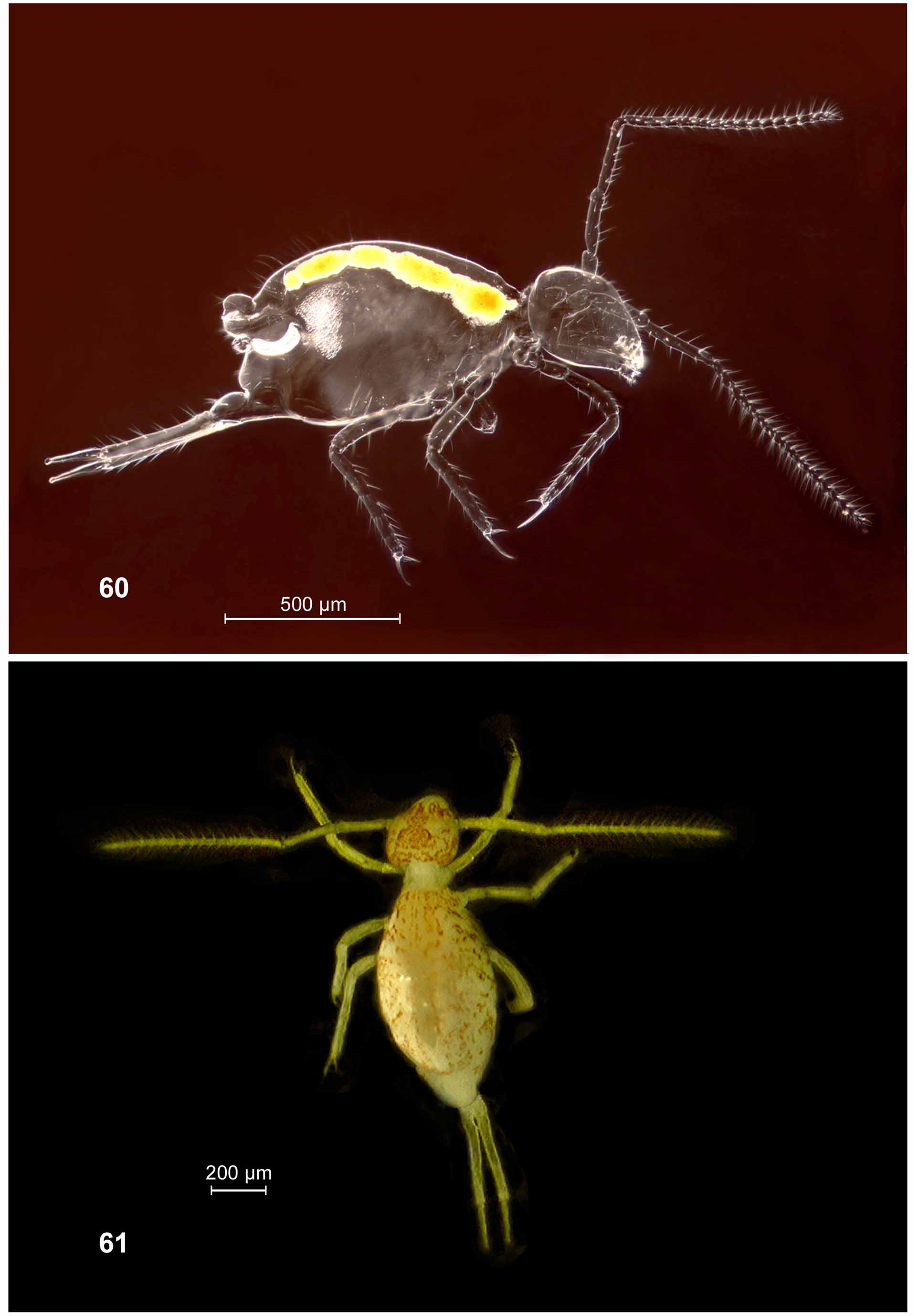
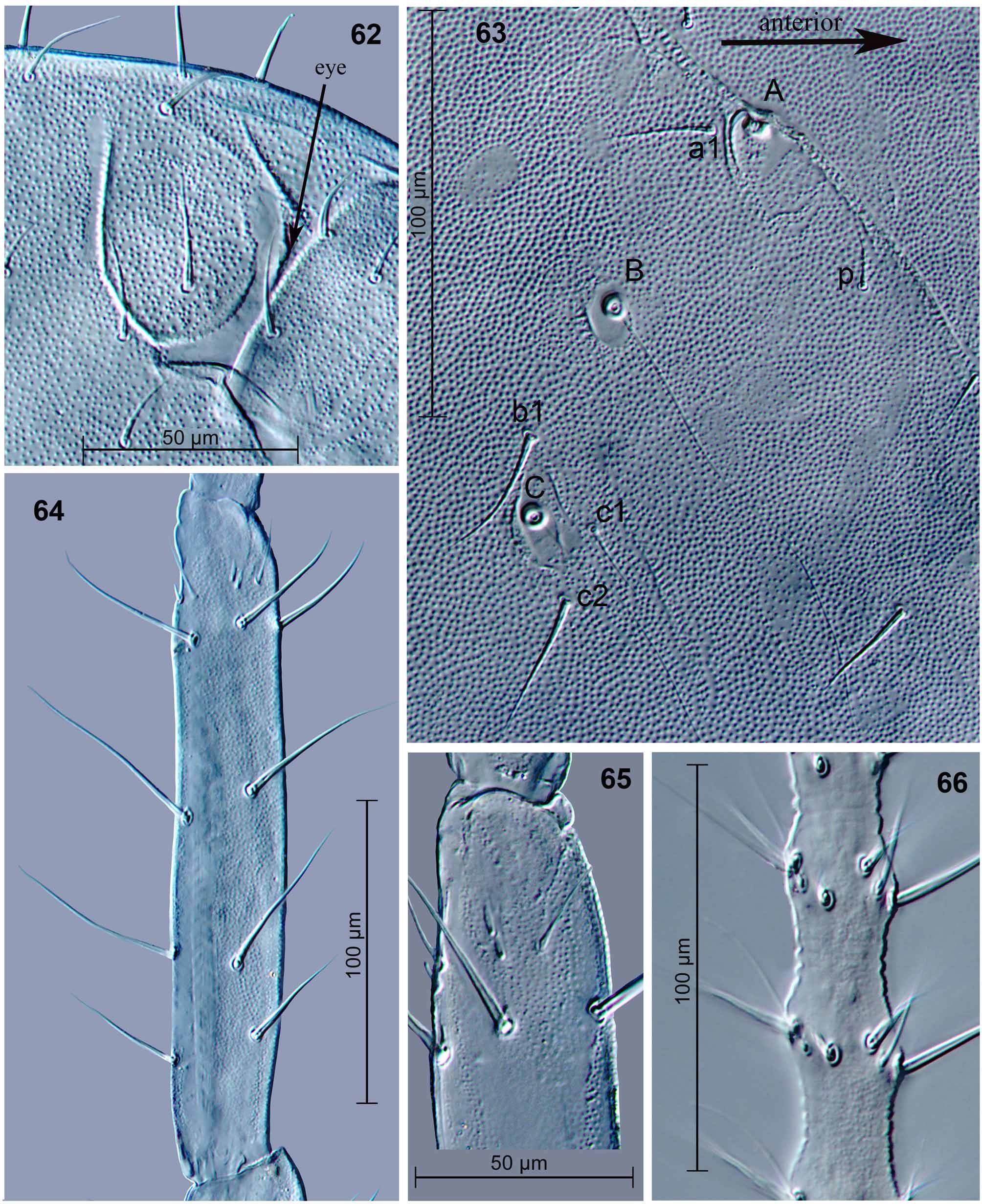
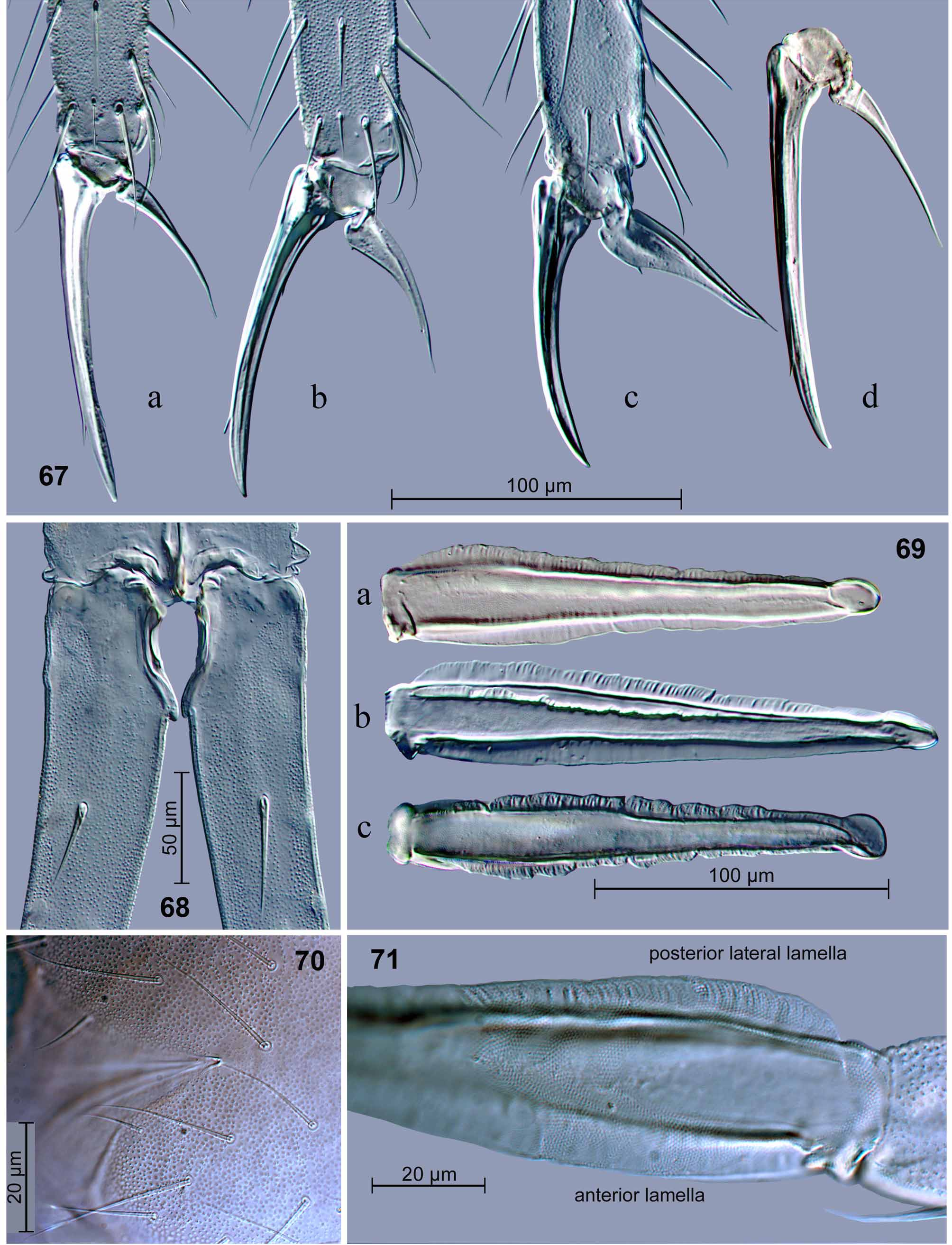
Description. Female: body about 1.4 mm length (holotype 1.49 mm). Coloration (alcohol material): unpigmented or with diffuse reddish-brownish pigmentation on dorsal part of head and great abdomen (Fig. 61). Head (Fig. 37). Eyes 1 + 1 very small, often uncertain to observe (Fig. 62). Labral chaetotaxy a: 4, m: 5, p: 5; prelabral: 6 (= 6 / 554); 2 inner setae of row a are hooked at the apex. Clypeal area with axial seta in row a. Interantennal area: 2 rows (α and β) with axial seta in row β. Dorsal area: 4 rows (from A to D) with 3 axial setae in rows A, B and C; no modified (spine-like) setae (Figs 37, 41). Antennae (Figs 50, 51): length about 3 × (2.7 – 3.1) of head (2.7 in holotype). Mean length ratio of antennal segments I: II: III: IV = 1: 2.9: 3.3: 9.7 (in holotype 1: 3.0: 3.5: 9.9). Ant I with 7 short setae, subapical one is very small. Ant II with 14 setae. Ant III without swelling, with 18 setae and 2 small sense rods in separate pits (7.2 µm in holotype); setae Api and Ape short and thin, seta Aai very small and blunt (Figs 50, 64, 65). Ant IV subdivided into 13 subsegments or pseudosubsegments, usually separated from each other by 2 – 3 (0 – 4) annuli which usually are more distinct in distal part of the segment (Figs 51, 66). (Pseudo) subsegmental formula: 1 + 11 + 1 = (A + M 1) + (M 2 – M 12) + (B). Ant IV bears 20 whorls of setae: 4 on apical subsegment (AI – AIII, M 1), 11 on median subsegments (M 2 – M 12) and 5 on basal subsegment (BA, BM 1 – BM 3, BB). Foreleg: precoxae 1, 2 and coxa with 1, 0, 1 setae respectively (Fig. 38). Trochanter with 3 anterior and 1 posterior setae; femur with 11 setae, a 4 turned perpendicularly to the longitudinal axis of the segment (Fig. 54). Tibiotarsus (Fig. 57) with 44 setae: 3 setae FP present (e, ae, pe); secondary seta FS missing; whorl I with 9 setae among which Ja curved and spine-like; each of whorls II – V with 8 setae; interior setae not much thickened. Pretarsus with 1 anterior and 1 posterior setulae. Foot complex (Figs 57, 67 a). Claw: very long and thin, 2.7 – 3 × shorter than tibiotarsus (2.7 in holotype); with vanishingly small or without inner tooth and with 2 pairs of lateral teeth: small subbasal and sharp thin subapical; without tunica. Empodium: thin, 2 – 2.4 × shorter than claw; without corner tooth. Mid leg: precoxae 1 and 2 with 1, 1 setae respectively, precoxal process present, coxa with 3 setae and microsensilla (Fig. 38). Trochanter with 3 simple setae and anterior trochanteral organ; femur with 11 setae (Fig. 55). Tibiotarsus (Fig. 58): 3 setae FP present, seta FS missing; whorl I with 9 setae among which Ja curved and thickened, whorls II – IV with 8 setae, whorl V with 7 setae. Foot complex (Figs 58, 67 b). Claw: very long and thin, 2.8 – 3.1 × shorter than tibiotarsus (2.81 in holotype); with small inner tooth and with 2 pairs of lateral teeth: small subbasal and sharp thin subapical; without tunica. Empodium: thin, 1.9 – 2.4 × shorter than claw; corner tooth present. Hind leg: precoxae 1 and 2 with 1, 1 setae respectively, process on precoxa 1 present, coxa with 3 setae and microsensilla (Fig. 38). Trochanter with anterior trochanteral organ, only 2 anterior and 1 posterior simple setae; femur with 11 setae (Fig. 56). Tibiotarsus (Fig. 59): 3 setae FP and seta FSa present; whorl I with 9 setae none of which are spine-like, whorls II – IV with 8 setae, whorl V with 7 setae. Foot complex (Figs 59, 67 c). Claw: long and thin, shorter than in fore- and mid leg (Table 1), 3.7 – 4.3 × shorter than tibiotarsus (3.7 in holotype); with vanishingly small or without inner tooth and with 2 pairs of lateral teeth: small subbasal and sharp thin subapical; without tunica. Empodium: broad, 1.5 – 1.6 × shorter than claw; with distinct corner tooth. Mean lengths ratio of tibiotarsi I: II: III = 1: 0.95: 1.14 (same in holotype). Mean ratio head: tibiotarsus I = 1.2. Ventral tube with 1 + 1 subapical setulae. Tenaculum (Fig. 48): each ramus with 3 sclerotic teeth and non sclerotized process; anterior lobe with 1 apical setula; tip of posterior lobe is approximately on one level with tip of anterior lobe. Furca (Fig. 52): manubrium with 5 + 5 setae on posterior side, sete pi 1 and p 2 thin, seta p 3 thin and short. Dens: with subbasal process (like blunt tooth) on interior side (Fig. 68); anterior side with 3, 2, 1, 1, 1 setae, IIa – IVa, Ba and IIae are heavy, Ia not spine-like (Fig. 45). Posterior side without distinct spines, but setae Ie, Ipe and Ii are thickened at the basis and slightly spine-like (Figs 46, 52). Seta IVpi absent. Mucro (Fig. 69 a – c, 71): posterior lamellae with teeth usually accreted together, so that margins look rather wavy; anterior lamella smooth and welldeveloped; tip distinctly broadened: globular or spoon-like. Dens 2 – 2.3 × as long as mucro (2.11 in holotype). Great abdomen (Fig. 38): mesothorax with short somewhat curved and not spine-like dorsal setae (Fig. 42). Row a of Abd I with 4 (not 5 as observed in other Arrhopalitidae) setae. Trichobothria ABC form very obtuse angle (160 – 173 o; 164 o in holotype) and AB is equidistant with BC. Single p seta of p-row of Abd I is located on or a little above the level of trichobothrium B; seta b 1 lies between trichobothria B and C a little posteriorly to the line BC; seta c 1 lies near and c 2 — below trichobothrium C (Fig. 63). Seta c 1 smaller than other setae of the trichobothrial complex (c 1 = 21 – 25 µm; and c 2 = 33 – 45 µm). Posterior lateral complex with 2 + 3 and furca base complex with 8 setae. Central dorsal complex with 3 subequal setae. Posterior dorsal complex with about 17 setae, the longest of which are a little shorter or subequal to hind claw (Figs 43, 44). Ventral complex with 2 or 3 (rarely 1) setae. Fifth abdominal segment (Fig. 38) with 2 setae and trichobothrium D in row a, and 2 setae in row p. Genital field with 4 + 4 setae. Sixth abdominal segment (Fig. 53) without cuticular spines; circumanal setae not thickened (Figs 39, 40, 70). Chaetotaxy reduced: dorsal valve bears 7 + 2 axial + 7 setae; each of lateral valve bears 15 setae (totally 46 setae on Abd VI). Circumanal row with setae mps 1, mps 3, mpi 1 and mpi 2 absent. Appendices anales (27.6 µm in holotype) rod-like, gradually slightly broadened, apically serrated, slightly curved in lateral view, inserted into semiglobular papilla (Fig. 47). Male: about 1.2 mm length, smaller than females (Fig. 60). Chaetotaxy is the same as in females except some details of Abd VI. Dorsal anal valve is exactly as in female with 7 + 2 axial + 7 thin setae, but each of lateral valves bears 12 setae (totally 40 setae on Abd VI versus 46 in female) (Fig. 49). Genital opening is surrounded with about 10 setulae. Variability. Bases of sense rods of AO-III usually lie close together on about one level, but one female has one rod situated much higher than another (Fig. 65). Ventral complex of great abdomen includes 3 or 2 (rarely asymmetrically 1) setae. In one specimen row m of Th II incomplete (2 setae instead of 3). In one female seta a 1 of trichobothrial complex is shifted and lies in the line between trichobothria A and B. Inner tooth of claws I and III hardly noticeable or absent. Seta IIIpi of dens in type specimens usually present, but in one female asymmetrically absent. Upper anal valve usually with 9 setae (7 + 2 axial) per side, one specimen with 10 (odd seta does not belong to circumanal row). Specimens from Tsebeldinskaya Cave differ from type specimens by: relatively longer claws (claw I up to 143 µm in female 1.22 mm: Fig. 67 d) with ratio Tita / claw I, II, III = 2.5, 2.5 and 3.4 respectively; permanent absence of inner tooth on claw I and III; absence of seta IIIpi on dens. This population seems to be a geographic variety of T. stygios, or possibly even an isolated subspecies. Bionomy and distribution. In Nizhnyaya Shakuranskaya Cave (type locality) specimens of the new species were found on the water surface of underground stream in gours and ponds and on calcite flowstones close to the water from 500 to 1000 m from the entrance. The air and water temperature was 11.8 o C and 11.2 – 12.2 o C respectively. In Tsebeldinskaya Cave specimens were sampled from the water surface about 300 m from the entrance. The air and water temperature was 11.2 o C and 12.1 o C respectively. In both caves the new species cohabit with different species from the genus Pygmarrhopalites. Terrestrial sampling and Barber’s traps in the same caves provided other species of Arrhopalitidae but not T. stygios sp. nov. This fact together with specific morphology (long thin claws and mucro with accreted teeth and well-developed anterior lamella) indicates epineustonic and hygropetric mode of life of the new species in subterranean habitat. Distribution of this species is restricted to few caves of Tsebelda Karst Massif, moreover, some differences (geographic variation) between populations exist. The new species most likely is a narrow troglobiont endemic.
New troglomorphic Arrhopalitidae (Collembola: Symphypleona) from the Western Caucasus

Diagnosis. Eyes 1 + 1, very small. Trichobothria AB equidistant with BC. Antenna about 3 × of head; Ant IV with 20 whorls of setae and with 13 subsegments, usually separated from each other by several annuli. No spines on head. Claws much elongated and thin, without tunica; fore and hind claw not always and mid claw always with small inner tooth. Empodia shorter than claws, empodium II and III with corner tooth. Manubrium with 5 + 5 setae; dens without distinct spines and without seta IVpi, with 3, 2, 1, 1, 1 thick anterior setae. Tip of mucro broadened: globular or spoon-like; posterior lamellae with wavy or ragged margins, anterior lamella well-developed. Tenaculum with 1 seta. Small abdomen without cuticular spines and broadened setae; appendices anales rod-like, gradually broadened and serrated apically.
New troglomorphic Arrhopalitidae (Collembola: Symphypleona) from the Western Caucasus
Remarks. Peculiar characteristic of the new species is oligochaetosis of several chaetotaxic elements: sixth abdominal segment (much reduced circumanal row), trochanter of hindleg (usually it comprises 5 setae but only 4 in sp. nov.), first abdominal segment (row a usually comprises 5 setae but only 4 in sp. nov.). With that it shows plurichaetosis of the fourth antennal segment corresponding with great number of subsegments. Besides, this species is deeply troglomorphic with extremely elongated antennae and claws. Among species of Arrhopalites only A. peculiaris shows certain reduction of circumanal row (absence of mps 3 and mpi 1). T. stygios sp. nov. differs from it by even more reduced circumanal row, trichobothrial pattern and other characters (Table 2).
New troglomorphic Arrhopalitidae (Collembola: Symphypleona) from the Western Caucasus

Etymology. “ stygios ” from Greek “ στύγɩος ” — Stygian, adjectival form of “ Στύξ ” — Styx, the river of mythic subterranean kingdom. The name denotes close relations of the new species with subterranean waters.
New troglomorphic Arrhopalitidae (Collembola: Symphypleona) from the Western Caucasus
Type material. Holotype on slide “ C- 737 - 4 ”: female, Western Caucasus, Abkhazia, Gulripsh District, right bank of Dzhampal River, near Amtkel Vill., Nizhnyaya Shakuranskaya Cave, 200 m a. s. l., 17. viii. 2010, R. S. Vargovitsh leg. Paratypes on slides: 2 males, 5 females collected together with holotype; female, same cave and collector, 4. vi. 2006; 3 females, same cave and collector, 15. viii. 2009. Types are preserved in SIZNAS. Other material. On slides: female, Gulripsh District, Verkhnyaya Shakuranskaya Cave, 5. vi. 2006, R. S. Vargovitsh leg.; 2 males, female, Gulripsh District, Tsebelda Vill., Tsebeldinskaya Cave, 510 m a. s. l., 2. vi. 2006, R. S. Vargovitsh leg. Besides slides, 101 specimens from Nizhnyaya Shakuranskaya Cave and 6 specimens from Tsebeldinskaya Cave are kept in alcohol.
New troglomorphic Arrhopalitidae (Collembola: Symphypleona) from the Western Caucasus
Export occurrence data

Darwin Core Archive (ZIP)

GEOGRAPHY

Distribution Map

Occurrence Map

Loading map…

Tiles © GBIF Maps API | Map powered by MapLibre GL

REGIONS

Geographic Distribution(2)

Europe
native
Europe
native

DATA

Occurrence Datasets

Loading datasets…

CLASSIFICATION

Taxonomic Classification Tree

MULTIMEDIA

Media Files(6)

FIGURES 37 – 49. Troglopalites stygios sp. nov.: 37, chaetotaxy of head, frontal view; 38, chaetotaxy of great abdomen, lateral view; 39 – 46, shape of setae: 39, ms 1 of Abd VI; 40, mi 2 of Abd VI; 41, seta of head vertex; 42, dorsal seta of mesothorax; 43, posterior dorsal seta of great abdomen; 44, dI- 1 of great abdomen; 45, Ia of dens; 46, Ie of dens; 47, appendices anales, dorsal view; 48, tenaculum; 49, chaetotaxy of male Abd VI.

Imageimage/png© Vargovitsh, Robert S.New troglomorphic Arrhopalitidae (Collembola: Symphypleona) from the Western Caucasus
FIGURES 50 – 53. Troglopalites stygios sp. nov.: 50 – 51, chaetotaxy of antennal segments, anterior view: 50, Ant I – III; 51, Ant IV; 52, chaetotaxy of furca, posterior view; 53, chaetotaxy of female Abd VI, lateral view.

Imageimage/png© Vargovitsh, Robert S.New troglomorphic Arrhopalitidae (Collembola: Symphypleona) from the Western Caucasus
FIGURES 54 – 59. Troglopalites stygios sp. nov.: 54 – 56, chaetotaxy of trochanter and femur, anterior view: 54, foreleg; 55, mid leg; 56, hind leg; 57 – 59, chaetotaxy of tibiotarsus and foot complex, anterior view: 57, foreleg; 58, mid leg; 59, hind leg.

Imageimage/png© Vargovitsh, Robert S.New troglomorphic Arrhopalitidae (Collembola: Symphypleona) from the Western Caucasus
FIGURES 60 – 61. Troglopalites stygios sp. nov.: 60, habitus of male, on slide; 61, habitus and pigmentation, alcohol specimen.

Imageimage/png© Vargovitsh, Robert S.New troglomorphic Arrhopalitidae (Collembola: Symphypleona) from the Western Caucasus

FIGURES 62 – 66. Troglopalites stygios sp. nov.: 62, fragment of head dorsum with eye field; 63, chaetotaxy of trichobothrial complex; 64 – 65, Ant III: 64, entire segment; 65, fragment with antennal organ with shifted rods; 66, fragment of Ant IV with annulations between subsegments.

Imageimage/png© Vargovitsh, Robert S.New troglomorphic Arrhopalitidae (Collembola: Symphypleona) from the Western Caucasus

FIGURES 67 – 71. Troglopalites stygios sp. nov.: 67, distal parts of legs (a—foreleg, b—mid leg, c—hind leg, d—fore claw of specimen from Tsebeldinskaya Cave); 68, dens base, anterior view; 69, mucro (a—lateral view, b—dorso-lateral view, c—dorsal view); 70, fragment of female Abd VI with thin setae; 71, fragment of mucro.

Imageimage/png© Vargovitsh, Robert S.New troglomorphic Arrhopalitidae (Collembola: Symphypleona) from the Western Caucasus

IMAGES

Gallery(6)

See Gallery

Occurrences with images

Source Information

GBIF Backbone Taxonomy

GBIF Backbone Taxonomy

checklist

The GBIF Backbone Taxonomy is a single, synthetic management classification with the goal of covering all names GBIF is dealing with. It's the taxonomic backbone that allows GBIF to integrate name based information from different resources, no matter if these are occurrence datasets, species pages, names from nomenclators or external sources like EOL, Genbank or IUCN. This backbone allows taxonomic search, browse and reporting operations across all those resources in a consistent way and to provide means to crosswalk names from one source to another.

It is updated regulary through an automated process in which the Catalogue of Life acts as a starting point also providing the complete higher classification above families. Additional scientific names only found in other authoritative nomenclatural and taxonomic datasets are then merged into the tree, thus extending the original catalogue and broadening the backbones name coverage. The GBIF Backbone taxonomy also includes identifiers for Operational Taxonomic Units (OTUs) drawn from the barcoding resources iBOL and UNITE.

International Barcode of Life project (iBOL), Barcode Index Numbers (BINs). BINs are connected to a taxon name and its classification by taking into account all names applied to the BIN and picking names with at least 80% consensus. If there is no consensus of name at the species level, the selection process is repeated moving up the major Linnaean ranks until consensus is achieved.

UNITE - Unified system for the DNA based fungal species, Species Hypotheses (SHs). SHs are connected to a taxon name and its classification based on the determination of the RefS (reference sequence) if present or the RepS (representative sequence). In the latter case, if there is no match in the UNITE taxonomy, the lowest rank with 100% consensus within the SH will be used.

The GBIF Backbone Taxonomy is available for download at https://hosted-datasets.gbif.org/datasets/backbone/ in different formats together with an archive of all previous versions.

The following 105 sources have been used to assemble the GBIF backbone with number of names given in brackets:

  • Catalogue of Life Checklist - 4766428 names
  • International Barcode of Life project (iBOL) Barcode Index Numbers (BINs) - 635951 names
  • UNITE - Unified system for the DNA based fungal species linked to the classification - 611208 names
  • The Paleobiology Database - 212054 names
  • World Register of Marine Species - 188857 names
  • The Interim Register of Marine and Nonmarine Genera - 183894 names
  • The World Checklist of Vascular Plants (WCVP) - 131891 names
  • GBIF Backbone Taxonomy - 114350 names
  • TAXREF - 109374 names
  • The Leipzig catalogue of vascular plants - 75380 names
  • ZooBank - 73549 names
  • Integrated Taxonomic Information System (ITIS) - 68377 names
  • Plazi.org taxonomic treatments database - 61346 names
  • Genome Taxonomy Database r207 - 60545 names
  • International Plant Names Index - 52329 names
  • Fauna Europaea - 45077 names
  • The National Checklist of Taiwan (Catalogue of Life in Taiwan, TaiCoL) - 36193 names
  • Dyntaxa. Svensk taxonomisk databas - 35892 names
  • The Plant List with literature - 32692 names
  • United Kingdom Species Inventory (UKSI) - 29643 names
  • Artsnavnebasen - 29208 names
  • The IUCN Red List of Threatened Species - 21221 names
  • Afromoths, online database of Afrotropical moth species (Lepidoptera) - 13961 names
  • Brazilian Flora 2020 project - Projeto Flora do Brasil 2020 - 13829 names
  • Prokaryotic Nomenclature Up-to-Date (PNU) - 10079 names
  • Checklist Dutch Species Register - Nederlands Soortenregister - 8814 names
  • ICTV Master Species List (MSL) - 7852 names
  • Cockroach Species File - 6020 names
  • GRIN Taxonomy - 5882 names
  • Taxon list of fungi and fungal-like organisms from Germany compiled by the DGfM - 4570 names
  • Catalogue of Afrotropical Bees - 3623 names
  • Catalogue of Tenebrionidae (Coleoptera) of North America - 3327 names
  • Checklist of Beetles (Coleoptera) of Canada and Alaska. Second Edition. - 3312 names
  • Systema Dipterorum - 2850 names
  • Catalogue of the Pterophoroidea of the World - 2807 names
  • The Clements Checklist - 2675 names
  • Taxon list of Hymenoptera from Germany compiled in the context of the GBOL project - 2496 names
  • IOC World Bird List, v13.2 - 2366 names
  • Official Lists and Indexes of Names in Zoology - 2310 names
  • National checklist of all species occurring in Denmark - 1922 names
  • Myriatrix - 1876 names
  • Database of Vascular Plants of Canada (VASCAN) - 1822 names
  • Taxon list of vascular plants from Bavaria, Germany compiled in the context of the BFL project - 1771 names
  • Orthoptera Species File - 1742 names
  • A list of the terrestrial fungi, flora and fauna of Madeira and Selvagens archipelagos - 1602 names
  • Aphid Species File - 1565 names
  • World Spider Catalog - 1561 names
  • Taxon list of Jurassic Pisces of the Tethys Palaeo-Environment compiled at the SNSB-JME - 1270 names
  • Backbone Family Classification Patch - 1143 names
  • GBIF Algae Classification - 1100 names
  • International Cichorieae Network (ICN): Cichorieae Portal - 975 names
  • Psocodea Species File - 803 names
  • New Zealand Marine Macroalgae Species Checklist - 787 names
  • Annotated checklist of endemic species from the Western Balkans - 754 names
  • Taxon list of animals with German names (worldwide) compiled at the SMNS - 503 names
  • Catalogue of the Alucitoidea of the World - 472 names
  • Lygaeoidea Species File - 462 names
  • Catálogo de Plantas y Líquenes de Colombia - 422 names
  • GBIF Backbone Patch - 317 names
  • Phasmida Species File - 259 names
  • Cortinariaceae fetched from the Index Fungorum API - 234 names
  • Coreoidea Species File - 233 names
  • GTDB supplement - 139 names
  • Mantodea Species File - 119 names
  • Endemic species in Taiwan - 93 names
  • Taxon list of Araneae from Germany compiled in the context of the GBOL project - 88 names
  • Species of Hominidae - 78 names
  • Taxon list of Sternorrhyncha from Germany compiled in the context of the GBOL project - 77 names
  • Taxon list of mosses from Germany compiled in the context of the GBOL project - 75 names
  • Mammal Species of the World - 73 names
  • Plecoptera Species File - 71 names
  • Species Fungorum Plus - 64 names
  • Catalogue of the type specimens of Cosmopterigidae (Lepidoptera: Gelechioidea) from research collections of the Zoological Institute, Russian Academy of Sciences - 47 names
  • Species named after famous people - 41 names
  • Dermaptera Species File - 36 names
  • Taxon list of Trichoptera from Germany compiled in the context of the GBOL project - 34 names
  • True Fruit Flies (Diptera, Tephritidae) of the Afrotropical Region - 33 names
  • Range and Regularities in the Distribution of Earthworms of the Earthworms of the USSR Fauna. Perel, 1979 - 32 names
  • Taxon list of Diplura from Germany compiled in the context of the GBOL project - 30 names
  • Lista de referencia de especies de aves de Colombia - 2022 - 24 names
  • Taxon list of Auchenorrhyncha from Germany compiled in the context of the GBOL project - 20 names
  • Catalogue of the type specimens of Polycestinae (Coleoptera: Buprestidae) from research collections of the Zoological Institute, Russian Academy of Sciences - 19 names
  • Taxon list of Thysanoptera from Germany compiled in the context of the GBOL project - 19 names
  • Lista de especies de vertebrados registrados en jurisdicción del Departamento del Huila - 18 names
  • Taxon list of Microcoryphia (Archaeognatha) from Germany compiled in the context of the GBOL project - 15 names
  • Catalogue of the type specimens of Bufonidae and Megophryidae (Amphibia: Anura) from research collections of the Zoological Institute, Russian Academy of Sciences - 12 names
  • Grylloblattodea Species File - 11 names
  • Coleorrhyncha Species File - 9 names
  • Taxon list of liverworts from Germany compiled in the context of the GBOL project - 9 names
  • Embioptera Species File - 7 names
  • Taxon list of Pisces and Cyclostoma from Germany compiled in the context of the GBOL project - 6 names
  • Taxon list of Pteridophyta from Germany compiled in the context of the GBOL project - 6 names
  • Taxon list of Siphonaptera from Germany compiled in the context of the GBOL project - 5 names
  • The Earthworms of the Fauna of Russia. Perel, 1997 - 5 names
  • Taxon list of Zygentoma from Germany compiled in the context of the GBOL project - 4 names
  • Asiloid Flies: new taxa of Diptera: Apioceridae, Asilidae, and Mydidae - 3 names
  • Taxon list of Protura from Germany compiled in the context of the GBOL project - 3 names
  • Taxon list of hornworts from Germany compiled in the context of the GBOL project - 2 names
  • Chrysididae Species File - 1 names
  • Taxon list of Dermaptera from Germany compiled in the context of the GBOL project - 1 names
  • Taxon list of Diplopoda from Germany in the context of the GBOL project - 1 names
  • Taxon list of Orthoptera (Grashoppers) from Germany compiled at the SNSB - 1 names
  • Taxon list of Pscoptera from Germany compiled in the context of the GBOL project - 1 names
  • Taxon list of Pseudoscorpiones from Germany compiled in the context of the GBOL project - 1 names
  • Taxon list of Raphidioptera from Germany compiled in the context of the GBOL project - 1 names

GBIF Secretariat (2023). GBIF Backbone Taxonomy. Checklist dataset https://doi.org/10.15468/39omei accessed via GBIF.org on 2026-06-14.

CC BYPublished 8/28/2023View dataset
GBIF Usage Key
7474388
Dataset Key
d7dddbf4-2cf0-4f39-9b2a-bb099caae36c
Origin
source
Backbone Key
7474388
Taxon ID
gbif:7474388
Last Crawled
8/22/2023
Last Interpreted
8/22/2023