AnimaliaData DeficientacceptedspeciesAccepted
Acanthosaura bintangensis

Acanthosaura bintangensis

Bukit Larut Mountain Horned Agamid(+7)·Wood, Grismer, Grismer, Ahmad, Onn & Bauer, 2009

GBIF:7664492

0countries
0year

ABOUT

Descriptions(6)

Bukit Larut Mountain Horned Agamid Acanthosaura crucigera. Boulenger, G. A. 1912: 69. A Vertebrate Fauna of the Malay Peninsula from the Isthmus of Kra to Singapore including the adjacent islands. Reptilia and Batrachia. Taylor and Francis, London.
Two new montane species of Acanthosaura Gray, 1831 (Squamata: Agamidae) from Peninsular Malaysia
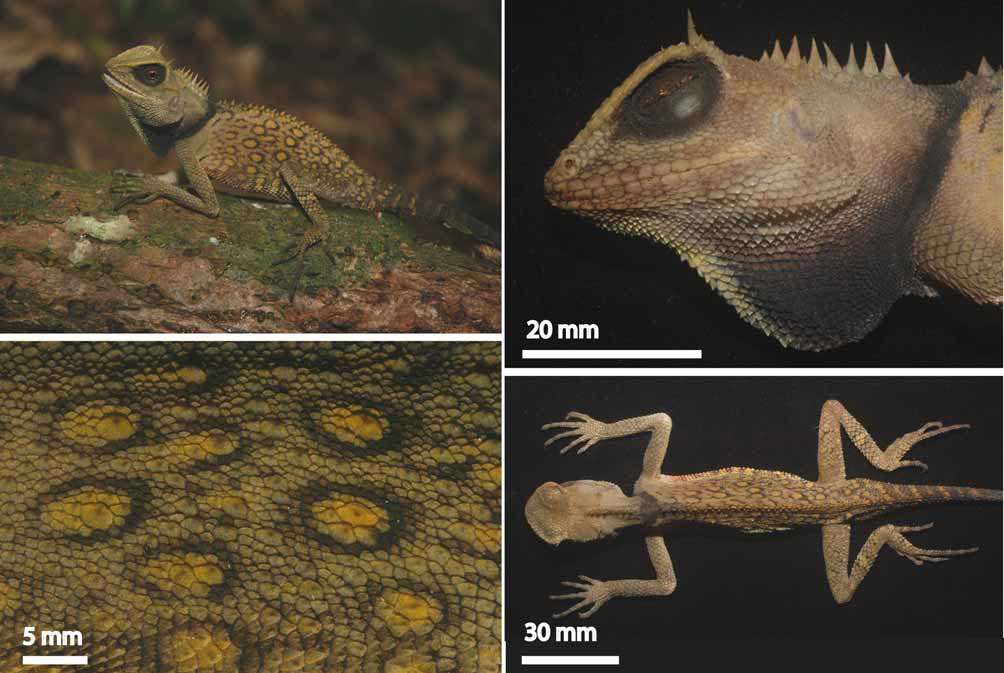
sp. nov sp. nov n = 3 n = 3 n = 26 n = 0 n = 2 n = 10 n = 1 n = 3 SVL 83.9 – 142 91.8 – 118.4 84.28 – 140 94 – 137.9 73 – 90 71 – 100.21 106.7 – 158 76.45 – 101.1 TL 112.8 – 206 136 – 174 105 – 186.9 133.6 – 182.1 115.5 – 115.8 95.6 – 162 171 – 287 130.6 – 144.1 to be continued. Description of the Holotype. (Fig. 2). Adult male, SVL 114.8 mm, TL 166.0 mm. Head short (HL / SVL 19 %), some what narrow (HW / SVL 17 %) moderately tall (HD / HL 0.85), triangular in dorsal and lateral profile; moderate snout length (SL / HL 46 % mm), interorbital and frontal regions and rostrum wide (RW / RH 229 %), steeply sloping anteriorly; canthus rostralis prominent, forming a large projecting shelf extending above eye, composed of 14 enlarged scales; shelf terminates with a notch anterior to the postorbital spine; rostral moderate in size, rectangular, bordered laterally by first supralabials and posteriorly by seven smaller scales; nasals concave, surrounded by one prenasal and three postnasal scales; eight scales between nasal scales; supranasals somewhat elongate; enlarged scales above orbit weakly keeled; an enlarged row of keeled scales below orbit extending from anterior margin of eye to middle of eye with two enlarged elliptical keeled scales, one near the anterior edge of orbit and another directly below orbit, with three smaller keeled scales in between them; eye large (EYE / HL 30 %); interorbital, frontal, and prefrontal scales keeled and smaller than enlarged row of keeled scales below the orbit; three enlarged, keeled, azygous prefrontals arranged in a Yshaped pattern; scales of occiput flat to weakly keeled; no enlarged parietal eyespot; short cylindrical epidermal spine above posterior margin of eye; occipital spine surrounded by seven enlarged keeled scales; suborbitals enlarged, keeled, extending in single row of six scales from below posterior margin of eye to anterior margin of tympanum, increasing in size posteriorly, terminal scale spine-like; elongate cylindrical epidermal spine on lateral margin of nape surrounded by a rosette of seven smaller spines; tympanum exposed, oblong, taller than wide, surrounded by small conical scales; supralabials 12, rectangular, not decreasing in size posteriorly; mental square above becoming triangular below, much larger than adjacent infralabials; two postmentals similar in size, five scales contacting mental; chinshields enlarged, extending posteriorly past angle of jaw, separated from infralabials by one scale row anteriorly and three at angle of jaw; infralabials 12, rectangular, scales in center of series largest; gulars sharply keeled and spinose with no enlarged midventral row; dewlap extensible; gular pouch large; nuchal crest with a diastema 11 scales at base of nape; nuchal crest composed of eight elongate, lancolate scales bordered on each side by two rows of enlarged, spinose scales; dorsal body crest present, extending from posterior margin of diastema onto base of tail, vertebral crest composed of enlarged epidermal, laterally compressed, spinose scales, bordered by a single row of slightly smaller paravertebral squarish, spinose scales; vertebral crest tapers slightly to base of tail then fades approximately midway down tail. Body moderately developed, triangular in cross-section; dorsal scales small with medially projecting spines; larger randomly arranged scale clusters among dorsals; scales of pectoral region and abdomen larger than dorsals, keeled, spinose, arranged in semi-transverse rows; keeled scales anterior to vent not enlarged; limbs relatively long; dorsal and ventral scales of forelimbs keeled, spinose, and nearly same size; five digits on manus; subdigital scales keeled; scales of hind limbs keeled and spinose; postfemoral scales small, interspersed with larger spinose scales; five digits on pes; subdigital scales keeled; subdigital lamellae under fourth finger 23; subdigital lamellae under fourth toe 25; tail 144 % of SVL, covered with keeled spinose scales; keels on subcaudals posteriorly directed, same size as keels of other caudal scales; base of tail in males nearly twice as wide as that in females. Coloration in life. (Fig. 2). Dorsal surface of head, body and limbs straw colored, sides and top of head immaculate straw colored; dark eye patch restricted to orbital region and not extending onto side of head; iris red; black collar complete dorsally; posterior gular region solid black, making contact with collar; yellow medial stripe on dewlap present, extending from base of gular region to the anterior edge of gular pouch; large yellow spots edged in blackish-brown arranged on body and base of tail, spots are larger towards the nape and decrease in size towards the base of the tail; forelimbs straw colored; faint spotting on hind limbs; tail faintly banded anteriorly, posterior 2 / 3 nearly solid black; underside of limbs and belly beige; pectoral region orangish. Variation. (Fig. 3). The paratypes resemble the holotype in most aspects of morphology except that the female FMNH 143140 has larger and fewer spots on the dorsum, black color in the gular region is not as prominent, medial yellow stripe on the dewlap is not as distinct, and tail bands are more prominent. The juvenile male ZRC 2.309 has smaller but more numerous spots on the dorsum, a faded black color and a lighter colored tail with prominent bands. Scalation and morphological variation is presented in Table 2. Sex ZRC 2.6804 Holotype Male FMNH 143140 Paratype Female ZRC 2.309 Paratype Juvenile SVL 114.8 142 83.9 TL 166 206 112.8 HL 22.4 25.4 16.9 HW 20 23.6 17.1 HD 19.2 20 15 SL 10.5 11.3 7.9 EYE 6.9 5.1 5.5 TD 3 2.5 2.7 TN 1 1 1 PS 4.2 1.9 2.4 NS 4.7 4.4 1.3 NSL 1.9 2.3 1.5 DS 1.8 2.2 / DSL 1.7 2.6 1.2 WN 1.6 2.1 1.7 WDS 2 2.4 1.7 DIAS 5 7.9 5.5 DIASN 11 15 13 DIAS / SVL 0.04 0.06 0.06 FOREL 56.4 61.5 33.9 HINDL 57.2 68.6 43.3 SUPRAL 12 12 12 INFRAL 12 12 11 VENT 53 55 51 FI 23 23 23 TO 26 28 27 TL / SVL 1.4 1.4 1.3 OS 2.4 2.6 1.2 NSSOS 7 7 6 CS 14 15 15 RW 3.9 5.3 3.6 RH 1.7 1.8 2 RS 9 7 9 to be continued.
Two new montane species of Acanthosaura Gray, 1831 (Squamata: Agamidae) from Peninsular Malaysia

Diagnosis. Maximum SVL 114.8 mm of males, maximum SVL of females 142.0 mm; head triangular, snout short (SL / HL 0.44 – 0.46); eye moderate to large (EYE / HL 0.20 – 0.32); two elliptical keeled scales below the orbit; 14 or 15 scales on canthus rostralis-supraorbital ridge; large rectangular rostral scale; single short cylindrical spine above posterior margin of eye surrounded by a rosette of six or seven smaller keeled scales at base; spine on occiput between tympanum and nuchal crest present; tympanum naked, oblong, taller than wide; dewlap present in males and females; body triangular in cross section; scales of flanks intermixed with randomly arranged clusters of larger keeled scales; nuchal crest present; 11 – 15 scales in nuchal diastema; vertebral crest composed of enlarged, pointed scales beginning at shoulder region and tapering to a series of enlarged keeled scales on anterior portion of tail; tail 1.3 – 1.5 % of SVL; black collar present; posterior 2 / 3 of tail black to dark reddish brown; yellow spots on body encircled with black or brown (Fig. 2); medial yellow stripe in black gular region (Table 1). bintangensis titwangsaensis armata capra coronata crucigera nataliae lepidogaster
Two new montane species of Acanthosaura Gray, 1831 (Squamata: Agamidae) from Peninsular Malaysia
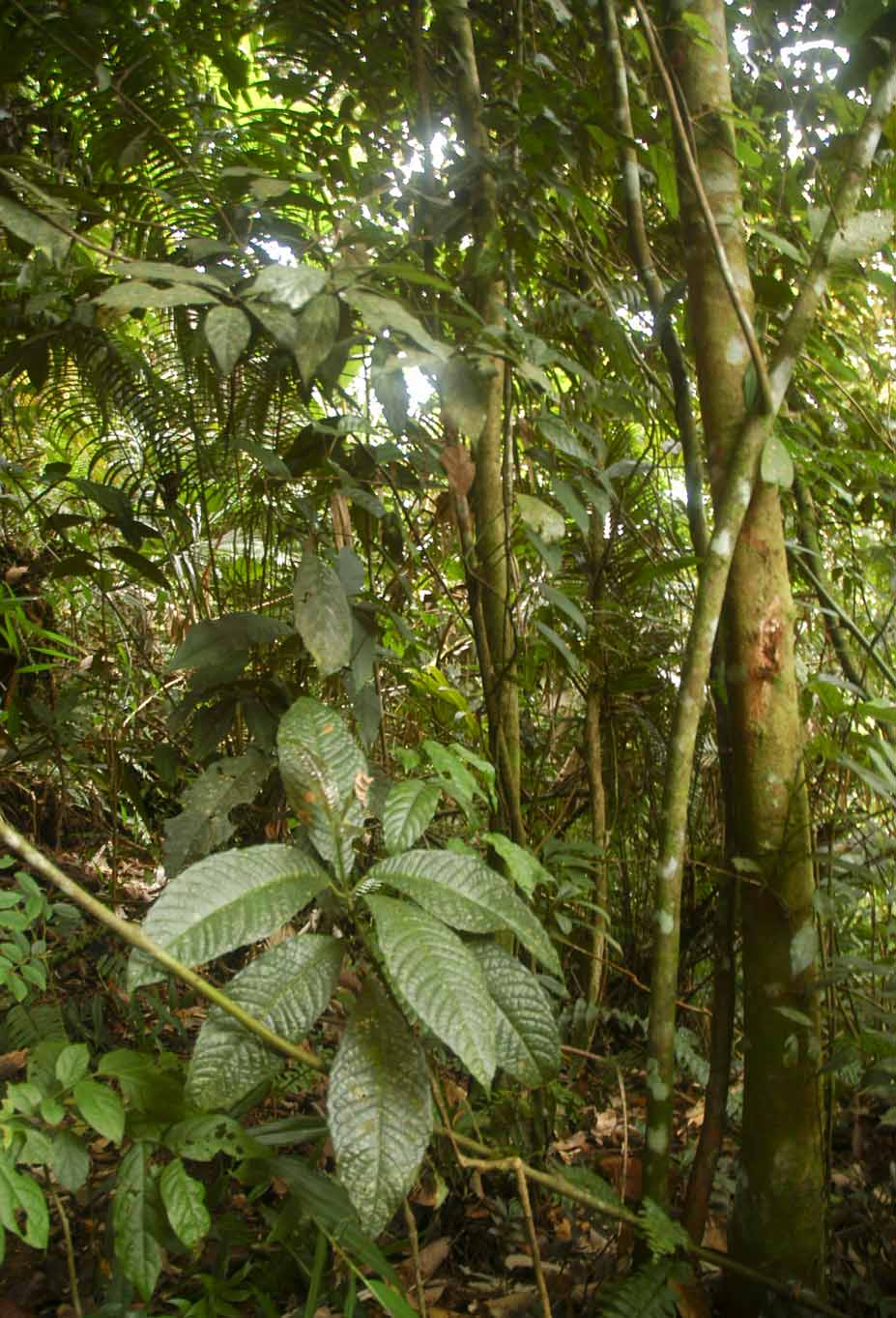
Distribution. Acanthosaura bintangensis is known only from the montane areas of Bukit Larut, Perak in the Banjaran Bintang, Peninsular Malaysia above 1,200 m in elevation. Given that this mountain range extends into southern Thailand and other montane endemics restricted to this range extends across the Thai- Malaysian border (Boulenger 1903; Flower 1896, 1899; Grismer et al. 2008), it is likely that A. bintangensis will be found further to the north as well. Natural history. Acanthosaura bintangensis is a montane species found in hill top dipterocarp forests ranging no lower than 1,200 m in elevation. The holotype was found during the day on the side of a small tree approximately 0.2 m in diameter in dense undergrowth approximately 1 – 2 m above the forest floor (Fig. 4) in an area where the immediate terrain is level but adjacent to hilly areas. Like other species of Acanthosaura, this species probably forages on the ground for food, digging through the soil (Taylor 1963). We hypothesize this based on soil fragments found on the labial scales and within the external nares of specimens. A gravid female was collected during August (FMNH 143140).
Two new montane species of Acanthosaura Gray, 1831 (Squamata: Agamidae) from Peninsular Malaysia
Etymology. This specific epithet bintangensis refers to the mountain range, Banjaran Bintang, to which this species appears to be restricted.
Two new montane species of Acanthosaura Gray, 1831 (Squamata: Agamidae) from Peninsular Malaysia
Holotype. Adult male (ZRC 2.6804) collected on 18 June 2008 by Jesse L. Grismer, L. Lee Grismer, Perry L. Wood Jr., at 1140 h at 1351 m a. s. l. from Bukit Larut, Perak, Peninsular Malaysia (04 º 51.446 ' N; 100 º 48.455 ' E). Paratypes. ZRC 2.309; juvenile male from Bukit Larut, Perak, Peninsular Malaysia. FMNH 143140; gravid female from Bukit Larut, Tuping, Perak, Peninsular Malaysia 4700 ′ (1,432 m) collected by Lim Boo Liat on 4 August 1959.
Two new montane species of Acanthosaura Gray, 1831 (Squamata: Agamidae) from Peninsular Malaysia

Export occurrence data

Darwin Core Archive (ZIP)

GEOGRAPHY

Distribution Map

Occurrence Map

Loading map…

Tiles © GBIF Maps API | Map powered by MapLibre GL

REGIONS

Geographic Distribution(4)

Southern Asia
W Malaysia (Perak)
W Malaysia (Perak)
Global
data deficient

DATA

Occurrence Datasets

Loading datasets…

Common names used for this species across different languages and regions. 1 preferred.

engBukit Larut Mountain Horned AgamidengengBintang Horned Tree LizardengengBintang Horned Tree LizardengengBintang Horned Tree LizardengengBukit Larut Mountain Horned Agamideng+3 more

Vernacular (common) names are the everyday names used for a species in different languages and regions. A single species may have dozens of common names worldwide. 1 name preferred.

engBintang Horned Tree Lizard
eng
Source: Catalogue of LifeSource taxon #299440884
engBintang Horned Tree Lizard
eng
Source: Integrated Taxonomic Information System (ITIS)Source taxon #135384228
engBintang Horned Tree Lizard
eng
Source: Catalogue of LifeSource taxon #273238895
engBukit Larut Mountain Horned Agamid
eng
Source: Integrated Taxonomic Information System (ITIS)Source taxon #135384228
engBukit Larut Mountain Horned Agamid
eng
Source: Catalogue of LifeSource taxon #299440884
engBukit Larut Mountain Horned Agamid
eng
Source: Catalogue of LifeSource taxon #273238895
engBukit Larut Mountain Horned Agamid
engpreferred
Source: The IUCN Red List of Threatened SpeciesSource taxon #176719682
engBintang Horned Tree Lizard
eng
Source: The IUCN Red List of Threatened SpeciesSource taxon #176719682

CLASSIFICATION

Taxonomic Classification Tree

MULTIMEDIA

Media Files(3)

FIGURE 2. Adult male holotype (ZRC 2.6804) of Acanthosaura bintangensis from Bukit Larut, Perak, Peninsular Malaysia. Upper left: in life. Lower left: lateral view of the scalation on the left side of the body. Upper right: lateral view of the head. Lower right: dorsal view.

Imageimage/png© Wood, Perry L.;Grismer, Jesse L.;Grismer, Lee;Ahmad, Norhayati;Onn, Chan Kin;Bauer, Aaron M.Two new montane species of Acanthosaura Gray, 1831 (Squamata: Agamidae) from Peninsular Malaysia

FIGURE 3. Type series of Acanthosaura bintangensis. Left: male holotype (ZRC 2.6804). Middle: female paratype (FMNH 143140). Right: juvenile male paratype (ZRC 2.309).

Imageimage/png© Wood, Perry L.;Grismer, Jesse L.;Grismer, Lee;Ahmad, Norhayati;Onn, Chan Kin;Bauer, Aaron M.Two new montane species of Acanthosaura Gray, 1831 (Squamata: Agamidae) from Peninsular Malaysia
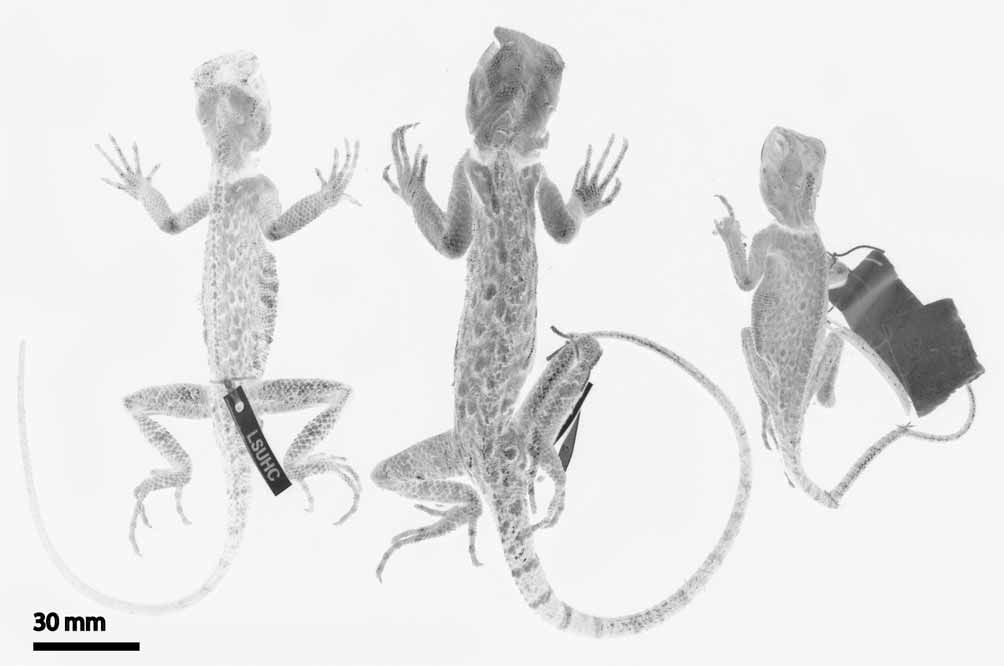
FIGURE 4. Habitat of type locality of Acanthosaura bintangensis from Bukit Larut, Perak, Peninsular Malaysia (04 º 51.446 ' N; 100 º 48.455 ' E, 1351 m a. s. l.).

Imageimage/png© Wood, Perry L.;Grismer, Jesse L.;Grismer, Lee;Ahmad, Norhayati;Onn, Chan Kin;Bauer, Aaron M.Two new montane species of Acanthosaura Gray, 1831 (Squamata: Agamidae) from Peninsular Malaysia
IMAGES

Gallery(3)

See Gallery

Occurrences with images

CITATIONS

References(1)

  • 1

    Wood, Perry L., Jr., Jesse L. Grismer, L. Lee Grismer, Norhayati Ahmad, Chan Kin Onn, et al., 2009: Two new montane species of Acanthosaura Gray, 1831 (Squamata: Agamidae) from Peninsular Malaysia. Zootaxa, issue 2012. 28-46.

    Integrated Taxonomic Information System (ITIS)
  • Source Information

    GBIF Backbone Taxonomy

    GBIF Backbone Taxonomy

    checklist

    The GBIF Backbone Taxonomy is a single, synthetic management classification with the goal of covering all names GBIF is dealing with. It's the taxonomic backbone that allows GBIF to integrate name based information from different resources, no matter if these are occurrence datasets, species pages, names from nomenclators or external sources like EOL, Genbank or IUCN. This backbone allows taxonomic search, browse and reporting operations across all those resources in a consistent way and to provide means to crosswalk names from one source to another.

    It is updated regulary through an automated process in which the Catalogue of Life acts as a starting point also providing the complete higher classification above families. Additional scientific names only found in other authoritative nomenclatural and taxonomic datasets are then merged into the tree, thus extending the original catalogue and broadening the backbones name coverage. The GBIF Backbone taxonomy also includes identifiers for Operational Taxonomic Units (OTUs) drawn from the barcoding resources iBOL and UNITE.

    International Barcode of Life project (iBOL), Barcode Index Numbers (BINs). BINs are connected to a taxon name and its classification by taking into account all names applied to the BIN and picking names with at least 80% consensus. If there is no consensus of name at the species level, the selection process is repeated moving up the major Linnaean ranks until consensus is achieved.

    UNITE - Unified system for the DNA based fungal species, Species Hypotheses (SHs). SHs are connected to a taxon name and its classification based on the determination of the RefS (reference sequence) if present or the RepS (representative sequence). In the latter case, if there is no match in the UNITE taxonomy, the lowest rank with 100% consensus within the SH will be used.

    The GBIF Backbone Taxonomy is available for download at https://hosted-datasets.gbif.org/datasets/backbone/ in different formats together with an archive of all previous versions.

    The following 105 sources have been used to assemble the GBIF backbone with number of names given in brackets:

    • Catalogue of Life Checklist - 4766428 names
    • International Barcode of Life project (iBOL) Barcode Index Numbers (BINs) - 635951 names
    • UNITE - Unified system for the DNA based fungal species linked to the classification - 611208 names
    • The Paleobiology Database - 212054 names
    • World Register of Marine Species - 188857 names
    • The Interim Register of Marine and Nonmarine Genera - 183894 names
    • The World Checklist of Vascular Plants (WCVP) - 131891 names
    • GBIF Backbone Taxonomy - 114350 names
    • TAXREF - 109374 names
    • The Leipzig catalogue of vascular plants - 75380 names
    • ZooBank - 73549 names
    • Integrated Taxonomic Information System (ITIS) - 68377 names
    • Plazi.org taxonomic treatments database - 61346 names
    • Genome Taxonomy Database r207 - 60545 names
    • International Plant Names Index - 52329 names
    • Fauna Europaea - 45077 names
    • The National Checklist of Taiwan (Catalogue of Life in Taiwan, TaiCoL) - 36193 names
    • Dyntaxa. Svensk taxonomisk databas - 35892 names
    • The Plant List with literature - 32692 names
    • United Kingdom Species Inventory (UKSI) - 29643 names
    • Artsnavnebasen - 29208 names
    • The IUCN Red List of Threatened Species - 21221 names
    • Afromoths, online database of Afrotropical moth species (Lepidoptera) - 13961 names
    • Brazilian Flora 2020 project - Projeto Flora do Brasil 2020 - 13829 names
    • Prokaryotic Nomenclature Up-to-Date (PNU) - 10079 names
    • Checklist Dutch Species Register - Nederlands Soortenregister - 8814 names
    • ICTV Master Species List (MSL) - 7852 names
    • Cockroach Species File - 6020 names
    • GRIN Taxonomy - 5882 names
    • Taxon list of fungi and fungal-like organisms from Germany compiled by the DGfM - 4570 names
    • Catalogue of Afrotropical Bees - 3623 names
    • Catalogue of Tenebrionidae (Coleoptera) of North America - 3327 names
    • Checklist of Beetles (Coleoptera) of Canada and Alaska. Second Edition. - 3312 names
    • Systema Dipterorum - 2850 names
    • Catalogue of the Pterophoroidea of the World - 2807 names
    • The Clements Checklist - 2675 names
    • Taxon list of Hymenoptera from Germany compiled in the context of the GBOL project - 2496 names
    • IOC World Bird List, v13.2 - 2366 names
    • Official Lists and Indexes of Names in Zoology - 2310 names
    • National checklist of all species occurring in Denmark - 1922 names
    • Myriatrix - 1876 names
    • Database of Vascular Plants of Canada (VASCAN) - 1822 names
    • Taxon list of vascular plants from Bavaria, Germany compiled in the context of the BFL project - 1771 names
    • Orthoptera Species File - 1742 names
    • A list of the terrestrial fungi, flora and fauna of Madeira and Selvagens archipelagos - 1602 names
    • Aphid Species File - 1565 names
    • World Spider Catalog - 1561 names
    • Taxon list of Jurassic Pisces of the Tethys Palaeo-Environment compiled at the SNSB-JME - 1270 names
    • Backbone Family Classification Patch - 1143 names
    • GBIF Algae Classification - 1100 names
    • International Cichorieae Network (ICN): Cichorieae Portal - 975 names
    • Psocodea Species File - 803 names
    • New Zealand Marine Macroalgae Species Checklist - 787 names
    • Annotated checklist of endemic species from the Western Balkans - 754 names
    • Taxon list of animals with German names (worldwide) compiled at the SMNS - 503 names
    • Catalogue of the Alucitoidea of the World - 472 names
    • Lygaeoidea Species File - 462 names
    • Catálogo de Plantas y Líquenes de Colombia - 422 names
    • GBIF Backbone Patch - 317 names
    • Phasmida Species File - 259 names
    • Cortinariaceae fetched from the Index Fungorum API - 234 names
    • Coreoidea Species File - 233 names
    • GTDB supplement - 139 names
    • Mantodea Species File - 119 names
    • Endemic species in Taiwan - 93 names
    • Taxon list of Araneae from Germany compiled in the context of the GBOL project - 88 names
    • Species of Hominidae - 78 names
    • Taxon list of Sternorrhyncha from Germany compiled in the context of the GBOL project - 77 names
    • Taxon list of mosses from Germany compiled in the context of the GBOL project - 75 names
    • Mammal Species of the World - 73 names
    • Plecoptera Species File - 71 names
    • Species Fungorum Plus - 64 names
    • Catalogue of the type specimens of Cosmopterigidae (Lepidoptera: Gelechioidea) from research collections of the Zoological Institute, Russian Academy of Sciences - 47 names
    • Species named after famous people - 41 names
    • Dermaptera Species File - 36 names
    • Taxon list of Trichoptera from Germany compiled in the context of the GBOL project - 34 names
    • True Fruit Flies (Diptera, Tephritidae) of the Afrotropical Region - 33 names
    • Range and Regularities in the Distribution of Earthworms of the Earthworms of the USSR Fauna. Perel, 1979 - 32 names
    • Taxon list of Diplura from Germany compiled in the context of the GBOL project - 30 names
    • Lista de referencia de especies de aves de Colombia - 2022 - 24 names
    • Taxon list of Auchenorrhyncha from Germany compiled in the context of the GBOL project - 20 names
    • Catalogue of the type specimens of Polycestinae (Coleoptera: Buprestidae) from research collections of the Zoological Institute, Russian Academy of Sciences - 19 names
    • Taxon list of Thysanoptera from Germany compiled in the context of the GBOL project - 19 names
    • Lista de especies de vertebrados registrados en jurisdicción del Departamento del Huila - 18 names
    • Taxon list of Microcoryphia (Archaeognatha) from Germany compiled in the context of the GBOL project - 15 names
    • Catalogue of the type specimens of Bufonidae and Megophryidae (Amphibia: Anura) from research collections of the Zoological Institute, Russian Academy of Sciences - 12 names
    • Grylloblattodea Species File - 11 names
    • Coleorrhyncha Species File - 9 names
    • Taxon list of liverworts from Germany compiled in the context of the GBOL project - 9 names
    • Embioptera Species File - 7 names
    • Taxon list of Pisces and Cyclostoma from Germany compiled in the context of the GBOL project - 6 names
    • Taxon list of Pteridophyta from Germany compiled in the context of the GBOL project - 6 names
    • Taxon list of Siphonaptera from Germany compiled in the context of the GBOL project - 5 names
    • The Earthworms of the Fauna of Russia. Perel, 1997 - 5 names
    • Taxon list of Zygentoma from Germany compiled in the context of the GBOL project - 4 names
    • Asiloid Flies: new taxa of Diptera: Apioceridae, Asilidae, and Mydidae - 3 names
    • Taxon list of Protura from Germany compiled in the context of the GBOL project - 3 names
    • Taxon list of hornworts from Germany compiled in the context of the GBOL project - 2 names
    • Chrysididae Species File - 1 names
    • Taxon list of Dermaptera from Germany compiled in the context of the GBOL project - 1 names
    • Taxon list of Diplopoda from Germany in the context of the GBOL project - 1 names
    • Taxon list of Orthoptera (Grashoppers) from Germany compiled at the SNSB - 1 names
    • Taxon list of Pscoptera from Germany compiled in the context of the GBOL project - 1 names
    • Taxon list of Pseudoscorpiones from Germany compiled in the context of the GBOL project - 1 names
    • Taxon list of Raphidioptera from Germany compiled in the context of the GBOL project - 1 names

    GBIF Secretariat (2023). GBIF Backbone Taxonomy. Checklist dataset https://doi.org/10.15468/39omei accessed via GBIF.org on 2026-06-14.

    CC BYPublished 8/28/2023View dataset
    GBIF Usage Key
    7664492
    Dataset Key
    d7dddbf4-2cf0-4f39-9b2a-bb099caae36c
    Origin
    source
    Backbone Key
    7664492
    Taxon ID
    gbif:7664492
    Last Crawled
    8/22/2023
    Last Interpreted
    8/22/2023