AnimaliaNot EvaluatedacceptedspeciesAccepted
Filispirifer hamadae

Filispirifer hamadae

GBIF:7988468

ABOUT

Descriptions(6)

Description of the holotype (SMF 65248 b) Form and size. The ventral internal mould is transverse, semielliptic in outline, and brachythyrid without mucronations. The specimen is strongly convex in longitudinal section. Exterior of ventral valve. The ventral umbo extends clearly to posterior over the hinge line. The ventral interarea is moderately high, apsacline, and curved. The delthyrium is open, restricted by a pair of thin deltidial lamellae that are not combined posteriorly. Interior of ventral valve. Ventral muscle field extends to posterior over the hinge line. Lateral apical cavities are almost completely filled by secondary shell material and not extending to posterior over the hinge line. A small septal pillow is developed dorsal of the ventral muscle field. Both sides of the septal pillow are bordered by a thin subdeltidial furrow on the internal mould of which only one is preserved. Ventral process weakly developed leaving a very small groove on the internal mould from the septal pillow to the beginning of the ventral myophragm. The myophragm is thick leaving a broad furrow through the posterior half of the ventral muscle field on the internal mould. The ventral muscle field is broad, elongated, almost diamondshaped in outline, and deeply impressed into the shell. On each side, 2 costae are gently impressed on the internal mould of the ventral muscle field. Diductor scars are impressed as subradial striae on the internal mould. Adductor scars situated next to the myophragm and enclosed completely by the diductor field; posterior and anterior pairs clearly differentiable and clearly impressed into shell. The anterior part is lancet-shaped and broad, the posterior part elongated and thin. Muscle bounding ridge broad and clearly developed, leaving a deep furrow on the internal mould as the lateral border of the ventral muscle field. Anteriorly, in the sulcus, the muscle bounding ridge is only weakly impressed. Free portions of dental plates short, leaving small wedge-like slits on either side of the ventral muscle field on the internal mould. Posteriorly they are imbedded into secondary shell material. Its anterior parts pass into the muscle bounding ridge. No teeth preserved. Due to the strong development of secondary shell material, a platform is formed on both sides of the ventral muscle field which is covered by numerous gonoglyphs preserved as tubercles on the internal mould. Sulcus smooth, conspicuous, and shallow, at base flattened in cross section. Each flank of the specimen is covered by 6 coarse and simple costae that are impressed anterior of the platform on the internal mould. The sulcus bounding costae are slightly weaker than the adjacent pair of costae and included into the sulcus. No impressions of growth lamellae. Description of paratypes Form and size. Shells medium to large-sized, compact to slightly transverse, and subcircular to subelliptic in outline. In longitudinal section biconvex, mostly equibiconvex to dorsibiconvex, brachythyrid to megathyrid without mucronations. Sometimes small ears are developed. Largest specimen 31.0 mm long and 46.3 mmm wide. Exterior of ventral valve. The ventral umbo extends to posterior over the hinge line. The ventral interarea is moderately high, apsacline, and curved. In the lower part of the ventral interarea growth lamellae parallel to the hinge line are weakly preserved. The delthyrium is open. It is slightly constricted by a pair of deltidial lamellae that are not fused posteriorly. A deltidium is not developed. In the posterior part of the ventral umbo a deep and narrow sulcus begins. It is angular in cross section and with steep flanks. The sulcus tongue is long to short, its outline at the anterior margin is rounded to angular. A weak median costa is often developed that is rounded in cross section. Exterior of dorsal valve. The dorsal umbo is small and extends slightly posterior over the hinge line. The dorsal interarea is very low and anacline to orthocline. The notothyrium is open, chilidial lamellae are not developed. In the posterior part of the umbo a steep and elevated fold begins that is angular in cross section. Macro-ornamentation. The external ventral valve is covered by 8 to 11 coarse and simple costae that do not multiply by bifurcation or intercalation and are angular in cross section. The first pair of costae is included into the sulcus and also more weakly developed than the second pair. The external dorsal valve is covered by one or two costae less than on the ventral shell. In some cases, the first pair of costae is situated on the flanks of the fold. The costae on both valves are coarse, simple, do not multiply by bifurcation or intercalation, and are angular in cross section. They are separated by furrows that are angular in cross section and of the same size as the costae. At the anterior margin, coarse and concentric growth lamellae are developed. The edges of the growth lamellae overhang on the next younger lamellae. Micro-ornamentation. The micro-ornamentation is capillate with 9 to 10 capillae per mm. Capillae are arranged in radial lines running over the whole shell. At the intersection of capillae and growth lamellae very small nodes are developed. (Pl. 1 Figs 9 B, C). Interior of ventral valve. The ventral muscle field extends posterior of the hinge line (Fig. 4 A). Lateral apical cavities are almost completly filled by secondary shell material, resulting in a deep imbedding of the ventral muscle field into the shell. Dorsal of the ventral muscle field, a small septal pillow (= coussinet septal sensu Gourvennec 1989: 27, fig. 13) is developed but hardly extending further posteriorly than the ventral muscle field. Both sides of the septal pillow are bordered by a very thin subdeltidial furrow (= sillon hypodeltidial sensu Gourvennec 1989: 23, 30, fig. 7) on the internal mould. Medially, the septal pillow is grooved by a fine furrow on the internal mould that is interpreted as a remnant of the small ventral process that leaves a small indentation in the posterior margin of the impression of the ventral muscle field (Fig. 4 A). A broad myophragm originates from the ventral process leaving a distinct furrow through the first half to two thirds of the ventral muscle field on the internal mould. The ventral muscle field is broad and generally elongated, always slightly longer than wide; subelliptic to rarely diamond-shaped in outline. Two to three costae are weakly impressed on the internal mould of the ventral muscle field. Diductor scars leave subradial striae on the internal mould. Adductor scars elongate, posterior and anterior pairs clearly differentiable, and situated admedian next to the myophragm. The posterior pair of adductor scars is thin and elongate. The anterior pair is elongate and lancet-shaped. Both pairs slightly imbedded into the shell. Muscle bounding ridge strongly to weakly developed leaving a fine to coarse furrow on the internal mould starting at the anterior end of the dental plates and diminishing towards the sulcus. Free portions of dental plates moderately short and knob-like, situated on the lateral border of the sulcus and leaving divergent broad slits on the internal mould. Even in juvenile specimens, dental plates are already imbedded into secondary shell material, in adult specimens they sometimes leave only a small indentation on the internal mould. Teeth are very small and knob-like (Figs 4 D, E; Pl. 1 Figs 1 C, D, 2 C). Due to the strong development of secondary shell material, a platform is developed next to the muscle field that increases in size in adult specimens. On this platform, gonoglyphs are preserved as narrow small tubercles on the internal mould (Pl. 1 Fig. 1 B). Sulcus small and shallow, at base rounded to flattened in cross section. Anterior of the platform, each flank is covered by 6 to 10 well developed impressions of simple costae that are mostly rounded in cross section. Costae are separated by furrows of the same width that are angular in cross section. The sulcus bounding costae are included into the sulcus and slightly smaller than the second pair of costae. Impressions of growth lamellae are not recognisable. Interior of dorsal valve. Dorsal filling of the umbo very small and extending a short distance over the hinge line. Notothyrial shelf lacking, in rare cases weakly indicated. Ctenophoridium situated posterior to the filling of the umbo perpendicular to commissural plane. Dorsal median process very weakly developed, situated dorsally of the ctenophoridium. It is followed by a fine myophragm that extends through the entire adductor field. Dental sockets thin, long, and rounded in cross section pointing in apical direction. Brachiophores long, relatively broad, and curved over the dental sockets (Pl. 1 Fig. 3 D). Crural bases individualised as thin lamellae (Fig. 4 E). Up to 16 whorls are hanging on each crus (Fig. 4 F). Delimitation of adductor field inconspicuous. Its anterior margin developed as a ridge on the fold of the internal mould. Very few gonoglyphs are preserved as small tubercles next to the filling of the dorsal umbo. Fold smooth, moderately to highly elevated, rounded on top in cross section with steep flanks. 6 to 8 impressions of simple costae are developed on each flank and are separated by furrows of same size. Costae are rounded, furrows are angular in cross section. Impressions of growth lamellae are not preserved.
A new species of Filispirifer (Brachiopoda: Delthyridoidea) from the Dra Valley, Morocco (Lower Devonian)

Geographic distribution: southwestern Anti-Atlas Mountains, Dra Valley (Morocco, North Africa).
A new species of Filispirifer (Brachiopoda: Delthyridoidea) from the Dra Valley, Morocco (Lower Devonian)
v 2001 Filispirifer cf. merzakhsaiensis. — Jansen: Unter-Devonische Brachiopoden Dra Ebene: 36, 38, tab. 2. v 2004 b Filispirifer cf. merzakhsaiensis. — Jansen et al.: Pragian at Assa: 64, pl. 1 fig. 6. v 2007 Filispirifer cf. merzakhsaiensis. — Jansen et al.: Neritic-pelagic correlation: 19, fig. 4.20.
A new species of Filispirifer (Brachiopoda: Delthyridoidea) from the Dra Valley, Morocco (Lower Devonian)
Diagnosis. Medium to large-sized Filispirifer with 8 to 11 coarse and simple costae on each external flank, a moderately high ventral interarea, a small ventral process, and an inconspicuous dorsal adductor field. The ventral muscle field is strongly imbedded, subelliptic to diamond-shaped in outline, and indented by a small ventral process. Median costa in sulcus may be lacking.
A new species of Filispirifer (Brachiopoda: Delthyridoidea) from the Dra Valley, Morocco (Lower Devonian)
Holotype: Internal mould of ventral valve, stored in the Forschungsinstitut und Naturmuseum Senckenberg under the inventory number SMF 65248 b (Pl. 1 Figs 1 A – D). Length 26.3 mm and width 38.2 mm. Derivation of name: After the Arabian word “ hamada ” for stony desert in which the type locality is situated. Type locality: El Ayoun, c. 12 km Southeast of Tata, southwestern Anti-Atlas Mountains, Dra Valley (Morocco, North Africa). Type horizon: Merzâ-Akhsaï Formation (‘ Rich 2 ’), exact position unknown, Middle / Upper Siegenian (middle Lower Devonian). Stratigraphic distribution: Assa Formation (‘ Rich 1 ’) to Merzâ-Akhsaï Formation (‘ Rich 2 ’), upper Lower Siegenian to Middle / Upper Siegenian (middle Lower Devonian).
A new species of Filispirifer (Brachiopoda: Delthyridoidea) from the Dra Valley, Morocco (Lower Devonian)
Material. Locality Assa I. 4 articulated shells: SMF 65204, 66539, 66543, 66578; 8 articulated internal moulds: SMF 66527, 66528, 66542, 66545, 66547, 66585 – 66587; 2 isolated ventral shells: SMF 66548, 66549; 14 ventral external shells: SMF 65206, 66529 – 66531, 66533, 66537, 66538, 66540, 66541, 66544, 66547, 66575 – 66577; 1 ventral internal shell: SMF 66579; 8 ventral internal moulds: SMF 65022, 65065 a, b, 65204, 66196, 66534, 66545, 66580; 7 dorsal internal moulds: SMF 66532, 66535, 66536, 66546, 66581, 66582, 66584; several shell fragments and fragments of internal moulds of both valves. Locality Assa II. 1 ventral internal mould: SMF 65218; 1 dorsal internal mould: SMF 66583. Locality El Ayoun. 2 ventral internal moulds: SMF 65248 a, b (holotype). Locality Foum el Hassane. 13 articulated shells: SMF 66556 – 66563, 66565 – 66567, 66570, 66572, 66590; 1 articulated internal mould: SMF 66564; 5 ventral external shells: SMF 66550, 66551, 66554, 66568, 66573; 1 ventral internal shell: SMF 66555; 1 ventral internal mould: SMF 66552; 1 dorsal external shell: SMF 66571; 1 dorsal internal shell: SMF 66569; several ventral internal moulds: SMF 66553. Locality Timziline. 1 ventral external mould: SMF 66589; 1 ventral internal mould: SMF 59649; 1 dorsal external mould: SMF 66588.
A new species of Filispirifer (Brachiopoda: Delthyridoidea) from the Dra Valley, Morocco (Lower Devonian)

Export occurrence data

Darwin Core Archive (ZIP)

CLASSIFICATION

Taxonomic Classification Tree

RELATED

Related Name Usages(3)

Matching names from other GBIF-indexed checklists and datasets.

MULTIMEDIA

Media Files(4)

FIGURE 1. Geologic map of in the Dra Valley, Morocco. Collection localities of the spiriferids.

Imageimage/png© Schemm-Gregory, MenaA new species of Filispirifer (Brachiopoda: Delthyridoidea) from the Dra Valley, Morocco (Lower Devonian)

FIGURE 2. Morphological terms for Filispirifer hamadae n. sp., SMF 65248 b, holotype. Internal mould of ventral valve. Plan view. Dental plates, ventral process, and myophragm are preserved as negative forms. Drawing: M. McMullen.

Imageimage/png© Schemm-Gregory, MenaA new species of Filispirifer (Brachiopoda: Delthyridoidea) from the Dra Valley, Morocco (Lower Devonian)
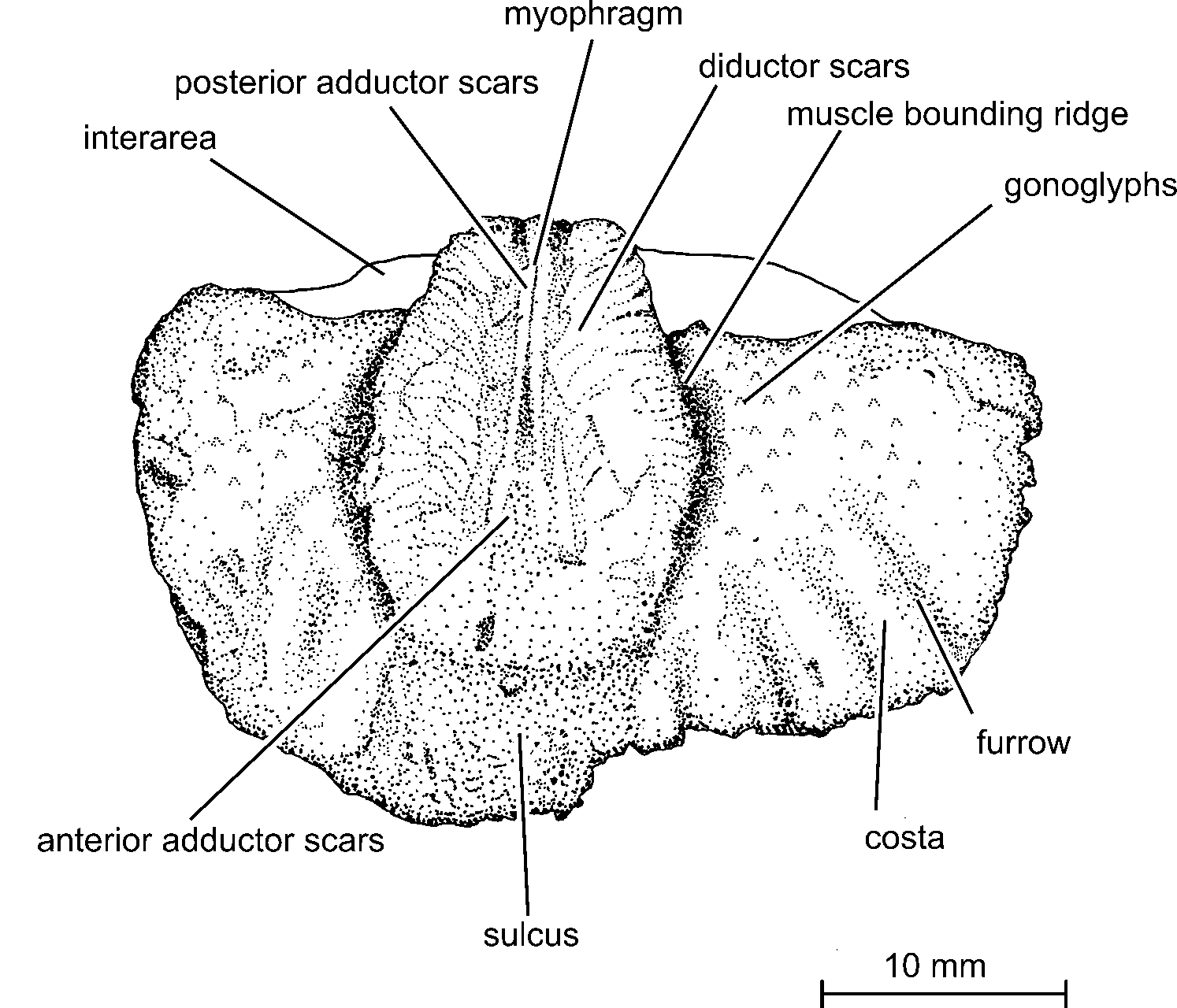
FIGURE 3. Morphological terms for Filispirifer hamadae n. sp., SMF 66583. Internal mould of dorsal valve. A. Plan view. B. Oblique posterior view. Dental sockets, brachiophores, and myophragm are preserved as negative forms. Drawing: J. Eberhardt.

Imageimage/png© Schemm-Gregory, MenaA new species of Filispirifer (Brachiopoda: Delthyridoidea) from the Dra Valley, Morocco (Lower Devonian)
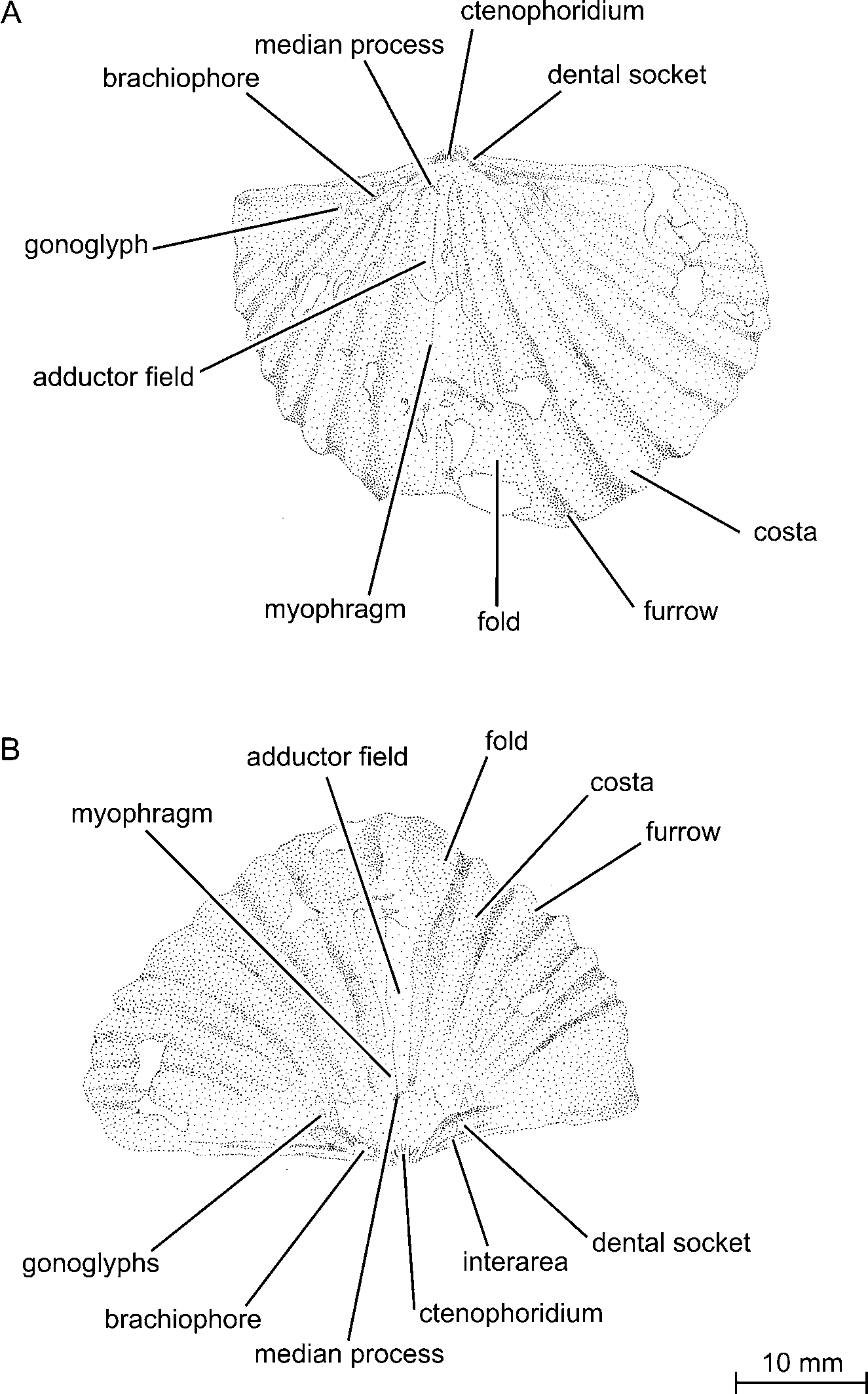
FIGURE 4. Serial sections of Filispirifer hamadae n. sp., A – G. SMF 66590, all figures of double size (2.0 x); sectioning perpendicular to commissural plane, shell material in black, sectioning distance in mm from posterior; c = crus, cb = crural base, ct = ctenophoridium, dp = dental plate, ds = dental socket, lac = lateral apical cavity, sp = spiralia, ssm = secondary shell material, t = tooth, vmf = ventral muscle field, vp = ventral process.

Imageimage/png© Schemm-Gregory, MenaA new species of Filispirifer (Brachiopoda: Delthyridoidea) from the Dra Valley, Morocco (Lower Devonian)

IMAGES

Gallery(4)

See Gallery

Occurrences with images

Source Information

GBIF Backbone Taxonomy

GBIF Backbone Taxonomy

checklist

The GBIF Backbone Taxonomy is a single, synthetic management classification with the goal of covering all names GBIF is dealing with. It's the taxonomic backbone that allows GBIF to integrate name based information from different resources, no matter if these are occurrence datasets, species pages, names from nomenclators or external sources like EOL, Genbank or IUCN. This backbone allows taxonomic search, browse and reporting operations across all those resources in a consistent way and to provide means to crosswalk names from one source to another.

It is updated regulary through an automated process in which the Catalogue of Life acts as a starting point also providing the complete higher classification above families. Additional scientific names only found in other authoritative nomenclatural and taxonomic datasets are then merged into the tree, thus extending the original catalogue and broadening the backbones name coverage. The GBIF Backbone taxonomy also includes identifiers for Operational Taxonomic Units (OTUs) drawn from the barcoding resources iBOL and UNITE.

International Barcode of Life project (iBOL), Barcode Index Numbers (BINs). BINs are connected to a taxon name and its classification by taking into account all names applied to the BIN and picking names with at least 80% consensus. If there is no consensus of name at the species level, the selection process is repeated moving up the major Linnaean ranks until consensus is achieved.

UNITE - Unified system for the DNA based fungal species, Species Hypotheses (SHs). SHs are connected to a taxon name and its classification based on the determination of the RefS (reference sequence) if present or the RepS (representative sequence). In the latter case, if there is no match in the UNITE taxonomy, the lowest rank with 100% consensus within the SH will be used.

The GBIF Backbone Taxonomy is available for download at https://hosted-datasets.gbif.org/datasets/backbone/ in different formats together with an archive of all previous versions.

The following 105 sources have been used to assemble the GBIF backbone with number of names given in brackets:

  • Catalogue of Life Checklist - 4766428 names
  • International Barcode of Life project (iBOL) Barcode Index Numbers (BINs) - 635951 names
  • UNITE - Unified system for the DNA based fungal species linked to the classification - 611208 names
  • The Paleobiology Database - 212054 names
  • World Register of Marine Species - 188857 names
  • The Interim Register of Marine and Nonmarine Genera - 183894 names
  • The World Checklist of Vascular Plants (WCVP) - 131891 names
  • GBIF Backbone Taxonomy - 114350 names
  • TAXREF - 109374 names
  • The Leipzig catalogue of vascular plants - 75380 names
  • ZooBank - 73549 names
  • Integrated Taxonomic Information System (ITIS) - 68377 names
  • Plazi.org taxonomic treatments database - 61346 names
  • Genome Taxonomy Database r207 - 60545 names
  • International Plant Names Index - 52329 names
  • Fauna Europaea - 45077 names
  • The National Checklist of Taiwan (Catalogue of Life in Taiwan, TaiCoL) - 36193 names
  • Dyntaxa. Svensk taxonomisk databas - 35892 names
  • The Plant List with literature - 32692 names
  • United Kingdom Species Inventory (UKSI) - 29643 names
  • Artsnavnebasen - 29208 names
  • The IUCN Red List of Threatened Species - 21221 names
  • Afromoths, online database of Afrotropical moth species (Lepidoptera) - 13961 names
  • Brazilian Flora 2020 project - Projeto Flora do Brasil 2020 - 13829 names
  • Prokaryotic Nomenclature Up-to-Date (PNU) - 10079 names
  • Checklist Dutch Species Register - Nederlands Soortenregister - 8814 names
  • ICTV Master Species List (MSL) - 7852 names
  • Cockroach Species File - 6020 names
  • GRIN Taxonomy - 5882 names
  • Taxon list of fungi and fungal-like organisms from Germany compiled by the DGfM - 4570 names
  • Catalogue of Afrotropical Bees - 3623 names
  • Catalogue of Tenebrionidae (Coleoptera) of North America - 3327 names
  • Checklist of Beetles (Coleoptera) of Canada and Alaska. Second Edition. - 3312 names
  • Systema Dipterorum - 2850 names
  • Catalogue of the Pterophoroidea of the World - 2807 names
  • The Clements Checklist - 2675 names
  • Taxon list of Hymenoptera from Germany compiled in the context of the GBOL project - 2496 names
  • IOC World Bird List, v13.2 - 2366 names
  • Official Lists and Indexes of Names in Zoology - 2310 names
  • National checklist of all species occurring in Denmark - 1922 names
  • Myriatrix - 1876 names
  • Database of Vascular Plants of Canada (VASCAN) - 1822 names
  • Taxon list of vascular plants from Bavaria, Germany compiled in the context of the BFL project - 1771 names
  • Orthoptera Species File - 1742 names
  • A list of the terrestrial fungi, flora and fauna of Madeira and Selvagens archipelagos - 1602 names
  • Aphid Species File - 1565 names
  • World Spider Catalog - 1561 names
  • Taxon list of Jurassic Pisces of the Tethys Palaeo-Environment compiled at the SNSB-JME - 1270 names
  • Backbone Family Classification Patch - 1143 names
  • GBIF Algae Classification - 1100 names
  • International Cichorieae Network (ICN): Cichorieae Portal - 975 names
  • Psocodea Species File - 803 names
  • New Zealand Marine Macroalgae Species Checklist - 787 names
  • Annotated checklist of endemic species from the Western Balkans - 754 names
  • Taxon list of animals with German names (worldwide) compiled at the SMNS - 503 names
  • Catalogue of the Alucitoidea of the World - 472 names
  • Lygaeoidea Species File - 462 names
  • Catálogo de Plantas y Líquenes de Colombia - 422 names
  • GBIF Backbone Patch - 317 names
  • Phasmida Species File - 259 names
  • Cortinariaceae fetched from the Index Fungorum API - 234 names
  • Coreoidea Species File - 233 names
  • GTDB supplement - 139 names
  • Mantodea Species File - 119 names
  • Endemic species in Taiwan - 93 names
  • Taxon list of Araneae from Germany compiled in the context of the GBOL project - 88 names
  • Species of Hominidae - 78 names
  • Taxon list of Sternorrhyncha from Germany compiled in the context of the GBOL project - 77 names
  • Taxon list of mosses from Germany compiled in the context of the GBOL project - 75 names
  • Mammal Species of the World - 73 names
  • Plecoptera Species File - 71 names
  • Species Fungorum Plus - 64 names
  • Catalogue of the type specimens of Cosmopterigidae (Lepidoptera: Gelechioidea) from research collections of the Zoological Institute, Russian Academy of Sciences - 47 names
  • Species named after famous people - 41 names
  • Dermaptera Species File - 36 names
  • Taxon list of Trichoptera from Germany compiled in the context of the GBOL project - 34 names
  • True Fruit Flies (Diptera, Tephritidae) of the Afrotropical Region - 33 names
  • Range and Regularities in the Distribution of Earthworms of the Earthworms of the USSR Fauna. Perel, 1979 - 32 names
  • Taxon list of Diplura from Germany compiled in the context of the GBOL project - 30 names
  • Lista de referencia de especies de aves de Colombia - 2022 - 24 names
  • Taxon list of Auchenorrhyncha from Germany compiled in the context of the GBOL project - 20 names
  • Catalogue of the type specimens of Polycestinae (Coleoptera: Buprestidae) from research collections of the Zoological Institute, Russian Academy of Sciences - 19 names
  • Taxon list of Thysanoptera from Germany compiled in the context of the GBOL project - 19 names
  • Lista de especies de vertebrados registrados en jurisdicción del Departamento del Huila - 18 names
  • Taxon list of Microcoryphia (Archaeognatha) from Germany compiled in the context of the GBOL project - 15 names
  • Catalogue of the type specimens of Bufonidae and Megophryidae (Amphibia: Anura) from research collections of the Zoological Institute, Russian Academy of Sciences - 12 names
  • Grylloblattodea Species File - 11 names
  • Coleorrhyncha Species File - 9 names
  • Taxon list of liverworts from Germany compiled in the context of the GBOL project - 9 names
  • Embioptera Species File - 7 names
  • Taxon list of Pisces and Cyclostoma from Germany compiled in the context of the GBOL project - 6 names
  • Taxon list of Pteridophyta from Germany compiled in the context of the GBOL project - 6 names
  • Taxon list of Siphonaptera from Germany compiled in the context of the GBOL project - 5 names
  • The Earthworms of the Fauna of Russia. Perel, 1997 - 5 names
  • Taxon list of Zygentoma from Germany compiled in the context of the GBOL project - 4 names
  • Asiloid Flies: new taxa of Diptera: Apioceridae, Asilidae, and Mydidae - 3 names
  • Taxon list of Protura from Germany compiled in the context of the GBOL project - 3 names
  • Taxon list of hornworts from Germany compiled in the context of the GBOL project - 2 names
  • Chrysididae Species File - 1 names
  • Taxon list of Dermaptera from Germany compiled in the context of the GBOL project - 1 names
  • Taxon list of Diplopoda from Germany in the context of the GBOL project - 1 names
  • Taxon list of Orthoptera (Grashoppers) from Germany compiled at the SNSB - 1 names
  • Taxon list of Pscoptera from Germany compiled in the context of the GBOL project - 1 names
  • Taxon list of Pseudoscorpiones from Germany compiled in the context of the GBOL project - 1 names
  • Taxon list of Raphidioptera from Germany compiled in the context of the GBOL project - 1 names

GBIF Secretariat (2023). GBIF Backbone Taxonomy. Checklist dataset https://doi.org/10.15468/39omei accessed via GBIF.org on 2026-06-15.

CC BYPublished 8/28/2023View dataset
GBIF Usage Key
7988468
Dataset Key
d7dddbf4-2cf0-4f39-9b2a-bb099caae36c
Origin
source
Backbone Key
7988468
Taxon ID
gbif:7988468
Last Crawled
8/22/2023
Last Interpreted
8/22/2023