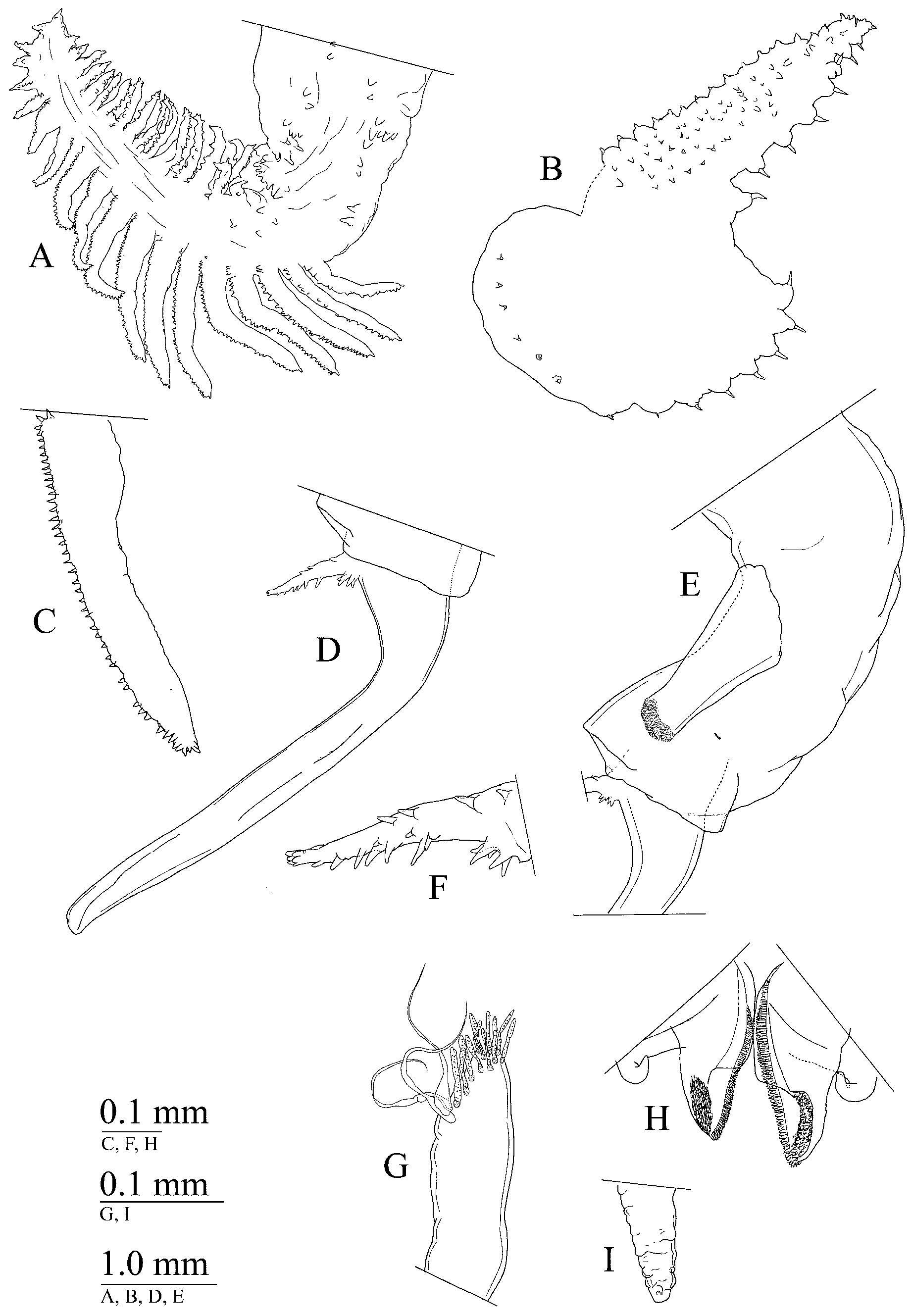
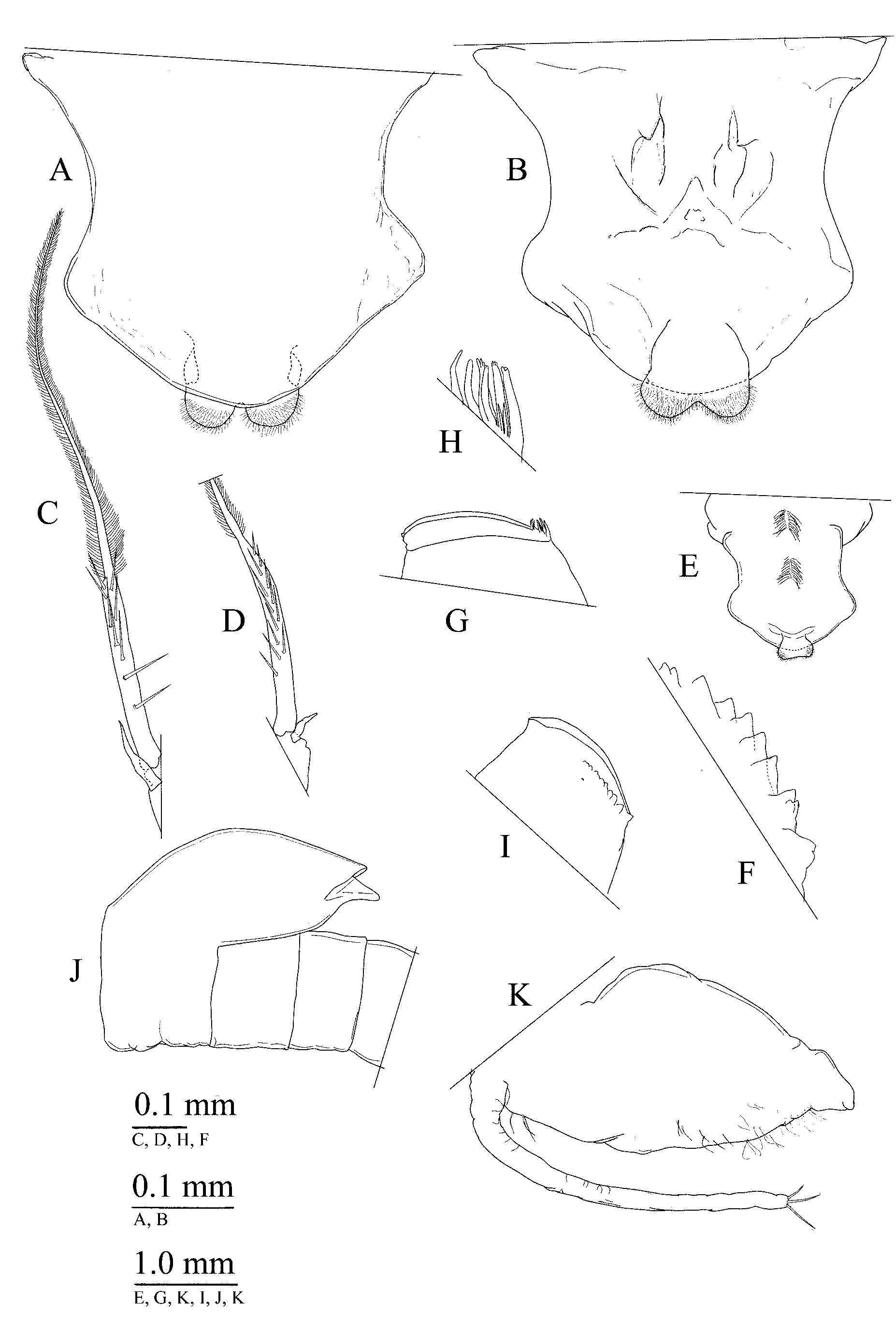
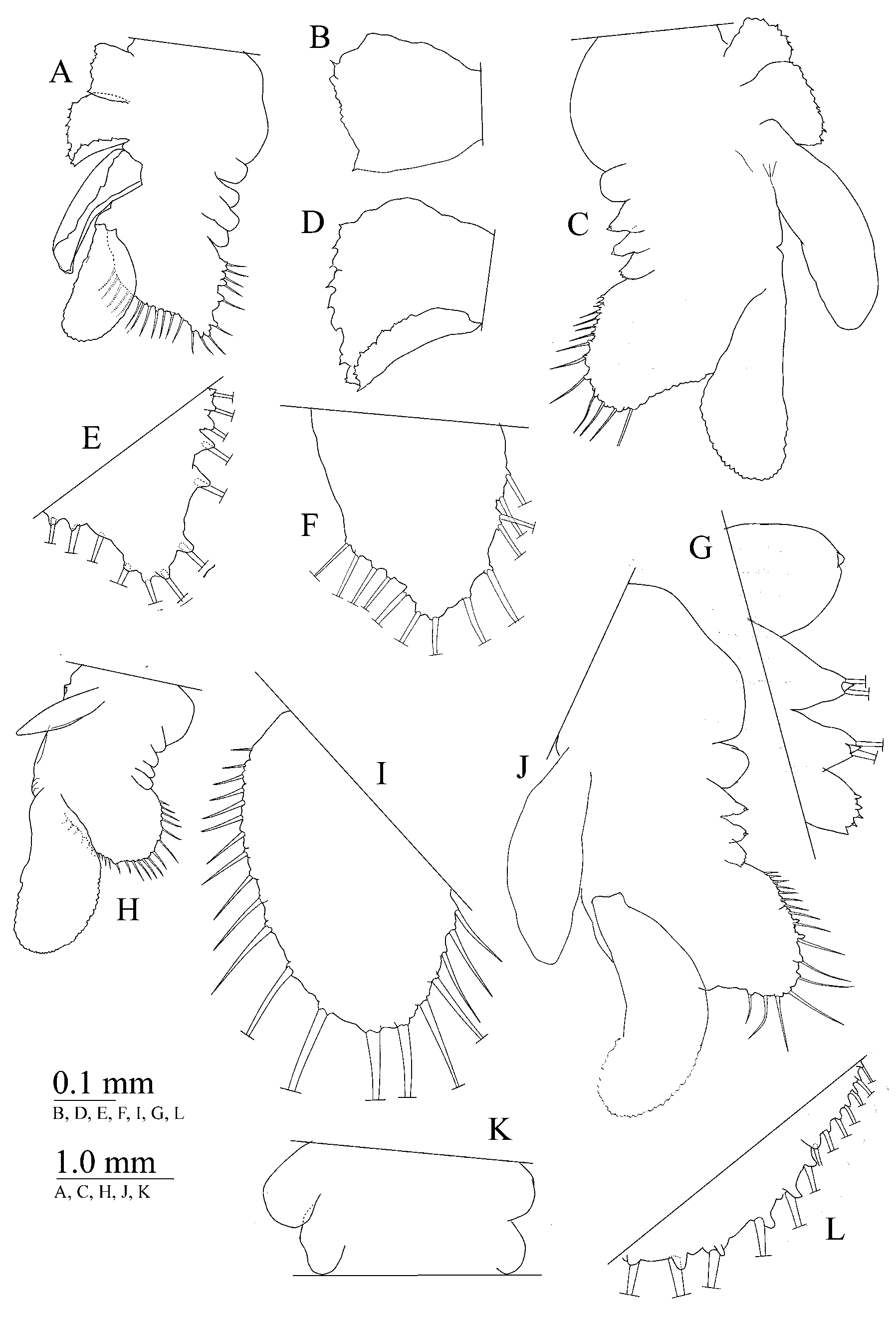
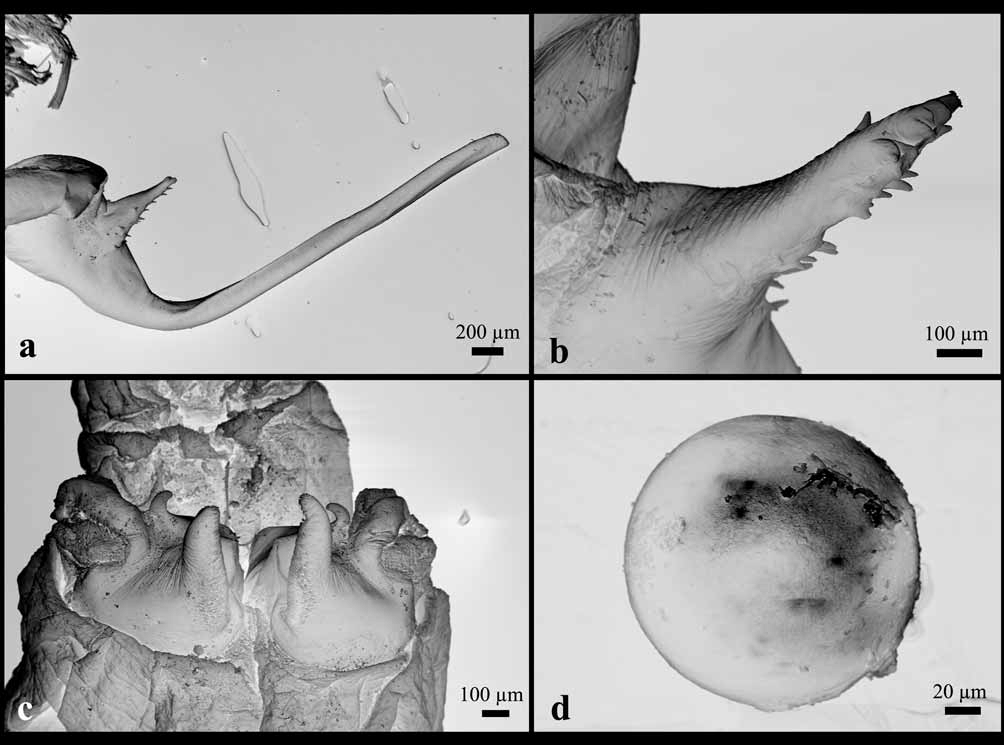
Description. Male. Average length of preserved material (4 males examined), measured from the anterior margin of the head to the tip of the cercopods, 11.5 mm. Thoracic and abdominal somites unadorned. First antennae (Fig. 5 G) thin and straight, ending in a claviform apex bearing three long distal setae enlarged proximally and 11 thin apical aesthetascs. Second antennae (Figs. 5 D – F; 13 a – b; 15 C – D): proximal antennomere cylindrical with parallel margins, rather bent medially; somewhat shorter than the distal antennomere, it bears a robust conical apophysis half the length of the proximal antennomere, with a convex apex covered with very small denticles (Fig. 5 E). Distal antennomere thin, bent almost at a right angle in its enlarged proximal part, then straight to the apex. A rather straight, thin apophysis tapering towards its end and adorned with several tiny sharp denticles arises on the medio-basal margin (Fig. 5 F; 13 b). Lower lamella (Fig. 5 B) bilobed, as long as the upper lamella; the greater lobe is rounded, with some short lobes and tubercles on its margin; the other lobe, triangular in shape, also bears lobes and small marginal tubercles, and exhibits a small carina dorsally (Figs. 15 A – B; E). Upper lamella (Fig. 5 A) characterized by numerous thin finger-like expansions on its margins; these expansions gradually taper towards the tip, and those on the medial margin are much more developed than those of the opposite side. The finger-like expansions are peculiar because of the presence of very small sharp denticles densely arranged on the margin (Fig. 5 C). Labrum also seems characteristic in this species (Figs. 6 A – B): the centro-ventral distal process is bilobed, a feature which, to our knowledge, has never been recorded in Chirocephalus. Mandibles (Figs. 6 G – F) asymmetrical. Right mandible: posterior tip of the molar surface provided with eight projections differing from each other. Left mandible: molar surface bearing a row of 8 teeth differing in size. First pair of maxillae adorned as illustrated in Fig. 6 D, also bearing a “ posterior ventral spine ” (Alonso & Jaume, 1991) of characteristic length and shape. Thoracic appendages: notopods of the first pair (Figs. 7 A – B; D – E) with a peculiarly featured endopodite; in the notopods of the sixth and seventh pair (Figs. 7 J, C), the margins of the endites (Fig. 7 G) and endopodite (Fig. 7 L) bear projections (12 in the P 6 endopodite of this species) that differ in shape and size. Eleventh pair illustrated in Fig. 7 H. Gonopods typical of the species of the “ diaphanus ” group (Figs. 5 H; 13 c). The tip of the retractile portion (Fig. 5 I) almost straight. Cercopods slightly shorter than the last three metameres. Female. Length measured as for male: 11.6 mm. First antennae as in the male. Second antennae (Fig. 6 K) as long as the first pair; distal end pointed and curved. Labrum (Fig. 6 E) as described for the male, although the bifurcation of the centro-ventral distal process previously noted in the male seems even more marked. Mandibles as in the male, whereas the posterior ventral spine of the first maxillae (Fig. 6 C) is much more developed than in the male. Thoracopods. First pair of the endopodites differ from that of the male (Fig. 7 F). Moreover, the endites and endopodite of the sixth pair (Fig. 7 I) do not exhibit the same features described for the male. Last thoracic segment (Fig. 7 K) laterally bearing a pair of rounded expansions. Brood pouch thick and short (Fig. 6 J). Cyst morphology. Only one of the observed females had cysts in the ovisac: the morphology and size of the eggs (Fig. 13 d) seem particularly interesting in that, among the species of the “ diaphanus ” group, they resemble the situation in C. marchesonii. Indeed, the two species have a similar ecology, as they live in high mountain waters. Variability: the characters did not exhibit noteworthy variation among the specimens of the type series, apart from the different length measured. Affinities. This species belongs to the “ diaphanus ” group. Being characterized by the absence of fingerlike latero-basal protuberances of the upper lamella, it is included in the list of species previously mentioned in the discussion of C. tauricus. The shape and size of the male antenna were discussed previously. In this regard, the distal article of the appendage tapers distally towards the apex, thus appearing much closer to C. neumanni than to C. tauricus. The basal apophysis of this article, quite elongated and narrow, straight and dentate, is characteristic; it somewhat resembles the corresponding apophysis of C. neumanni, although the latter is larger and distally bent. The apophysis of the basal article of the antenna resembles that of C. skorikowi in its proportions, and partly that of C. appendicularis in its shape, although it is smaller. The upper lamella conforms well to the already described pattern, in that all of the previously discussed species exhibit finger-like expansions on the medial margin that are markedly more developed than those ornamenting the opposite margin. Apart from this, the appendage, being somewhat longer than the lower lamella, is closest to the corresponding ones of C. marchesonii and C. skorikowi. The lower lamella of the antennal process exhibits a small carina located in a peculiar position, which is characteristic and exclusive of the species described here. The shape of this carina resembles that of C. weisigi (proportionally much larger) and somewhat less that of C. marchesonii (cf. Cottarelli & Mura, 1983). Similar upper lamellae can be observed in C. appendicularis and C. tauricus, although they lack a carina. In C. neumanni, the lower lamella has a slight keel (or carina), but the shape and size of this appendage differ from those observed in the new species. The morphology of the eversible part of the gonopods (cyrrus), i. e. narrow and thin, and ornamented by tiny denticles, seems to be unique to this species. The females of C. algidus sp. nov. do not show peculiar ornamentations; the ovisac is very short and does not reach the length of the two subsequent somites. Similar characteristics can be seen only in C. tauricus, which has a somewhat longer ovisac although different in shape, and in C. marchesonii, in which the ovisac differs in shape but has a similar size.
Fairy shrimps from Asiatic Turkey: Redescription of C hirocephalus tauricus Pesta, 1921 and descriptions of C hirocephalus algidus sp. nov. and C hirocephalus brteki sp. nov. (Crustacea, Branchiopoda, Anostraca)