AnimaliaNot EvaluatedacceptedspeciesAccepted
Leiopathes annosa

Leiopathes annosa

Wagner & Opresko, 2015

GBIF:8509811

0countries
0year

PROFILE

Species Profile

Habitat

Marine

Characteristics

Extant

ABOUT

Descriptions(6)

Description of holotype. The holotype (BPBM D 1871) consists of two separate ethanol-preserved fragments collected from the distal part of a colony (Fig. 1 a – b). The colony from which the holotype fragments were collected, branches sparsely towards the center of the corallum, and becomes more dense and irregular distally, with multiple orders of branching (Fig. 1 a – b, 3 a). The first holotype fragment has a basal branch diameter of 5 mm and is approximately 31 cm long and 16 cm wide, whereas the second fragment has a basal branch diameter of 6 mm, measures 33 cm in length and 18 cm in width. On both fragments polyps are arranged irregularly on all sides of the axis on the main branch and larger branches, and uniserially on the terminal branches. Polyps are 0.88 – 3.35 mm in transverse diameter, and spaced 1.2 – 3.2 mm apart on the terminal branches, resulting in 5 – 6 polyps / cm. Terminal branches are typically 3 – 4 cm in length (range = 1.5 – 6 cm), 1.4 mm in width at their midpoint with tissue (range = 1.0 – 1.8 mm) and 280 Μm in width without tissue (range = 165 – 400 Μm). On the terminal branches, 3 – 4 spine rows are visible in lateral view; however, on thicker branches the spine arrangement in rows becomes obscured (Fig. 2 a – b). Spines are smooth and typically hemispherical, but spines with multiple lobes occur often (Fig. 2 c – d). On terminal branches spines are generally 70 Μm tall (range = 30 – 100 Μm) and 145 Μm wide (range = 70 – 310 Μm). On thicker branches (width = 400 – 810 Μm without tissue), spines range between 30 – 110 Μm in height and 130 – 315 Μm in width (Fig. 2 a). Description of paratype. The paratype (USNM 77480) consists of a dried colony that is 63 cm tall, 17 cm wide, 8 mm in basal diameter and was broken off above the base (Fig. 1 c, e). The branching is sparse towards the center of the corallum, and becomes more dense and irregular distally, with nine orders of branching (Fig. 1 c). Most of the smaller branches are directed distally relative to the branches from which they arise, as well as upwards towards the top of the corallum (Fig. 1 c, e). Branching is mostly irregularly bilateral, but uniserial in some places, with the branches tending to be directed vertically (Fig. 1 c, e). Branches coming off the main axis range between 3 – 5 mm in diameter. The terminal branches are 1.5 – 6 cm long, tend to be curved distally, and measure 400 – 650 Μm at their midpoint with remaining tissue. On portions without remaining tissue, terminal branches measure 280 – 440 Μm at their midpoint. Despite being preserved as a dry specimen, polyp remnants remain on a few terminal branchlets of the paratype (Fig. 1 e) and measure 2 – 2.5 mm in diameter. On the terminal branches, 4 – 5 spine rows are visible in lateral view; however, on thicker branches the spine arrangement in rows becomes obscured. Spines on terminal branches are smooth and range between hemispherical, balloon-shaped and irregularly knobby. On terminal branches (250 – 400 Μm at their midpoint without spines), spines are 55 – 140 Μm tall and 75 – 240 Μm wide at their base. On thicker branches (width = 450 – 675 Μm without tissue), spines range between 50 – 120 Μm in height, 120 – 260 Μm in width and tend to be mound-like, conical or deltoid in shape. Intraspecific variability and a unique morphotype. The holotype and paratype of Leiopathes annosa sp. nov. both have skeletal spines that are smooth, hemispherical, often times multi-lobed, 30 – 225 Μm in height and 35 – 310 Μm in width. In the examination of the 14 additional specimens assigned to this species (see Table 1), skeletal spine morphology ranged widely even within the same specimen, and varied from hemispherical, balloonshaped, irregularly knobby, multi-lobed, mound-like, conical and deltoid (Fig. 4 a – o). However, spines with multiple lobes were present on all specimens assigned to L. annosa sp. nov. (see Table 1). Similar to skeletal spine morphology, the dimensions of skeletal spines varied between the 16 specimens assigned to L. annosa sp. nov. (Table 1), and ranged from an average height of 55 Μm and average basal width of 125 Μm for specimen USNM 1071417, to an average height of 95 Μm and average basal width of 190 Μm for specimen USNM 99500. However, the skeletal spines of all specimens assigned to L. annosa sp. nov., ranged between 30 – 225 Μm in height and 35 – 310 Μm in width at the base. In contrast, one specimen from Hawaiian waters (Leiopathes sp.; USNM 52278) was unique in that its skeletal spines were (1) much smaller (average = 40 Μm; range = 20 – 65 Μm), (2) narrower (average = 90 Μm; range = 30 – 160 Μm), and (3) had almost no multi-lobed spines (Fig. 4 p). Additionally, while the polyp spacing of specimen USNM 52278 (1.2 – 3.05 mm) is similar to those of the specimens assigned to L. annosa sp. nov (1.2 – 3.2 mm), its polyps are smaller (0.70 – 2.10 mm vs. 0.88 – 3.35 mm). Furthermore, the 16 Hawaiian specimens assigned to L. annosa sp. nov. were all collected at depths ranging between 295 – 536 m, whereas specimen USNM 52278 was collected in much deeper waters (966 m; Table 1). Based on these substantial differences, specimen USNM 52278 represents a distinct species that is morphologically more similar to L. montana and L. glaberrima. However, a more detailed study, ideally using both morphological and molecular markers, will be needed to determine the taxonomic identity and affinities of specimen USNM 52278. Comparisons. In Hawaiian waters, Leiopathes annosa sp. nov. has previously been referred to as Leiopathes sp. (Roark et al. 2009; Wagner et al. 2011; Wagner et al. 2012; Brugler et al. 2013) and L. glaberrima (Grigg and Opresko 1977; Grigg 1988; Chave and Malahoff 1988; Roark et al. 2006; Parrish and Baco 2007). As part of this study, we reexamined in situ photographs and specimens referenced in those previous studies, and as a result reassigned those records to L. annosa sp. nov. The previous misidentification of the Hawaiian specimens as L. glaberrima was due to: (1) Hawaiian specimens were not compared to specimens from other geographic locations, and (2) diagnostic characters of L. glaberrima were largely unknown because Esper's (1792) original species description was quite brief and type material remained without further reexamination until recently (Opresko & Baron-Szabo 2001). The recent redescription of L. glaberrima has established the diagnostic characters of this species which include (1) triangular, simple and smooth spines which are 20 – 60 Μm tall, (2) polyps that are up to 1 mm in diameter, (3) terminal branches with a length of 1 – 2 cm, and (4) an irregularly branched corallum (Opresko & Baron-Szabo 2001). Leiopathes annosa sp. nov. differs from L. glaberrima in that its spines are hemispherical and frequently multi-lobed, and substantially larger (30 – 225 Μm) (Fig. 5 a. e). Additionally, polyps of L. annosa sp. nov. reach a larger maximum size (3.35 mm) than those in L. glaberrima (1 mm), and its terminal branches are longer (<6 cm). Finally, L. annosa sp. nov. colonies are fan-like and bright orange in situ (Fig. 1 a, 3 a – h), whereas living colonies of L. glaberrima are grayish-white, white, pale orange or bright orange, and branched irregularly (Bo 2008; Vertino et al. 2010; Mastrototaro et al. 2010; Bo et al. 2015). Leiopathes glaberrima has been reported to occur at depths as shallow as 37 m in the Gulf of Mexico (Opresko 2009) and as deep as 1532 m off Morocco (Grasshoff 1989), whereas L. annosa sp. nov. has a limited bathymetric range (295 – 536 m). Leiopathes annosa sp. nov. can be easily differentiated from all but one of the remaining seven described species of Leiopathes on the basis of the morphology of its skeletal spines (Fig. 5 a – e). In L. expansa, L. grimaldi, L. valdiviae, L. secunda, L. acanthophora and L. montana, the spines are predominantly conical, subdeltoid or relatively tall (height greater than width at the base) with a rounded apex. In none of these seven species are the spines hemispherical or multi-lobed (see summary of species characteristics as given on Table 1 in Molodtsova 2011). Hemispherical spines are, however, found in L. bullosa (Fig. 5 b, 6 f – h). The major morphological difference between L. annosa sp. nov. and L. bullosa is the fact that in the former the spines, especially those on the terminal branches, can be multi-lobed (Fig. 4 a – o, 6 c – d), whereas in L. bullosa multi-lobed spines have not been reported (Fig. 6 f – h). Other differences between the two species exist in the maximum thickness of the terminal branches (0.2 mm in L. bullosa and 0.4 mm in L. annosa sp. nov.), maximum length of the terminal branches (2 cm in L. bullosa and 6 cm in L. annosa sp. nov.), maximum size of the spines (140 Μm in L. bullosa and 225 Μm in L. annosa sp. nov.), arrangement of the spines (clearly in rows in L. bullosa, and not in discernable rows in L. annosa sp. nov.), maximum size of the polyps (2 mm in L. bullosa and 3.35 mm in L. annosa sp. nov.), and in the density of the polyps (3 – 5 / cm in L. bullosa and 5 – 6 / cm in L. annosa). L. annosa sp. nov. forms colonies that are large, flabellate, with relatively thick branches (Fig. 1 a, 3 a – h). In comparison, the branches of L. bullosa are much thinner, and even though individual clusters of branches of the holotype were described as being somewhat planar, the holotype consists of small fragments, and therefore the size, shape, and branching pattern of intact colonies of L. bullosa are unknown. Previous studies in Hawaiʻi. Several studies have reported on different ecological aspects of L. annosa sp. nov. in Hawai‘i (identified at the time as L. glaberrima or Leiopathes sp.), including on its: (1) growth rate and longevity (Roark et al. 2006; Roark et al. 2009), (2) population density (Grigg 1988), (3) associated fish assemblages (Parrish 2006), and (4) sexual reproduction (Wagner et al. 2011). Roark et al. (2006, 2009) used highresolution skeletal radiocarbon measurements and estimated average radial growth rates of 5 – 13 µm / year for this species, corresponding to longevities ranging between 350 – 4,265 years, thus making this the longest living marine organism studied to date. Furthermore, Roark et al. (2009) concluded that growth rates are not uniform throughout the lifespan of this species, with faster initial growth rates that gradually decrease with age. Grigg (1988) examined the population densities of various dominant deep-water corals (365 – 400 m) off Oʻahu Island, and noted average densities of 0.002 – 0.003 colonies / m 2 for this species. Parrish (2006) studied fish assemblages within deep-water corals (300 – 500 m) across various Hawaiian Islands, and noted that various fish occasionally use taller colonies of L. annosa sp. nov. as shelter. Wagner et al. (2011) used histological techniques to study the reproductive anatomy of eight Hawaiian antipatharian species, including a sample of the L. annosa sp. nov. holotype, and noted that it had both previtellogenic and vitellogenic oocytes within its primary mesenteries. Finally, as part of a study on the evolutionary history of the order Antipatharia, Brugler et al. (2013) provided mitochondrial and nuclear DNA sequence data for two specimens (USNM 1070976 and BPBM D 1871 as P 4 - 227 - 2) that are assigned to L. annosa sp. nov. here (see Table 1 for GenBank accession numbers). Molecular sequences of these two specimens had identical sequences in the intergenic region between nad 5 and nad 1, and between cox 3 - cox 1, but did differ in a single position in the intergenic region between trnW and nad 2 (Brugler et al. 2013). Future studies will need to include a molecular component in order to determine whether the morphological analysis presented in this study holds up, as well as to elucidate the taxonomic relationships among the various species within the genus Leiopathes.
Description of a new species of Leiopathes (Antipatharia: Leiopathidae) from the Hawaiian Islands

Diagnosis. Colonies are up to 1 m in height or more, with most branches located in an approximately single plane like a fan (Fig. 1 a – c, 3 a – h). In some colonies, branches overlap considerably producing a rather thick corallum that is still planar, whereas in others all the branches are in a single plane (Fig. 1 a – c, 3 a – h). Most of the smaller branches are directed distally relative to the branches from which they arise, as well as upwards towards the top of the corallum. Branching is mostly irregularly bilateral, but uniserial in some places, with the branches tending to be directed vertically. The highest order branches are typically 1.5 – 6 cm in length, 1.4 mm in diameter at their midpoint with tissue (range = 1.0 – 1.8 mm), and on average spaced 0.8 cm apart (range = 0.4 – 1.7 cm). Polyps are variable in size (0.88 – 3.35 mm), arranged irregularly on all sides of the corallum on thicker branches and uniserially on terminal branches with adjacent polyps spaced 1.2 – 3.2 mm apart, resulting in 5 – 6 polyps / cm (Fig. 1). Spines are typically 75 Μm tall (range = 30 – 225 Μm) and 140 Μm wide at the base (range = 35 – 315 Μm). On the terminal branchlets (~ 0.07 mm in diameter excluding the spines), the spines can be hemispherical, balloon-shaped, irregularly knobby or with one or more round or misshapen lobes (Fig. 2 d, 4 a – o). On such terminal branchlets, 3 – 5 spine rows are visible in lateral view (Fig 2 d, 4 a – o). On thicker branches (0.15 mm in diameter excluding spines), the spines are more hemispherical to mound-like with fewer, but larger round lobes, and the spine arrangement in rows becomes obscured (Fig. 2 b – c). On branches thicker than 0.27 mm in diameter excluding the spines, the spines become smaller and more knob-like or somewhat conical to deltoid in shape, with little remaining evidence of lobes (Fig 2 a). The living tissues are colored bright orange (Fig. 1 a, 3 a – h).
Description of a new species of Leiopathes (Antipatharia: Leiopathidae) from the Hawaiian Islands
Distribution. Under the name L. glaberrima or Leiopathes sp., L. annosa sp. nov., has previously been reported throughout the Hawaiian Islands (Grigg & Opresko 1977; Chave & Malahoff 1998; Parrish and Baco 2007; Roark et al. 2006; Roark et al. 2009; Wagner et al. 2011; Wagner et al. 2012; Brugler et al. 2013), as well as from Johnston Atoll (Chave & Malahoff 1998) at depths between 300 – 500 m. Specimens examined as part of this study were collected throughout the Hawaiian Archipelago from Hawai‘i Island (19 ° 30 ' 00 '' N 155 ° 00 ' 00 '' W) to Salmon Bank (27 ° 01 ' 10 '' N 176 ° 31 ' 33 '' W) at depths between 295 – 536 m (Table 1).
Description of a new species of Leiopathes (Antipatharia: Leiopathidae) from the Hawaiian Islands
Etymology. From the latin ‘ annosa ’ (long-lived) in reference to the extreme longevity estimates reported for this species (350 – 4,265 years; Roark et al. 2006; Roark et al. 2009).
Description of a new species of Leiopathes (Antipatharia: Leiopathidae) from the Hawaiian Islands
Material examined. Holotype (BPBM D 1871), south of Niʻihau Island, Main Hawaiian Islands, 21 ° 49 ’ 21 ” N 160 ° 6 ’ 37 ” W, 382 m, HURL submersible Pisces IV, dive P 4 - 227, specimen 2, 2 December 2009, ethanol. Paratype (USNM 77480), bank north of Necker Island, Northwestern Hawaiian Islands, no coordinates recorded, 457 m, R / V Townsend Cromwell, cruise 76 - 06 - 73, fish trawl, 15 October 1976, dry. For all other non-type material examined as part of this study see Table 1.
Description of a new species of Leiopathes (Antipatharia: Leiopathidae) from the Hawaiian Islands
Type locality. South of Ni‘ihau Island, Main Hawaiian Islands, 21 ° 49 ’ 21 ” N 160 ° 6 ’ 37 ” W, 382 m. TABLE 1. Leiopathes specimens examined as part of this study (* = type material; NR = not reported; 1 molecular sequence data for specimen BPBM D 1871 (as P 4 - 227 - 2) was reported in Brugler et al. (2013) and is available from GenBank under accession numbers KF 054599, KF 054665 and KF 054466; 2 molecular sequence data for specimen USNM 1070976 was reported in Brugler et al. (2013) and is available from GenBank under accession numbers KF 054593, KF 054663 and KF 054467).
Description of a new species of Leiopathes (Antipatharia: Leiopathidae) from the Hawaiian Islands

Export occurrence data

Darwin Core Archive (ZIP)

GEOGRAPHY

Distribution Map

Occurrence Map

Loading map…

Tiles © GBIF Maps API | Map powered by MapLibre GL

REGIONS

Geographic Distribution(12)

Hawaiian Islands
Midway Is.
Johnston Atoll Exclusive Economic Zone
native
Hawaiian Exclusive Economic Zone
native
Hawaiian Islands
Midway Is.
United States Exclusive Economic Zone (Hawaii)
native
United States Exclusive Economic Zone (Johnston Atoll)
native
Midway Is.
Johnston Atoll Exclusive Economic Zone
native
Hawaiian Islands
Hawaiian Exclusive Economic Zone
native

DATA

Occurrence Datasets

Loading datasets…

CLASSIFICATION

Taxonomic Classification Tree

MULTIMEDIA

Media Files(6)

FIGURE 1. Leiopathes annosa sp. nov. type material. a. holotype (BPBM D 1871) in situ, b. preserved specimen of holotype (BPBM D 1871), c. dry specimen of paratype (USNM 77480). d. polyps of holotype (BPBM D 1871) under light microscopy, e. distal branches of paratype (USNM 77480) (scale bars: b = 8 cm; c = 8 cm; d = 2 mm).

Imageimage/png© Wagner, Daniel;Opresko, Dennis M.Description of a new species of Leiopathes (Antipatharia: Leiopathidae) from the Hawaiian Islands

FIGURE 2. Scanning electron micrographs of skeletal spines on various branches of the holotype of Leiopathes annosa sp. nov. (BPBM D 1871; scale bars = 100 µm).

Imageimage/png© Wagner, Daniel;Opresko, Dennis M.Description of a new species of Leiopathes (Antipatharia: Leiopathidae) from the Hawaiian Islands
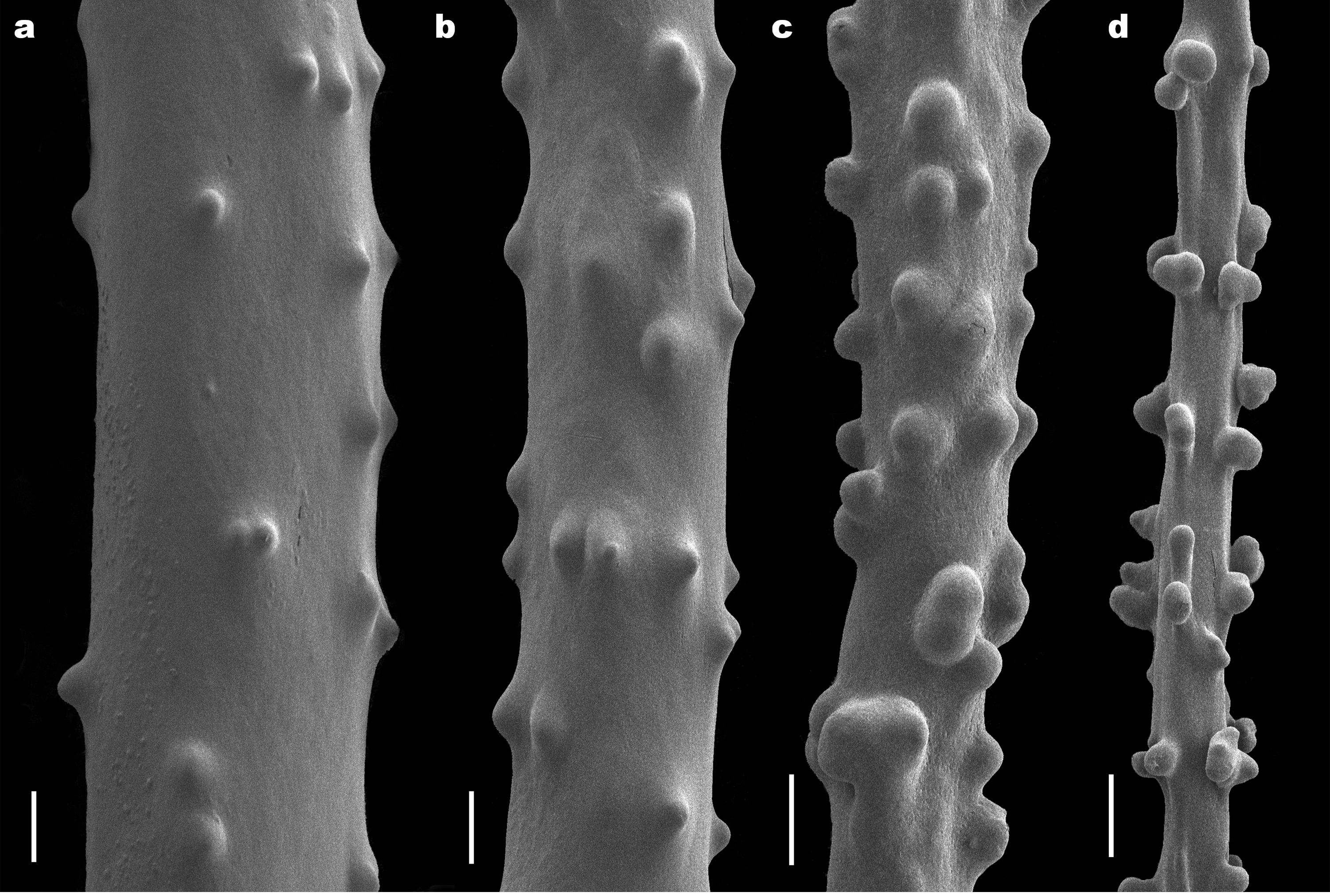
FIGURE 4. Scanning electron micrographs of skeletal spines of Hawaiian Leiopathes specimens examined as part of this study, assigned to L. annosa sp. nov. (a-o) and Leiopathes sp. (p). a. BPBM D 1871, b. BPBM 910, c. BPBM 970, d. USNM 77082, e. USNM 77480, f. USNM 99500, g. USNM 99497, h. USNM 99496, i. USNM 1071405, j. USNM 1071416, k. USNM 1071417, l. USNM 1070976, m. USNM 1070976, n. USNM 1129919, o. USNM 99501 and p. USNM 52278 (scale bars = 100 µm).

Imageimage/png© Wagner, Daniel;Opresko, Dennis M.Description of a new species of Leiopathes (Antipatharia: Leiopathidae) from the Hawaiian Islands
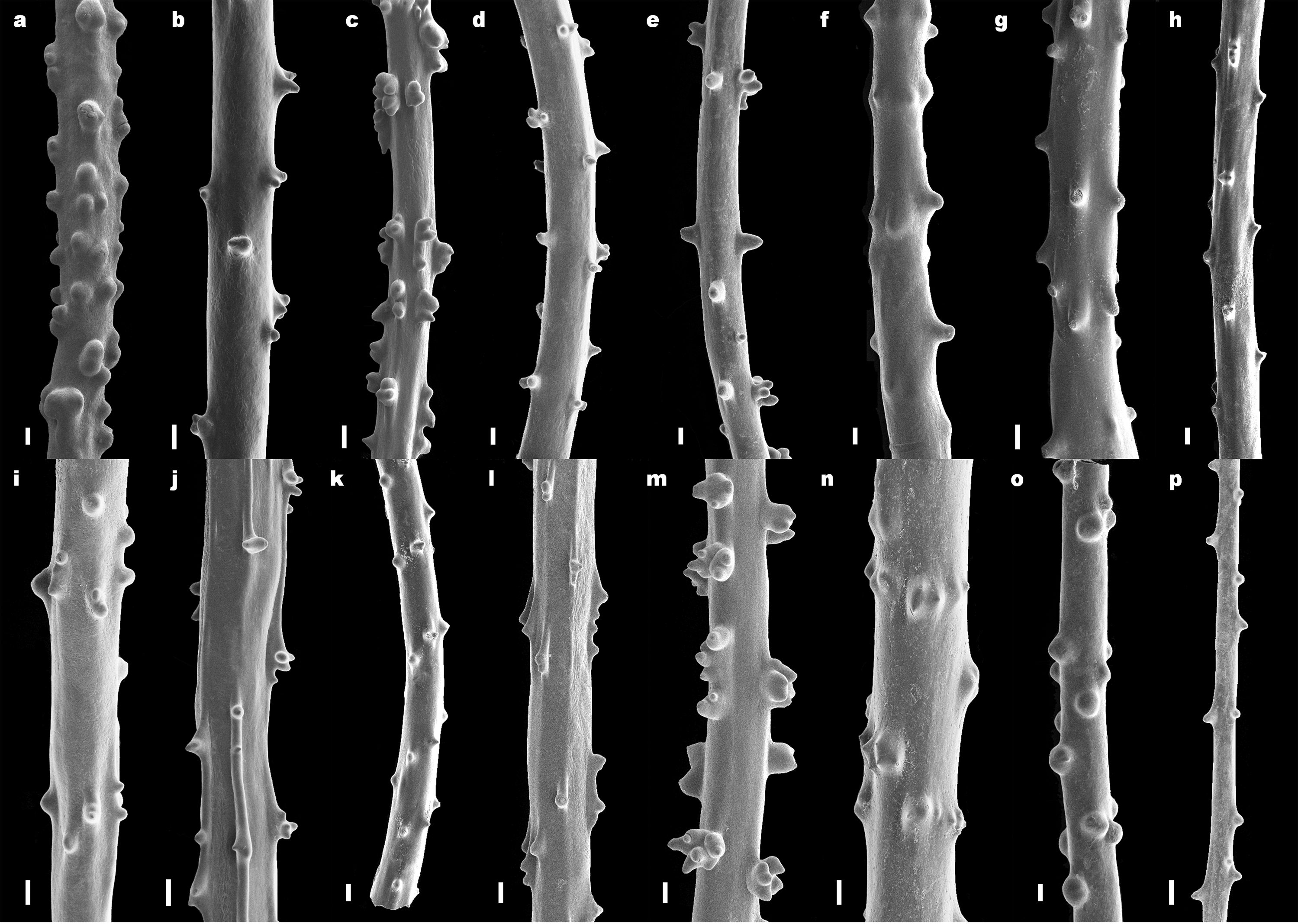
FIGURE 5. Scanning electron micrographs of skeletal spines of various Leiopathes spp. including a. L. annosa sp. nov. (BPBM D 1871), b. L. bullosa (USNM 99409), c. L. secunda (USNM 99404), d. L. acanthophora (USNM 99402), and e. L. glaberrima (USNM 1099249) (scale bars = 100 µm).

Imageimage/png© Wagner, Daniel;Opresko, Dennis M.Description of a new species of Leiopathes (Antipatharia: Leiopathidae) from the Hawaiian Islands
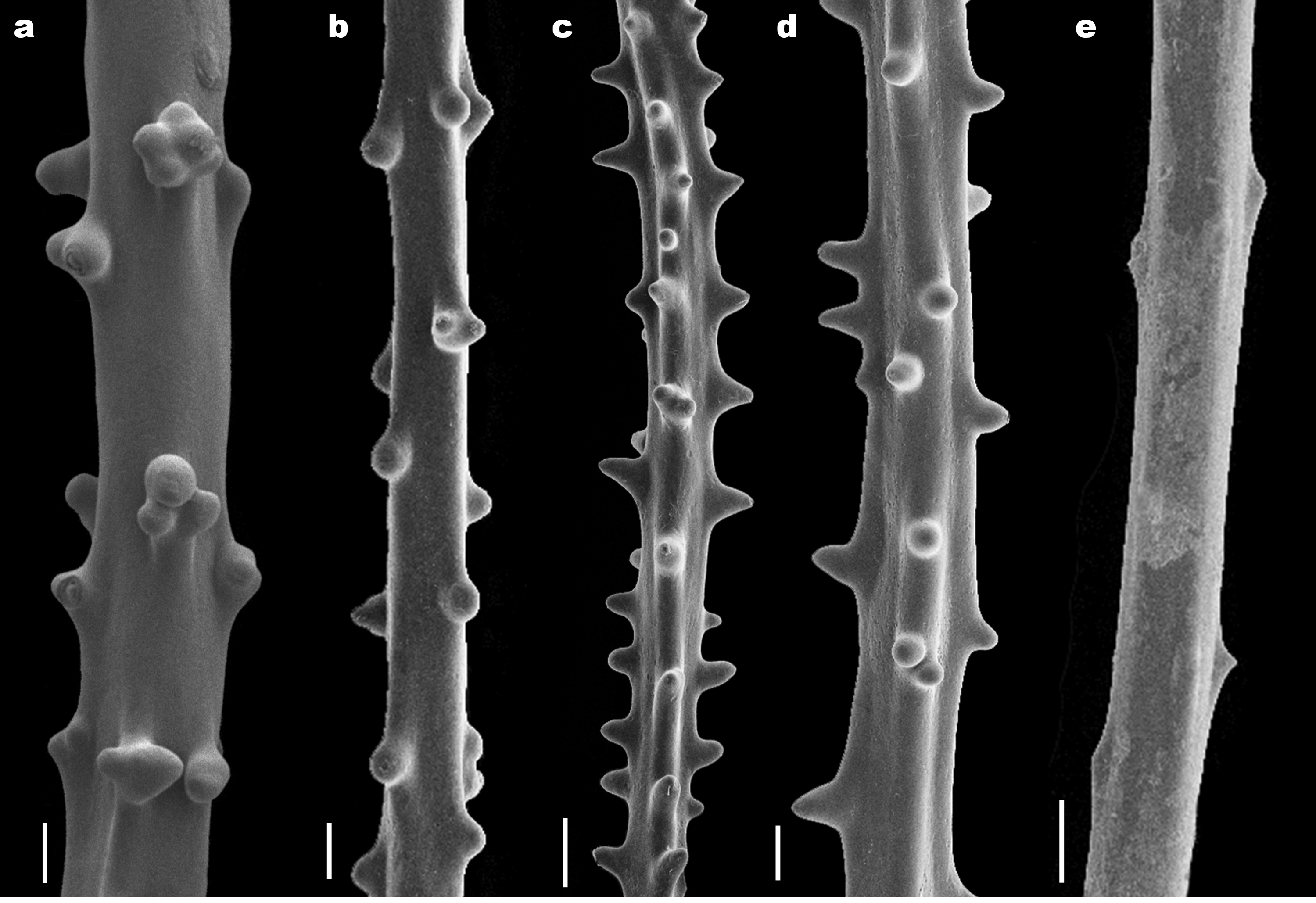
FIGURE 6. Comparison of branching pattern and skeletal spine morphology between a – d. L. annosa sp. nov. (USNM 77480), and e – h. L. bullosa (USNM 99409) (scale bars: a and e = 2 cm; b – d and f – h = 100 µm).

Imageimage/png© Wagner, Daniel;Opresko, Dennis M.Description of a new species of Leiopathes (Antipatharia: Leiopathidae) from the Hawaiian Islands
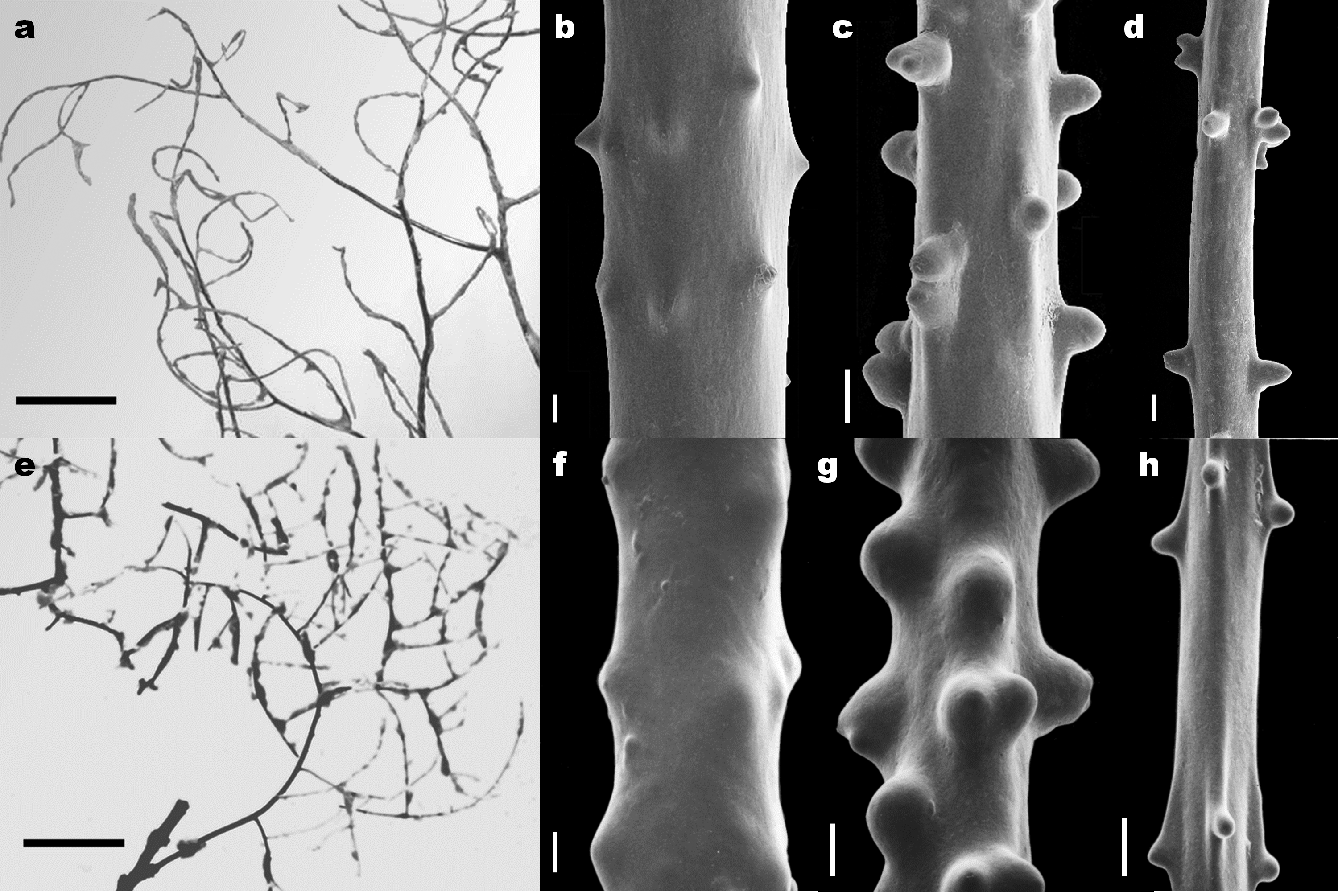
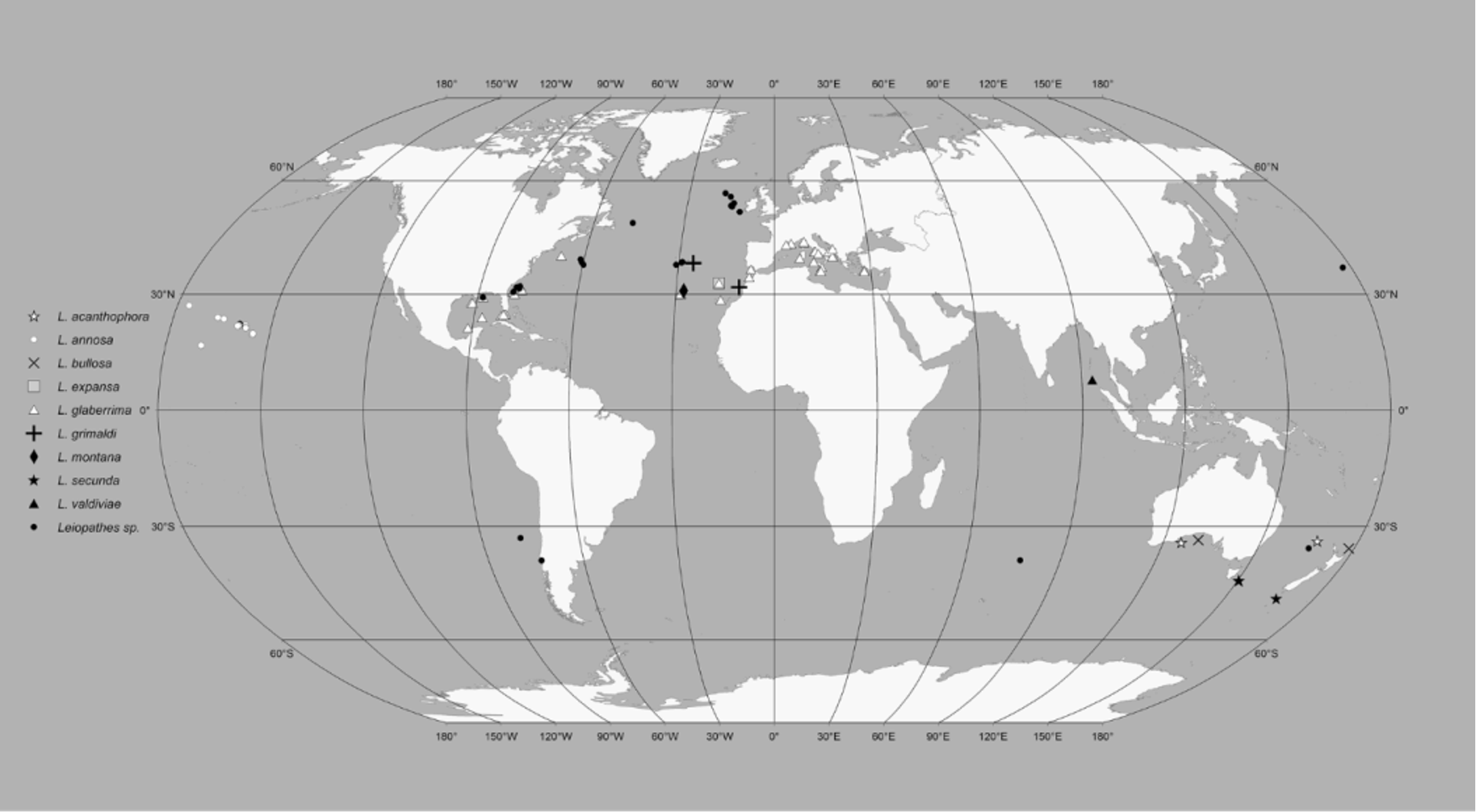
FIGURE 7. World distribution of black coral species in the genus Leiopathes.

Imageimage/png© Wagner, Daniel;Opresko, Dennis M.Description of a new species of Leiopathes (Antipatharia: Leiopathidae) from the Hawaiian Islands
IMAGES

Gallery(6)

See Gallery

Occurrences with images

CITATIONS

References(1)

  • 1

    Wagner, D.; Opresko, D. M. (2015). Description of a new species of <em>Leiopathes</em> (Antipatharia: Leiopathidae) from the Hawaiian Islands. <em>Zootaxa.</em> 3974(2): 277.

    original descriptionWorld Register of Marine Species
  • Source Information

    GBIF Backbone Taxonomy

    GBIF Backbone Taxonomy

    checklist

    The GBIF Backbone Taxonomy is a single, synthetic management classification with the goal of covering all names GBIF is dealing with. It's the taxonomic backbone that allows GBIF to integrate name based information from different resources, no matter if these are occurrence datasets, species pages, names from nomenclators or external sources like EOL, Genbank or IUCN. This backbone allows taxonomic search, browse and reporting operations across all those resources in a consistent way and to provide means to crosswalk names from one source to another.

    It is updated regulary through an automated process in which the Catalogue of Life acts as a starting point also providing the complete higher classification above families. Additional scientific names only found in other authoritative nomenclatural and taxonomic datasets are then merged into the tree, thus extending the original catalogue and broadening the backbones name coverage. The GBIF Backbone taxonomy also includes identifiers for Operational Taxonomic Units (OTUs) drawn from the barcoding resources iBOL and UNITE.

    International Barcode of Life project (iBOL), Barcode Index Numbers (BINs). BINs are connected to a taxon name and its classification by taking into account all names applied to the BIN and picking names with at least 80% consensus. If there is no consensus of name at the species level, the selection process is repeated moving up the major Linnaean ranks until consensus is achieved.

    UNITE - Unified system for the DNA based fungal species, Species Hypotheses (SHs). SHs are connected to a taxon name and its classification based on the determination of the RefS (reference sequence) if present or the RepS (representative sequence). In the latter case, if there is no match in the UNITE taxonomy, the lowest rank with 100% consensus within the SH will be used.

    The GBIF Backbone Taxonomy is available for download at https://hosted-datasets.gbif.org/datasets/backbone/ in different formats together with an archive of all previous versions.

    The following 105 sources have been used to assemble the GBIF backbone with number of names given in brackets:

    • Catalogue of Life Checklist - 4766428 names
    • International Barcode of Life project (iBOL) Barcode Index Numbers (BINs) - 635951 names
    • UNITE - Unified system for the DNA based fungal species linked to the classification - 611208 names
    • The Paleobiology Database - 212054 names
    • World Register of Marine Species - 188857 names
    • The Interim Register of Marine and Nonmarine Genera - 183894 names
    • The World Checklist of Vascular Plants (WCVP) - 131891 names
    • GBIF Backbone Taxonomy - 114350 names
    • TAXREF - 109374 names
    • The Leipzig catalogue of vascular plants - 75380 names
    • ZooBank - 73549 names
    • Integrated Taxonomic Information System (ITIS) - 68377 names
    • Plazi.org taxonomic treatments database - 61346 names
    • Genome Taxonomy Database r207 - 60545 names
    • International Plant Names Index - 52329 names
    • Fauna Europaea - 45077 names
    • The National Checklist of Taiwan (Catalogue of Life in Taiwan, TaiCoL) - 36193 names
    • Dyntaxa. Svensk taxonomisk databas - 35892 names
    • The Plant List with literature - 32692 names
    • United Kingdom Species Inventory (UKSI) - 29643 names
    • Artsnavnebasen - 29208 names
    • The IUCN Red List of Threatened Species - 21221 names
    • Afromoths, online database of Afrotropical moth species (Lepidoptera) - 13961 names
    • Brazilian Flora 2020 project - Projeto Flora do Brasil 2020 - 13829 names
    • Prokaryotic Nomenclature Up-to-Date (PNU) - 10079 names
    • Checklist Dutch Species Register - Nederlands Soortenregister - 8814 names
    • ICTV Master Species List (MSL) - 7852 names
    • Cockroach Species File - 6020 names
    • GRIN Taxonomy - 5882 names
    • Taxon list of fungi and fungal-like organisms from Germany compiled by the DGfM - 4570 names
    • Catalogue of Afrotropical Bees - 3623 names
    • Catalogue of Tenebrionidae (Coleoptera) of North America - 3327 names
    • Checklist of Beetles (Coleoptera) of Canada and Alaska. Second Edition. - 3312 names
    • Systema Dipterorum - 2850 names
    • Catalogue of the Pterophoroidea of the World - 2807 names
    • The Clements Checklist - 2675 names
    • Taxon list of Hymenoptera from Germany compiled in the context of the GBOL project - 2496 names
    • IOC World Bird List, v13.2 - 2366 names
    • Official Lists and Indexes of Names in Zoology - 2310 names
    • National checklist of all species occurring in Denmark - 1922 names
    • Myriatrix - 1876 names
    • Database of Vascular Plants of Canada (VASCAN) - 1822 names
    • Taxon list of vascular plants from Bavaria, Germany compiled in the context of the BFL project - 1771 names
    • Orthoptera Species File - 1742 names
    • A list of the terrestrial fungi, flora and fauna of Madeira and Selvagens archipelagos - 1602 names
    • Aphid Species File - 1565 names
    • World Spider Catalog - 1561 names
    • Taxon list of Jurassic Pisces of the Tethys Palaeo-Environment compiled at the SNSB-JME - 1270 names
    • Backbone Family Classification Patch - 1143 names
    • GBIF Algae Classification - 1100 names
    • International Cichorieae Network (ICN): Cichorieae Portal - 975 names
    • Psocodea Species File - 803 names
    • New Zealand Marine Macroalgae Species Checklist - 787 names
    • Annotated checklist of endemic species from the Western Balkans - 754 names
    • Taxon list of animals with German names (worldwide) compiled at the SMNS - 503 names
    • Catalogue of the Alucitoidea of the World - 472 names
    • Lygaeoidea Species File - 462 names
    • Catálogo de Plantas y Líquenes de Colombia - 422 names
    • GBIF Backbone Patch - 317 names
    • Phasmida Species File - 259 names
    • Cortinariaceae fetched from the Index Fungorum API - 234 names
    • Coreoidea Species File - 233 names
    • GTDB supplement - 139 names
    • Mantodea Species File - 119 names
    • Endemic species in Taiwan - 93 names
    • Taxon list of Araneae from Germany compiled in the context of the GBOL project - 88 names
    • Species of Hominidae - 78 names
    • Taxon list of Sternorrhyncha from Germany compiled in the context of the GBOL project - 77 names
    • Taxon list of mosses from Germany compiled in the context of the GBOL project - 75 names
    • Mammal Species of the World - 73 names
    • Plecoptera Species File - 71 names
    • Species Fungorum Plus - 64 names
    • Catalogue of the type specimens of Cosmopterigidae (Lepidoptera: Gelechioidea) from research collections of the Zoological Institute, Russian Academy of Sciences - 47 names
    • Species named after famous people - 41 names
    • Dermaptera Species File - 36 names
    • Taxon list of Trichoptera from Germany compiled in the context of the GBOL project - 34 names
    • True Fruit Flies (Diptera, Tephritidae) of the Afrotropical Region - 33 names
    • Range and Regularities in the Distribution of Earthworms of the Earthworms of the USSR Fauna. Perel, 1979 - 32 names
    • Taxon list of Diplura from Germany compiled in the context of the GBOL project - 30 names
    • Lista de referencia de especies de aves de Colombia - 2022 - 24 names
    • Taxon list of Auchenorrhyncha from Germany compiled in the context of the GBOL project - 20 names
    • Catalogue of the type specimens of Polycestinae (Coleoptera: Buprestidae) from research collections of the Zoological Institute, Russian Academy of Sciences - 19 names
    • Taxon list of Thysanoptera from Germany compiled in the context of the GBOL project - 19 names
    • Lista de especies de vertebrados registrados en jurisdicción del Departamento del Huila - 18 names
    • Taxon list of Microcoryphia (Archaeognatha) from Germany compiled in the context of the GBOL project - 15 names
    • Catalogue of the type specimens of Bufonidae and Megophryidae (Amphibia: Anura) from research collections of the Zoological Institute, Russian Academy of Sciences - 12 names
    • Grylloblattodea Species File - 11 names
    • Coleorrhyncha Species File - 9 names
    • Taxon list of liverworts from Germany compiled in the context of the GBOL project - 9 names
    • Embioptera Species File - 7 names
    • Taxon list of Pisces and Cyclostoma from Germany compiled in the context of the GBOL project - 6 names
    • Taxon list of Pteridophyta from Germany compiled in the context of the GBOL project - 6 names
    • Taxon list of Siphonaptera from Germany compiled in the context of the GBOL project - 5 names
    • The Earthworms of the Fauna of Russia. Perel, 1997 - 5 names
    • Taxon list of Zygentoma from Germany compiled in the context of the GBOL project - 4 names
    • Asiloid Flies: new taxa of Diptera: Apioceridae, Asilidae, and Mydidae - 3 names
    • Taxon list of Protura from Germany compiled in the context of the GBOL project - 3 names
    • Taxon list of hornworts from Germany compiled in the context of the GBOL project - 2 names
    • Chrysididae Species File - 1 names
    • Taxon list of Dermaptera from Germany compiled in the context of the GBOL project - 1 names
    • Taxon list of Diplopoda from Germany in the context of the GBOL project - 1 names
    • Taxon list of Orthoptera (Grashoppers) from Germany compiled at the SNSB - 1 names
    • Taxon list of Pscoptera from Germany compiled in the context of the GBOL project - 1 names
    • Taxon list of Pseudoscorpiones from Germany compiled in the context of the GBOL project - 1 names
    • Taxon list of Raphidioptera from Germany compiled in the context of the GBOL project - 1 names

    GBIF Secretariat (2023). GBIF Backbone Taxonomy. Checklist dataset https://doi.org/10.15468/39omei accessed via GBIF.org on 2026-06-16.

    CC BYPublished 8/28/2023View dataset
    GBIF Usage Key
    8509811
    Dataset Key
    d7dddbf4-2cf0-4f39-9b2a-bb099caae36c
    Origin
    source
    Backbone Key
    8509811
    Taxon ID
    gbif:8509811
    Last Crawled
    8/22/2023
    Last Interpreted
    8/22/2023