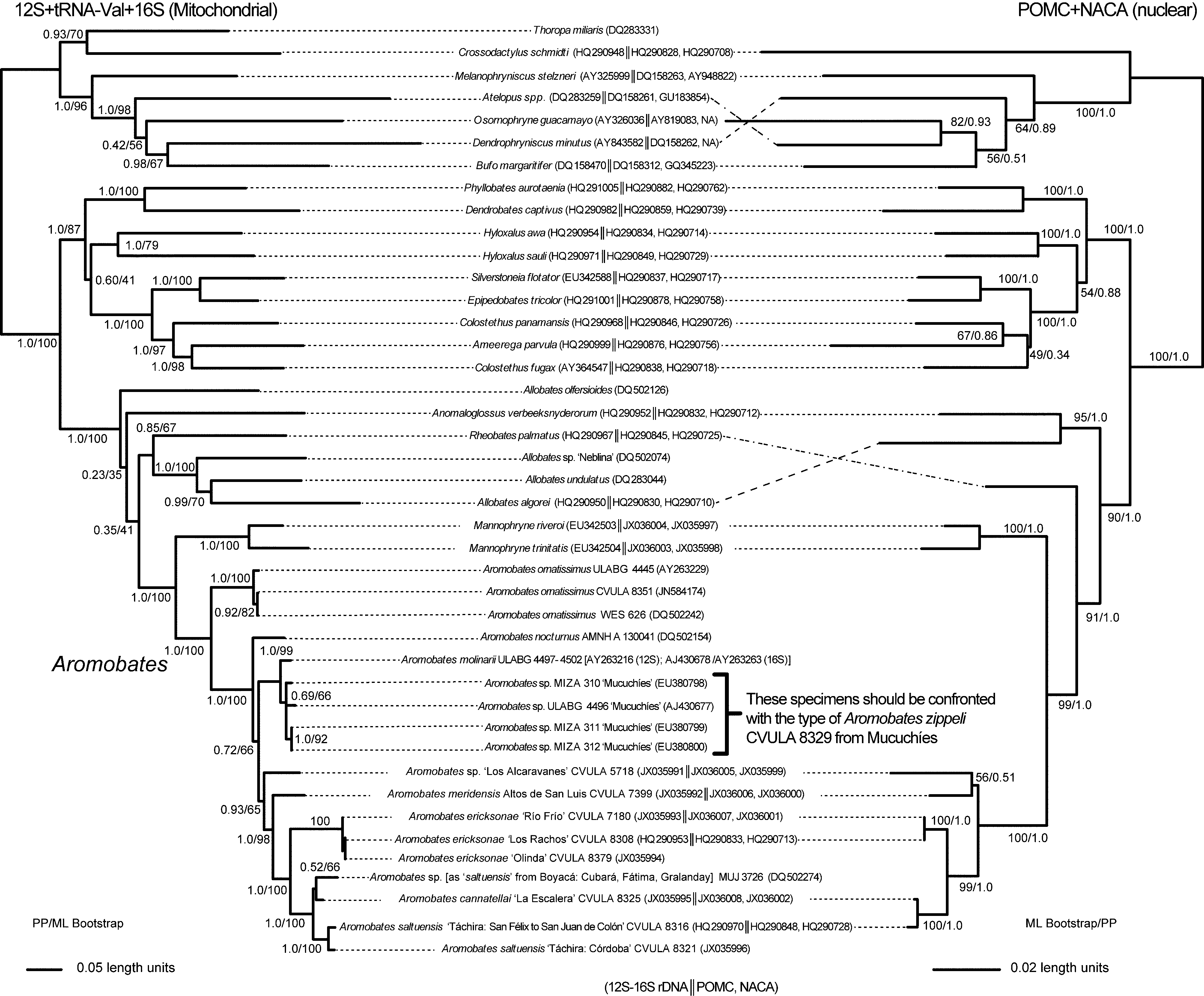
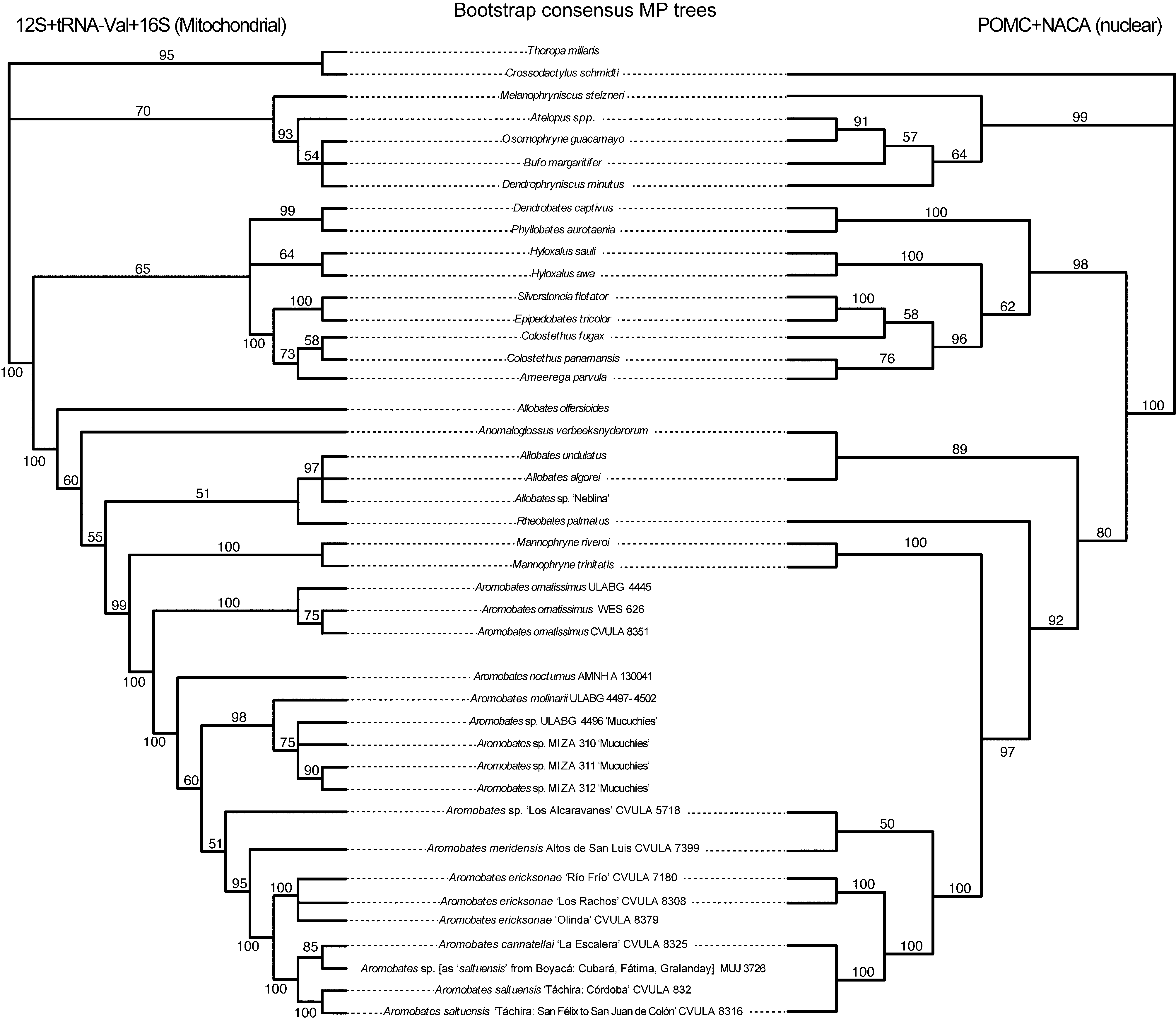
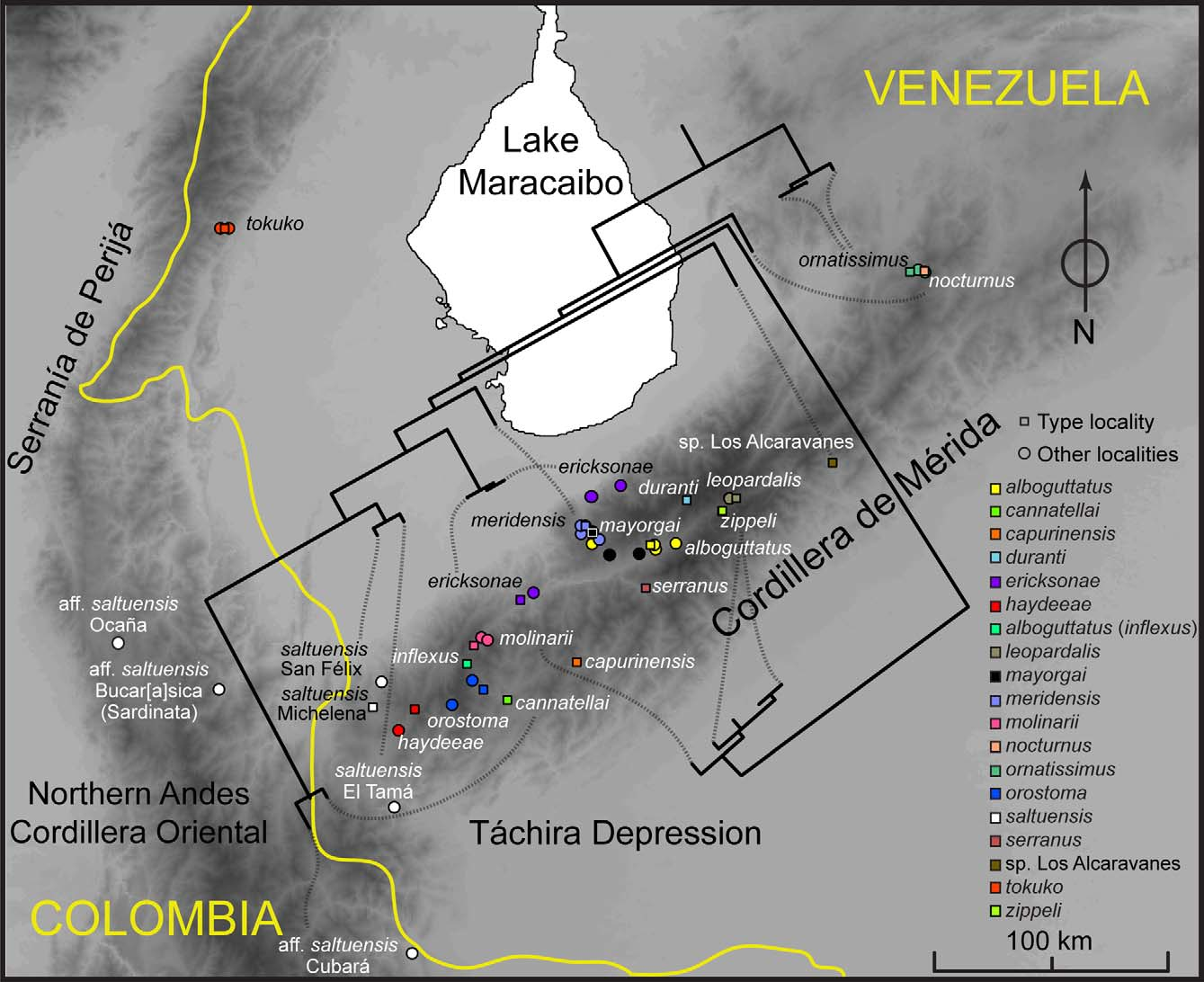
Holotype. CVULA 8309, an adult male from Los Ranchos, Santa Cruz de Mora, Estado Mérida, Venezuela (8.3989 N, 71.6801 W), elevation 1193 m, collected by the authors on June 1 st, 2007. Paratopotypes. Five adult males CVULA 8299, 8308, and 8310 - 12; and seven adult females CVULA 8300 - 0 4, and 8313 - 14. All specimens with the same information as the holotype; with the exception of CVULA 8299 - 304 that were collected by E. Arrieta on December 2003. Referred specimens. CVULA 8305 - 07, from Santa Cruz de Mora via Los Ranchos, Estado Mérida, Ve n ez u - ela (8.4265 N, 71.6281 W), 937 m, collected by the authors on June 1 st, 2007. CVULA 7180, from Río Frío, Municipio Córdoba, northwestern slope of the Cordillera de Mérida, Estado Mérida, Venezuela (8.8500 N, 71.2833 W), 676 m. CVULA 7344 from Cascada La Palmita, in the way from La Azulita to Santa Elena de Arenales, Estado Mérida, Venezuela (8.7333 N, 71.4333 W), 910 m; CVULA 8379 - 82 from Olinda, Estado Mérida, Venezuela (8.7373 N, 71.4681 W), 800 m. Tadpoles. Unknown. Definition: We assigned this species to Aromobates based on its phylogenetic position (Figs. 1 and 2), the combination of the molecular synapomorphies (Table 2), and the following characters. (1) Skin on dorsum smooth. (2) Paired dorsal scutes present on digits. (3) Distal tubercle on FIV present. (4) FIV length reaches half distal subarticular tubercle of FIII. (5) FI longer than FII. (6) Digital discs present. (7) Finger discs barely expanded. (8) Fringes present on fingers. (9) Metacarpal ridge absent. (10) FIII not swollen in adult males. (11) Carpal pad absent. (12) Male excrescences on thumb absent. (13) Thenar tubercle present, small. (14) Black arm gland in adult males absent. (15) Tarsal keel thick, long, to mid-tarsus, straight. (16) Toe discs weakly expanded. (17) Toe webbing basal. (18) Metatarsal fold absent. (19) External coloration with pale dorsolateral stripes; ventrolateral stripe absent; oblique lateral stripe formed by a series of diffuse yellow and white spots. (20) Gular-chest markings present, from fine reticulation to diffuse spotting. (21) Dermal collar absent. (22) Male throat coloration white with profusion of melanophores to dirty white with dark brown reticulation or spotting; female throat coloration white with a profusion of melanophores to white few irregular reticulation or spotting. (23) Male abdomen color immaculate white. (24) Female abdomen color pattern immaculate white. (25) Iris coloration golden with black, fine reticulation; gold-colored pupil ring. (26) Large intestine unpigmented. (27) Enlarged white testes. (28) Median lingual process absent. (29) Tympanum indistinct, tympanic annulus absent. (30) Vocal sac distinct. (31) Teeth present on the maxillary arch. (32) Body size small, males (n = 8) 20.5 – 24.4 mm, mean = 21.9 ± 1.1; females (n = 8) 22.3 – 25.7 mm, mean = 24.2 ± 1.4. Comparisons. Aromobates ericksonae (characters in parenthesis) differs by its smaller size from large species of the genus, such as A. alboguttatus, A. leopardalis, A. meridensis, A. nocturnus, and A. capurinensis, all with maximum SVL> 31 mm (up to 25.5 mm). The eight other species of Aromobates (A. cannatellai sp. nov., A. duranti, A. haydeeae, A. mayorgai, A. molinarii, A. orostoma, A. saltuensis, and A. serranus) are similar in size to Aromobates ericksonae. Aromobates cannatellai is somewhat larger, with females up to 28.6 mm (25.7) in SVL, finger discs moderately expanded (barely expanded), toe discs moderately expanded (weakly expanded), and more extensive toe webbing (basal). Aromobates duranti is a larger frog, up to 30.7 mm (up to 25.7 mm), with its venter gray with white dots (unicolor white without dots), and toe discs not expanded (expanded). Aromobates haydeeae has no fringes on fingers (present), tarsal fold ill-defined (well defined), dorsal color reddish copper (dark to light brown), and ventral parts orange (white). Aromobates mayorgai has dorsal skin smooth with a few tubercles posteriorly (smooth without tubercles in preservative), FI shorter than FII or equal (FI longer than FII), ventral parts yellow in females (white), dark in breeding males with a suffusion of small white spots (only the throat is dark, belly whitish), and oblique lateral stripe absent (formed by small whitish spots). Aromobates molinarii is the geographically closest species but it is a larger frog with females up to 30.3 mm (up to 25.7 mm), it has FII and II equal in length (FI longer than FII), fringes absent on fingers (present), tarsal keel ill-defined (straight and well-defined), toes moderately webbed (basally webbed), and oblique lateral stripe absent (formed by diffuse whitish spots). Aromobates orostoma has a distinct tympanum (indistinct), FI shorter than FII (FI longer than FII), and no fringes on fingers (present). Aromobates saltuensis has FI and FII equal in length (FI longer than FII), dorsal skin smooth with a few tubercles posteriorly (smooth without tubercles in preservative), and supratympanic bulge absent (ill-defined but present). Aromobates serranus has a distinct tympanum (indistinct), dorsum brown with blotches or reticulum (usually uniform, but not reticulated), and belly parts creamy white with brown reticulation (immaculate white).
A phylogeny for Aromobates (Anura: Dendrobatidae) with description of three new species from the Andes of Venezuela, taxonomic comments on Aromobates saltuensis, A. inflexus, and notes on the conservation status of the genus