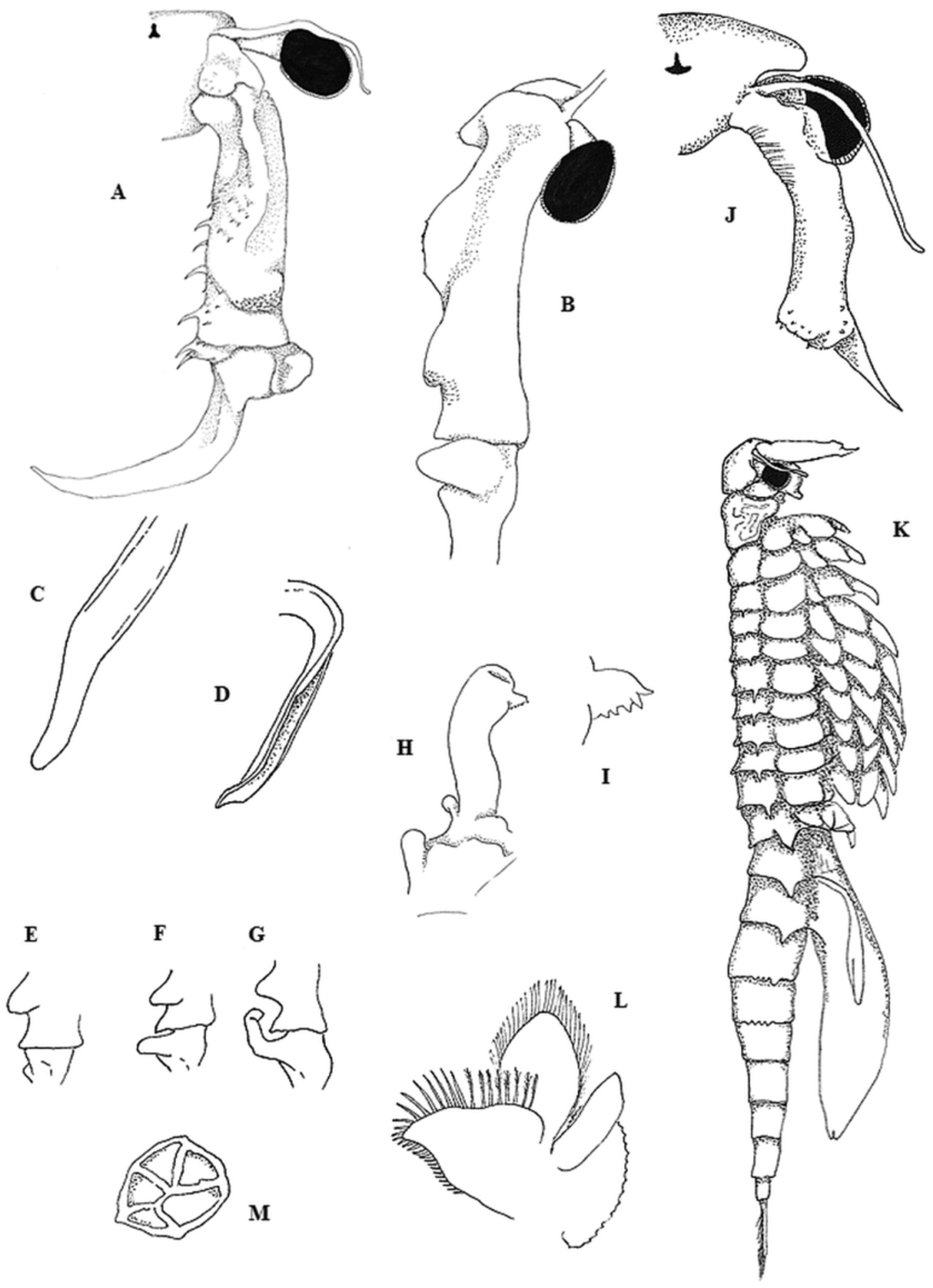
Female (Figs 1 J – K). Second antennae medial surface with proximal transverse grooves. Thoracic segments III through XIII each bearing a lateral spiniform projection. Abdominal segments I and II laterally with a crenulate posterior margin. Description. Average length of preserved material: 10.1 mm from apex of head to apex of telson. Male. Anterolateral corner of the head not projecting over base of eyestalk (Fig. 1 A). Eye plus peduncle four fifths as long as first antenna. Eye large, nearly as wide as base of second antenna. Labrum smooth. First antenna approximately 30 % the length of second antennae proximal antennomere. Second antennae capable of extending back to thoracopod IV or V. Second antennal proximal antennomere with an anteriobasal protuberance bearing fine, scattered setae (Fig. 1 B). Pulvillus and apophysis lacking. Anterior surface with a longitudinal ridge and a subdistal, anteriolateral protuberance. Medial surface bearing oblique, broken rows of spines, with mesad and distad most spines largest. Spine rows continuing onto medial side of anterior longitudinal ridge. Anteriolateral protuberance with transverse rows of scaliform spinulae. Second antennal distal antennomere approximately two thirds the length of proximal antennomere, flattened laterally, arcing medially in the proximal third, medial third straight, and apex curved medially (Figs 1 A, C). Distal antennomere bearing an anteriobasal, lobiform projection, generally directed anteriorly, but may be directed dorsally and laterally (Figs 1 A, B, E – G). Lobiform projection may be small, rounded, as long as broad, twice as long as broad, or four times as long as broad. Antennomere concave laterally, convex medially. Apex rounded, lacking a rasp. Maxillae lobiform with 4 to 6 apical setae. Abdominal segments smooth. Thoracopods serially homologous. Thoracopod V praeepipodite broadly oval with a serrate margin (Fig. 1 L). Epipodite elongated and oval. Epipodite narrow, apically subacute. Exopodite broadly oval, margined in plumose setae. Endopodite subtriangular, apex subacute, curving dorsally. Endopodite margined on distal third with plumose setae, remaining margins with stout, pectinate spines, decreasing in length towards endites. Endite I and II with long plumose setae. Endite III with two rows of spines: anterior row bearing three short spines, two long pectinate spines, then two short spines; posterior row composed of long plumose setae. Endite IV with two rows of spines: anterior row bearing three short spines, three long pectinate spines, then two short spines; posterior row composed of long plumose setae. Endite V with two rows of spines: anterior row bearing three short spines, six long pectinate spines, then two short spines; posterior row composed of long plumose setae. Everted gonopods short, extending to second abdominal segment (Figs 1 H, I). Gonopods each with a single medial basal rounded projection. Everted gonopod basally with a medial rounded projection. Everted gonopod apex with one chitinized, transverse crest. Crest dorsolateral to the apical gonopore, bearing five or six conical spines, the distal most spine largest. Testes extend anteriorly to thoracic segment VIII and posteriorly to abdominal segment III. Telson as typical for genus. Cercopods margined with plumose setae, and of proportions typical of the genus. Female. Head smooth, anteriolateral corners projecting over eyestalks (Fig. 1 J). First antenna three quarters the length of second antenna. Second antenna subcylindrical, proximally with a series of transverse striae, and distally a medially directed bulge, bearing a few small spines. Apex directed laterally and subaciculate. Second antennae with a few scattered spinules medially and laterally. Head without dorsal cornified protuberances. Thorax smooth dorsally, lateral margins of thoracic segments III through XIII bearing a triangular spine, distal most spines being largest (Fig. 1 K). Maxillae and thoracopods as in male. Brood pouch fusiform, extending to abdominal segment IV or V (Fig. 1 K). Ovaries extend anteriorly to thoracic segment VIII and posteriorly to abdominal segment III. Abdominal segments I and II with lateral margins crenulate, with ventral most crenulation largest. All crenulations rounded. Telson normal. Cercopods plumose. Egg. Subspherical, with obtuse angles, diameter approximately 240 µm. Surface with few, large, angular depressions, up to 50 µm across (Fig. 1 M). Comparisons. Branchinecta uruguayensis n. sp. is most similar to B. achalensis César, 1985. Males are separated by the presence of an anteriobasal protuberance bearing fine, scattered setae on the second antennal proximal antennomere in B. uruguayensis n. sp., and the presence of rounded mounds (Cohen 2012) on the anterior surface of the head in B. achalensis. Additionally, the subdistal, anteriolateral protuberance (“ sensory bulge ” in Cohen 2012) is transverse, directed distally, and located in the distal third of the second antenna proximal antennomere in B. uruguayensis n. sp., whereas in B. achalensis it is conical, directed anteriorly, and placed just distad of the antennomere midway point.
A new species of Branchinecta (Crustacea: Anostraca) from Uruguay