
AnimaliaNear ThreatenedacceptedspeciesAcceptedRestricted
Astylosternus laticephalus

Astylosternus laticephalus

Rödel, Hillers, Leaché, Kouamé, Ofori-Boateng, Diaz & Sandberger, 2012

GBIF:8706708

0countries
0year

PROFILE

Species Profile

Characteristics

Extant

ABOUT

Descriptions(7)

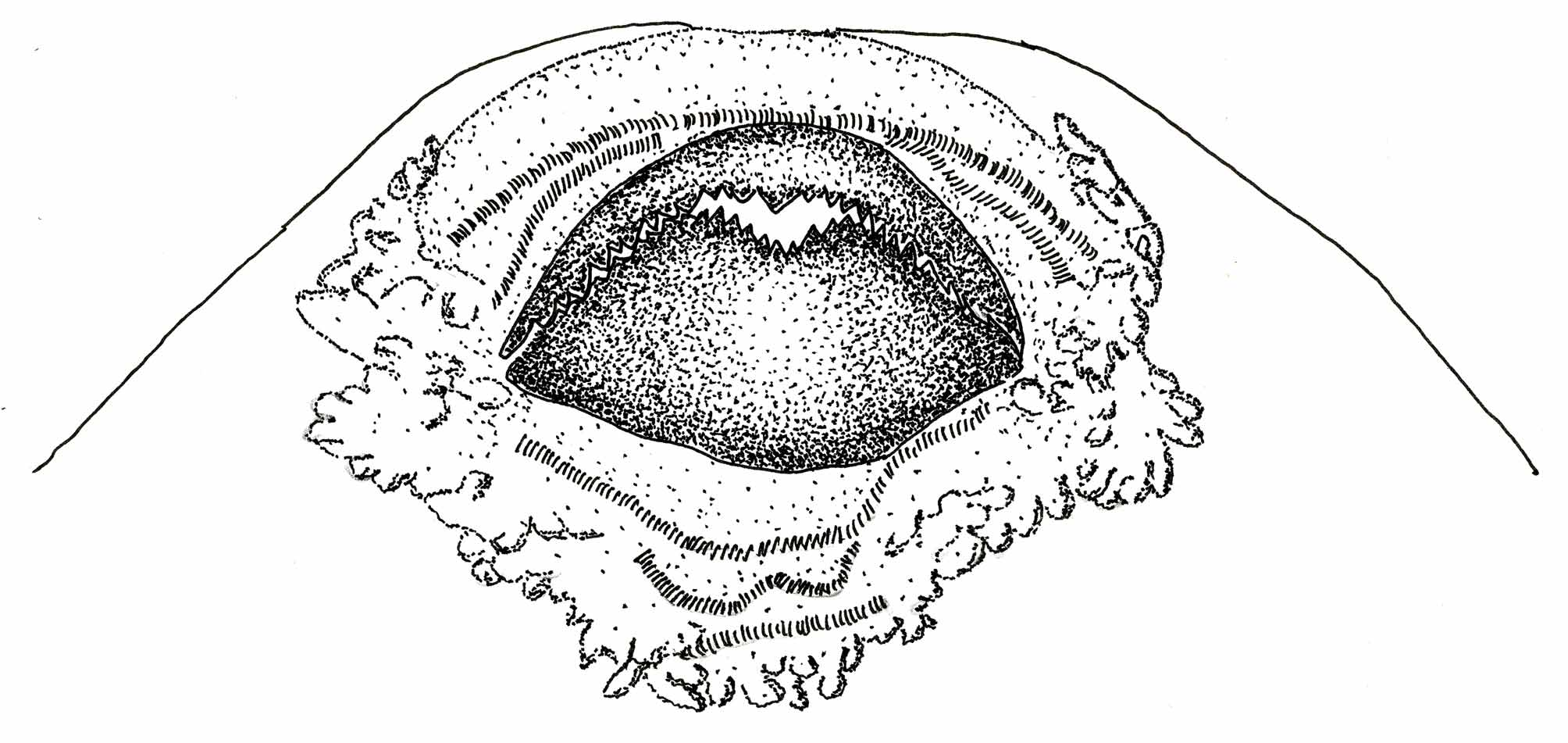
Description. Long tadpole with muscular tail; body oval in dorsal and lateral view (Fig. 8); snout broadly rounded in dorsal view, almost truncated in lateral view; body length 36.4 % of total length; body height 29.5 % of body length; body width 69.6 % of body length; eyes positioned dorsolaterally, eye diameter 11.0 % of body length; nostrils positioned dorsally, closer to snout tip than to eyes; inter-nostril distance 34.4 % of interorbital distance; tail fins narrow, dorsal and ventral fin originating from tail base, ventral fin narrower, 82.6 % of dorsal fin height; body height around 130 % of maximum tail height; tail axis width 35.4 % of body width; tail axis height 65.1 % of maximum tail height; vent tube dextral, body with huge lateral sacs, extending from halfway in between eye level and spiracle to end of body; short spiracle (almost impossible to see), sinistral; mouth ventral and close to snout, mouth smaller than interorbital distance; labial tooth formula 1: 1 + 1 / 1 + 1: 2, the first pair rows in the lower lip are very close to each other (Roedel et al. 2012 interpreted this as being 1: 1 + 1 / 3); anterior lip with lateral papillae and large rostral gap; posterior lip with 1 or 2 rows of small, uniformly rounded papillae (Fig. 8 c), which are as long as they are wide; black, massive, serrated jaws; upper jaw broadly arched with a small medial fang, lower jaw broadly V-shaped. The maximum size of A. laticephalus tadpoles is estimated to be around 60 - 70 mm. The total length of ZMB 75460 is 62.1 mm.
Tadpoles of three western African frog genera: Astylosternus Werner, 1898, Nyctibates Boulenger, 1904, and Scotobleps Boulenger, 1900 (Amphibia, Anura, Arthroleptidae)
Material examined. ZMB 75460 (Gosner stage 39, Ghana, Afao Hills, 531 m, 6 ° 15 ' 19.36 " N, 2 ° 17 ' 37.14 " W, 28 March 2007, leg. C. O. Boateng & A. Hillers). This tadpole was already assigned to A. laticephalus and described in Roedel et al. (2012) and in Channing et al. (2012). The tail tip is lost, so total length was taken from Roedel et al. (2012). This specimen has various preservation artifacts.
Tadpoles of three western African frog genera: Astylosternus Werner, 1898, Nyctibates Boulenger, 1904, and Scotobleps Boulenger, 1900 (Amphibia, Anura, Arthroleptidae)
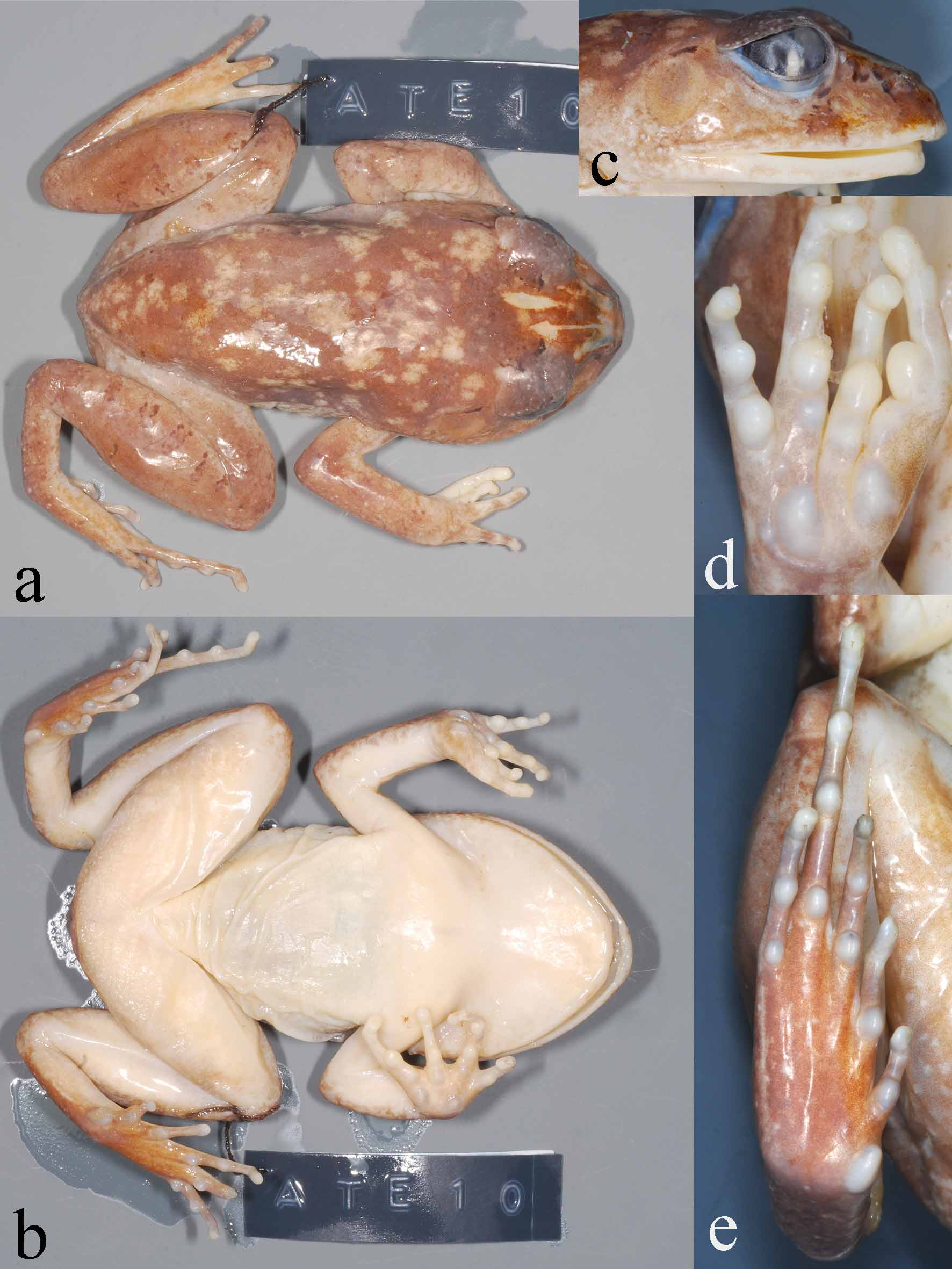
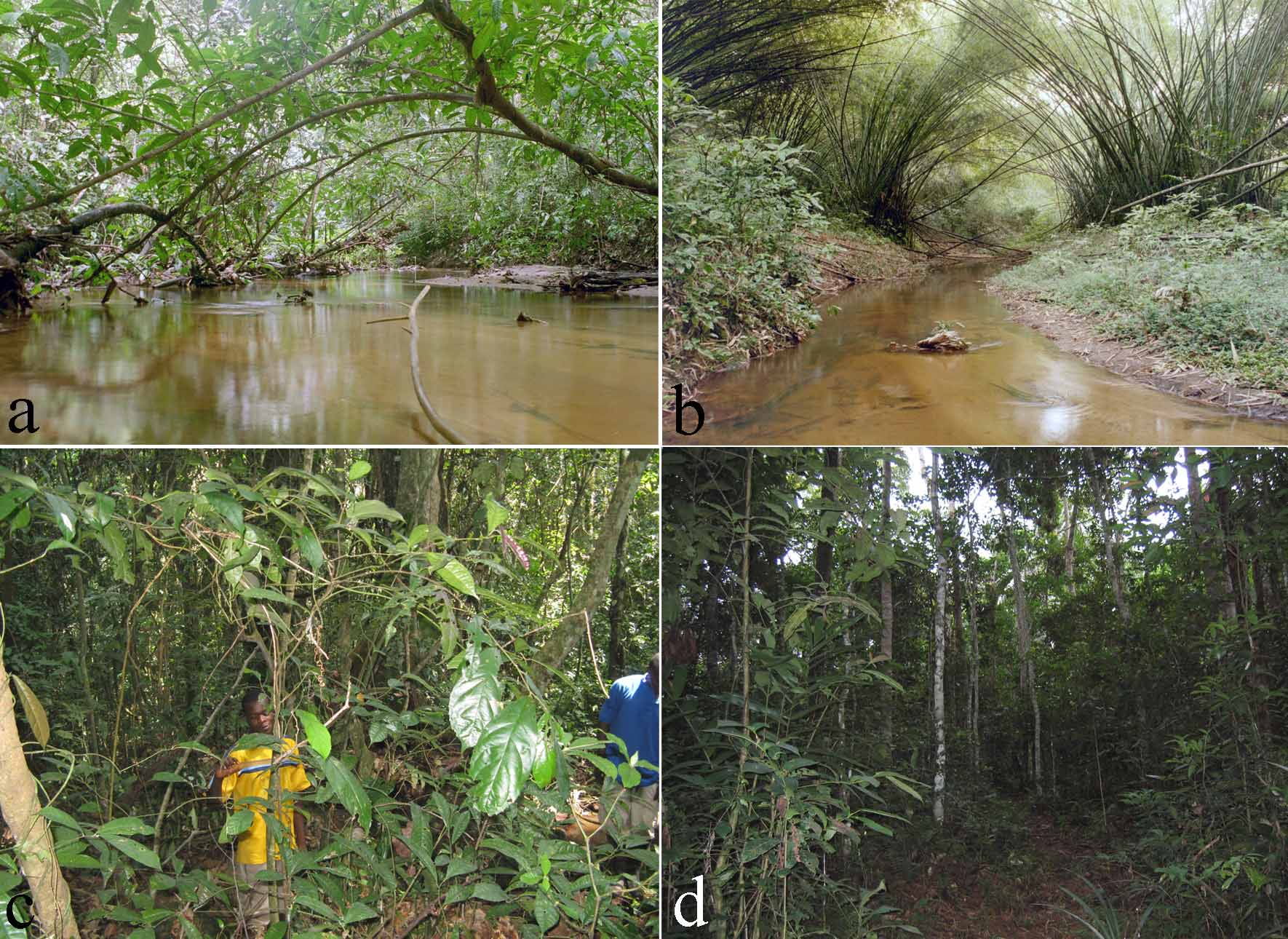
Description of the holotype [measures in mm]. The holotype is an adult female with a snout-vent length of 58.6; head width 22.7; head as long as broad; interorbital distance narrower than length of upper eyelid; snout rounded in dorsal view, obtuse in lateral view, longer than eye diameter; eyes large (7.9) and protuberant directed anterolaterally; interorbital distance 7.2; pupil vertically elliptical; eye diameter larger than tympanum diameter, 5.3; tympanum vertically elliptical; supratympanal fold from posterior vertical midpoint of orbit to meet with dorsal border of tympanic annulus, where descent is sharp and terminates at half the vertical diameter of the tympanic annulus dorsally to the axilla; nares closer to snout-tip (2.7) than to eye (5.5), nostrils oriented posterolaterally; internarial distance 4.4; canthus rostralis rounded and straight; loreal region slightly concave and gradually sloping laterally; single, small, tooth-like process at lower jaw symphysis, with corresponding socket in between premaxillae; upper premaxillae and maxillae with numerous teeth; vomerine teeth in form of two hemispherical odontophores, perpendicular to body axis, almost being in contact to each other medially, each with row of teeth like tips (5 left, 6 right); distance from odontophores to elliptical choanae slightly larger than maximum length of odontophores; choanae almost equal in size to odontophores; tongue broadly heart shaped, deeply notched anteriorly, densely beset with small papillae, extends over entire length of lower jaw; posterior 2 / 3 of tongue free. Forelimbs robust, fingers slender and long; prepollex absent; first finger 10.3, almost double the length of second finger (5.1); relative finger lengths I> III> II> IV; finger tips broadened without forming discs; subarticular tubercles large, subconical, protruding distally; thenar and palmar tubercles large and elliptical; supernumerary tubercles absent; number of subarticular tubercles on digits I-IV: 1, 1, 2, 2; no digital webbing; hind limbs short and robust; femur length 28.3, almost equal to tibia 28.4; tibia-fibula with longest toe 38.4; relative toe lengths IV> III> V> II> I; shortest toe (4.2) almost double the length of inner metatarsal tubercle (2.3); inner metatarsal tubercle large, elliptical; toe tips broadened without forming discs; number of subconical subarticular tubercles on toes I-V: 1, 1, 2, 3, 2; supernumerary tubercles absent; traces of webbing between toe bases; no skin fringes along toes. Tip of toe IV on left foot missing. Skin on head, back, belly and throat predominantly smooth; small whitish spines scattered on back, dorsal parts of extremities and eyelids; white warts posterior to angle of mouth, ventral from tympanum; posterior region of thighs areolate; irregularly spread narrow low tubercles along flanks; no tubercles or warts on forearms or interocular region; head with white scratches (scars). Base colour of dorsum in preservation is a light brown to reddish brown; back with irregularly arranged and shaped light beige spots; upper eyelids greyish; head laterally with two darker bars, the posterior one below eye; upper and lower lips white; supratympanic fold anteriorly rimmed thin black; warts on flanks beige; forelimbs dorsally light brown, slightly mottled beige, first two fingers almost uniform white; hind limb colour as forelimbs, dark bordered cross bars indicated in thighs (4) and lower legs (5 - 6); throat, belly, ventral parts of fore- and hind limbs uniform white or creamish; only ventral part of feet reddish brown, metatarsal tubercle and subarticular tubercles creamish white. Variation. Females seem to be larger (up to 67.0 mm; MVZ 244910) than males (53.8 mm), although the small sample size of the latter (N = 2) does not allow for generalization. The tympanum shape varies between vertically elliptical (most vouchers) to round; the supratympanic fold is sometimes thin to absent; sometimes tympanic membrane prominent within faint tympanic annulus. Other measures and indices identical between the two sexes; values are summarized in Tabs. 1 and 2. Dorsal and lateral skin texture can consist of many irregularly spaced small roundish warts, not arranged in rows, sometimes fused to small ridge like structures (Fig. 11). Males have paired subgular vocal sacs, visible in preserved frogs as slightly loose, granular black skin near the angles of the mouth; males with large brown nuptial pads on the external side of the thumb. Canthus rostralis in males more prominent bulging and rounded; males with more massive forearms than females. In contrast to other western West African Astylosternus, A. laticephalus sp. nov. males in breeding condition, lack spines on throat and belly. The dorsal base colouration in life consists of a light grey, brown, reddish brown or almost black; all specimens exhibit a more or less dense pattern of smaller to larger, irregularly shaped red spots on back; smaller black or brown spots may be present, in particular in juveniles; iris greyish, upper third reddish to orange; the anterior part of the eyelids bright yellow to red blotches, connected by a very conspicuous interorbital stripe of the same colour; snout tip and area posterior to interorbital stripe, including posterior part of eyelid, darker than rest of back, this pattern sometimes consisting of a symmetrical pair of triangular shaped black spots (Fig. 11); frenal area dark as snout tip; loreal area distinctly lighter coloured than snout tip; light infraorbital batch; supratympanal ridge usually bordered by thin black line; fore and hind limbs with or without distinct black cross bars; lateral colour gradually fainting from back colour to whitish venter, with irregularly scattered black points; ventral coloration (throat and abdomen) creamish-white; ventral surface of thighs and arms creamish-yellow with reddish brown mottling around lateral margins of limbs. In preservative all patterns and coloration almost as in life, but faded; the red dorsal spots remain as light beige spots. Tadpole [measures in mm; description based on ZMB 75460]. Exotrophic, lentic tadpole; Gosner stage 39; total length 62.1; body broad almost as long as wide, slightly elliptical in dorsal, slightly depressed in lateral view (possibly a preservation artefact); body length 23.8; body width 24.2; sides of body slightly concave, snout in dorsal view broadly rounded, a bit more pointed in lateral view; large lateral sacs originating posterior to eyes run along flanks; small eyes, positioned dorsolaterally, pupil round; nares small, positioned dorsolaterally, closer to snout trip than to eyes; oral apparatus in anteroventral position; dorsal lip wide and smooth, with large anterior gap between marginal papillae; lateral papillae ventral lip with large, uni- or biserial marginal papillae; upper jaw sheath massif, broad U-shaped, strongly serrated margin, most central “ tooth ” most prominent; lower jaw sheath massif, V-shaped, margin strongly serrated; labial tooth-row formula 1: 1 + 1 / 3; all keratodont rows on skin sheaths; labial keratodonts unidenticulate, connected by a hyaline skin; vent tube dextral; spiracle sinistral (almost invisible); very long tail axis (> 2.5 times body length); tail axis height largely exceeding height of dorsal and ventral fin, both fins very narrow; dorsal fin originates slightly posterior to tail body junction; dorsal fin almost parallel to tail axis up to rounded tip; no pores (neuromast canals) visible (possibly due to poor preservation or advanced developmental stage); body more or less beige, mottled with dark brown, tail fin brown to almost black in last third of tail. Newly metamorphosed froglets measured 25.6 – 28.7 mm (N = 2). Natural history. Not much is known about the biology of the new species. Astylosternus laticephalus sp. nov. lives in lowland rainforest habitats (Fig. 13), mostly close to small or mid sized streams (Rödel et al. 2005; Assemian et al. 2006). In Banco National Park, Ivory Coast we recorded the new species in the leaf litter of swampy areas in closed canopy forest, open forest and in natural forest gaps, both in close vicinity to the River Banco and in larger distance (about 1 km) from the river (Assemian et al. 2006). A total of 12 specimens were only observed during the rainy season, 11 of them during the night. In the Ankasa Conservation Area we found the new species in wet evergreen forest on a trail adjacent to the Bamboo Cathedral (Fig. 13 b).
The genus Astylosternus in the Upper Guinea rainforests, West Africa, with the description of a new species (Amphibia: Anura: Arthroleptidae)
Diagnosis. Astylosternus laticephalus sp. nov. has the typical body shape of frogs of the genus Astylosternus, however, with exceptionally broad heads, i. e. broader than in A. occidentalis; males of the new species without spines on throat and belly (always present in A. occidentalis males); males without nuptial black skin layer in pectoral region (present in male A. occidentalis from western Guinea); back brownish to brownish red, always with distinct red dots (red dots only rarely present in A. occidentalis); bicoloured iris, grey with a reddish upper third (A. occidentalis always with uniform grey iris). A. laticephalus sp. nov. differs from A. occidentalis by a mean of 3.2 % (range 2.9 - 3.7 %) in the investigated part of the 16 S rRNA gene. Genetic divergence to the morphologically most similar Central African species, A. diadematus, was 11.9 %.
The genus Astylosternus in the Upper Guinea rainforests, West Africa, with the description of a new species (Amphibia: Anura: Arthroleptidae)
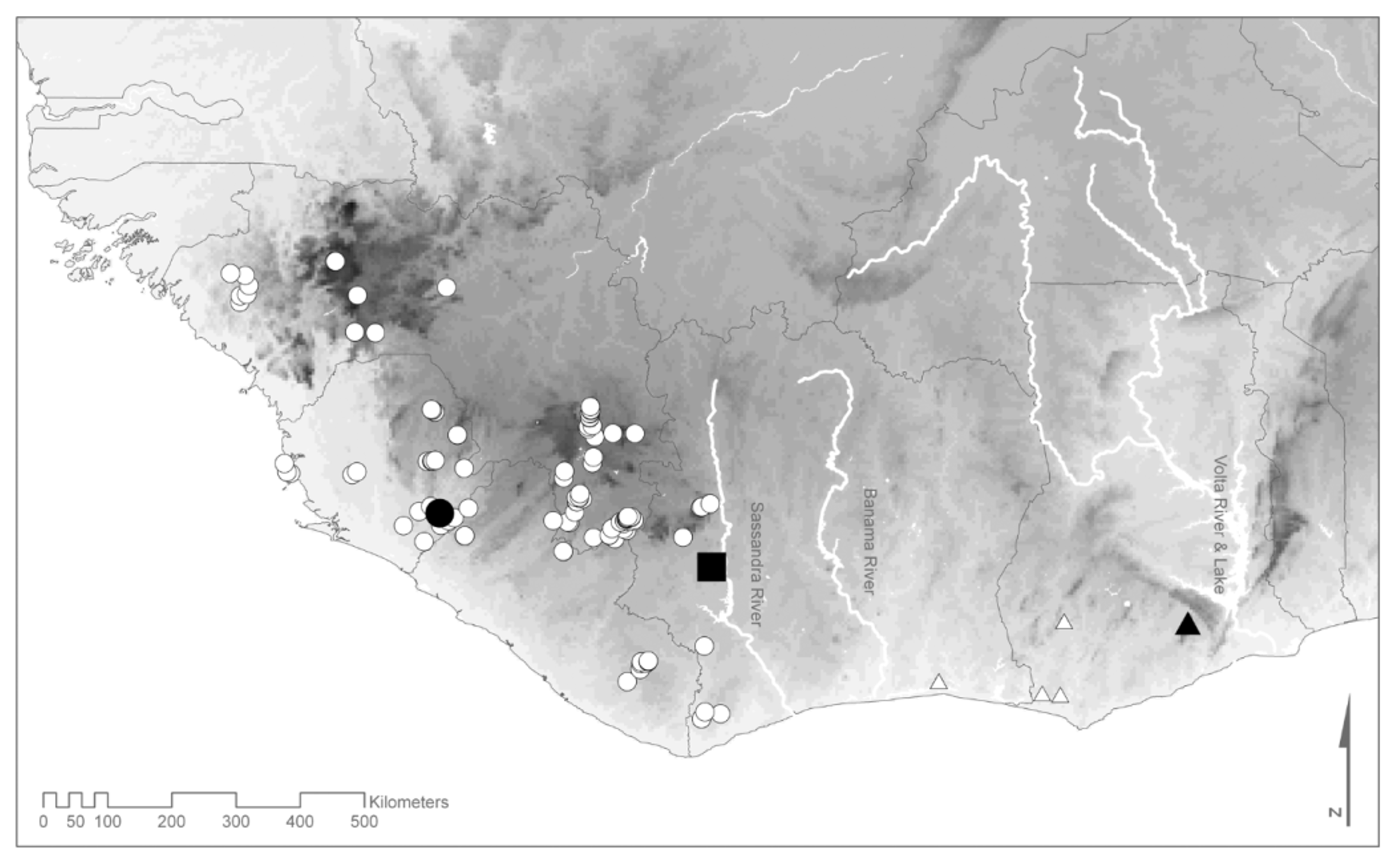
Distribution. So far A. laticephalus sp. nov. is known from one forest in eastern Ivory Coast, the Banco National Park (Assemian et al. 2006), and various sites in Ghana: Afao Hills Forest Reserve, Draw River Forest Reserve and Ankasa Conservation Area in south-western Ghana (Rödel et al. 2005; this paper), and Atewa Range in southern-central Ghana (Fig. 8). The latter site was chosen as type locality of the new taxon to underline the outstanding importance of this mountainous region for the Ghanaian biodiversity. Conservation status. The distribution of the species from eastern Ivory Coast to southern-central Ghana, including various protected areas (i. e. Banco National Park, Afao Hills Forest Reserve, Ankasa Conservation Area), seems to imply a IUCN RedList classification of “ Least Concern ”. However, rainforests in south-eastern Ivory Coast are under intense logging pressure and highly fragmented. Forests in south-western Ghana are better protected but likewise fragmented and the Atewa Range is currently under threat because of small scale mining activities and further plans to mine for gold, diamonds and bauxite on an industrial scale. We thus suggest classifying the new species as “ Near Threatened ”.
The genus Astylosternus in the Upper Guinea rainforests, West Africa, with the description of a new species (Amphibia: Anura: Arthroleptidae)
Etymology. The name derives from the Latin words latus for wide and the Greek Kεφάλɩ for head, referring to the conspicuous wide head of the new species.
The genus Astylosternus in the Upper Guinea rainforests, West Africa, with the description of a new species (Amphibia: Anura: Arthroleptidae)
Holotype. ZMB 75449 (field and tissue #: ATE 10, female, 58.6 mm), Ghana, Atewa Forest Reserve, 6.23375 / - 0.56557, 14 April 2007, forest around stream next to road, coll. C. Ofori-Boateng, A. Hillers & G. Segniagbeto. Paratypes. Ivory Coast: MTD 48026 (field and tissue #: Ba 04.24, female, 62.2 mm), ZMB 75454 - 75458 (Ba 04.26, subadult, 45.5 mm; Ba 04.25, female, 62.5 mm; Ba 04.21, female, 64.4 mm; Ba 04.22, subadult, 43.3 mm; Ba 04.23, female, 58.4 mm;), Banco National Park, 5.41667 / - 4.10500, rainy season 2004, swampy forest, coll. N. E. Assemian, B. Tohé & G. Kouamé; MNHN 1993.6073 (male, 53.8 mm), 1999.7333 (female, 54.8 mm), 1999.7334 (male, 48.7 mm), 1999.7335 (female, 59.8 mm), 1999.7736 (female, 52.6 mm), 1999.7337 (female, 51.8 mm), Banco National Park, Abidjan; Ghana: ZMB 75459 (AF 4, juvenile, 25.6 mm), ZMB 75459 - 75460 (AF 3 juvenile; 26.7 mm; AF 2, tadpole), Afao Hills Forest Reserve, 6.25461 / - 2.29492, riparian forest around small stream in valley, coll. C. Ofori-Boateng & A. Hillers; ZMB 75450 - 75453 (COB 90, juvenile, 34.7 mm; COB 318, subadult, 40.8 mm; COB 119, juvenile, 38.6 mm; COB 123, juvenile, 31.7 mm), Western Province, Ankasa Conservation Area, pristine forest along streams in dry season, coll. C. Ofori-Boateng; MVZ 244910 (female, 67 mm), Ankasa Conservation Area, 5.28173 / - 2.64022, 26 June 2004, wet evergreen forest area, trail adjacent to the bamboo cathedral, coll. A. D. Leaché & R. Diaz; MVZ 244909 (juvenile, 35 mm), 28 June 2004, approximately 1 km farther from the bamboo cathedral, other data as MVZ 244909. Additional material. ZMB 77461 (field # AF 03), tadpole, Ghana, Afao Hills Forest Reserve, 6.25461 / - 2.29492, riparian forest around small stream in valley, coll. C. Ofori-Boateng & A. Hillers; ATE 7 (tissue only), juvenile, 25.8 mm; ATE 8 (tissue only), juvenile, 28.6 mm; ATE 27 (tissue only), male, 45.6 mm, Ghana, Atewa Forest Reserve, 6.23375 / - 0.56557, 15 April 2007, swampy area next to small stream, in valley in forest, coll. C. Ofori-Boateng, A. Hillers & G. Segniagbeto; COB 2202 (collection Ofori-Boateng, Kumasi, Ghana), Ghana, Atewa Forest Reserve, coll. C. Ofori-Boateng; three adult specimens without number (amphibian reference collection at University Abobo-Adjamé, Ivory Coast), male (51.0 mm), females (60.0, 67.0 mm), Ivory Coast, Banco National Park, 5.41667 / - 4.10500, 5 May 2004, forest close to Banco River, coll. N. E. Assemian, N. G. Kouamé & B. Tohé.
The genus Astylosternus in the Upper Guinea rainforests, West Africa, with the description of a new species (Amphibia: Anura: Arthroleptidae)

Export occurrence data

Darwin Core Archive (ZIP)

GEOGRAPHY

Distribution Map

Occurrence Map

Loading map…

Tiles © GBIF Maps API | Map powered by MapLibre GL

REGIONS

Geographic Distribution(1)

Global
near threatened

DATA

Occurrence Datasets

Loading datasets…

CLASSIFICATION

Taxonomic Classification Tree

MULTIMEDIA

Media Files(6)

FIGURE 8. Known records of West African Astylosternus taxa; circles: Astylosternus occidentalis, black circle: “ type locality ” (compare text); triangles: A. laticephalus sp. nov., black triangle: type locality; black square: Mont Péko, locality of A. sp. (for exact localities see Appendix 1); country boundaries, topography and three major rivers (Sassandra, Bandama, Volta) are indicated; map based on the ASTER Global Digital Elevation Model: www. ersdac. or. jp.
Imageimage/png© Rödel, Mark-Oliver;Barej, Michael F.;Hillers, Annika;Leaché, Adam D.;Kouamé, N’Goran G;Ofori-Boateng, Caleb;Assemian, Emmanuel;Tohé, Blayda;Penner, Johannes;Hirschfeld, Mareike;Doumbia, Joseph;Gonwouo, Legrand Nono;Nopper, Joachim;Brede, Christian;Diaz, Raul;Fujita, Matthew K.;Gil, Marlon;H, GabrielThe genus Astylosternus in the Upper Guinea rainforests, West Africa, with the description of a new species (Amphibia: Anura: Arthroleptidae)

FIGURE 9. Astylosternus laticephalus sp. nov. female (holotype, ZMB 75449, 58.6 mm) from Atewa Forest Reserve, Ghana; dorsal (a) and ventral (b) view, portrait (c); ventral views of right hand (d) and right foot (e).

Imageimage/png© Rödel, Mark-Oliver;Barej, Michael F.;Hillers, Annika;Leaché, Adam D.;Kouamé, N’Goran G;Ofori-Boateng, Caleb;Assemian, Emmanuel;Tohé, Blayda;Penner, Johannes;Hirschfeld, Mareike;Doumbia, Joseph;Gonwouo, Legrand Nono;Nopper, Joachim;Brede, Christian;Diaz, Raul;Fujita, Matthew K.;Gil, Marlon;H, GabrielThe genus Astylosternus in the Upper Guinea rainforests, West Africa, with the description of a new species (Amphibia: Anura: Arthroleptidae)

FIGURE 10. Left thumb in dorsal view with nuptial pad (a), left hand in ventral view (b) and throat (c) of adult male Astylosternus laticephalus sp. nov. (paratype, MNHN 1999.7334, 48.7 mm) from Banco National Park, Ivory Coast.

Imageimage/png© Rödel, Mark-Oliver;Barej, Michael F.;Hillers, Annika;Leaché, Adam D.;Kouamé, N’Goran G;Ofori-Boateng, Caleb;Assemian, Emmanuel;Tohé, Blayda;Penner, Johannes;Hirschfeld, Mareike;Doumbia, Joseph;Gonwouo, Legrand Nono;Nopper, Joachim;Brede, Christian;Diaz, Raul;Fujita, Matthew K.;Gil, Marlon;H, GabrielThe genus Astylosternus in the Upper Guinea rainforests, West Africa, with the description of a new species (Amphibia: Anura: Arthroleptidae)

FIGURE 11. Life colouration of female and juvenile (c) Astylosternus laticephalus sp. nov. from Ghana, Ankasa Conservation Area (a, b, d, e, f, g) and Afao Hills Forest Reserve (c); b, d, f: MVZ 244910; c: ZMB 75459.
Imageimage/png© Rödel, Mark-Oliver;Barej, Michael F.;Hillers, Annika;Leaché, Adam D.;Kouamé, N’Goran G;Ofori-Boateng, Caleb;Assemian, Emmanuel;Tohé, Blayda;Penner, Johannes;Hirschfeld, Mareike;Doumbia, Joseph;Gonwouo, Legrand Nono;Nopper, Joachim;Brede, Christian;Diaz, Raul;Fujita, Matthew K.;Gil, Marlon;H, GabrielThe genus Astylosternus in the Upper Guinea rainforests, West Africa, with the description of a new species (Amphibia: Anura: Arthroleptidae)

FIGURE 12. Mouth part of a Astylosternus laticephalus sp. nov. tadpole from Afao Hills, Ghana (ZMB 75460; Gosner stage 39; SVL: 23.8 mm).
Imageimage/png© Rödel, Mark-Oliver;Barej, Michael F.;Hillers, Annika;Leaché, Adam D.;Kouamé, N’Goran G;Ofori-Boateng, Caleb;Assemian, Emmanuel;Tohé, Blayda;Penner, Johannes;Hirschfeld, Mareike;Doumbia, Joseph;Gonwouo, Legrand Nono;Nopper, Joachim;Brede, Christian;Diaz, Raul;Fujita, Matthew K.;Gil, Marlon;H, GabrielThe genus Astylosternus in the Upper Guinea rainforests, West Africa, with the description of a new species (Amphibia: Anura: Arthroleptidae)

FIGURE 13. Rainforest habitats of Astylosternus laticephalus sp. nov.; streams in Ankasa Conservation Area (a, b), and forest in Atewa Forest Reserve (c) and Ankasa Conservation Area (d), Ghana.

Imageimage/png© Rödel, Mark-Oliver;Barej, Michael F.;Hillers, Annika;Leaché, Adam D.;Kouamé, N’Goran G;Ofori-Boateng, Caleb;Assemian, Emmanuel;Tohé, Blayda;Penner, Johannes;Hirschfeld, Mareike;Doumbia, Joseph;Gonwouo, Legrand Nono;Nopper, Joachim;Brede, Christian;Diaz, Raul;Fujita, Matthew K.;Gil, Marlon;H, GabrielThe genus Astylosternus in the Upper Guinea rainforests, West Africa, with the description of a new species (Amphibia: Anura: Arthroleptidae)

IMAGES

Gallery(6)

See Gallery

Occurrences with images

Source Information

GBIF Backbone Taxonomy

GBIF Backbone Taxonomy

checklist

The GBIF Backbone Taxonomy is a single, synthetic management classification with the goal of covering all names GBIF is dealing with. It's the taxonomic backbone that allows GBIF to integrate name based information from different resources, no matter if these are occurrence datasets, species pages, names from nomenclators or external sources like EOL, Genbank or IUCN. This backbone allows taxonomic search, browse and reporting operations across all those resources in a consistent way and to provide means to crosswalk names from one source to another.

It is updated regulary through an automated process in which the Catalogue of Life acts as a starting point also providing the complete higher classification above families. Additional scientific names only found in other authoritative nomenclatural and taxonomic datasets are then merged into the tree, thus extending the original catalogue and broadening the backbones name coverage. The GBIF Backbone taxonomy also includes identifiers for Operational Taxonomic Units (OTUs) drawn from the barcoding resources iBOL and UNITE.

International Barcode of Life project (iBOL), Barcode Index Numbers (BINs). BINs are connected to a taxon name and its classification by taking into account all names applied to the BIN and picking names with at least 80% consensus. If there is no consensus of name at the species level, the selection process is repeated moving up the major Linnaean ranks until consensus is achieved.

UNITE - Unified system for the DNA based fungal species, Species Hypotheses (SHs). SHs are connected to a taxon name and its classification based on the determination of the RefS (reference sequence) if present or the RepS (representative sequence). In the latter case, if there is no match in the UNITE taxonomy, the lowest rank with 100% consensus within the SH will be used.

The GBIF Backbone Taxonomy is available for download at https://hosted-datasets.gbif.org/datasets/backbone/ in different formats together with an archive of all previous versions.

The following 105 sources have been used to assemble the GBIF backbone with number of names given in brackets:

  • Catalogue of Life Checklist - 4766428 names
  • International Barcode of Life project (iBOL) Barcode Index Numbers (BINs) - 635951 names
  • UNITE - Unified system for the DNA based fungal species linked to the classification - 611208 names
  • The Paleobiology Database - 212054 names
  • World Register of Marine Species - 188857 names
  • The Interim Register of Marine and Nonmarine Genera - 183894 names
  • The World Checklist of Vascular Plants (WCVP) - 131891 names
  • GBIF Backbone Taxonomy - 114350 names
  • TAXREF - 109374 names
  • The Leipzig catalogue of vascular plants - 75380 names
  • ZooBank - 73549 names
  • Integrated Taxonomic Information System (ITIS) - 68377 names
  • Plazi.org taxonomic treatments database - 61346 names
  • Genome Taxonomy Database r207 - 60545 names
  • International Plant Names Index - 52329 names
  • Fauna Europaea - 45077 names
  • The National Checklist of Taiwan (Catalogue of Life in Taiwan, TaiCoL) - 36193 names
  • Dyntaxa. Svensk taxonomisk databas - 35892 names
  • The Plant List with literature - 32692 names
  • United Kingdom Species Inventory (UKSI) - 29643 names
  • Artsnavnebasen - 29208 names
  • The IUCN Red List of Threatened Species - 21221 names
  • Afromoths, online database of Afrotropical moth species (Lepidoptera) - 13961 names
  • Brazilian Flora 2020 project - Projeto Flora do Brasil 2020 - 13829 names
  • Prokaryotic Nomenclature Up-to-Date (PNU) - 10079 names
  • Checklist Dutch Species Register - Nederlands Soortenregister - 8814 names
  • ICTV Master Species List (MSL) - 7852 names
  • Cockroach Species File - 6020 names
  • GRIN Taxonomy - 5882 names
  • Taxon list of fungi and fungal-like organisms from Germany compiled by the DGfM - 4570 names
  • Catalogue of Afrotropical Bees - 3623 names
  • Catalogue of Tenebrionidae (Coleoptera) of North America - 3327 names
  • Checklist of Beetles (Coleoptera) of Canada and Alaska. Second Edition. - 3312 names
  • Systema Dipterorum - 2850 names
  • Catalogue of the Pterophoroidea of the World - 2807 names
  • The Clements Checklist - 2675 names
  • Taxon list of Hymenoptera from Germany compiled in the context of the GBOL project - 2496 names
  • IOC World Bird List, v13.2 - 2366 names
  • Official Lists and Indexes of Names in Zoology - 2310 names
  • National checklist of all species occurring in Denmark - 1922 names
  • Myriatrix - 1876 names
  • Database of Vascular Plants of Canada (VASCAN) - 1822 names
  • Taxon list of vascular plants from Bavaria, Germany compiled in the context of the BFL project - 1771 names
  • Orthoptera Species File - 1742 names
  • A list of the terrestrial fungi, flora and fauna of Madeira and Selvagens archipelagos - 1602 names
  • Aphid Species File - 1565 names
  • World Spider Catalog - 1561 names
  • Taxon list of Jurassic Pisces of the Tethys Palaeo-Environment compiled at the SNSB-JME - 1270 names
  • Backbone Family Classification Patch - 1143 names
  • GBIF Algae Classification - 1100 names
  • International Cichorieae Network (ICN): Cichorieae Portal - 975 names
  • Psocodea Species File - 803 names
  • New Zealand Marine Macroalgae Species Checklist - 787 names
  • Annotated checklist of endemic species from the Western Balkans - 754 names
  • Taxon list of animals with German names (worldwide) compiled at the SMNS - 503 names
  • Catalogue of the Alucitoidea of the World - 472 names
  • Lygaeoidea Species File - 462 names
  • Catálogo de Plantas y Líquenes de Colombia - 422 names
  • GBIF Backbone Patch - 317 names
  • Phasmida Species File - 259 names
  • Cortinariaceae fetched from the Index Fungorum API - 234 names
  • Coreoidea Species File - 233 names
  • GTDB supplement - 139 names
  • Mantodea Species File - 119 names
  • Endemic species in Taiwan - 93 names
  • Taxon list of Araneae from Germany compiled in the context of the GBOL project - 88 names
  • Species of Hominidae - 78 names
  • Taxon list of Sternorrhyncha from Germany compiled in the context of the GBOL project - 77 names
  • Taxon list of mosses from Germany compiled in the context of the GBOL project - 75 names
  • Mammal Species of the World - 73 names
  • Plecoptera Species File - 71 names
  • Species Fungorum Plus - 64 names
  • Catalogue of the type specimens of Cosmopterigidae (Lepidoptera: Gelechioidea) from research collections of the Zoological Institute, Russian Academy of Sciences - 47 names
  • Species named after famous people - 41 names
  • Dermaptera Species File - 36 names
  • Taxon list of Trichoptera from Germany compiled in the context of the GBOL project - 34 names
  • True Fruit Flies (Diptera, Tephritidae) of the Afrotropical Region - 33 names
  • Range and Regularities in the Distribution of Earthworms of the Earthworms of the USSR Fauna. Perel, 1979 - 32 names
  • Taxon list of Diplura from Germany compiled in the context of the GBOL project - 30 names
  • Lista de referencia de especies de aves de Colombia - 2022 - 24 names
  • Taxon list of Auchenorrhyncha from Germany compiled in the context of the GBOL project - 20 names
  • Catalogue of the type specimens of Polycestinae (Coleoptera: Buprestidae) from research collections of the Zoological Institute, Russian Academy of Sciences - 19 names
  • Taxon list of Thysanoptera from Germany compiled in the context of the GBOL project - 19 names
  • Lista de especies de vertebrados registrados en jurisdicción del Departamento del Huila - 18 names
  • Taxon list of Microcoryphia (Archaeognatha) from Germany compiled in the context of the GBOL project - 15 names
  • Catalogue of the type specimens of Bufonidae and Megophryidae (Amphibia: Anura) from research collections of the Zoological Institute, Russian Academy of Sciences - 12 names
  • Grylloblattodea Species File - 11 names
  • Coleorrhyncha Species File - 9 names
  • Taxon list of liverworts from Germany compiled in the context of the GBOL project - 9 names
  • Embioptera Species File - 7 names
  • Taxon list of Pisces and Cyclostoma from Germany compiled in the context of the GBOL project - 6 names
  • Taxon list of Pteridophyta from Germany compiled in the context of the GBOL project - 6 names
  • Taxon list of Siphonaptera from Germany compiled in the context of the GBOL project - 5 names
  • The Earthworms of the Fauna of Russia. Perel, 1997 - 5 names
  • Taxon list of Zygentoma from Germany compiled in the context of the GBOL project - 4 names
  • Asiloid Flies: new taxa of Diptera: Apioceridae, Asilidae, and Mydidae - 3 names
  • Taxon list of Protura from Germany compiled in the context of the GBOL project - 3 names
  • Taxon list of hornworts from Germany compiled in the context of the GBOL project - 2 names
  • Chrysididae Species File - 1 names
  • Taxon list of Dermaptera from Germany compiled in the context of the GBOL project - 1 names
  • Taxon list of Diplopoda from Germany in the context of the GBOL project - 1 names
  • Taxon list of Orthoptera (Grashoppers) from Germany compiled at the SNSB - 1 names
  • Taxon list of Pscoptera from Germany compiled in the context of the GBOL project - 1 names
  • Taxon list of Pseudoscorpiones from Germany compiled in the context of the GBOL project - 1 names
  • Taxon list of Raphidioptera from Germany compiled in the context of the GBOL project - 1 names

GBIF Secretariat (2023). GBIF Backbone Taxonomy. Checklist dataset https://doi.org/10.15468/39omei accessed via GBIF.org on 2026-06-14.

CC BYPublished 8/28/2023View dataset
GBIF Usage Key
8706708
Dataset Key
d7dddbf4-2cf0-4f39-9b2a-bb099caae36c
Origin
source
Backbone Key
8706708
Taxon ID
gbif:8706708
Last Crawled
8/22/2023
Last Interpreted
8/22/2023