AnimaliaNot EvaluatedacceptedspeciesAcceptedRestricted
Neelus fimbriatus

Neelus fimbriatus

Bretfeld & Trinklein, 2000

GBIF:9520596

0countries
0year

0

Synonyms

PROFILE

Species Profile

Habitat

Terrestrial

ABOUT

Descriptions(12)

Distribution. Ecuador and Colombia (Bretfeld & Trinklein 2000; Marín & Palacios-Vargas 2018; Mari-Mutt et al. 1997 – 2023; Bellinger et al. 1996 – 2023).
An updated catalogue of the Collembola (Hexapoda) from Colombia and a perspective for unexplored richness
Type locality. Ecuador: Cotopaxi, Otonga (Bretfeld & Trinklein 2000: 179). Records from Colombia. Locality 20 (Marín & Palacios-Vargas 2018: 416).
An updated catalogue of the Collembola (Hexapoda) from Colombia and a perspective for unexplored richness
Labrum with 4,5,5,4 setae (Figs 1 A and 5 A). Anterior labral setae a 1 and a 2 thick, curved; a 2 longer than a 1 (16 and 12 µm, respectively). Seta a 1 apically with 3 small serrations and one big basal tooth, a 2 medially with 3 _ 4 strong serrations and some small externally. Medial setae (m-row) subequal (12 µm), smooth, slightly curved, the central one displaced in a small anterior lobe (Figs 1 A, 5 B). Posterior setae (p-row) smooth, subequal and slightly curved (12 µm). Maxillary palp simple, with 1 enlarged terminal seta (11 µm). Basomedian field of labium with 4 + 4 setae (Figs 1 E, 5 D), medial setae longer (16 µm) than others (10 – 11 µm); basolateral field with 1 setae and hyaline microsetae on a big alveolus, as illustrated for N. murinus by Schneider (2017). Ventral side of head with 3 + 3 postlabial setae (18 µm): 2 + 2 distal and 1 + 1 proximal thicker and barbulate (Figs 1 E, 5 C, 5 D). Mandible strong, with 5 apical teeth, and one external appendage, right mandible with an internal triangular tooth between incisive area and molar surface (Fig. 1 D). Maxilla with 6 fringed lamellae (Fig. 1 C). Thorax and abdomen (Fig. 2). Dorsal side of thorax and abdomen covered with ordinary setae, wax rods, swollen S-setae and tertiary rods. Dorso-lateral area of Th. II with: 13 + 13 ordinary setae. Precoxal area of Th. II with 2 + 2 ordinary setae, 1 + 1 τ-setae and 1 + 1 flame-shaped S-setae (s 1). Dorso-lateral area of Th. III-anterior abdomen, with 5 + 5 setae, 2 + 2 round-shaped S setae (s 3, s 3 ’), 7 + 7 wrc (wrc 1 – 7), 8 + 8 τ-setae and several tertiary rods arranged as in Fig. 2 A. Precoxal area of Th. III with 2 + 2 ordinary setae and 1 + 1 τ-setae. Abdomen with about 50 + 50 microsetae (3 – 5 µm), 1 + 1 T-shaped S-setae (s 2), 1 + 1 wrc arranged as in Fig. 2 A. Abd. V, with 4 + 4 setae (17 – 20 µm), VI with 5 + 5 setae (16 – 17 µm), 1 + 1 microsetae (µ. av) and 1 paired posterior mesoseta of anal valve (av, 4 µm) (Fig. 2 E). Male genital plate with 9 + 10 microsetae (6 – 8 µm) arranged in circle (Fig. 2 D). Female genital plate with 4 + 4 setae (9 – 10 µm) and microsetae absent (Fig. 2 E). Abd. IV sternum with 4 + 4 setae (9 – 10 µm), and 1 + 1 distal seta (9 – 10 µm). Ventrally on Abd. III and IV there are one pair of acetabular structures on each side (Fig. 6 C) similar to those of dens. Lateral part of Abd. IV sternum with 1 + 1 short, sharp and curved neosminthuroid setae (8 µm). Appendages. Ant. III and IV distinctly separated (Fig. 4 A). Length of antennae 117 µm, ratio of antenna / head = 0.6. Ratio of Ant. I: II; III; IV as 1: 2,7; 3,7; 4,3. Ant. I with 3 short dorsal setae (5 µm). Ant. II with 4 apical dorsal setae arranged in a whorl. Ant. III with 13 ordinary setae in five whorls (distribution from base to apex: 1, 1, 3, 2 and 6 setae). Antennal organ of Ant. III with 5 apical sensorial elements: Sgd, and Sgv sensilla, two microsensilla; and one ventral m’ spine-shaped (sgd: 15 µm, m: 6 µm, m’: 4 µm). Ant. IV with 10 ordinary setae; 7 sensilla (15 - 19 µm), Sx (10 µm) and Sy (15 µm); 3 long sensilla and 2 rod-like curved setae in apical (a) and subapical position (sa) and subapical organite “ Or ” with two filaments (7 µm). Setation of legs I – III (Figs. 3 A-C): scx I: 1, 1, 3; scx II: 1, 1, 1; coxae: 1, 1, 1; trochantera: 4, 3, 4; femora: 9, 10, 8 and tibiotarsi: 16, 18, 17. Some tibiotarsal setae (table 2) are on a tuberculate alveolus (Fig. 6 B). For details of shape of setae of legs see table 2. Unguis narrow and elongated, both unguis and unguiculus different long in leg I, II and III: unguis 36, 33 and 31 µm, respectively; unguiculus 16, 14 and 16 µm, respectively. Unguis bears one dorsal pseudonychia. Unguiculus untoothed without apical filament, with basal tubercule. Ventral tube with 2 + 2 distal setae and posterior lobe (Fig. 2 B). Retinaculum with 3 + 3 teeth, seta on corpus absent (Fig. 2 C). Furcula well developed (Fig. 4 B), length of manubrium, dens and mucro: 52, 105, and 66 µm, respectively. Manubrium posteriorly with 3 + 3 setae (Fig. 4 B), two distal (17 µm), one proximal (20 µm). Posterior surface of dens I with one long (20 µm) and thick seta, posterio-external part of dens II, with 3 conical spines, one central seta, and one triangular spur on each side, two internal triangular spines in the internal side, anterior surface of dens II with one apical very thin spine (setola). Mucro with both lamellae serrate, tip of mucro rounded. Sensory fields 6 + 6 s. f. placed in depressions each with secretory rod (13 – 15 µm), blunt, straight seta with basal part inserted in the cuticle and placed in upper margin of the field. The fields have following arrangement: (a) anterior and posterior field on head (s. f. I and II; 16 x 9 and 15 x 14 µm respectively) each with secretory rod and 1 internal seta (on anterior field 17 µm, on posterior one 15 µm, and 11 and 9 respectively); (b) large thoracic field (s. f. III; 35 x 20 µm) with secretory rod, 3 internal spines arranged in triangle, 2 marginal setae (13 - 15 µm); and 3 spine-like setae (26 µm); anteriorly with 3 lanceolate spines (axial shorter than lateral); (c) abdominal field VI (s. f. 6; 19 x 14 µm) with secretory rod, 1 curved internal spine, 2 marginal setae (1 internal, 1 external; 8 µm and 13 µm respectively) and T-shaped S-setae (s 2); (d) fields in the precoxal area of Th. II and III (s. f. IV, V; 18 x 14, and 20 x 19 µm, respectively) each with secretory rod, 2 curved spines. Both s. f. with 2 marginal external setae (9 - 16 µm). Both sexes known. Males are smaller than females, the only other difference between sexes is in shape and chaetotaxy of genital area, 18 microsetae in males (Fig. 6 D) vs. 10 in females.
Redescription of Neelus fimbriatus Bretfeld & Trinklein, 2000 (Collembola: Neelidae) from Colombia

Diagnosis. Anterior part of head with mesosetae, posterior with microsetae. Anterior part of abdomen with microsetae, posterior with some mesosetae and tertiary rods. Anterior labral setae a 1 and a 2 thick, a 1 with a big tooth and externally with 3 small serrations, a 2 medially with 3 – 4 strong external serrations. Sensory field on thorax furnished with 3 anterior lanceolate spines. Ant. I with 3 setae. Ant. II with 4 setae. Ant. III with 13 ordinary setae and five sensorial elements. Ventral side of head with one pair of proximal barbulate seta, smaller than two distal pairs. Sterna III and IV with a pair of acetabular formations each. Manubrium with 3 + 3 posterior setae. Dens proximal with only one posterior seta. Dens distal with 3 conical externo-posterior spines. Mucro with both lamellae strongly serrate and tip rounded.
Redescription of Neelus fimbriatus Bretfeld & Trinklein, 2000 (Collembola: Neelidae) from Colombia
Remarks. N. fimbriatus is very different to N. desantisi Najt, 1971, the only other species known in Southamerica. If differs by the absence of stouter and longer lanceolate spines around thoracic s. f. and macrosetae on posterior part of abdomen. Other differences are that N. desantisi has only 1 + 1 apical seta on ventral tube and only 2 conical spines on postero-external surface of distal dens. Being those characters unknown in other member of the genus, what makes a revision of type material needed. Photos of types were sent to us, by they are dried up and need to be remounted for proper study. N. fimbriatus clearly differs from other Neelus species by the absence lanceolate anterior spines around thoracal s. f. Moreover, it has small body size of all Neelus congeners. Original description of N. fimbriatus was based on 3 females and one juvenile (in alcohol), 2 females and one male under slides and 2 alcoholic specimens from other sample. They were from Otonga, Cotopaxi Province, Ecuador, at 1,900 m alt. July, 1998. Ours come from Guacarí, Valle del Cauca, Colombia. The only diagnostic characters mentioned by Bretfeld & Trinklein (2000) are: “ upper setae pair of ventral head-back ciliate (apomorphy), setae of labial row “ a ” thick and roughly serrate (apomorphy), posterior side of dentes with 1 + 1 basal setae (other 2 + 2) ”. In addition, they mention the “ Total length up to 0.5 mm, length of neosminthururoid setae 6 – 7 µm. Manubrium: dens: mucro = 1.7: 1.8: 1. In our specimens this ratio is 0.78: 1.6: 1. Original description the labrum is very accurate, but basoextenal field of labium was not illustrated. Fig. 9 of Bretfeld & Trinklein (2000) does not illustrate the dental spurs AJ 1 and AE 1. The ratio of antennal segments of our specimens is very similar to that found by Schneider (2017) but the number of setae Ant. II is 4 in ours (5 after Schneider) The total length of the antenna in Colombian specimens is 117 – 120 µm, shorter than those of type material (143 µm). Organite “ Or ” also with two apical filaments. Genital plate of male with only 9 + 9 setae and not 13 + 13 as in the type material. In the discussion, Schneider (2017) states that N. fimbriatus differs from Neelus murinus and Neelus koseli in antennal chaetotaxy, labral setae morphology and post-labial setae morphology. Neelus koseli and N. murinus have 6 setae on Ant. II, our specimens from Colombia have 4 setae and the redescription of Schneider illustrate 5 setae in Fig. 36 A. As the only real diagnostic character of N. fimbriatus is the barbulate seta of the post-labial area of the head, we must consider our specimens belonging to this species.
Redescription of Neelus fimbriatus Bretfeld & Trinklein, 2000 (Collembola: Neelidae) from Colombia
Description based on Colombian specimens (Figs 1 – 6). Body length 0.4 – 0.5 mm, habitus typical of the genus. Body color on alcohol mostly whitish, dorsally with few brown dots of pigmentation on head, thorax and abdomen. Integumentary channels observed ventrally on head (Fig. 6 A), thorax, and abdomen. Most of setae are microsetae, abdomen with about 50 pairs of tertiary rods. Measurement of most of characters are in micrometers and are presented on table 1. Those of males are average of two specimens and those of female of one specimen. Head (Fig. 1 A). Head length and width as 184 and 176 µm, respectively. Dorsal setae on head smooth and acuminate, frontal setae longer (12 – 16 µm) than those posterior (5 – 7 µm). Antero-dorsal area with 8 + 8 setae and with unpaired seta a 0. Antero-lateral area with 2 + 2 setae. Posterodorsal area with 12 setae. Postero-lateral area with 3 + 3 setae.
Redescription of Neelus fimbriatus Bretfeld & Trinklein, 2000 (Collembola: Neelidae) from Colombia
Material studied. Male and female mounted on slide, Colombia: Valle del Cauca, Guacarí, Santa Rosa de Tapias (coordinates N 3.81583 ° W 76.24166 °, alt. 1300 m.), 10. vi. 2017, E. P. Marín col., ex. soil. Material deposited at Facultad of Ciencias, UNAM under the numbers 22314 and 22315 (two females); 22316 and 22317 (two males), 22318 and 22319 (unknown sex).
Redescription of Neelus fimbriatus Bretfeld & Trinklein, 2000 (Collembola: Neelidae) from Colombia
Description. Addendum to Bretfeld & Trinklein (2000). Antenna, adult. Total length of antenna ~ 143.3 µm; max width (Ant. III) ~ 19.4 µm; ratio width: length ~ 0.14; ratio length of Ant. I: Ant. II: Ant. III: Ant. IV ~ 0.22: 0.59: 0.82: 1. Ant. I with three chaetae on dorsal side (Fig. 36 A). Ant. II with five chaetae in two whorls, one chaeta in basal whorl, four chaetae in apical whorl (Fig. 36 A). Ant. III with 13 mesochaetae in five rough whorls (distribution from base to apex: 1, 1, 3, 2 and 6 chaetae), 10 of those chaetae particularly thick; five apical S-chaetae (S 1 – S 5), S 1 and S 4 long and tubular, S 2 and S 3 short and tubular, S 5 short and flam-shaped (Fig. 36 B). S 4 full length could not be assessed. Ant. IV with 15 thin mesochaetae; 11 S-chaetae, nine long with round apex (S), one shorter than S with pointed apex (Sx, 6 µm) and one thicker than S with round apex (Sy); two apical special chaetae with long and thin apex in apical (a) and sub-apical position (sa); a sub-apical organite Or with two apical filaments, in basal position in regard to sa, and apical position in regard to Sx (Fig. 36 C, D). Antenna, sub-adult. Total length of antenna ~ 107.5 µm; max width (Ant. III) ~ 22.3 µm; ratio width: length ~ 0.20; ratio length of Ant. I: Ant. II: Ant. III: Ant. IV ~ 0.35: 0.59: 0.75: 1. Only two chaetae could be see on Ant. I. Ant. II and III as the adult, S 4 full length could not be assessed (Fig. 36 E, F). Only 13 ordinary chaetae could be see on Ant. IV, rest of the chaetotaxy as the adult (Fig. 36 E, F). The chaetotaxic pattern of the apex of the antenna matches with Bretfeld & Trinklein (2000) — see their Fig. 6. Male sexual apparatus. Abd. VI sternum with at least 1 + 1 swollen chaetae sm, maybe 2 + 2 (Fig. 36 G); genital plate with 13 + 13 chaetae (Fig. 36 G); testis slender and curved (Fig. 36 H).
Morphological review of the order Neelipleona (Collembola) through the redescription of the type species of Acanthoneelidus, Neelides and Neelus
Diagnosis. Whitish with dark brown or reddish brown. 500 µm. Labrum: chaetae a 1 and a 2 with 3 to 7 external teeth. Posterior pair of post-labial chaetae ciliate. Ant. IV with nine S-chaetae S, a and sa acuminate. Abdomen with numerous microspines (tertiary rods). Manubrium with 3 + 3 posterior chaetae. dp with 1 + 1 chaetae.
Morphological review of the order Neelipleona (Collembola) through the redescription of the type species of Acanthoneelidus, Neelides and Neelus
Comments. There were two pairs of females labeled with the same number (“ ♀ 1 ” and “ ♀ 2 ”). I added a label “ ♀ 4 ” on one of the females “ ♀ 1 ” and a label “ ♀ 5 ” on one of the females “ ♀ 2 ”, at the back of the slides. Early instars were not available but most of the specimens of Neelus fimbriatus I observed did not seem to have reach full development of the antenna morphology (while having mature genital plate). Adult morphology of the antenna was drawn after the specimen “ ♀ 4 ” and sub-adult morphology was drawn after the specimen “ ♀ 5 ”. The antennae of the juvenile were not studied due to a poor positioning on the slide.
Morphological review of the order Neelipleona (Collembola) through the redescription of the type species of Acanthoneelidus, Neelides and Neelus
Discussion. Closely related to Neelus murinus and Neelus koseli from which it differs in antennal chaetotaxy, labral chaetae morphology and post-labial chaetae morphology.
Morphological review of the order Neelipleona (Collembola) through the redescription of the type species of Acanthoneelidus, Neelides and Neelus
Material examined. Holotype. ♀ on a slide, Cotopaxi Province, Otonga Reserve, cloud forest, 1900 m, litter sample C, 26. viii. 1996, N. Trinklein leg., [SMC]. Paratypes. 4 ♀ on 13 slides, 1 ♂ on a slide and 1 juvenile on a slide, same data as the holotype, [SMC].
Morphological review of the order Neelipleona (Collembola) through the redescription of the type species of Acanthoneelidus, Neelides and Neelus

Export occurrence data

Darwin Core Archive (ZIP)

GEOGRAPHY

Distribution Map

Occurrence Map

Loading map…

Tiles © GBIF Maps API | Map powered by MapLibre GL

REGIONS

Geographic Distribution(2)

Andean
native
Andean
native

DATA

Occurrence Datasets

Loading datasets…

CLASSIFICATION

Taxonomic Classification Tree

MULTIMEDIA

Media Files(7)

FIGURE 1. Neelus fimbriatus: A, Head chaetotaxy dorsal view; B, labrum, setae of anterior row from bellow, enlarged view; C, maxilla, dorsal and ventral views; D, mandibles; E, ventral view of labium.

Imageimage/png© Marín, Elida P.;Palacios-Vargas, José G.Redescription of Neelus fimbriatus Bretfeld & Trinklein, 2000 (Collembola: Neelidae) from Colombia

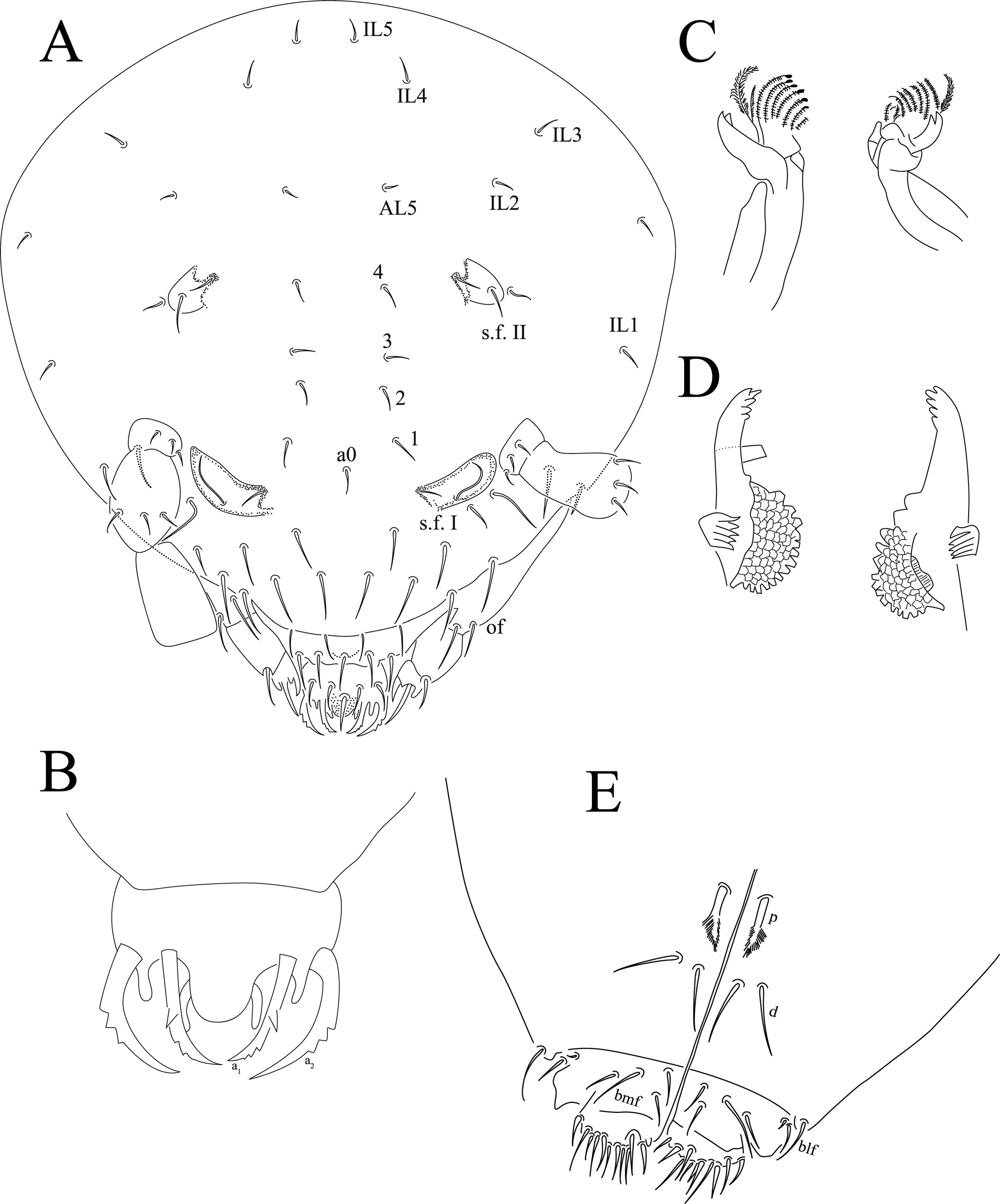
FIGURE 2. Neelus fimbriatus: A, thoracic and abdominal chaetotaxy with abdominal thoracic sensory fields III and IV enlarged; B, ventral tube, latero-posterior side; C, tenaculum; D, male genital plate, latero-ventral view; E, female genital plate and sternite IV, V and VI.

Imageimage/png© Marín, Elida P.;Palacios-Vargas, José G.Redescription of Neelus fimbriatus Bretfeld & Trinklein, 2000 (Collembola: Neelidae) from Colombia

FIGURE 3. Neelus fimbriatus: A, leg I, from precoxa II to tibiotarsus; B, leg from precoxa I to tibiotarsus and sensory field IV; C, leg III from precoxa I to tibiotarsus and sensory field V.

Imageimage/png© Marín, Elida P.;Palacios-Vargas, José G.Redescription of Neelus fimbriatus Bretfeld & Trinklein, 2000 (Collembola: Neelidae) from Colombia

FIGURE 4. Neelus fimbriatus: A, antenna, lateral view; B, furcula, posterior view.

Imageimage/png© Marín, Elida P.;Palacios-Vargas, José G.Redescription of Neelus fimbriatus Bretfeld & Trinklein, 2000 (Collembola: Neelidae) from Colombia

FIGURE 5. Neelus fimbriatus: A, CFM, labrum dorsal view; B, labrum ventral view; C, ventral view of anterior head; D, labium, with basomedial field setae and proximal barbulate setae.

Imageimage/png© Marín, Elida P.;Palacios-Vargas, José G.Redescription of Neelus fimbriatus Bretfeld & Trinklein, 2000 (Collembola: Neelidae) from Colombia

FIGURE 6. Neelus fimbriatus CFM: A, lateral integumentary channels of head; B, tibiotarsi with tuberculate setae; C, abdominal acetabulum on Abd. II and III; D, male genital plate and testis.

Imageimage/png© Marín, Elida P.;Palacios-Vargas, José G.Redescription of Neelus fimbriatus Bretfeld & Trinklein, 2000 (Collembola: Neelidae) from Colombia

IMAGES

Gallery(7)

See Gallery

Occurrences with images

Source Information

GBIF Backbone Taxonomy

GBIF Backbone Taxonomy

checklist

The GBIF Backbone Taxonomy is a single, synthetic management classification with the goal of covering all names GBIF is dealing with. It's the taxonomic backbone that allows GBIF to integrate name based information from different resources, no matter if these are occurrence datasets, species pages, names from nomenclators or external sources like EOL, Genbank or IUCN. This backbone allows taxonomic search, browse and reporting operations across all those resources in a consistent way and to provide means to crosswalk names from one source to another.

It is updated regulary through an automated process in which the Catalogue of Life acts as a starting point also providing the complete higher classification above families. Additional scientific names only found in other authoritative nomenclatural and taxonomic datasets are then merged into the tree, thus extending the original catalogue and broadening the backbones name coverage. The GBIF Backbone taxonomy also includes identifiers for Operational Taxonomic Units (OTUs) drawn from the barcoding resources iBOL and UNITE.

International Barcode of Life project (iBOL), Barcode Index Numbers (BINs). BINs are connected to a taxon name and its classification by taking into account all names applied to the BIN and picking names with at least 80% consensus. If there is no consensus of name at the species level, the selection process is repeated moving up the major Linnaean ranks until consensus is achieved.

UNITE - Unified system for the DNA based fungal species, Species Hypotheses (SHs). SHs are connected to a taxon name and its classification based on the determination of the RefS (reference sequence) if present or the RepS (representative sequence). In the latter case, if there is no match in the UNITE taxonomy, the lowest rank with 100% consensus within the SH will be used.

The GBIF Backbone Taxonomy is available for download at https://hosted-datasets.gbif.org/datasets/backbone/ in different formats together with an archive of all previous versions.

The following 105 sources have been used to assemble the GBIF backbone with number of names given in brackets:

  • Catalogue of Life Checklist - 4766428 names
  • International Barcode of Life project (iBOL) Barcode Index Numbers (BINs) - 635951 names
  • UNITE - Unified system for the DNA based fungal species linked to the classification - 611208 names
  • The Paleobiology Database - 212054 names
  • World Register of Marine Species - 188857 names
  • The Interim Register of Marine and Nonmarine Genera - 183894 names
  • The World Checklist of Vascular Plants (WCVP) - 131891 names
  • GBIF Backbone Taxonomy - 114350 names
  • TAXREF - 109374 names
  • The Leipzig catalogue of vascular plants - 75380 names
  • ZooBank - 73549 names
  • Integrated Taxonomic Information System (ITIS) - 68377 names
  • Plazi.org taxonomic treatments database - 61346 names
  • Genome Taxonomy Database r207 - 60545 names
  • International Plant Names Index - 52329 names
  • Fauna Europaea - 45077 names
  • The National Checklist of Taiwan (Catalogue of Life in Taiwan, TaiCoL) - 36193 names
  • Dyntaxa. Svensk taxonomisk databas - 35892 names
  • The Plant List with literature - 32692 names
  • United Kingdom Species Inventory (UKSI) - 29643 names
  • Artsnavnebasen - 29208 names
  • The IUCN Red List of Threatened Species - 21221 names
  • Afromoths, online database of Afrotropical moth species (Lepidoptera) - 13961 names
  • Brazilian Flora 2020 project - Projeto Flora do Brasil 2020 - 13829 names
  • Prokaryotic Nomenclature Up-to-Date (PNU) - 10079 names
  • Checklist Dutch Species Register - Nederlands Soortenregister - 8814 names
  • ICTV Master Species List (MSL) - 7852 names
  • Cockroach Species File - 6020 names
  • GRIN Taxonomy - 5882 names
  • Taxon list of fungi and fungal-like organisms from Germany compiled by the DGfM - 4570 names
  • Catalogue of Afrotropical Bees - 3623 names
  • Catalogue of Tenebrionidae (Coleoptera) of North America - 3327 names
  • Checklist of Beetles (Coleoptera) of Canada and Alaska. Second Edition. - 3312 names
  • Systema Dipterorum - 2850 names
  • Catalogue of the Pterophoroidea of the World - 2807 names
  • The Clements Checklist - 2675 names
  • Taxon list of Hymenoptera from Germany compiled in the context of the GBOL project - 2496 names
  • IOC World Bird List, v13.2 - 2366 names
  • Official Lists and Indexes of Names in Zoology - 2310 names
  • National checklist of all species occurring in Denmark - 1922 names
  • Myriatrix - 1876 names
  • Database of Vascular Plants of Canada (VASCAN) - 1822 names
  • Taxon list of vascular plants from Bavaria, Germany compiled in the context of the BFL project - 1771 names
  • Orthoptera Species File - 1742 names
  • A list of the terrestrial fungi, flora and fauna of Madeira and Selvagens archipelagos - 1602 names
  • Aphid Species File - 1565 names
  • World Spider Catalog - 1561 names
  • Taxon list of Jurassic Pisces of the Tethys Palaeo-Environment compiled at the SNSB-JME - 1270 names
  • Backbone Family Classification Patch - 1143 names
  • GBIF Algae Classification - 1100 names
  • International Cichorieae Network (ICN): Cichorieae Portal - 975 names
  • Psocodea Species File - 803 names
  • New Zealand Marine Macroalgae Species Checklist - 787 names
  • Annotated checklist of endemic species from the Western Balkans - 754 names
  • Taxon list of animals with German names (worldwide) compiled at the SMNS - 503 names
  • Catalogue of the Alucitoidea of the World - 472 names
  • Lygaeoidea Species File - 462 names
  • Catálogo de Plantas y Líquenes de Colombia - 422 names
  • GBIF Backbone Patch - 317 names
  • Phasmida Species File - 259 names
  • Cortinariaceae fetched from the Index Fungorum API - 234 names
  • Coreoidea Species File - 233 names
  • GTDB supplement - 139 names
  • Mantodea Species File - 119 names
  • Endemic species in Taiwan - 93 names
  • Taxon list of Araneae from Germany compiled in the context of the GBOL project - 88 names
  • Species of Hominidae - 78 names
  • Taxon list of Sternorrhyncha from Germany compiled in the context of the GBOL project - 77 names
  • Taxon list of mosses from Germany compiled in the context of the GBOL project - 75 names
  • Mammal Species of the World - 73 names
  • Plecoptera Species File - 71 names
  • Species Fungorum Plus - 64 names
  • Catalogue of the type specimens of Cosmopterigidae (Lepidoptera: Gelechioidea) from research collections of the Zoological Institute, Russian Academy of Sciences - 47 names
  • Species named after famous people - 41 names
  • Dermaptera Species File - 36 names
  • Taxon list of Trichoptera from Germany compiled in the context of the GBOL project - 34 names
  • True Fruit Flies (Diptera, Tephritidae) of the Afrotropical Region - 33 names
  • Range and Regularities in the Distribution of Earthworms of the Earthworms of the USSR Fauna. Perel, 1979 - 32 names
  • Taxon list of Diplura from Germany compiled in the context of the GBOL project - 30 names
  • Lista de referencia de especies de aves de Colombia - 2022 - 24 names
  • Taxon list of Auchenorrhyncha from Germany compiled in the context of the GBOL project - 20 names
  • Catalogue of the type specimens of Polycestinae (Coleoptera: Buprestidae) from research collections of the Zoological Institute, Russian Academy of Sciences - 19 names
  • Taxon list of Thysanoptera from Germany compiled in the context of the GBOL project - 19 names
  • Lista de especies de vertebrados registrados en jurisdicción del Departamento del Huila - 18 names
  • Taxon list of Microcoryphia (Archaeognatha) from Germany compiled in the context of the GBOL project - 15 names
  • Catalogue of the type specimens of Bufonidae and Megophryidae (Amphibia: Anura) from research collections of the Zoological Institute, Russian Academy of Sciences - 12 names
  • Grylloblattodea Species File - 11 names
  • Coleorrhyncha Species File - 9 names
  • Taxon list of liverworts from Germany compiled in the context of the GBOL project - 9 names
  • Embioptera Species File - 7 names
  • Taxon list of Pisces and Cyclostoma from Germany compiled in the context of the GBOL project - 6 names
  • Taxon list of Pteridophyta from Germany compiled in the context of the GBOL project - 6 names
  • Taxon list of Siphonaptera from Germany compiled in the context of the GBOL project - 5 names
  • The Earthworms of the Fauna of Russia. Perel, 1997 - 5 names
  • Taxon list of Zygentoma from Germany compiled in the context of the GBOL project - 4 names
  • Asiloid Flies: new taxa of Diptera: Apioceridae, Asilidae, and Mydidae - 3 names
  • Taxon list of Protura from Germany compiled in the context of the GBOL project - 3 names
  • Taxon list of hornworts from Germany compiled in the context of the GBOL project - 2 names
  • Chrysididae Species File - 1 names
  • Taxon list of Dermaptera from Germany compiled in the context of the GBOL project - 1 names
  • Taxon list of Diplopoda from Germany in the context of the GBOL project - 1 names
  • Taxon list of Orthoptera (Grashoppers) from Germany compiled at the SNSB - 1 names
  • Taxon list of Pscoptera from Germany compiled in the context of the GBOL project - 1 names
  • Taxon list of Pseudoscorpiones from Germany compiled in the context of the GBOL project - 1 names
  • Taxon list of Raphidioptera from Germany compiled in the context of the GBOL project - 1 names

GBIF Secretariat (2023). GBIF Backbone Taxonomy. Checklist dataset https://doi.org/10.15468/39omei accessed via GBIF.org on 2026-06-14.

CC BYPublished 8/28/2023View dataset
GBIF Usage Key
9520596
Dataset Key
d7dddbf4-2cf0-4f39-9b2a-bb099caae36c
Origin
source
Backbone Key
9520596
Taxon ID
gbif:9520596
Last Crawled
8/22/2023
Last Interpreted
8/22/2023