
AnimaliaNot EvaluatedacceptedspeciesAccepted
Vasopora ceramica

Vasopora ceramica

Grischenko, Gordon & Melnik, 2021

GBIF:11376411

0year

PROFILE

Species Profile

Habitat

Marine

Characteristics

Extant

ABOUT

Descriptions(6)

(Figs 2 – 4) Genus et species indet.: Grischenko, Gordon & Melnik 2018: p. 55, figs 36 – 38.
Vasopora ceramica n. gen., n. sp. - a new abyssal cyclostome bryozoan from polymetallic nodules in the Russian exploration area, Clarion-Clipperton Fracture Zone, eastern Pacific Ocean
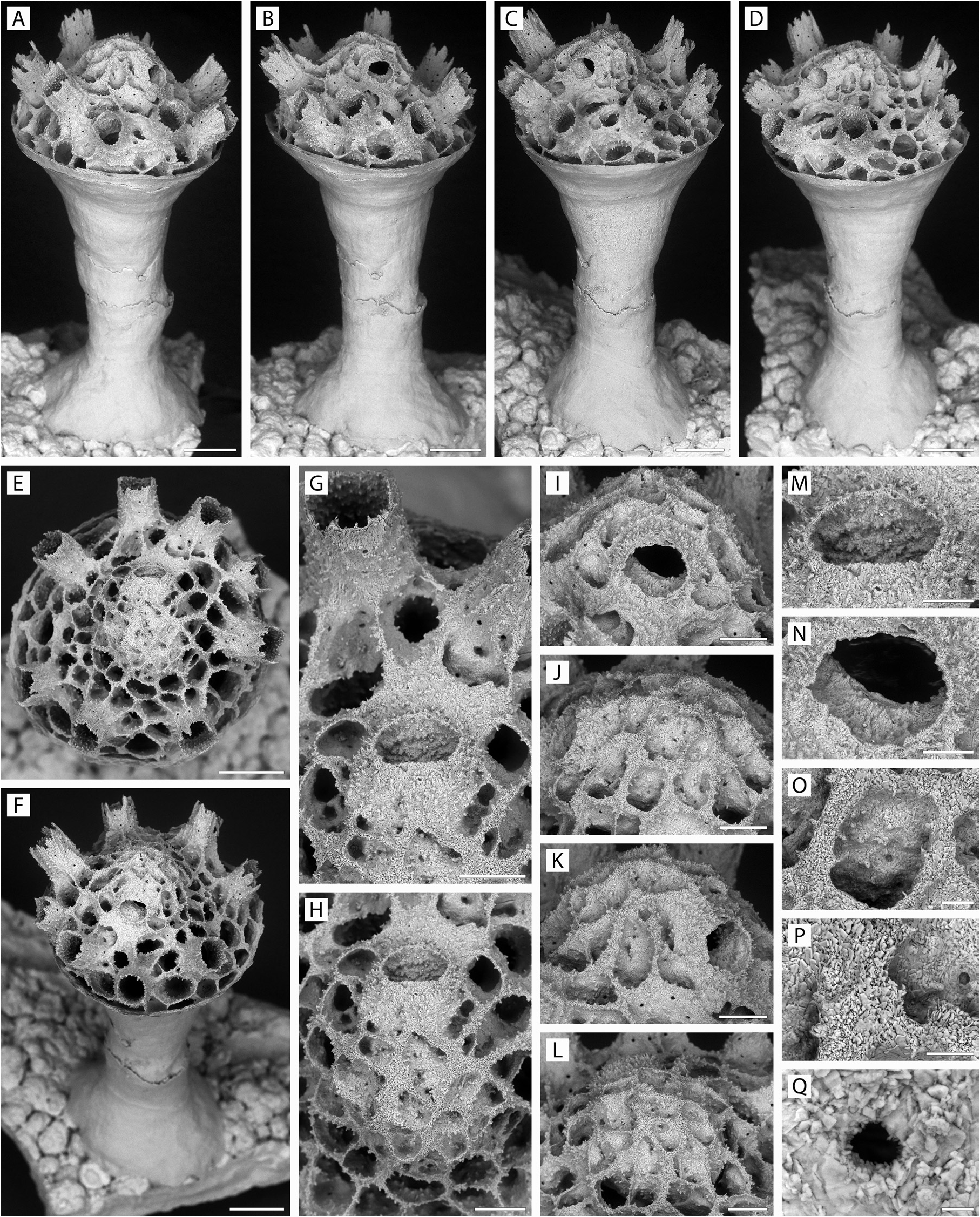
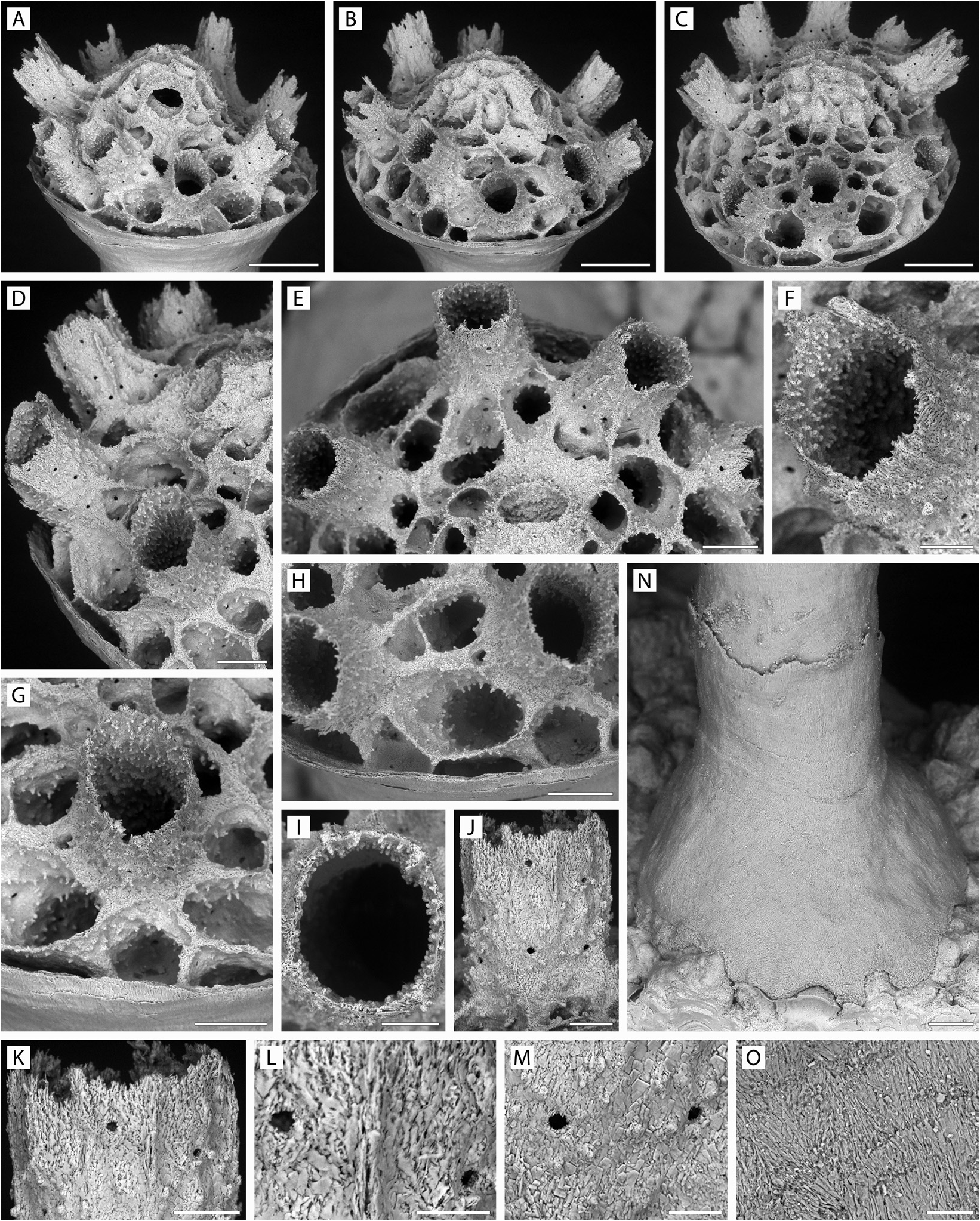
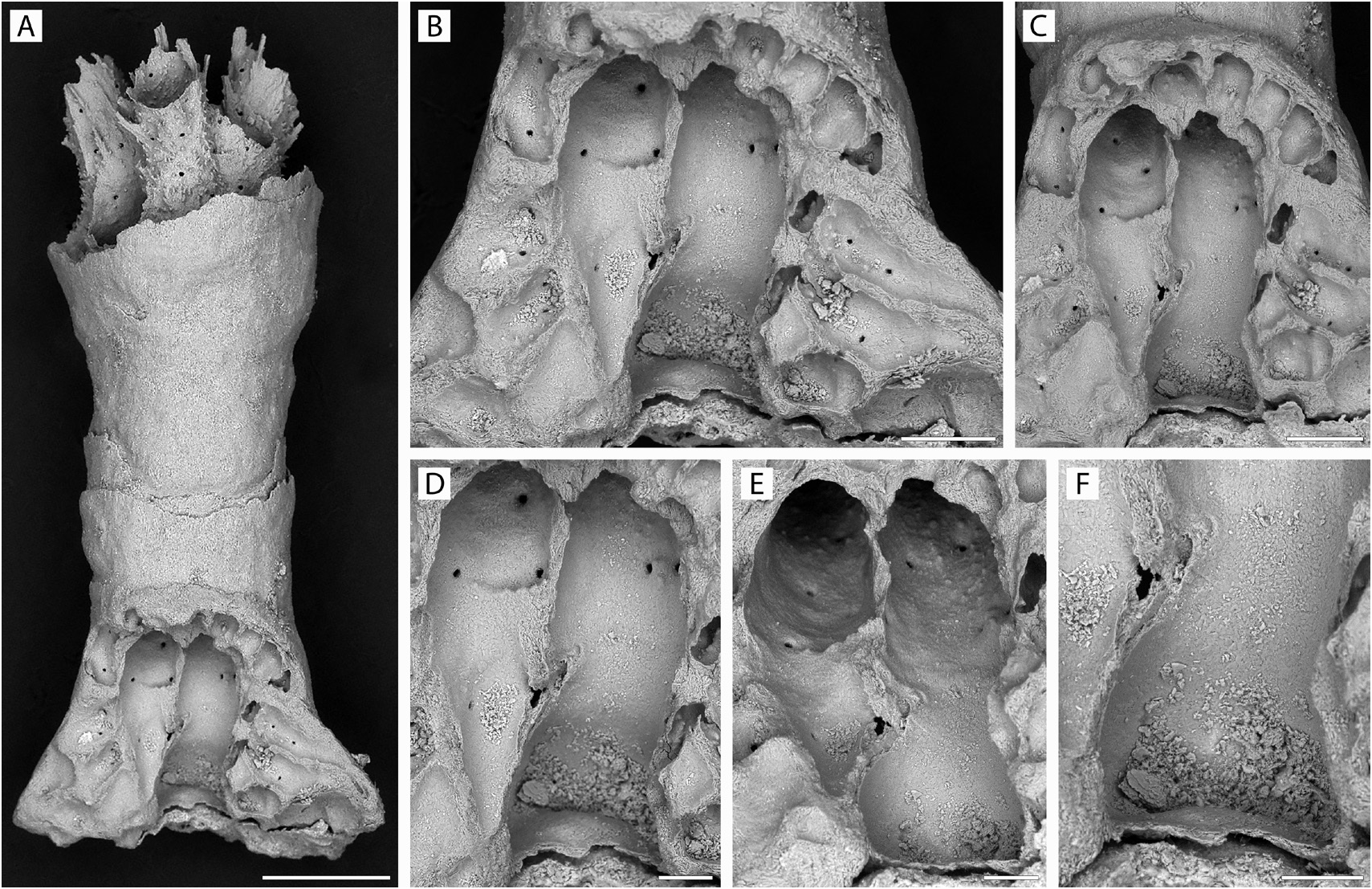
Description. Colony erect, miniature, vasiform, with relatively convex capitulum on proportionately thin and tall column (Figs 2 A – D, F, 3 A, B). Capitulum: column height ratio 1: 3. Capitulum with thin outer rim encircling eight radially orientated autozooidal peristomes and alveoli arranged along periphery (Fig. 2 E, F), with centrally located incubation chamber on top (Figs 2 E, F, 3 A – C). Alveoli immediately inside calyx rim ovoid to slit-like. Much of remainder of capitulum comprising polygonal to subrounded alveoli, their combined rims giving a reticulated appearance (Fig. 2 E, F). Entire skeletal surface of capitulum minutely densely granular to subspinulate (Figs 2 G ‒ L, 3 D ‒ H). Peristomes relatively short, eight in number, directed obliquely outwards at angle of c. 30 – 65 ° (Figs 2 F, 3 A – F). Peristomial rims of a few well-preserved peristomes with six to eight spine-like processes around margin (Figs 2 F, 3 A – D), each associated with longitudinal ridge on outside of peristomial base (Fig. 3 D, E, J – L). Peristomial walls with sparse, simple communication pores (Figs 2 G, 3 D, E, J ‒ M). At higher magnification, outer surface constructed of irregular (Fig. 3 L) or wedge-shaped crystallites (Fig. 3 M). Gonozooid solitary, capacious, sac-like, domed, swollen, located centrally, with insignificant marginal shift relative to capitulum center, unidirectional (Figs 2 E, F, I – L, 3 A – C). Ooeciostome negligible, barely discernible, in form of very narrow, densely granulated band of calcification encircling ooeciopore and lacking pores (Fig. 2 G, J, K). Ooeciopore (Fig. 2 M, N) transversely subcircular, with flatter and straighter upper margin, located on slope of gonozooid, orientated perpendicularly relative to main colony axis, facing outwards (Figs 2 F, I – K, 3 D, E). Gonozooid with tiny circular pores concentrated on roof and less frequent on lateral and back sides (Fig. 2 G ‒ L). Gonozooid covered by dense network of polygonal ridges (Fig. 2 E, H) representing shallow alveoli, continuous with larger, deeper surrounding alveoli. Surface microstructure of gonozooid with imbricated irregular crystallites (Fig. 2 O – Q). Column vase-like, elongated (Fig. 2 A – D), 75 % of colony height, narrowest in middle, flaring toward base (Fig. 3 N) and capitulum. Entire column surface exterior-walled, smooth, glabrous, lacking pseudopores, with traces of regeneration preserved in form of weakly prominent rims with roughly uneven edges (Figs 2 A – D, 3 N). Skeletal microstructure (Fig. 3 O) comprising planar-spherulitic surface fabric of closely appressed acicular to irregular sharp crystallites, clustered into parallel horizontal to oblique strips or fans parallel to wall surface. Upper margin of column (outer rim) even along whole perimeter (Figs 2 A – D, 3 A – E, G, H), smooth-surfaced, identically to main column surface, locally with gentle undulations in horizontal profile and very short straightening in vertical profile. Basal column margin deeply undulating over entire length (Figs 2 A – D, 3 N), following irregularities of substratum microrelief. Early astogeny (examined using non-type specimen, Fig. 4 A – F) indicates protoecial dome, rather narrow in diameter (Fig. 4 F), with erect ancestrular peristome arising from its entire roof (Fig. 4 B, D, F), with first zooid also produced from dome adjacent to it (best seen in Fig. 4 E). Multiple elongated to shortened trabeculae occupy periphery of expanded colony base to support continuing elevation and expansion, with greatly variable (tubular, cubical, oval to irregular) extrazooidal alveolar spaces or kenozooid-like chambers supporting base and stem (Fig. 4 B, C). Measurements (mm). Holotype, ZIRAS 1 / 50740 (Figs 2, 3): Colony height 2.18; capitulum height 0.55; capitulum cross-section 1.16 × 1.06; column height 1.63; base at substratum cross-section 0.93 × 0.80; column narrowest cross-section 0.42 × 0.38; column upper margin (outer rim) cross-section 1.11 × 1.08. ZL 0.306 – 0.507 (0.423 ± 0.058) (n = 8); PeL 0.141 – 0.306 (0.240 ± 0.050) (n = 8); PeD 0.153 – 0.173 (0.163 ± 0.007) (n = 8); ApL 0.143 – 0.164 (0.153 ± 0.007) (n = 8); ApW 0.121 – 0.134 (0.127 ± 0.004) (n = 8). Gonozooid (n = 1): GZL 0.504; GZW 0.341; GZH 0.357; OpL 0.111; OpW 0.132. Non-type specimen YMG 4 – 17, Stn 381 (Fig. 4 D, E): AnPrD 0.149 (n = 1); AnPeD 0.094 (n = 1).
Vasopora ceramica n. gen., n. sp. - a new abyssal cyclostome bryozoan from polymetallic nodules in the Russian exploration area, Clarion-Clipperton Fracture Zone, eastern Pacific Ocean
Remarks. Vasopora n. gen. clearly conforms to the characters of the rectangulate cyclostome family Alyonushkidae in general gross morphology, i. e. in possessing: 1) erect pedunculate colony with flaring capitulum of radially orientated autozooidal peristomes in one irregular level; 2) relatively large incubation chamber located in calyx center and surrounded by alveoli; 3) proximally tapering column to expanded base, incorporating vertically erect ancestrula with peristome arising from apex of protoecial dome (Fig. 4). At the same time, the new genus displays a combination of characters not previously observed in the two earlier-described alyonushkid genera. A comparison shows the following principal differences: 1) Species of Alyonushka and Calyssopora have no distinct structural boundary between the stalk (column) and capitulum, so that the stalk calcification is continuous with that of the capitulum and autozooidal peristomes in both of these taxa; in contrast, in Vasopora n. gen. the capitulum is encircled by a thin outer rim, present at all stages of astogeny, including ancestrulate and young infertile colonies (Grischenko et al. 2018, p. 58, fig. 38), conferring a consistent vasiform appearance, with a clear border between column and capitulum, where the autozooidal peristomes are always trapped inside the edge of the vase-like column. Among CCFZ fungiform cyclostomes, the sharp margin between stalk and capitulum is also known for Discantenna metallica Grischenko, Gordon & Melnik, 2018, but the latter species is tubuliporine, and clearly differs in having a stem with peristomes of feeding zooids between substratum and disk. 2) The reticulate appearance of the gonozooid roof and whole capitulum, giving the appearance of a network of ridges and contrasting with the smooth column, is unknown in any species of Alyonushka and Calyssopora. An alveolate calyx surface with a moderately developed trabeculate network is seen only in C. vasiformis (Grischenko et al. 2018, p. 50, fig. 31) but colonies of the latter species have a wholly dimpled surface over the capitulum and stalk. 3) Colonies of known species of Alyonushka and Calyssopora have a single type of microscopic calcification. Specifically, the entire outer colony surface is minutely prickled in every Alyonushka species, while in Calyssopora it is granular-tubercular (C. volcano), irregularly textured with minute dimples and granules (C. clarionensis), or dimpled (C. vasiformis), but in all cases the surface shows uniform topography for each given species. Microstructurally, the surface of these taxa is nearly identical, with imbricated platy crystallites (see for detail Grischenko et al. 2018, p. 38, fig. 22 E; p. 42, fig. 25; p. 44, fig. 27 E; p. 48, fig. 29 H; p. 50, fig. 31 I; p. 53, fig. 34 J, K). In contrast, V. ceramica n. gen., n. sp. shows two different types of calcification with two clearly distinguishable forms of crystallites within colony: whereas surfaces of capitulum structures (peristomes, gonozooid, and trabeculate network) are minutely granular to subspinulate, the column surface is exterior-walled, smooth, glabrous and lacking pseudopores. Capitulum microstructure comprises polygonal wedge-shaped crystallites, while that of the column is planar-spherulitic with appressed acicular crystallites, clustered into horizontal to oblique belts or fans parallel to the surface. At the macro-level, these microstructural differences result in the strongly contrasting appearance of capitulum and column. In sum, the vivid contrast between the coarsely-surfaced reticulate capitulum and perfectly smooth glabrous column, with a clear boundary (rim) between, supplemented with two types of calcification and two forms of crystallites, makes Vasopora ceramica n. gen., n. sp. clearly distinguishable from other alyonushkids and hence a unique taxon among cyclostome genera described from the CCFZ.
Vasopora ceramica n. gen., n. sp. - a new abyssal cyclostome bryozoan from polymetallic nodules in the Russian exploration area, Clarion-Clipperton Fracture Zone, eastern Pacific Ocean
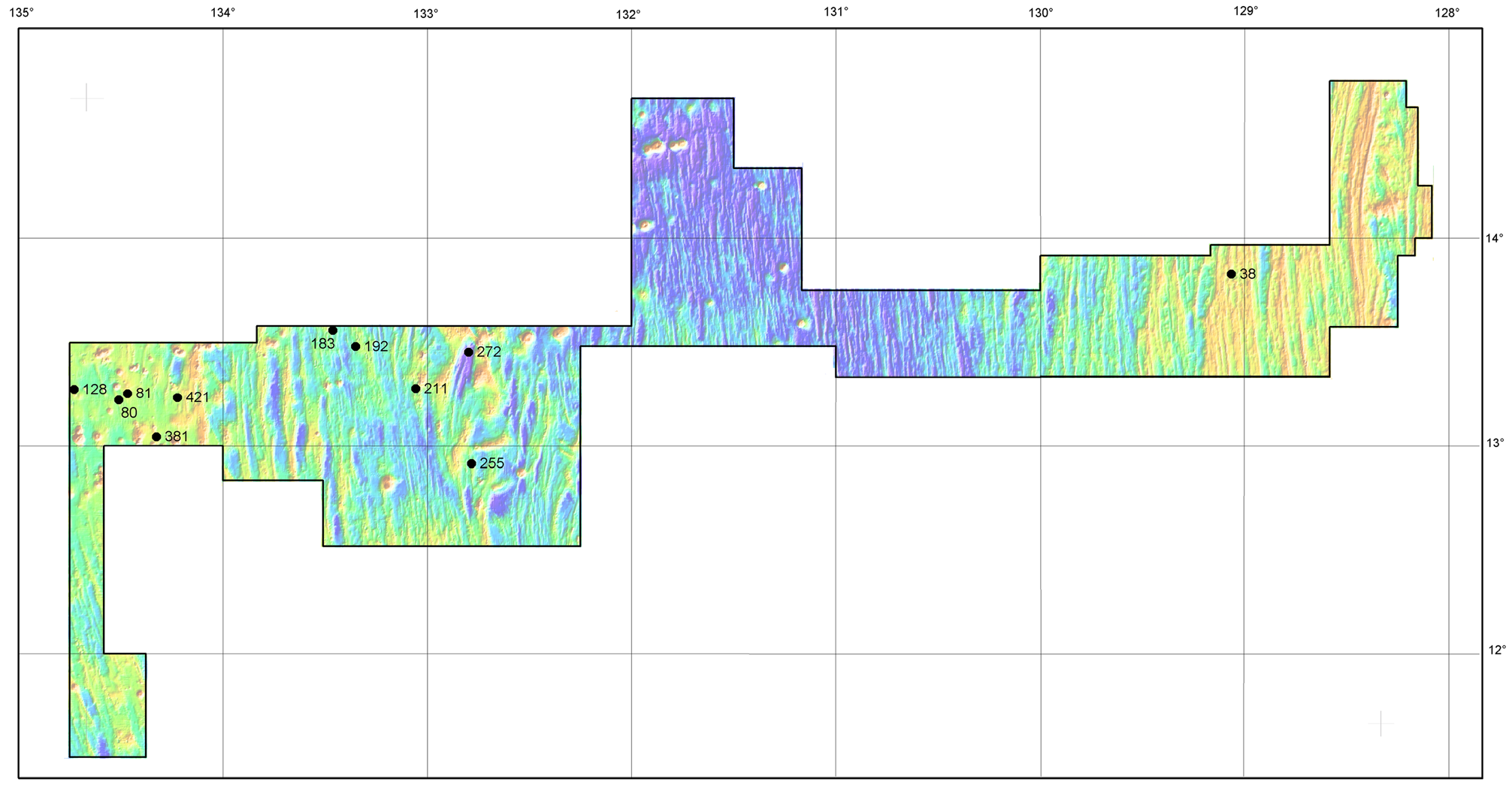
Distribution. The newly obtained holotype colony was collected from 13.23408 ° N, 134.22180 ° W at 4809 m. Overall, Vasopora ceramica n. gen., n. sp. so far occurs only within the Russian exploration area of the Clarion – Clipperton Fracture Zone from eleven stations (Fig. 1), bounded by coordinates 12.91588 – 13.82842 ° N, 129.06438 – 134.73936 ° W, at 4725 – 5280 m depth.
Vasopora ceramica n. gen., n. sp. - a new abyssal cyclostome bryozoan from polymetallic nodules in the Russian exploration area, Clarion-Clipperton Fracture Zone, eastern Pacific Ocean
Etymology. Latinized form of Greek keramos, ceramic, alluding to the very smooth, glabrous surface of the colony stalk (column), resembling the surface of a ceramic vase. Gender feminine.
Vasopora ceramica n. gen., n. sp. - a new abyssal cyclostome bryozoan from polymetallic nodules in the Russian exploration area, Clarion-Clipperton Fracture Zone, eastern Pacific Ocean
Material examined. Holotype: ZIRAS 1 / 50740, colony attached to nodule particle, YMG R. V. Gelendzhik cruise GLD 4 – 19, Stn 421, 8 February 2021, 13.23408 ° N, 134.22180 ° W, 4809 m. Paratype 1: ZIRAS 2 / 50738, colony (‘ colony 1 ’ in Grischenko et al. 2018, p. 55, figs 36 A, B, 37 A, D, F, G), attached to nodule particle, YMG R. V. Gelendzhik cruise GLD 4 – 11, Stn 211, 21 April 2012, 13.27820 ° N, 133.05707 ° W, 4846 m. Paratype 2: ZIRAS 3 / 50739, colony (‘ colony 2 ’ in Grischenko et al. 2018, p. 55, figs 36 C, D, 37 B, C, E, H, I), attached to nodule particle, YMG R. V. Gelendzhik cruise GLD 4 – 12, Stn 255, 8 April 2013, 12.91588 ° N, 132.78325 ° W, 4801 m. Additional material: YMG 18 – 01, Stn 38; YMG 4 – 06, Stns 80, 81; YMG 4 – 07, Stn 128; GLD 4 – 09, Stns 183, 192; GLD 4 – 12, Stn 272; YMG 4 – 17, Stn 381; GLD 4 – 19, Stn 421. Total specimens examined eleven.
Vasopora ceramica n. gen., n. sp. - a new abyssal cyclostome bryozoan from polymetallic nodules in the Russian exploration area, Clarion-Clipperton Fracture Zone, eastern Pacific Ocean

Export occurrence data

Darwin Core Archive (ZIP)

CLASSIFICATION

Taxonomic Classification Tree

MULTIMEDIA

Media Files(4)

FIGURE 1. The eastern Russian exploration area of the CCFZ, with depth intervals ranging from 4510 m (orange) to 5280 m (purplish-blue), showing sampling stations for Vasopora ceramica n. gen., n. sp.
Imageimage/png© Grischenko, Andrei V.;Gordon, Dennis P.;Melnik, Viacheslav P.Vasopora ceramica n. gen., n. sp. - a new abyssal cyclostome bryozoan from polymetallic nodules in the Russian exploration area, Clarion-Clipperton Fracture Zone, eastern Pacific Ocean

FIGURE 2. Vasopora ceramica n. gen., n. sp. Holotype, ZIRAS 1/50740. A–D, rotational views of fertile colony; E, capitulum with centrally located incubation chamber, covered and surrounded by network of ridges and alveoli, with radially arranged autozooidal peristomes at periphery; F, oblique view of colony attached to nodule particle; G, center to margin of capitulum, showing distal half of incubation chamber with ooeciopore, with trabecular ridges in-between, and connecting peristomes with gonozooid, encircling deep alveoli; H, gonozooid with numerous irregular pores within shallow alveoli on roof surface, surrounded by dense network of tuberculated ridges defining deep marginal alveoli; I–L, rotational views of gonozooid: I, distal, J, lateral, K, distolateral, and L, back-side view; note continuous cover of thick ridges, connected to trabecular network around peristomes; M, N, frontal and distal views of ooeciopore, respectively; O, close-up of L, showing shallow alveolus and coarse surface; P, enlargement of trabeculate ridge margin, showing imbricated foliated fabric of wedge-shaped crystallites; Q, enlargement of gonozooid wall, showing pore surrounded by wedge-shaped crystallites. Scale bars: A–F, 250 µm; G–L, 100 µm; M, N, 50 µm; O, P, 25 µm; Q, 5 µm.
Imageimage/png© Grischenko, Andrei V.;Gordon, Dennis P.;Melnik, Viacheslav P.Vasopora ceramica n. gen., n. sp. - a new abyssal cyclostome bryozoan from polymetallic nodules in the Russian exploration area, Clarion-Clipperton Fracture Zone, eastern Pacific Ocean

FIGURE 3. Vasopora ceramica n. gen., n. sp. Holotype, ZIRAS 1/50740. A–C, rotational views of capitulum; D, lateral view of capitulum periphery, showing relatively short, radially arranged peristomes connected with trabeculate network defining alveoli and extrazooidal spaces; E, frontal view of half the capitulum, showing distal third of gonozooid connected with marginal peristomes by narrow vertical ridges/trabeculae; F, oblique view of autozooidal peristome and aperture, showing dense spinose granulation of interior surfaces and less evident sparse tubercules on exterior; G, autozooidal peristome surrounded by alveoli and extrazooidal spaces; H, side-view of capitulum margin with peristomes surrounded by alveoli and extrazooidal spaces; note densely spinulate to granular surface of all capitulum structures contrasting with smooth surface of outer rim and column; I, vertical view of autozooidal aperture with dense spinose granulation around internal margin; J, frontal view of zooidal peristome with thin parallel ridges (continuations of spine-like marginal processes) and sparse circular communication pores on coarse tuberculated surface; K, enlargement of J, showing distal third of peristome with partially abraded/broken margin; L, close-up of K, showing irregularly-shaped crystallites flanking peristomial ridge and surrounding communication pores; M, close-up of J, showing basal part of peristome with imbricated foliated fabric of wedge-shaped crystallites; N, basal region of column, showing its smooth surface; note undulating basal margin of column, following micro-relief irregularities along attachment to substratum; O, enlargement of column surface, showing planar-spherulitic fabric of closely appressed acicular crystallites. Scale bars: A–C, 250 µm; D, E, G, H, N, 100 µm; F, I–K, 50 µm; L, M, O, 25 µm.
Imageimage/png© Grischenko, Andrei V.;Gordon, Dennis P.;Melnik, Viacheslav P.Vasopora ceramica n. gen., n. sp. - a new abyssal cyclostome bryozoan from polymetallic nodules in the Russian exploration area, Clarion-Clipperton Fracture Zone, eastern Pacific Ocean

FIGURE 4. Vasopora ceramica n. gen., n. sp. Specimen YMG4–17, Stn 381. A, general view of ancestrular colony with three mature zooids, attached to nodule particle, fractured along expanded base; B, base of colony, showing protoecial dome (central zooid with own basal wall) with ancestrular peristome emerging from its apex, and first daughter zooid also originating from protoecium laterally (precise place of its communication pore outside plane of section); note elongated marginal, radially arranged trabeculae separating tubular extrazooidal alveolar spaces and kenozooid-like chambers; C, same, tilted forward; note shortened trabeculae delineating oval to cubical kenozooid-like chambers, surrounding ancestrular peristome with first daughter zooid in arch-like pattern; D, enlargement of protoecial dome with ancestrular peristome emerging from its entire roof and first daughter zooid also originating from protoecium laterally; E, same, tilted forward; F, detail of protoecial dome. Scale bars: A, 250 µm; B, C, 100 µm; D–F, 50 µm.

Imageimage/png© Grischenko, Andrei V.;Gordon, Dennis P.;Melnik, Viacheslav P.Vasopora ceramica n. gen., n. sp. - a new abyssal cyclostome bryozoan from polymetallic nodules in the Russian exploration area, Clarion-Clipperton Fracture Zone, eastern Pacific Ocean

IMAGES

Gallery(4)

See Gallery

Occurrences with images

CITATIONS

References(1)

  • 1

    Grischenko, A. V.; Gordon, D. P.; Melnik, V. P. (2021). Vasopora ceramica n. gen., n. sp.—a new abyssal cyclostome bryozoan from polymetallic nodules in the Russian exploration area, Clarion–Clipperton Fracture Zone, eastern Pacific Ocean. <em>Zootaxa.</em> 5047(4): 444-452.

    original descriptionWorld Register of Marine Species
  • Source Information

    GBIF Backbone Taxonomy

    GBIF Backbone Taxonomy

    checklist

    The GBIF Backbone Taxonomy is a single, synthetic management classification with the goal of covering all names GBIF is dealing with. It's the taxonomic backbone that allows GBIF to integrate name based information from different resources, no matter if these are occurrence datasets, species pages, names from nomenclators or external sources like EOL, Genbank or IUCN. This backbone allows taxonomic search, browse and reporting operations across all those resources in a consistent way and to provide means to crosswalk names from one source to another.

    It is updated regulary through an automated process in which the Catalogue of Life acts as a starting point also providing the complete higher classification above families. Additional scientific names only found in other authoritative nomenclatural and taxonomic datasets are then merged into the tree, thus extending the original catalogue and broadening the backbones name coverage. The GBIF Backbone taxonomy also includes identifiers for Operational Taxonomic Units (OTUs) drawn from the barcoding resources iBOL and UNITE.

    International Barcode of Life project (iBOL), Barcode Index Numbers (BINs). BINs are connected to a taxon name and its classification by taking into account all names applied to the BIN and picking names with at least 80% consensus. If there is no consensus of name at the species level, the selection process is repeated moving up the major Linnaean ranks until consensus is achieved.

    UNITE - Unified system for the DNA based fungal species, Species Hypotheses (SHs). SHs are connected to a taxon name and its classification based on the determination of the RefS (reference sequence) if present or the RepS (representative sequence). In the latter case, if there is no match in the UNITE taxonomy, the lowest rank with 100% consensus within the SH will be used.

    The GBIF Backbone Taxonomy is available for download at https://hosted-datasets.gbif.org/datasets/backbone/ in different formats together with an archive of all previous versions.

    The following 105 sources have been used to assemble the GBIF backbone with number of names given in brackets:

    • Catalogue of Life Checklist - 4766428 names
    • International Barcode of Life project (iBOL) Barcode Index Numbers (BINs) - 635951 names
    • UNITE - Unified system for the DNA based fungal species linked to the classification - 611208 names
    • The Paleobiology Database - 212054 names
    • World Register of Marine Species - 188857 names
    • The Interim Register of Marine and Nonmarine Genera - 183894 names
    • The World Checklist of Vascular Plants (WCVP) - 131891 names
    • GBIF Backbone Taxonomy - 114350 names
    • TAXREF - 109374 names
    • The Leipzig catalogue of vascular plants - 75380 names
    • ZooBank - 73549 names
    • Integrated Taxonomic Information System (ITIS) - 68377 names
    • Plazi.org taxonomic treatments database - 61346 names
    • Genome Taxonomy Database r207 - 60545 names
    • International Plant Names Index - 52329 names
    • Fauna Europaea - 45077 names
    • The National Checklist of Taiwan (Catalogue of Life in Taiwan, TaiCoL) - 36193 names
    • Dyntaxa. Svensk taxonomisk databas - 35892 names
    • The Plant List with literature - 32692 names
    • United Kingdom Species Inventory (UKSI) - 29643 names
    • Artsnavnebasen - 29208 names
    • The IUCN Red List of Threatened Species - 21221 names
    • Afromoths, online database of Afrotropical moth species (Lepidoptera) - 13961 names
    • Brazilian Flora 2020 project - Projeto Flora do Brasil 2020 - 13829 names
    • Prokaryotic Nomenclature Up-to-Date (PNU) - 10079 names
    • Checklist Dutch Species Register - Nederlands Soortenregister - 8814 names
    • ICTV Master Species List (MSL) - 7852 names
    • Cockroach Species File - 6020 names
    • GRIN Taxonomy - 5882 names
    • Taxon list of fungi and fungal-like organisms from Germany compiled by the DGfM - 4570 names
    • Catalogue of Afrotropical Bees - 3623 names
    • Catalogue of Tenebrionidae (Coleoptera) of North America - 3327 names
    • Checklist of Beetles (Coleoptera) of Canada and Alaska. Second Edition. - 3312 names
    • Systema Dipterorum - 2850 names
    • Catalogue of the Pterophoroidea of the World - 2807 names
    • The Clements Checklist - 2675 names
    • Taxon list of Hymenoptera from Germany compiled in the context of the GBOL project - 2496 names
    • IOC World Bird List, v13.2 - 2366 names
    • Official Lists and Indexes of Names in Zoology - 2310 names
    • National checklist of all species occurring in Denmark - 1922 names
    • Myriatrix - 1876 names
    • Database of Vascular Plants of Canada (VASCAN) - 1822 names
    • Taxon list of vascular plants from Bavaria, Germany compiled in the context of the BFL project - 1771 names
    • Orthoptera Species File - 1742 names
    • A list of the terrestrial fungi, flora and fauna of Madeira and Selvagens archipelagos - 1602 names
    • Aphid Species File - 1565 names
    • World Spider Catalog - 1561 names
    • Taxon list of Jurassic Pisces of the Tethys Palaeo-Environment compiled at the SNSB-JME - 1270 names
    • Backbone Family Classification Patch - 1143 names
    • GBIF Algae Classification - 1100 names
    • International Cichorieae Network (ICN): Cichorieae Portal - 975 names
    • Psocodea Species File - 803 names
    • New Zealand Marine Macroalgae Species Checklist - 787 names
    • Annotated checklist of endemic species from the Western Balkans - 754 names
    • Taxon list of animals with German names (worldwide) compiled at the SMNS - 503 names
    • Catalogue of the Alucitoidea of the World - 472 names
    • Lygaeoidea Species File - 462 names
    • Catálogo de Plantas y Líquenes de Colombia - 422 names
    • GBIF Backbone Patch - 317 names
    • Phasmida Species File - 259 names
    • Cortinariaceae fetched from the Index Fungorum API - 234 names
    • Coreoidea Species File - 233 names
    • GTDB supplement - 139 names
    • Mantodea Species File - 119 names
    • Endemic species in Taiwan - 93 names
    • Taxon list of Araneae from Germany compiled in the context of the GBOL project - 88 names
    • Species of Hominidae - 78 names
    • Taxon list of Sternorrhyncha from Germany compiled in the context of the GBOL project - 77 names
    • Taxon list of mosses from Germany compiled in the context of the GBOL project - 75 names
    • Mammal Species of the World - 73 names
    • Plecoptera Species File - 71 names
    • Species Fungorum Plus - 64 names
    • Catalogue of the type specimens of Cosmopterigidae (Lepidoptera: Gelechioidea) from research collections of the Zoological Institute, Russian Academy of Sciences - 47 names
    • Species named after famous people - 41 names
    • Dermaptera Species File - 36 names
    • Taxon list of Trichoptera from Germany compiled in the context of the GBOL project - 34 names
    • True Fruit Flies (Diptera, Tephritidae) of the Afrotropical Region - 33 names
    • Range and Regularities in the Distribution of Earthworms of the Earthworms of the USSR Fauna. Perel, 1979 - 32 names
    • Taxon list of Diplura from Germany compiled in the context of the GBOL project - 30 names
    • Lista de referencia de especies de aves de Colombia - 2022 - 24 names
    • Taxon list of Auchenorrhyncha from Germany compiled in the context of the GBOL project - 20 names
    • Catalogue of the type specimens of Polycestinae (Coleoptera: Buprestidae) from research collections of the Zoological Institute, Russian Academy of Sciences - 19 names
    • Taxon list of Thysanoptera from Germany compiled in the context of the GBOL project - 19 names
    • Lista de especies de vertebrados registrados en jurisdicción del Departamento del Huila - 18 names
    • Taxon list of Microcoryphia (Archaeognatha) from Germany compiled in the context of the GBOL project - 15 names
    • Catalogue of the type specimens of Bufonidae and Megophryidae (Amphibia: Anura) from research collections of the Zoological Institute, Russian Academy of Sciences - 12 names
    • Grylloblattodea Species File - 11 names
    • Coleorrhyncha Species File - 9 names
    • Taxon list of liverworts from Germany compiled in the context of the GBOL project - 9 names
    • Embioptera Species File - 7 names
    • Taxon list of Pisces and Cyclostoma from Germany compiled in the context of the GBOL project - 6 names
    • Taxon list of Pteridophyta from Germany compiled in the context of the GBOL project - 6 names
    • Taxon list of Siphonaptera from Germany compiled in the context of the GBOL project - 5 names
    • The Earthworms of the Fauna of Russia. Perel, 1997 - 5 names
    • Taxon list of Zygentoma from Germany compiled in the context of the GBOL project - 4 names
    • Asiloid Flies: new taxa of Diptera: Apioceridae, Asilidae, and Mydidae - 3 names
    • Taxon list of Protura from Germany compiled in the context of the GBOL project - 3 names
    • Taxon list of hornworts from Germany compiled in the context of the GBOL project - 2 names
    • Chrysididae Species File - 1 names
    • Taxon list of Dermaptera from Germany compiled in the context of the GBOL project - 1 names
    • Taxon list of Diplopoda from Germany in the context of the GBOL project - 1 names
    • Taxon list of Orthoptera (Grashoppers) from Germany compiled at the SNSB - 1 names
    • Taxon list of Pscoptera from Germany compiled in the context of the GBOL project - 1 names
    • Taxon list of Pseudoscorpiones from Germany compiled in the context of the GBOL project - 1 names
    • Taxon list of Raphidioptera from Germany compiled in the context of the GBOL project - 1 names

    GBIF Secretariat (2023). GBIF Backbone Taxonomy. Checklist dataset https://doi.org/10.15468/39omei accessed via GBIF.org on 2026-06-14.

    CC BYPublished 8/28/2023View dataset
    GBIF Usage Key
    11376411
    Dataset Key
    d7dddbf4-2cf0-4f39-9b2a-bb099caae36c
    Origin
    source
    Backbone Key
    11376411
    Taxon ID
    gbif:11376411
    Last Crawled
    8/22/2023
    Last Interpreted
    8/22/2023