
AnimaliaNot EvaluatedacceptedspeciesAccepted
Andrias jiangxiensis

Andrias jiangxiensis

Jiangxi giant salamander(+6)·Chai, Lu, Yi, Dai, Weng, Di, Peng, Tang, Shan, Wang, Liu, Zhao, Jin, Cao, Lu, Luo, Murphy, Zhang & Che, 2022

GBIF:11563118

0year

PROFILE

Species Profile

Characteristics

Extant

ABOUT

Descriptions(9)

Conservation: Our long-term field monitoring of A. jiangxiensis sp. nov. yielded only a single incident of a breeding, wild population in the protected area at Daqi Mountain, Jing’an County. This protected area has a riverine habitat of only 6.50 km in linear distance and 36.0 km 2 of area. The upstream water runs inconstantly throughout the year, as flash floods occur occasionally in summer and droughts often occur in the winter, which lead to frequent habitat fragmentations. The downstream habitat out of the nature reserve is blocked by a dam and is inhabitable to A. jiangxiensis sp. nov. due to anthropogenic activities. This small, isolated, and sometimes fragmented population is particularly vulnerable to environmental changes, and thus the species faces a great extinction threat. Therefore, following the IUCN criteria B 1 (extent of occurrence less than 100 km 2, known to exist at only a single location, and extreme fluctuation of extent of occurrence) (IUCN, 2012), we recommend to classify A. jiangxiensis sp. nov. as Critically Endangered (CR), and we recommend to list the species as Class II protected in China, and to implement further assessments.
Discovery of a wild, genetically pure Chinese giant salamander creates new conservation opportunities.
(Figure 4; Supplementary Table S 4)
Discovery of a wild, genetically pure Chinese giant salamander creates new conservation opportunities.
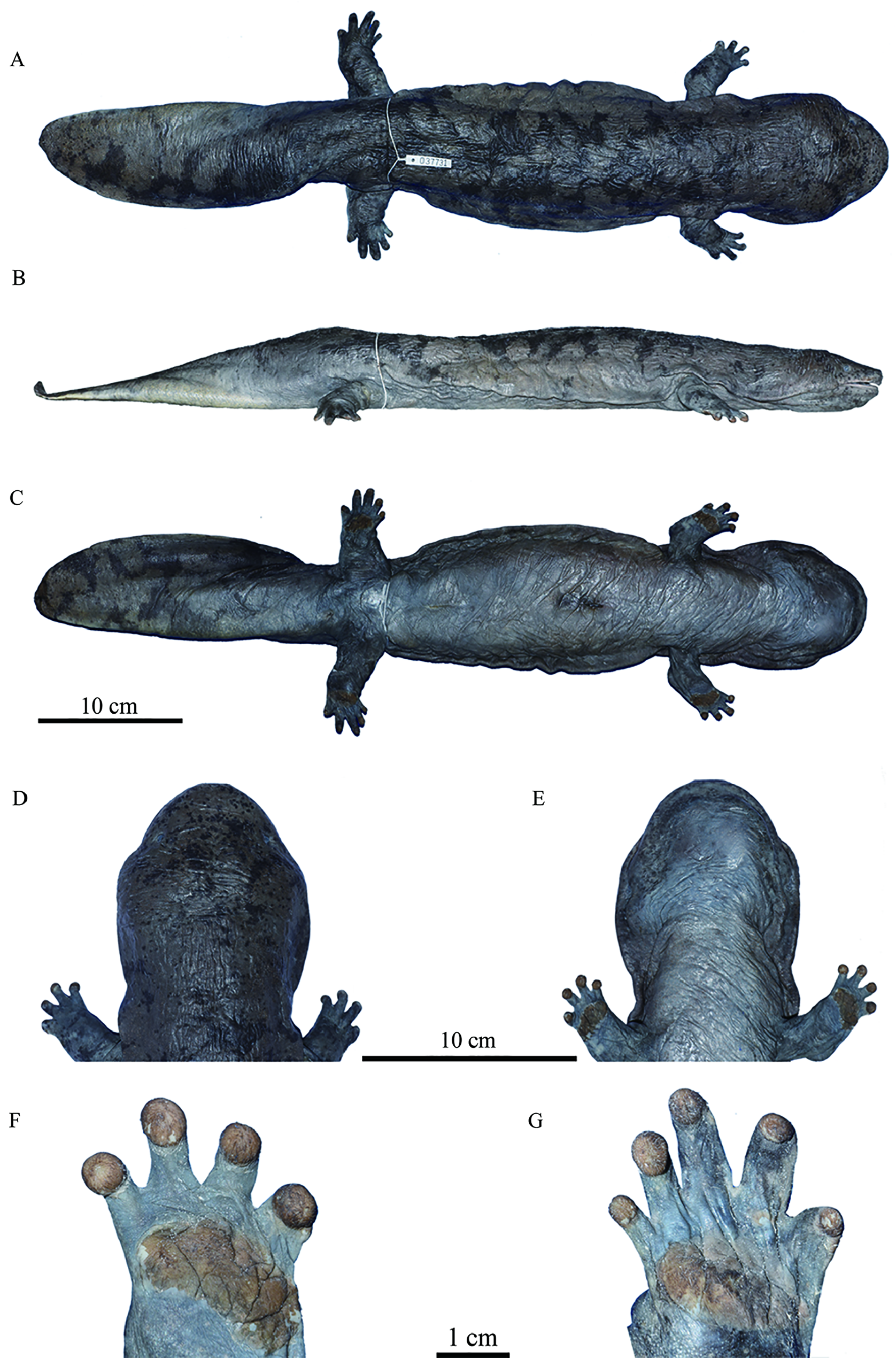
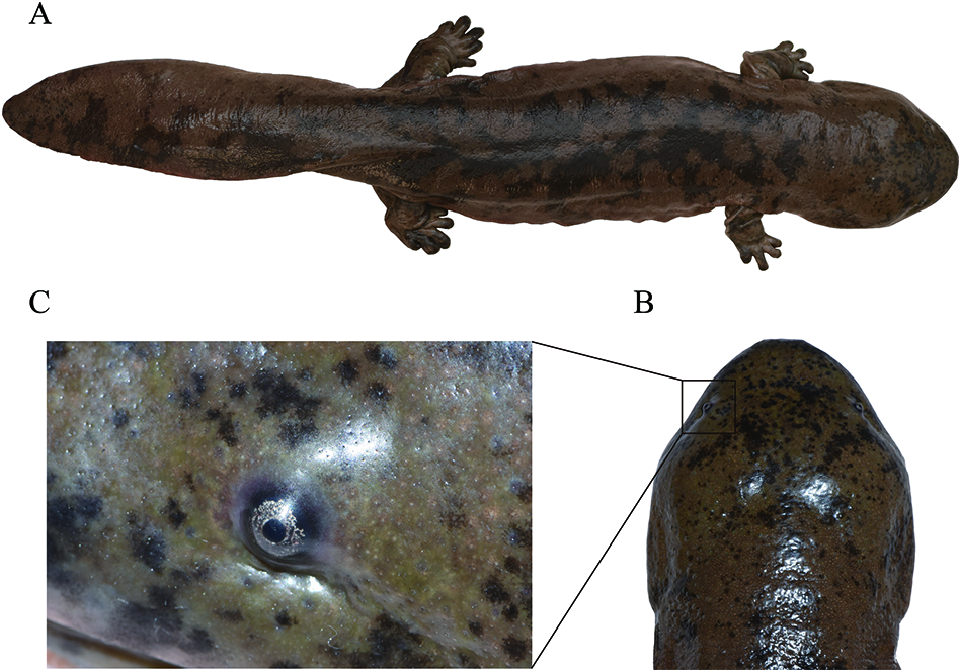
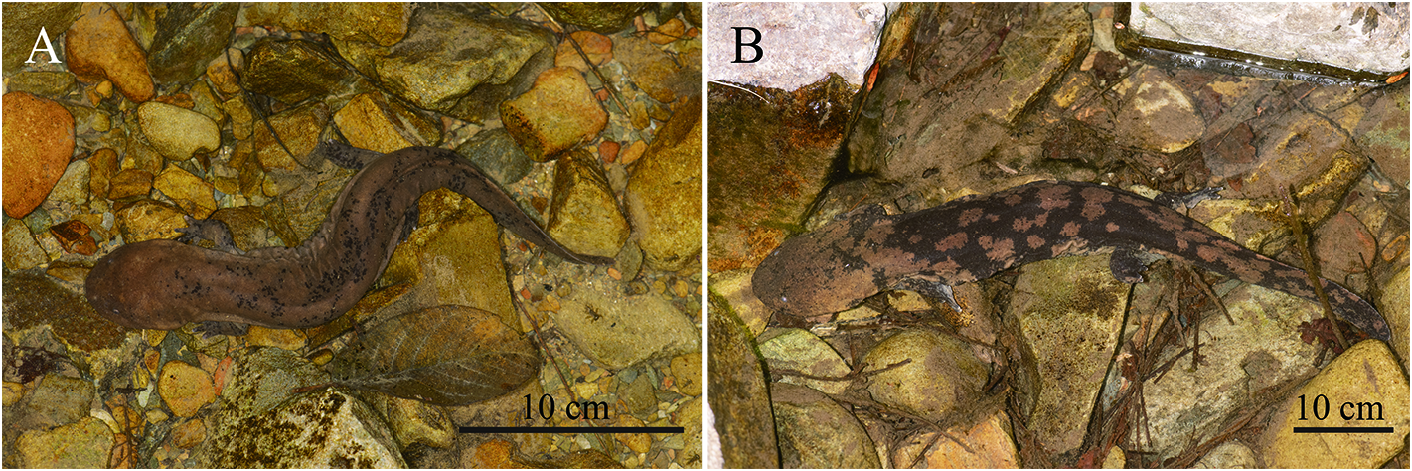
Description of holotype: Adult male, body size relatively small, SVL 381 mm, TTL 589 mm; tail muscular, thick at base, gradually flattening posteriorly and distally; dorsal fin well developed, ventral fin much reduced, maximum tail height 76.2 mm; tail short, TAL 208 mm, TAL 54.6 % SVL, 35.3 % TTL. Head dorsally compressed, wide, HL 102 % HW; snout truncated, blunt, widen gradually posteriorly, projecting beyond lower jaw in ventral view; jaw muscular, distinctively widen from snout; jaw muscles continuous with two ovoid, convex temporal muscles dorsally posterior to each eye; nostrils small, NL 1.5 mm, anteriorly and laterally positioned, eye – nare distance 27.6 mm. Eyes small, rounded, EL 4.2 mm, 2.8 times NL, protuberant in life, lacking eyelids; dorsolaterally positioned, wide apart, IND 31.6 % IOD, EL 44.2 % SOD. Mouth large, corner almost reaching mid temporal protuberances; supralabial fold distinct; extending from posterior edge of mouth to axillary. Skin of head and lower jaw mostly smooth with small tubercles scattered dorsolaterally on temporal head and neck in life, all distributed irregularly, gradually increasing in numbers posteriorly; tubercles indistinct after preservation. Transverse gular fold present, without distinct glands. Body robust, dorsally compressed but less than head, elongated, AXD 34.1 % TTL; costal grooves in life, less distinct after preservation; vertebral groove distinct on posterior 3 / 4 of body; neck fold strongly developed, from corner of mouth to posterosuperior axillary; lateral body folds strongly developed, anterior end inferior and discontinuous from neck fold at limb insertion point, extending to caudal base; single dorsolateral series of large tubercles just above base of lateral fold on each side of vertebrate from neck to caudal base, more distinct in life, barely visible after preservation; remaining body skin mostly smooth in life. Limbs short, robust, dorsoventrally compressed, with distinct lateral skin folds, more prominent on posterior limbs; hindlimbs relatively longer and stronger than forelimbs, FLL 10 % TTL, PLL 12 % TTL. Hands and feet dorsally compressed, finger and toe tips enlarged, rounded; finger and toe tips and ventral hands and feet covered with dark carotin layer; four fingers, no webbing, length formula II> III> I> IV, lateral skin fringe distinct on finger IV, continuous with lateral limb fold; five toes, with rudimentary webbing, toe length formula III> IV> II> V> I, toe III, IV, and Vwith stronger lateral fringes. Coloration of holotype: In life (Figure 5), dorsum red-brown, with large continuous or discontinuous irregular black patches, gradually decreasing and broken from midbody to head and tail, a few black spots scattered between large patches; ventral surface grayish brown, with black spots scattered along the mandibular margin only; small white spots with tan edge throughout the body; grayish white around eyes, iris gold with black markings. In preservative (Figure 4), bright tints faded, dorsum and abdomen faded to grayish brown and gray, respectively, white spots with tan edge, black patches and spots remain distinct; horny epidermis on tips of fingers and toes as well as palms and soles brown. Variation: No significant differences in morphology and coloration were found among all adult specimens of the type series, or between genders. However, a distinctive ontogenetic shift existed in coloration. Juveniles less than 30 cm long were mostly spotted (Figure 6 A) instead of having larger patches; after exceeding 40 cm, their coloration pattern resembled the type specimens (Figure 6 B).
Discovery of a wild, genetically pure Chinese giant salamander creates new conservation opportunities.
Diagnosis: Andrias jiangxiensis sp. nov. can be distinguished from its congeners by a combination of the following characters: (1) head length almost equal to width; (2) head and lower jaw relatively smooth, with small tubercles arranged irregularly; (3) lateral neck fold discontinuous with body fold at forelimb insertion; (4) finger III distinctly longer than finger I; and (5) dorsum red-brown or yellow-brown in life, with large, irregular black patches. Comparisons: Andrias jiangxiensis sp. nov. can be distinguished from A. japonicus (Temminck, 1836) by having smoother head with indistinct tubercles (vs. dense, distinct, large tubercles). Considering that no population has been genetically identified as both pure A. davidianus and A. sligoi, and that farm-bred individuals exhibit genetic contamination (Yan et al., 2018), to avoid confusion due to translocated animals or hybrids, morphological comparisons are constrained to holotypes only. Specifically, Andrias jiangxiensis sp. nov. differs from A. davidianus (holotype MNHN-RA- 0.7613, images posted on: http: // coldb. mnhn. fr / catalognumber / mnhn / ra / 0.7613) by having a smooth head and lower jaw with indistinct, small, irregularly arranged tubercles (vs. head and lower jaw rough, with distinct, regularly arranged tubercles); from A. sligoi (holotype BMNH 1945.11.7.1., images in Turvey et al. (2019 )) by having a smooth skin on the snout and around eyes (vs. with numerous distinct tubercles), and a distinct finger length formula (finger III distinctly longer than finger I vs. finger III equal to finger I).
Discovery of a wild, genetically pure Chinese giant salamander creates new conservation opportunities.
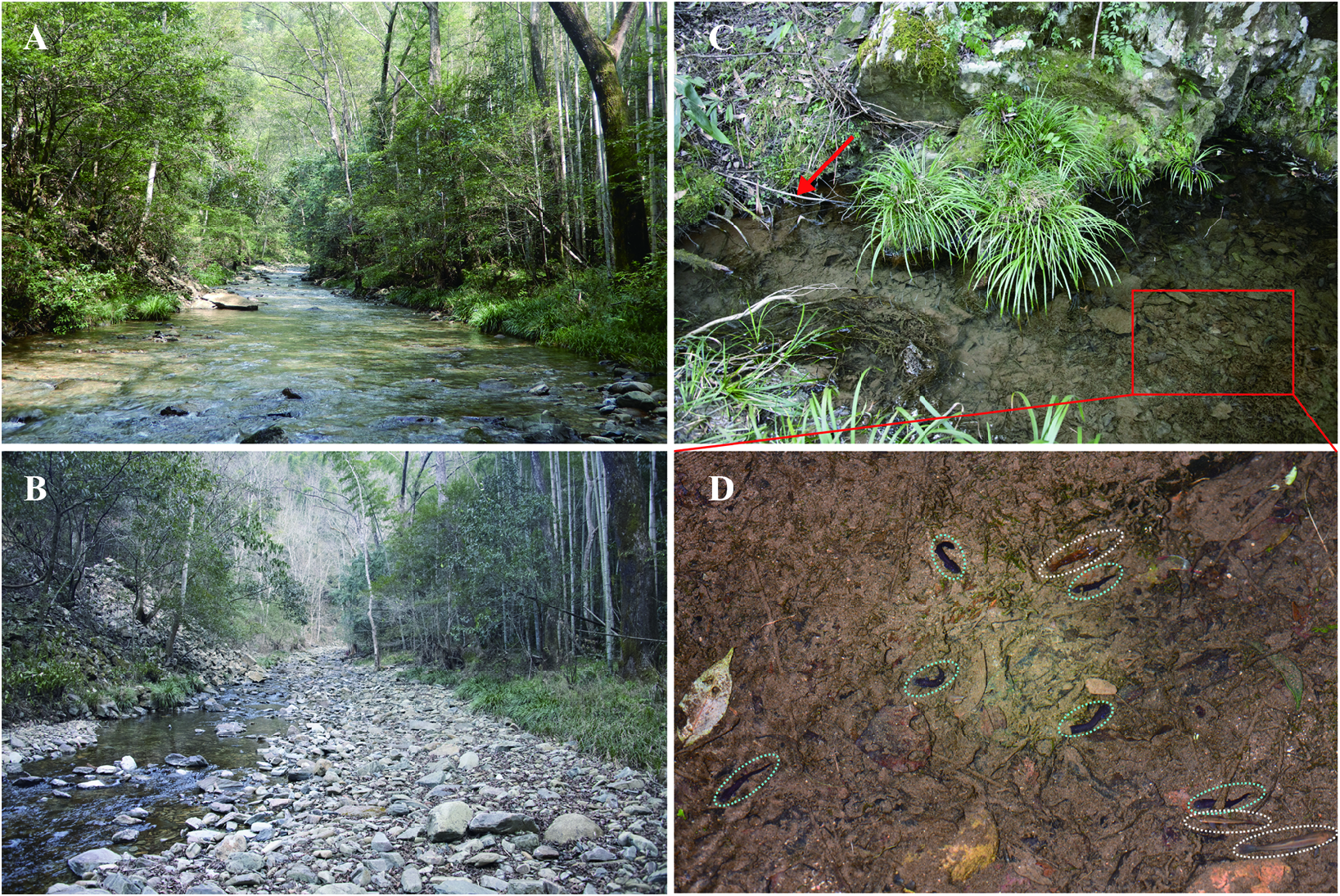
During the field surveys from September 2020 to March 2022, over 291 wild individuals of adults and juveniles were found in medium-sized, pristine mountain streams with 8 – 10 m wide, water depth 0.1 – 1.5 m, and with rocky substrate (Figure 7 A, B). Many natural caves formed by fallen wood, tree roots and cracks among rocks on both sides of streams provide hiding places for the new species. As a nocturnal species, A. jiangxiensis sp. nov. forages at night. Dorsal color patterning makes it blend well with the rocks at the bottom of the stream, making it difficult to find in flowing water. Vomit and excrement analyses of five wild individuals in July 2021 revealed fish, frogs, aquatic insects, and crustaceans in the natural diet. Two breeding caves were found in a backwater bay of the stream in January 2021 (Figure 7 C, D) and January 2022. A large number of larvae gathered at the entrance, emerging most likely two months after hatching (Figure 7 C, D). Larvae sightings peaked in February and exceeded 100 individuals per day. This continued until March, when no more new larvae emerged from the cave, and the larvae outside began to scatter throughout the stream. Combined with a questionnaire to local giant salamander farmers, we speculate that the breeding season of A. jiangxiensis sp. nov. occurs in mid-September.
Discovery of a wild, genetically pure Chinese giant salamander creates new conservation opportunities.
Local cultural values: Local cultural pride might have contributed positively to the conservation of indigenous species. Interviews near the survey sites found that most people did not often eat CGS, although nine out of 50 persons had eaten CGS one or two times from curiosity. Six of the 50 interviewed people in Jing’an County, including the towns Guanzhuang and Zhongyuan, could distinguish between the indigenous and introduced CGS species by the shape of head and coloration of adults. They proudly said the indigenous species is “ more beautiful ” than others (Supplementary Dataset S 1); one person described the indigenous species as having a smoother head without tubercles. This differed from negative cultural views of CGS reported in Shaanxi (Cunningham et al., 2016), indicating diverse cultural values across China. We interviewed the owners of two small-scale farms adjacent to the field survey sites, which have existed for years (Supplementary Dataset S 1). They did not cease activities following the dramatic slide in CGS prices from 3 000 RMB / kg (US $ 470 / kg) (Cheng & Zhang, 2015; Shu et al., 2021) to 60 RMB / kg ($ 9 / kg) after 2015. They had refused to use outside sources of CGS (Supplementary Dataset S 1), even during the “ salamander rush ” involving large-scale salamander trading. Such small-scale farms in remote montane villages may be more likely to preserve purebred indigenous lineages than large commercial farms that frequently introduce and sell animals of unknown provenance. They can serve as effective targets for genetic screening, and as reservoirs for potential future population augmentation programs which should such be deemed necessary.
Discovery of a wild, genetically pure Chinese giant salamander creates new conservation opportunities.
Distribution and natural history: Questionnaires with local residents suggest that this species was densely distributed in two towns of Jing’an County before the 1990 s. Due to commercial breeding, some indigenous purebred individuals served as breed stock in some local small farms. According to our field monitoring, the wild population of this species appears to occur only in Jiulingshan National Nature Reserve. This protected area contains intact habitat, including forested mountains and streams without villages and human activities. It also contains a diversity of teleosts, amphibians, non-avian reptiles, birds and a few mammals.
Discovery of a wild, genetically pure Chinese giant salamander creates new conservation opportunities.
Etymology: The specific epithet “ jiangxiensis ” refers to the type locality of the new species in Jiangxi, China. It denotes the endemicity of the new species to Jiangxi based on our detailed population surveys. We suggest Jiangxi Giant Salamander as its English common name, and Ữ & 大 ª (Pinyin: Jiāng Xī Dà Ní) as its Chinese common name.
Discovery of a wild, genetically pure Chinese giant salamander creates new conservation opportunities.
Holotype: KIZ 037731, adult male (Figure 4), ex situ from first generation of offspring of the wild-caught parents, which were collected in Guanzhuang Township, Jing’an County, Jiangxi, China. Paratypes: KIZ 037728, 037730 (adult females), KIZ 037729 (adult male), all with the same collection information as the holotype.
Discovery of a wild, genetically pure Chinese giant salamander creates new conservation opportunities.

Export occurrence data

Darwin Core Archive (ZIP)

Common names used for this species across different languages and regions. Available in 6 languages.

engJiangxi giant salamanderengfraSalamandre géante du Jiangxifrahuncsianghszi óriásszalamandrahunaraسلمندر جيانغشي العملاقaraaraسمندل جيانغشي العملاقara+2 more

Vernacular (common) names are the everyday names used for a species in different languages and regions. A single species may have dozens of common names worldwide. This taxon has names in 6 languages.

engJiangxi giant salamander
eng
Source: Catalogue of LifeSource taxon #288561487
fraSalamandre géante du Jiangxi
fra
Source: Catalogue of LifeSource taxon #288561487
huncsianghszi óriásszalamandra
hun
Source: Catalogue of LifeSource taxon #288561487
araسلمندر جيانغشي العملاق
ara
Source: Catalogue of LifeSource taxon #288561487
araسمندل جيانغشي العملاق
ara
Source: Catalogue of LifeSource taxon #288561487
zho江西大鲵
zho
Source: Catalogue of LifeSource taxon #288561487
kor장시장수도롱뇽
kor
Source: Catalogue of LifeSource taxon #288561487

CLASSIFICATION

Taxonomic Classification Tree

MULTIMEDIA

Media Files(4)

Figure 4 Holotype of Andrias jiangxiensis sp. nov. (KIZ 037731) in preservative A–C: Holotype of A. jiangxiensis sp. nov., in dorsal (A), lateral (B), and ventral (C) views. D, E: Dorsal (D) and ventral (E) views of head of holotype of A. jiangxiensis sp. nov. F, G: Ventral view of the left hand (F) and left foot (G) of the holotype of A. jiangxiensis sp. nov. Photos by Chen-Qi Lu.
Imageimage/png© Chai, Jing;Lu, Chen-Qi;Yi, Mu-Rong;Dai, Nian-Hua;Weng, Xiao-Dong;Di, Ming-Xiao;Peng, Yong;Tang, Yong;Shan, Qing-Hua;Wang, Kai;Liu, Huan-Zhang;Zhao, Hai-Peng;Jin, Jie-Qiong;Cao, Ru-Jun;Lu, Ping;Luo, Lai-Chun;Murphy, Robert W;Zhang, Ya-Ping;Che, JingDiscovery of a wild, genetically pure Chinese giant salamander creates new conservation opportunities.

Figure 5 The holotype of Andrias jiangxiensis sp. nov. (KIZ 037731) in life A–C: Coloration of dorsum of whole body (A), head (B), and enlarged view (C) of left periocular area. Photos by Chen-Qi Lu.
Imageimage/png© Chai, Jing;Lu, Chen-Qi;Yi, Mu-Rong;Dai, Nian-Hua;Weng, Xiao-Dong;Di, Ming-Xiao;Peng, Yong;Tang, Yong;Shan, Qing-Hua;Wang, Kai;Liu, Huan-Zhang;Zhao, Hai-Peng;Jin, Jie-Qiong;Cao, Ru-Jun;Lu, Ping;Luo, Lai-Chun;Murphy, Robert W;Zhang, Ya-Ping;Che, JingDiscovery of a wild, genetically pure Chinese giant salamander creates new conservation opportunities.

Figure 6 Ontogenetic variation in coloration pattern A: Coloration of dorsum with spotted pattern in a juvenile with body length of ~20 cm. B: Coloration of dorsum having larger patch patterns in an adult with body length over 50 cm. Photos by Mu-Rong Yi.
Imageimage/png© Chai, Jing;Lu, Chen-Qi;Yi, Mu-Rong;Dai, Nian-Hua;Weng, Xiao-Dong;Di, Ming-Xiao;Peng, Yong;Tang, Yong;Shan, Qing-Hua;Wang, Kai;Liu, Huan-Zhang;Zhao, Hai-Peng;Jin, Jie-Qiong;Cao, Ru-Jun;Lu, Ping;Luo, Lai-Chun;Murphy, Robert W;Zhang, Ya-Ping;Che, JingDiscovery of a wild, genetically pure Chinese giant salamander creates new conservation opportunities.

Figure 7 The habitat of Andrias jiangxiensis sp. nov. in Daqi Mountain, Jing’an County, Jiangxi, China A, B: Summer (A) and winter (B) scene of 8–10 meters-wide stream with excellent vegetation coverage. C: A breeding cave for A. jiangxiensis sp. nov. found in a backwater bay of the stream. Red arrow indicates the exit of the cave. D: Enlarged area near the exit of the cave. Dashed circles in cyan indicate six larvae of A. jiangxiensis sp. nov., and the ones in white indicate the co-occurring shrimps and fishes. Photos by Mu-Rong Yi.

Imageimage/png© Chai, Jing;Lu, Chen-Qi;Yi, Mu-Rong;Dai, Nian-Hua;Weng, Xiao-Dong;Di, Ming-Xiao;Peng, Yong;Tang, Yong;Shan, Qing-Hua;Wang, Kai;Liu, Huan-Zhang;Zhao, Hai-Peng;Jin, Jie-Qiong;Cao, Ru-Jun;Lu, Ping;Luo, Lai-Chun;Murphy, Robert W;Zhang, Ya-Ping;Che, JingDiscovery of a wild, genetically pure Chinese giant salamander creates new conservation opportunities.

IMAGES

Gallery(4)

See Gallery

Occurrences with images

Source Information

GBIF Backbone Taxonomy

GBIF Backbone Taxonomy

checklist

The GBIF Backbone Taxonomy is a single, synthetic management classification with the goal of covering all names GBIF is dealing with. It's the taxonomic backbone that allows GBIF to integrate name based information from different resources, no matter if these are occurrence datasets, species pages, names from nomenclators or external sources like EOL, Genbank or IUCN. This backbone allows taxonomic search, browse and reporting operations across all those resources in a consistent way and to provide means to crosswalk names from one source to another.

It is updated regulary through an automated process in which the Catalogue of Life acts as a starting point also providing the complete higher classification above families. Additional scientific names only found in other authoritative nomenclatural and taxonomic datasets are then merged into the tree, thus extending the original catalogue and broadening the backbones name coverage. The GBIF Backbone taxonomy also includes identifiers for Operational Taxonomic Units (OTUs) drawn from the barcoding resources iBOL and UNITE.

International Barcode of Life project (iBOL), Barcode Index Numbers (BINs). BINs are connected to a taxon name and its classification by taking into account all names applied to the BIN and picking names with at least 80% consensus. If there is no consensus of name at the species level, the selection process is repeated moving up the major Linnaean ranks until consensus is achieved.

UNITE - Unified system for the DNA based fungal species, Species Hypotheses (SHs). SHs are connected to a taxon name and its classification based on the determination of the RefS (reference sequence) if present or the RepS (representative sequence). In the latter case, if there is no match in the UNITE taxonomy, the lowest rank with 100% consensus within the SH will be used.

The GBIF Backbone Taxonomy is available for download at https://hosted-datasets.gbif.org/datasets/backbone/ in different formats together with an archive of all previous versions.

The following 105 sources have been used to assemble the GBIF backbone with number of names given in brackets:

  • Catalogue of Life Checklist - 4766428 names
  • International Barcode of Life project (iBOL) Barcode Index Numbers (BINs) - 635951 names
  • UNITE - Unified system for the DNA based fungal species linked to the classification - 611208 names
  • The Paleobiology Database - 212054 names
  • World Register of Marine Species - 188857 names
  • The Interim Register of Marine and Nonmarine Genera - 183894 names
  • The World Checklist of Vascular Plants (WCVP) - 131891 names
  • GBIF Backbone Taxonomy - 114350 names
  • TAXREF - 109374 names
  • The Leipzig catalogue of vascular plants - 75380 names
  • ZooBank - 73549 names
  • Integrated Taxonomic Information System (ITIS) - 68377 names
  • Plazi.org taxonomic treatments database - 61346 names
  • Genome Taxonomy Database r207 - 60545 names
  • International Plant Names Index - 52329 names
  • Fauna Europaea - 45077 names
  • The National Checklist of Taiwan (Catalogue of Life in Taiwan, TaiCoL) - 36193 names
  • Dyntaxa. Svensk taxonomisk databas - 35892 names
  • The Plant List with literature - 32692 names
  • United Kingdom Species Inventory (UKSI) - 29643 names
  • Artsnavnebasen - 29208 names
  • The IUCN Red List of Threatened Species - 21221 names
  • Afromoths, online database of Afrotropical moth species (Lepidoptera) - 13961 names
  • Brazilian Flora 2020 project - Projeto Flora do Brasil 2020 - 13829 names
  • Prokaryotic Nomenclature Up-to-Date (PNU) - 10079 names
  • Checklist Dutch Species Register - Nederlands Soortenregister - 8814 names
  • ICTV Master Species List (MSL) - 7852 names
  • Cockroach Species File - 6020 names
  • GRIN Taxonomy - 5882 names
  • Taxon list of fungi and fungal-like organisms from Germany compiled by the DGfM - 4570 names
  • Catalogue of Afrotropical Bees - 3623 names
  • Catalogue of Tenebrionidae (Coleoptera) of North America - 3327 names
  • Checklist of Beetles (Coleoptera) of Canada and Alaska. Second Edition. - 3312 names
  • Systema Dipterorum - 2850 names
  • Catalogue of the Pterophoroidea of the World - 2807 names
  • The Clements Checklist - 2675 names
  • Taxon list of Hymenoptera from Germany compiled in the context of the GBOL project - 2496 names
  • IOC World Bird List, v13.2 - 2366 names
  • Official Lists and Indexes of Names in Zoology - 2310 names
  • National checklist of all species occurring in Denmark - 1922 names
  • Myriatrix - 1876 names
  • Database of Vascular Plants of Canada (VASCAN) - 1822 names
  • Taxon list of vascular plants from Bavaria, Germany compiled in the context of the BFL project - 1771 names
  • Orthoptera Species File - 1742 names
  • A list of the terrestrial fungi, flora and fauna of Madeira and Selvagens archipelagos - 1602 names
  • Aphid Species File - 1565 names
  • World Spider Catalog - 1561 names
  • Taxon list of Jurassic Pisces of the Tethys Palaeo-Environment compiled at the SNSB-JME - 1270 names
  • Backbone Family Classification Patch - 1143 names
  • GBIF Algae Classification - 1100 names
  • International Cichorieae Network (ICN): Cichorieae Portal - 975 names
  • Psocodea Species File - 803 names
  • New Zealand Marine Macroalgae Species Checklist - 787 names
  • Annotated checklist of endemic species from the Western Balkans - 754 names
  • Taxon list of animals with German names (worldwide) compiled at the SMNS - 503 names
  • Catalogue of the Alucitoidea of the World - 472 names
  • Lygaeoidea Species File - 462 names
  • Catálogo de Plantas y Líquenes de Colombia - 422 names
  • GBIF Backbone Patch - 317 names
  • Phasmida Species File - 259 names
  • Cortinariaceae fetched from the Index Fungorum API - 234 names
  • Coreoidea Species File - 233 names
  • GTDB supplement - 139 names
  • Mantodea Species File - 119 names
  • Endemic species in Taiwan - 93 names
  • Taxon list of Araneae from Germany compiled in the context of the GBOL project - 88 names
  • Species of Hominidae - 78 names
  • Taxon list of Sternorrhyncha from Germany compiled in the context of the GBOL project - 77 names
  • Taxon list of mosses from Germany compiled in the context of the GBOL project - 75 names
  • Mammal Species of the World - 73 names
  • Plecoptera Species File - 71 names
  • Species Fungorum Plus - 64 names
  • Catalogue of the type specimens of Cosmopterigidae (Lepidoptera: Gelechioidea) from research collections of the Zoological Institute, Russian Academy of Sciences - 47 names
  • Species named after famous people - 41 names
  • Dermaptera Species File - 36 names
  • Taxon list of Trichoptera from Germany compiled in the context of the GBOL project - 34 names
  • True Fruit Flies (Diptera, Tephritidae) of the Afrotropical Region - 33 names
  • Range and Regularities in the Distribution of Earthworms of the Earthworms of the USSR Fauna. Perel, 1979 - 32 names
  • Taxon list of Diplura from Germany compiled in the context of the GBOL project - 30 names
  • Lista de referencia de especies de aves de Colombia - 2022 - 24 names
  • Taxon list of Auchenorrhyncha from Germany compiled in the context of the GBOL project - 20 names
  • Catalogue of the type specimens of Polycestinae (Coleoptera: Buprestidae) from research collections of the Zoological Institute, Russian Academy of Sciences - 19 names
  • Taxon list of Thysanoptera from Germany compiled in the context of the GBOL project - 19 names
  • Lista de especies de vertebrados registrados en jurisdicción del Departamento del Huila - 18 names
  • Taxon list of Microcoryphia (Archaeognatha) from Germany compiled in the context of the GBOL project - 15 names
  • Catalogue of the type specimens of Bufonidae and Megophryidae (Amphibia: Anura) from research collections of the Zoological Institute, Russian Academy of Sciences - 12 names
  • Grylloblattodea Species File - 11 names
  • Coleorrhyncha Species File - 9 names
  • Taxon list of liverworts from Germany compiled in the context of the GBOL project - 9 names
  • Embioptera Species File - 7 names
  • Taxon list of Pisces and Cyclostoma from Germany compiled in the context of the GBOL project - 6 names
  • Taxon list of Pteridophyta from Germany compiled in the context of the GBOL project - 6 names
  • Taxon list of Siphonaptera from Germany compiled in the context of the GBOL project - 5 names
  • The Earthworms of the Fauna of Russia. Perel, 1997 - 5 names
  • Taxon list of Zygentoma from Germany compiled in the context of the GBOL project - 4 names
  • Asiloid Flies: new taxa of Diptera: Apioceridae, Asilidae, and Mydidae - 3 names
  • Taxon list of Protura from Germany compiled in the context of the GBOL project - 3 names
  • Taxon list of hornworts from Germany compiled in the context of the GBOL project - 2 names
  • Chrysididae Species File - 1 names
  • Taxon list of Dermaptera from Germany compiled in the context of the GBOL project - 1 names
  • Taxon list of Diplopoda from Germany in the context of the GBOL project - 1 names
  • Taxon list of Orthoptera (Grashoppers) from Germany compiled at the SNSB - 1 names
  • Taxon list of Pscoptera from Germany compiled in the context of the GBOL project - 1 names
  • Taxon list of Pseudoscorpiones from Germany compiled in the context of the GBOL project - 1 names
  • Taxon list of Raphidioptera from Germany compiled in the context of the GBOL project - 1 names

GBIF Secretariat (2023). GBIF Backbone Taxonomy. Checklist dataset https://doi.org/10.15468/39omei accessed via GBIF.org on 2026-06-14.

CC BYPublished 8/28/2023View dataset
GBIF Usage Key
11563118
Dataset Key
d7dddbf4-2cf0-4f39-9b2a-bb099caae36c
Origin
source
Backbone Key
11563118
Taxon ID
gbif:11563118
Last Crawled
8/22/2023
Last Interpreted
8/22/2023