
AnimaliaNot EvaluatedacceptedspeciesAccepted
Carpocladus fertilis

Carpocladus fertilis

Vervoort & Watson, 2003

GBIF:2267437

0countries
0year

0

Synonyms

PROFILE

Species Profile

Habitat

Marine

Characteristics

Extant

ABOUT

Descriptions(5)

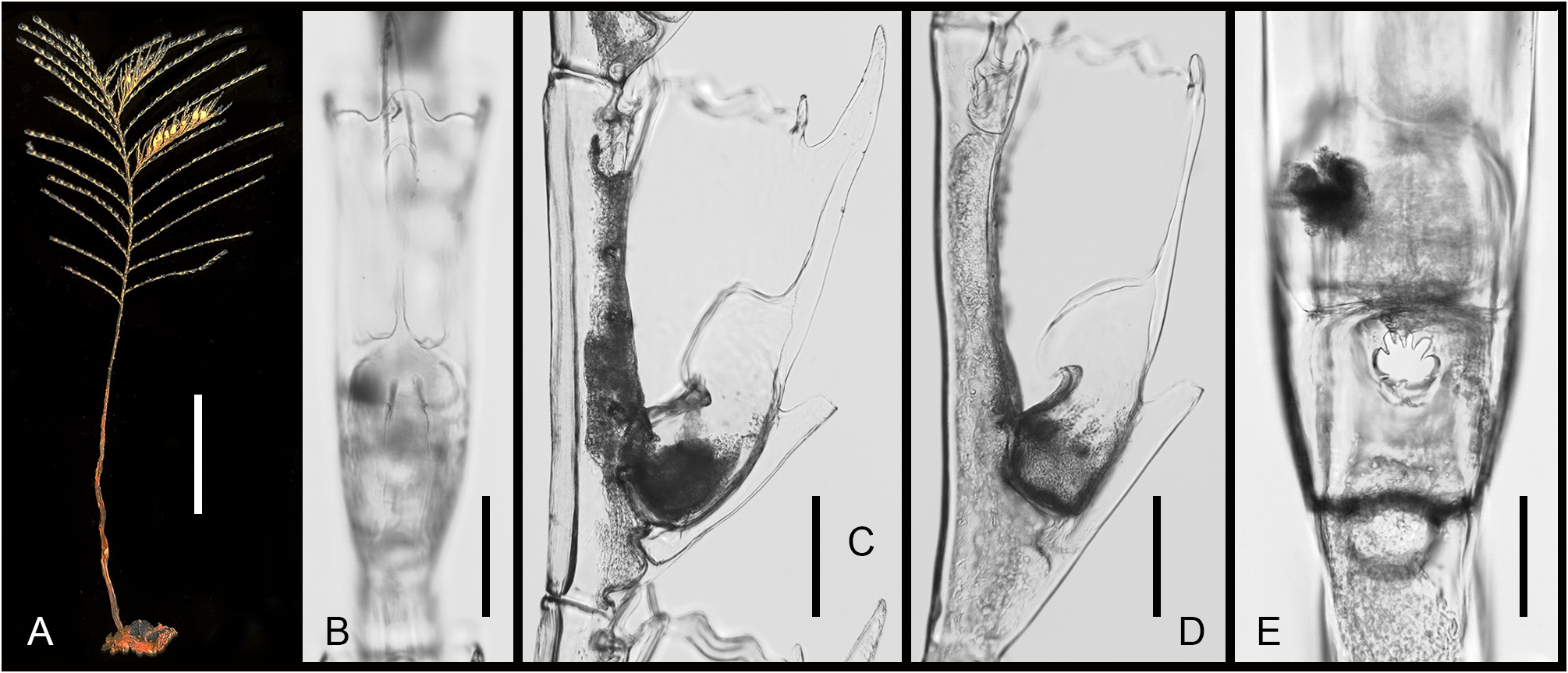
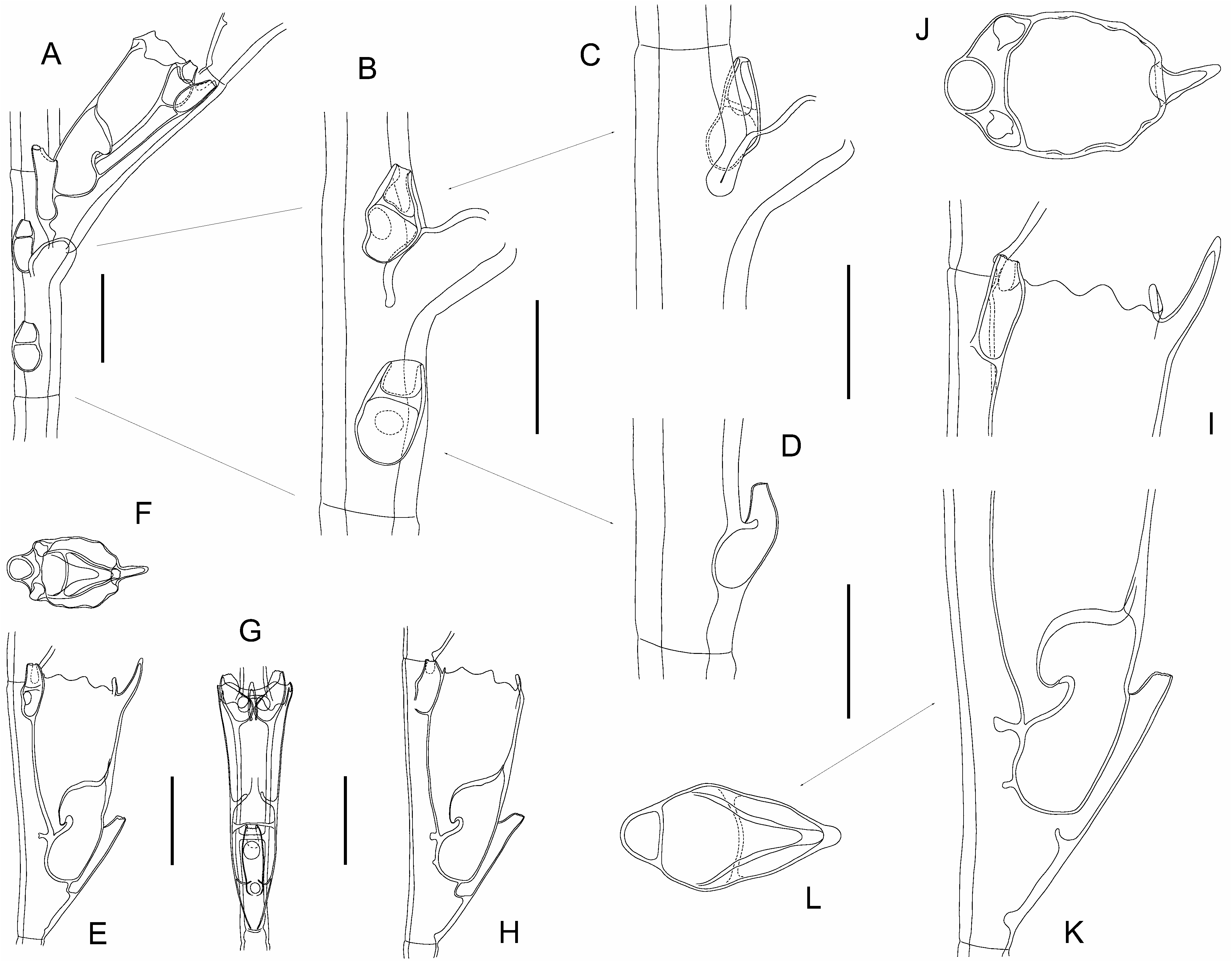
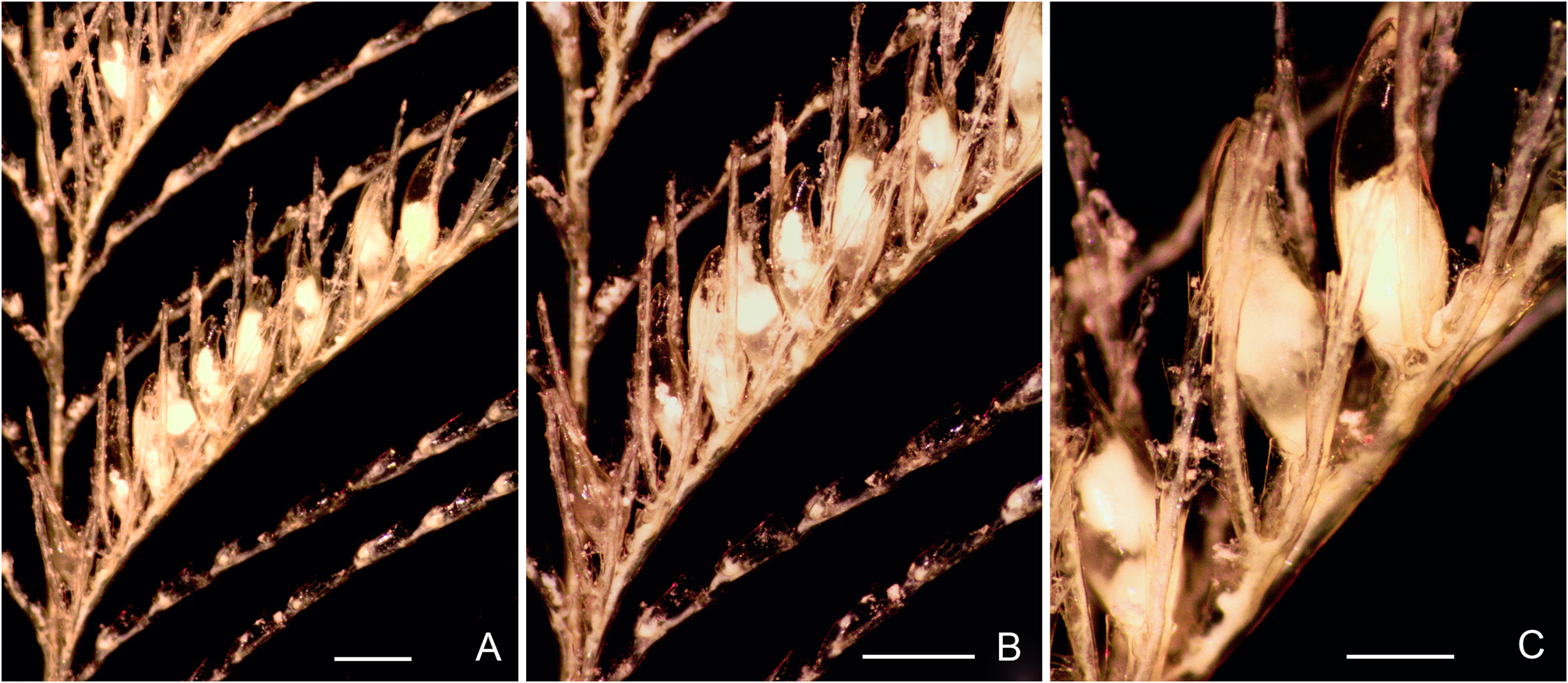
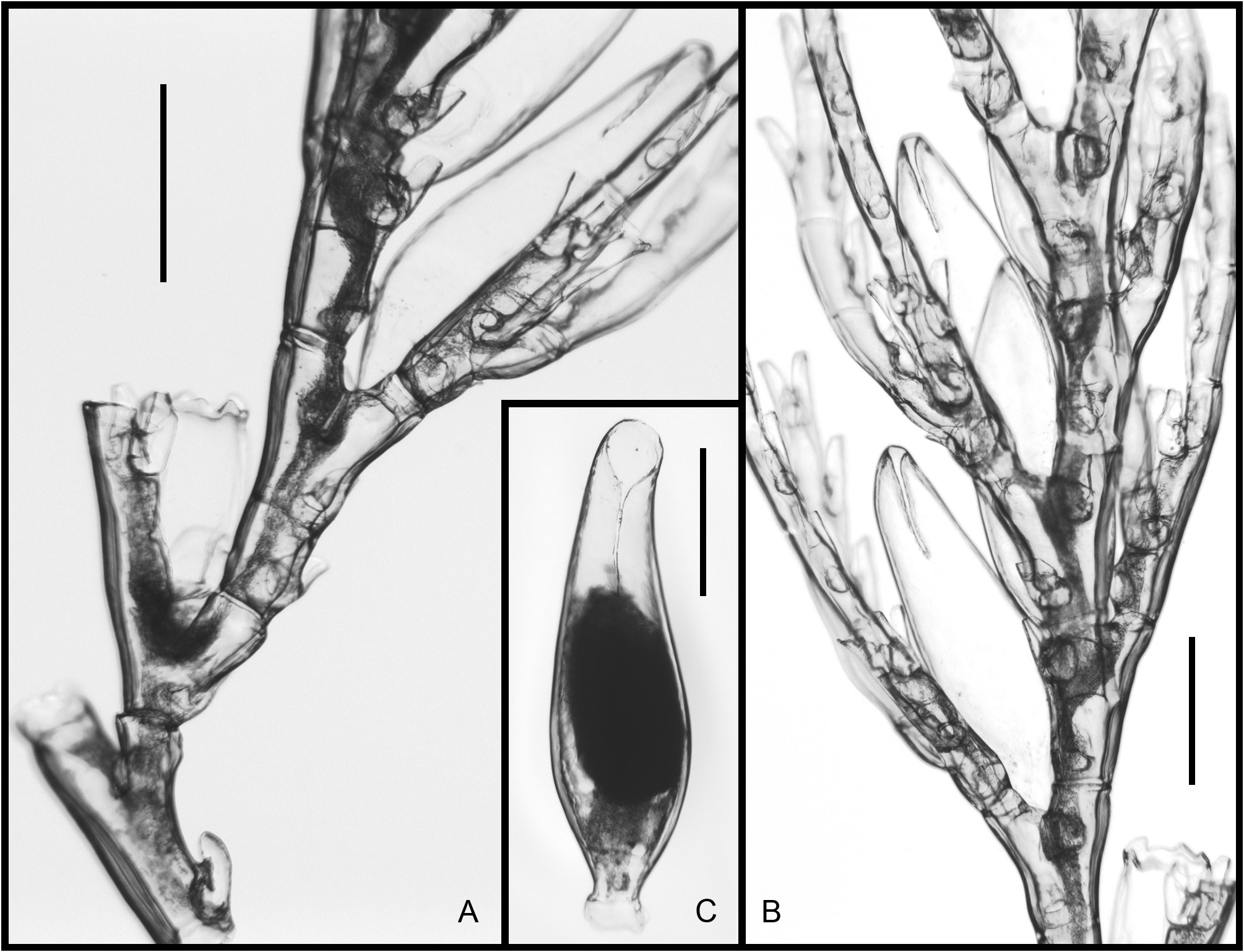
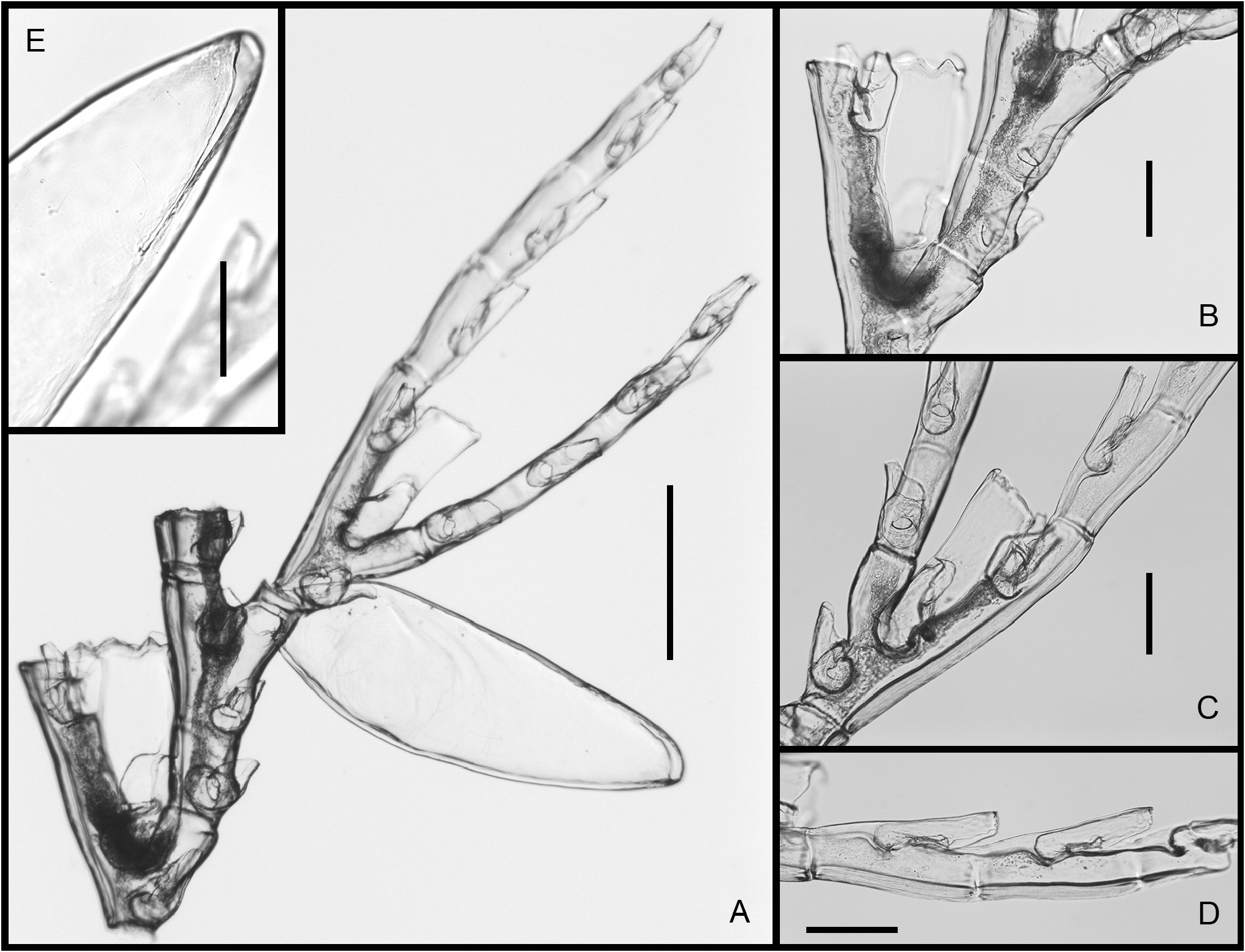
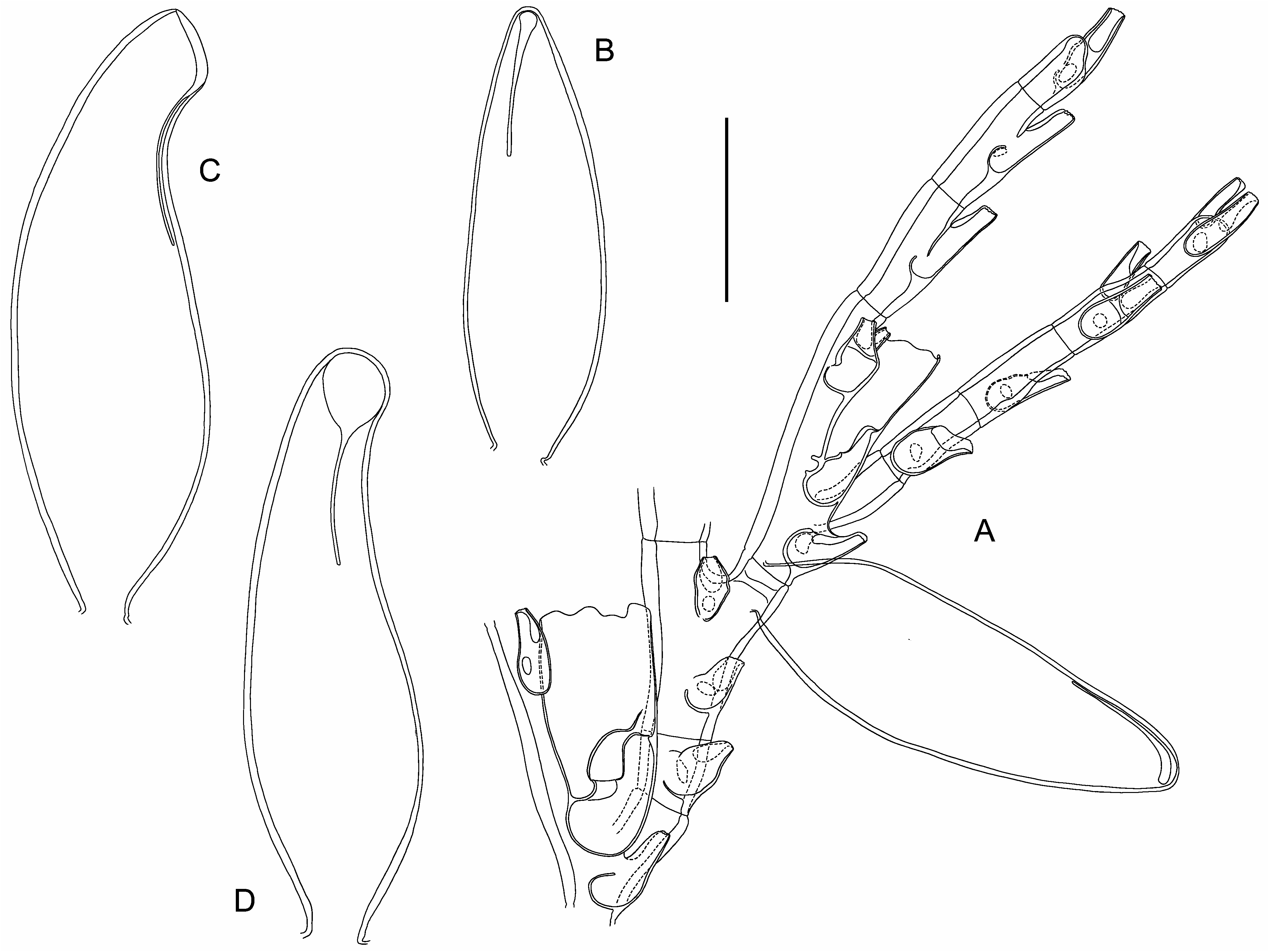
Description. Colonies up to 5 cm high, arising from rhizoid stolons firmly attached to pebbles (Fig. 1 A). Stems unbranched, lightly fascicled proximally, unable to support themselves when out of liquid; divided into a proximal, acladiate part of varied length, and a generally longer, distal part bearing alternate hydrocladia; both parts separated by up to five prosegments delimited by deeply-incised hinge-joints, each bearing one or two frontal nematothecae; hinge-joint region distinctly flattened laterally, allowing the colony to swing freely in the water currents; upper part of stem regularly-divided into internodes by means of oblique constrictions of the perisarc; internodes moderatelylong, each with a lateral apophysis in upper half, an axillar nematotheca, and a centrally-placed nematotheca in the lower half (Fig. 2 A); cauline nematothecae scoop-shaped: axillar ones narrower, lower ones comparatively broader (Fig. 2 B – D); apophyses short, alternate, given off at an angle of about 60 ° with the long axis of the internodes, and slightly frontally (Fig. 2 B); apophyses separated by the corresponding cladia by a slightly oblique node. Cladia unbranched, up to 14 mm long, arching gracefully downward distally; divided into up to 14 internodes by regular, transverse nodes; internodes long, each accommodating a hydrotheca occupying upper 4 / 5 of their length (Fig. 2 E, H). Hydrothecae deep, slightly inverted-conical, laterally-flattened, fully adnate, aperture ovoid, distal, slightly tilted forwards (Figs 1 B – D; 2 E – H); an internal, transverse, upwardly-directed septum projecting into the lower fourth of the lumen, distal edge backwardly-rolled (Fig. 2 K); above, two lateral, sigmoid septa meeting frontally divide the hydrothecal lumen into a lower third and an upper two-thirds, leaving a V-shaped passage for the hydranth (Fig. 2 K, L); several short perisarc plugs project into the internode behind the adaxial hydrothecal wall: one prolongs the transverse septum in the opposite direction, another one is given off at junction between the hydrothecal base and the adaxial wall (Fig. 2 K), and two others are occasionally present behind the adaxial wall (not shown); an additional perisarc plug is to be found proximally on the adaxial side of the cladial internode (Fig. 2 K); below the intrathecal transverse septum, there is a round hydropore surrounded by whorl of spines (Fig. 1 E); hydrothecal rim with a broad, median, rounded cusp with thickened perisarc (Fig. 1 B), and four lateral pairs of triangular cusps, those of the first pair distinctly blunted, and those of the fourth pair partly fused to the lateral nematothecae (Figs 1 C, D; 2 I); adaxially, hydrothecal rim broadly scooped; most hydrothecae are provided with a slender, horn-like, upwardlycurved, hollow perisarc projection (Figs 1 B, C; 2 E, I) of varied development (though generally unmistakable) and prolonged proximally into a short, longitudinal, median carina. Three nematothecae associated to each hydrotheca: a mesial one and a pair of laterals; mesial nematotheca originating slightly below the hydrothecal base, long, tubular, adnate for 4 / 5 of its length, aperture gutter-shaped, rim distinctly crenulate (Fig. 2 K); lateral nematothecae slightly surpassing the hydrothecal rim, monothalamic, urn-shaped, with deep, adaxial emargination, rim crenulate (Fig. 2 I). Phylactocarps borne on the proximal-most cormidia (Fig. 3 A), and given off slightly in front of the cormoid (Fig. 1 A); up to 9 mm long; first cormidium with a short, lateral, athecate apophysis inserted below the hydrothecal base, thus displacing the mesial nematotheca towards the proximal end of the internode, and forcing it to adopt the same shape as the cauline nematothecae (Figs 4 A; 6 A); phylactocarp composed of a proximal-most, short internode bearing a median nematotheca (Figs 4 A; 5 A, B; 6 A), followed by a regular succession of up to 16 geniculate internodes forming its rachis (Fig. 4 B); rachial internodes geniculate, moderately-long, composed of a lateral apophysis supporting a costa (apophyses alternate), an axillar nematotheca, and another nematotheca proximally (Fig. 6 A); nematothecae scoop-shaped; costae widely-spaced (Fig. 4 B), phylactocarp open (Fig. 3); costae bifid (Figs 3 C; 5 A; 6 A), with a basal, smaller hydrotheca (Fig. 5 C) whose modified mesial nematotheca is displaced proximally; hydrothecate internode prolonged distally by up to six short, collinear internodes, each provided with a single or a pair of elongate nematothecae set laterally; between the mesial nematotheca and the hydrothecal base, a slightly laterally-projecting apophysis supporting the second branch of the costa; second branch with up to four nematothecate internodes (Fig. 6 A); nematothecae half-adnate, gutter-shaped distally, with crenulate rim (Fig. 5 D). Gonothecae borne on inconspicuous swellings of the rachial apophyses supporting the costae, the latter arching over the gonothecae; gonothecae fusiform, sexually dimorphic, female (Figs 4 C; 6 D) comparatively longer and curving away distally (Fig. 6 C), and with wider distal apertures than the male ones (compare Fig. 4 C and B, and 6 D and B, respectively); apertures set distally, transverse, circular in shape, prolonged downward as long slits (Figs 4 B, C; 5 E; 6 B, D). Coenosarc poorly-preserved, the number of tentacles in hydranths and of oocytes in the female gonothecae could not be ascertained. Perisarc of colony straw colored.
Second records and redescriptions of two rare thecate hydroids (Cnidaria: Hydrozoa) from the southwestern Pacific
Figs 1 – 6, Table 1
Second records and redescriptions of two rare thecate hydroids (Cnidaria: Hydrozoa) from the southwestern Pacific
Remarks. Cormoids in the present material are comparatively smaller (4 – 5 cm high) than in the holotype colony (12 cm high). Consequently, their stems are less fascicled, and their cladia shorter (up to 14 mm vs. 25 – 30 mm long in the holotype), comprising lesser cormidia (14 vs. up to 35) (Vervoort & Watson 2003). Reportedly, up to 5 internal, incomplete, annular ridges can be found in the internode behind the hydrotheca. Unlike in the present material, the pedicel of the phylactocarp could be quite long, and composed of up to 12 nematothecate internodes, as noted in the holotype. Not stated in the original account, the nematothecae of this species have distinctly crenulated rims. Prior to this study, only the male gonothecae have been described (Vervoort & Watson 2003). However, one of the cormoids examined here bears phylactocarps with female gonothecae. Similar in shape to their male counterparts, but larger, they nevertheless possess comparatively broader apertures apically (compare Fig. 6 D and 6 B, respectively). The genus Carpocladus was created to accommodate Cladocarpus - like hydroids producing rather complex phylactocarps whose lateral, alternate costae are bifid, each being provided with an axillar hydrotheca between two flanking nematothecate ramuli. In Vervoort & Watson’s (2003) view, their genus showed closer affinities with Cladocarpoides Bogle, 1984, in which the exceedingly long phylactocarps have costae also provided with a hydrotheca (ending in a “ nematophorous spine ”), in front of which (between the proximally-displaced mesial nematotheca and the hydrothecal base) arises an antler-shaped, “ nematophorous branchlet ” or “ phylactogonium ” (Bogle 1984). Strikingly, the relationships between Carpocladus and Wanglaophenia Vervoort & Watson, 2003, a hydroid genus forming nearly identical phylactocarps, were not discussed. Given the lack of genetic material, not only of C. fertilis, but also of many Cladocarpus species and members of Cladocarpus - like genera, and the unpredictable relationships between the few species for which genetic data are already available (Moura et al. 2018), it is impossible for the time being to ascertain the validity of the genus Carpocladus, as well as its phylogenetic position within the family Aglaopheniidae.
Second records and redescriptions of two rare thecate hydroids (Cnidaria: Hydrozoa) from the southwestern Pacific
Distribution. Tasman Sea (Vervoort & Watson 2003), off southern New Caledonia (present study). Occurs at depths between 979 – 1274 m [Vervoort & Watson (2003) and present study, respectively].
Second records and redescriptions of two rare thecate hydroids (Cnidaria: Hydrozoa) from the southwestern Pacific
Material examined. MNHN-IK- 2015 - 3028, KANADEEP 2, Stn. DW 5107, off southern New Caledonia, Mount Munida, 22 ° 59.9 ’ S, 168 ° 14.4 ’ E, 30 Sep 2019, 1151 – 1274 m, a ca. 5 cm high cormoid bearing two phylactocarps with female gonothecae. — MNHN-IK- 2015 - 3026, KANADEEP 2, Stn. CP 5095, off southern New Caledonia, Capucine Bassin, 23 ° 38 ’ S, 167 ° 53.1 ’ E, 29 Sep 2019, 1087 – 1081 m, a ca. 4 cm high cormoid bearing three phylactocarps with male gonothecae.
Second records and redescriptions of two rare thecate hydroids (Cnidaria: Hydrozoa) from the southwestern Pacific

Export occurrence data

Darwin Core Archive (ZIP)

GEOGRAPHY

Distribution Map

Occurrence Map

Loading map…

Tiles © GBIF Maps API | Map powered by MapLibre GL

REGIONS

Geographic Distribution(6)

Tasman Sea
New Zealand Exclusive Economic Zone
Tasman Sea
New Zealand Exclusive Economic Zone
Tasman Sea
New Zealand Exclusive Economic Zone(NZ)

DATA

Occurrence Datasets

Loading datasets…

CLASSIFICATION

Taxonomic Classification Tree

NOMENCLATURE

Nomenclatural Combinations(1)

Nomenclatural recombinations of this name in other genera or at different ranks.

Cladocarpus fertilis(Vervoort & Watson, 2003)
speciessynonym

MULTIMEDIA

Media Files(6)

FIGURE 1. Carpocladus fertilis Vervoort & Watson, 2003.A. Fertile colony. B–D. Hydrothecae seen frontally (B) and laterally (C, D), with (C) and without (D) a median spine. E. Foramen for the passage of the hydranth, showing spines. Scale bars: E = 100 µm; B–D = 200 µm; A = 1 cm.
Imageimage/png© Galea, Horia R.Second records and redescriptions of two rare thecate hydroids (Cnidaria: Hydrozoa) from the southwestern Pacific

FIGURE 2. Carpocladus fertilis Vervoort & Watson, 2003.A–D. Stem internode seen frontally (A); the same, enlarged, to show its nematothecae either frontally (B) or laterally (C, D). E–H. Hydrothecae with (E–G) or without (H) a median spine, seen laterally (E, H), apically (F) and frontally (G). I, J. Hydrothecal aperture seen both laterally (I) and apically (J). K, L. Intrathecal septa seen both laterally (K) and apically (L). Scale bars: A–L = 500 µm.
Imageimage/png© Galea, Horia R.Second records and redescriptions of two rare thecate hydroids (Cnidaria: Hydrozoa) from the southwestern Pacific

FIGURE3. Carpocladusfertilis Vervoort&Watson,2003.A–C.Phylactocarp with femalegonothecae,at variousmagnifications. Scale bars: C = 500 µm; A, B = 1 mm.
Imageimage/png© Galea, Horia R.Second records and redescriptions of two rare thecate hydroids (Cnidaria: Hydrozoa) from the southwestern Pacific

FIGURE 4. Carpocladus fertilis Vervoort & Watson, 2003. A. A stem internode bearing the proximal most cormidium (following cormidia voluntarily removed) supporting a phylactocarp (only its proximal part is shown). B. Central part of the same phylactocarp seen from below, showing its rachis, alternate costae, and male gonothecae. C. Isolated female gonotheca; note its broader aperture compared to its male counterparts. Scale bars: A–C = 500 µm.
Imageimage/png© Galea, Horia R.Second records and redescriptions of two rare thecate hydroids (Cnidaria: Hydrozoa) from the southwestern Pacific

FIGURE 5. Carpocladus fertilis Vervoort & Watson, 2003. A. Proximal most part of a phylactocarp, showing the proximal most cladial cormidium, the proximal nematothecate internode, and the first regular rachial internode with male gonotheca, bifid costa and axillar hydrotheca. B. Detail of the origin of a phylactocarp, showing the proximal most cladial hydrotheca, its lateral apophysis, the first (nematothecate only) rachial internode, and the first regular rachial internode. C. Detail of the branching site of a costa, showing the axillar hydrotheca, the peculiar position and shape of its mesial nematotheca, and the apophysis supporting the frontal branch of the costa. D. Nematothecae of a costa. E. Detail of the aperture of a male gonotheca. Scale bars: B–E = 200 µm; A = 500 µm.
Imageimage/png© Galea, Horia R.Second records and redescriptions of two rare thecate hydroids (Cnidaria: Hydrozoa) from the southwestern Pacific

FIGURE 6. Carpocladus fertilis Vervoort & Watson, 2003. A. Line drawing of the same gonosomal portion illustrated in Fig. 5A, to show fine details. B–D. Male (B) and female (C, D) gonothecae seen either frontally (B, D) or laterally (C). Scale bars: A–D = 500 µm.

Imageimage/png© Galea, Horia R.Second records and redescriptions of two rare thecate hydroids (Cnidaria: Hydrozoa) from the southwestern Pacific

IMAGES

Gallery(6)

See Gallery

Occurrences with images

CITATIONS

References(3)

  • 1

    Cairns, S.D., L. Gershwin, F.J. Brook, P. Pugh, E.W. Dawson, O.V. Ocaña, W. Vervoort, G. Williams, J.E. Watson, D.M. Opresko, P. Schuchert, P.M. Hine, D.P. Gordon, H.I. Campbell, A.J. Wright, J.A.Sánchez & D.G. Fautin. (2009). Phylum Cnidaria: corals, medusae, hydroids, myxozoans. <em>in: Gordon, D.P. (Ed.) (2009). New Zealand inventory of biodiversity: 1. Kingdom Animalia: Radiata, Lophotrochozoa, Deuterostomia.</em> :59-101.

    additional sourceWorld Register of Marine Species
  • 2

    Galea, H. R. (2021). Second records and redescriptions of two rare thecate hydroids (Cnidaria: Hydrozoa) from the southwestern Pacific. <em>Zootaxa.</em> 5082(4): 373-383.

    redescriptionWorld Register of Marine SpeciesDOI: 10.11646/zootaxa.5082.4.5
  • 3

    Vervoort, W., & Watson, J. E. 2003. The marine fauna of New Zealand: Leptothecata (Cnidaria: Hydrozoa) (thecate hydroids). NIWA Biodiversity Memoir 119: 1-538.

    original descriptionWorld Register of Marine Species
  • Source Information

    GBIF Backbone Taxonomy

    GBIF Backbone Taxonomy

    checklist

    The GBIF Backbone Taxonomy is a single, synthetic management classification with the goal of covering all names GBIF is dealing with. It's the taxonomic backbone that allows GBIF to integrate name based information from different resources, no matter if these are occurrence datasets, species pages, names from nomenclators or external sources like EOL, Genbank or IUCN. This backbone allows taxonomic search, browse and reporting operations across all those resources in a consistent way and to provide means to crosswalk names from one source to another.

    It is updated regulary through an automated process in which the Catalogue of Life acts as a starting point also providing the complete higher classification above families. Additional scientific names only found in other authoritative nomenclatural and taxonomic datasets are then merged into the tree, thus extending the original catalogue and broadening the backbones name coverage. The GBIF Backbone taxonomy also includes identifiers for Operational Taxonomic Units (OTUs) drawn from the barcoding resources iBOL and UNITE.

    International Barcode of Life project (iBOL), Barcode Index Numbers (BINs). BINs are connected to a taxon name and its classification by taking into account all names applied to the BIN and picking names with at least 80% consensus. If there is no consensus of name at the species level, the selection process is repeated moving up the major Linnaean ranks until consensus is achieved.

    UNITE - Unified system for the DNA based fungal species, Species Hypotheses (SHs). SHs are connected to a taxon name and its classification based on the determination of the RefS (reference sequence) if present or the RepS (representative sequence). In the latter case, if there is no match in the UNITE taxonomy, the lowest rank with 100% consensus within the SH will be used.

    The GBIF Backbone Taxonomy is available for download at https://hosted-datasets.gbif.org/datasets/backbone/ in different formats together with an archive of all previous versions.

    The following 105 sources have been used to assemble the GBIF backbone with number of names given in brackets:

    • Catalogue of Life Checklist - 4766428 names
    • International Barcode of Life project (iBOL) Barcode Index Numbers (BINs) - 635951 names
    • UNITE - Unified system for the DNA based fungal species linked to the classification - 611208 names
    • The Paleobiology Database - 212054 names
    • World Register of Marine Species - 188857 names
    • The Interim Register of Marine and Nonmarine Genera - 183894 names
    • The World Checklist of Vascular Plants (WCVP) - 131891 names
    • GBIF Backbone Taxonomy - 114350 names
    • TAXREF - 109374 names
    • The Leipzig catalogue of vascular plants - 75380 names
    • ZooBank - 73549 names
    • Integrated Taxonomic Information System (ITIS) - 68377 names
    • Plazi.org taxonomic treatments database - 61346 names
    • Genome Taxonomy Database r207 - 60545 names
    • International Plant Names Index - 52329 names
    • Fauna Europaea - 45077 names
    • The National Checklist of Taiwan (Catalogue of Life in Taiwan, TaiCoL) - 36193 names
    • Dyntaxa. Svensk taxonomisk databas - 35892 names
    • The Plant List with literature - 32692 names
    • United Kingdom Species Inventory (UKSI) - 29643 names
    • Artsnavnebasen - 29208 names
    • The IUCN Red List of Threatened Species - 21221 names
    • Afromoths, online database of Afrotropical moth species (Lepidoptera) - 13961 names
    • Brazilian Flora 2020 project - Projeto Flora do Brasil 2020 - 13829 names
    • Prokaryotic Nomenclature Up-to-Date (PNU) - 10079 names
    • Checklist Dutch Species Register - Nederlands Soortenregister - 8814 names
    • ICTV Master Species List (MSL) - 7852 names
    • Cockroach Species File - 6020 names
    • GRIN Taxonomy - 5882 names
    • Taxon list of fungi and fungal-like organisms from Germany compiled by the DGfM - 4570 names
    • Catalogue of Afrotropical Bees - 3623 names
    • Catalogue of Tenebrionidae (Coleoptera) of North America - 3327 names
    • Checklist of Beetles (Coleoptera) of Canada and Alaska. Second Edition. - 3312 names
    • Systema Dipterorum - 2850 names
    • Catalogue of the Pterophoroidea of the World - 2807 names
    • The Clements Checklist - 2675 names
    • Taxon list of Hymenoptera from Germany compiled in the context of the GBOL project - 2496 names
    • IOC World Bird List, v13.2 - 2366 names
    • Official Lists and Indexes of Names in Zoology - 2310 names
    • National checklist of all species occurring in Denmark - 1922 names
    • Myriatrix - 1876 names
    • Database of Vascular Plants of Canada (VASCAN) - 1822 names
    • Taxon list of vascular plants from Bavaria, Germany compiled in the context of the BFL project - 1771 names
    • Orthoptera Species File - 1742 names
    • A list of the terrestrial fungi, flora and fauna of Madeira and Selvagens archipelagos - 1602 names
    • Aphid Species File - 1565 names
    • World Spider Catalog - 1561 names
    • Taxon list of Jurassic Pisces of the Tethys Palaeo-Environment compiled at the SNSB-JME - 1270 names
    • Backbone Family Classification Patch - 1143 names
    • GBIF Algae Classification - 1100 names
    • International Cichorieae Network (ICN): Cichorieae Portal - 975 names
    • Psocodea Species File - 803 names
    • New Zealand Marine Macroalgae Species Checklist - 787 names
    • Annotated checklist of endemic species from the Western Balkans - 754 names
    • Taxon list of animals with German names (worldwide) compiled at the SMNS - 503 names
    • Catalogue of the Alucitoidea of the World - 472 names
    • Lygaeoidea Species File - 462 names
    • Catálogo de Plantas y Líquenes de Colombia - 422 names
    • GBIF Backbone Patch - 317 names
    • Phasmida Species File - 259 names
    • Cortinariaceae fetched from the Index Fungorum API - 234 names
    • Coreoidea Species File - 233 names
    • GTDB supplement - 139 names
    • Mantodea Species File - 119 names
    • Endemic species in Taiwan - 93 names
    • Taxon list of Araneae from Germany compiled in the context of the GBOL project - 88 names
    • Species of Hominidae - 78 names
    • Taxon list of Sternorrhyncha from Germany compiled in the context of the GBOL project - 77 names
    • Taxon list of mosses from Germany compiled in the context of the GBOL project - 75 names
    • Mammal Species of the World - 73 names
    • Plecoptera Species File - 71 names
    • Species Fungorum Plus - 64 names
    • Catalogue of the type specimens of Cosmopterigidae (Lepidoptera: Gelechioidea) from research collections of the Zoological Institute, Russian Academy of Sciences - 47 names
    • Species named after famous people - 41 names
    • Dermaptera Species File - 36 names
    • Taxon list of Trichoptera from Germany compiled in the context of the GBOL project - 34 names
    • True Fruit Flies (Diptera, Tephritidae) of the Afrotropical Region - 33 names
    • Range and Regularities in the Distribution of Earthworms of the Earthworms of the USSR Fauna. Perel, 1979 - 32 names
    • Taxon list of Diplura from Germany compiled in the context of the GBOL project - 30 names
    • Lista de referencia de especies de aves de Colombia - 2022 - 24 names
    • Taxon list of Auchenorrhyncha from Germany compiled in the context of the GBOL project - 20 names
    • Catalogue of the type specimens of Polycestinae (Coleoptera: Buprestidae) from research collections of the Zoological Institute, Russian Academy of Sciences - 19 names
    • Taxon list of Thysanoptera from Germany compiled in the context of the GBOL project - 19 names
    • Lista de especies de vertebrados registrados en jurisdicción del Departamento del Huila - 18 names
    • Taxon list of Microcoryphia (Archaeognatha) from Germany compiled in the context of the GBOL project - 15 names
    • Catalogue of the type specimens of Bufonidae and Megophryidae (Amphibia: Anura) from research collections of the Zoological Institute, Russian Academy of Sciences - 12 names
    • Grylloblattodea Species File - 11 names
    • Coleorrhyncha Species File - 9 names
    • Taxon list of liverworts from Germany compiled in the context of the GBOL project - 9 names
    • Embioptera Species File - 7 names
    • Taxon list of Pisces and Cyclostoma from Germany compiled in the context of the GBOL project - 6 names
    • Taxon list of Pteridophyta from Germany compiled in the context of the GBOL project - 6 names
    • Taxon list of Siphonaptera from Germany compiled in the context of the GBOL project - 5 names
    • The Earthworms of the Fauna of Russia. Perel, 1997 - 5 names
    • Taxon list of Zygentoma from Germany compiled in the context of the GBOL project - 4 names
    • Asiloid Flies: new taxa of Diptera: Apioceridae, Asilidae, and Mydidae - 3 names
    • Taxon list of Protura from Germany compiled in the context of the GBOL project - 3 names
    • Taxon list of hornworts from Germany compiled in the context of the GBOL project - 2 names
    • Chrysididae Species File - 1 names
    • Taxon list of Dermaptera from Germany compiled in the context of the GBOL project - 1 names
    • Taxon list of Diplopoda from Germany in the context of the GBOL project - 1 names
    • Taxon list of Orthoptera (Grashoppers) from Germany compiled at the SNSB - 1 names
    • Taxon list of Pscoptera from Germany compiled in the context of the GBOL project - 1 names
    • Taxon list of Pseudoscorpiones from Germany compiled in the context of the GBOL project - 1 names
    • Taxon list of Raphidioptera from Germany compiled in the context of the GBOL project - 1 names

    GBIF Secretariat (2023). GBIF Backbone Taxonomy. Checklist dataset https://doi.org/10.15468/39omei accessed via GBIF.org on 2026-06-17.

    CC BYPublished 8/28/2023View dataset
    GBIF Usage Key
    2267437
    Dataset Key
    d7dddbf4-2cf0-4f39-9b2a-bb099caae36c
    Origin
    source
    Backbone Key
    2267437
    Taxon ID
    gbif:2267437
    Last Crawled
    8/22/2023
    Last Interpreted
    8/22/2023