AnimaliaNot EvaluatedacceptedspeciesAcceptedRestricted
Alluroides pordagei

Alluroides pordagei

Beddard, 1894

GBIF:2308692

0countries
0datasets
0year

0

Descendants

0

Children

PROFILE

Species Profile

Habitat

Freshwater

ABOUT

Descriptions(3)

Length 25 – 48 mm, width 1.0 mm, segments 202. Prolobous. Form approximately cylindrical throughout, anterior segments at least biannulate with the transverse furrow shortly postsetal. Lateral line in bc, nearer to b than to c. Anus terminal. Ventral setal couples of XIII absent at maturity; all setae sigmoid, with approximately central, well – developed node; none modified as genital setae. Outer setal couples dorsal, dd: u = ca 0.2. Clitellum annular, XII – XVI. Male pores a pair precisely lateral, or slightly ventrolateral, nearer to b than to c lines in the setal arc of XIII, each surrounded by a circular tumescence almost filling the segment longitudinally. Female pores in 13 / 14 directly in line with the male pores, inconspicuous. Spermathecal pore paired or single, dorsal and anterior in VIII, in the type paired near the dorsal midline. Septa 4 / 5 (the first clearly developed), 9 / 10 exceptionally strongly thickened, 10 / 11 thin and attenuated, 11 / 12 and (though less so) 12 / 13 moderately thickened, the succeeding septa thin. Septal glands posterior in V – IX? Nephridia commencing in XII – XVI. Pharynx anterior to septum 4 / 5. Intestine commencing in XIII, internal epithelium with tall cilia; oesophagus similarly ciliated in XII in front of the oesophageal valve; ciliation not certainly present further anteriorly. Brown – granuled chloragogen cells commencing (always?) at 1 / 2 IX. Dorsal blood vessel large and adherent to the gut in XIII posteriorly; slender and freer anteriorly to this. Hearts (posterior commissural) very tortuous extending posteriorly into XI (XII?). Septum 10 / 11 bulging posteriorly far into XI to form a wide – mouthed (unpaired?) seminal vesicle. Muscular tubes of the atria forming slender somewhat coiled tubes extending from XIII into XIV or as far as XVI and widening immediately before opening at the male pores. With the exception of the terminal ectal chamber each tubular atrium surrounded by a sheath of unicellular prostate cells, which approximately doubled the width of the apparatus, the cells communicating with the atrial lumen by minute ductules. Vasa deferentia running in the glandular prostatic duct and presumably entering the atrium entally. Ovaries and funnels in XIII. Oviduct penetrating the body wall immediately behind septum 13 / 14. Female gonadial cells, at maturity, in XIII – XXI, probably in ovisacs. Spermatheca single or paired, dorsally in VIII.
A monograph of the Oligochaete family Alluroididae
Remarks. Because of the uncertain status of Michaelsen’s material this account (from Jamieson 1968) was derived solely from Beddard’s type – series, and his description, and incorporated results of examinations by Brinkhurst (1964) and Jamieson (Athi River material). The extreme septal thickening, and its distribution, now emerge as diagnostic features of A. pordagei (condition still unknown, however, in A. tanganyikae s. Beddard and s. Michaelsen). Intraspecific variation from a paired to a single spermatheca (in VIII) is confirmed and reinforces Brinkhurst’s conclusion (1964) that A. tanganyikae s. Michaelsen (spermatheca single in VIII), but not s. Beddard (spermatheca single in IX), should be included in A. pordagei. The decision by Michaelsen (1936) to recognize three subspecies, pordagei, tanganyikae and congicus, has not been followed here though it still deserves consideration. A. tanganyikae has been retained as a distinct species but recognition of congicus, from Leopoldsville, as a subspecies appears reasonable. Michaelsen distinguished it by the spermatheca with a thin – walled, sac – like ampulla and sharply demarcated muscular duct. He added that congicus was 90 – 100 mm long, with ca 210 segments, the largest form, whereas the typical subspecies was 22 mm long, the smallest form, while tanganyikae had a length of 45 mm, with ca 150 segments, intermediate between the two other forms. Some of these figures no longer hold.
A monograph of the Oligochaete family Alluroididae
Distribution. Kenya: swamp 4 miles inland from Mombasa (Type locality, Beddard 1894); lower forest region of Mt. Kenya at 2400 m (Michaelsen 1914 a, b; Michaelsen 1915, as A. tanganyikae); Kahawa stream, Athi River tributary, near Nairobi, collector B. G. M. Jamieson, 11 Dec. 1967. Republic of the Congo: Mulongo, Niunzu; Albertville (Michaelsen 1935); Leopoldville (Michaelsen 1936). Rhodesia: swampy earth, Zambezi River, near Victoria Falls (as A. tanganyikae, Michaelsen 1913).
A monograph of the Oligochaete family Alluroididae

Export occurrence data

Darwin Core Archive (ZIP)

GEOGRAPHY

Distribution Map

Occurrence Map

Loading map…

Tiles © GBIF Maps API | Map powered by MapLibre GL

REGIONS

Geographic Distribution(2)

Afrotropical
Africa

DATA

Occurrence Datasets

Loading datasets…

CLASSIFICATION

Taxonomic Classification Tree

MULTIMEDIA

Media Files(7)

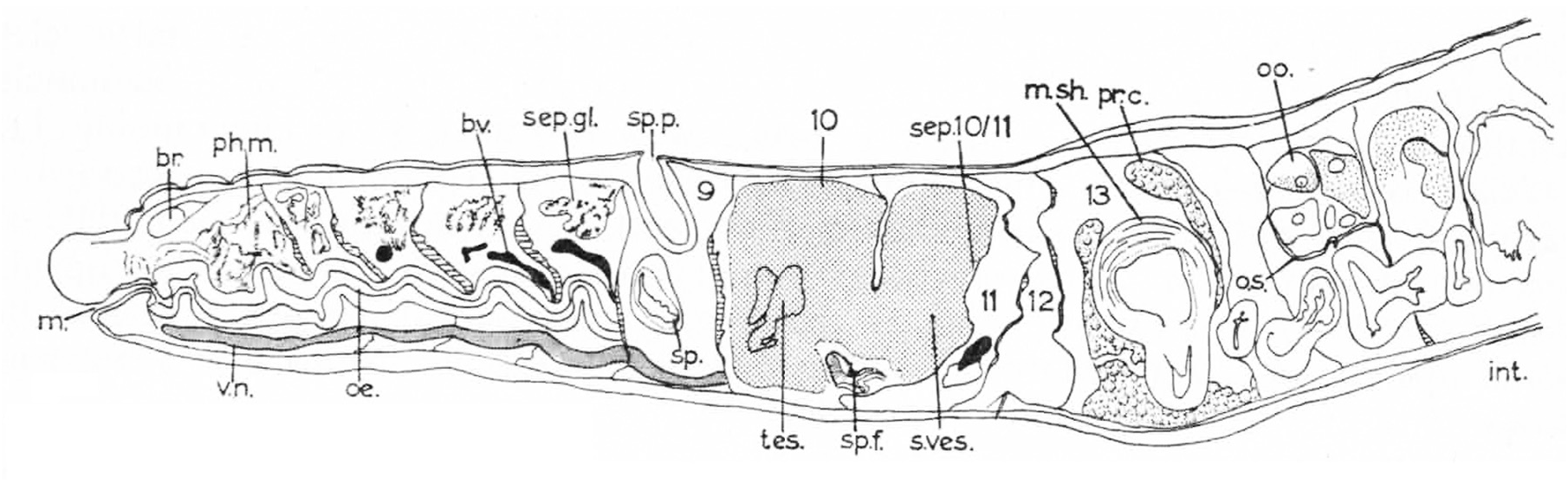
FIGURE 4. Alluroides brinkhursti brinkhursti Jamieson (1968). Longitudinal section of the holotype. Abbreviations: br, brain; bv, blood vessel; m, mouth; msh, muscular sheath of atrium; oe, oesophagus; oo, oocyte: os, ovisac; ph m, pharyngeal musculature; pr c, prostatic cells; sep, septum; sep gl, septal gland; sp p, spermathecal pore; s. ves, seminal vesicle; sp, spermatheca; sp f, sperm funnel; tes, testis; vd, vas deferens; v n, ventral nerve cord. Adapted from Jamieson (1968).

Imageimage/png© Jamieson, Barrie G. M.;Fragoso, CarlosA monograph of the Oligochaete family Alluroididae

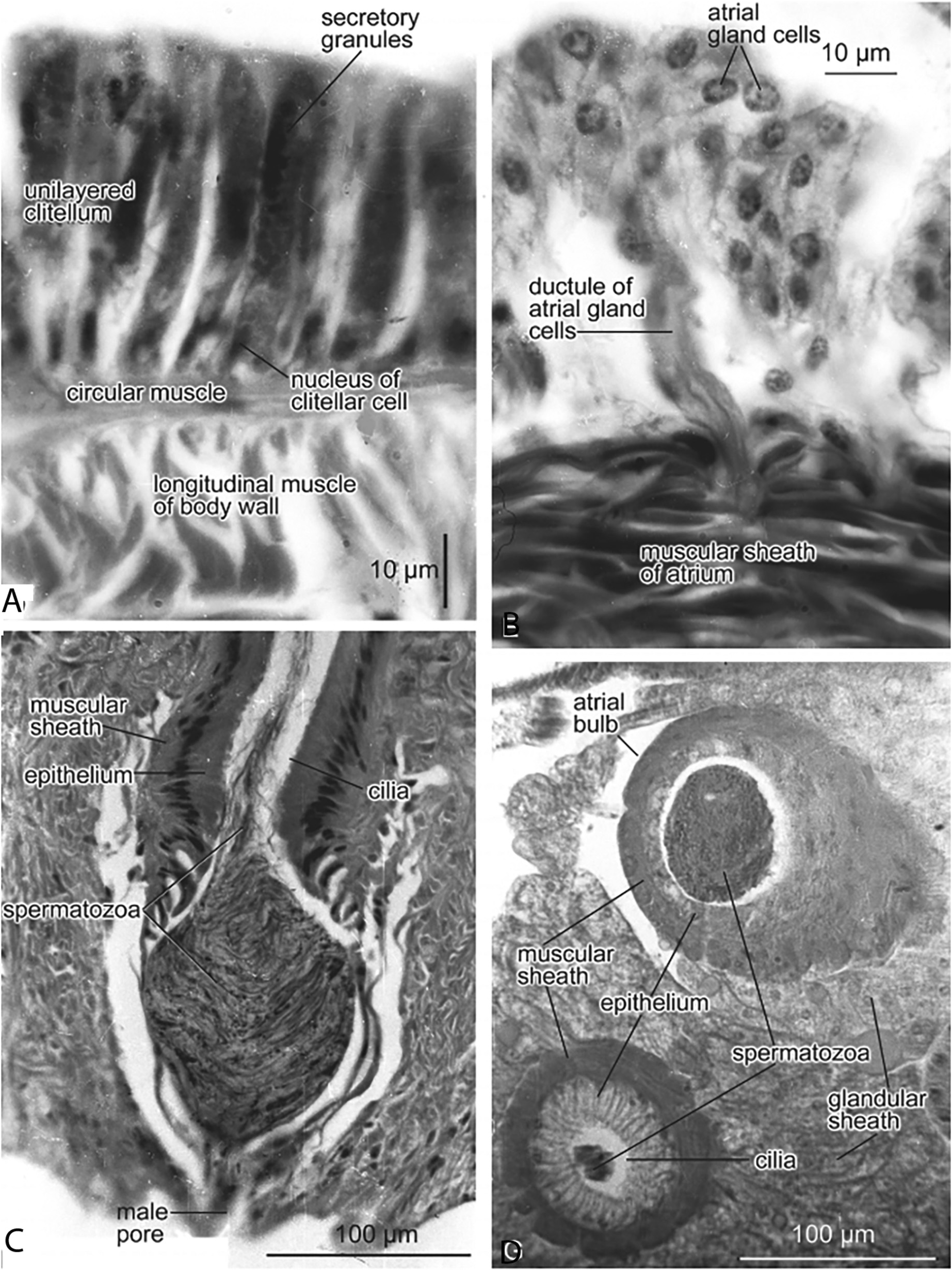
FIGURE 5. Alluroides brinkhursti brinkhursti Jamieson (1968). A. Transverse section (TS) of clitellum, showing single cell layer; the cells with conspicuous secretory granules and each with a basal nucleus. B. TS through the wall of the atrium, showing a group of atrial gland cells with ductule penetrating the muscular sheath of the atrium. C. Longitudinal section through the male pore, showing the ectal end of the atrium, which forms a penis with muscular sheath, ciliated epithelium and rope of spermatozoa in the lumen, forming in the ectal chamber a sperm mass. D. Alluroides pordagei. Oblique section through the atrial bulb, containing a large sperm mass, and the associated atrium. From Jamieson (2006).

Imageimage/png© Jamieson, Barrie G. M.;Fragoso, CarlosA monograph of the Oligochaete family Alluroididae

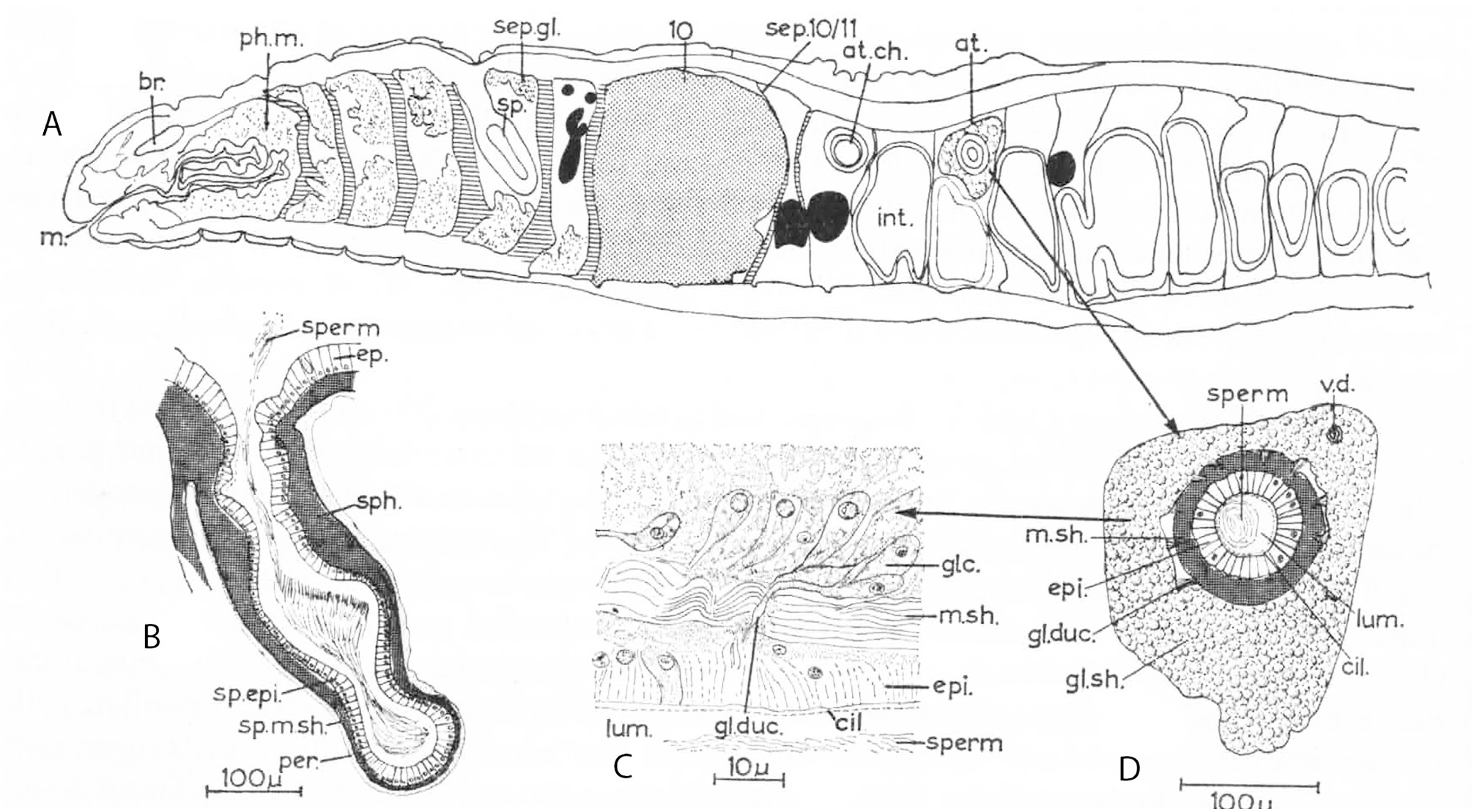
FIGURE 8. Alluroides pordagei Beddard 1894. A. Longitudinal section of the anterior region of the body of Beddard’s paratype. B. Spermatheca. C. Longitudinal section of wall of atrium. D. Transverse section of atrium.Abbreviations: at, atrium; at ch, atrial chamber; br, brain; cil, cilia; ep, epidermis; epi, epithelium; gl duc, glandular ductule(s); gl sh, glandular sheath; int, intestine; lum, lumen; m, mouth; ph m, pharyngeal musculature; per, peritoneum; sep.gl, septal gland; sp, spermatheca; sperm, spermatozoa; sph, sphincter; sp epi, spermathecal epithelium; sp m sh, muscular sheath of spermatheca; v.d, vas deferens.. Slightly modified from Jamieson (1968).

Imageimage/png© Jamieson, Barrie G. M.;Fragoso, CarlosA monograph of the Oligochaete family Alluroididae

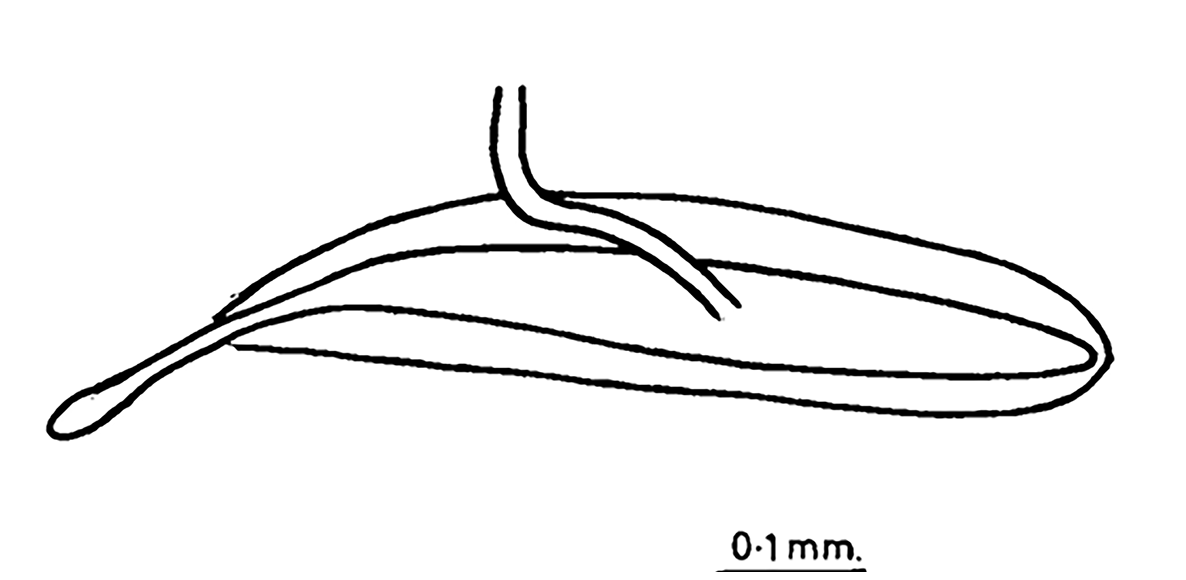
FIGURE 9. Alluroides ruwenzoriensis Brinkhurst 1964. Atrium and vas deferens entering at midlength. From Brinkhurst (1964).

Imageimage/png© Jamieson, Barrie G. M.;Fragoso, CarlosA monograph of the Oligochaete family Alluroididae

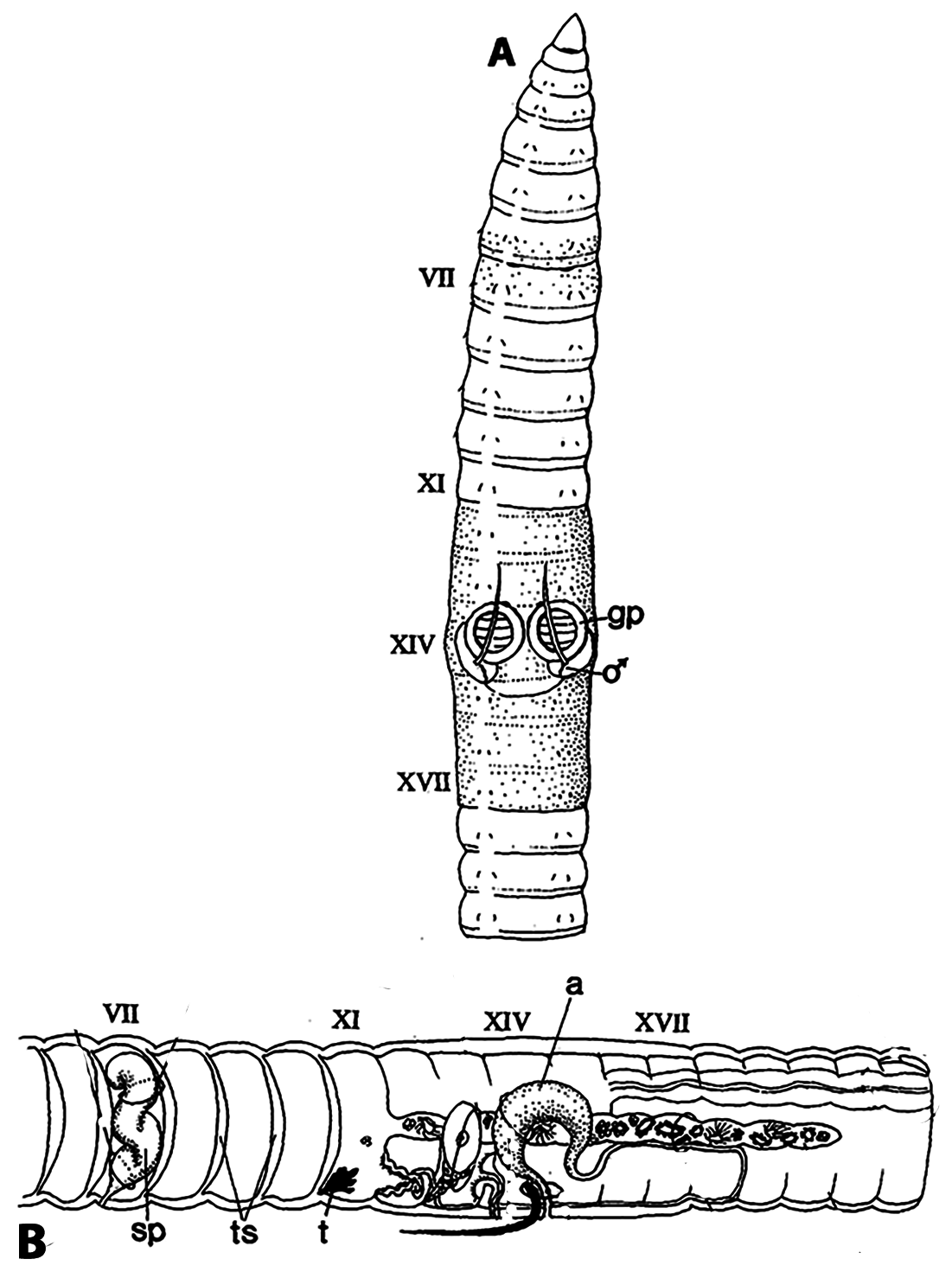
FIGURE 13. Kathrynella guyanae Omodeo 1996.A. Ventral view of anterior segments.Note the pale lateral line.B. arrangement of genital organs. Abbreviations: a, atrium; gp, genital papilla; ♂, male pore; sp, spematheca; t, testis; ts, thickened septum. The penial setae are seen projecting from the male pore. Modified from Omodeo (1996).

Imageimage/png© Jamieson, Barrie G. M.;Fragoso, CarlosA monograph of the Oligochaete family Alluroididae

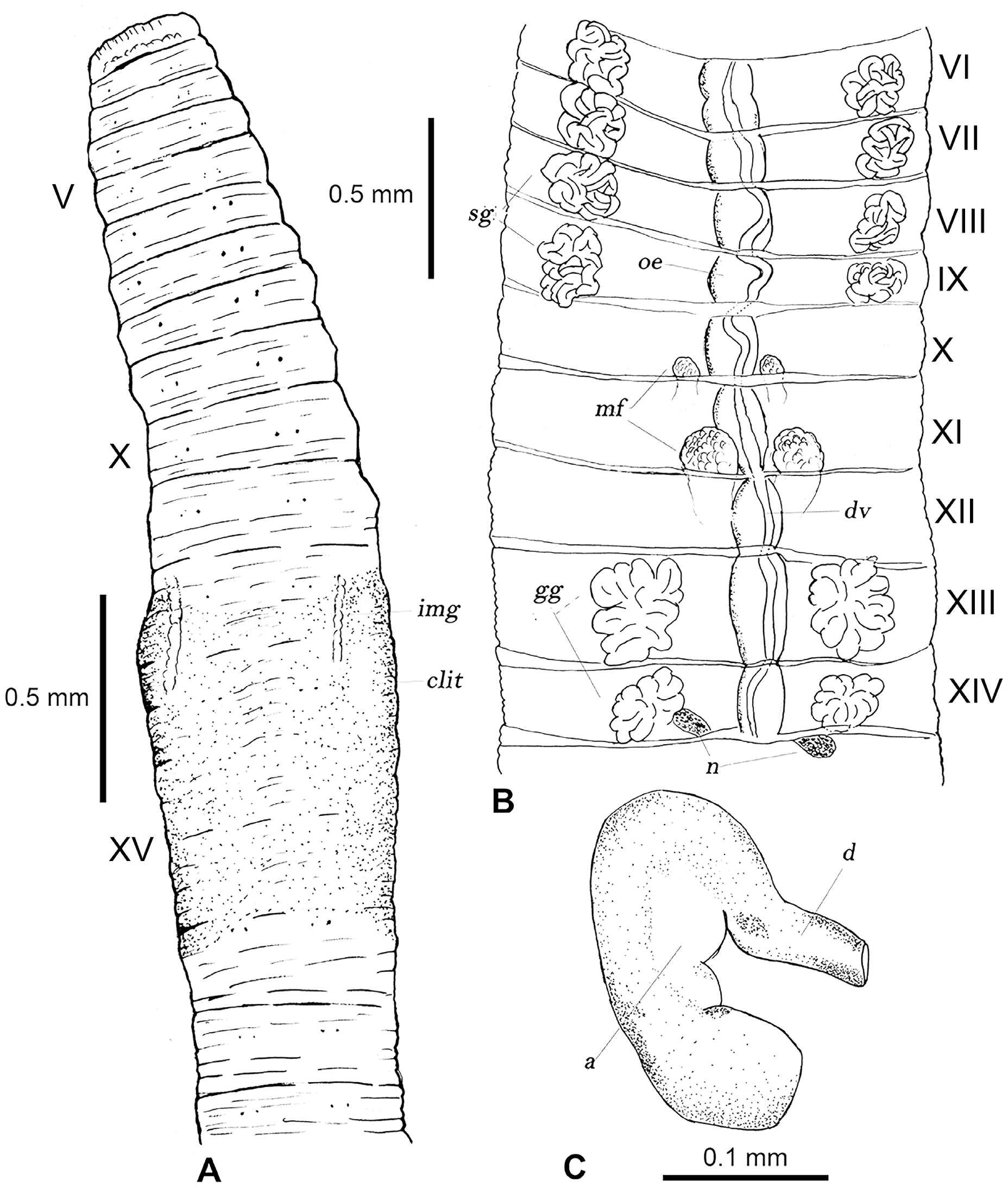
FIGURE 14. Lacandodrilus paludosus Fragoso & Rojas 2023. A. External view of the anterior ventral region of a clitellate adult. B. Internal view of the anterior region of an adult. C. Spermatheca. Abbreviations: a, ampulla: clit, clitellum; d, duct; dv, dorsal vessel; gg, genital glands (prostates?); img, internal male gonoducts; mf, male funnels; n, nephridia; oe, oesophagus; sg, septal glands. Modified from Fragoso & Rojas (2023).

Imageimage/png© Jamieson, Barrie G. M.;Fragoso, CarlosA monograph of the Oligochaete family Alluroididae

IMAGES

Gallery(7)

See Gallery

Occurrences with images

CITATIONS

References(7)

  • 1

    Beddard, F. E. (1894). A Contribution to our knowledge of the Oligochaeta of Tropical Eastern Africa. <em>Quarterly Journal of Microscopical Science.</em> 1894: 201-270.

    original descriptionWorld Register of Marine Species
  • 2

    Beddard, F. E. (1906). Report on the Oligochaeta. Zoological Results of the Third Tanganyika Expedition conducted by Dr. W. A. Cunnington, 1904-1905. <em>Proceedings of the Zoological Society of London.</em> [1906] p206-218.

    additional sourceWorld Register of Marine Species
  • 3

    Beddard, F.E. (1895). A monograph of the order of Oligochaeta. <em>[Book].</em> 769 pp. The Clarendon Press, Oxford.

    additional sourceWorld Register of Marine Species
  • 4

    Brinkhurst, R.O. (1964). A taxonomic revision of the Alluroididae (Oligochaeta). <em>Proceedings of the Zoological Society of London.</em> 142(3): 527-536.

    additional sourceWorld Register of Marine Species
  • 5

    Jamieson, B. G. M. (1968). A new species of Glyphidrilus (Microchaetidae: Oligochaeta) from East Africa. <em>Journal of Natural History.</em> 2(3): 387-395.

    additional sourceWorld Register of Marine Species
  • Source Information

    GBIF Backbone Taxonomy

    GBIF Backbone Taxonomy

    checklist

    The GBIF Backbone Taxonomy is a single, synthetic management classification with the goal of covering all names GBIF is dealing with. It's the taxonomic backbone that allows GBIF to integrate name based information from different resources, no matter if these are occurrence datasets, species pages, names from nomenclators or external sources like EOL, Genbank or IUCN. This backbone allows taxonomic search, browse and reporting operations across all those resources in a consistent way and to provide means to crosswalk names from one source to another.

    It is updated regulary through an automated process in which the Catalogue of Life acts as a starting point also providing the complete higher classification above families. Additional scientific names only found in other authoritative nomenclatural and taxonomic datasets are then merged into the tree, thus extending the original catalogue and broadening the backbones name coverage. The GBIF Backbone taxonomy also includes identifiers for Operational Taxonomic Units (OTUs) drawn from the barcoding resources iBOL and UNITE.

    International Barcode of Life project (iBOL), Barcode Index Numbers (BINs). BINs are connected to a taxon name and its classification by taking into account all names applied to the BIN and picking names with at least 80% consensus. If there is no consensus of name at the species level, the selection process is repeated moving up the major Linnaean ranks until consensus is achieved.

    UNITE - Unified system for the DNA based fungal species, Species Hypotheses (SHs). SHs are connected to a taxon name and its classification based on the determination of the RefS (reference sequence) if present or the RepS (representative sequence). In the latter case, if there is no match in the UNITE taxonomy, the lowest rank with 100% consensus within the SH will be used.

    The GBIF Backbone Taxonomy is available for download at https://hosted-datasets.gbif.org/datasets/backbone/ in different formats together with an archive of all previous versions.

    The following 105 sources have been used to assemble the GBIF backbone with number of names given in brackets:

    • Catalogue of Life Checklist - 4766428 names
    • International Barcode of Life project (iBOL) Barcode Index Numbers (BINs) - 635951 names
    • UNITE - Unified system for the DNA based fungal species linked to the classification - 611208 names
    • The Paleobiology Database - 212054 names
    • World Register of Marine Species - 188857 names
    • The Interim Register of Marine and Nonmarine Genera - 183894 names
    • The World Checklist of Vascular Plants (WCVP) - 131891 names
    • GBIF Backbone Taxonomy - 114350 names
    • TAXREF - 109374 names
    • The Leipzig catalogue of vascular plants - 75380 names
    • ZooBank - 73549 names
    • Integrated Taxonomic Information System (ITIS) - 68377 names
    • Plazi.org taxonomic treatments database - 61346 names
    • Genome Taxonomy Database r207 - 60545 names
    • International Plant Names Index - 52329 names
    • Fauna Europaea - 45077 names
    • The National Checklist of Taiwan (Catalogue of Life in Taiwan, TaiCoL) - 36193 names
    • Dyntaxa. Svensk taxonomisk databas - 35892 names
    • The Plant List with literature - 32692 names
    • United Kingdom Species Inventory (UKSI) - 29643 names
    • Artsnavnebasen - 29208 names
    • The IUCN Red List of Threatened Species - 21221 names
    • Afromoths, online database of Afrotropical moth species (Lepidoptera) - 13961 names
    • Brazilian Flora 2020 project - Projeto Flora do Brasil 2020 - 13829 names
    • Prokaryotic Nomenclature Up-to-Date (PNU) - 10079 names
    • Checklist Dutch Species Register - Nederlands Soortenregister - 8814 names
    • ICTV Master Species List (MSL) - 7852 names
    • Cockroach Species File - 6020 names
    • GRIN Taxonomy - 5882 names
    • Taxon list of fungi and fungal-like organisms from Germany compiled by the DGfM - 4570 names
    • Catalogue of Afrotropical Bees - 3623 names
    • Catalogue of Tenebrionidae (Coleoptera) of North America - 3327 names
    • Checklist of Beetles (Coleoptera) of Canada and Alaska. Second Edition. - 3312 names
    • Systema Dipterorum - 2850 names
    • Catalogue of the Pterophoroidea of the World - 2807 names
    • The Clements Checklist - 2675 names
    • Taxon list of Hymenoptera from Germany compiled in the context of the GBOL project - 2496 names
    • IOC World Bird List, v13.2 - 2366 names
    • Official Lists and Indexes of Names in Zoology - 2310 names
    • National checklist of all species occurring in Denmark - 1922 names
    • Myriatrix - 1876 names
    • Database of Vascular Plants of Canada (VASCAN) - 1822 names
    • Taxon list of vascular plants from Bavaria, Germany compiled in the context of the BFL project - 1771 names
    • Orthoptera Species File - 1742 names
    • A list of the terrestrial fungi, flora and fauna of Madeira and Selvagens archipelagos - 1602 names
    • Aphid Species File - 1565 names
    • World Spider Catalog - 1561 names
    • Taxon list of Jurassic Pisces of the Tethys Palaeo-Environment compiled at the SNSB-JME - 1270 names
    • Backbone Family Classification Patch - 1143 names
    • GBIF Algae Classification - 1100 names
    • International Cichorieae Network (ICN): Cichorieae Portal - 975 names
    • Psocodea Species File - 803 names
    • New Zealand Marine Macroalgae Species Checklist - 787 names
    • Annotated checklist of endemic species from the Western Balkans - 754 names
    • Taxon list of animals with German names (worldwide) compiled at the SMNS - 503 names
    • Catalogue of the Alucitoidea of the World - 472 names
    • Lygaeoidea Species File - 462 names
    • Catálogo de Plantas y Líquenes de Colombia - 422 names
    • GBIF Backbone Patch - 317 names
    • Phasmida Species File - 259 names
    • Cortinariaceae fetched from the Index Fungorum API - 234 names
    • Coreoidea Species File - 233 names
    • GTDB supplement - 139 names
    • Mantodea Species File - 119 names
    • Endemic species in Taiwan - 93 names
    • Taxon list of Araneae from Germany compiled in the context of the GBOL project - 88 names
    • Species of Hominidae - 78 names
    • Taxon list of Sternorrhyncha from Germany compiled in the context of the GBOL project - 77 names
    • Taxon list of mosses from Germany compiled in the context of the GBOL project - 75 names
    • Mammal Species of the World - 73 names
    • Plecoptera Species File - 71 names
    • Species Fungorum Plus - 64 names
    • Catalogue of the type specimens of Cosmopterigidae (Lepidoptera: Gelechioidea) from research collections of the Zoological Institute, Russian Academy of Sciences - 47 names
    • Species named after famous people - 41 names
    • Dermaptera Species File - 36 names
    • Taxon list of Trichoptera from Germany compiled in the context of the GBOL project - 34 names
    • True Fruit Flies (Diptera, Tephritidae) of the Afrotropical Region - 33 names
    • Range and Regularities in the Distribution of Earthworms of the Earthworms of the USSR Fauna. Perel, 1979 - 32 names
    • Taxon list of Diplura from Germany compiled in the context of the GBOL project - 30 names
    • Lista de referencia de especies de aves de Colombia - 2022 - 24 names
    • Taxon list of Auchenorrhyncha from Germany compiled in the context of the GBOL project - 20 names
    • Catalogue of the type specimens of Polycestinae (Coleoptera: Buprestidae) from research collections of the Zoological Institute, Russian Academy of Sciences - 19 names
    • Taxon list of Thysanoptera from Germany compiled in the context of the GBOL project - 19 names
    • Lista de especies de vertebrados registrados en jurisdicción del Departamento del Huila - 18 names
    • Taxon list of Microcoryphia (Archaeognatha) from Germany compiled in the context of the GBOL project - 15 names
    • Catalogue of the type specimens of Bufonidae and Megophryidae (Amphibia: Anura) from research collections of the Zoological Institute, Russian Academy of Sciences - 12 names
    • Grylloblattodea Species File - 11 names
    • Coleorrhyncha Species File - 9 names
    • Taxon list of liverworts from Germany compiled in the context of the GBOL project - 9 names
    • Embioptera Species File - 7 names
    • Taxon list of Pisces and Cyclostoma from Germany compiled in the context of the GBOL project - 6 names
    • Taxon list of Pteridophyta from Germany compiled in the context of the GBOL project - 6 names
    • Taxon list of Siphonaptera from Germany compiled in the context of the GBOL project - 5 names
    • The Earthworms of the Fauna of Russia. Perel, 1997 - 5 names
    • Taxon list of Zygentoma from Germany compiled in the context of the GBOL project - 4 names
    • Asiloid Flies: new taxa of Diptera: Apioceridae, Asilidae, and Mydidae - 3 names
    • Taxon list of Protura from Germany compiled in the context of the GBOL project - 3 names
    • Taxon list of hornworts from Germany compiled in the context of the GBOL project - 2 names
    • Chrysididae Species File - 1 names
    • Taxon list of Dermaptera from Germany compiled in the context of the GBOL project - 1 names
    • Taxon list of Diplopoda from Germany in the context of the GBOL project - 1 names
    • Taxon list of Orthoptera (Grashoppers) from Germany compiled at the SNSB - 1 names
    • Taxon list of Pscoptera from Germany compiled in the context of the GBOL project - 1 names
    • Taxon list of Pseudoscorpiones from Germany compiled in the context of the GBOL project - 1 names
    • Taxon list of Raphidioptera from Germany compiled in the context of the GBOL project - 1 names

    GBIF Secretariat (2023). GBIF Backbone Taxonomy. Checklist dataset https://doi.org/10.15468/39omei accessed via GBIF.org on 2026-06-14.

    CC BYPublished 8/28/2023View dataset
    GBIF Usage Key
    2308692
    Dataset Key
    d7dddbf4-2cf0-4f39-9b2a-bb099caae36c
    Origin
    source
    Backbone Key
    2308692
    Taxon ID
    gbif:2308692
    Last Crawled
    8/22/2023
    Last Interpreted
    8/22/2023