
AnimaliaNot EvaluatedacceptedspeciesAcceptedRestricted
Chrysopetalum elegantoides

Chrysopetalum elegantoides

Aguado, Capa & San Martín, 2003

GBIF:2312813

0countries
0year

PROFILE

Species Profile

Habitat

Marine

Characteristics

Extant

ABOUT

Descriptions(10)

Description. Based on the best-preserved specimen (ECOSUR- 2991): complete with 78 segments. TL = 10.2 mm, TW = 1.5 mm. Body long, broad, tapered posteriorly (Fig. 20 A). Body whitish to pale yellow. Paleae fan bright yellow, slightly imbricated dorsally. Prostomium visible between the first two segments. Lateral antennae short, inserted on the antero-ventral prostomial margin, median antenna slightly shorter than lateral ones, inserted in front of the first pair of eyes. Eyes red-violet, two pairs, first pair larger. Nuchal organ, small, not covering the prostomium (Fig. 20 B). Palps long, cylindrical, visible in dorsal view. Mouth fold large, placed between segment 3 and 4. Pharynx eversible, not exposed, stylets thick. Parapodium from segment 35, notochaetae in three main groups (Fig. 20 E). Notochaetae: lateral group inserted below notaciculum, 2 – 6 paleae, narrow and asymmetrical, with 2 – 3 (4) internal ribs and 1 raised rib (Fig. 20 G). Main group, 10 – 14 paleae; lateral-most paleae, slender and asymmetrical, with (4) 5 – 6 internal ribs and 0 – 1 raised rib (Fig. 20 H); mid-most paleae, asymmetrical or symmetrical, with (5) 6 – 7 (8) internal ribs (Fig. 20 I); midlinemost paleae, broad and asymmetrical, with 6 – 7 internal ribs (Fig. 20 J). Median group, 2 – 4 paleae, shorter, narrow and asymmetrical, with 3 – 4 internal ribs and 1 raised rib (Fig. 20 K). All paleal groups with margins markedly serrated, including the small dorsal spines (Fig. 20 F); paleal dorsal surface ornamented with tiny tubercles. Neuropodium conical, longer than notopodium. Neurochaetae: unit 1, 1 – 2 falcigers, blades straight and long, 14 – 15 times longer than wide (Fig. 20 L). Unit 2, 7 – 8 falcigers, blades straight and medium-sized, 6 – 7 times longer than wide (Fig. 20 M). Unit 3, 5 – 6 falcigers, blades straight and medium-sized, 5 – 7 times longer than wide (Fig. 20 N). Unit 4, 4 – 5 falcigers, blades straight and short, 4 – 5 times longer than wide. Pygidium rounded with two anal cirri (Fig. 20 C). Oocyte size: 25.6 – 30 µm (n = 4) (Fig. 20 D). Habitat. Intertidal to subtidal (1 – 11.7 m). Specimens of this species were collected in rocks, dead coral, pier piles, and as epibionts on sponge, mollusk, and sabellariids tubes. The species has been collected on living and dead coral, coarse sand and pier piles (Aguado et al. 2003; Cruz-Gómez & Bastida-Zavala 2018).
A new genus and seven new species of chrysopetalids (Annelida, Chrysopetalidae) from the Tropical Eastern Pacific
Figs 20, 25, 26
A new genus and seven new species of chrysopetalids (Annelida, Chrysopetalidae) from the Tropical Eastern Pacific
Remarks. The specimens of C. elegantoides revised herein agree with the description by Aguado et al. (2003). Originally, Aguado et al. (2003) stated that specimens of C. elegantoides lack interramal gland, and this feature was used to differentiate it from other related species such as C. elegans Bush in Verrill, 1910. However, the morphological significance should be reevaluated in order to confirm if the feature is useful to separate species. According to Watson (Pers. Comm. 2020), the development of the interramal gland, along with the cirrophoral gland, depends on the maturity of the specimen examined.
A new genus and seven new species of chrysopetalids (Annelida, Chrysopetalidae) from the Tropical Eastern Pacific
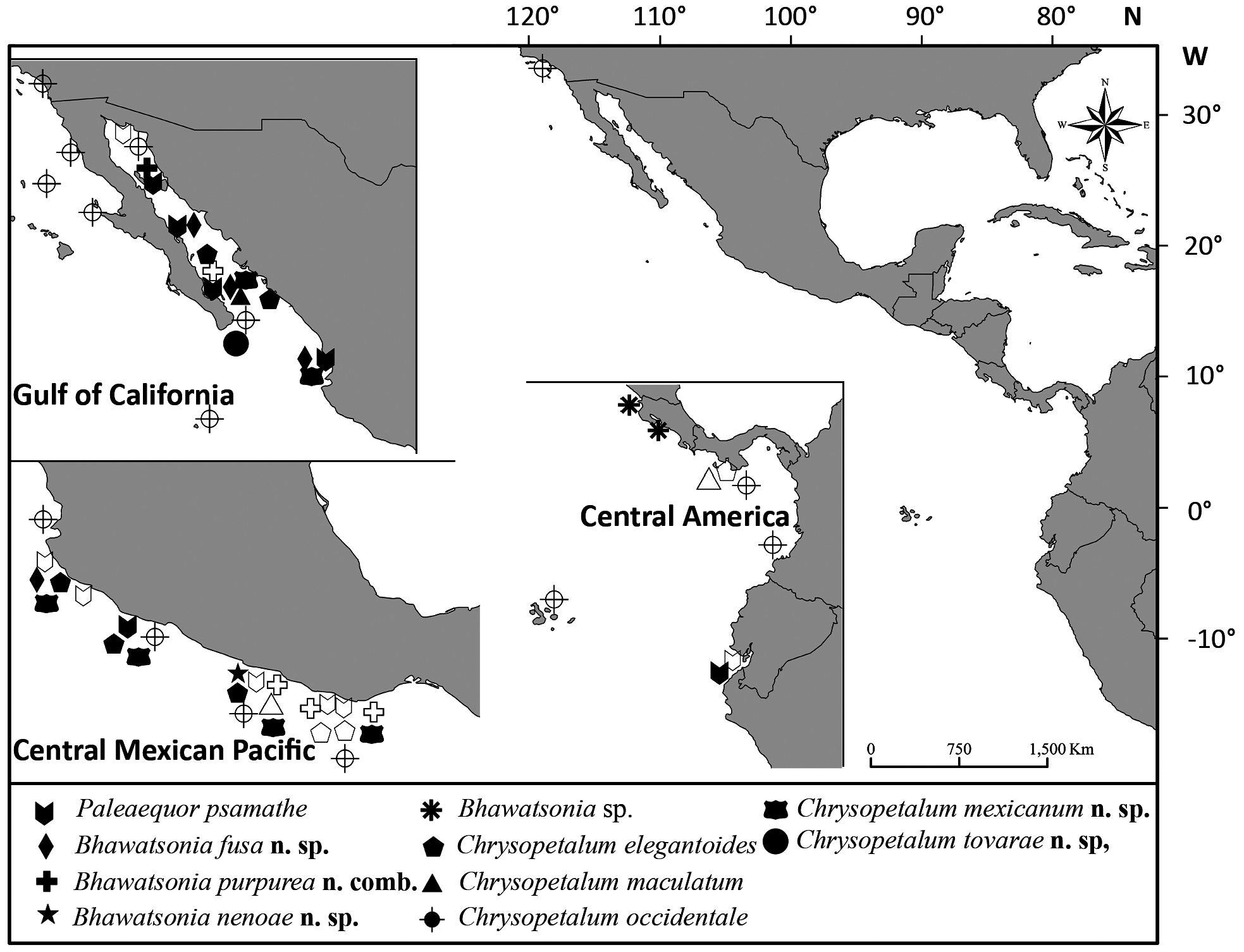
Distribution. From La Paz Bay, Baja California Sur to Uvas Island, Panama (Fig. 26).
A new genus and seven new species of chrysopetalids (Annelida, Chrysopetalidae) from the Tropical Eastern Pacific
Type locality: Rosario Beach, Coiba Island, Panamá, on dead coral at 2.5 m (Aguado et al. 2003). Material examined. Nine specimens. Baja California Sur: ECOSUR- 2991, El Caimancito Beach, February 29, 2004; ECOSUR- 2981, La Paz Bay, 1 m, March 02, 2004. Sinaloa: UANL- 0046, 2 spec. Mazatlán, July 18, 1985, coll. SSV. Jalisco: ECOSUR-XXX Melaque, December 01, 2004. Michoacán: UMAR-Poly 938, 2 spec. Caleta de Campos, pier piles, 3 m, October 7, 1994, coll. RBZ & SGM. Guerrero: ECOSUR- 3001, Los Cantiles, 5 m, May 26, 2000; ECOSUR-P 2985, La Quebrada, on Pinctada sp., 2 m, May 25, 2000; ECOSUR-PXXX, La Quebrada, on Pinctada sp., 6 m, May 25, 2002, coll. AM; UMAR-Poly 939, 2 spec. Coral Beach, 17 º 40 ’ 36 ” N, 101 º 39 ’ 22 ” O, Ixtapa, on dead coral, 1. 5 m, September 19, 2007, coll. SGM et al. Oaxaca: ECOSUR- 2993, La Entrega, on stromatolite, 3 m, May 23, 2000; UMAR-Poly 940, Estacahuite Bay, 15 º 40´05 ” N, 96 º 28´56 ” W, on dead coral, June 3, 2007, coll. JJG & PHM; UMAR-Poly 941, Corralero Lagoon, 16 º 14´11 ” N, 98 º 11´36 ” W, on sand, June 18, 2009, coll. JMM & JRC.
A new genus and seven new species of chrysopetalids (Annelida, Chrysopetalidae) from the Tropical Eastern Pacific
(Figures 4 A – J, 5, 8, 14 F, 15 C)
Chrysopetalids (Phyllodocida: Chrysopetalidae) from the southern Mexican Pacific, including a new species
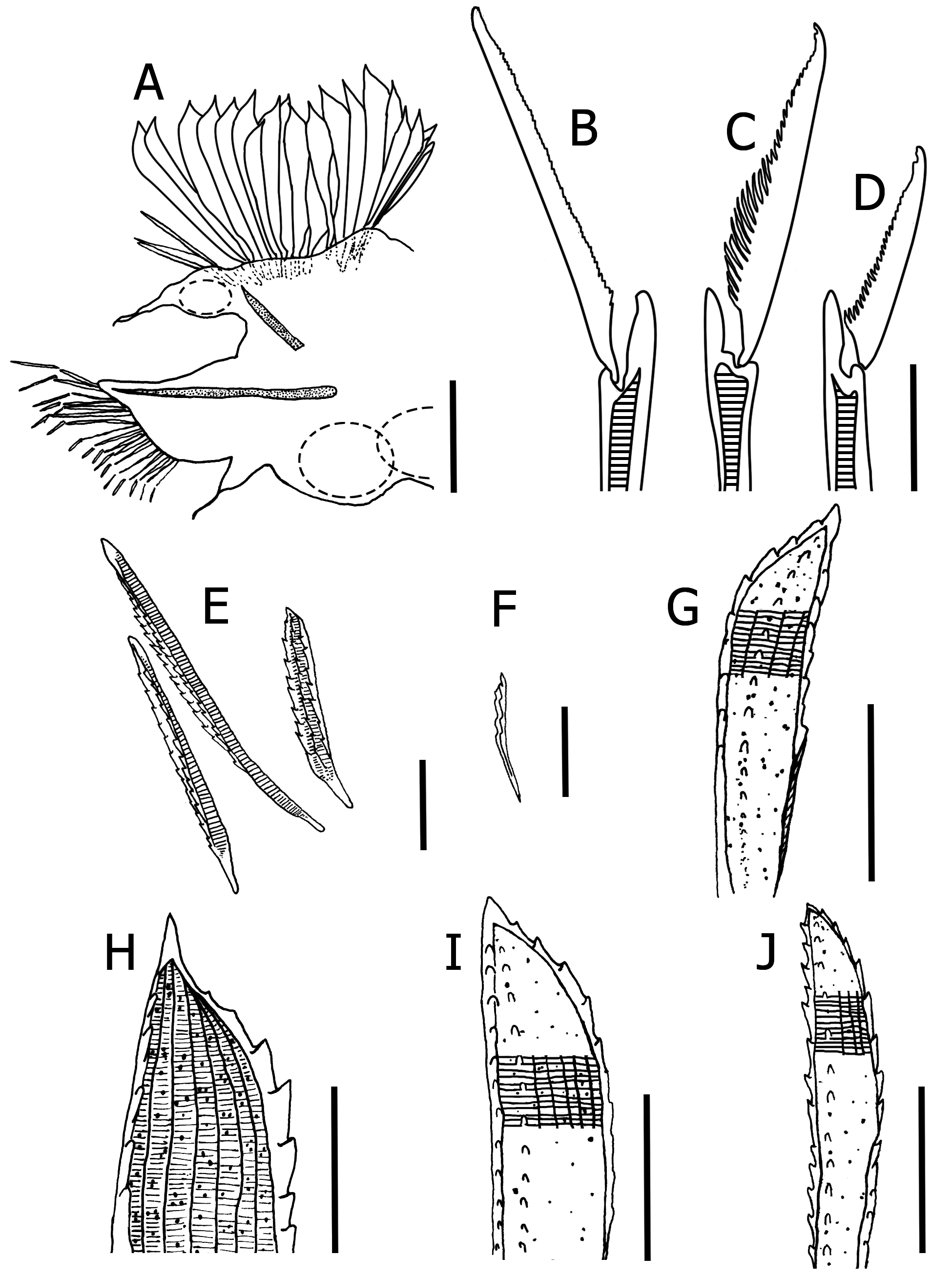
Description. Based mainly on the largest complete specimen, 8.7 mm long, 1.3 mm wide, 68 segments. Body rectangular and wide in the most anterior segments. Body yellow to orange. Paleae fans yellow and iridescent, slightly imbricated over dorsum. Prostomium rounded and completely visible among the first four segments. Two lateral subulate antennae; a small median antenna inserted between two pairs of eyes. Two pairs of reddish eyes, first pair slightly larger than second pair. Nuchal fold smaller than prostomium. Two pear-shaped palps, visible under the lateral antennae. Small and subtriangular mouth fold between third and fourth segment. Eversible proboscis with two slim stylet. Parapodium from the tenth segment. Notochaetae separate in three main groups and two subgroups (Fig. 4 A). Lateral group inserted over the dorsal notoaciculum, comprising 3 – 6 slender and symmetrical paleae with 2 – 5 ribs and one raised rib (Fig. 4 E); over dorsal cirrus 3 – 5 small and slender spines (Fig. 4 F). As sub-unit 1, 1 – 2 asymmetrical and serrated paleae with 6 – 7 ribs and one raised rib (Fig. 4 G). Main group, comprising 12 – 15 asymmetrical and strongly serrated paleae with 5 – 7 raised ribs (Fig. 4 H). As sub-unit 2, three larger paleae (1 / 4 larger than main paleae) with 6 – 7 ribs and one raised rib (Fig. 4 I). Median group, comprising 3 – 4 symmetrical and spine-like paleae, slightly smaller than main paleae with 4 – 5 ribs and 1 raised rib (Fig. 4 J). The serration on all paleae groups is present in both lateral margins of each palea, in main and median group the serration is more marked only in one side margin. Neuropodium large and leaf-shape. Heterogomph neurochaetae composed of three groups (Figs 4 B – D). Neurochaetiger with 1 – 3 superior spinigers with a serrated straight blade. First three segments neurochaetaewith superior spinigers only. Mid-superior group and mid-inferior group indistinguishable, composed of 13 – 16 falcigers with medium and toothed blades (1 / 2 of spiniger blade length). Inferior group of 3 – 4 falcigers with short and serrated blades (1 / 4 of spiniger blade length). Pygidium rounded, with two anal cirri. Habitat. Intertidal to subtidal (0.5 – 11.7 m). Collected from sponges, pier pilings, as epibionts of mollusks, in dead coral and rocks.
Chrysopetalids (Phyllodocida: Chrysopetalidae) from the southern Mexican Pacific, including a new species
Remarks. Chrysopetalum elegantoides was described from the Pacific coast of Panama. The specimens from Oaxaca accord with the description by Aguado et al. (2003). Nevertheless, we noticed possible intraspecific differences in the number of dorsal paleae. For comparison purposes, 14 complete specimens of Chrysopetalum elegantoides Aguado, Capa & San Martín, 2003, were measured: total length and total number of dorsal paleae from the 15 th segment. An average was obtained from the number of paleae from the left and the right bundles, assuming that descriptions of chrysopetalids paleae are based on the number of paleae of these bundles. Through statistical analysis we confirmed that variability in the number of paleae is size related, showing a direct association of 79 % (t cal = 4.51, t 0.05 (12) = 1.79; p <0.05) (Fig. 5).
Chrysopetalids (Phyllodocida: Chrysopetalidae) from the southern Mexican Pacific, including a new species
Distribution. Central Pacific of America, from Ixtapa, Guerrero, to Uvas Island, coast of Panama (Aguado et al. 2003) (Fig. 8).
Chrysopetalids (Phyllodocida: Chrysopetalidae) from the southern Mexican Pacific, including a new species
Material examined. Guerrero: ECOSUR-P 2939, five spec. (La Quebrada, Acapulco, 16 ° 50 ’ 47 ’’ N, 99 ° 54 ’ 55 ’’ W, on Pinctada mazatlanica (Hanley, 1856), 6 m, May 25, 2000, coll. A. Medina); ECOSUR-P 2940, one spec. (Los Cantiles, Acapulco, 16 ° 50 ’ 45 ’’ N, 99 ° 54 ’ 55 ’’ W, on bivalve shells, 8 m, May 26, 2000, coll. A. Medina); UMAR- Poly 856, five spec. (Coral Beach, Ixtapa, 17 ° 40 ’ 36 ’’ N, 101 ° 39 ’ 22 ’’ W, on dead coral, 4 m, September 19, 2007, coll. M. S García-Madrigal); UMAR-Poly 857, one spec. (La Ropa Beach, 17 ° 37 ’ 37 ’’ N, 101 ° 32 ’ 46 ’’ W, rocks, 0.5 m, September 19, 2007, coll. M. S. García-Madrigal); UMAR-Poly 858, four spec. (Manzanillo Beach, 16 ° 50 ’ 31 ’ N, 99 ° 54 ’ 37 ’’ W, on sponge from pier piling, 4 m, September 21, 2007, coll. M. S. García-Madrigal); UMAR-Poly 859, two spec. (La Quebrada, Acapulco, 16 ° 50 ’ 45 ’’ N, 99 ° 54 ’ 55 ’’ W, September 21, 2007, coll. M. S. García-Madrigal); UMAR-Poly 860, four spec. (La Roqueta Island, Acapulco, 16 ° 49 ’ 21 ’’ N, 99 ° 54 ’ 29 ’’ W, 0 – 4 m, September 21, 2007, coll. M. S. García-Madrigal); UMAR-Poly 861, one spec. (Zacatoso, 17 ° 03 ’ 46 ’’ N, 100 ° 19 ’ 46 ’’ W, on stony coral, 9.1 m, December 1, 2010, coll. S. D. Güenduláin); UMAR-Poly 862, one spec. (Caleta de Chón, 17 ° 36 ’ 49 ’’ N, 101 ° 33 ’ 18 ’’ W, on stony coral, 4.3 – 6.1 m, December 2, 2010, coll. S. D. Güenduláin); UMAR-Poly 863, three spec. (Morros de Potosí, 17 ° 38 ’ 49 ’’ N, 101 ° 37 ’ 44 ’’ W, on Pocillopora damicornis (Linnaeus, 1758), 6.1 – 11.7 m, December 3, 2010, coll. S. D. Güenduláin); UMAR-Poly 864, two spec. (Morros de Potosí, 17 ° 38 ’ 49 ’’ N, 101 ° 37 ’ 44 ’’ W, on P. damicornis, 11.7 m, December 7, 2010, coll. S. D. Güenduláin & R. N.); Oaxaca: ECOSUR-P 0339, one spec. (Tangolunda Bay, Huatulco, 15 ° 46 ’ 20 ’’ N, 96 ° 05 ’ 49 ’’ W, on coral, April 1, 1986, coll. G. Sandoval); UMAR-Poly 865, three spec. (El Arrocito Beach, 15 ° 45 ’ 38 ’’ N, 96 ° 06 ’ 00 ’’ W, on dead coral, 3 m, May 25, 2000, coll. J. R. Bastida- Zavala); UMAR-Poly 866, six spec. (Estacahuite Bay, 15 ° 40 ’ 05 ’’ N, 96 ° 28 ’ 56 ’’ W, dead coral, 3 m, April 9, 2005, coll. J. R. Bastida-Zavala et al.); UMAR-Poly 867, three spec. (La Tijera, 15 ° 41 ’ 14 ’’ N, 96 ° 26 ’ 34 ’’ W, on dead coral, 3 m, April 30, 2005, coll. J. R. Bastida-Zavala); UMAR-Poly 868, one spec. (Estacahuite Bay, 15 ° 40 ’ 05 ’’ N, 96 ° 28 ’ 56 ’’ W, on rocks, 3 m, July 30, 2005, coll. G. Ruíz-Cancino); UMAR-Poly 869, five spec. (Estacahuite Bay, 15 ° 40 ’ 05 ’’ N, 96 ° 28 ’ 56 ’’ W, on dead coral, 1 m, September 10, 2005, coll. J. R. Bastida-Zavala et al.); UMAR-Poly 870, four spec. (Estacahuite Bay, 15 ° 40 ’ 05 ’’ N, 96 ° 28 ’ 56 ’’ W, on rocks, 3 m, August 25, 2006, coll. J. R. Bastida-Zavala et al.); UMAR-Poly 871, thirty eight spec. (La Tijera, 15 ° 41 ’ 14 ’’ N, 96 ° 26 ’ 34 ’’ W, on dead coral, 2 – 4 m, September 12, 2006, coll. J. R. Bastida-Zavala); UMAR-Poly 872, sixteen spec. (Estacahuite Bay, 15 ° 40 ’ 05 ’’ N, 96 ° 28 ’ 56 ’’ W, 4 m, December 1, 2006, coll. M. S. García-Madrigal); UMAR-Poly 873, one spec. (mouth of Corralero Lagoon, 16 ° 14 ’ 11 ’’ N, 98 ° 11 ’ 36 ’’ W, on sabellariid tubes, 1 m, December 8, 2006, coll. J. R. Bastida-Zavala et al.); UMAR-Poly 874, one spec. (Panteón Beach, 15 ° 39 ’ 50 ’’ N, 96 ° 29 ’ 43 ’’ W, on dead coral, March 31, 2007, coll. Y. Solís & P. Maza); UMAR-Poly 875, two spec. (main pier, Puerto Ángel, 15 ° 39 ’ 55 ’’ N, 96 ° 29 ’ 28 ’’ W, on dock pilings, 0.5 m, May 20, 2007, coll. F. Cortés-Carrasco); UMAR-Poly 876, one spec. (El Arrocito Beach, 15 ° 45 ’ 38 ’’ N, 96 ° 06 ’ 00 ’’ W, July 4, 2007, coll. B. Martínez et al.); UMAR-Poly 877, one spec. (Chacahua Lagoon, 15 ° 58 ’ 07 ’’ N, 97 ° 41 ’ 01 ’’ W, on rocks, intertidal, November 10, 2007, coll. P. Hernández); UMAR-Poly 878, two spec. (Chacahua Lagoon, 15 ° 58 ’ 07 ’’ N, 97 ° 41 ’ 01 ’’ W, on sabellariid colony, 0.5 m, April 3, 2008, coll. J. Jarquín); UMAR-Poly 879, one spec. (Chacahua Lagoon, 15 ° 58 ’ 07 ’’ N, 97 ° 41 ’ 01 ’’ W, on artificial mount, April 3, 2008, coll. J. Jarquín); UMAR-Poly 880, two spec. (La Tijera, 15 ° 41 ’ 14 ’’ N, 96 ° 26 ’ 34 ’’ W, on dead coral, 3 m, April 17, 2009, coll. F. Cortés-Carrasco); UMAR-Poly 881, six spec. (Montosa Island, 15 ° 45 ’ 52 ’’ N, 96 ° 05 ’ 04 ’’ W, on Pocillopora damicornis, 2.7 – 5.8 m, February 22, 2010, coll. R. Granja-Fernández & S. D. Güenduláin); UMAR-Poly 882, two spec. (San Agustín Bay, 15 ° 41 ’ 23 ’’ N, 96 ° 14 ’ 05 ’’ W, on P. damicornis, 3.3 – 6.4 m, February 23, 2010, coll. R. Granja-Fernández & S. D. Güenduláin); UMAR-Poly 883, six spec. (Estacahuite Bay, 15 ° 40 ’ 05 ’’ N, 96 ° 28 ’ 56 ’’ W, on P. damicornis, 6.4 – 9.7 m, March 26, 2010, coll. A. López- Pérez & R. Zepeta); UMAR-Poly 884, four spec. (Salchi, 15 ° 40 ’ 05 ’’ N, 96 ° 28 ’ 56 ’’ W, stony coral, 6.1 – 7.9 m, March 26, 2010, coll. A. López-Pérez); UMAR-Poly 885, three spec. (Mazunte, 15 ° 39 ’ 42 ’’ N, 96 ° 33 ’ 21 ’’ W, on stony coral, 4.5 m, June 3, 2010); UMAR-Poly 886, six spec. (Mazunte, 15 ° 39 ’ 42 ’’ N, 96 ° 33 ’ 21 ’’ W, on P. damicornis, 7.5 m, August 11, 2010, coll. A. López-Pérez & R. Zepeta).
Chrysopetalids (Phyllodocida: Chrysopetalidae) from the southern Mexican Pacific, including a new species

Export occurrence data

Darwin Core Archive (ZIP)

GEOGRAPHY

Distribution Map

Occurrence Map

Loading map…

Tiles © GBIF Maps API | Map powered by MapLibre GL

REGIONS

Geographic Distribution(3)

Panamanian Exclusive Economic Zone
Panamanian Exclusive Economic Zone(PA)

DATA

Occurrence Datasets

Loading datasets…

CLASSIFICATION

Taxonomic Classification Tree

MULTIMEDIA

Media Files(8)

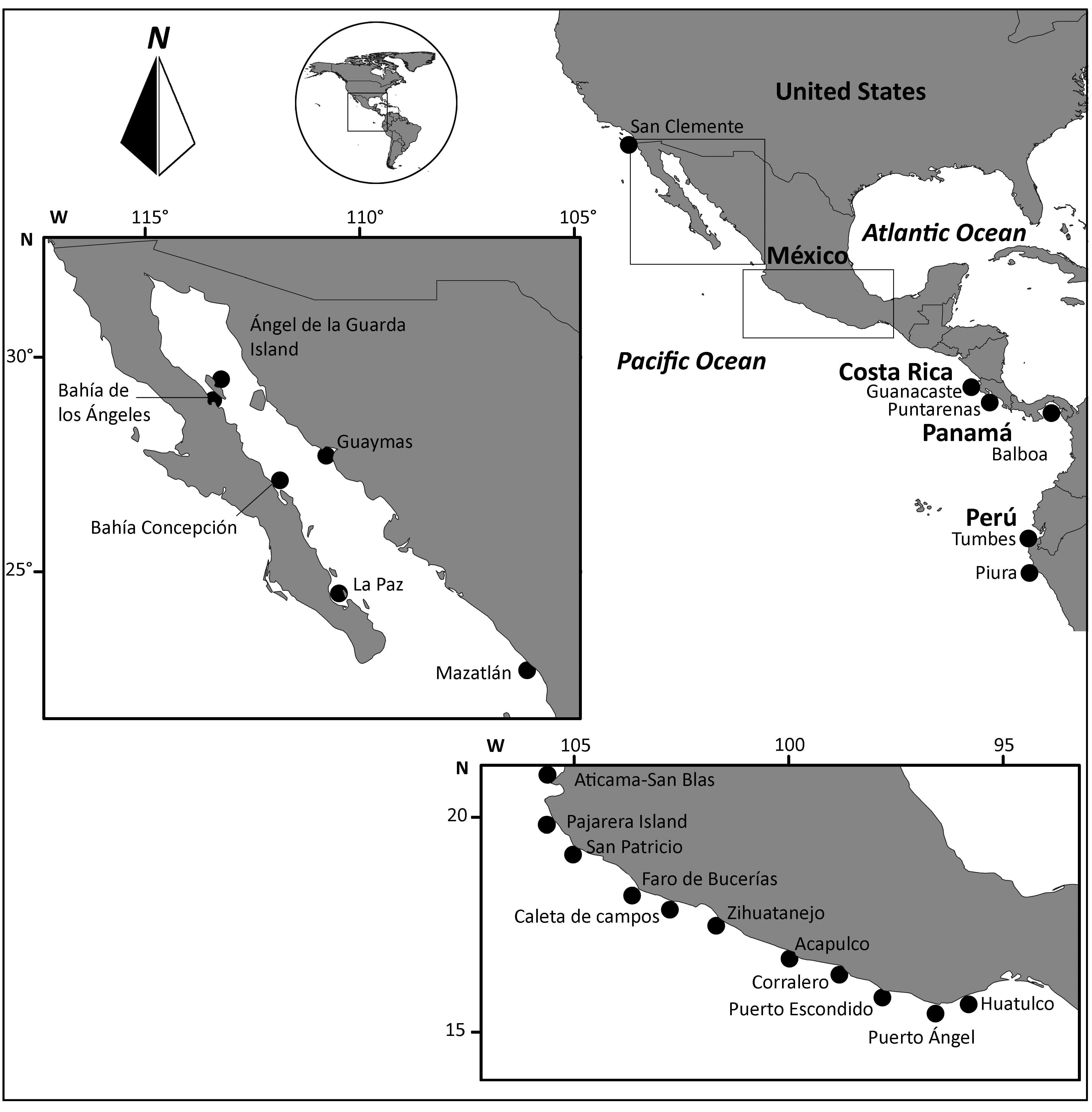
FIGURE 1. Study area. The Tropical Eastern Pacific, and southmost part of Warm Temperate Northern Pacific, with the names of the main localities.
Imageimage/png© Cruz-Gómez, ChristopherA new genus and seven new species of chrysopetalids (Annelida, Chrysopetalidae) from the Tropical Eastern Pacific

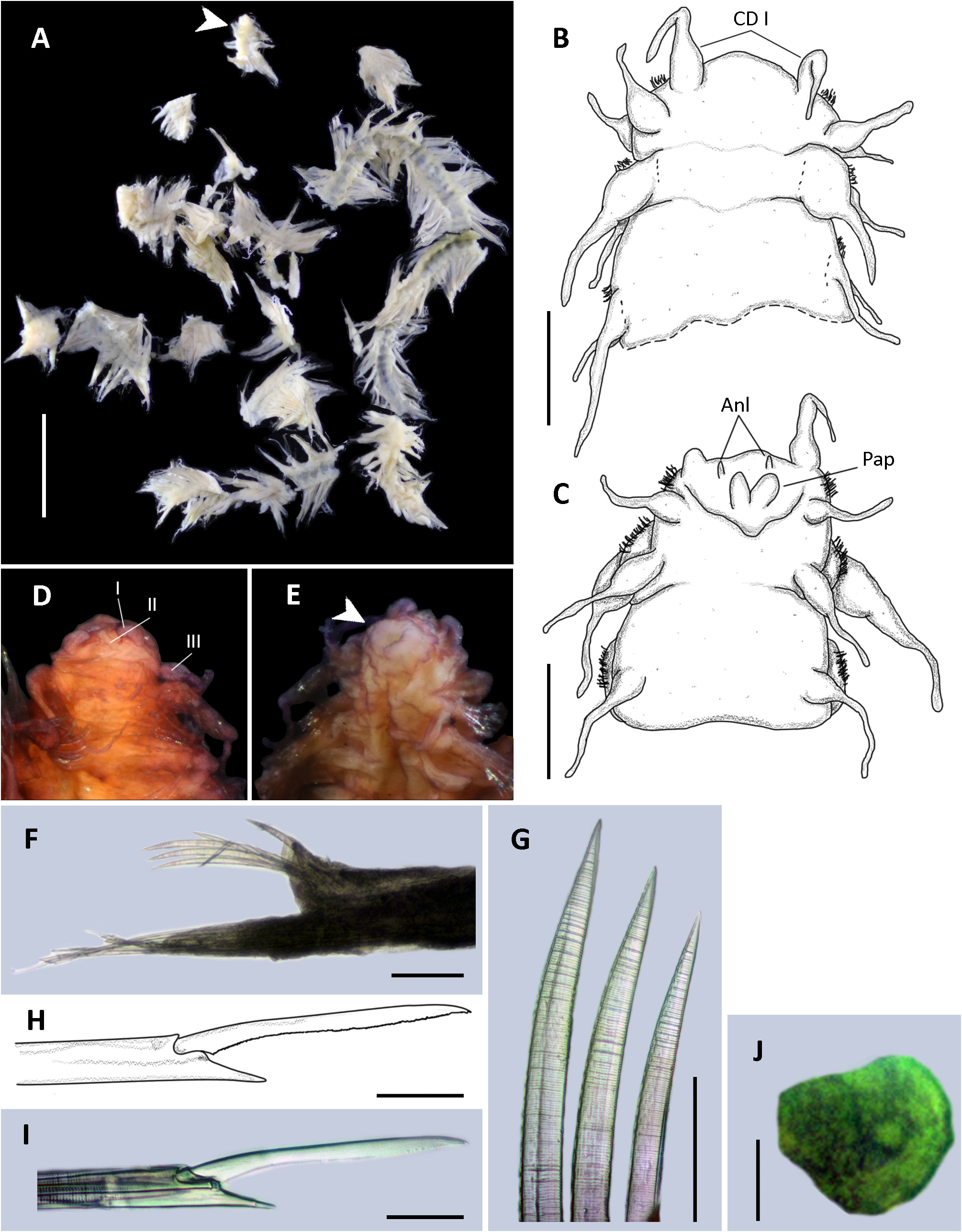
FIGURE 2. Boudemos cf. flokati, non-type specimen (ECOSUR-3006). A) Fragmented body, arrow indicates prostomium. B) Drawing of prostomium, dorsal view. C) Drawing of prostomium, ventral view. From a different specimen: D) Prostomium, dorsal view. E) Prostomium, ventral view, arrow indicates pharynx ring. F) Parapodium from segment 69. G) Detail of dorsal spines. H–I) Unit 1. J) Oocyte. Scales: 20 µm (J), 30 µm (GHI), 200 µm (BCF), 4 mm (A).

Imageimage/png© Cruz-Gómez, ChristopherA new genus and seven new species of chrysopetalids (Annelida, Chrysopetalidae) from the Tropical Eastern Pacific

FIGURE 20. Chrysopetalum elegantoides Aguado, Capa & San Martín, 2003, non-type specimen (ECOSUR-2991). A) Complete fragmented body. B) Drawing of prostomium, dorsal view. C) Drawing of pygidium, ventral view. D) Oocyte. E) Parapodium of segment 35. F) Drawing of dorsal spine. G) Lateral paleae. H) Main palea, lateral-most. I) Main palea, mid-most. J) Main paleae, midline-most. K) Median paleae. L) Unit 1. M) Unit 2. N) Unit 3. O) Unit 4. Scales: 5 µm (F), 10 µm (D), 20 µm (GHIJK), 50 µm (C), 100 µm (B), 200 µm (E), 1 mm (A).
Imageimage/png© Cruz-Gómez, ChristopherA new genus and seven new species of chrysopetalids (Annelida, Chrysopetalidae) from the Tropical Eastern Pacific

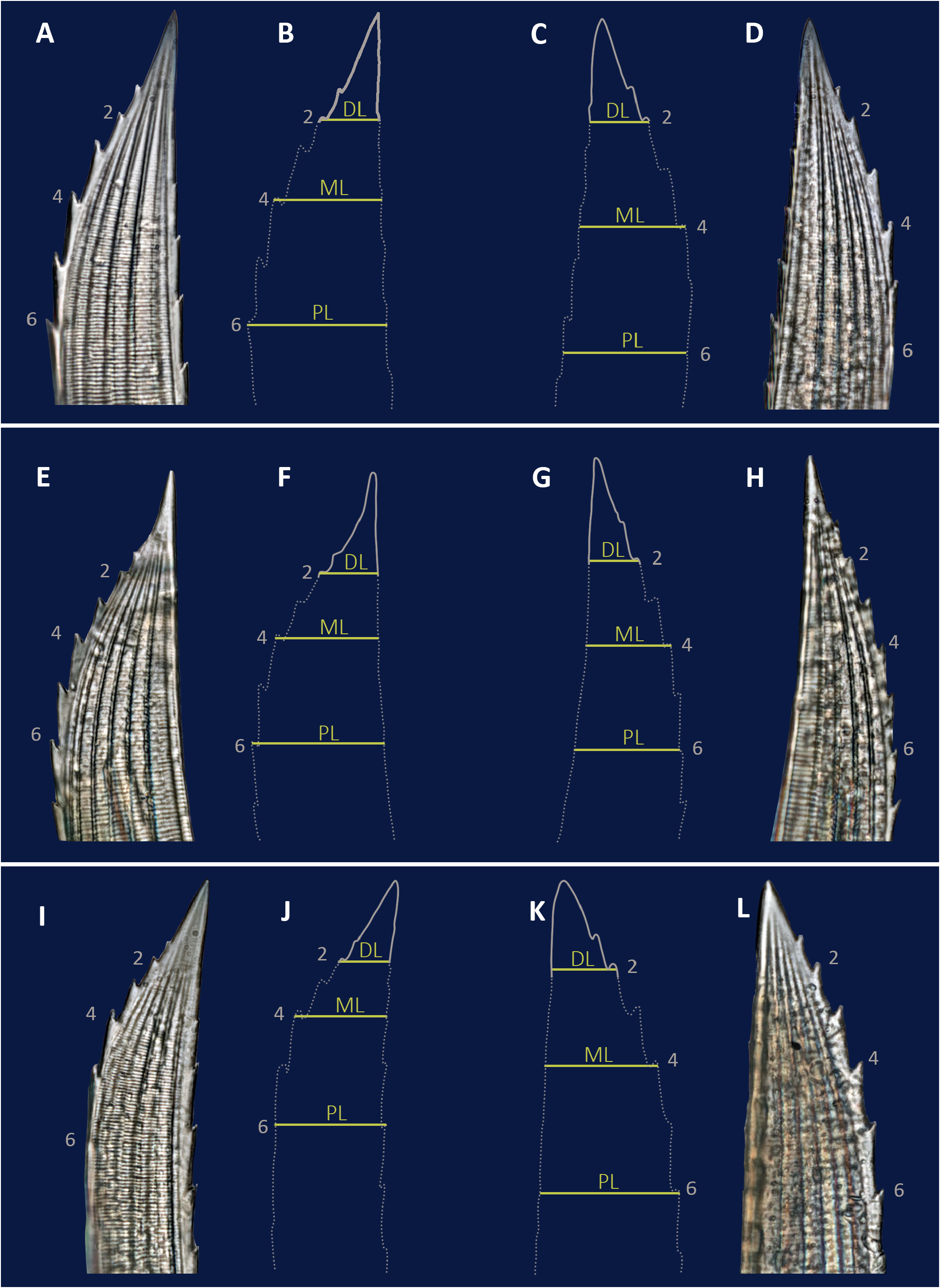
FIGURE 25. Apex of main paleae of some Chrysopetalum species from the Tropical Eastern Pacific, and the southernmost part of Warm Temperate Northeast Pacific. Chrysopetalum elegantoides Aguado, Capa & San Martín, 2003 (ECOSUR-3001). A) Main palea, lateral-most. B) Schematic of A. C) Schematic of D. D) Main paleae, midline-most. Chrysopetalum mexicanum n. sp. (ECOSUR-270). E) Main palea, lateral-most. F) Schematic of E. G) Schematic of H. H) Main paleae, midline-most. Chrysopetalum tovarae n. sp. (ECOSUR-273). I) Main palea, lateral-most. J) Schematic of I. K) Schematic of L. L) Main paleae, midline-most.
Imageimage/png© Cruz-Gómez, ChristopherA new genus and seven new species of chrysopetalids (Annelida, Chrysopetalidae) from the Tropical Eastern Pacific

FIGURE 26. Previous and new records of chrysopetalids in the Tropical Eastern Pacific. Empty symbols indicate historic records.
Imageimage/png© Cruz-Gómez, ChristopherA new genus and seven new species of chrysopetalids (Annelida, Chrysopetalidae) from the Tropical Eastern Pacific

FIGURE 4. Chrysopetalum elegantoides. A, parapodium middle segment; B–D, neurochaetal types; E, lateral paleae; F, spine G, subunit 1 palea; H, final tip of main palea; I, subunit 2 palea; J, median palea. Scale bars: 20 µm (HIJ), 30 µm (BCD) 50 µm (EFG), 200 µm (A).

Imageimage/png© Cruz-Gómez, Christopher;Bastida-Zavala, J. RolandoChrysopetalids (Phyllodocida: Chrysopetalidae) from the southern Mexican Pacific, including a new species

IMAGES

Gallery(8)

See Gallery

Occurrences with images

CITATIONS

References(3)

  • 1

    Aguado, M.T.; Capa, M. and San Martin, G. (2003). The genus Chrysopetalum Ehlers, 1864 (Annelida: Polychaeta: Chrysopetalidae) in the Pacific coast of Panama. <em>Proceedings of the Biological Society of Washington.</em> 116(1): 82-95.

    original descriptionWorld Register of Marine Species
  • 2

    Cruz-Gómez, Christopher. (2021). A new genus and seven new species of chrysopetalids (Annelida, Chrysopetalidae) from the Tropical Eastern Pacific. <em>Zootaxa.</em> 5068(1): 1-59.

    taxonomy sourceWorld Register of Marine SpeciesDOI: 10.11646/zootaxa.5068.1.1
  • 3

    Cruz-Gómez, Christopher; Bastida-Zavala, J. Rolando. (2018). Chrysopetalids (Phyllodocida: Chrysopetalidae) from the southern Mexican Pacific, including a new species. <em>Zootaxa.</em> 4521(1): 61-88.

    taxonomy sourceWorld Register of Marine Species
  • Source Information

    GBIF Backbone Taxonomy

    GBIF Backbone Taxonomy

    checklist

    The GBIF Backbone Taxonomy is a single, synthetic management classification with the goal of covering all names GBIF is dealing with. It's the taxonomic backbone that allows GBIF to integrate name based information from different resources, no matter if these are occurrence datasets, species pages, names from nomenclators or external sources like EOL, Genbank or IUCN. This backbone allows taxonomic search, browse and reporting operations across all those resources in a consistent way and to provide means to crosswalk names from one source to another.

    It is updated regulary through an automated process in which the Catalogue of Life acts as a starting point also providing the complete higher classification above families. Additional scientific names only found in other authoritative nomenclatural and taxonomic datasets are then merged into the tree, thus extending the original catalogue and broadening the backbones name coverage. The GBIF Backbone taxonomy also includes identifiers for Operational Taxonomic Units (OTUs) drawn from the barcoding resources iBOL and UNITE.

    International Barcode of Life project (iBOL), Barcode Index Numbers (BINs). BINs are connected to a taxon name and its classification by taking into account all names applied to the BIN and picking names with at least 80% consensus. If there is no consensus of name at the species level, the selection process is repeated moving up the major Linnaean ranks until consensus is achieved.

    UNITE - Unified system for the DNA based fungal species, Species Hypotheses (SHs). SHs are connected to a taxon name and its classification based on the determination of the RefS (reference sequence) if present or the RepS (representative sequence). In the latter case, if there is no match in the UNITE taxonomy, the lowest rank with 100% consensus within the SH will be used.

    The GBIF Backbone Taxonomy is available for download at https://hosted-datasets.gbif.org/datasets/backbone/ in different formats together with an archive of all previous versions.

    The following 105 sources have been used to assemble the GBIF backbone with number of names given in brackets:

    • Catalogue of Life Checklist - 4766428 names
    • International Barcode of Life project (iBOL) Barcode Index Numbers (BINs) - 635951 names
    • UNITE - Unified system for the DNA based fungal species linked to the classification - 611208 names
    • The Paleobiology Database - 212054 names
    • World Register of Marine Species - 188857 names
    • The Interim Register of Marine and Nonmarine Genera - 183894 names
    • The World Checklist of Vascular Plants (WCVP) - 131891 names
    • GBIF Backbone Taxonomy - 114350 names
    • TAXREF - 109374 names
    • The Leipzig catalogue of vascular plants - 75380 names
    • ZooBank - 73549 names
    • Integrated Taxonomic Information System (ITIS) - 68377 names
    • Plazi.org taxonomic treatments database - 61346 names
    • Genome Taxonomy Database r207 - 60545 names
    • International Plant Names Index - 52329 names
    • Fauna Europaea - 45077 names
    • The National Checklist of Taiwan (Catalogue of Life in Taiwan, TaiCoL) - 36193 names
    • Dyntaxa. Svensk taxonomisk databas - 35892 names
    • The Plant List with literature - 32692 names
    • United Kingdom Species Inventory (UKSI) - 29643 names
    • Artsnavnebasen - 29208 names
    • The IUCN Red List of Threatened Species - 21221 names
    • Afromoths, online database of Afrotropical moth species (Lepidoptera) - 13961 names
    • Brazilian Flora 2020 project - Projeto Flora do Brasil 2020 - 13829 names
    • Prokaryotic Nomenclature Up-to-Date (PNU) - 10079 names
    • Checklist Dutch Species Register - Nederlands Soortenregister - 8814 names
    • ICTV Master Species List (MSL) - 7852 names
    • Cockroach Species File - 6020 names
    • GRIN Taxonomy - 5882 names
    • Taxon list of fungi and fungal-like organisms from Germany compiled by the DGfM - 4570 names
    • Catalogue of Afrotropical Bees - 3623 names
    • Catalogue of Tenebrionidae (Coleoptera) of North America - 3327 names
    • Checklist of Beetles (Coleoptera) of Canada and Alaska. Second Edition. - 3312 names
    • Systema Dipterorum - 2850 names
    • Catalogue of the Pterophoroidea of the World - 2807 names
    • The Clements Checklist - 2675 names
    • Taxon list of Hymenoptera from Germany compiled in the context of the GBOL project - 2496 names
    • IOC World Bird List, v13.2 - 2366 names
    • Official Lists and Indexes of Names in Zoology - 2310 names
    • National checklist of all species occurring in Denmark - 1922 names
    • Myriatrix - 1876 names
    • Database of Vascular Plants of Canada (VASCAN) - 1822 names
    • Taxon list of vascular plants from Bavaria, Germany compiled in the context of the BFL project - 1771 names
    • Orthoptera Species File - 1742 names
    • A list of the terrestrial fungi, flora and fauna of Madeira and Selvagens archipelagos - 1602 names
    • Aphid Species File - 1565 names
    • World Spider Catalog - 1561 names
    • Taxon list of Jurassic Pisces of the Tethys Palaeo-Environment compiled at the SNSB-JME - 1270 names
    • Backbone Family Classification Patch - 1143 names
    • GBIF Algae Classification - 1100 names
    • International Cichorieae Network (ICN): Cichorieae Portal - 975 names
    • Psocodea Species File - 803 names
    • New Zealand Marine Macroalgae Species Checklist - 787 names
    • Annotated checklist of endemic species from the Western Balkans - 754 names
    • Taxon list of animals with German names (worldwide) compiled at the SMNS - 503 names
    • Catalogue of the Alucitoidea of the World - 472 names
    • Lygaeoidea Species File - 462 names
    • Catálogo de Plantas y Líquenes de Colombia - 422 names
    • GBIF Backbone Patch - 317 names
    • Phasmida Species File - 259 names
    • Cortinariaceae fetched from the Index Fungorum API - 234 names
    • Coreoidea Species File - 233 names
    • GTDB supplement - 139 names
    • Mantodea Species File - 119 names
    • Endemic species in Taiwan - 93 names
    • Taxon list of Araneae from Germany compiled in the context of the GBOL project - 88 names
    • Species of Hominidae - 78 names
    • Taxon list of Sternorrhyncha from Germany compiled in the context of the GBOL project - 77 names
    • Taxon list of mosses from Germany compiled in the context of the GBOL project - 75 names
    • Mammal Species of the World - 73 names
    • Plecoptera Species File - 71 names
    • Species Fungorum Plus - 64 names
    • Catalogue of the type specimens of Cosmopterigidae (Lepidoptera: Gelechioidea) from research collections of the Zoological Institute, Russian Academy of Sciences - 47 names
    • Species named after famous people - 41 names
    • Dermaptera Species File - 36 names
    • Taxon list of Trichoptera from Germany compiled in the context of the GBOL project - 34 names
    • True Fruit Flies (Diptera, Tephritidae) of the Afrotropical Region - 33 names
    • Range and Regularities in the Distribution of Earthworms of the Earthworms of the USSR Fauna. Perel, 1979 - 32 names
    • Taxon list of Diplura from Germany compiled in the context of the GBOL project - 30 names
    • Lista de referencia de especies de aves de Colombia - 2022 - 24 names
    • Taxon list of Auchenorrhyncha from Germany compiled in the context of the GBOL project - 20 names
    • Catalogue of the type specimens of Polycestinae (Coleoptera: Buprestidae) from research collections of the Zoological Institute, Russian Academy of Sciences - 19 names
    • Taxon list of Thysanoptera from Germany compiled in the context of the GBOL project - 19 names
    • Lista de especies de vertebrados registrados en jurisdicción del Departamento del Huila - 18 names
    • Taxon list of Microcoryphia (Archaeognatha) from Germany compiled in the context of the GBOL project - 15 names
    • Catalogue of the type specimens of Bufonidae and Megophryidae (Amphibia: Anura) from research collections of the Zoological Institute, Russian Academy of Sciences - 12 names
    • Grylloblattodea Species File - 11 names
    • Coleorrhyncha Species File - 9 names
    • Taxon list of liverworts from Germany compiled in the context of the GBOL project - 9 names
    • Embioptera Species File - 7 names
    • Taxon list of Pisces and Cyclostoma from Germany compiled in the context of the GBOL project - 6 names
    • Taxon list of Pteridophyta from Germany compiled in the context of the GBOL project - 6 names
    • Taxon list of Siphonaptera from Germany compiled in the context of the GBOL project - 5 names
    • The Earthworms of the Fauna of Russia. Perel, 1997 - 5 names
    • Taxon list of Zygentoma from Germany compiled in the context of the GBOL project - 4 names
    • Asiloid Flies: new taxa of Diptera: Apioceridae, Asilidae, and Mydidae - 3 names
    • Taxon list of Protura from Germany compiled in the context of the GBOL project - 3 names
    • Taxon list of hornworts from Germany compiled in the context of the GBOL project - 2 names
    • Chrysididae Species File - 1 names
    • Taxon list of Dermaptera from Germany compiled in the context of the GBOL project - 1 names
    • Taxon list of Diplopoda from Germany in the context of the GBOL project - 1 names
    • Taxon list of Orthoptera (Grashoppers) from Germany compiled at the SNSB - 1 names
    • Taxon list of Pscoptera from Germany compiled in the context of the GBOL project - 1 names
    • Taxon list of Pseudoscorpiones from Germany compiled in the context of the GBOL project - 1 names
    • Taxon list of Raphidioptera from Germany compiled in the context of the GBOL project - 1 names

    GBIF Secretariat (2023). GBIF Backbone Taxonomy. Checklist dataset https://doi.org/10.15468/39omei accessed via GBIF.org on 2026-06-15.

    CC BYPublished 8/28/2023View dataset
    GBIF Usage Key
    2312813
    Dataset Key
    d7dddbf4-2cf0-4f39-9b2a-bb099caae36c
    Origin
    source
    Backbone Key
    2312813
    Taxon ID
    gbif:2312813
    Last Crawled
    8/22/2023
    Last Interpreted
    8/22/2023