AnimaliaNot EvaluatedacceptedspeciesAccepted
Distaplia arnbackae

Distaplia arnbackae

Sanamyan, Schories & Sanamyan, 2010

GBIF:6486684

0year

PROFILE

Species Profile

Habitat

Marine

ABOUT

Descriptions(5)

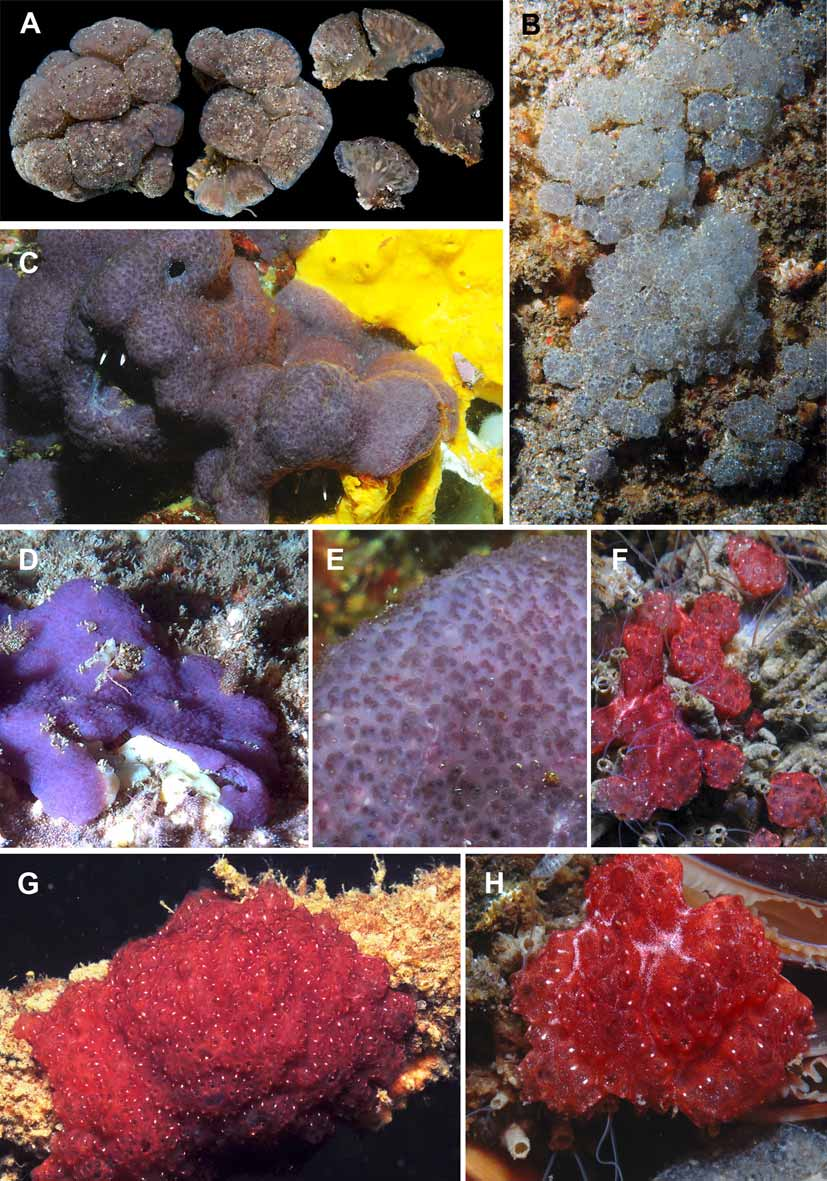
Description. Younger colonies consist of several small button shaped cormidiums some of which are well separated and some fused together (Figure 6 F); larger colonies are mostly solid encrusting sheets or cushions attached to substratum by the whole lower surface. In preservative they are rarely more than 5 mm thick and the largest collected colony is about 5 cm in extent. The test is free from encrusting or embedded sand and has soft spongy consistence characteristic for many Distaplia species. Zooids open on the upper surface only and are arranged into crowded circular or oval systems, each containing about 10 to 20 zooids with a cloacal opening in its centre. In younger colonies the systems are less crowded and are separated from each other by a shallow groove; smaller, button shaped colonies contain mostly a single system. The colour is very constant, all collected colonies as numerous seen on underwater photographs are always brilliant scarlet red, sometimes with sparse minute granules of white pigment especially between the systems, and often with white dot or a short white band on intersiphonal area of each zooid sometimes extending to the atrial languet. These markings may appear on photographs as small white splashes (Figure 6 G, H). The colour is not retained in preservative (formaline) for a long time, the preservative extracts red pigment, become purple-violet, and colonies fade to gray in about one year. Contracted zooids are no more than 3 mm long. Elongated branchial siphon has 6 small rounded lobes. Atrial aperture is a narrow transverse slit with short plain edged anterior languet; sometimes short atrial siphon is present (Figure 4 B). Crowded circular muscles form a sphincter around the branchial siphon and similar, but more spaced muscles are around trial aperture. About 15 fine spaced muscles are on the thorax. Some of them originate at the base of the branchial siphon, but most run obliquely from ventral side to the base of the thorax. Branchial sac has four rows of 15 or 16 long stigmata; each row is crossed by a parastigmatic vessel. Oesophageal neck is not especially long, being typically of the same length as the thorax. Obliquely oriented asymmetrical stomach has almost smooth wall, with faint and not always obvious internal plications. There are no apparent subdivisions of the intestine. A conspicuous elongated gastric reservoir lies in the gut loop and sometimes fills whole free space there. Gonads are on the right and below the pole of the gut loop. Male follicles form a loose rosette or a bunch with their ducts converging to the proximal end of the vas deferens in the centre of the bunch. One to three large ova are just below the gut loop. Several colonies contain numerous brood pooches with developing embryos and larvae which are mostly detached from zooids and freely lie in the tunic. Up to five larvae may present in each brood pouch. Larvae are elongated, with a trunk up to 1.1 mm long and a tail reaching a little more than halfway around it. An ocellus and an otolith are present. Adhesive organs are arranged triradially, two ventral ones have a single bulb at ventral side of the bases of their stalk, and a dorsal adhesive organ has two bulbs on the dorsal side of its stalk.
New records of aplousobranch ascidians from Central Chile
Distaplia sp. Ärnbäck, 1929: 14.
New records of aplousobranch ascidians from Central Chile
No other species of this genus are known from Chilean coasts north off Strait of Magellan. The colonies identified as D. colligans by Lagger et al. (2009) from Lilihuapi Island (42 ° S) are certainly misidentified, they have much smaller larva than usually found in Distaplia and the colour photo (Lagger et al., 2009: Figure 2 F) shows colonies very similar to colonies of Diplosoma species which is abundand in neighboring waters (e. g. Chiloe Island, our unpublished data).
New records of aplousobranch ascidians from Central Chile
Remarks. This species was described by Ärnbäck (1929) from Guaitecas Island, a location where it is rather common. A small colony examined by Ärnbäck's (1929) contained only immature zooids. Basing on the structure of zooid she pointed a close similarity of her material with Californian D. occidentalis but hesitated to identify Chilean specimens with that species referring to a large geographical distance between the records of these species. Van Name (1945) included Ärnbäck's record under the question to synonymy of D. occidentalis, and latter identified specimens from Chile with this species. He wrote: " In the present report I venture to assign the Chilean specimens to the North American species, as I am not able to mention any distinguishing characters. " (Van Name, 1954: 9). Nevertheless, although zooids of Chilean species are similar to those of N. American D. occidentalis, the North and South American species appear to be distinct. Indeed, although several Distaplia species have distinctive zooids, in many others the zooids are virtually identical and in many cases features of a colony may be more important to delimitate species. Colonies of D.
New records of aplousobranch ascidians from Central Chile
Material examined: Chile, 4. region, Punta de Choros: Bajo tiburon, 15 m, 1 colony; 17 m, several fragments; Chile, 10. region, Caleta la Arena, 0 4 April 2009, several colonies (Holotype KBPIG 1399 / 1). Additional specimens: 10. region: Caleta la Arena, several colonies ¸ Yaldad (Chiloe), 25 February 2007, mussel culture, several colonies.
New records of aplousobranch ascidians from Central Chile

Export occurrence data

Darwin Core Archive (ZIP)

CLASSIFICATION

Taxonomic Classification Tree

MULTIMEDIA

Media Files(2)

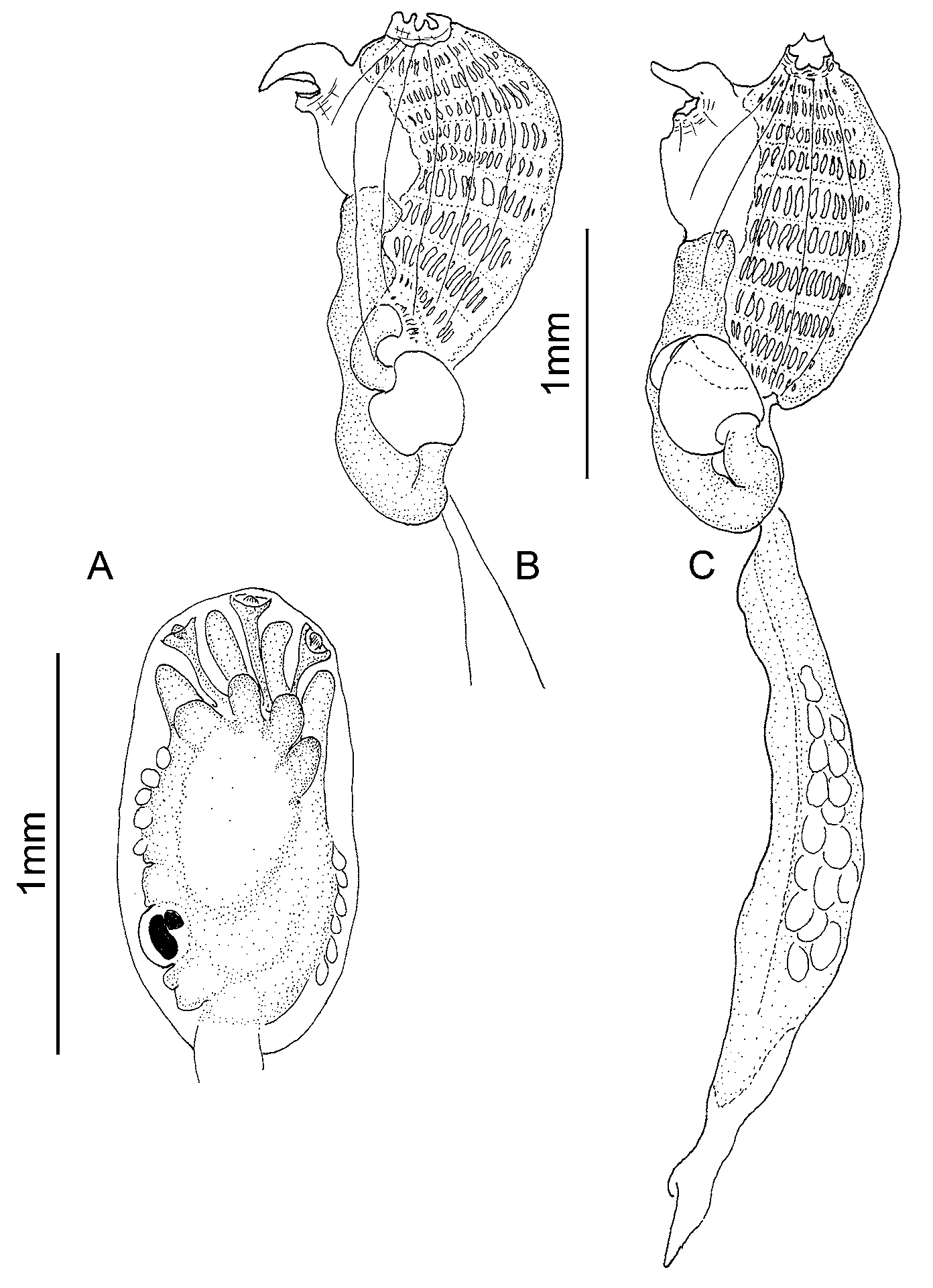
FIGURE 2. A, Aplidium falklandicum, larva. B, C, Aplidiopsis chilensis n. sp., zooids.

Imageimage/png© Sanamyan, Karen;Schories, Dirk;Sanamyan, NadyaNew records of aplousobranch ascidians from Central Chile

FIGURE 6. A, B, Aplidiopsis chilensis n. sp. C, D, E, Eudistoma clivosum n. sp. F, G, H, Distaplia arnbackae n. sp.

Imageimage/png© Sanamyan, Karen;Schories, Dirk;Sanamyan, NadyaNew records of aplousobranch ascidians from Central Chile

IMAGES

Gallery(2)

See Gallery

Occurrences with images

CITATIONS

References(1)

  • 1

    Sanamyan, K.; Schories, D.; Sanamyan, N. (2010). New records of aplousobranch ascidians from Central Chile. <em>Zootaxa.</em> 2537: 58–68.

    original descriptionWorld Register of Marine Species
  • Source Information

    GBIF Backbone Taxonomy

    GBIF Backbone Taxonomy

    checklist

    The GBIF Backbone Taxonomy is a single, synthetic management classification with the goal of covering all names GBIF is dealing with. It's the taxonomic backbone that allows GBIF to integrate name based information from different resources, no matter if these are occurrence datasets, species pages, names from nomenclators or external sources like EOL, Genbank or IUCN. This backbone allows taxonomic search, browse and reporting operations across all those resources in a consistent way and to provide means to crosswalk names from one source to another.

    It is updated regulary through an automated process in which the Catalogue of Life acts as a starting point also providing the complete higher classification above families. Additional scientific names only found in other authoritative nomenclatural and taxonomic datasets are then merged into the tree, thus extending the original catalogue and broadening the backbones name coverage. The GBIF Backbone taxonomy also includes identifiers for Operational Taxonomic Units (OTUs) drawn from the barcoding resources iBOL and UNITE.

    International Barcode of Life project (iBOL), Barcode Index Numbers (BINs). BINs are connected to a taxon name and its classification by taking into account all names applied to the BIN and picking names with at least 80% consensus. If there is no consensus of name at the species level, the selection process is repeated moving up the major Linnaean ranks until consensus is achieved.

    UNITE - Unified system for the DNA based fungal species, Species Hypotheses (SHs). SHs are connected to a taxon name and its classification based on the determination of the RefS (reference sequence) if present or the RepS (representative sequence). In the latter case, if there is no match in the UNITE taxonomy, the lowest rank with 100% consensus within the SH will be used.

    The GBIF Backbone Taxonomy is available for download at https://hosted-datasets.gbif.org/datasets/backbone/ in different formats together with an archive of all previous versions.

    The following 105 sources have been used to assemble the GBIF backbone with number of names given in brackets:

    • Catalogue of Life Checklist - 4766428 names
    • International Barcode of Life project (iBOL) Barcode Index Numbers (BINs) - 635951 names
    • UNITE - Unified system for the DNA based fungal species linked to the classification - 611208 names
    • The Paleobiology Database - 212054 names
    • World Register of Marine Species - 188857 names
    • The Interim Register of Marine and Nonmarine Genera - 183894 names
    • The World Checklist of Vascular Plants (WCVP) - 131891 names
    • GBIF Backbone Taxonomy - 114350 names
    • TAXREF - 109374 names
    • The Leipzig catalogue of vascular plants - 75380 names
    • ZooBank - 73549 names
    • Integrated Taxonomic Information System (ITIS) - 68377 names
    • Plazi.org taxonomic treatments database - 61346 names
    • Genome Taxonomy Database r207 - 60545 names
    • International Plant Names Index - 52329 names
    • Fauna Europaea - 45077 names
    • The National Checklist of Taiwan (Catalogue of Life in Taiwan, TaiCoL) - 36193 names
    • Dyntaxa. Svensk taxonomisk databas - 35892 names
    • The Plant List with literature - 32692 names
    • United Kingdom Species Inventory (UKSI) - 29643 names
    • Artsnavnebasen - 29208 names
    • The IUCN Red List of Threatened Species - 21221 names
    • Afromoths, online database of Afrotropical moth species (Lepidoptera) - 13961 names
    • Brazilian Flora 2020 project - Projeto Flora do Brasil 2020 - 13829 names
    • Prokaryotic Nomenclature Up-to-Date (PNU) - 10079 names
    • Checklist Dutch Species Register - Nederlands Soortenregister - 8814 names
    • ICTV Master Species List (MSL) - 7852 names
    • Cockroach Species File - 6020 names
    • GRIN Taxonomy - 5882 names
    • Taxon list of fungi and fungal-like organisms from Germany compiled by the DGfM - 4570 names
    • Catalogue of Afrotropical Bees - 3623 names
    • Catalogue of Tenebrionidae (Coleoptera) of North America - 3327 names
    • Checklist of Beetles (Coleoptera) of Canada and Alaska. Second Edition. - 3312 names
    • Systema Dipterorum - 2850 names
    • Catalogue of the Pterophoroidea of the World - 2807 names
    • The Clements Checklist - 2675 names
    • Taxon list of Hymenoptera from Germany compiled in the context of the GBOL project - 2496 names
    • IOC World Bird List, v13.2 - 2366 names
    • Official Lists and Indexes of Names in Zoology - 2310 names
    • National checklist of all species occurring in Denmark - 1922 names
    • Myriatrix - 1876 names
    • Database of Vascular Plants of Canada (VASCAN) - 1822 names
    • Taxon list of vascular plants from Bavaria, Germany compiled in the context of the BFL project - 1771 names
    • Orthoptera Species File - 1742 names
    • A list of the terrestrial fungi, flora and fauna of Madeira and Selvagens archipelagos - 1602 names
    • Aphid Species File - 1565 names
    • World Spider Catalog - 1561 names
    • Taxon list of Jurassic Pisces of the Tethys Palaeo-Environment compiled at the SNSB-JME - 1270 names
    • Backbone Family Classification Patch - 1143 names
    • GBIF Algae Classification - 1100 names
    • International Cichorieae Network (ICN): Cichorieae Portal - 975 names
    • Psocodea Species File - 803 names
    • New Zealand Marine Macroalgae Species Checklist - 787 names
    • Annotated checklist of endemic species from the Western Balkans - 754 names
    • Taxon list of animals with German names (worldwide) compiled at the SMNS - 503 names
    • Catalogue of the Alucitoidea of the World - 472 names
    • Lygaeoidea Species File - 462 names
    • Catálogo de Plantas y Líquenes de Colombia - 422 names
    • GBIF Backbone Patch - 317 names
    • Phasmida Species File - 259 names
    • Cortinariaceae fetched from the Index Fungorum API - 234 names
    • Coreoidea Species File - 233 names
    • GTDB supplement - 139 names
    • Mantodea Species File - 119 names
    • Endemic species in Taiwan - 93 names
    • Taxon list of Araneae from Germany compiled in the context of the GBOL project - 88 names
    • Species of Hominidae - 78 names
    • Taxon list of Sternorrhyncha from Germany compiled in the context of the GBOL project - 77 names
    • Taxon list of mosses from Germany compiled in the context of the GBOL project - 75 names
    • Mammal Species of the World - 73 names
    • Plecoptera Species File - 71 names
    • Species Fungorum Plus - 64 names
    • Catalogue of the type specimens of Cosmopterigidae (Lepidoptera: Gelechioidea) from research collections of the Zoological Institute, Russian Academy of Sciences - 47 names
    • Species named after famous people - 41 names
    • Dermaptera Species File - 36 names
    • Taxon list of Trichoptera from Germany compiled in the context of the GBOL project - 34 names
    • True Fruit Flies (Diptera, Tephritidae) of the Afrotropical Region - 33 names
    • Range and Regularities in the Distribution of Earthworms of the Earthworms of the USSR Fauna. Perel, 1979 - 32 names
    • Taxon list of Diplura from Germany compiled in the context of the GBOL project - 30 names
    • Lista de referencia de especies de aves de Colombia - 2022 - 24 names
    • Taxon list of Auchenorrhyncha from Germany compiled in the context of the GBOL project - 20 names
    • Catalogue of the type specimens of Polycestinae (Coleoptera: Buprestidae) from research collections of the Zoological Institute, Russian Academy of Sciences - 19 names
    • Taxon list of Thysanoptera from Germany compiled in the context of the GBOL project - 19 names
    • Lista de especies de vertebrados registrados en jurisdicción del Departamento del Huila - 18 names
    • Taxon list of Microcoryphia (Archaeognatha) from Germany compiled in the context of the GBOL project - 15 names
    • Catalogue of the type specimens of Bufonidae and Megophryidae (Amphibia: Anura) from research collections of the Zoological Institute, Russian Academy of Sciences - 12 names
    • Grylloblattodea Species File - 11 names
    • Coleorrhyncha Species File - 9 names
    • Taxon list of liverworts from Germany compiled in the context of the GBOL project - 9 names
    • Embioptera Species File - 7 names
    • Taxon list of Pisces and Cyclostoma from Germany compiled in the context of the GBOL project - 6 names
    • Taxon list of Pteridophyta from Germany compiled in the context of the GBOL project - 6 names
    • Taxon list of Siphonaptera from Germany compiled in the context of the GBOL project - 5 names
    • The Earthworms of the Fauna of Russia. Perel, 1997 - 5 names
    • Taxon list of Zygentoma from Germany compiled in the context of the GBOL project - 4 names
    • Asiloid Flies: new taxa of Diptera: Apioceridae, Asilidae, and Mydidae - 3 names
    • Taxon list of Protura from Germany compiled in the context of the GBOL project - 3 names
    • Taxon list of hornworts from Germany compiled in the context of the GBOL project - 2 names
    • Chrysididae Species File - 1 names
    • Taxon list of Dermaptera from Germany compiled in the context of the GBOL project - 1 names
    • Taxon list of Diplopoda from Germany in the context of the GBOL project - 1 names
    • Taxon list of Orthoptera (Grashoppers) from Germany compiled at the SNSB - 1 names
    • Taxon list of Pscoptera from Germany compiled in the context of the GBOL project - 1 names
    • Taxon list of Pseudoscorpiones from Germany compiled in the context of the GBOL project - 1 names
    • Taxon list of Raphidioptera from Germany compiled in the context of the GBOL project - 1 names

    GBIF Secretariat (2023). GBIF Backbone Taxonomy. Checklist dataset https://doi.org/10.15468/39omei accessed via GBIF.org on 2026-06-14.

    CC BYPublished 8/28/2023View dataset
    GBIF Usage Key
    6486684
    Dataset Key
    d7dddbf4-2cf0-4f39-9b2a-bb099caae36c
    Origin
    source
    Backbone Key
    6486684
    Taxon ID
    gbif:6486684
    Last Crawled
    8/22/2023
    Last Interpreted
    8/22/2023