AnimaliaNear ThreatenedacceptedspeciesAcceptedRestricted
Anomaloglossus apiau

Anomaloglossus apiau

Serra do Apiaú Rocket Frog·Fouquet, Souza, Nunes, Kok, Curcio, Carvalho, Grant & Rodrigues, 2015

GBIF:8460372

0countries
0datasets
0year

0

Descendants

0

Children

PROFILE

Species Profile

Characteristics

Extant

ABOUT

Descriptions(4)

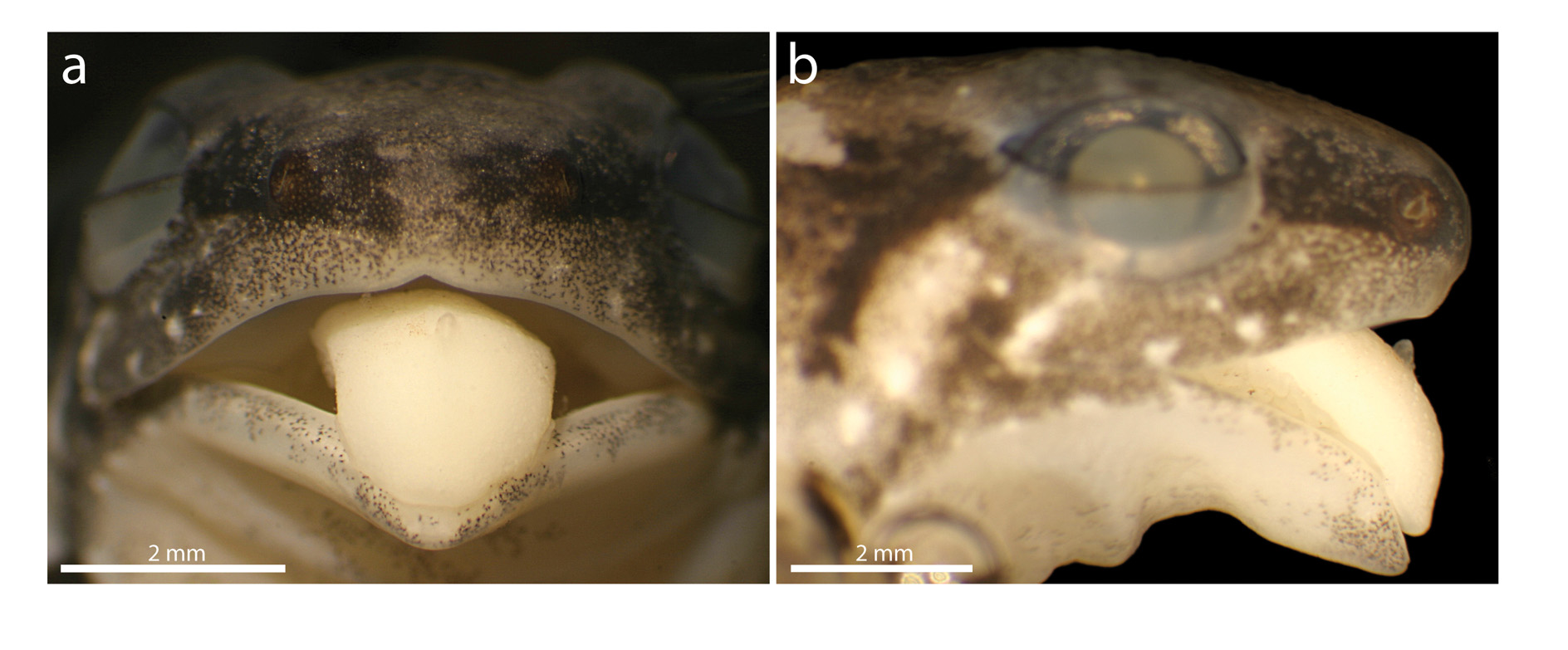
Description of the holotype. An adult male of 17.7 mm SVL. Dorsal skin granular on posterior dorsum, thighs, and shanks; ventral skin smooth (Fig. 6). Cloacal tubercles absent. Head wider than long. Snout bluntly pointed in lateral view, extending past the lower jaw, bluntly pointed in ventral and dorsal views. Nares located close to tip of snout, directed posterolaterally; nares visible in frontal view, barely visible in dorsal or ventral view; IN 39 % of HW. Canthus rostralis well defined; loreal region straight, sloping outward to lip. IO 69 % of ED. SL 96 % of ED, 45 % of HL; EN 62 % of ED. Tympanic membrane inconspicuous, round, concealed posterodorsally by a diffuse supratympanic swelling; tympanic annulus not visible posterodorsally and partly unpigmented; TYM 35 % of eye length. Maxillary teeth present, small. Median lingual process short, about as wide as long, tapered, bluntly pointed, smooth (non-papillate), reclined in lingual pit. Vocal sac and vocal slits visible. Hand moderate in size, 27 % of SVL, 79 % of HW. Relative length of fingers III> IV> I> II. Fingers unwebbed. Discs of fingers expanded, disc on Finger III and IV widest (state 2 sensu Grant et al. 2006), discs on other fingers sub-equal (state 1 sensu Grant et al. 2006). Fingers with fringes, best developed preaxially on Finger II and III (Fig. 6). Palmar tubercle large, rounded, thenar tubercle smaller, elliptical; one or two round to ovoid subarticular tubercles (one each on Fingers I and II, two each on Fingers III and IV). Tip of Finger IV distinctly surpassing the base of distal subarticular tubercle on Finger III when fingers appressed. No fleshy supracarpal fold atop wrist (Fig. 6 b). Finger III strongly swollen dorsally and preaxially, swelling extending from the wrist to the third subarticular tubercle [state 3 sensu Grant et al. (2006)]. Hind limbs robust, moderately long, TIL 49 % of SVL. Relative lengths of appressed toes IV> III> V> II> I; Toe I short, not reaching the base of subarticular tubercle of Toe II. Toe discs expanded, distinctly larger than finger discs, largest on Toes II, III and IV. Feet weakly webbed; all toes with well-developed fringes. Webbing formula I 1 ½ – 2 - II 2 + – 3 - III 2 ½ – 4 IV 4 - – 2 - V (Fig. 6 b). Inner metatarsal tubercle small, elliptical; outer metatarsal tubercle small, round, about half the size of the inner metatarsal tubercle. One to three round to ovoid subarticular tubercles (one each on Toes I and II, two each on Toes III and V, and three on Toe IV with proximal tubercle on Toe IV the smallest and least conspicuous). A strong outer metatarsal fold is present, coextensive with the fringe on Toe V and almost reaching the outer metatarsal tubercle. Tarsal keel weakly curved proximally, discontinuous with the fringe along the outer edge of the first toe, strongly elevated and tubercle-like proximally (Fig. 6 b). Colour of holotype in life. Dorsal ground colour brown with a light brown interorbital triangle (Fig. 6 c). Upper surface of arm with a bright yellow mark with ill defined dark brown and white marks on forearm and wrist; upper surface of thigh yellow with well defined dark brown transverse bands, shank and foot light brown also with well defined dark brown transverse bands. Flanks dark brown, with some blue / whitish irregular iridescent blotches on the lower part, and a lateral stripe of yellowish spots from the inguinal region to the middle of the flank becoming conspicuous again with a short orange stripe on the upper posterior corner of the eye. Dorsolateral stripe absent. Upper lip brown with iridescent white marks below the eye; loreal region and side of head dark; a small whitish stripe is present from arm insertion to tympanum partly depigmented. A dark brown stripe is present on the anterior edge of upper arm, tapering from arm insertion to forearm. Throat, belly and undersurface of arm, thigh and shank marbled with patches of dark brown melanophores. Rear of thigh and cloacal region brown. Paracloacal marks orange. Palms and soles brown (Fig. 6 c). Colour of holotype in preservative. Dorsal ground colour dark brown with a thin light gray to light brown interorbital stripe and a similarly coloured small spot behind the eyes (Fig. 6 a). Dorsal surface of arm brown with dark brown transverse bands on forearm and wrist, upper arm cream; dorsal surface of leg brown with well-defined dark brown transverse bands on thigh, shank, and foot. Flanks dark brown with some irregular spots and a few whitish irregular blotches ventrolaterally. A few white spots (covering small tubercles) form a dotted oblique lateral stripe that only extends from the inguinal region to the middle of the flanks. Throat, belly, and under-surface of arms and legs marbled with patches of melanophores; rear of thigh and cloacal region brown. Paracloacal marks whitish. Palms and soles dark brown (Fig. 6 b). Variation. Males are smaller than females (average male SVL = 17.1 mm 15.5 – 20.0 mm, n = 14; average female SVL = 20.2 mm, 17.7 – 21.8 mm, n = 15), usually with third Finger III distinctly swollen. There is marked sexual dichromatism (Fig. 7). Dorsal colouration of females is light to dark brown with small diffuse black marks and no lateral dotted stripe. Males, however, are generally darker with a highly variable and conspicuous pattern as well as a lateral stripe consisting of white, bluish and even sometimes orange spots. Whitish-blue marks also occur ventrally on flank, shoulder and lip in males, but found in one female only. Hind limbs are also generally markedly sexually dichromatic, being of similar colouration to the dorsum in females, but with orange markings of various extents in males (from inexistent to small patches, or even sometimes becoming the main background colour). Ventral colouration of females is immaculate white, sometimes with diffuse melanophores and a yellowish throat. Males, however, generally have extensively pigmented ventral surfaces (with one exception; Fig. 7, MZUSP 155836, SVL 16.8 mm, despite conspicuous dorsal colouration and swollen third finger) giving a marbled aspect, especially on throat. In addition to sexual dimorphism in size and colour pattern, variation is extensive within sexes. Among females, dorsal colouration varies from light to dark brown and from immaculate to vermiculate with dark patches. The dark bands on thigh and shank vary from conspicuous to very faint. Lip pattern varies from almost immaculate cream to covered with dark brown marks. Shoulder is orange to light brown. In males, variation in colouration is even more striking and might depend partly on reproductive activity given that more conspicuously coloured males also have swollen third fingers. Dorsal colouration in males varies from immaculate dark brown to light brown with various different patterns of dark brown markings. The distribution of bluish white iridescent dots ranges from a few large ones on the ventral part of the flanks and lips to completely peppering flanks and lips. Limbs and ventral surface are also highly variable in colouration (see above). Advertisement calls. The call is a long trill of 19.6 s on average (sd = 11.0, range = 7.0 – 39.4, n = 10) consisting of pairs of very short pulses (average duration of pulses = 0.03 s, sd = 0.005, 0.02 – 0.04, n = 50; interpulse interval within pair 0.03 s and between pairs 0.073 s on average) (Fig. 8). Pulse rate per second 11.3 on average (sd = 0.55). Four harmonics are visible, with the dominant frequency located in the lowest harmonic (= fundamental frequency). The dominant frequency increases during the first seconds of the call (~ 4 s) but reaches a plateau of 4.3 kHz on average (sd = 0.129, 4.147 – 4.526, n = 5; Fig. 8; Table 2). FIGURE 8. Advertisement call of Anomalogossus apiau (IND 5) showing call length (> 17 s) and spectral structure. Note the paired pulses (inset). The specimen was recorded in October 2011 around 11 am at the type locality (21 ° C). The temporal structure of the call differs markedly from that of congeneric species in the duration of the call. Anomaloglossus degranvillei (Marty & Gaucher 1999), A. surinamensis (Ouboter & Jairam 2012) and A. praderioi (Kok 2010) emit a single note at rates between 50 and 100 calls / min; A. beebei (Kok et al. 2006 a), A. tamacuarensis (Myers & Donnelly 1997) and A. kaiei (Kok et al. 2006 b) emit short series of pulses (4 – 5, 2, and 1 – 2 pulses / call, respectively); A. baeobatrachus (Marty & Gaucher 1999) and A. stepheni (Lima et al. 2006; Martins 1989) emit short trills of 7 – 19 pulses and less than 1 s of duration. Anomaloglossus rufulus emits shorter (<3 s) and regular trills with lower pulse rate (7 pulses / s) (Barrio-Amorós & Santos 2011). The only known Anomaloglossus call that has a similar temporal structure to the call of A. apiau is the one of A. verbeeksnyderorum (Barrio-Amorós et al. 2010). However pulse rate of A. apiau is higher (11.27 pulses / s vs. 8.87 in A. verbeeksnyderorum) and the pulses are paired (vs. regularly spaced in A. verbeeksnyderorum). MEAN SD IND 1 REC 1 IND 2 REC 1 IND 3 REC 1
Two new endangered species of Anomaloglossus (Anura: Aromobatidae) from Roraima State, northern Brazil

Distribution and ecology. Anomaloglossus apiau sp. nov. was observed exclusively along rocky streams (only a few meters away from water maximal level), on the slopes of Serra de Apiaú above 500 m elevation and up to the summit at ~ 1400 m. These streams are usually shallow, but they can be fast flowing and up to 15 m wide (but unlikely torrential) or reduced to rivulets with only a film of water running on the rocks (Fig. 6 d). Males call from the stream banks or on rocks; they only call from the banks alongside larger streams. The species is locally abundant with one calling male found every ~ 5 m along the stream when calling activity is at its peak, i. e. during late afternoon or after rainfall.
Two new endangered species of Anomaloglossus (Anura: Aromobatidae) from Roraima State, northern Brazil
Etymology. The specific epithet is a noun in apposition and refers to the name of the region where the type locality lies (Serra do Apiaú, Roraima State, Brazil). Adult definition and diagnosis. (1) a small Anomaloglossus (average male SVL = 17.1 mm [15.5 – 20.0, n = 14], average female SVL = 20.2 mm [18.4 – 21.8, n = 15]) (Table 1); (2) body robust; (3) skin on dorsum granular, especially posteriorly, venter smooth; (4) Finger II shorter than I when fingers are appressed, but Finger I shorter than II (3.3 vs. 3.5 mm in holotype) using the method of Kaplan (1997); (5) tip of Finger IV surpassing the base of the distal subarticular tubercle on Finger III when fingers appressed; (6) distal subarticular tubercle on Finger III indistinct; (7) Finger III distinctly swollen in males; (8) fingers with keel-like lateral folds particularly developed preaxially on Finger III; (9) toe webbing basal, with well developed fringes (sensu Grant et al. 2006; keel-like lateral folds sensu Myers & Donnelly 2008); (10) tarsal keel well defined, short, strongly curved, strongly elevated and tubercle-like proximally; (11) black arm gland in males (sensu Grant & Castro-Herrera 1998, see also Grant et al. 2006) and cloacal tubercles absent; (12) pale paracloacal mark present; (13) dorsolateral stripe absent; (15) ventrolateral stripe present in males as a series of more or less conspicuous white dots; (16) oblique lateral stripe present as conspicuous white dots extending from groin midway along flank and inconspicuous to the upper posterior edge of the orbit; (17) sexual dichromatism in throat and venter colour pattern present, with only a few scattered melanophores in females while males possess marbled ventral skin; (18) iris with metallic pigmentation and pupil ring; (20) median lingual process short, slightly longer than wide, tapered, bluntly pointed, smooth (non-papillate), reclined in pit (Fig. 5); (21) maxillary teeth present, small; (22) testes immaculate white, mature ova very large (3 mm in diameter), yellowish brown. Morphological comparisons with congeneric species. Anomaloglossus apiau can easily be distinguished from A. ayarzaguenai, A. breweri, A. guanayensis, A. megacephalus, A. moffetti, A. murisipanensis, A. parimae, A. parkerae, A. shrevei, A. tamacuarensis, A. tepequem, A. tepuyensis, A. triunfo, A. verbeeksnyderorum, and A. wothuja in having basal toe webbing (moderate to extensive in the aforementioned species). Anomaloglossus apiau can be readily distinguished from A. beebei, A. kaiei, A. rufulus and A. roraima in having folded fringes on fingers, best developed preaxially on Finger III (fringes barely distinct, not distinctly folded in the aforementioned species). Anomaloglossus apiau can be distinguished from A. baeobatrachus, A. leopardus, and A. stepheni by its faint, discontinuous oblique ventrolateral stripe (conspicuous and continuous in A. baeobatrachus, A. leopardus, and A. stepheni). Anomaloglossus apiau can be distinguished from A. praderioi by lacking a conspicuous light dorsolateral stripe (present in A. praderioi). Anomaloglossus apiau can be distinguished from Anomaloglossus degranvillei, A. surinamensis and A. apiau by its Finger II longer than Finger I (equal in size in A. degranvillei and A. surinamensis), and by a third finger swollen in male (not swollen in A. degranvillei and A. surinamensis). From all the other nominal species of Anomaloglossus it can be distinguished by its long advertisement call composed of pairs of short pulses (see below).
Two new endangered species of Anomaloglossus (Anura: Aromobatidae) from Roraima State, northern Brazil
Holotype. MZUSP 155833 (SMS 962), an adult male collected by Antoine Fouquet, Sergio Marques de Sousa and Pedro Murilo Sales Nunes in October 2011 at ~ 580 m at Serra do Apiaú, Roraima State, Brazil (2.430168 N, 61.411715 W). Paratopotypes. (n = 35): MZUSP 155814 – 15, 155818, 155826, 155828 – 29 155831 – 32, eight males, and MZUSP 155812 – 13, 155816 – 17, 155819 – 25, 11 females, collected in October 2011 by AF, SMS and PMSN, and MZUSP 155834, 155836, 155838, 155840, 155842 – 43, 155851 – 52, eight males, and MZUSP 155837, 155839, 155841, 155844 – 46, 155850, 155853, eight females, collected in June 2012 by AF and PMSN.
Two new endangered species of Anomaloglossus (Anura: Aromobatidae) from Roraima State, northern Brazil

Export occurrence data

Darwin Core Archive (ZIP)

GEOGRAPHY

Distribution Map

Occurrence Map

Loading map…

Tiles © GBIF Maps API | Map powered by MapLibre GL

REGIONS

Geographic Distribution(1)

Global
near threatened

DATA

Occurrence Datasets

Loading datasets…

Common names used for this species across different languages and regions.

engSerra do Apiaú Rocket Frogeng

Vernacular (common) names are the everyday names used for a species in different languages and regions. A single species may have dozens of common names worldwide.

engSerra do Apiaú Rocket Frog
eng
Source: Catalogue of LifeSource taxon #299414256

CLASSIFICATION

Taxonomic Classification Tree

HIERARCHY

Child Taxa(1)

MULTIMEDIA

Media Files(3)

FIGURE 5. The median lingual process of Anomaloglossus apiau sp. nov. in anterior (a) and lateral (b) views (MZUSP 155853, subadult female). Photographs by TG.

Imageimage/png© Fouquet, Antoine;Souza, Sergio Marques;Sales Nunes, Pedro M.;Kok, Philippe J. R.;Curcio, Felipe Franco;Carvalho, Celso Morato De;Grant, Taran;Rodrigues, Miguel TrefautTwo new endangered species of Anomaloglossus (Anura: Aromobatidae) from Roraima State, northern Brazil

FIGURE 6. (a) Holotype (MZUSP 155833) of Anomaloglossus apiau sp. nov. in dorsal and ventral view. (b) Left hand and left foot in ventral view, numbers refer to the characters in the diagnosis. (c) Holotype in life and (d) the stream were specimens were collected in October 2011 and June 2012. Photographs by AF.

Imageimage/png© Fouquet, Antoine;Souza, Sergio Marques;Sales Nunes, Pedro M.;Kok, Philippe J. R.;Curcio, Felipe Franco;Carvalho, Celso Morato De;Grant, Taran;Rodrigues, Miguel TrefautTwo new endangered species of Anomaloglossus (Anura: Aromobatidae) from Roraima State, northern Brazil
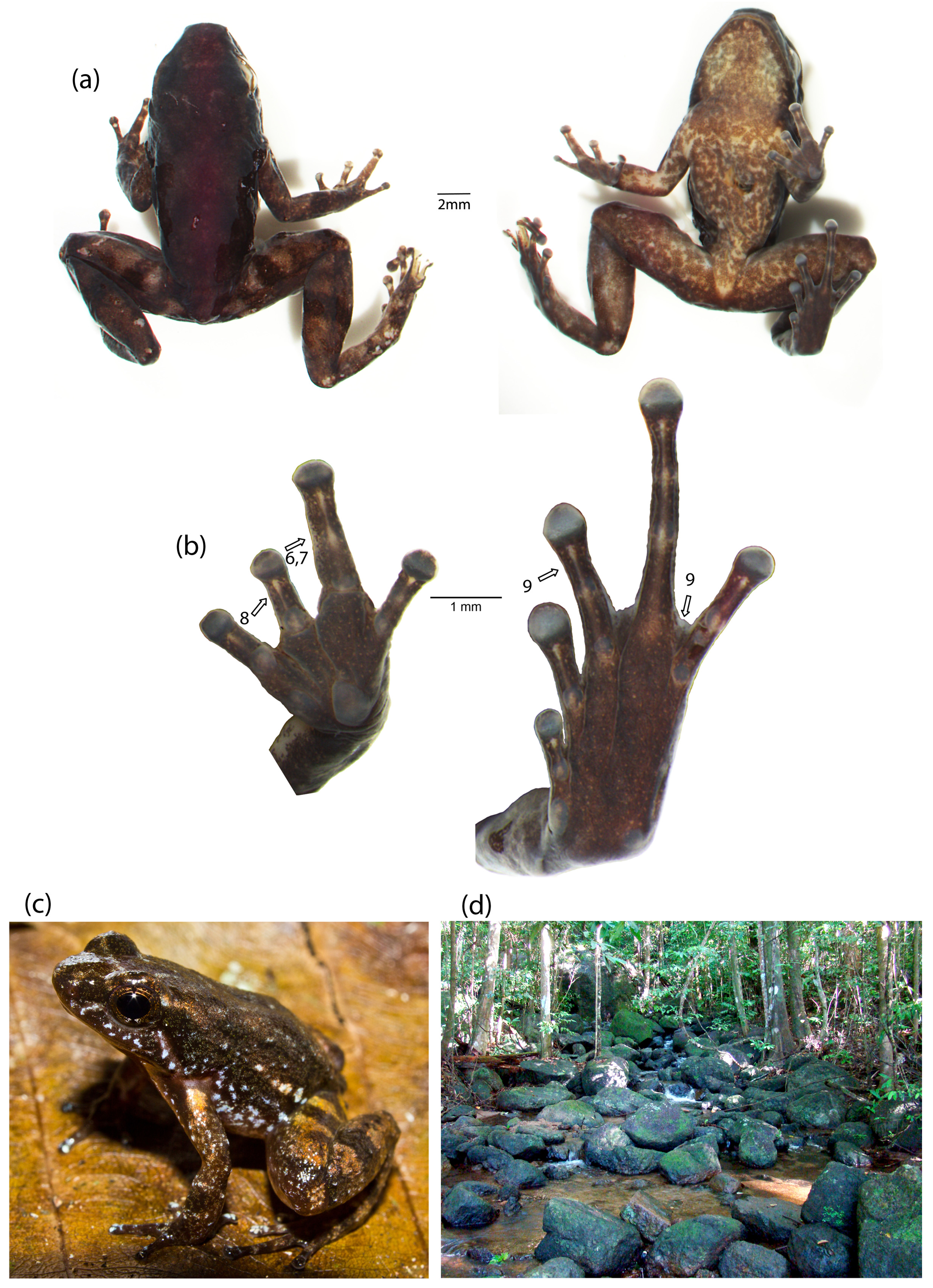
FIGURE 7. Eight paratypes (four females and four males) of Anomaloglossus apiau sp. nov. in profile and ventral view. Photographs by AF.

Imageimage/png© Fouquet, Antoine;Souza, Sergio Marques;Sales Nunes, Pedro M.;Kok, Philippe J. R.;Curcio, Felipe Franco;Carvalho, Celso Morato De;Grant, Taran;Rodrigues, Miguel TrefautTwo new endangered species of Anomaloglossus (Anura: Aromobatidae) from Roraima State, northern Brazil

IMAGES

Gallery(3)

See Gallery

Occurrences with images

Source Information

GBIF Backbone Taxonomy

GBIF Backbone Taxonomy

checklist

The GBIF Backbone Taxonomy is a single, synthetic management classification with the goal of covering all names GBIF is dealing with. It's the taxonomic backbone that allows GBIF to integrate name based information from different resources, no matter if these are occurrence datasets, species pages, names from nomenclators or external sources like EOL, Genbank or IUCN. This backbone allows taxonomic search, browse and reporting operations across all those resources in a consistent way and to provide means to crosswalk names from one source to another.

It is updated regulary through an automated process in which the Catalogue of Life acts as a starting point also providing the complete higher classification above families. Additional scientific names only found in other authoritative nomenclatural and taxonomic datasets are then merged into the tree, thus extending the original catalogue and broadening the backbones name coverage. The GBIF Backbone taxonomy also includes identifiers for Operational Taxonomic Units (OTUs) drawn from the barcoding resources iBOL and UNITE.

International Barcode of Life project (iBOL), Barcode Index Numbers (BINs). BINs are connected to a taxon name and its classification by taking into account all names applied to the BIN and picking names with at least 80% consensus. If there is no consensus of name at the species level, the selection process is repeated moving up the major Linnaean ranks until consensus is achieved.

UNITE - Unified system for the DNA based fungal species, Species Hypotheses (SHs). SHs are connected to a taxon name and its classification based on the determination of the RefS (reference sequence) if present or the RepS (representative sequence). In the latter case, if there is no match in the UNITE taxonomy, the lowest rank with 100% consensus within the SH will be used.

The GBIF Backbone Taxonomy is available for download at https://hosted-datasets.gbif.org/datasets/backbone/ in different formats together with an archive of all previous versions.

The following 105 sources have been used to assemble the GBIF backbone with number of names given in brackets:

  • Catalogue of Life Checklist - 4766428 names
  • International Barcode of Life project (iBOL) Barcode Index Numbers (BINs) - 635951 names
  • UNITE - Unified system for the DNA based fungal species linked to the classification - 611208 names
  • The Paleobiology Database - 212054 names
  • World Register of Marine Species - 188857 names
  • The Interim Register of Marine and Nonmarine Genera - 183894 names
  • The World Checklist of Vascular Plants (WCVP) - 131891 names
  • GBIF Backbone Taxonomy - 114350 names
  • TAXREF - 109374 names
  • The Leipzig catalogue of vascular plants - 75380 names
  • ZooBank - 73549 names
  • Integrated Taxonomic Information System (ITIS) - 68377 names
  • Plazi.org taxonomic treatments database - 61346 names
  • Genome Taxonomy Database r207 - 60545 names
  • International Plant Names Index - 52329 names
  • Fauna Europaea - 45077 names
  • The National Checklist of Taiwan (Catalogue of Life in Taiwan, TaiCoL) - 36193 names
  • Dyntaxa. Svensk taxonomisk databas - 35892 names
  • The Plant List with literature - 32692 names
  • United Kingdom Species Inventory (UKSI) - 29643 names
  • Artsnavnebasen - 29208 names
  • The IUCN Red List of Threatened Species - 21221 names
  • Afromoths, online database of Afrotropical moth species (Lepidoptera) - 13961 names
  • Brazilian Flora 2020 project - Projeto Flora do Brasil 2020 - 13829 names
  • Prokaryotic Nomenclature Up-to-Date (PNU) - 10079 names
  • Checklist Dutch Species Register - Nederlands Soortenregister - 8814 names
  • ICTV Master Species List (MSL) - 7852 names
  • Cockroach Species File - 6020 names
  • GRIN Taxonomy - 5882 names
  • Taxon list of fungi and fungal-like organisms from Germany compiled by the DGfM - 4570 names
  • Catalogue of Afrotropical Bees - 3623 names
  • Catalogue of Tenebrionidae (Coleoptera) of North America - 3327 names
  • Checklist of Beetles (Coleoptera) of Canada and Alaska. Second Edition. - 3312 names
  • Systema Dipterorum - 2850 names
  • Catalogue of the Pterophoroidea of the World - 2807 names
  • The Clements Checklist - 2675 names
  • Taxon list of Hymenoptera from Germany compiled in the context of the GBOL project - 2496 names
  • IOC World Bird List, v13.2 - 2366 names
  • Official Lists and Indexes of Names in Zoology - 2310 names
  • National checklist of all species occurring in Denmark - 1922 names
  • Myriatrix - 1876 names
  • Database of Vascular Plants of Canada (VASCAN) - 1822 names
  • Taxon list of vascular plants from Bavaria, Germany compiled in the context of the BFL project - 1771 names
  • Orthoptera Species File - 1742 names
  • A list of the terrestrial fungi, flora and fauna of Madeira and Selvagens archipelagos - 1602 names
  • Aphid Species File - 1565 names
  • World Spider Catalog - 1561 names
  • Taxon list of Jurassic Pisces of the Tethys Palaeo-Environment compiled at the SNSB-JME - 1270 names
  • Backbone Family Classification Patch - 1143 names
  • GBIF Algae Classification - 1100 names
  • International Cichorieae Network (ICN): Cichorieae Portal - 975 names
  • Psocodea Species File - 803 names
  • New Zealand Marine Macroalgae Species Checklist - 787 names
  • Annotated checklist of endemic species from the Western Balkans - 754 names
  • Taxon list of animals with German names (worldwide) compiled at the SMNS - 503 names
  • Catalogue of the Alucitoidea of the World - 472 names
  • Lygaeoidea Species File - 462 names
  • Catálogo de Plantas y Líquenes de Colombia - 422 names
  • GBIF Backbone Patch - 317 names
  • Phasmida Species File - 259 names
  • Cortinariaceae fetched from the Index Fungorum API - 234 names
  • Coreoidea Species File - 233 names
  • GTDB supplement - 139 names
  • Mantodea Species File - 119 names
  • Endemic species in Taiwan - 93 names
  • Taxon list of Araneae from Germany compiled in the context of the GBOL project - 88 names
  • Species of Hominidae - 78 names
  • Taxon list of Sternorrhyncha from Germany compiled in the context of the GBOL project - 77 names
  • Taxon list of mosses from Germany compiled in the context of the GBOL project - 75 names
  • Mammal Species of the World - 73 names
  • Plecoptera Species File - 71 names
  • Species Fungorum Plus - 64 names
  • Catalogue of the type specimens of Cosmopterigidae (Lepidoptera: Gelechioidea) from research collections of the Zoological Institute, Russian Academy of Sciences - 47 names
  • Species named after famous people - 41 names
  • Dermaptera Species File - 36 names
  • Taxon list of Trichoptera from Germany compiled in the context of the GBOL project - 34 names
  • True Fruit Flies (Diptera, Tephritidae) of the Afrotropical Region - 33 names
  • Range and Regularities in the Distribution of Earthworms of the Earthworms of the USSR Fauna. Perel, 1979 - 32 names
  • Taxon list of Diplura from Germany compiled in the context of the GBOL project - 30 names
  • Lista de referencia de especies de aves de Colombia - 2022 - 24 names
  • Taxon list of Auchenorrhyncha from Germany compiled in the context of the GBOL project - 20 names
  • Catalogue of the type specimens of Polycestinae (Coleoptera: Buprestidae) from research collections of the Zoological Institute, Russian Academy of Sciences - 19 names
  • Taxon list of Thysanoptera from Germany compiled in the context of the GBOL project - 19 names
  • Lista de especies de vertebrados registrados en jurisdicción del Departamento del Huila - 18 names
  • Taxon list of Microcoryphia (Archaeognatha) from Germany compiled in the context of the GBOL project - 15 names
  • Catalogue of the type specimens of Bufonidae and Megophryidae (Amphibia: Anura) from research collections of the Zoological Institute, Russian Academy of Sciences - 12 names
  • Grylloblattodea Species File - 11 names
  • Coleorrhyncha Species File - 9 names
  • Taxon list of liverworts from Germany compiled in the context of the GBOL project - 9 names
  • Embioptera Species File - 7 names
  • Taxon list of Pisces and Cyclostoma from Germany compiled in the context of the GBOL project - 6 names
  • Taxon list of Pteridophyta from Germany compiled in the context of the GBOL project - 6 names
  • Taxon list of Siphonaptera from Germany compiled in the context of the GBOL project - 5 names
  • The Earthworms of the Fauna of Russia. Perel, 1997 - 5 names
  • Taxon list of Zygentoma from Germany compiled in the context of the GBOL project - 4 names
  • Asiloid Flies: new taxa of Diptera: Apioceridae, Asilidae, and Mydidae - 3 names
  • Taxon list of Protura from Germany compiled in the context of the GBOL project - 3 names
  • Taxon list of hornworts from Germany compiled in the context of the GBOL project - 2 names
  • Chrysididae Species File - 1 names
  • Taxon list of Dermaptera from Germany compiled in the context of the GBOL project - 1 names
  • Taxon list of Diplopoda from Germany in the context of the GBOL project - 1 names
  • Taxon list of Orthoptera (Grashoppers) from Germany compiled at the SNSB - 1 names
  • Taxon list of Pscoptera from Germany compiled in the context of the GBOL project - 1 names
  • Taxon list of Pseudoscorpiones from Germany compiled in the context of the GBOL project - 1 names
  • Taxon list of Raphidioptera from Germany compiled in the context of the GBOL project - 1 names

GBIF Secretariat (2023). GBIF Backbone Taxonomy. Checklist dataset https://doi.org/10.15468/39omei accessed via GBIF.org on 2026-06-14.

CC BYPublished 8/28/2023View dataset
GBIF Usage Key
8460372
Dataset Key
d7dddbf4-2cf0-4f39-9b2a-bb099caae36c
Origin
source
Backbone Key
8460372
Taxon ID
gbif:8460372
Last Crawled
8/22/2023
Last Interpreted
8/22/2023