
AnimaliaNot EvaluatedacceptedgenusAccepted
Anomaloglossus

Anomaloglossus

Anomaloglosse(+2)·Grant, Frost, Caldwell, Gagliardo, Haddad, Kok, Means, Noonan, Schargel & Wheeler, 2006

GBIF:2426205

0datasets
0year

0

Descendants

0

Children

0

Species

PROFILE

Species Profile

Characteristics

Extant

ABOUT

Descriptions(11)

Remarks: Genus Anomaloglossus, recognized by the presence of a median lingual process (MLP), was described by Grant et al. (1997). Currently 28 species are known from the Guiana Shield and northern Amazon (Frost 2018). The seven trans-Andean species with MLP now belong to Ectopoglossus Grant, Rada, Anganoy-Criollo, Batista, Dias, Jeckel, Machado and Rueda-Almonacid, 2017.
Catalogue of the amphibians of Venezuela: Illustrated and annotated species list, distribution, and conservation
Type species: Colostethus beebei Noble, 1923, by original designation.
Catalogue of the amphibians of Venezuela: Illustrated and annotated species list, distribution, and conservation
Larval morphology. The following description is based on three tadpoles at stage 26, 28 and 30 (Fig. 6). Tadpoles correspond to a Type 4 tadpole of Orton (1953); exotrophic; body skin smooth; TL 12.21 – 19.43 mm; BL 4.41 – 7.14 mm, 35 – 37 % of TL, 164 – 181 % of BW, 221 – 256 % of BH; BW 131 – 143 % of BH (Table 3); body ovoid, snout round in dorsal and lateral view; eyes positioned and directed laterally; ED 0.48 – 0.63 mm, 45 – 98 % of IOD; IOD equal to IND; nares frontally positioned and directed laterodorsally; narial opening reniform in lateral view; END 0.34 – 0.73 mm. Spiracular tube sinistral, conical, projecting posterodorsally, its tip located at 60 – 63 % of BL posteriorly to snout. Lateral-line system inconspicuous. Caudal musculature highest at its base, tapering posteriorly, terminating at tail tip; tail tip rounded; upper fin originating at junction of body and tail, gradually increasing in height to about 3 / 4 of tail; UTF 28 – 53 % of TMH; LTF 38 – 55 % of TMH; MTH 14 – 17 % of TL (Fig. 6, Table 3). Mouth ventral, oral disc strongly emarginated, width 1.90 mm. Labial teeth long, in single rows, LTRF 2 (2) / 3. A- 2 consisting of two short rows, separated by a large and deep gap; P- 1 not interrupted. Marginal papillae long, of equal size on each labium, tapered, blunt-tipped, in a single row, evenly distributed; median gap on upper labium approximately 2 / 3 the length of A- 1; jaw sheaths large, serrated, lower jaw sheath broadly V-shaped. In life, the entire body is dark grey with abundant golden flecks, particularly on dorsum. Golden flecks become scarce ventrally. Posteriorly, dark grey coloration fades and tail becomes translucent. Tadpoles of Anomaloglossus mitaraka can be distinguished from those of any other described Anomaloglossus of the stepheni group (A. stepheni and A. baeobatrachus - this study) by the presence of a functional mouth with marginal papillae and labial teeth.
A new species of Anomaloglossus (Anura: Aromobatidae) of the stepheni group with the redescription of A. baeobatrachus (Boistel and de Massary, 1999), and an amended definition of A. leopardus Ouboter and Jairam, 2012
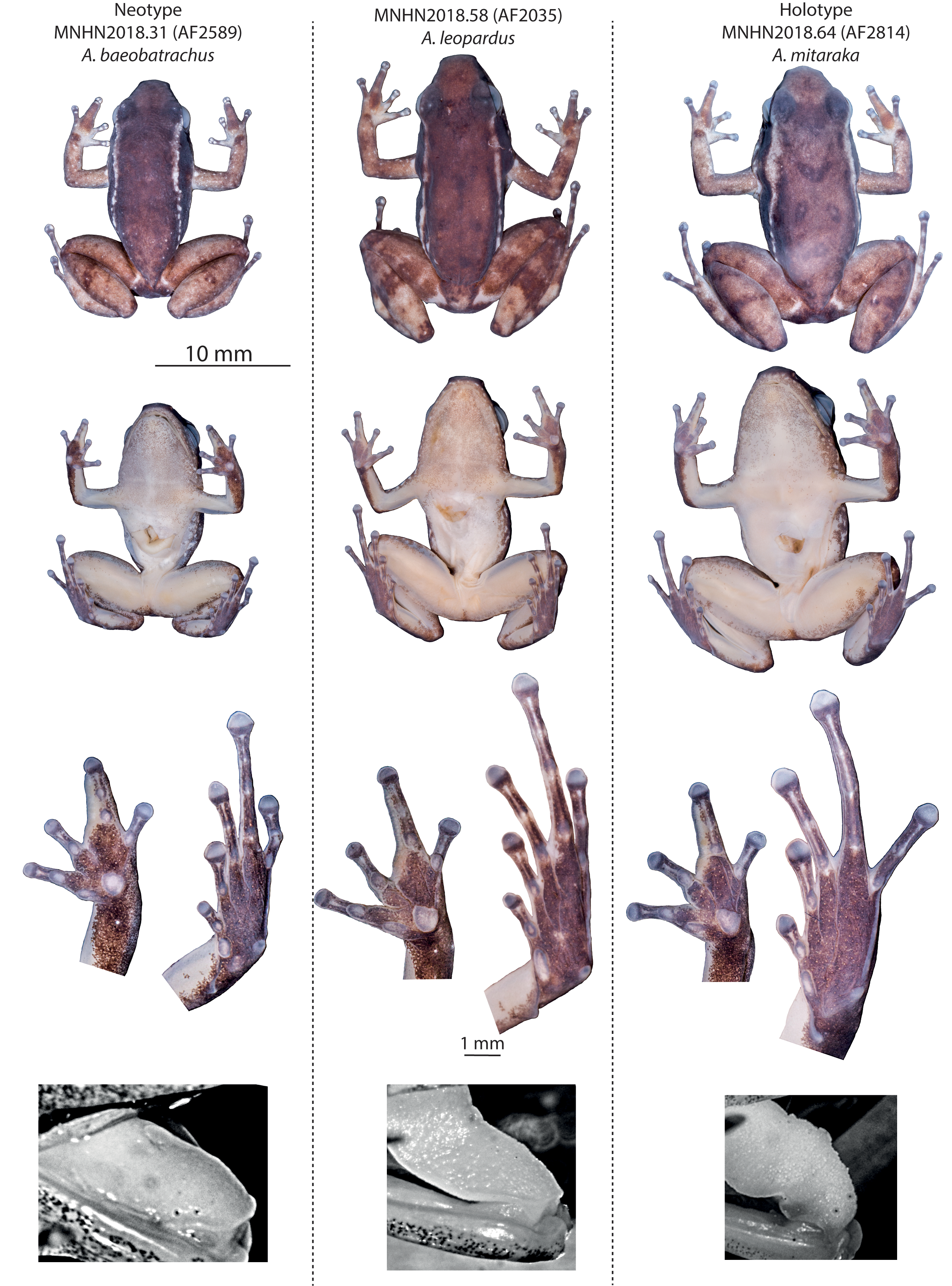
Morphological comparisons with other Anomaloglossus. The only other species group co-occurring with the Anomaloglossus stepheni group is the A. degranvillei group, represented by A. blanci, A. degranvillei, A. dewynteri and A. surinamensis, which are readily distinguishable by their moderate webbing (basal in A. mitaraka) and well-developed fringes on all toes (smaller and more developed on Toe II, III, IV) and the absence of a dorsolateral stripe (present). Outside these two groups all the other described Anomaloglossus species exclusively occur in Pantepui (i. e., the Guiana Shield highlands, see Kok et al. 2018) and have moderate to extensive toe webbing except A. meansi Kok, Nicolaï, Lathrop & MacCulloch, 2018, A. kaiei (Kok, Sambhu, Roopsind, Lenglet & Bourne, 2006), A. rufulus (Gorzula, 1990) and A. roraima (La Marca, 1997). However, unlike A. mitaraka, A. meansi lacks a conspicuous dorsolateral stripe, Finger III in males of A. kaei is not distinctly swollen, A. rufulus has as an extensively spotted ventral face, and A. roraima lacks well-developed fringes. Within the Anomaloglossus stepheni group, A. mitaraka can be distinguished from its probable sister species (Fouquet et al. 2019) A. leopardus (Figs. 2 – 3) by (1) narrower dark brown bars on legs vs large and more conspicuous dark transverse bars on legs in A. leopardus; (3) ventral coloration with orange restricted to the posterior part in males in A. mitaraka vs. generally entirely yellow in A. leopardus; (4) dorsolateral line thin in A. mitaraka vs. thick and well defined in A. leopardus; (5) advertisement call with a slower note rate (mean = 11.43, range 10.8 – 12.3 note / s in A. mitaraka [n = 6] vs. mean = 13.4, range 12.9 – 13.6 notes / s in A. leopardus [n = 4]) (Table 2). Anomaloglossus mitaraka can be distinguished from A. stepheni (Figs. 2 – 3, Table 1) by (1) a larger body size (mean = 18.6; range 18.2 – 19.3 mm in males [n = 7] and mean = 20.1; range 19.2 – 21.0 mm in females [n = 3] in A. mitaraka vs. mean = 17.15, range 16.5 – 18.0 mm in males [n = 10] and mean = 17.3, range 17.0 – 18.0 mm in females [n = 5] [from Martins 1989] in A. stepheni); (2) skin of dorsum with scattered tubercules in A. mitaraka vs. evenly tuberculate in A. stepheni; (3) orange ventral coloration posteriorly and laterally in males of A. mitaraka vs. entirely translucent white in A. stepheni; (4) dorsolateral line thin but well defined and continuous in A. mitaraka vs. thick and ill-defined dorsally in A. stepheni; (5) advertisement call much longer (mean = 1.04 s, range 0.74 – 1.23 s in A. mitaraka [n = 6] vs. mean = 0.25 s, range 0.18 – 0.29 s in A. stepheni [n = 4]), emitted at a slower pace (call rate mean = 0.43, range 0.32 – 0.52 calls / s in A. mitaraka [n = 6] vs. mean = 1.40, range 1.10 – 1.89 calls / s in A. stepheni [n = 4]) (Table 2). Anomaloglossus mitaraka can be distinguished from A. baeobatrachus by (1) a larger body size (mean = 18.6; range 18.2 – 19.3 mm in males [n = 7] and mean = 20.1; range 19.2 – 21.0 mm in females [n = 3] in A. mitaraka vs. mean = 16.2; range 14.8 – 17.1 mm in males [n = 16] and mean = 18.4; range 17.3 – 19.4 mm in females [n = 4] in A. baeobatrachus); (2) ventral coloration posteriorly and laterally in males in A. mitaraka vs. yellow and less extensive in A. baeobatrachus; (3) dorsolateral line thin but well defined and solid in A. mitaraka vs. narrower and interrupted in A. baeobatrachus; (4) call with lower note rate (mean = 11.43 notes / s, range 10.83 – 12.28 in A. mitaraka [n = 6] vs. mean = 16.10, range 15.62 – 16.85 s in A. baeobatrachus [n = 9]) lower dominant frequency (mean = 4.44, range 4.13 – 4.76 kHz in A. mitaraka [n = 6] vs. mean = 5.39, range 4.96 – 5.59 kHz in A. baeobatrachus [n = 9]) (Table 2). Description of the holotype. An adult male, 18.6 mm SVL; body robust; head wider than long, HL 94 % of HW; HL 33 % of SVL; dorsal skin tuberculate, one enlarged tubercle on each eyelid, snout long (SL 52 % of HL), rounded to nearly truncate in dorsal view, protruding in lateral view, extending past lower jaw. Nares located anterolaterally; canthus rostralis rounded, loreal region concave; IN 39 % of HW; EN 29 % of HL, 75 % of ED. Tympanum distinct anteroventrally; supratympanic fold inconspicuous; choanae small, circular, located anterolaterally (Figs. 2 – 3). Forelimb slender, skin tuberculate; metacarpal ridge present; HAND 24 % of SVL; Finger I longer than Finger II when fingers adpressed; fingers large and flattened; webbings absent on fingers; lateral fringes present on preaxial edges of Finger II; Finger III distinctly swollen dorsally and preaxially; tip of Finger IV not reaching distal subarticular tubercle on Finger III when fingers adpressed; finger discs expanded, wider than long, about 1.5 times width of digit; width of disc on Finger III 0.6 mm; discs with distinct dorsal scutes. Relative lengths of adpressed fingers III> IV> I> II; palmar tubercle large, heart-shaped, 0.8 mm in diameter (larger than Finger’s III disc), thenar tubercle elliptic, small (equal to Finger III’s disc in maximum diameter), elliptic, half the size of palmar tubercle, well separated from palmar tubercle. Only basal subarticular tubercles on Fingers are conspicuous; subarticular tubercles on fingers I and II the largest, followed by Finger IV’s subarticular tubercles and basal subarticular tubercle on Finger III. Hind limb robust, skin tuberculate; TL 47 % of SVL; heels in contact when hind limbs are flexed at right angles to the sagittal plane of body; FL 42 % of SVL; relative length of adpressed toes IV> III> V> II> I; Toe I very short, its tip reaching the base of subarticular tubercle on Toe II when toes adpressed; toe discs larger than width of toes. Width of disc on Toe IV 0.7 mm. Foot basally webbed; lateral fringes present on all toes. Toe webbing formula I 1 + – 1 - II 1 + – 1 - III 1 + – 1 + IV 0 – 1 + V. One to three subarticular tubercles on toes as follows: one on Toes I and II, two on Toes III and V, three on Toe IV. Inner metatarsal tubercle protuberant elliptical, 0.5 mm in length, outer metatarsal tubercle round, protuberant, 0.3 mm in diameter. Tarsal keel well defined, tubercle-like and strongly curved at proximal end. Metatarsal fold strong. Color of holotype in life. Dorsal color uniformly dark brown. Dorsolateral stripe thin, continuous, bluish white (yellow near groin) (Fig. 2). Dark brown lateral band extending from tip of snout to the groin and containing the indistinct dorsal part of tympanum, tapering posteriorly. Upper lip with small white blotches. Lower flanks pale white anteriorly and orange posteriorly with small white blotches. Throat white covered with melanophores, more densely anterolaterally; belly anteriorly white, white laterally, orange posteriorly, ventral surfaces of thighs and arms orange. Iris with coper metallic pigmentation and pupil ring interrupted dorsally and ventrally by transversal pigmentation (Fig. 2). Upper and lower arm pale red dorsally, light brown with small dark brown spots elsewhere. Dorsal surfaces of thigh, shank and tarsus brown with dark brown transverse bars and ill-defined blotches. Paracloacal marks orangish, elongated anteroposteriorly. Toes and digits with small light blue dots dorsally and laterally. Palms and soles dark brown. Color of holotype in preservative. After three years in 70 % ethanol, some colors of the specimen faded and the dorsal coloration now varies from brown to grey with interorbital, mid-dorsal and sacral dark brown blotches and the orangish ventral coloration disappeared (Fig. 3). Bluish freckles and orange and reddish marks turned cream.
A new species of Anomaloglossus (Anura: Aromobatidae) of the stepheni group with the redescription of A. baeobatrachus (Boistel and de Massary, 1999), and an amended definition of A. leopardus Ouboter and Jairam, 2012
Distribution and natural history. Anomaloglossus mitaraka is a diurnal species inhabiting the leaf litter in primary forest at low to mid elevations (from 150 to 500 m a. s. l.). The species is usually found close to streams next to which it deposits its exotrophic tadpoles into puddles, but some specimens can be found more than 50 m from water bodies. Males call all day long when the weather is rainy. Breeding occurs during the rainy season, between January and May. The males respond to intraspecific playbacks with shorter and more rapidly emitted note trills. Males are territorial, their small territories being spaced at least a few meters apart. Males usually call slightly above the leaf litter, exposed on a branch or a dead leaf. Eggs are deposited in the fold of a dead leaf (a single observation). This clutch was raised (Fig. 6) and some tadpoles were genotyped. Populations have been documented in southwestern French Guiana and adjacent Suriname (Mitaraka massif, Pic Coudreau, Haute Marwini, upper Tapanahony; Fig. 1). It also likely occurs in adjacent Brazil and may occupy similar habitats in other regions of Suriname.
A new species of Anomaloglossus (Anura: Aromobatidae) of the stepheni group with the redescription of A. baeobatrachus (Boistel and de Massary, 1999), and an amended definition of A. leopardus Ouboter and Jairam, 2012
Etymology. The specific epithet is a noun in apposition and refers to the type locality (Mitaraka, French Guiana). Definition. (1) Medium-sized Anomaloglossus (average male SVL 18.6 mm [18.2 – 19.3, n = 7], female SVL 20.1 mm [19.2 – 21.0, n = 3]) (Table 1); (2) body robust; (3) skin on dorsum with irregularly scattered tubercles becoming denser on the posterior half and legs, with a larger tubercle on each eyelid, ventral skin smooth; (4) inconspicuous supratympanic fold; (5) tympanum distinct anteroventrally; (6) snout short and protruding in lateral view; (7) nares oriented ventrolaterally, situated near tip of snout; (8) Finger II equal to Finger I when fingers adpressed; (9) tip of Finger IV not reaching distal subarticular tubercle on Finger III when fingers adpressed; (10) distal subarticular tubercle distinct on Finger III, absent on the other fingers; (11) Finger III swollen dorsally and preaxially, extending largely towards dorsal surface of hand in males; (12) fringes present on all fingers particularly developed preaxially on Finger II in males and females; (13) toes basally webbed, with well-developed fringes on all toes, more developed preaxially on Toe II, and pre- and postaxially on toes III and IV (sensu Grant et al. 2006; keel-like lateral folds sensu Myers & Donnelly 2008); (14) tarsal keel well-defined, curved; (15) black arm gland at the junction with wrist in males (sensu Grant & Castro 1998, see also Grant et al. 2006); (16) cloacal tubercles present; (17) paracloacal mark present (orangish in life, cream in preservative); (18) pale dorsolateral stripe present, solid (white to orangish anteriorly, yellow posteriorly in life, white in preservative), flanks and dorsum uniformly dark brown in males, reddish brown with dark brown blotches in females in life; (19) ventrolateral stripe absent; (20) sexual dichromatism in throat color pattern present in life, sometimes anteriorly yellow in males with sparse black melanophores, evenly and entirely yellow in females; (21) sexual dichromatism in ventral color pattern present, abdomen mostly cream, posteriorly and laterally yellow in males, uniformly bright yellow in females in life; (22) iris with metallic pigmentation and pupil ring interrupted ventrally and dorsally by transversal black pigmentation; (23) median lingual process as long as wide, tapered, bluntly pointed, smooth (non-papillate), reclined in pit; (24) a 0.74 – 1.23 s length call consisting of a train of 8 – 16 notes of 0.028 – 0.036 s in length and spaced by intervals of 0.051 – 0.068 s and of dominant frequency at 4.13 – 4.76 kHz (n = 6); (25) tadpole of type 4 (Orton 1953), exotrophic, with a functional mouth with marginal papillae and labial teeth (Fig. 4; Table 2).
A new species of Anomaloglossus (Anura: Aromobatidae) of the stepheni group with the redescription of A. baeobatrachus (Boistel and de Massary, 1999), and an amended definition of A. leopardus Ouboter and Jairam, 2012
Holotype. MNHN 2018.64 (field n ° AF 2814), an adult male, collected by A. Fouquet and M. Dewynter, 24 February 2015, Mitaraka, French Guiana, 2.23577 ° N 54.44928 ° W, ~ 150 m elevation (Figs. 2 – 3). Paratopotypes. Nine specimens: MNHN 2018.65 – 70 (field n ° AF 2732, 2750 - 1, 2754, 2808, 2878) six adult males and MNHN 2018.71 – 73 (field n ° AF 2724, 2731, 2824) three females collected with the holotype by A. Fouquet and M. Dewynter.
A new species of Anomaloglossus (Anura: Aromobatidae) of the stepheni group with the redescription of A. baeobatrachus (Boistel and de Massary, 1999), and an amended definition of A. leopardus Ouboter and Jairam, 2012
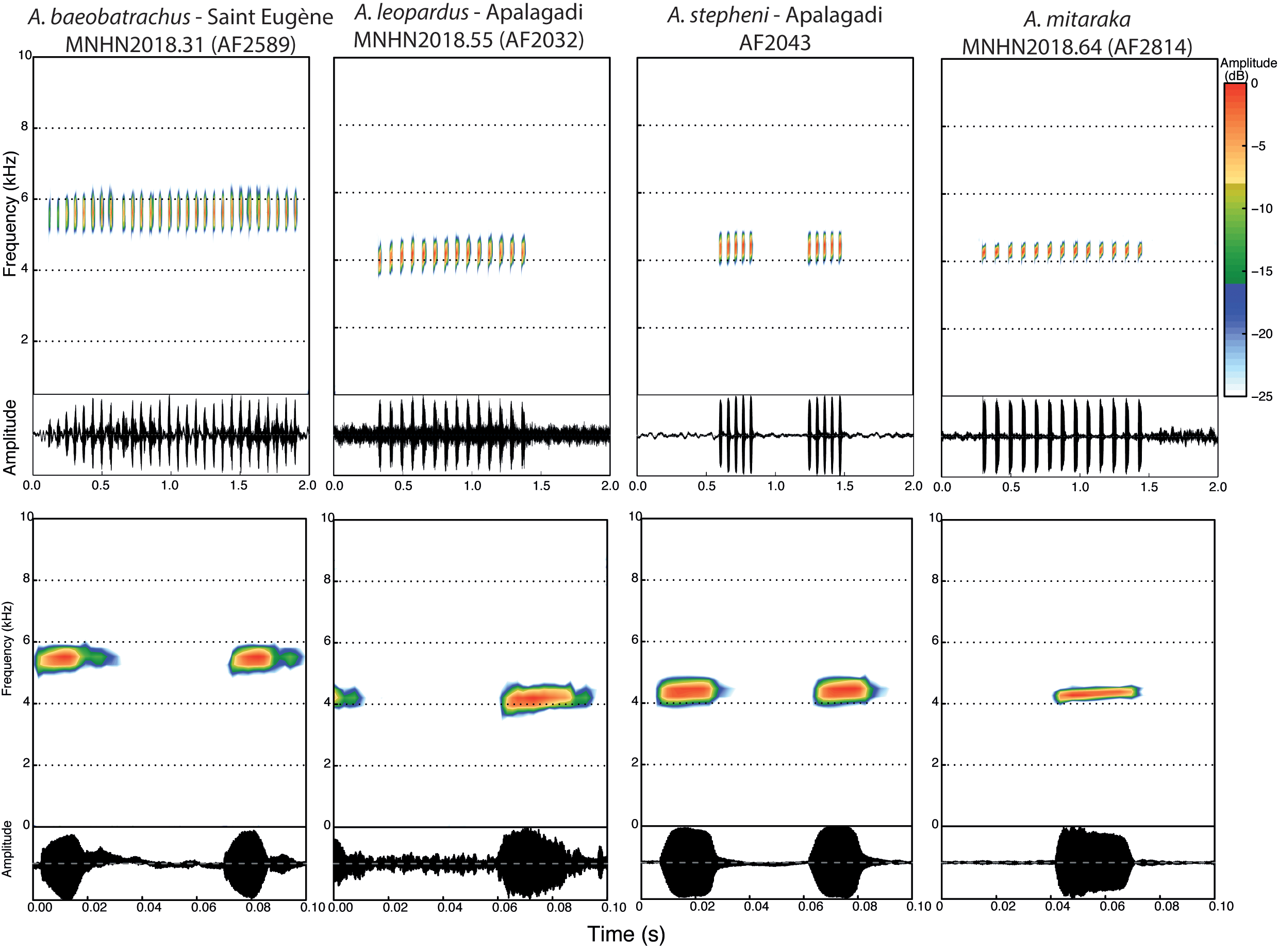
Variation among type specimens. Measurements (range, mean, and standard deviation) of the type series are provided in Table 1. Coloration of limbs varies from brown to reddish brown, females being paler and with more conspicuous dark dorsal blotches. Colour of dorsolateral line varies from white to orangish. Overall dorsal and lateral coloration and tuberculation may vary with light intensity, time of the day and probably reproductive activity as males carrying tadpoles apparently display overall lighter colors, smoother skin and sharper contrasts, whereas calling males are very dark and highly tuberculate. Ventral coloration of female is entirely orangish while the orangish parts are limited in various extent to the posterior region and throat in males. Vocal sac, slits and small dark melanophores on throat only observed in males as well as swelling on the Finger III. Advertisement call. Six specimens (one uncollected) calling from the leaf litter were recorded from a distance of about 1 m and at temperatures ranging from 23 to 26 ° C. Descriptive statistics of call parameters are presented in Table 2. Anomaloglossus mitaraka emits trains (call length mean = 1.04 s; range 0.74 – 1.23 s) of short notes (note length mean = 0.030 s; range 0.028 – 0.036 s; inter-note interval mean = 0.060 s; range 0.051 – 0.068 s). The spectral structure of the note has a developed harmonic structure and the dominant frequency is 4.44 kHz on average (range 4.13 – 4.76 kHz) with a slight upward modulation (ca. 0.2 kHz) (Fig. 4, Table 2).
A new species of Anomaloglossus (Anura: Aromobatidae) of the stepheni group with the redescription of A. baeobatrachus (Boistel and de Massary, 1999), and an amended definition of A. leopardus Ouboter and Jairam, 2012

Eastern Pantepui Anomaloglossus species

Anomaloglossus megacephalus can be distinguished from A. beebei by (characters of A. beebei in parentheses, see also Kok et al. 2006b and Kok & Kalamandeen 2008) its larger size, female SVL max 28.3 mm [n=3] in A. megacephalus (18.7 mm in A. beebei, n=27), fingers with keel-like lateral folds, best developed preaxially on Fingers II and III (fringes not folded), toes with folded flaplike fringing (fringes not folded), throat in adult female blotched (immaculate), palm dark brown to black (yellowish), distinct dark bands on thigh and shank (absent), dark interorbital V-shaped band (absent).

Anomaloglossus megacephalus can be distinguished from A. breweri (Barrio-Amorós, 2006) by (characters of A. breweri in parentheses) its larger size, female SVL max 28.3 mm [n=3] in A. megacephalus (23.8 mm in A. breweri, n=1), throat in adult female blotched (immaculate), median lingual process short, wider than long, tapered (distinctly longer than wide, tip pointed).

Anomaloglossus megacephalus can be distinguished from A. kaiei by (characters of A. kaiei in parentheses, see also Kok & Kalamandeen 2008) its larger size, female SVL max 28.3 mm [n=3] in A. megacephalus (19.8 mm in A. kaiei, n=25), fingers with keel-like lateral folds, best developed preaxially on Fingers II and III (fringes not folded), toes moderately webbed (basally webbed), dorsolateral stripe absent (present), oblique lateral stripe present (absent), throat in adult female blotched (immaculate).

Anomaloglossus megacephalus can be distinguished from A. murisipanensis (La Marca, 1998) in having (characters of A. murisipanensis in parentheses, all based on the preserved holotype, which is a juvenile and the only known specimen) fingers with keel-like lateral folds, best developed preaxially on Fingers II and III (fringes barely detectable), more webbing on toes, symmetrical cloacal tubercles present (absent), tarsal keel weakly to distinctly curved, slightly tuberclelike (straight, not tuberclelike), oblique lateral stripe always present, even if broken in spots (not distinguishable), no white stripe between naris and eye in preservative (present).

Anomaloglossus megacephalus can be distinguished from A. praderioi by (characters of A. praderioi in parentheses, see also Kok 2010) its larger size, female SVL max 28.3 mm (n=3) in A. megacephalus (22.7 mm in A. praderioi, n=1), Finger IV longer than I (equal), tip of Finger IV always surpassing the base of the distal subarticular tubercle on Finger III when fingers adpressed (barely reaching the base), toes moderately webbed with folded flaplike fringing (basally webbed, folded flaplike fringing not present on all toes), dorsolateral stripe absent (present), oblique lateral stripe present (absent), throat in adult female blotched (immaculate).

Anomaloglossus megacephalus can be distinguished from A. roraima in having (characters of A. roraima in parentheses) fingers with keel-like lateral folds, best developed preaxially on Fingers II and III (fringes barely distinct, not distinctly folded), all toes with folded flaplike fringing (absent), webbing on toes moderate (absent).

Anomaloglossus megacephalus can be distinguished from A. rufulus (Gorzula, 1990) in having (characters of A. rufulus in parentheses) webbing on toes moderate (rudimentary), and most remarkably by ventral colour pattern; light with a few dark brown blotches in A. megacephalus (dark brown marbled with white blotches in A. rufulus).

The new species superficially most resembles A. parkerae, A. tepuyensis (with which it has been confused), and A. triunfo (Barrio-Amorós, Fuentes-Ramos & Rivas-Fuenmayor, 2004), in sharing a similar dorsal pattern. It should be noted that A. triunfo is a possible synonym of A. tepuyensis (Kok & Barrio- Amorós unpubl. data, see also comments by Myers & Donnelly 2008). Anomaloglossus parkerae is distinguished from A. tepuyensis and A. triunfo only by a few characters such as size, definition of dorsal pattern, and condition of finger and toe fringes (Myers & Donnelly 2008). Adults of A. megacephalus can notably be distinguished from those three similar taxa in having a more slender body ( Anomaloglossus parkerae, A. tepuyensis and A. triunfo are distinctly stockier frogs), a comparatively longer snout and a larger, somewhat more massive head [See Fig. 5 for close comparison between A. megacephalus and A. tepuyensis and A. parkerae; compare also with Duellman’s (1997: 10) colour plate of A. parkerae, fig. 30 (showing A. parkerae) in Lötters et al. (2007), and figs. 13, 15 and 16 illustrating A. tepuyensis in Myers & Donnelly (2008); see also below for further comments], and in having symmetrical cloacal tubercles (absent in all females of A. parkerae, A. tepuyensis and A. triunfo examined).

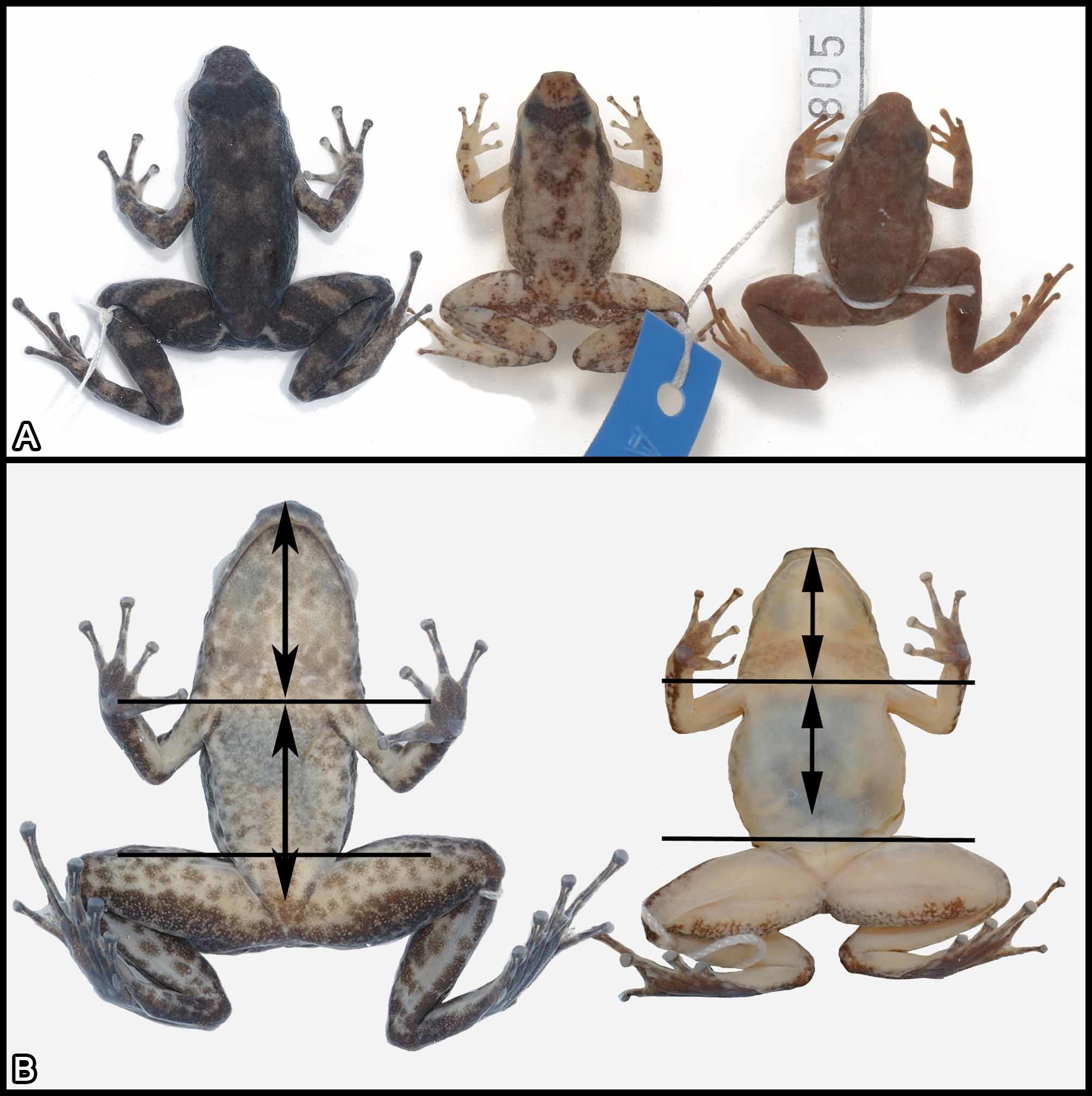
Direct comparison of specimens shows a difference in head size in Anomaloglossus megacephalus compared to the similar A. parkerae, A. tepuyensis and A. triunfo, as confirmed by plotting of morphometric proportions. Comparison of HL3 with BEL indicates that the new species proportionally has a longer head than A. tepuyensis (Fig. 6). In order to distinguish between those similar species, the midline distance from the tip of the snout to an imaginary line between anterior insertions of upper arms is measured, and that distance is then extended posteriorly from the same imaginary line. In two of the three available A. megacephalus adult specimens the distance reaches or surpasses the anterior insertion of thigh, whereas in all adult specimens of A. parkerae, A. tepuyensis and A. triunfo examined (n = 20), the distance fails to reach the thigh insertion (see Fig. 5 B). It is noteworthy to mention that the only specimen of A. megacephalus in which HL3 is not longer than BEL is in poor preservation state.

A new species of Anomaloglossus (Anura: Aromobatidae) from the Pakaraima Mountains of GuyanaMagnoliaPress via PlaziNo known copyright restrictions apply. See Agosti, D., Egloff, W., 2009. Taxonomic information exchange and copyright: the Plazi approach. BMC Research Notes 2009, 2:53 for further explanation.
We first present a focussed comparison between the new species and the ten Anomaloglossus species known to occur in the Eastern Pantepui District (i. e. east of the Rio Caroní). The Rio Caroní likely acts as a biogeographic barrier for Anomaloglossus species since no species has been reported to occur on both sides of the river in the Guiana highlands of Venezuela and Guyana (it must be noted that very few Pantepui anurans are known to occur on both sides of the river). But, in order to provide a more comprehensive comparison, we also compared the new species with the six known Anomaloglossus species that occur in the Western Pantepui District (i. e. west of the Rio Caroní) in the Guiana highlands of Venezuela.
A new species of Anomaloglossus (Anura: Aromobatidae) from the Pakaraima Mountains of Guyana
Among the Western Pantepui Anomaloglossus species, A. ayarzaguenai (La Marca, 1998) and A. moffetti Barrio-Amorós and Brewer-Carías, 2008 are the geographically closest species to A. megacephalus (ca. 400 km airline to the west). Anomaloglossus ayarzaguenai and A. moffetti are very similar to each other, geographically close (from Cerro Jaua and Cerro Sarisariñama, respectively) and possible synonyms (Kok & Barrio-Amorós unpubl. data). Anomaloglossus megacephalus is distinguished from A. ayarzaguenai and A. moffetti in having a comparatively longer snout, and a larger, somewhat more massive head [compare Figs. 1 and 2 B with fig. 4 a – c illustrating A. moffetti in Barrio-Amorós & Brewer-Carías (2008)], in having a distinct tympanum in life (barely distinct in A. ayarzaguenai and A. moffetti), separated from eye by 42 – 60 % of its greatest length (25 % or less in A. ayarzaguenai and A. moffetti), and in lacking a dark area spotted with white ventrolaterally at the level of arm insertion (always present in A. ayarzaguenai and A. moffetti).
A new species of Anomaloglossus (Anura: Aromobatidae) from the Pakaraima Mountains of Guyana

Export occurrence data

Darwin Core Archive (ZIP)

Common names used for this species across different languages and regions. From 1 country.

FRAnomaloglossefrafraAnomaloglossefrafraAnomaloglossesfra

Vernacular (common) names are the everyday names used for a species in different languages and regions. A single species may have dozens of common names worldwide.

FRAnomaloglosse
fraFRfra
fraAnomaloglosse
fra
Source: Catalogue of LifeSource taxon #299414175
fraAnomaloglosses
fra
Source: Catalogue of LifeSource taxon #299414175

CLASSIFICATION

Taxonomic Classification Tree

MULTIMEDIA

Media Files(9)

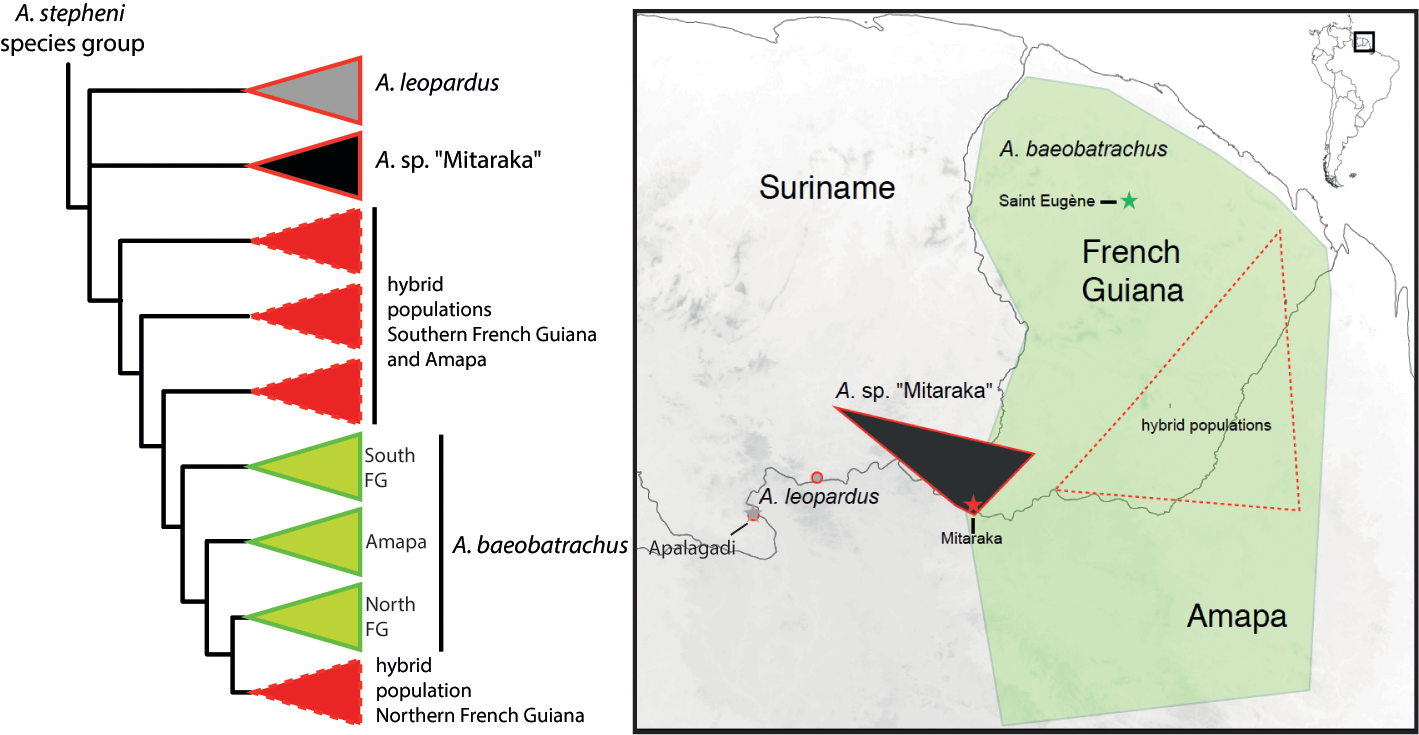
FIGURE 1. Phylogenetic tree adapted from Fouquet et al. (2019) and respective distributions of A. baeobatrachus, A. leopardus and A. sp “Mitaraka”. Red contours of collapsed branches in the tree indicate groups with exotrophic tadpoles, while green contours indicate groups with endotrophic tadpoles. Stars with corresponding colours indicate type localities.

Imageimage/png© Fouquet, Antoine;Vacher, Jean-Pierre;Courtois, Elodie A.;Deschamps, Chloé;Ouboter, Paul;Jairam, Rawien;Gaucher, Philippe;Dubois, Alain;Kok, Philippe J. R.A new species of Anomaloglossus (Anura: Aromobatidae) of the stepheni group with the redescription of A. baeobatrachus (Boistel and de Massary, 1999), and an amended definition of A. leopardus Ouboter and Jairam, 2012

FIGURE 2. Three males (top) and one female (bottom) of four species of the Anomaloglossus stepheni group. Size of the specimens with asterisk is not scaled.
Imageimage/png© Fouquet, Antoine;Vacher, Jean-Pierre;Courtois, Elodie A.;Deschamps, Chloé;Ouboter, Paul;Jairam, Rawien;Gaucher, Philippe;Dubois, Alain;Kok, Philippe J. R.A new species of Anomaloglossus (Anura: Aromobatidae) of the stepheni group with the redescription of A. baeobatrachus (Boistel and de Massary, 1999), and an amended definition of A. leopardus Ouboter and Jairam, 2012

FIGURE 3. Views of dorsum, venter, left hand, left foot and Median Lingual Process of the neotype of A. baeobatrachus (left column), of a topotypical specimen of A. leopardus (central column) and of the holotype of A. mitaraka sp. nov. (right column).
Imageimage/png© Fouquet, Antoine;Vacher, Jean-Pierre;Courtois, Elodie A.;Deschamps, Chloé;Ouboter, Paul;Jairam, Rawien;Gaucher, Philippe;Dubois, Alain;Kok, Philippe J. R.A new species of Anomaloglossus (Anura: Aromobatidae) of the stepheni group with the redescription of A. baeobatrachus (Boistel and de Massary, 1999), and an amended definition of A. leopardus Ouboter and Jairam, 2012

FIGURE 4. Spectrograms and oscillograms of typical call of four species of the Anomaloglossus stepheni group in a 2 s and a 0.1 s time windows.

Imageimage/png© Fouquet, Antoine;Vacher, Jean-Pierre;Courtois, Elodie A.;Deschamps, Chloé;Ouboter, Paul;Jairam, Rawien;Gaucher, Philippe;Dubois, Alain;Kok, Philippe J. R.A new species of Anomaloglossus (Anura: Aromobatidae) of the stepheni group with the redescription of A. baeobatrachus (Boistel and de Massary, 1999), and an amended definition of A. leopardus Ouboter and Jairam, 2012

FIGURE 6. Tadpoles of Anomaloglossus mitaraka: on the left dorsal, lateral and ventral pictures of AF2875A preserved (top) and lateral picture of AF2875B in life (bottom); on the right picture of AF2732A in the nest (top), froglet AF2875B (middle), male AF2878 carrying tadpoles to the water (bottom).
Imageimage/png© Fouquet, Antoine;Vacher, Jean-Pierre;Courtois, Elodie A.;Deschamps, Chloé;Ouboter, Paul;Jairam, Rawien;Gaucher, Philippe;Dubois, Alain;Kok, Philippe J. R.A new species of Anomaloglossus (Anura: Aromobatidae) of the stepheni group with the redescription of A. baeobatrachus (Boistel and de Massary, 1999), and an amended definition of A. leopardus Ouboter and Jairam, 2012

FIGURE 5. Comparison of Anomaloglossus megacephalus sp. nov. and the similar A. tepuyensis and A. parkerae. A: Dorsal view of preserved specimens of (from left to right) A. megacephalus sp. nov. (IRSNB 1986, 27.3 mm SVL), A. tepuyensis (MHNLS 17401, 23.3 mm SVL) and A. parkerae (MHNLS 11089, 23.2 mm SVL). B: Comparison between midline distance from snout tip to an imaginary line between anterior arm insertions and the same distance reported posteriorly from the same imaginary line in A. megacephalus sp. nov. and A. tepuyensis. In most A. megacephalus specimens (left, IRSNB 1986, 27.3 mm SVL) the distance reaches or surpasses the anterior insertion of thigh, whereas in all specimens of A. tepuyensis examined (right, MHNLS 17401, 23.3 mm SVL), the distance fails to reach the thigh. Photos by PJRK.

Imageimage/png© Kok, Philippe J. R.;Macculloch, Ross D.;Lathrop, Amy;Willaert, Bert;Bossuyt, FrankyA new species of Anomaloglossus (Anura: Aromobatidae) from the Pakaraima Mountains of Guyana

IMAGES

Gallery(9)

See Gallery

Occurrences with images

CITATIONS

References(6)

  • 1

    Article title: Phylogenetic systematics of dart-poison frogs and their relatives (Amphibia: Athesphatanura: Dendrobatidae).

    original descriptionThe Interim Register of Marine and Nonmarine Genera
  • 2

    Bulletin of the American Museum of Natural History 299.

    original descriptionThe Interim Register of Marine and Nonmarine Genera
  • 3

    inferred from original work (title)

    habitat flag sourceThe Interim Register of Marine and Nonmarine Genera
  • 4

    original publication

    current name sourceThe Interim Register of Marine and Nonmarine Genera
  • 5

    web search (AJR)

    extant flag sourceThe Interim Register of Marine and Nonmarine Genera
  • Source Information

    GBIF Backbone Taxonomy

    GBIF Backbone Taxonomy

    checklist

    The GBIF Backbone Taxonomy is a single, synthetic management classification with the goal of covering all names GBIF is dealing with. It's the taxonomic backbone that allows GBIF to integrate name based information from different resources, no matter if these are occurrence datasets, species pages, names from nomenclators or external sources like EOL, Genbank or IUCN. This backbone allows taxonomic search, browse and reporting operations across all those resources in a consistent way and to provide means to crosswalk names from one source to another.

    It is updated regulary through an automated process in which the Catalogue of Life acts as a starting point also providing the complete higher classification above families. Additional scientific names only found in other authoritative nomenclatural and taxonomic datasets are then merged into the tree, thus extending the original catalogue and broadening the backbones name coverage. The GBIF Backbone taxonomy also includes identifiers for Operational Taxonomic Units (OTUs) drawn from the barcoding resources iBOL and UNITE.

    International Barcode of Life project (iBOL), Barcode Index Numbers (BINs). BINs are connected to a taxon name and its classification by taking into account all names applied to the BIN and picking names with at least 80% consensus. If there is no consensus of name at the species level, the selection process is repeated moving up the major Linnaean ranks until consensus is achieved.

    UNITE - Unified system for the DNA based fungal species, Species Hypotheses (SHs). SHs are connected to a taxon name and its classification based on the determination of the RefS (reference sequence) if present or the RepS (representative sequence). In the latter case, if there is no match in the UNITE taxonomy, the lowest rank with 100% consensus within the SH will be used.

    The GBIF Backbone Taxonomy is available for download at https://hosted-datasets.gbif.org/datasets/backbone/ in different formats together with an archive of all previous versions.

    The following 105 sources have been used to assemble the GBIF backbone with number of names given in brackets:

    • Catalogue of Life Checklist - 4766428 names
    • International Barcode of Life project (iBOL) Barcode Index Numbers (BINs) - 635951 names
    • UNITE - Unified system for the DNA based fungal species linked to the classification - 611208 names
    • The Paleobiology Database - 212054 names
    • World Register of Marine Species - 188857 names
    • The Interim Register of Marine and Nonmarine Genera - 183894 names
    • The World Checklist of Vascular Plants (WCVP) - 131891 names
    • GBIF Backbone Taxonomy - 114350 names
    • TAXREF - 109374 names
    • The Leipzig catalogue of vascular plants - 75380 names
    • ZooBank - 73549 names
    • Integrated Taxonomic Information System (ITIS) - 68377 names
    • Plazi.org taxonomic treatments database - 61346 names
    • Genome Taxonomy Database r207 - 60545 names
    • International Plant Names Index - 52329 names
    • Fauna Europaea - 45077 names
    • The National Checklist of Taiwan (Catalogue of Life in Taiwan, TaiCoL) - 36193 names
    • Dyntaxa. Svensk taxonomisk databas - 35892 names
    • The Plant List with literature - 32692 names
    • United Kingdom Species Inventory (UKSI) - 29643 names
    • Artsnavnebasen - 29208 names
    • The IUCN Red List of Threatened Species - 21221 names
    • Afromoths, online database of Afrotropical moth species (Lepidoptera) - 13961 names
    • Brazilian Flora 2020 project - Projeto Flora do Brasil 2020 - 13829 names
    • Prokaryotic Nomenclature Up-to-Date (PNU) - 10079 names
    • Checklist Dutch Species Register - Nederlands Soortenregister - 8814 names
    • ICTV Master Species List (MSL) - 7852 names
    • Cockroach Species File - 6020 names
    • GRIN Taxonomy - 5882 names
    • Taxon list of fungi and fungal-like organisms from Germany compiled by the DGfM - 4570 names
    • Catalogue of Afrotropical Bees - 3623 names
    • Catalogue of Tenebrionidae (Coleoptera) of North America - 3327 names
    • Checklist of Beetles (Coleoptera) of Canada and Alaska. Second Edition. - 3312 names
    • Systema Dipterorum - 2850 names
    • Catalogue of the Pterophoroidea of the World - 2807 names
    • The Clements Checklist - 2675 names
    • Taxon list of Hymenoptera from Germany compiled in the context of the GBOL project - 2496 names
    • IOC World Bird List, v13.2 - 2366 names
    • Official Lists and Indexes of Names in Zoology - 2310 names
    • National checklist of all species occurring in Denmark - 1922 names
    • Myriatrix - 1876 names
    • Database of Vascular Plants of Canada (VASCAN) - 1822 names
    • Taxon list of vascular plants from Bavaria, Germany compiled in the context of the BFL project - 1771 names
    • Orthoptera Species File - 1742 names
    • A list of the terrestrial fungi, flora and fauna of Madeira and Selvagens archipelagos - 1602 names
    • Aphid Species File - 1565 names
    • World Spider Catalog - 1561 names
    • Taxon list of Jurassic Pisces of the Tethys Palaeo-Environment compiled at the SNSB-JME - 1270 names
    • Backbone Family Classification Patch - 1143 names
    • GBIF Algae Classification - 1100 names
    • International Cichorieae Network (ICN): Cichorieae Portal - 975 names
    • Psocodea Species File - 803 names
    • New Zealand Marine Macroalgae Species Checklist - 787 names
    • Annotated checklist of endemic species from the Western Balkans - 754 names
    • Taxon list of animals with German names (worldwide) compiled at the SMNS - 503 names
    • Catalogue of the Alucitoidea of the World - 472 names
    • Lygaeoidea Species File - 462 names
    • Catálogo de Plantas y Líquenes de Colombia - 422 names
    • GBIF Backbone Patch - 317 names
    • Phasmida Species File - 259 names
    • Cortinariaceae fetched from the Index Fungorum API - 234 names
    • Coreoidea Species File - 233 names
    • GTDB supplement - 139 names
    • Mantodea Species File - 119 names
    • Endemic species in Taiwan - 93 names
    • Taxon list of Araneae from Germany compiled in the context of the GBOL project - 88 names
    • Species of Hominidae - 78 names
    • Taxon list of Sternorrhyncha from Germany compiled in the context of the GBOL project - 77 names
    • Taxon list of mosses from Germany compiled in the context of the GBOL project - 75 names
    • Mammal Species of the World - 73 names
    • Plecoptera Species File - 71 names
    • Species Fungorum Plus - 64 names
    • Catalogue of the type specimens of Cosmopterigidae (Lepidoptera: Gelechioidea) from research collections of the Zoological Institute, Russian Academy of Sciences - 47 names
    • Species named after famous people - 41 names
    • Dermaptera Species File - 36 names
    • Taxon list of Trichoptera from Germany compiled in the context of the GBOL project - 34 names
    • True Fruit Flies (Diptera, Tephritidae) of the Afrotropical Region - 33 names
    • Range and Regularities in the Distribution of Earthworms of the Earthworms of the USSR Fauna. Perel, 1979 - 32 names
    • Taxon list of Diplura from Germany compiled in the context of the GBOL project - 30 names
    • Lista de referencia de especies de aves de Colombia - 2022 - 24 names
    • Taxon list of Auchenorrhyncha from Germany compiled in the context of the GBOL project - 20 names
    • Catalogue of the type specimens of Polycestinae (Coleoptera: Buprestidae) from research collections of the Zoological Institute, Russian Academy of Sciences - 19 names
    • Taxon list of Thysanoptera from Germany compiled in the context of the GBOL project - 19 names
    • Lista de especies de vertebrados registrados en jurisdicción del Departamento del Huila - 18 names
    • Taxon list of Microcoryphia (Archaeognatha) from Germany compiled in the context of the GBOL project - 15 names
    • Catalogue of the type specimens of Bufonidae and Megophryidae (Amphibia: Anura) from research collections of the Zoological Institute, Russian Academy of Sciences - 12 names
    • Grylloblattodea Species File - 11 names
    • Coleorrhyncha Species File - 9 names
    • Taxon list of liverworts from Germany compiled in the context of the GBOL project - 9 names
    • Embioptera Species File - 7 names
    • Taxon list of Pisces and Cyclostoma from Germany compiled in the context of the GBOL project - 6 names
    • Taxon list of Pteridophyta from Germany compiled in the context of the GBOL project - 6 names
    • Taxon list of Siphonaptera from Germany compiled in the context of the GBOL project - 5 names
    • The Earthworms of the Fauna of Russia. Perel, 1997 - 5 names
    • Taxon list of Zygentoma from Germany compiled in the context of the GBOL project - 4 names
    • Asiloid Flies: new taxa of Diptera: Apioceridae, Asilidae, and Mydidae - 3 names
    • Taxon list of Protura from Germany compiled in the context of the GBOL project - 3 names
    • Taxon list of hornworts from Germany compiled in the context of the GBOL project - 2 names
    • Chrysididae Species File - 1 names
    • Taxon list of Dermaptera from Germany compiled in the context of the GBOL project - 1 names
    • Taxon list of Diplopoda from Germany in the context of the GBOL project - 1 names
    • Taxon list of Orthoptera (Grashoppers) from Germany compiled at the SNSB - 1 names
    • Taxon list of Pscoptera from Germany compiled in the context of the GBOL project - 1 names
    • Taxon list of Pseudoscorpiones from Germany compiled in the context of the GBOL project - 1 names
    • Taxon list of Raphidioptera from Germany compiled in the context of the GBOL project - 1 names

    GBIF Secretariat (2023). GBIF Backbone Taxonomy. Checklist dataset https://doi.org/10.15468/39omei accessed via GBIF.org on 2026-06-14.

    CC BYPublished 8/28/2023View dataset
    GBIF Usage Key
    2426205
    Dataset Key
    d7dddbf4-2cf0-4f39-9b2a-bb099caae36c
    Origin
    source
    Backbone Key
    2426205
    Taxon ID
    gbif:2426205
    Last Crawled
    8/22/2023
    Last Interpreted
    8/22/2023