AnimaliaNot EvaluatedacceptedspeciesAcceptedRestricted
Pseudalataspora kovalevae

Pseudalataspora kovalevae

Kalavati, MacKenzie, Collins, Hemmingsen & Brickle, 2013

GBIF:8489853

0countries
0year

PROFILE

Species Profile

Habitat

Marine

ABOUT

Descriptions(5)

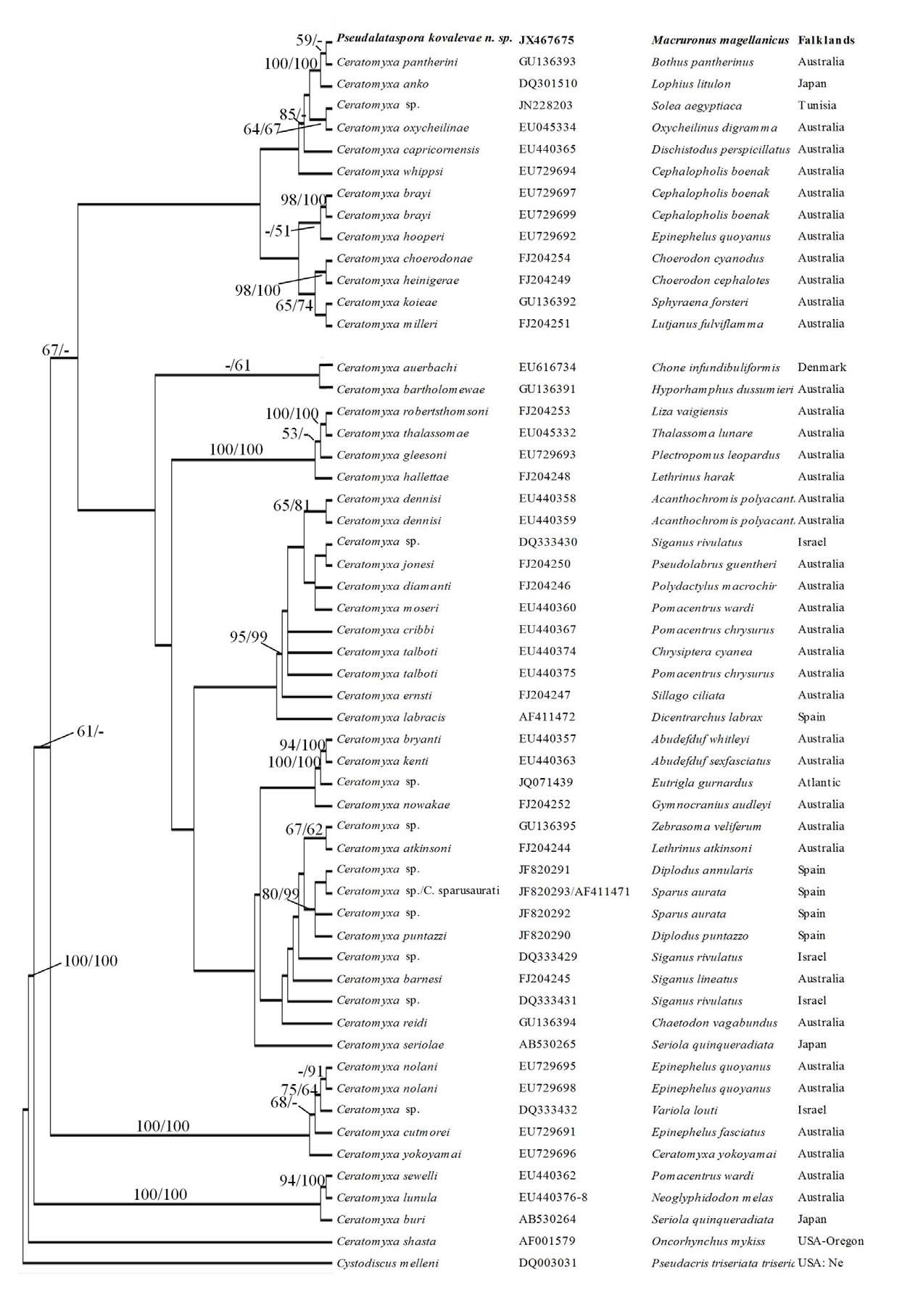
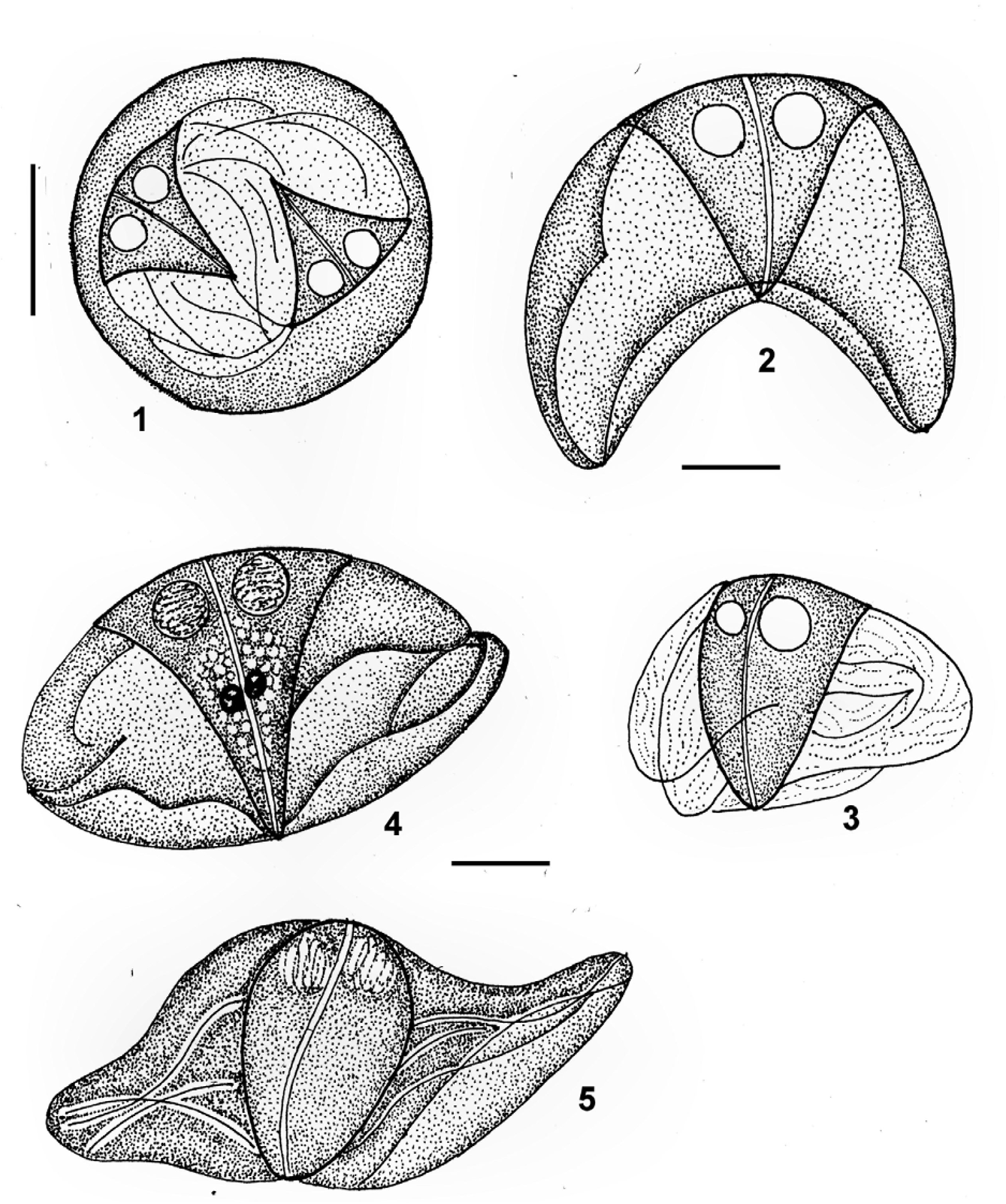
Host length range: 25 – 42 cm. Collection numbers: NHMUK 2012.3.19.1, 2012.3.19.2, 2012.3.19.3. Morphological description. Sporoblast globular, disporic (Fig. 1). No pseudopodia observed. Ectoplasm dense and clearly demarcated from fine endoplasm. Dimensions, based on 10 fixed specimens: 28.4 – 38.4 x 28.0 – 36.0. Spore (Figs. 2 – 6) triangular with sharply pointed tips in side view, flat anteriorly and curved in apical view. Sutural line prominent and raised. Sporoplasm deeply staining and binucleate. Valves drawn out into two delicate broad alate processes joined together at their proximal extremities to form a parachute-like structure over the valves. Polar capsules spherical, close together. Polar filament thick, number of coils not visible. Dimensions, based on 30 fixed spores, as ranges with means ± SD in parentheses: spore length 8.0 – 10.5 (9.1 ± 0.68); spore thickness, including alate processes 30.0 – 35.5 (31.8 ± 1.52), excluding alate processes 8.8 – 11.6 (9.0 ± 1.2); spore width 14.0 – 20.0 (15.7 ± 1.57); polar capsule diameter 2.5 – 3.0 (2.7 ± 0.16); polar capsule length: spore length = 1: 2.8 – 3.8; spore length: spore width = 1: 3.0 – 4.9. Molecular results: Pseudalataspora kovalevae. PCR amplification of the myxosporean 18 S rRNA gene from four infected gall bladders from sample (4) above generated a product of approximately 1650 nucleotides in both of the samples processed from each fish. Forward and reverse 18 S rRNA gene sequences were obtained for PCR products from both samples from each individual host, and internal sequences from a single sample from each host. All sequences were identical. Two polymorphic positions were found. A final sequence of 1594 nucleotides was submitted to Genebank under Accession No. JX 467675. The sequence was novel with respect to previously generated data from myxosporean species. Pseudalataspora kovalevae 18 S rRNA gene sequence showed closest sequence identity to Ceratomyxa anko Freeman et al., 2008 (DQ 301510) and Ceratomyxa pantherini Gunter et al., 2010 (GU 136393) based on BLAST analysis with 92 % and 97 % identity over 92 % and 85 % of its sequence respectively. Following removal of gaps and ambiguous bases, 1034 nucleotides remained for phylogenetic analyses. Cystodiscus melleni (Jirku et al., 2006) was chosen as the outgroup based on its position in the distance tree generated following initial BLAST analyses of the P. kovalevae sequence. MP and ML trees showed similar topologies, P. kovalevae grouping with C. pantherini and C. anko in both cases, with strong bootstrap support (100) (Fig. 7).
Two new species of myxosporean parasites (Myxosporea: Bivalvulida) from gall bladders of Macruronus magellanicus Lönnberg, 1907 (Teleostei: Merlucciidae)
Localities, dates and depths: (1) off southern Chile, 55 º 30´S, 71 º 30´W, October 2007, 350 m; (2) off Chiloe Island, Chile, 43 º 0 0 ˏS, 73 º 0 0 ˏW, June 2007, 300 m; (3) west of Falkland Islands, 51 º 00´to 52 º 30´S, 62 º 00´to 62 º 30´W, October 2007, 200 – 250 m; (4) west of Falkland Islands, 51 º 00´to 52 º 30´S, 62 º 00´to 62 º 30´W, October 2009, 200 – 250 m.
Two new species of myxosporean parasites (Myxosporea: Bivalvulida) from gall bladders of Macruronus magellanicus Lönnberg, 1907 (Teleostei: Merlucciidae)
Discussion. Twelve species of the genus Pseudalataspora have been described from the gall bladders of marine fishes but none has been sequenced to date. In addition, we were made aware of an unpublished manuscript discovered in the late Professor Kovaleva’s laboratory in Kaliningrad, which includes the morphological description of Pseudalataspora pacifica Kovaleva and Grudnev, a new species found in the gall bladder of M. magellanicus caught off the coast of Chile in 1983. The authors described the new species as being similar to P. umbraculiformis, originally described by Gaevskaya and Kovaleva (1984) from the gadid fish Gaidropsarus mediterraneus (L., 1758) in the Northeast Atlantic. However, they considered the two species to differ sufficiently in certain features to be considered different species. The main differences they identified were in the shape and size of the spores, the diameter of the polar capsules, and the number of coils in the polar filament. Because the description of P. pacifica remains unpublished, it cannot be considered to be a valid species, but in recognition of Professor Kovaleva’s discovery we decided to name our new species after her. Table 1 compares P. kovalevae with both P. umbraculiformis and P. pacifica. Pseudalataspora kovalevae is from the same host and locality as P. pacifica and these two species are clearly more similar in morphology than either is to P. umbraculiformis. Gunter et al. (2009) suggested that the Ceratomyxa clade currently contains a number of as yet undifferentiated genera and that additional sampling and further morphological and genetic data are needed to resolve the divisions within the group. As previously mentioned, there are currently no sequence data deposited in GenBank for any species of Pseudalataspora, and the new P. kovalevae 18 S rRNA gene sequence grouped most closely with some Ceratomyxa species. Morphologically the spores of these two genera are very similar, with the presence or absence of delicate alate processes being the main distinguishing feature between them. The morphological and molecular similarities between these genera therefore suggest that they are closely related, but they are currently classified in different families. The alate processes are fragile and not always easily observed, which raises the possibility that some species currently assigned to the genus Ceratomyxa may turn out on closer inspection to belong in Pseudalataspora. Feature P. umbraculiformis P. “ pacifica ” (*) P. kovalevae Plasmodium shape Club-shaped or spherical, Spherical, disporous Spherical, disporous disporous Plasmodium dimensions 18.0 – 21.0 29.28 – 32.28 28.4 – 38.4 x 28.0 – 36.0 Spore shape Wedge-shaped, expanded Rounded tops, sharply Triangular with pointed anteriorly, narrowed curved anteriorly extremities in side view; curved posteriorly and flat anteriorly in apical view Spore length 8.0 – 9.3 7.98 – 12.63 8.0 – 10.5 Spore thickness with alate 14.6 – 17.3 27.93 – 35.91 30.0 – 35.5 processes Spore thickness without alate 6.7 – 8.0 Not given 8.8 – 11.6 processes Spore width 14.6 – 17.3 Not given 14.0 – 20.0 Sutural line Clear and straight Clear and straight Prominent, raised Polar capsule diameter 2.7 3.0 - 3.32 2.5 – 3.0 No. of polar filament coils 5 6 Number not observed
Two new species of myxosporean parasites (Myxosporea: Bivalvulida) from gall bladders of Macruronus magellanicus Lönnberg, 1907 (Teleostei: Merlucciidae)
Material studied Type host: Macruronus magellanicus Lönnberg, 1907 Site of infection: gall bladder
Two new species of myxosporean parasites (Myxosporea: Bivalvulida) from gall bladders of Macruronus magellanicus Lönnberg, 1907 (Teleostei: Merlucciidae)
Type locality: (1). Prevalence: (1) 40 % (4 of 9); (2) 64 % (16 of 23); (3) 23 % (7 of 30); (4) 57 % (24 of 42).
Two new species of myxosporean parasites (Myxosporea: Bivalvulida) from gall bladders of Macruronus magellanicus Lönnberg, 1907 (Teleostei: Merlucciidae)

Export occurrence data

Darwin Core Archive (ZIP)

GEOGRAPHY

Distribution Map

Occurrence Map

Loading map…

Tiles © GBIF Maps API | Map powered by MapLibre GL

REGIONS

Geographic Distribution(3)

Magellanic
Magellanic
Magellanic

DATA

Occurrence Datasets

Loading datasets…

CLASSIFICATION

Taxonomic Classification Tree

MULTIMEDIA

Media Files(3)

FIGURES 1 – 5. Line drawings of Pseudalataspora kovalevae n. sp. 1. Disporic sporoblast, unstained. Scale bar: 10 μm. 2, 3. Spores, unstained. Scale bar: 5 μm. 4, 5. Spores stained with Giemsa. Scale bar: 5 μm.

Imageimage/png© Kalavati, Chaganti;Mackenzie, Ken;Collins, Catherine;Hemmingsen, Willy;Brickle, PaulTwo new species of myxosporean parasites (Myxosporea: Bivalvulida) from gall bladders of Macruronus magellanicus Lönnberg, 1907 (Teleostei: Merlucciidae)

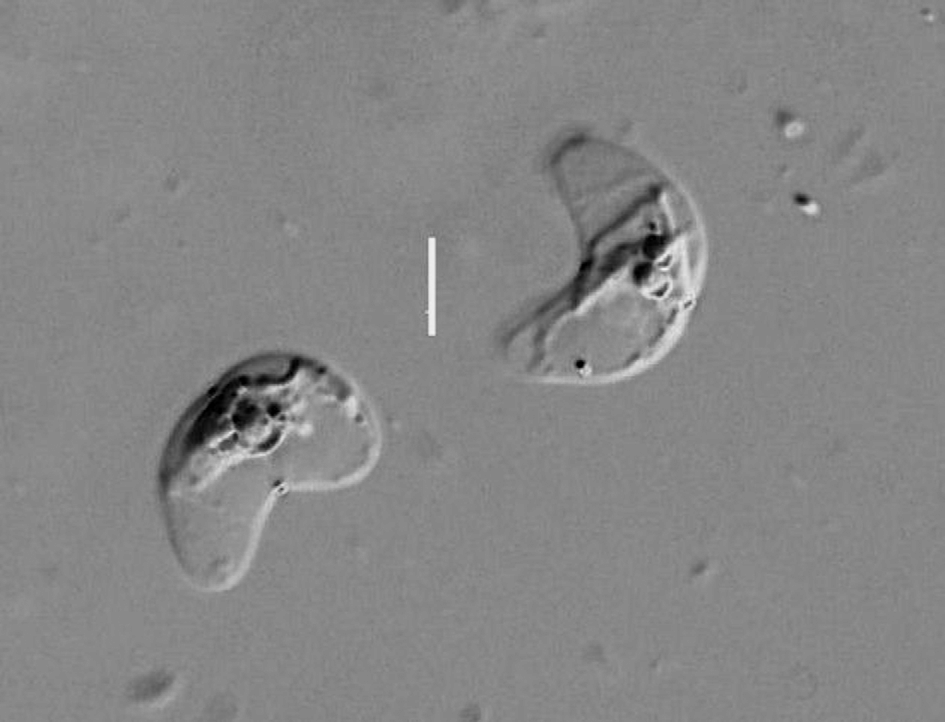
FIGURE 6. Pseudalataspora kovalevae n. sp. Fresh spores under Nomarski interference-contrast illumination. Scale bar: 10 μm.

Imageimage/png© Kalavati, Chaganti;Mackenzie, Ken;Collins, Catherine;Hemmingsen, Willy;Brickle, PaulTwo new species of myxosporean parasites (Myxosporea: Bivalvulida) from gall bladders of Macruronus magellanicus Lönnberg, 1907 (Teleostei: Merlucciidae)

FIGURE 7. Maximum Parsimony tree of 18 S rDNA sequences from Pseudalataspora kovalevae (in bold) and most closely related myxosporean species as determined by BLAST analysis. Cystodiscus melleni (syn. Myxidium melleni) was chosen as the outgroup. Bootstrap values indicating ≥ than 50 % support for Maximum Parsimony and Maximum Likelihood analyses are shown. Host species and geographical location from which parasites were isolated are listed.

Imageimage/png© Kalavati, Chaganti;Mackenzie, Ken;Collins, Catherine;Hemmingsen, Willy;Brickle, PaulTwo new species of myxosporean parasites (Myxosporea: Bivalvulida) from gall bladders of Macruronus magellanicus Lönnberg, 1907 (Teleostei: Merlucciidae)

IMAGES

Gallery(3)

See Gallery

Occurrences with images

CITATIONS

References(2)

  • 1

    Kalavati, C.; Mackenzie, K.; Collins, C.; Hemmingsen, W.; Brickle, P. (2013). Two new species of myxosporean parasites (Myxosporea: Bivalvulida) from gall bladders of <i>Macruronus magellanicus</i> Lönnberg, 1907 (Teleostei: Merlucciidae). <em>Zootaxa.</em> 3647(4): 541-554.

    original descriptionWorld Register of Marine Species
  • 2

    Vidal, L.P., Iannacone, J., Whipps, C.M., Luque, J.L. (2017). Synopsis of the species of Myxozoa Grassé, 1970 (Cnidaria: Myxosporea) in the Americas. <em>Neotropical Helminthology.</em> 11(2): 413-511.

    additional sourceWorld Register of Marine Species
  • Source Information

    GBIF Backbone Taxonomy

    GBIF Backbone Taxonomy

    checklist

    The GBIF Backbone Taxonomy is a single, synthetic management classification with the goal of covering all names GBIF is dealing with. It's the taxonomic backbone that allows GBIF to integrate name based information from different resources, no matter if these are occurrence datasets, species pages, names from nomenclators or external sources like EOL, Genbank or IUCN. This backbone allows taxonomic search, browse and reporting operations across all those resources in a consistent way and to provide means to crosswalk names from one source to another.

    It is updated regulary through an automated process in which the Catalogue of Life acts as a starting point also providing the complete higher classification above families. Additional scientific names only found in other authoritative nomenclatural and taxonomic datasets are then merged into the tree, thus extending the original catalogue and broadening the backbones name coverage. The GBIF Backbone taxonomy also includes identifiers for Operational Taxonomic Units (OTUs) drawn from the barcoding resources iBOL and UNITE.

    International Barcode of Life project (iBOL), Barcode Index Numbers (BINs). BINs are connected to a taxon name and its classification by taking into account all names applied to the BIN and picking names with at least 80% consensus. If there is no consensus of name at the species level, the selection process is repeated moving up the major Linnaean ranks until consensus is achieved.

    UNITE - Unified system for the DNA based fungal species, Species Hypotheses (SHs). SHs are connected to a taxon name and its classification based on the determination of the RefS (reference sequence) if present or the RepS (representative sequence). In the latter case, if there is no match in the UNITE taxonomy, the lowest rank with 100% consensus within the SH will be used.

    The GBIF Backbone Taxonomy is available for download at https://hosted-datasets.gbif.org/datasets/backbone/ in different formats together with an archive of all previous versions.

    The following 105 sources have been used to assemble the GBIF backbone with number of names given in brackets:

    • Catalogue of Life Checklist - 4766428 names
    • International Barcode of Life project (iBOL) Barcode Index Numbers (BINs) - 635951 names
    • UNITE - Unified system for the DNA based fungal species linked to the classification - 611208 names
    • The Paleobiology Database - 212054 names
    • World Register of Marine Species - 188857 names
    • The Interim Register of Marine and Nonmarine Genera - 183894 names
    • The World Checklist of Vascular Plants (WCVP) - 131891 names
    • GBIF Backbone Taxonomy - 114350 names
    • TAXREF - 109374 names
    • The Leipzig catalogue of vascular plants - 75380 names
    • ZooBank - 73549 names
    • Integrated Taxonomic Information System (ITIS) - 68377 names
    • Plazi.org taxonomic treatments database - 61346 names
    • Genome Taxonomy Database r207 - 60545 names
    • International Plant Names Index - 52329 names
    • Fauna Europaea - 45077 names
    • The National Checklist of Taiwan (Catalogue of Life in Taiwan, TaiCoL) - 36193 names
    • Dyntaxa. Svensk taxonomisk databas - 35892 names
    • The Plant List with literature - 32692 names
    • United Kingdom Species Inventory (UKSI) - 29643 names
    • Artsnavnebasen - 29208 names
    • The IUCN Red List of Threatened Species - 21221 names
    • Afromoths, online database of Afrotropical moth species (Lepidoptera) - 13961 names
    • Brazilian Flora 2020 project - Projeto Flora do Brasil 2020 - 13829 names
    • Prokaryotic Nomenclature Up-to-Date (PNU) - 10079 names
    • Checklist Dutch Species Register - Nederlands Soortenregister - 8814 names
    • ICTV Master Species List (MSL) - 7852 names
    • Cockroach Species File - 6020 names
    • GRIN Taxonomy - 5882 names
    • Taxon list of fungi and fungal-like organisms from Germany compiled by the DGfM - 4570 names
    • Catalogue of Afrotropical Bees - 3623 names
    • Catalogue of Tenebrionidae (Coleoptera) of North America - 3327 names
    • Checklist of Beetles (Coleoptera) of Canada and Alaska. Second Edition. - 3312 names
    • Systema Dipterorum - 2850 names
    • Catalogue of the Pterophoroidea of the World - 2807 names
    • The Clements Checklist - 2675 names
    • Taxon list of Hymenoptera from Germany compiled in the context of the GBOL project - 2496 names
    • IOC World Bird List, v13.2 - 2366 names
    • Official Lists and Indexes of Names in Zoology - 2310 names
    • National checklist of all species occurring in Denmark - 1922 names
    • Myriatrix - 1876 names
    • Database of Vascular Plants of Canada (VASCAN) - 1822 names
    • Taxon list of vascular plants from Bavaria, Germany compiled in the context of the BFL project - 1771 names
    • Orthoptera Species File - 1742 names
    • A list of the terrestrial fungi, flora and fauna of Madeira and Selvagens archipelagos - 1602 names
    • Aphid Species File - 1565 names
    • World Spider Catalog - 1561 names
    • Taxon list of Jurassic Pisces of the Tethys Palaeo-Environment compiled at the SNSB-JME - 1270 names
    • Backbone Family Classification Patch - 1143 names
    • GBIF Algae Classification - 1100 names
    • International Cichorieae Network (ICN): Cichorieae Portal - 975 names
    • Psocodea Species File - 803 names
    • New Zealand Marine Macroalgae Species Checklist - 787 names
    • Annotated checklist of endemic species from the Western Balkans - 754 names
    • Taxon list of animals with German names (worldwide) compiled at the SMNS - 503 names
    • Catalogue of the Alucitoidea of the World - 472 names
    • Lygaeoidea Species File - 462 names
    • Catálogo de Plantas y Líquenes de Colombia - 422 names
    • GBIF Backbone Patch - 317 names
    • Phasmida Species File - 259 names
    • Cortinariaceae fetched from the Index Fungorum API - 234 names
    • Coreoidea Species File - 233 names
    • GTDB supplement - 139 names
    • Mantodea Species File - 119 names
    • Endemic species in Taiwan - 93 names
    • Taxon list of Araneae from Germany compiled in the context of the GBOL project - 88 names
    • Species of Hominidae - 78 names
    • Taxon list of Sternorrhyncha from Germany compiled in the context of the GBOL project - 77 names
    • Taxon list of mosses from Germany compiled in the context of the GBOL project - 75 names
    • Mammal Species of the World - 73 names
    • Plecoptera Species File - 71 names
    • Species Fungorum Plus - 64 names
    • Catalogue of the type specimens of Cosmopterigidae (Lepidoptera: Gelechioidea) from research collections of the Zoological Institute, Russian Academy of Sciences - 47 names
    • Species named after famous people - 41 names
    • Dermaptera Species File - 36 names
    • Taxon list of Trichoptera from Germany compiled in the context of the GBOL project - 34 names
    • True Fruit Flies (Diptera, Tephritidae) of the Afrotropical Region - 33 names
    • Range and Regularities in the Distribution of Earthworms of the Earthworms of the USSR Fauna. Perel, 1979 - 32 names
    • Taxon list of Diplura from Germany compiled in the context of the GBOL project - 30 names
    • Lista de referencia de especies de aves de Colombia - 2022 - 24 names
    • Taxon list of Auchenorrhyncha from Germany compiled in the context of the GBOL project - 20 names
    • Catalogue of the type specimens of Polycestinae (Coleoptera: Buprestidae) from research collections of the Zoological Institute, Russian Academy of Sciences - 19 names
    • Taxon list of Thysanoptera from Germany compiled in the context of the GBOL project - 19 names
    • Lista de especies de vertebrados registrados en jurisdicción del Departamento del Huila - 18 names
    • Taxon list of Microcoryphia (Archaeognatha) from Germany compiled in the context of the GBOL project - 15 names
    • Catalogue of the type specimens of Bufonidae and Megophryidae (Amphibia: Anura) from research collections of the Zoological Institute, Russian Academy of Sciences - 12 names
    • Grylloblattodea Species File - 11 names
    • Coleorrhyncha Species File - 9 names
    • Taxon list of liverworts from Germany compiled in the context of the GBOL project - 9 names
    • Embioptera Species File - 7 names
    • Taxon list of Pisces and Cyclostoma from Germany compiled in the context of the GBOL project - 6 names
    • Taxon list of Pteridophyta from Germany compiled in the context of the GBOL project - 6 names
    • Taxon list of Siphonaptera from Germany compiled in the context of the GBOL project - 5 names
    • The Earthworms of the Fauna of Russia. Perel, 1997 - 5 names
    • Taxon list of Zygentoma from Germany compiled in the context of the GBOL project - 4 names
    • Asiloid Flies: new taxa of Diptera: Apioceridae, Asilidae, and Mydidae - 3 names
    • Taxon list of Protura from Germany compiled in the context of the GBOL project - 3 names
    • Taxon list of hornworts from Germany compiled in the context of the GBOL project - 2 names
    • Chrysididae Species File - 1 names
    • Taxon list of Dermaptera from Germany compiled in the context of the GBOL project - 1 names
    • Taxon list of Diplopoda from Germany in the context of the GBOL project - 1 names
    • Taxon list of Orthoptera (Grashoppers) from Germany compiled at the SNSB - 1 names
    • Taxon list of Pscoptera from Germany compiled in the context of the GBOL project - 1 names
    • Taxon list of Pseudoscorpiones from Germany compiled in the context of the GBOL project - 1 names
    • Taxon list of Raphidioptera from Germany compiled in the context of the GBOL project - 1 names

    GBIF Secretariat (2023). GBIF Backbone Taxonomy. Checklist dataset https://doi.org/10.15468/39omei accessed via GBIF.org on 2026-06-16.

    CC BYPublished 8/28/2023View dataset
    GBIF Usage Key
    8489853
    Dataset Key
    d7dddbf4-2cf0-4f39-9b2a-bb099caae36c
    Origin
    source
    Backbone Key
    8489853
    Taxon ID
    gbif:8489853
    Last Crawled
    8/22/2023
    Last Interpreted
    8/22/2023