AnimaliaData DeficientacceptedspeciesAcceptedRestricted
Allobates bacurau

Allobates bacurau

Simões, 2016

GBIF:8781153

0countries
0year

PROFILE

Species Profile

Characteristics

Extant

ABOUT

Descriptions(5)

Allobates bacurau is distinguished from A. marchesianus (Melin 1941) by lacking basal webbing between Toes II and III and by the absence of strong sexual dimorphism in color of ventral surfaces of preserved and live specimens (basal webbing present between Toes II and III in A. marchesianus; throat and chest of males strongly pigmented, appearing dark gray; ventral surfaces of preserved females uniformly cream, bright yellow in life).
A new species of nurse-frog (Aromobatidae, Allobates) from the Madeira River basin with a small geographic range
Description of holotype. Measurements of the holotype are presented in Table 1. Body is robust, head wider than long (HL / HW = 0.84), head length 0.29 times the SVL (Fig 1 A, B; Fig. 2 A). Eye diameter larger than distance from anterior corner of the eye to nostril (EN / EL = 0.63). Nares located posterolaterally to tip of snout, directed laterally, visible in dorsal, ventral, lateral, and anterior views. Distance between nostrils 0.82 times that of HW. Canthus rostralis slightly convex from tip of snout to nostril, straight from nostril to anterior corner of the eye. Loreal region vertical. Tympanum round, 0.37 times the maximum diameter of the eye. Margins of tympanum indistinct to the naked eye, visible under a dissecting microscope, more conspicuous anteroventrally. Maxillary teeth absent, not visually detectable under 40 X magnification or when a wire probe is moved along the maxillary surface. Tongue conspicuously longer than wide, with anterior tip attached to the mouth floor. Median lingual process absent. Choanae round, positioned anterodorsally to eye bulge. Vocal sac single, corresponding to most of the area of the medial and posterior subgular region. Lateral vocal slits conspicuous. Palmar tubercle elliptical, with the longer width aligned towards the base of Finger II. Thenar tubercle conspicuous, oval, evident in ventral view and in hand profile. Maximum diameter of thenar tubercle 68 % of maximum diameter of palmar tubercle (Fig. 3 A). Subarticular tubercles of Fingers II, III and IV round, small, never exceeding the width of phalanges. Subarticular tubercle on Finger I elliptical, protuberant, 1.2 times larger than thenar tubercle in maximum diameter. Distal subarticular tubercle absent on Finger IV. Supernumerary tubercles absent. Carpal and metacarpal ridges absent. Fringes or webbings absent on fingers. Length of Finger II equivalent to approximately 85 % of Finger I´s length. Tip of Finger IV does not reach distal subarticular tubercle of Finger III when fingers are juxtaposed. Relative lengths of fingers: IV = II
A new species of nurse-frog (Aromobatidae, Allobates) from the Madeira River basin with a small geographic range
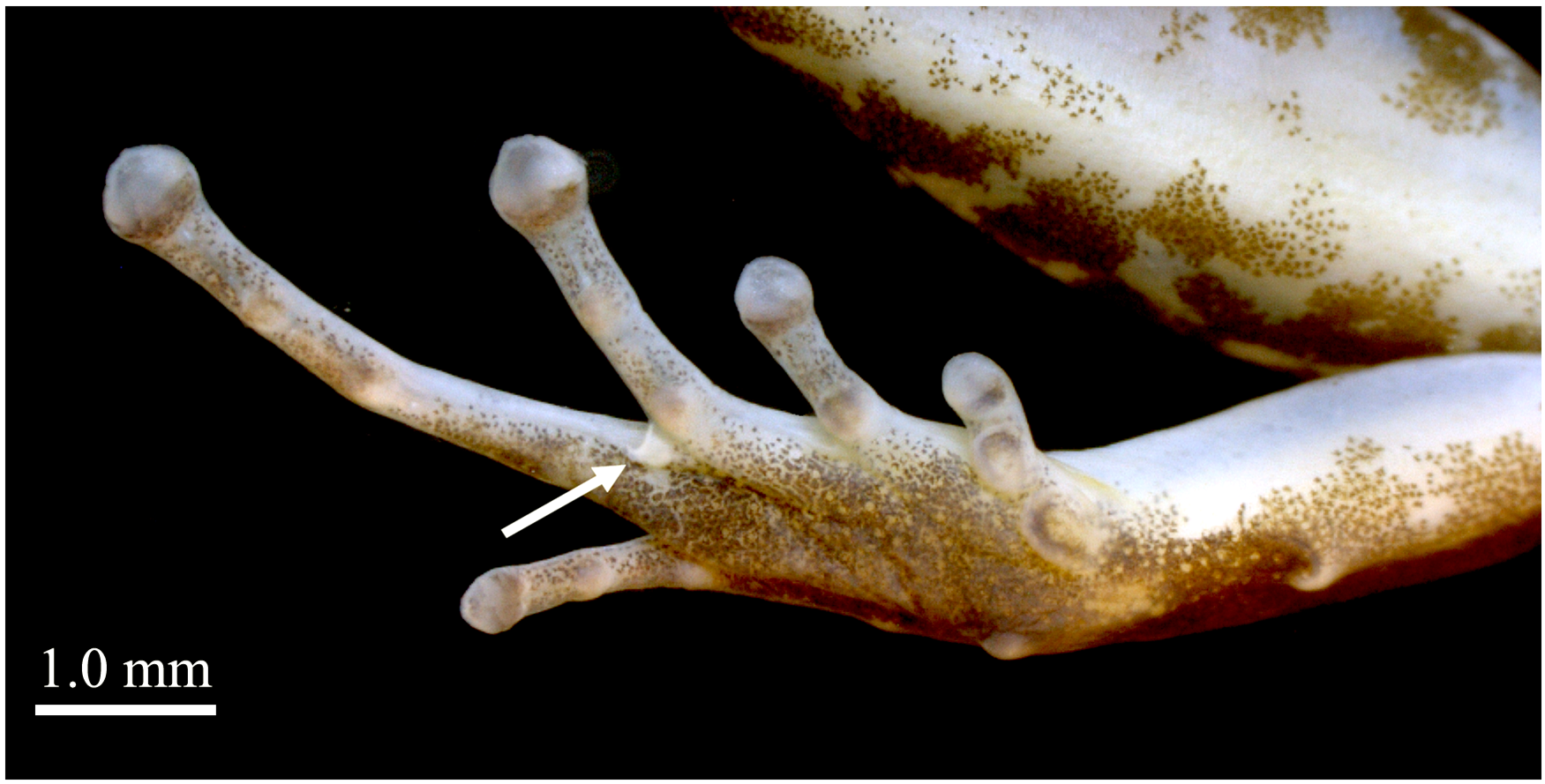
Diagnosis. Allobates bacurau is characterized by: (1) skin texture of dorsum granular, flat granules scattered from the level of tympanum to the urostyle region, more evident from mid to posterior dorsum; (2) paired dorsal digital scutes present; (3) distal tubercle absent on Finger IV; (4) discs on fingers II and III unexpanded, discs of fingers I and IV weakly expanded; (5) dermal lateral fringes and basal webbing absent on fingers; (6) metacarpal ridge absent; (7) Finger III swollen in male specimens, width of swelling variable among males; Finger III not swollen in females; (8) carpal pad absent; (9) male excrescences absent on thumbs; (10) thenar tubercle conspicuous; (11) black gland absent on arm; (12) tarsal keel present, tubercle-like, strongly curved; (13) disc of Toe I weakly expanded; discs of toes II, III and IV moderately expanded; (14) basal webbing present between toes III and IV; (15) metartarsal fold absent; (16) cryptic external coloration; background color of dorsum tan brown, with darker brown spots scattered from the level of tympanum to posterior dorsum; large diamond, “ X ” or hourglass-shaped marks absent on dorsum; dorsal surface of thigh grayish brown in life, light brown in preserved specimens, with no transverse bars; dorsal surface of arm yellow to dark copper in life, cream in specimens preserved for at least five years; pale dorsolateral stripe present, well defined, variable in width among specimens; a dark brown lateral stripe surrounds the whole body, reaching leg-body insertion; pale oblique lateral stripe absent; pale ventrolateral stripe present, partially diffuse, extending from behind the eyes to groin, cream in preserved specimens, iridescent white in live individuals; small, brown irregular blotches or marbling present ventrolaterally from snout to groin; pale paracloacal mark present; (17) dark throat-collar absent; (18) color of throat generally cream in preserved specimens, appearing light brown in specimens with higher concentration of melanophores on throat skin; density of melanophores on throat variable among specimens; throat light to dark gray in life; (19) central abdominal region immaculate, white to translucent in live male and female specimens; throat region with a variable number of melanophores in both sexes; chest and posterior third of throat light to dark gray in live males, white to translucent in live females, with parietal peritoneum projecting anteriorly from the level of chest and visible through skin; (20) iris metallic gold with tiny black flecks and a light gold pupil ring; (21) large intestine unpigmented; (22) testis unpigmented; (23) mature oocytes pigmented, pigments dark brown; (24) median lingual process absent; (25) tympanum inconspicuous; (26) vocal sac single; (27) maxillary teeth absent or inconspicuous; (27) habit is diurnal, males calling during daytime; (28) advertisement calls characterized by distinctively long trills (7 – 11 s) formed by approximately 60 – 80 short notes, emitted at an average rate of seven notes per second; (29) very small snout-to-vent length (SVL), adult males 14.4 mm on average (range 14.0 – 14.7 mm), adult females 14.8 mm on average (range 14.7 – 14.9 mm). The new species is assigned to genus Allobates by the combination of characters 14, 17, 22, 24, 27 and 29. Species comparisons. The new species has a small geographic distribution in central Brazilian Amazonia (see Geographic distribution section below), located at least 600 km from the nearest country border. Thus, we restrict comparisons to Allobates species occurring in Brazil and to three additional species distributed outside the country, but which closely resemble the new species in external morphology.
A new species of nurse-frog (Aromobatidae, Allobates) from the Madeira River basin with a small geographic range
Etymology. The specific epithet is in reference to the Portuguese word “ bacurau ” (modified from the original native Tupi word “ wakura’wa ”), which designates several species of nighthawks (Family Caprimulgidade). Inhabitants of Manicoré have historically entitled themselves “ Povo Bacurau ” (“ The Nighthawk People ”). The origin of this habit is disputed, but it possibly relates to the nickname of a notable citizen, Mr. Francisco A. Vieira Nunes (1939 – 1997), a writer and politician who gained prestige as a social worker and activist for Hansen’s disease awareness. The epithet is applied as a noun in apposition.
A new species of nurse-frog (Aromobatidae, Allobates) from the Madeira River basin with a small geographic range
Holotype. INPA-H 35398 (original field number APL 12647). An adult male collected by P. I. Simões on 4 th of December 2007, at Estrada do Miriti, in the outskirts of the city of Manicoré, on the right bank of the Madeira River, State of Amazonas, Brazil (05 ° 52 ' 05 " S, 61 ° 17 ' 13 " W). Advertisement calls of holotype recorded at 11: 30 h and 25.2 ° C. Paratypes. INPA-H 35397, 35399 – 35409 (original field numbers APL 12644 – 12646, 12648 – 12656), ten males, two females. Collected by P. I. Simões on 4 th – 5 th of December 2007, proceeding from the same locality.
A new species of nurse-frog (Aromobatidae, Allobates) from the Madeira River basin with a small geographic range

Export occurrence data

Darwin Core Archive (ZIP)

GEOGRAPHY

Distribution Map

Occurrence Map

Loading map…

Tiles © GBIF Maps API | Map powered by MapLibre GL

REGIONS

Geographic Distribution(1)

Global
data deficient

DATA

Occurrence Datasets

Loading datasets…

CLASSIFICATION

Taxonomic Classification Tree

MULTIMEDIA

Media Files(11)

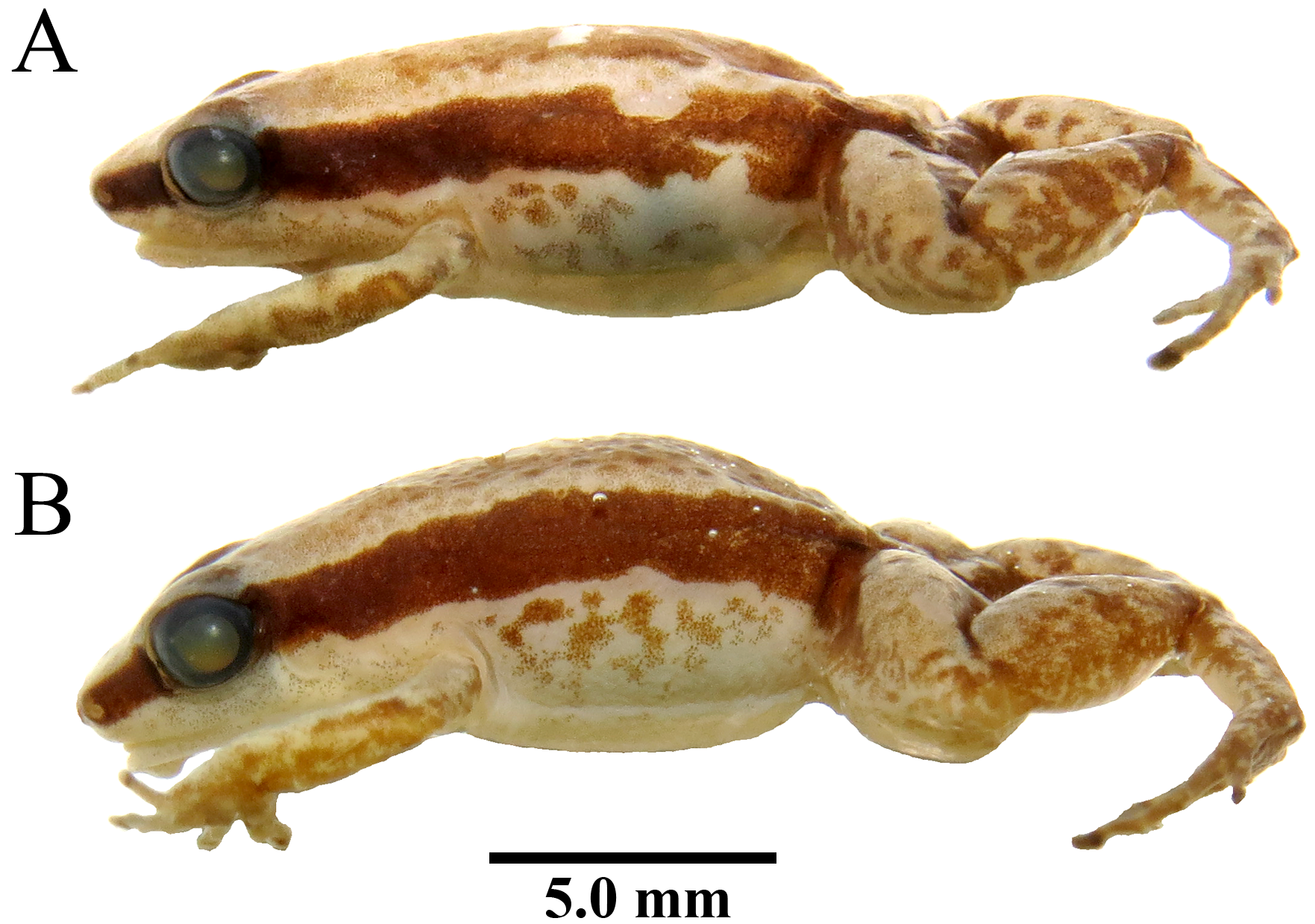
FIGURE 2. (A) Lateral view of Allobates bacurau holotype (INPA-H 35398). (B) Lateral view of a female paratype (INPA-H 35397).

Imageimage/png© Simões, Pedro IvoA new species of nurse-frog (Aromobatidae, Allobates) from the Madeira River basin with a small geographic range

FIGURE 3. (A) Hand of Allobates bacurau holotype (INPA-H 35398). (B) Hand of a female paratype (INPA-H 35397). Edges of some tubercles have been digitally highlighted for improved clarity. Variation in swelling of Finger III is not exclusively sexually dimorphic. Some male specimens have Finger III more similar to (B).

Imageimage/png© Simões, Pedro IvoA new species of nurse-frog (Aromobatidae, Allobates) from the Madeira River basin with a small geographic range

FIGURE 4. Foot of Allobates bacurau holotype (INPA-H 35398). White arrow indicates basal webbing between Toes III and IV.

Imageimage/png© Simões, Pedro IvoA new species of nurse-frog (Aromobatidae, Allobates) from the Madeira River basin with a small geographic range

FIGURE 5. Variation in dorsal color pattern among six male paratypes of Allobates bacurau. Clockwise from upper left: INPA-H 35405, 35403, 35406, 35409, 35401 and 35407. Note presence of a pale dorsolateral stripe and the absence of dark transverse bars on thighs of all specimens. Scratches on skin occurred post-preservation.

Imageimage/png© Simões, Pedro IvoA new species of nurse-frog (Aromobatidae, Allobates) from the Madeira River basin with a small geographic range

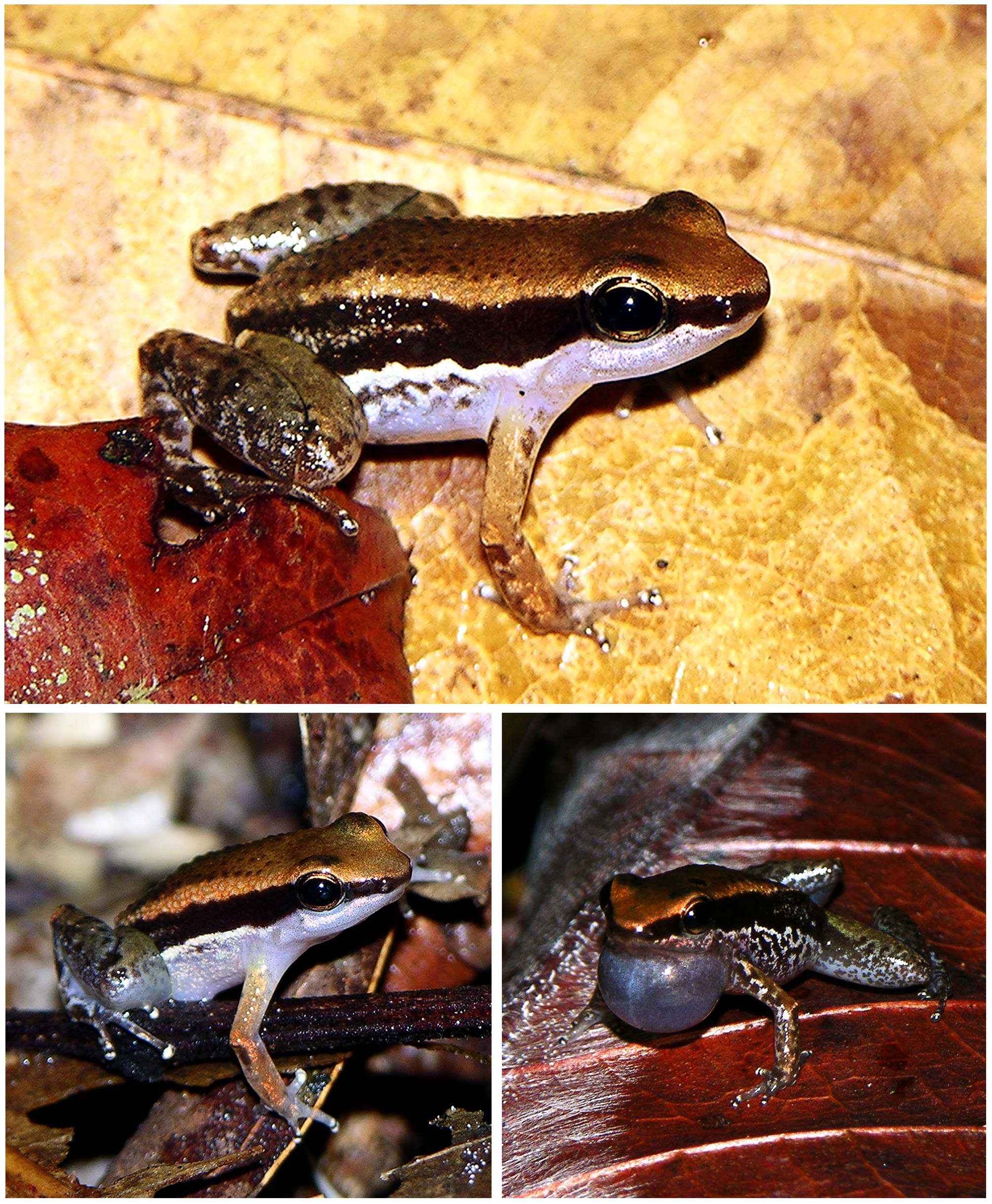
FIGURE 6. Color in life of Allobates bacurau photographed at the species type locality in Manicoré, on the eastern bank of the Madeira River, in Amazonas State, Brazil. (A) Dorsolateral view of a male specimen. (B) Lateral view of a second male specimen. (C) Calling male. Note gray-colored vocal-sac. Also note variation in coverage of iridescent-white reticulation on the ventrolateral region among the three specimens.

Imageimage/png© Simões, Pedro IvoA new species of nurse-frog (Aromobatidae, Allobates) from the Madeira River basin with a small geographic range

FIGURE 7. (A) Dorsal and ventral views of a live female paratype of Allobates bacurau (INPA-H 35408). Note that throat is pigmented anteriorly and white posteriorly. (B) Dorsolateral view of a second live female paratype (INPA-H 35397). (C) Variation in throat pigmentation density among live male paratypes of A. bacurau (from left to right: INPA-H 35398, 35402, 35401).

Imageimage/png© Simões, Pedro IvoA new species of nurse-frog (Aromobatidae, Allobates) from the Madeira River basin with a small geographic range

IMAGES

Gallery(11)

See Gallery

Occurrences with images

Source Information

GBIF Backbone Taxonomy

GBIF Backbone Taxonomy

checklist

The GBIF Backbone Taxonomy is a single, synthetic management classification with the goal of covering all names GBIF is dealing with. It's the taxonomic backbone that allows GBIF to integrate name based information from different resources, no matter if these are occurrence datasets, species pages, names from nomenclators or external sources like EOL, Genbank or IUCN. This backbone allows taxonomic search, browse and reporting operations across all those resources in a consistent way and to provide means to crosswalk names from one source to another.

It is updated regulary through an automated process in which the Catalogue of Life acts as a starting point also providing the complete higher classification above families. Additional scientific names only found in other authoritative nomenclatural and taxonomic datasets are then merged into the tree, thus extending the original catalogue and broadening the backbones name coverage. The GBIF Backbone taxonomy also includes identifiers for Operational Taxonomic Units (OTUs) drawn from the barcoding resources iBOL and UNITE.

International Barcode of Life project (iBOL), Barcode Index Numbers (BINs). BINs are connected to a taxon name and its classification by taking into account all names applied to the BIN and picking names with at least 80% consensus. If there is no consensus of name at the species level, the selection process is repeated moving up the major Linnaean ranks until consensus is achieved.

UNITE - Unified system for the DNA based fungal species, Species Hypotheses (SHs). SHs are connected to a taxon name and its classification based on the determination of the RefS (reference sequence) if present or the RepS (representative sequence). In the latter case, if there is no match in the UNITE taxonomy, the lowest rank with 100% consensus within the SH will be used.

The GBIF Backbone Taxonomy is available for download at https://hosted-datasets.gbif.org/datasets/backbone/ in different formats together with an archive of all previous versions.

The following 105 sources have been used to assemble the GBIF backbone with number of names given in brackets:

  • Catalogue of Life Checklist - 4766428 names
  • International Barcode of Life project (iBOL) Barcode Index Numbers (BINs) - 635951 names
  • UNITE - Unified system for the DNA based fungal species linked to the classification - 611208 names
  • The Paleobiology Database - 212054 names
  • World Register of Marine Species - 188857 names
  • The Interim Register of Marine and Nonmarine Genera - 183894 names
  • The World Checklist of Vascular Plants (WCVP) - 131891 names
  • GBIF Backbone Taxonomy - 114350 names
  • TAXREF - 109374 names
  • The Leipzig catalogue of vascular plants - 75380 names
  • ZooBank - 73549 names
  • Integrated Taxonomic Information System (ITIS) - 68377 names
  • Plazi.org taxonomic treatments database - 61346 names
  • Genome Taxonomy Database r207 - 60545 names
  • International Plant Names Index - 52329 names
  • Fauna Europaea - 45077 names
  • The National Checklist of Taiwan (Catalogue of Life in Taiwan, TaiCoL) - 36193 names
  • Dyntaxa. Svensk taxonomisk databas - 35892 names
  • The Plant List with literature - 32692 names
  • United Kingdom Species Inventory (UKSI) - 29643 names
  • Artsnavnebasen - 29208 names
  • The IUCN Red List of Threatened Species - 21221 names
  • Afromoths, online database of Afrotropical moth species (Lepidoptera) - 13961 names
  • Brazilian Flora 2020 project - Projeto Flora do Brasil 2020 - 13829 names
  • Prokaryotic Nomenclature Up-to-Date (PNU) - 10079 names
  • Checklist Dutch Species Register - Nederlands Soortenregister - 8814 names
  • ICTV Master Species List (MSL) - 7852 names
  • Cockroach Species File - 6020 names
  • GRIN Taxonomy - 5882 names
  • Taxon list of fungi and fungal-like organisms from Germany compiled by the DGfM - 4570 names
  • Catalogue of Afrotropical Bees - 3623 names
  • Catalogue of Tenebrionidae (Coleoptera) of North America - 3327 names
  • Checklist of Beetles (Coleoptera) of Canada and Alaska. Second Edition. - 3312 names
  • Systema Dipterorum - 2850 names
  • Catalogue of the Pterophoroidea of the World - 2807 names
  • The Clements Checklist - 2675 names
  • Taxon list of Hymenoptera from Germany compiled in the context of the GBOL project - 2496 names
  • IOC World Bird List, v13.2 - 2366 names
  • Official Lists and Indexes of Names in Zoology - 2310 names
  • National checklist of all species occurring in Denmark - 1922 names
  • Myriatrix - 1876 names
  • Database of Vascular Plants of Canada (VASCAN) - 1822 names
  • Taxon list of vascular plants from Bavaria, Germany compiled in the context of the BFL project - 1771 names
  • Orthoptera Species File - 1742 names
  • A list of the terrestrial fungi, flora and fauna of Madeira and Selvagens archipelagos - 1602 names
  • Aphid Species File - 1565 names
  • World Spider Catalog - 1561 names
  • Taxon list of Jurassic Pisces of the Tethys Palaeo-Environment compiled at the SNSB-JME - 1270 names
  • Backbone Family Classification Patch - 1143 names
  • GBIF Algae Classification - 1100 names
  • International Cichorieae Network (ICN): Cichorieae Portal - 975 names
  • Psocodea Species File - 803 names
  • New Zealand Marine Macroalgae Species Checklist - 787 names
  • Annotated checklist of endemic species from the Western Balkans - 754 names
  • Taxon list of animals with German names (worldwide) compiled at the SMNS - 503 names
  • Catalogue of the Alucitoidea of the World - 472 names
  • Lygaeoidea Species File - 462 names
  • Catálogo de Plantas y Líquenes de Colombia - 422 names
  • GBIF Backbone Patch - 317 names
  • Phasmida Species File - 259 names
  • Cortinariaceae fetched from the Index Fungorum API - 234 names
  • Coreoidea Species File - 233 names
  • GTDB supplement - 139 names
  • Mantodea Species File - 119 names
  • Endemic species in Taiwan - 93 names
  • Taxon list of Araneae from Germany compiled in the context of the GBOL project - 88 names
  • Species of Hominidae - 78 names
  • Taxon list of Sternorrhyncha from Germany compiled in the context of the GBOL project - 77 names
  • Taxon list of mosses from Germany compiled in the context of the GBOL project - 75 names
  • Mammal Species of the World - 73 names
  • Plecoptera Species File - 71 names
  • Species Fungorum Plus - 64 names
  • Catalogue of the type specimens of Cosmopterigidae (Lepidoptera: Gelechioidea) from research collections of the Zoological Institute, Russian Academy of Sciences - 47 names
  • Species named after famous people - 41 names
  • Dermaptera Species File - 36 names
  • Taxon list of Trichoptera from Germany compiled in the context of the GBOL project - 34 names
  • True Fruit Flies (Diptera, Tephritidae) of the Afrotropical Region - 33 names
  • Range and Regularities in the Distribution of Earthworms of the Earthworms of the USSR Fauna. Perel, 1979 - 32 names
  • Taxon list of Diplura from Germany compiled in the context of the GBOL project - 30 names
  • Lista de referencia de especies de aves de Colombia - 2022 - 24 names
  • Taxon list of Auchenorrhyncha from Germany compiled in the context of the GBOL project - 20 names
  • Catalogue of the type specimens of Polycestinae (Coleoptera: Buprestidae) from research collections of the Zoological Institute, Russian Academy of Sciences - 19 names
  • Taxon list of Thysanoptera from Germany compiled in the context of the GBOL project - 19 names
  • Lista de especies de vertebrados registrados en jurisdicción del Departamento del Huila - 18 names
  • Taxon list of Microcoryphia (Archaeognatha) from Germany compiled in the context of the GBOL project - 15 names
  • Catalogue of the type specimens of Bufonidae and Megophryidae (Amphibia: Anura) from research collections of the Zoological Institute, Russian Academy of Sciences - 12 names
  • Grylloblattodea Species File - 11 names
  • Coleorrhyncha Species File - 9 names
  • Taxon list of liverworts from Germany compiled in the context of the GBOL project - 9 names
  • Embioptera Species File - 7 names
  • Taxon list of Pisces and Cyclostoma from Germany compiled in the context of the GBOL project - 6 names
  • Taxon list of Pteridophyta from Germany compiled in the context of the GBOL project - 6 names
  • Taxon list of Siphonaptera from Germany compiled in the context of the GBOL project - 5 names
  • The Earthworms of the Fauna of Russia. Perel, 1997 - 5 names
  • Taxon list of Zygentoma from Germany compiled in the context of the GBOL project - 4 names
  • Asiloid Flies: new taxa of Diptera: Apioceridae, Asilidae, and Mydidae - 3 names
  • Taxon list of Protura from Germany compiled in the context of the GBOL project - 3 names
  • Taxon list of hornworts from Germany compiled in the context of the GBOL project - 2 names
  • Chrysididae Species File - 1 names
  • Taxon list of Dermaptera from Germany compiled in the context of the GBOL project - 1 names
  • Taxon list of Diplopoda from Germany in the context of the GBOL project - 1 names
  • Taxon list of Orthoptera (Grashoppers) from Germany compiled at the SNSB - 1 names
  • Taxon list of Pscoptera from Germany compiled in the context of the GBOL project - 1 names
  • Taxon list of Pseudoscorpiones from Germany compiled in the context of the GBOL project - 1 names
  • Taxon list of Raphidioptera from Germany compiled in the context of the GBOL project - 1 names

GBIF Secretariat (2023). GBIF Backbone Taxonomy. Checklist dataset https://doi.org/10.15468/39omei accessed via GBIF.org on 2026-06-14.

CC BYPublished 8/28/2023View dataset
GBIF Usage Key
8781153
Dataset Key
d7dddbf4-2cf0-4f39-9b2a-bb099caae36c
Origin
source
Backbone Key
8781153
Taxon ID
gbif:8781153
Last Crawled
8/22/2023
Last Interpreted
8/22/2023