AnimaliaNot EvaluatedacceptedspeciesAcceptedRestricted
Kathrynella guyanae

Kathrynella guyanae

Omodeo, 1996

GBIF:9419865

0countries
0year

PROFILE

Species Profile

Habitat

Freshwater

ABOUT

Descriptions(4)

Kathrynella guyanae Omodeo, 1996

Kathrynella guyanae Omodeo, 1996 Hydrobiologia 334: 11.

A tribute to a master and friend: Pietro Omodeo (1919 - 2024)MagnoliaPress via PlaziNo known copyright restrictions apply. See Agosti, D., Egloff, W., 2009. Taxonomic information exchange and copyright: the Plazi approach. BMC Research Notes 2009, 2:53 for further explanation.
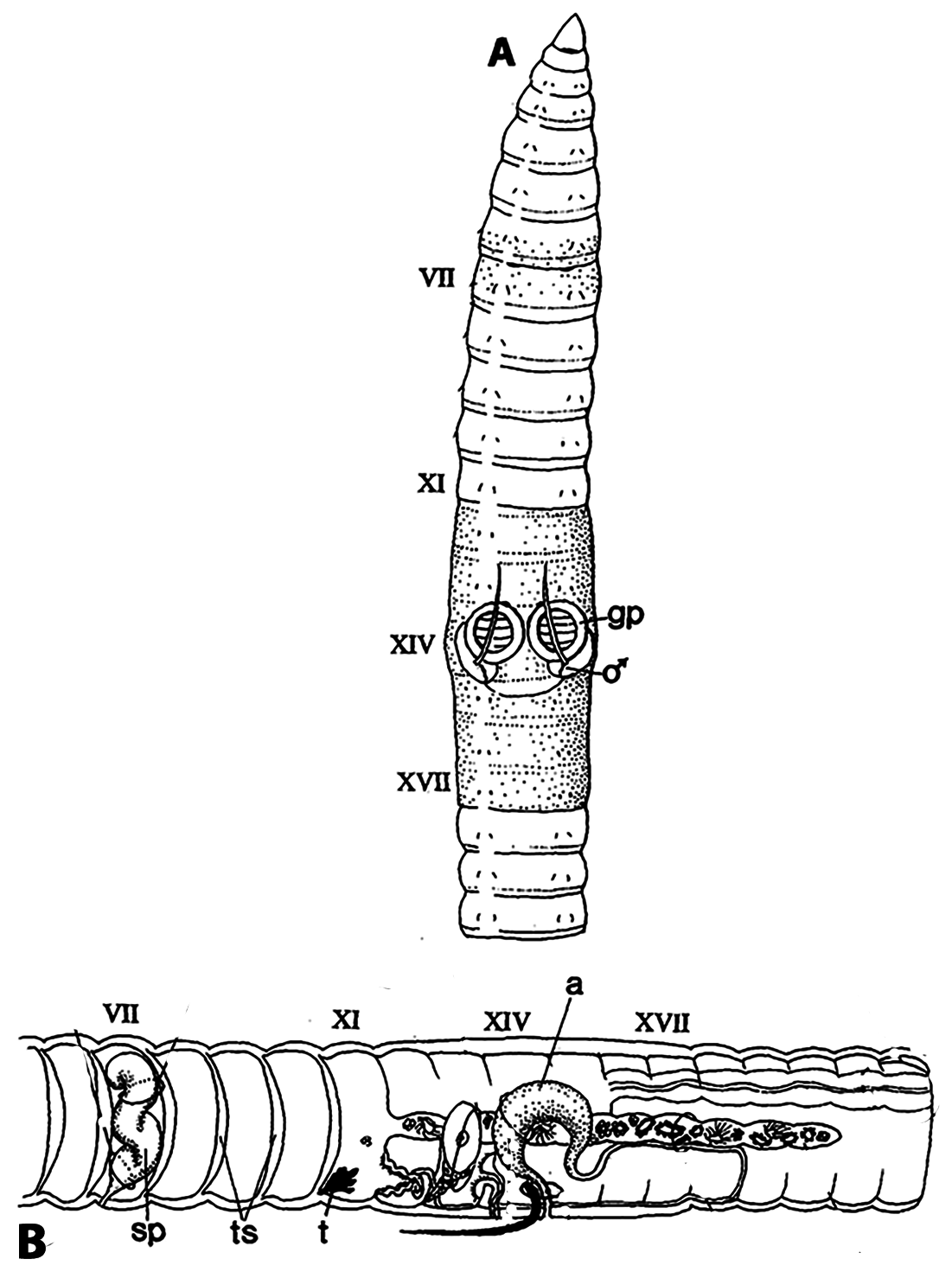
Length 85 – 89 mm; diameter 600 µm at X, 520 µm at mid – body, segments 282, 259. No cutaneous pigmentation, integument transparent. Prostomium zygolobous, conical; peristomium short. Setae paired with lumbricin arrangement. Pygidium small, anus a vertical cleft. Clitellum annular, extending from the posterior part of XI to XVII; the ventral side of XIV with two large, circular papillae with swollen borders and a very thick, whitish, central part crossed by 4 – 5 transverse furrows; behind and beside these papillae two crescent – shaped fields visible, each bearing a single, large, grooved, penial seta. In all specimens examined, penial setae were broken but their length estimated as longer than 300 µm. No other ventral setae visible in XIV. Dorsal setal couples of midclitellar segments slanting relative to the long body axis, setae c located more posteriorly than setae d. Male pore as a slit on hinder portion of each crescent – shaped field in XIV; paired female pores on anterior border of XIV, near midventral line. No dorsal pores. Nephridiopores inconspicuous. Spermathecal pores in furrow 6 / 7 on setal line a. Setal ratio aa: ab: bc: cd: dd = 5.6: 1.1: 5.6: 1: 10 at segment X; 2.5: 1: 1.5: 1: 12 in posterior segments (where all setae are displaced ventrad). The length of setae increases from II, where it is 37 µm, to VII where setae a and b measure 92 µm and setae c and d 43 µm. Further posteriorly, the setal length decreases gradually (penial setae of XIV excepted), to become constant (ca 50 µm) behind the clitellum. Only caudal setae show distal ornamentation. Body wall thin; cuticle approximately 0.5 µm thick; layer of circular muscles very thin. Septa 5 / 6 – 10 / 11 thickened, funnel – shaped. No pharyngeal pad distinguishable. Neither a gizzard, nor any apparent distinction between oesophagus and intestine present. Ciliated epithelium of intestine ending in clitellar region. Peri – intestinal blood sinus occurring from XII backwards. Holonephridia, apparently avesiculate, beginning in XII or XIII; initially poorly developed and acquiring normal size only behind clitellum. The circulatory apparatus exceptionally well developed. Dorsal and ventral vessels run the whole length of the worm and have very large diameters, only slightly less than that of the intestine. Seven pairs of long commissural vessels in V – XI, wound in balls whose size increases backwards; each ball covered with chloragocytes. A pair of large vessels originates in VII from the peri – intestinal blood sinus, and from XII to XVI run along the sperm sacs. Many lesser vessels seen everywhere, but no capillaries. Testes anterior in XI, facing the large seminiferous funnels, covered with sperm and bulging into segment XII. Sperm ducts coiled in XII in their proximal course, then running laterally within the body wall till XVII where they emerge again in the coelomic cavity, become thicker, and run forwards till XIV, where they form the atria. Atria possess thick muscular walls and appear as shining, bent, spindles which open in the middle of XIV, behind the penial setae; atria (which correspond to the ‘ euprostates’ of Eudrilidae) with a thin external coating of non – glandular cells. Two long sperm sacs begin from septum 11 / 12 and run till XX, parallel to the egg sacs and to the posterior course of vasa deferentia. Ovaries located in the ventral forepart of XIII; two long cylindrical egg sacs, apparently beginning in XVII, extending as far back as XXXV; possessing thick glandular walls and containing up to a dozen large ripe eggs (ca 530 µm wide) between XXV – XXXV. Two large, convoluted spermathecae in VII; consisting of a short, partly ciliated duct and elongate ampulla; the ectal section of the latter containing the bulk of spermatozoa, whereas the ental section is filled with a hyaline secretion. The spermathecal length exceeds the body diameter and possibly the length of penial setae. It can be inferred that during copulation the sucker – shaped genital papillae in XIV help to fasten the two partners together, while at the same time the penial grooved setae are introduced into the spermathecae for sperm transfer.
A monograph of the Oligochaete family Alluroididae
Remarks. In his elegant paper, Omodeo (1996) considered that Kathrynella guyanae showed traits, discussed here in a previous section, which were reminiscent of various ‘ microdrile’ taxa. Omodeo saw two main differences (autapomorphies) of Kathrynella from the Alluroididae previously described i. e. the location of male pores in XIV and the metandric condition of the male apparatus which contrasted with the proandric condition of the Alluroidinae and the holoandric, supposedly plesiomorphic (cf. Jamieson 1980), condition of the Syngenodrilinae. He noted a resemblance of the ‘ atria’ of Kathrynella to the typical ‘ euprostates’ of the Eudrilidae, an African family of unknown kinship.
A monograph of the Oligochaete family Alluroididae
Distribution. Known only from the type locality in Guyana.
A monograph of the Oligochaete family Alluroididae

Export occurrence data

Darwin Core Archive (ZIP)

GEOGRAPHY

Distribution Map

Occurrence Map

Loading map…

Tiles © GBIF Maps API | Map powered by MapLibre GL

REGIONS

Geographic Distribution(2)

Neotropical
South America

DATA

Occurrence Datasets

Loading datasets…

CLASSIFICATION

Taxonomic Classification Tree

MULTIMEDIA

Media Files(6)

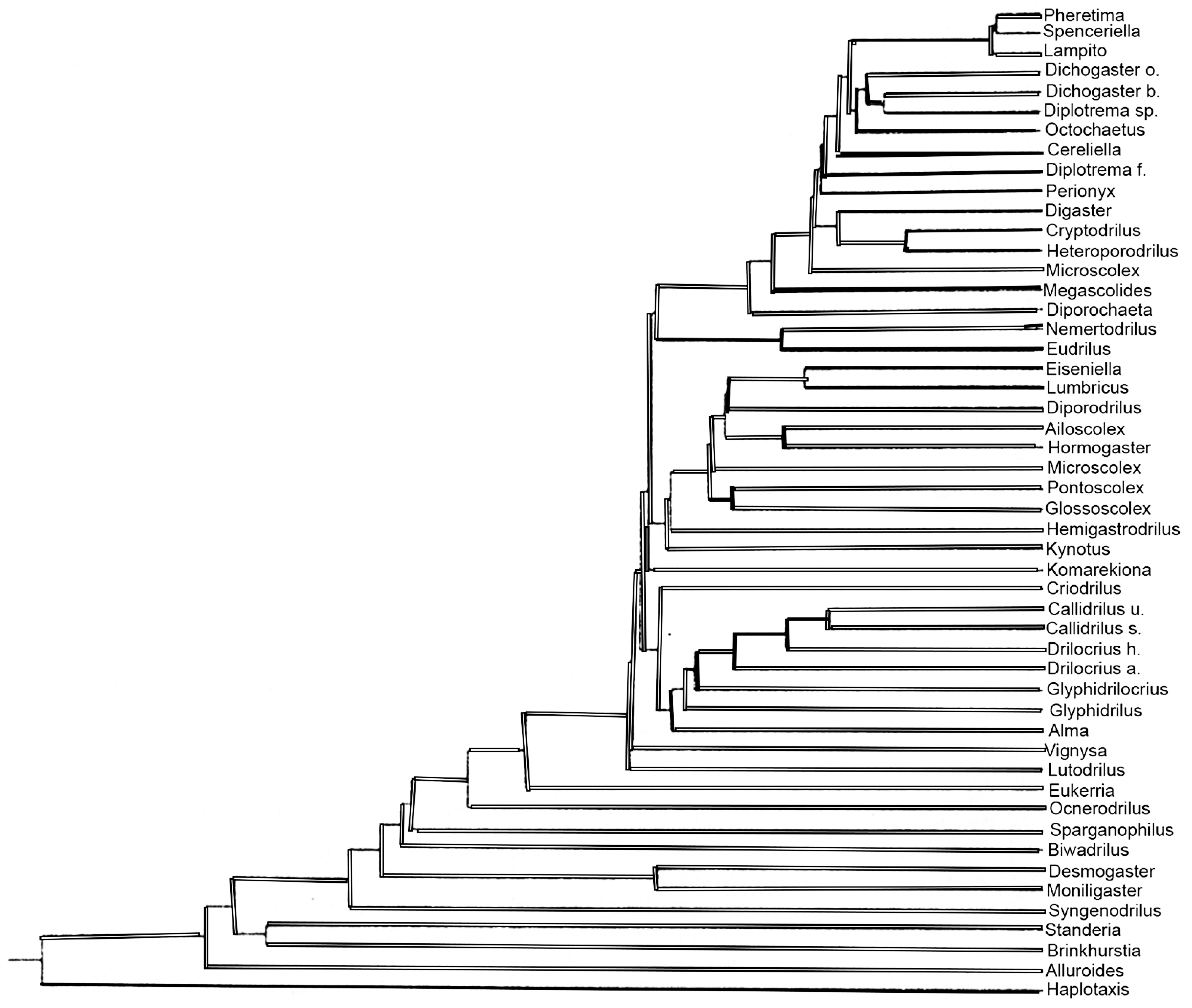
FIGURE 1A. Hennigram (morphological phylogram) for all families of the opisthoporous oligochaetes constructed by nearestneighbour clustering. For details see Jamieson (1978). Redrawn.

Imageimage/png© Jamieson, Barrie G. M.;Fragoso, CarlosA monograph of the Oligochaete family Alluroididae

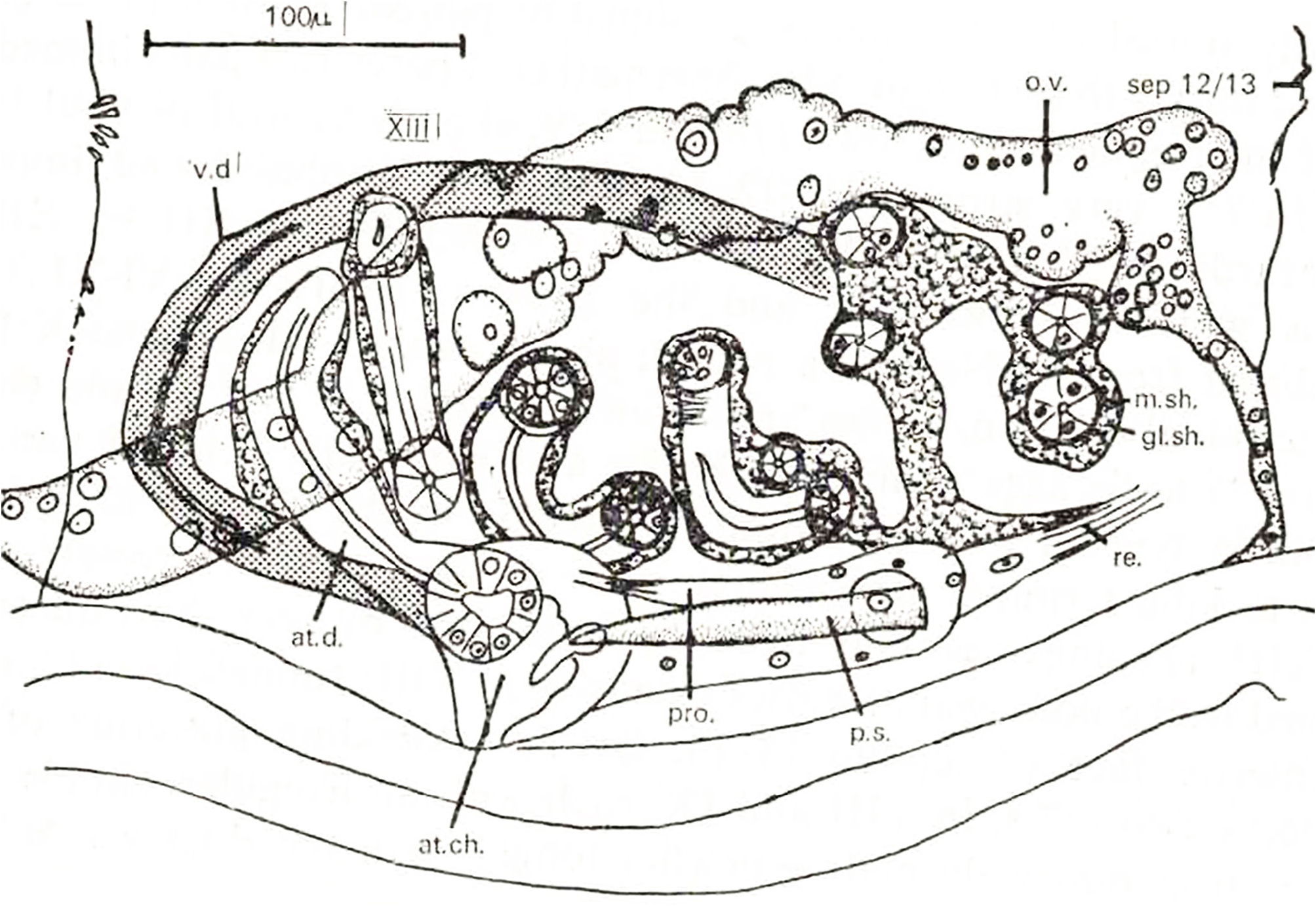
FIGURE 3. Brinkhurstia americanus (Brinkhurst 1964). Longitudinal section through the male terminalia. at.ch, terminal chamber of atrium; at.d, atrial duct; gl.sh, glandular sheath; m.sh, muscular sheath; o.v, ovary; pro, protractor muscle; p.s, penial seta; re, retractor muscle; sep, septum; v.d, vas deferens. From Jamieson (1968).

Imageimage/png© Jamieson, Barrie G. M.;Fragoso, CarlosA monograph of the Oligochaete family Alluroididae

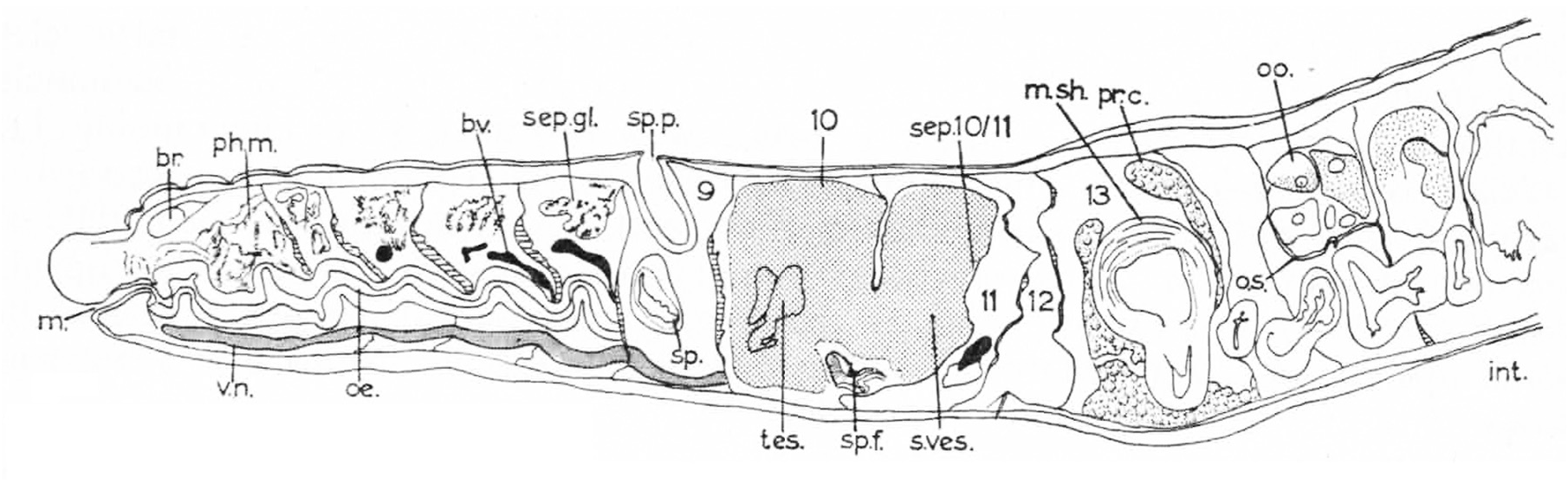
FIGURE 4. Alluroides brinkhursti brinkhursti Jamieson (1968). Longitudinal section of the holotype. Abbreviations: br, brain; bv, blood vessel; m, mouth; msh, muscular sheath of atrium; oe, oesophagus; oo, oocyte: os, ovisac; ph m, pharyngeal musculature; pr c, prostatic cells; sep, septum; sep gl, septal gland; sp p, spermathecal pore; s. ves, seminal vesicle; sp, spermatheca; sp f, sperm funnel; tes, testis; vd, vas deferens; v n, ventral nerve cord. Adapted from Jamieson (1968).

Imageimage/png© Jamieson, Barrie G. M.;Fragoso, CarlosA monograph of the Oligochaete family Alluroididae

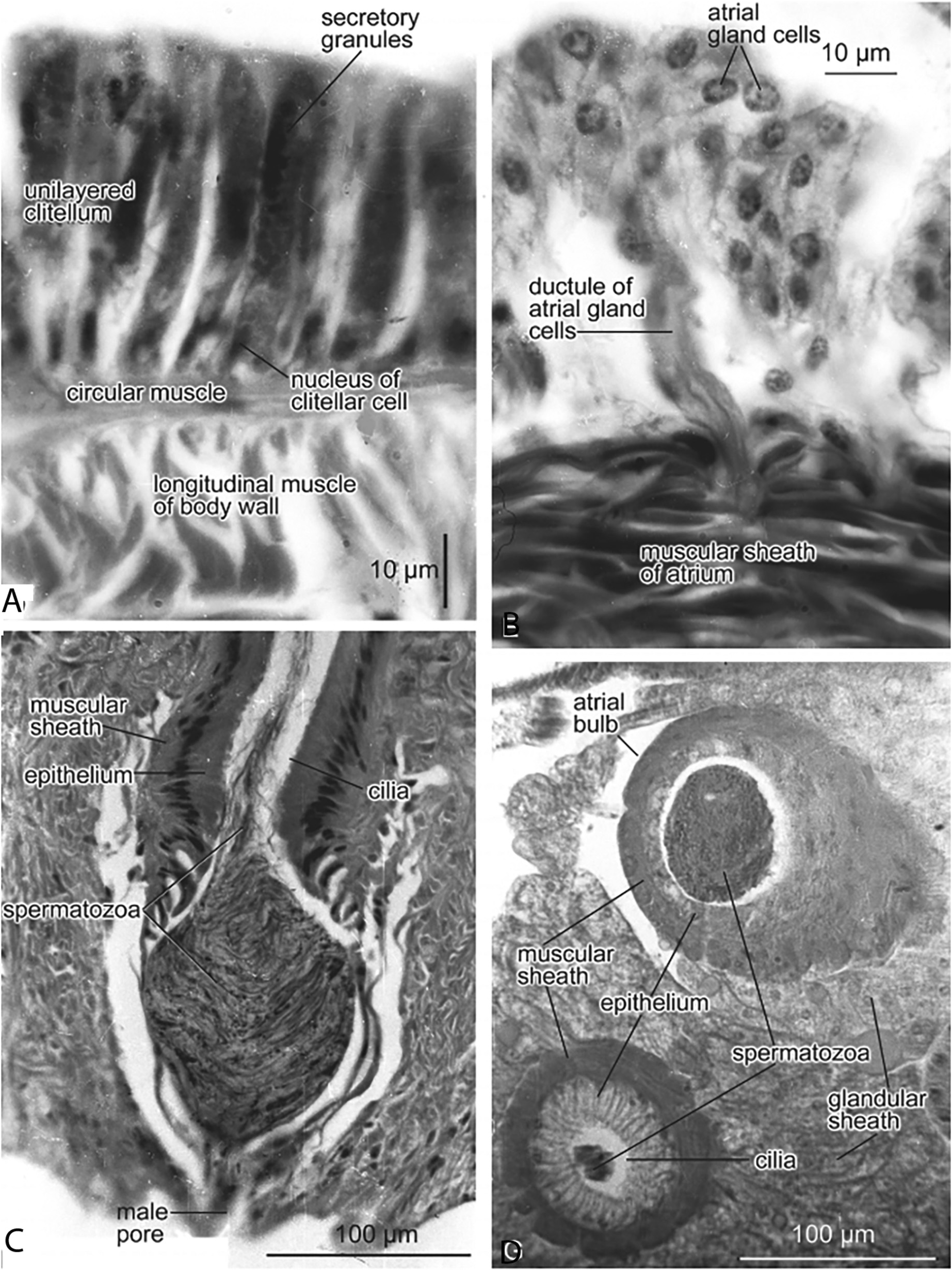
FIGURE 5. Alluroides brinkhursti brinkhursti Jamieson (1968). A. Transverse section (TS) of clitellum, showing single cell layer; the cells with conspicuous secretory granules and each with a basal nucleus. B. TS through the wall of the atrium, showing a group of atrial gland cells with ductule penetrating the muscular sheath of the atrium. C. Longitudinal section through the male pore, showing the ectal end of the atrium, which forms a penis with muscular sheath, ciliated epithelium and rope of spermatozoa in the lumen, forming in the ectal chamber a sperm mass. D. Alluroides pordagei. Oblique section through the atrial bulb, containing a large sperm mass, and the associated atrium. From Jamieson (2006).

Imageimage/png© Jamieson, Barrie G. M.;Fragoso, CarlosA monograph of the Oligochaete family Alluroididae

FIGURE 13. Kathrynella guyanae Omodeo 1996.A. Ventral view of anterior segments.Note the pale lateral line.B. arrangement of genital organs. Abbreviations: a, atrium; gp, genital papilla; ♂, male pore; sp, spematheca; t, testis; ts, thickened septum. The penial setae are seen projecting from the male pore. Modified from Omodeo (1996).

Imageimage/png© Jamieson, Barrie G. M.;Fragoso, CarlosA monograph of the Oligochaete family Alluroididae

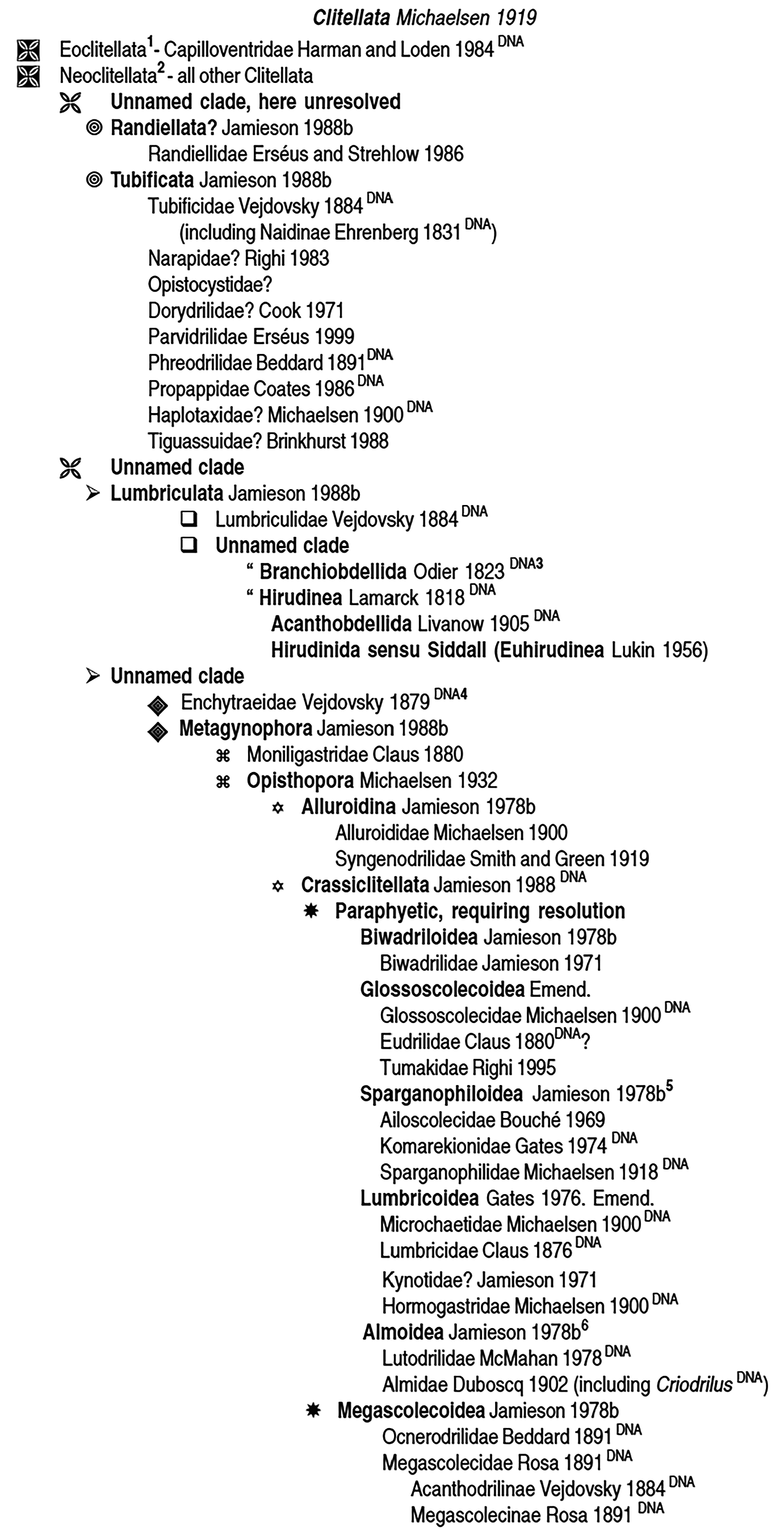
FIGURE 2. A phylogenetic classification of the Clitellata. (From Jamieson 2006).

Imageimage/png© Jamieson, Barrie G. M.;Fragoso, CarlosA monograph of the Oligochaete family Alluroididae

IMAGES

Gallery(6)

See Gallery

Occurrences with images

CITATIONS

References(4)

  • 1

    Martin, P.; Martinez-Ansemil, E.; Pinder, A.; Timm T.; Wetzel, M. J. (2016). World checklist of freshwater Oligochaeta species. <em>World Wide Web electronic publication.</em>

    basis of recordWorld Register of Marine Species
  • 2

    Omodeo, P. (1996). Kathrynella, a new oligochaete genus from Guyana, Netherlands. <em>Aquatic Oligochaete Biology VI.</em> 11-15.

    original descriptionWorld Register of Marine Species
  • 3

    Omodeo, Pietro, 1996: Kathrynella, a new oligochaete genus from Guyana. Hydrobiologia, vol. 334, nos. 1-3. 11-15.

    Integrated Taxonomic Information System (ITIS)
  • 4

    Omodeo, Pietro, and Kathryn A. Coates, 2001: New alluroidids (Annelida, Clitellata) from Guyana. Hydrobiologia, vol. 463, nos. 1-3. 39-47.

    Integrated Taxonomic Information System (ITIS)
  • Source Information

    GBIF Backbone Taxonomy

    GBIF Backbone Taxonomy

    checklist

    The GBIF Backbone Taxonomy is a single, synthetic management classification with the goal of covering all names GBIF is dealing with. It's the taxonomic backbone that allows GBIF to integrate name based information from different resources, no matter if these are occurrence datasets, species pages, names from nomenclators or external sources like EOL, Genbank or IUCN. This backbone allows taxonomic search, browse and reporting operations across all those resources in a consistent way and to provide means to crosswalk names from one source to another.

    It is updated regulary through an automated process in which the Catalogue of Life acts as a starting point also providing the complete higher classification above families. Additional scientific names only found in other authoritative nomenclatural and taxonomic datasets are then merged into the tree, thus extending the original catalogue and broadening the backbones name coverage. The GBIF Backbone taxonomy also includes identifiers for Operational Taxonomic Units (OTUs) drawn from the barcoding resources iBOL and UNITE.

    International Barcode of Life project (iBOL), Barcode Index Numbers (BINs). BINs are connected to a taxon name and its classification by taking into account all names applied to the BIN and picking names with at least 80% consensus. If there is no consensus of name at the species level, the selection process is repeated moving up the major Linnaean ranks until consensus is achieved.

    UNITE - Unified system for the DNA based fungal species, Species Hypotheses (SHs). SHs are connected to a taxon name and its classification based on the determination of the RefS (reference sequence) if present or the RepS (representative sequence). In the latter case, if there is no match in the UNITE taxonomy, the lowest rank with 100% consensus within the SH will be used.

    The GBIF Backbone Taxonomy is available for download at https://hosted-datasets.gbif.org/datasets/backbone/ in different formats together with an archive of all previous versions.

    The following 105 sources have been used to assemble the GBIF backbone with number of names given in brackets:

    • Catalogue of Life Checklist - 4766428 names
    • International Barcode of Life project (iBOL) Barcode Index Numbers (BINs) - 635951 names
    • UNITE - Unified system for the DNA based fungal species linked to the classification - 611208 names
    • The Paleobiology Database - 212054 names
    • World Register of Marine Species - 188857 names
    • The Interim Register of Marine and Nonmarine Genera - 183894 names
    • The World Checklist of Vascular Plants (WCVP) - 131891 names
    • GBIF Backbone Taxonomy - 114350 names
    • TAXREF - 109374 names
    • The Leipzig catalogue of vascular plants - 75380 names
    • ZooBank - 73549 names
    • Integrated Taxonomic Information System (ITIS) - 68377 names
    • Plazi.org taxonomic treatments database - 61346 names
    • Genome Taxonomy Database r207 - 60545 names
    • International Plant Names Index - 52329 names
    • Fauna Europaea - 45077 names
    • The National Checklist of Taiwan (Catalogue of Life in Taiwan, TaiCoL) - 36193 names
    • Dyntaxa. Svensk taxonomisk databas - 35892 names
    • The Plant List with literature - 32692 names
    • United Kingdom Species Inventory (UKSI) - 29643 names
    • Artsnavnebasen - 29208 names
    • The IUCN Red List of Threatened Species - 21221 names
    • Afromoths, online database of Afrotropical moth species (Lepidoptera) - 13961 names
    • Brazilian Flora 2020 project - Projeto Flora do Brasil 2020 - 13829 names
    • Prokaryotic Nomenclature Up-to-Date (PNU) - 10079 names
    • Checklist Dutch Species Register - Nederlands Soortenregister - 8814 names
    • ICTV Master Species List (MSL) - 7852 names
    • Cockroach Species File - 6020 names
    • GRIN Taxonomy - 5882 names
    • Taxon list of fungi and fungal-like organisms from Germany compiled by the DGfM - 4570 names
    • Catalogue of Afrotropical Bees - 3623 names
    • Catalogue of Tenebrionidae (Coleoptera) of North America - 3327 names
    • Checklist of Beetles (Coleoptera) of Canada and Alaska. Second Edition. - 3312 names
    • Systema Dipterorum - 2850 names
    • Catalogue of the Pterophoroidea of the World - 2807 names
    • The Clements Checklist - 2675 names
    • Taxon list of Hymenoptera from Germany compiled in the context of the GBOL project - 2496 names
    • IOC World Bird List, v13.2 - 2366 names
    • Official Lists and Indexes of Names in Zoology - 2310 names
    • National checklist of all species occurring in Denmark - 1922 names
    • Myriatrix - 1876 names
    • Database of Vascular Plants of Canada (VASCAN) - 1822 names
    • Taxon list of vascular plants from Bavaria, Germany compiled in the context of the BFL project - 1771 names
    • Orthoptera Species File - 1742 names
    • A list of the terrestrial fungi, flora and fauna of Madeira and Selvagens archipelagos - 1602 names
    • Aphid Species File - 1565 names
    • World Spider Catalog - 1561 names
    • Taxon list of Jurassic Pisces of the Tethys Palaeo-Environment compiled at the SNSB-JME - 1270 names
    • Backbone Family Classification Patch - 1143 names
    • GBIF Algae Classification - 1100 names
    • International Cichorieae Network (ICN): Cichorieae Portal - 975 names
    • Psocodea Species File - 803 names
    • New Zealand Marine Macroalgae Species Checklist - 787 names
    • Annotated checklist of endemic species from the Western Balkans - 754 names
    • Taxon list of animals with German names (worldwide) compiled at the SMNS - 503 names
    • Catalogue of the Alucitoidea of the World - 472 names
    • Lygaeoidea Species File - 462 names
    • Catálogo de Plantas y Líquenes de Colombia - 422 names
    • GBIF Backbone Patch - 317 names
    • Phasmida Species File - 259 names
    • Cortinariaceae fetched from the Index Fungorum API - 234 names
    • Coreoidea Species File - 233 names
    • GTDB supplement - 139 names
    • Mantodea Species File - 119 names
    • Endemic species in Taiwan - 93 names
    • Taxon list of Araneae from Germany compiled in the context of the GBOL project - 88 names
    • Species of Hominidae - 78 names
    • Taxon list of Sternorrhyncha from Germany compiled in the context of the GBOL project - 77 names
    • Taxon list of mosses from Germany compiled in the context of the GBOL project - 75 names
    • Mammal Species of the World - 73 names
    • Plecoptera Species File - 71 names
    • Species Fungorum Plus - 64 names
    • Catalogue of the type specimens of Cosmopterigidae (Lepidoptera: Gelechioidea) from research collections of the Zoological Institute, Russian Academy of Sciences - 47 names
    • Species named after famous people - 41 names
    • Dermaptera Species File - 36 names
    • Taxon list of Trichoptera from Germany compiled in the context of the GBOL project - 34 names
    • True Fruit Flies (Diptera, Tephritidae) of the Afrotropical Region - 33 names
    • Range and Regularities in the Distribution of Earthworms of the Earthworms of the USSR Fauna. Perel, 1979 - 32 names
    • Taxon list of Diplura from Germany compiled in the context of the GBOL project - 30 names
    • Lista de referencia de especies de aves de Colombia - 2022 - 24 names
    • Taxon list of Auchenorrhyncha from Germany compiled in the context of the GBOL project - 20 names
    • Catalogue of the type specimens of Polycestinae (Coleoptera: Buprestidae) from research collections of the Zoological Institute, Russian Academy of Sciences - 19 names
    • Taxon list of Thysanoptera from Germany compiled in the context of the GBOL project - 19 names
    • Lista de especies de vertebrados registrados en jurisdicción del Departamento del Huila - 18 names
    • Taxon list of Microcoryphia (Archaeognatha) from Germany compiled in the context of the GBOL project - 15 names
    • Catalogue of the type specimens of Bufonidae and Megophryidae (Amphibia: Anura) from research collections of the Zoological Institute, Russian Academy of Sciences - 12 names
    • Grylloblattodea Species File - 11 names
    • Coleorrhyncha Species File - 9 names
    • Taxon list of liverworts from Germany compiled in the context of the GBOL project - 9 names
    • Embioptera Species File - 7 names
    • Taxon list of Pisces and Cyclostoma from Germany compiled in the context of the GBOL project - 6 names
    • Taxon list of Pteridophyta from Germany compiled in the context of the GBOL project - 6 names
    • Taxon list of Siphonaptera from Germany compiled in the context of the GBOL project - 5 names
    • The Earthworms of the Fauna of Russia. Perel, 1997 - 5 names
    • Taxon list of Zygentoma from Germany compiled in the context of the GBOL project - 4 names
    • Asiloid Flies: new taxa of Diptera: Apioceridae, Asilidae, and Mydidae - 3 names
    • Taxon list of Protura from Germany compiled in the context of the GBOL project - 3 names
    • Taxon list of hornworts from Germany compiled in the context of the GBOL project - 2 names
    • Chrysididae Species File - 1 names
    • Taxon list of Dermaptera from Germany compiled in the context of the GBOL project - 1 names
    • Taxon list of Diplopoda from Germany in the context of the GBOL project - 1 names
    • Taxon list of Orthoptera (Grashoppers) from Germany compiled at the SNSB - 1 names
    • Taxon list of Pscoptera from Germany compiled in the context of the GBOL project - 1 names
    • Taxon list of Pseudoscorpiones from Germany compiled in the context of the GBOL project - 1 names
    • Taxon list of Raphidioptera from Germany compiled in the context of the GBOL project - 1 names

    GBIF Secretariat (2023). GBIF Backbone Taxonomy. Checklist dataset https://doi.org/10.15468/39omei accessed via GBIF.org on 2026-06-14.

    CC BYPublished 8/28/2023View dataset
    GBIF Usage Key
    9419865
    Dataset Key
    d7dddbf4-2cf0-4f39-9b2a-bb099caae36c
    Origin
    source
    Backbone Key
    9419865
    Taxon ID
    gbif:9419865
    Last Crawled
    8/22/2023
    Last Interpreted
    8/22/2023