AnimaliaNot EvaluatedacceptedspeciesAccepted
Pseudaegina rhodina

Pseudaegina rhodina

カリブツヅミクラゲ·(Haeckel, 1879)

GBIF:9484726

0countries
0year

0

Synonyms

PROFILE

Species Profile

Habitat

Marine

Characteristics

Extant

ABOUT

Descriptions(6)

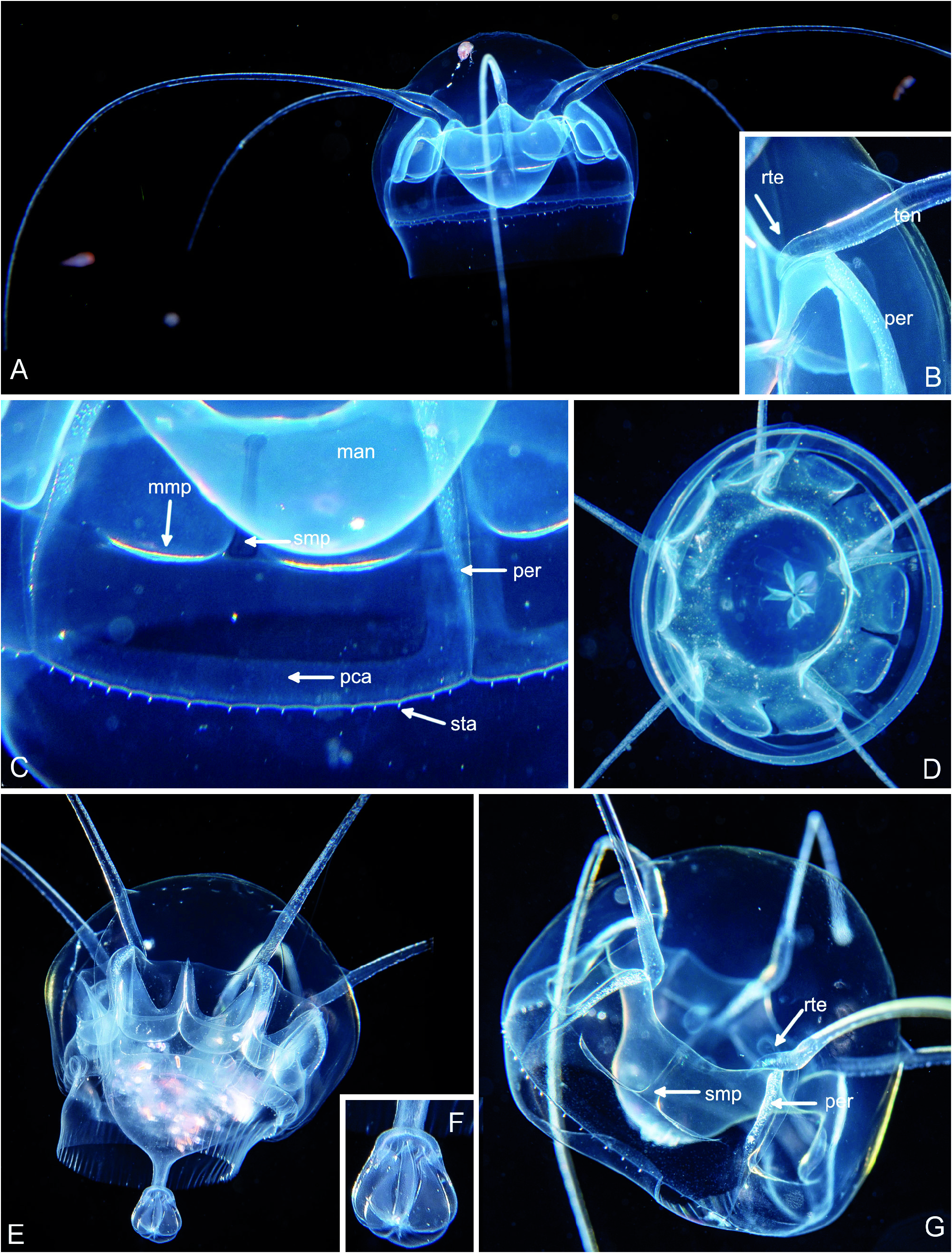
Fig 51 A-G, Fig. 52 A-B
Hydromedusae observed during night dives in the Gulf Stream
Observations Form with 5 tentacles: Umbrella approximately hemispherical, 15 - 20 mm, jelly firm, apical mesoglea half the bell height, tentacles issue at about 2 / 3 of bell height, above tentacles a small bulge (Fig. 51 A- B). Velum broad (Fig. 51 A). Stomach about half the bell diameter, mounted on a rounded mesogleal cone of the same diameter reaching to level of bell margin (Fig. 51 A). Mouth rim can form temporary folds or even a tubular extension with terminal folds (Fig. 51 D-F). Five subdivided manubrial pockets (Fig. 51 C-D). Manubrial pockets broadly U-shaped, reaching from stomach rim to about half the distance to bell margin (Fig. 51 A), in middle a narrow septum which does not reach to the stomach level or level of tentacle origin (Fig. 51 C, smp). At bottom of left and right side of the pairs of pouches originates a broad peripheral canal, directed first along peronium towards the bell margin and then following the latter (Fig. 51 C). Five tentacles originating in upper half of medusa at about upper level of stomach, the proximal end embedded in an exumbrellar furrow, the tentacle roots rather short, entering the mesoglea, tapering, and curved towards oral (Fig. 51 B); tentacle length about 2 - 3 bell diameters, curved towards oral, nematocysts concentrated on upper side but also present on underside. Below tentacles a deep cleft in exumbrella reaching down to bell margin, its floor with a thickened epidermis containing nematocysts (= peronium, Fig. 51 C-G). 48 to ca. 68 statocysts. No otoporpae. Almost colourless, greenish or yellowish cast in daylight. Form with 4 tentacles: As above, but only four tentacles and four pairs of manubrial pouches, size 9 to 11 mm, 36 to 60 statocysts.
Hydromedusae observed during night dives in the Gulf Stream
Remarks: Haeckel’s type material of this species consisted in three specimens. Two of them had four tentacles and a size of 40 mm, one had five tentacles and measured 50 mm. He depicted a mature female with four tentacles. The statocyst numbers were given as two per manubrial hemi-pouch (16 - 20 in total). Kramp (1955 b, 1961) synonymized this species with the similar Aegina citrea Eschscholtz, 1829, an opinion already pondered by Mayer (1910). This view was upheld until Lindsay et al. (2017) revised Aegina citrea and split it into several species and belonging to separate families, this based on morphological and genetic differences. The main morphological difference to Aegina is the shape of the tentacle root. In Aegina they are curved towards aboral, in Pseudaegina they are curved towards oral. Our specimens with 5 tentacles matched the description of Lindsay et al. (2017) very well as they came from the same region. There are, however, some differences to Haeckel’s description. Our specimens were smaller (up to 20 mm) but all immature. The most obvious difference is the number of statocysts: Haeckel saw about 16 - 20, while we found regularly 60 - 68. The haplotype divergence in our sample was high (p-value up to 7.8 %) and in the maximum likelihood tree the samples split into two sub-clades (Fig. 48). This separation coincided with two morphotypes: the four- and five-tentacled form (see above). Unfortunately, we could get only one sequence of the four-tentacled form and due to the low number of samples, this distribution could also be due to mere contingency. The four-tentacled medusae were all smaller than those with five tentacles and it is nevertheless the possible that our material was composed of two sister-species. Because the original material of Haeckel included both four- and five-tentacled forms, it is not possible to use the tentacle number in the diagnosis of a new species without the designation of a lectotype (or a neotype as Haeckel’s material is likely lost). A population-genetic study at the type locality combined with the designation of a neotype is thus needed to resolve this taxonomic problem. Because of these unresolved issues and because our samples were monophyletic, we felt it premature to describe one of the clades as a new species. One particularity not mentioned in previous descriptions concerns the temporary folds of the mouth region (Fig. 51 D-F). One of the figures in Lindsay et al. (2017: fig. 12 C) also shows this ruffling of the mouth margin. In one of our animals the mouth was even drawn out to a tube ending in a flower-like, folded mouth region. The folds disappeared after fixation. It is thus unlikely that they can ever be seen in standard net-plankton samples.
Hydromedusae observed during night dives in the Gulf Stream
16 S data: In the maximum likelihood tree (Fig. 48), all five samples clustered in a lineage that was well separated from most other Narcomedusae. The clade had a distinct internal dichotomy with the single 4 - tentacled specimen being rather apart from the 5 - tentacled medusae (7.6 to 7.8 % base pair differences). The three haplotypes of the 5 - tentacled medusae were rather similar (0.18 - 0.36 % divergences, Table 1).
Hydromedusae observed during night dives in the Gulf Stream
Distribution: Tropical to subtropical Atlantic Ocean (Lindsay et al., 2017). Type locality: Canary Islands, Lanzarote.
Hydromedusae observed during night dives in the Gulf Stream
Examined material Specimens with 5 tentacles: BFLA 4015; 1 specimen; 17 - JAN- 2019; size 18 mm; part preserved in formalin and deposited as UF- 013441, small part in alcohol for DNA extraction; 16 S sequence MW 528658. – BFLA 4047; 1 specimen; 01 - APR- 2019; size 16 mm; part preserved in formalin and deposited as UF- 013451, small part in alcohol for DNA extraction; 16 S sequence MW 528659. – BFLA 4067; 1 specimen; 10 - APR- 2019; size 20 mm; part preserved in formalin and deposited as UF- 013778, small part in alcohol for DNA extraction; 16 S sequence identical to MW 528659. – BFLA 4322; 1 specimen; 24 - JAN- 2020; size 15 mm; part preserved in formalin and deposited as UF- 013887, small part in alcohol for DNA extraction; 16 S sequence MW 528707. – 13 - MAR- 2020; 1 specimen; 15 mm; not collected. Specimens with 4 tentacles: BFLA 4120; 1 specimen; 04 - JUN- 2019; size 9 mm; part preserved in formalin and deposited as UF- 013803, small part in alcohol for DNA extraction; 16 S sequence MW 528678. – BFLA 4134; 1 specimen; 15 - JUN- 2019; size 11 mm; part preserved in formalin and deposited as UF- 013809, small part in alcohol for DNA extraction; 16 S sequence not determinable. – BFLA 4118; 1 specimen; 04 - JUN- 2019; size 9 mm; part preserved in formalin and deposited as UF- 013809, small part in alcohol for DNA extraction, not examined.
Hydromedusae observed during night dives in the Gulf Stream

Export occurrence data

Darwin Core Archive (ZIP)

GEOGRAPHY

Distribution Map

Occurrence Map

Loading map…

Tiles © GBIF Maps API | Map powered by MapLibre GL

REGIONS

Geographic Distribution(12)

Tropical Atlantic
Atlantic Coast of Florida
Lanzarote
Subtropical Atlantic
Tropical Atlantic
Subtropical Atlantic
Atlantic Coast of Florida
Subtropical Atlantic
Tropical Atlantic
Lanzarote
Lanzarote(ES)
Atlantic Coast of Florida(US)

DATA

Occurrence Datasets

Loading datasets…

Common names used for this species across different languages and regions.

jpnカリブツヅミクラゲjpn

Vernacular (common) names are the everyday names used for a species in different languages and regions. A single species may have dozens of common names worldwide.

jpnカリブツヅミクラゲ
jpn
Source: Catalogue of LifeSource taxon #299646036

CLASSIFICATION

Taxonomic Classification Tree

MULTIMEDIA

Media Files(3)

Fig. 51. Pseudaegina rhodina with 5 tentacles. (A-C) BFLA4015, size 18 mm. (D) BFLA4047, size 16 mm. (E-F) BFLA4067, size 20 mm. (G) BFLA4322, size 15 mm. (A) Lateral view. (B) Higher magnification of tentacle root (rte, arrow), note inflection towards below (= oral). (C) Details of bell margin. (D) Aboral view, note the (temporary) folding of mouth margin. (E-F) Medusa which has recently fed and its stomach is full of prey. Note the particular, most likely transitory, formation of a mouth tube and folded mouth margin, shown at higher magnification in F. (G). Lateral view. Abbreviations: man – manubrium/ stomach covering conical jelly cone, mmp – distal margin of manubrial pouch, pca – peripheral canal, per – peronium, rte – tentacle root, smp – septum in middle of manubrial pouch, sta – statocyst.

Imageimage/png© Schuchert, Peter;Collins, RichardHydromedusae observed during night dives in the Gulf Stream

Fig. 52. Pseudaegina rhodina with 4 tentacles. (A) BFLA4134, size 9 mm, animal has semi-digested prey items in its gastric system including the peripheral canal system rendering it thus much more visible. (B) BFLA4120, bell size 9 mm, lateral view.

Imageimage/png© Schuchert, Peter;Collins, RichardHydromedusae observed during night dives in the Gulf Stream

Fig. 48. Maximum likelihood phylogenetic tree of Narcomedusae obtained with PhyML (GTR+G+I model) and based on about 600 bp positions of the mitochondrial 16S gene. Node-support values are bootstrap values of 100 pseudoreplicates (shown only if> 70%). Sequence labels start with the GenBank numbers (except for identical haplotypes) permitting the retrieval of more information. Some proveniences were obtained from Lindsay et al. (2017) or through personal communications. Red ODEHOV DUH QHZ VHTXHQFHV IURP WKLV VWXG\. &RORXUHG ER[HV LQGLFDWH IDPLO\ DI¿OLDWLRQV DFFRUGLQJ WR WKH FXUUHQWO\ XVHG V\VWHP. (") 'HQRWHV SRVVLEOH PLVLGHQWL¿FDWLRQV.

Imageimage/png© Schuchert, Peter;Collins, RichardHydromedusae observed during night dives in the Gulf Stream

IMAGES

Gallery(3)

See Gallery

Occurrences with images

CITATIONS

References(3)

  • 1

    Lindsay, D. J.; Grossmann, M. M.; Bentlage, B.; Collins, A. G.; Minemizu, R.; Hopcroft, R. R.; Miyake, H.; Hidaka-Umetsu, M.; Nishikawa, J. (2017). The perils of online biogeographic databases: a case study with the ‘monospecific' genus Aegina (Cnidaria, Hydrozoa, Narcomedusae). <em>Marine Biology Research.</em> 13(5): 494-512.

    basis of recordWorld Register of Marine Species
  • 2

    Schuchert P., Collins R. (2024). Additional observations on hydromedusae during night dives in the Gulf Stream. <em>Revue suisse de Zoologie.</em> 131(1): 43-120.

    additional sourceWorld Register of Marine Species
  • 3

    Schuchert P.; Collins R. (2021). Hydromedusae observed during night dives in the Gulf Stream. <em>Revue suisse de Zoologie.</em> 128(2): 237-356.

    identification resourceWorld Register of Marine SpeciesDOI: 10.35929/rsz.0049
  • Source Information

    GBIF Backbone Taxonomy

    GBIF Backbone Taxonomy

    checklist

    The GBIF Backbone Taxonomy is a single, synthetic management classification with the goal of covering all names GBIF is dealing with. It's the taxonomic backbone that allows GBIF to integrate name based information from different resources, no matter if these are occurrence datasets, species pages, names from nomenclators or external sources like EOL, Genbank or IUCN. This backbone allows taxonomic search, browse and reporting operations across all those resources in a consistent way and to provide means to crosswalk names from one source to another.

    It is updated regulary through an automated process in which the Catalogue of Life acts as a starting point also providing the complete higher classification above families. Additional scientific names only found in other authoritative nomenclatural and taxonomic datasets are then merged into the tree, thus extending the original catalogue and broadening the backbones name coverage. The GBIF Backbone taxonomy also includes identifiers for Operational Taxonomic Units (OTUs) drawn from the barcoding resources iBOL and UNITE.

    International Barcode of Life project (iBOL), Barcode Index Numbers (BINs). BINs are connected to a taxon name and its classification by taking into account all names applied to the BIN and picking names with at least 80% consensus. If there is no consensus of name at the species level, the selection process is repeated moving up the major Linnaean ranks until consensus is achieved.

    UNITE - Unified system for the DNA based fungal species, Species Hypotheses (SHs). SHs are connected to a taxon name and its classification based on the determination of the RefS (reference sequence) if present or the RepS (representative sequence). In the latter case, if there is no match in the UNITE taxonomy, the lowest rank with 100% consensus within the SH will be used.

    The GBIF Backbone Taxonomy is available for download at https://hosted-datasets.gbif.org/datasets/backbone/ in different formats together with an archive of all previous versions.

    The following 105 sources have been used to assemble the GBIF backbone with number of names given in brackets:

    • Catalogue of Life Checklist - 4766428 names
    • International Barcode of Life project (iBOL) Barcode Index Numbers (BINs) - 635951 names
    • UNITE - Unified system for the DNA based fungal species linked to the classification - 611208 names
    • The Paleobiology Database - 212054 names
    • World Register of Marine Species - 188857 names
    • The Interim Register of Marine and Nonmarine Genera - 183894 names
    • The World Checklist of Vascular Plants (WCVP) - 131891 names
    • GBIF Backbone Taxonomy - 114350 names
    • TAXREF - 109374 names
    • The Leipzig catalogue of vascular plants - 75380 names
    • ZooBank - 73549 names
    • Integrated Taxonomic Information System (ITIS) - 68377 names
    • Plazi.org taxonomic treatments database - 61346 names
    • Genome Taxonomy Database r207 - 60545 names
    • International Plant Names Index - 52329 names
    • Fauna Europaea - 45077 names
    • The National Checklist of Taiwan (Catalogue of Life in Taiwan, TaiCoL) - 36193 names
    • Dyntaxa. Svensk taxonomisk databas - 35892 names
    • The Plant List with literature - 32692 names
    • United Kingdom Species Inventory (UKSI) - 29643 names
    • Artsnavnebasen - 29208 names
    • The IUCN Red List of Threatened Species - 21221 names
    • Afromoths, online database of Afrotropical moth species (Lepidoptera) - 13961 names
    • Brazilian Flora 2020 project - Projeto Flora do Brasil 2020 - 13829 names
    • Prokaryotic Nomenclature Up-to-Date (PNU) - 10079 names
    • Checklist Dutch Species Register - Nederlands Soortenregister - 8814 names
    • ICTV Master Species List (MSL) - 7852 names
    • Cockroach Species File - 6020 names
    • GRIN Taxonomy - 5882 names
    • Taxon list of fungi and fungal-like organisms from Germany compiled by the DGfM - 4570 names
    • Catalogue of Afrotropical Bees - 3623 names
    • Catalogue of Tenebrionidae (Coleoptera) of North America - 3327 names
    • Checklist of Beetles (Coleoptera) of Canada and Alaska. Second Edition. - 3312 names
    • Systema Dipterorum - 2850 names
    • Catalogue of the Pterophoroidea of the World - 2807 names
    • The Clements Checklist - 2675 names
    • Taxon list of Hymenoptera from Germany compiled in the context of the GBOL project - 2496 names
    • IOC World Bird List, v13.2 - 2366 names
    • Official Lists and Indexes of Names in Zoology - 2310 names
    • National checklist of all species occurring in Denmark - 1922 names
    • Myriatrix - 1876 names
    • Database of Vascular Plants of Canada (VASCAN) - 1822 names
    • Taxon list of vascular plants from Bavaria, Germany compiled in the context of the BFL project - 1771 names
    • Orthoptera Species File - 1742 names
    • A list of the terrestrial fungi, flora and fauna of Madeira and Selvagens archipelagos - 1602 names
    • Aphid Species File - 1565 names
    • World Spider Catalog - 1561 names
    • Taxon list of Jurassic Pisces of the Tethys Palaeo-Environment compiled at the SNSB-JME - 1270 names
    • Backbone Family Classification Patch - 1143 names
    • GBIF Algae Classification - 1100 names
    • International Cichorieae Network (ICN): Cichorieae Portal - 975 names
    • Psocodea Species File - 803 names
    • New Zealand Marine Macroalgae Species Checklist - 787 names
    • Annotated checklist of endemic species from the Western Balkans - 754 names
    • Taxon list of animals with German names (worldwide) compiled at the SMNS - 503 names
    • Catalogue of the Alucitoidea of the World - 472 names
    • Lygaeoidea Species File - 462 names
    • Catálogo de Plantas y Líquenes de Colombia - 422 names
    • GBIF Backbone Patch - 317 names
    • Phasmida Species File - 259 names
    • Cortinariaceae fetched from the Index Fungorum API - 234 names
    • Coreoidea Species File - 233 names
    • GTDB supplement - 139 names
    • Mantodea Species File - 119 names
    • Endemic species in Taiwan - 93 names
    • Taxon list of Araneae from Germany compiled in the context of the GBOL project - 88 names
    • Species of Hominidae - 78 names
    • Taxon list of Sternorrhyncha from Germany compiled in the context of the GBOL project - 77 names
    • Taxon list of mosses from Germany compiled in the context of the GBOL project - 75 names
    • Mammal Species of the World - 73 names
    • Plecoptera Species File - 71 names
    • Species Fungorum Plus - 64 names
    • Catalogue of the type specimens of Cosmopterigidae (Lepidoptera: Gelechioidea) from research collections of the Zoological Institute, Russian Academy of Sciences - 47 names
    • Species named after famous people - 41 names
    • Dermaptera Species File - 36 names
    • Taxon list of Trichoptera from Germany compiled in the context of the GBOL project - 34 names
    • True Fruit Flies (Diptera, Tephritidae) of the Afrotropical Region - 33 names
    • Range and Regularities in the Distribution of Earthworms of the Earthworms of the USSR Fauna. Perel, 1979 - 32 names
    • Taxon list of Diplura from Germany compiled in the context of the GBOL project - 30 names
    • Lista de referencia de especies de aves de Colombia - 2022 - 24 names
    • Taxon list of Auchenorrhyncha from Germany compiled in the context of the GBOL project - 20 names
    • Catalogue of the type specimens of Polycestinae (Coleoptera: Buprestidae) from research collections of the Zoological Institute, Russian Academy of Sciences - 19 names
    • Taxon list of Thysanoptera from Germany compiled in the context of the GBOL project - 19 names
    • Lista de especies de vertebrados registrados en jurisdicción del Departamento del Huila - 18 names
    • Taxon list of Microcoryphia (Archaeognatha) from Germany compiled in the context of the GBOL project - 15 names
    • Catalogue of the type specimens of Bufonidae and Megophryidae (Amphibia: Anura) from research collections of the Zoological Institute, Russian Academy of Sciences - 12 names
    • Grylloblattodea Species File - 11 names
    • Coleorrhyncha Species File - 9 names
    • Taxon list of liverworts from Germany compiled in the context of the GBOL project - 9 names
    • Embioptera Species File - 7 names
    • Taxon list of Pisces and Cyclostoma from Germany compiled in the context of the GBOL project - 6 names
    • Taxon list of Pteridophyta from Germany compiled in the context of the GBOL project - 6 names
    • Taxon list of Siphonaptera from Germany compiled in the context of the GBOL project - 5 names
    • The Earthworms of the Fauna of Russia. Perel, 1997 - 5 names
    • Taxon list of Zygentoma from Germany compiled in the context of the GBOL project - 4 names
    • Asiloid Flies: new taxa of Diptera: Apioceridae, Asilidae, and Mydidae - 3 names
    • Taxon list of Protura from Germany compiled in the context of the GBOL project - 3 names
    • Taxon list of hornworts from Germany compiled in the context of the GBOL project - 2 names
    • Chrysididae Species File - 1 names
    • Taxon list of Dermaptera from Germany compiled in the context of the GBOL project - 1 names
    • Taxon list of Diplopoda from Germany in the context of the GBOL project - 1 names
    • Taxon list of Orthoptera (Grashoppers) from Germany compiled at the SNSB - 1 names
    • Taxon list of Pscoptera from Germany compiled in the context of the GBOL project - 1 names
    • Taxon list of Pseudoscorpiones from Germany compiled in the context of the GBOL project - 1 names
    • Taxon list of Raphidioptera from Germany compiled in the context of the GBOL project - 1 names

    GBIF Secretariat (2023). GBIF Backbone Taxonomy. Checklist dataset https://doi.org/10.15468/39omei accessed via GBIF.org on 2026-06-16.

    CC BYPublished 8/28/2023View dataset
    GBIF Usage Key
    9484726
    Dataset Key
    d7dddbf4-2cf0-4f39-9b2a-bb099caae36c
    Origin
    source
    Backbone Key
    9484726
    Taxon ID
    gbif:9484726
    Last Crawled
    8/22/2023
    Last Interpreted
    8/22/2023
