AnimaliaEndangeredacceptedspeciesAcceptedRestricted
Anomaloglossus blanci

Anomaloglossus blanci

Anomaloglosse de Blanc(+4)·Fouquet, Vacher, Courtois, Villette, Reizine, Gaucher, Jairam, Ouboter & Kok, 2018

GBIF:9727674

0countries
0datasets
0year

0

Descendants

0

Children

PROFILE

Species Profile

Characteristics

Extant

ABOUT

Descriptions(6)

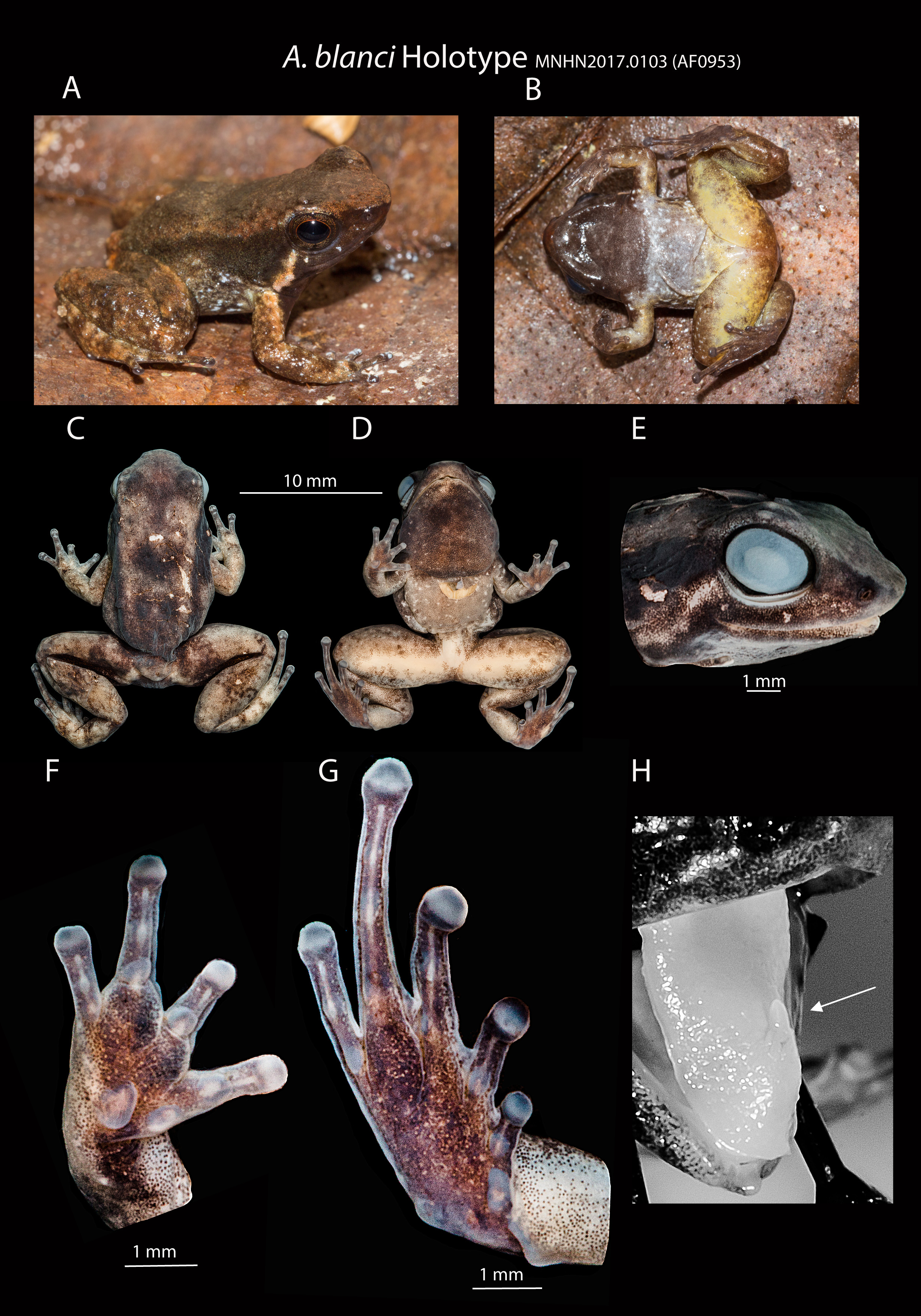
Description of the holotype (Figure 2). An adult male, 17.1 mm SVL; body robust; head wider than long, HL 89 % of HW; HL 33 % of SVL; dorsal skin tuberculate, one enlarged tubercle on each eyelid, snout long (SL 53 % of HL), rounded to nearly truncate in dorsal view, protruding in lateral view, extending past lower jaw. Nares located anterolaterally; canthus rostralis rounded, loreal region concave; IN 42 % of HW; EN 28 % of HL, 70 % of ED. Tympanum indistinct; supratympanic fold present extending from posteroventral corner of the eye onto the upper arm; choanae small, circular, located anterolaterally. Forelimb slender, skin tuberculate; metacarpal ridge absent; HAND 24 % of SVL; Finger I longer than Finger II when fingers adpressed; fingers large and flattened without webbing, lateral fringes present on preaxial edges of Fingers II and III; Finger III not distinctly swollen; tip of Finger IV not reaching distal subarticular tubercle on Finger III when fingers adpressed; finger discs expanded, wider than long, about 1.5 X width of digit; width of disc on Finger III 0.6 mm; discs with distinct dorsal scutes. Relative lengths of adpressed fingers III> IV> I> II; palmar tubercle large, heart-shaped, 0.8 mm in diameter (larger than Finger III disc), thenar tubercle small (equal to Finger III disc), elliptic, half the size of palmar tubercle, well separated from palmar tubercle. Only basal subarticular tubercles on Fingers III and IV are conspicuous; Finger I subarticular tubercle largest followed by Finger II subarticular tubercle, basal subarticular tubercle on Finger III and IV smaller, subequal. Hind limb robust, skin tuberculate; TL 46 % of SVL; heels not in contact when hind limbs are flexed at right angle to sagittal plane of body; FL 42 % of SVL; relative length of adpressed toes IV> III> V> II> I; Toe I very short, its tip reaching the base of subarticular tubercle on Toe II when toes adpressed; toe discs larger than width of toes; disc on Toe I only slightly larger than width of digit. Width of disc on Toe IV 0.8 mm. Feet moderately webbed, webbing present between Toes I – IV, webbing without melanophores; lateral fringes present on all toes. Toe webbing formula I 1 ½ - 1 - II 1 ½ - 2 - III 1 - - 3 IV 3 - - 2 + V. One to three subarticular tubercles on toes as follows: one on Toes I and II, two on Toes III and V, three on Toe IV. Inner metatarsal tubercle protuberant elliptical, 0.5 mm in length, outer metatarsal tubercle round, protuberant, 0.3 mm in diameter. Tarsal keel well defined, tubercle-like and strongly curved at proximal end, extending distally to the fringe on preaxial edge of Toe I. Metatarsal fold strong. Colour of holotype in life (Figure 2). Dorsal colour chestnut brown, with a diffuse dark brown hourglass pattern extending from the interorbital region to middorsum immediately followed by a diffuse dark brown patch over the sacrum. Faint dorsolateral stripes. Black lateral mask extending from tip of snout to the upper part of flanks, tapering to groin and containing most of the indistinct tympanum and supratympanic fold, only interrupted by a large postocular orange stripe extending from eye onto the upper arm down to the anterior cubital region. Upper lip with 2 – 3 small light blue blotches. Posteroventral part of flanks pale brown with a few small white-blue and dark brown blotches. Throat solid black becoming paler posteriorly; belly grey with ill-defined light blue and white spots, lower part of belly and ventral surface of thighs and arms orange with a few ill-defined grey spots. Iris with reddish metallic pigmentation and pupil ring interrupted dorsally and ventrally by transversal pigmentation. Upper arm pale orange dorsally, black on its anterior part (same colour as throat), and dark brown with illdefined orange marbling on its posterior part. Lower arm light brown with two ill-defined dark brown cross bands. Dorsal surfaces of thigh, shank and tarsus with diffuse combination of orange, pale brown and a wide ill-defined dark brown cross band; more cross bands on tarsus. Reddish paracloacal marks. Toes and digits with small light blue dots. Palms and soles dark grey. Colour of holotype in preservative. After three years in preservative (70 % ethanol), the specimen faded and the dorsal colouration now varies from brown to grey. The bluish freckles turned cream as did the orange and reddish marks.
On the brink of extinction: two new species of Anomaloglossus from French Guiana and amended definitions of Anomaloglossus degranvillei and A. surinamensis (Anura: Aromobatidae)
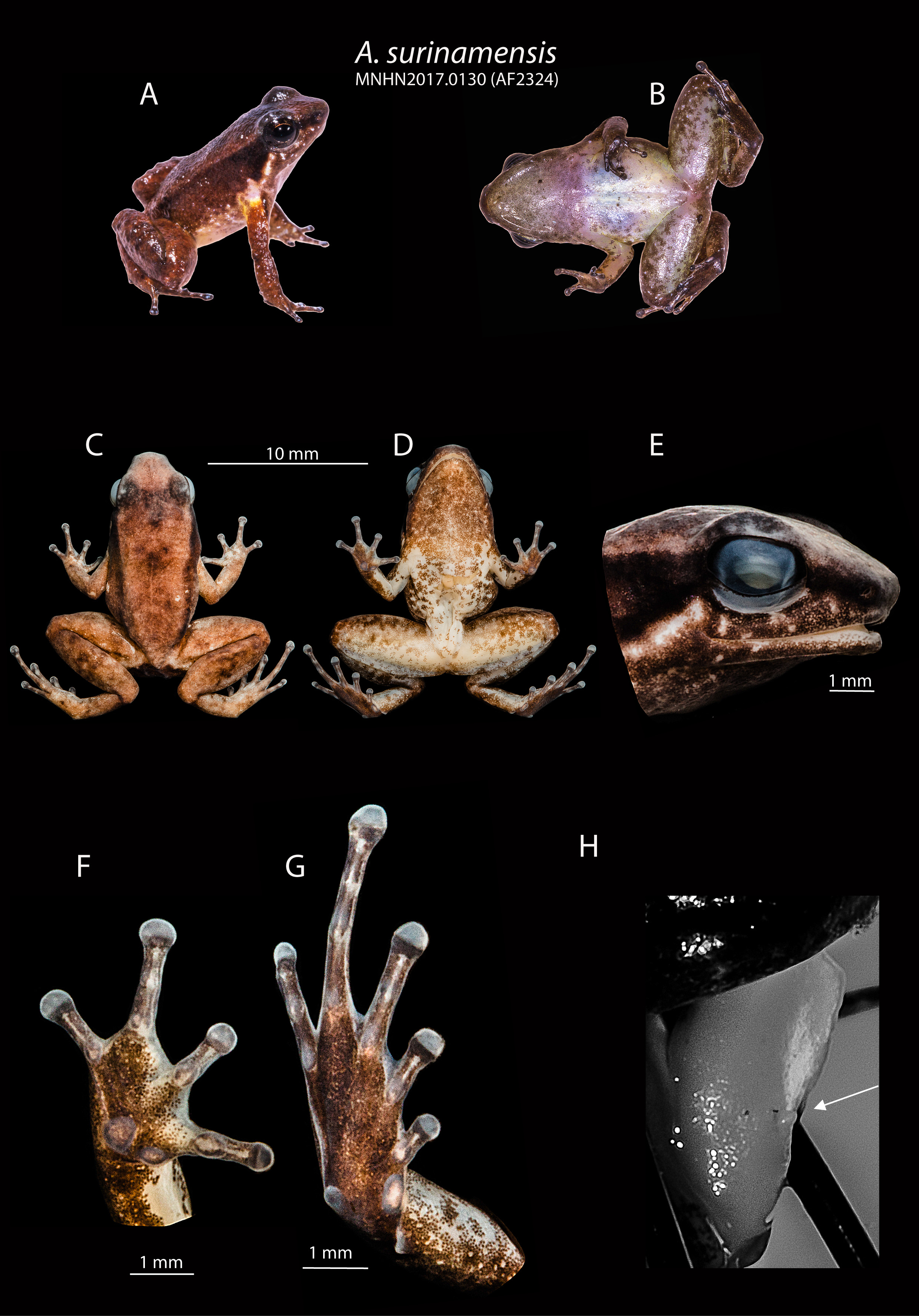
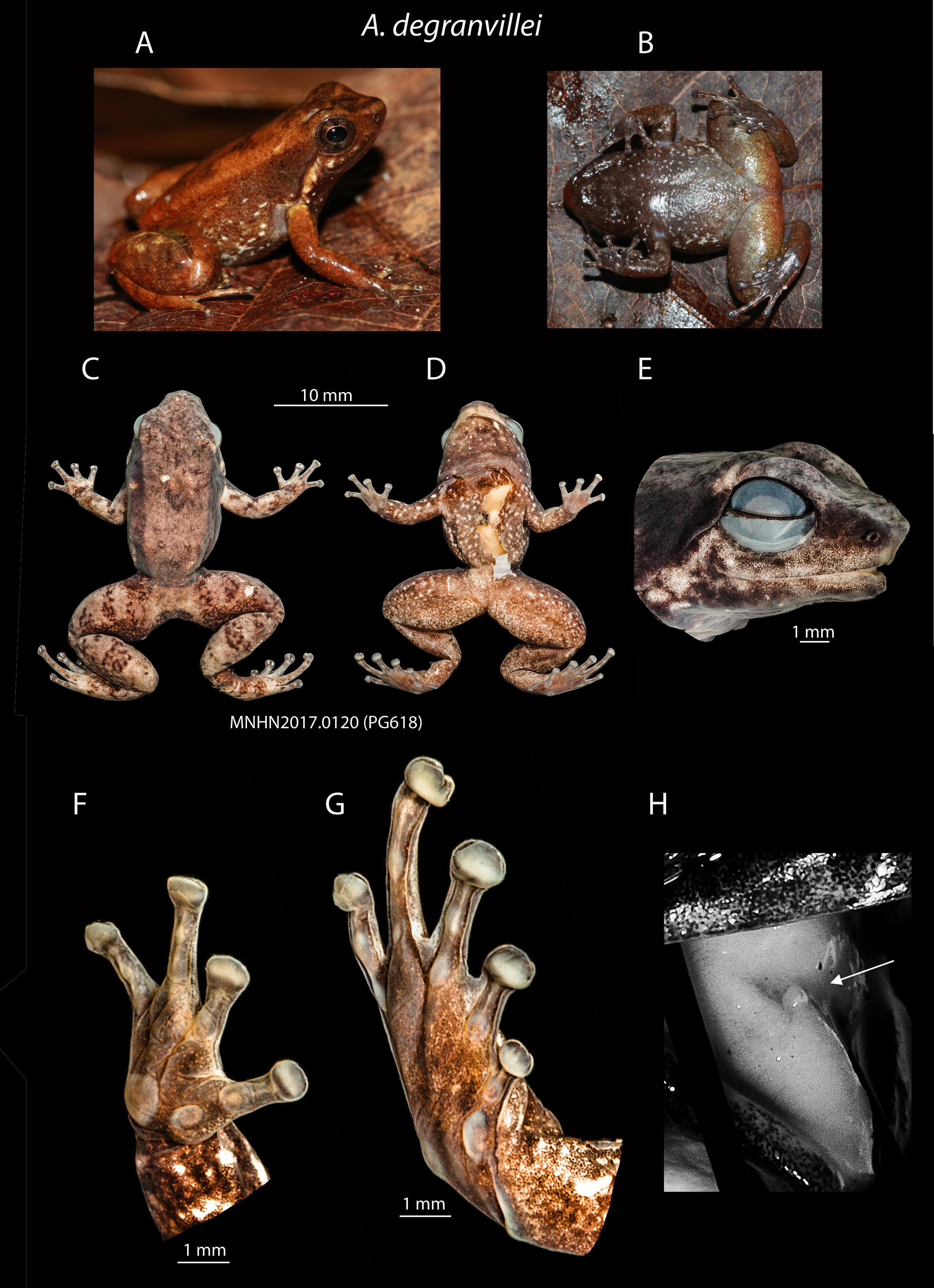
Definition and diagnosis. We assigned the new species to the genus Anomaloglossus based on previous studies (Fouquet et al. 2012; Vacher et al. 2017) and the presence of a median lingual process. The new species belongs to the A. degranvillei clade (Vacher et al. 2017). (1) Small-sized Anomaloglossus (average male SVL = 16.9 mm [15.9 – 18.8, n = 8], female SVL = 17.9 mm [n = 1]) (Table 1); (2) body robust; (3) skin tuberculate on dorsum (particularly the posterior half) and legs, with a larger tubercle on each eyelid, ventral skin smooth; (4) conspicuous dark brown to black glandulous supratympanic fold anteroventrally bordered by a light stripe (orange in life, cream in preservative) extending from the ventroposterior edge of the eye onto the upper arm to the anterior cubital region; (5) tympanum indistinct; (6) snout short and protruding in lateral view; (7) nares oriented ventrolaterally, situated near tip of snout; (8) Finger II shorter than Finger I when fingers adpressed; (9) tip of Finger IV almost reaching distal subarticular tubercle on Finger III when fingers adpressed; (10) distal subarticular tubercle on Finger III and IV indistinct; (11) Finger III not distinctly swollen in males; (12) Fingers II and III with preaxial fringes particularly developed in males, inconspicuous in females; (13) toes moderately webbed, with well-developed fringes on Toes II, III and IV (sensu Grant et al. 2006; keel-like lateral folds sensu Myers & Donnelly 2008); (14) tarsal keel well-defined, curved; (15) no black arm gland in males (sensu Grant & Castro 1998, see also Grant et al. 2006); (16) cloacal tubercles present; (17) paracloacal mark ill-defined but present (reddish in life, cream speckled with melanophores in preservative); (18) dorsolateral stripe present, faint, upper part of flanks much darker than dorsum, a thin middorsal raphe going from the tip of snout to behind the head and more rarely to the vent sometimes present; (19) ventrolateral stripe absent but ventral part of flanks lighter with white or bluish flecks (in life); (20) sexual dichromatism in throat colour pattern present, throat black in reproductive males, evenly grey with small ill-defined white dots in females; (21) no sexual dichromatism in ventral colour pattern, abdomen mostly pale grey with small ill-defined white dots in both sexes, lower abdomen and ventral surface of legs yellowish in life and cream in preservative; (22) iris with metallic pigmentation and pupil ring interrupted ventrally and dorsally by transversal black pigmentation; (23) median lingual process longer than wide, tapered, bluntly pointed, smooth (non-papillate), reclined in pit; (24) single note call of 0.090 – 0.103 s length and dominant frequency at 4.48 – 5.41 kHz (n = 6) (Figure 3; Table 2). Morphological comparisons with other lowland Anomaloglossus. The only other species group cooccurring with the Anomaloglossus degranvillei group is the A. stepheni group, represented in French Guiana by A. baeobatrachus, which is readily distinguishable by conspicuous dorsolateral stripes, swollen third finger in males and absence of webbing and fringes on toes. Within the Anomaloglossus degranvillei group, A. blanci can be distinguished from A. surinamensis (Figure 4) by (1) a shorter snout, protruding in lateral view (vs. rounded in A. surinamensis); (2) a larger body size (X ¯ = 16.9; range 15.9 – 18.8 mm in males [n = 8] and one adult female measuring 17.9 mm in A. blanci vs. X ¯ = 14.75, range 14.0 – 15.3 mm in males [n = 8] and X ¯ = 16.5, range 16.0 – 17.1 mm in females [n = 4] in A. surinamensis); (3) large fringes on fingers and toes in males (narrow in A. surinamensis); (4) presence of a large tubercle on the top of the eyelid (inconspicuous in A. surinamensis); (5) ventral colouration entirely grey with small ill-defined white dots (vs. grey throat and cream belly, the latter with irregular grey blotches less abundant posteriorly in A. surinamensis); (6) yellowish ventral surface of thigh (vs. light grey and more heavily spotted with black in A. surinamensis); (7) large MLP (> 0.5 mm vs. <0.5 mm in A. surinamensis); (8) call characterized by longer pulsed notes (X ¯ = 0.094, range 0.090 – 0.103 s in A. blanci [n = 6] vs. tonal note X ¯ = 0.032, range 0.028 – 0.037 s in A. surinamensis [n = 20]) emitted between longer intervals (X ¯ = 1.414, range 1.200 – 1.906 s in A. blanci [n = 6] vs. X ¯ = 0.573, range 0.372 – 0.825 s in A. surinamensis [n = 20]), but both species have a similar dominant frequency (X ¯ = 4.75, range 4.48 – 5.41 kHz in A. blanci [n = 6] vs. X ¯ = 4.89 kHZ, range 4.55 – 5.35 kHz in A. surinamensis [n = 20]). Anomaloglossus blanci can be distinguished from A. degranvillei (Figure 5) by (1) a smaller size (X ¯ = 16.9; range 15.9 – 18.8 mm in males [n = 8] and one female measuring 17.9 mm in A. blanci vs. X ¯ = 20.17; range 19.60 – 20.50 mm in males [n = 3] and X ¯ = 23.40, range 22.4 – 23.9 mm in females [n = 5] of A. degranvillei); (2) belly pale grey with small ill-defined white dots (from solid black to dark grey with abundant small conspicuous white spots in A. degranvillei); (3) ventral surface of thighs yellowish in life and cream in preservative (dark grey in A. degranvillei); (4) call with shorter notes (0.090 – 0.103 s in A. blanci [n = 6] vs. 0.157 – 0.160 s in A. degranvillei [n = 2]) and higher dominant frequency (4.48 – 5.41 kHz in A. blanci [n = 6] vs. 3.60 – 3.62 s in A. degranvillei [n = 2]).
On the brink of extinction: two new species of Anomaloglossus from French Guiana and amended definitions of Anomaloglossus degranvillei and A. surinamensis (Anura: Aromobatidae)
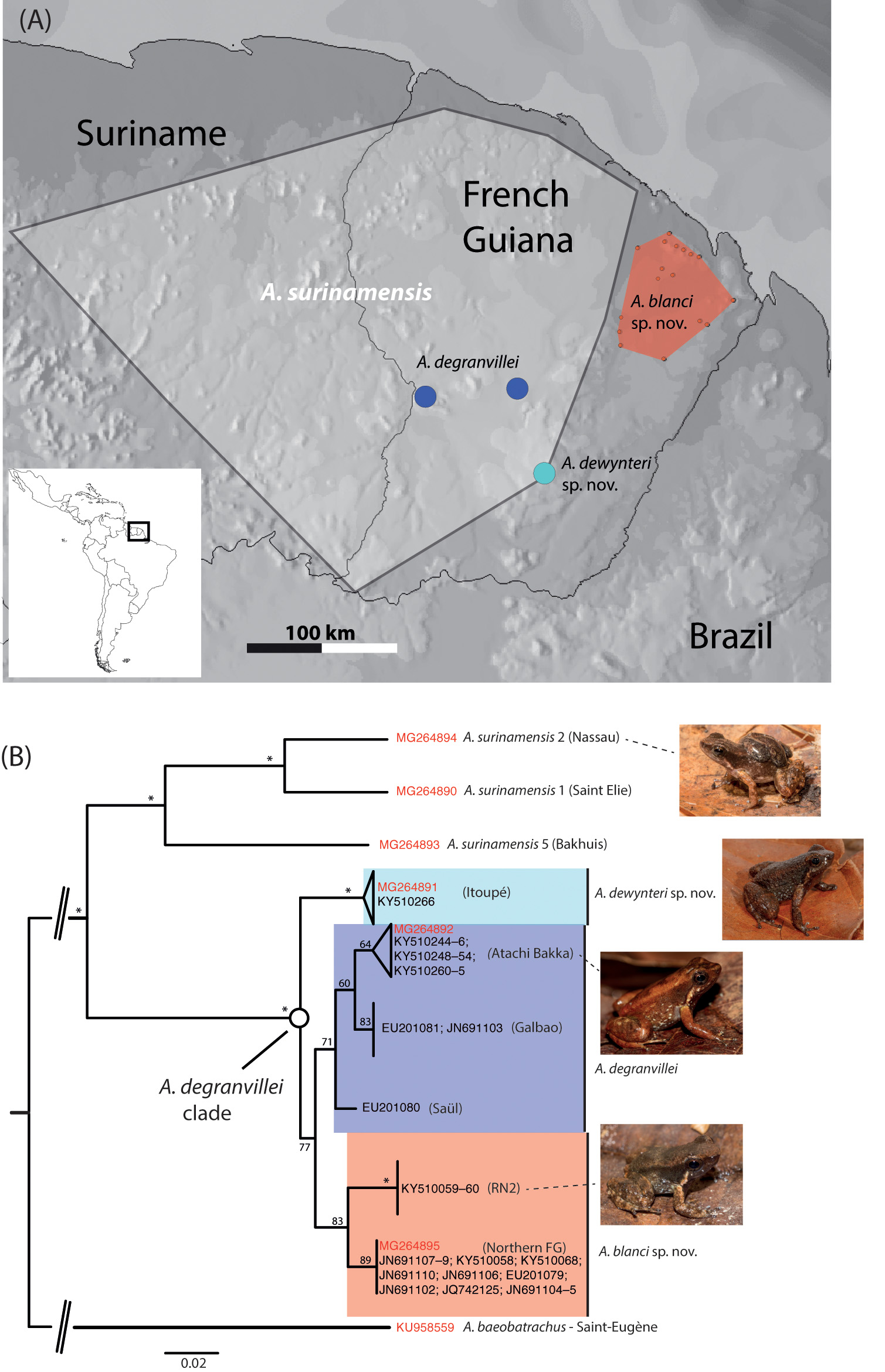
Distribution and ecology. Anomaloglossus blanci inhabits small sandy or rocky streams at low elevations (from 50 to 200 m elevation) often close to larger tributaries (e. g. Crique Diamant, Approuague). Males call from stream banks during the day with peak in intensity at dawn (6 – 7 am) and late afternoon (4 – 5 pm) during the rainy season, but also during humid days of the dry season. Eighteen populations have been documented in north-eastern French Guiana (Figure 1), but despite intensive surveys of these populations in 2016, no individual could be found in three of them. No noticeable degradation of the habitat has been observed. Interestingly, this species does not co-occur with A. surinamensis, whose populations seem stable. No tadpole before Gosner stage 41 has been observed, either in the water or carried by males. However, two observations have been made of adults carrying tadpoles at a late development stage (> stage 41) (Figure 6). The tadpoles are endotrophic and lack functional mouth. If they are detached from the back of their father, they die within a few hours despite humid and ideal thermal conditions (pers. obs.). These observations suggest that the tadpoles may undergo a phase of nidicolous development after hatching and only complete their development on the back of the adult from an advanced stage. Only 1 – 4 tadpoles of the same stage were observed at a time carried by adults. This reduced clutch size is likely linked to the fact that large eggs are needed to complete endotrophic development. However, adults were often observed carrying tadpoles at two different stages, demonstrating that they can keep mating while already attending a clutch. This is likely linked to the extended time needed for the tadpoles to develop until complete metamorphosis.
On the brink of extinction: two new species of Anomaloglossus from French Guiana and amended definitions of Anomaloglossus degranvillei and A. surinamensis (Anura: Aromobatidae)
Etymology. This species is dedicated to our friend Michel Blanc, in honour of his invaluable contribution to field herpetology in French Guiana, notably the discovery of many previously undocumented species and crucial natural history observations.
On the brink of extinction: two new species of Anomaloglossus from French Guiana and amended definitions of Anomaloglossus degranvillei and A. surinamensis (Anura: Aromobatidae)
Holotype. MNHN 2017.0103 (field no. AF 0953), an adult male, collected by Michel Blanc and Maël Dewynter, 10 August 2014, corridor 7 on Route Nationale 2, French Guiana, 4.0639 N 52.0416 W, ~ 100 m elevation (Figure 2). Paratypes. Ten specimens: MNHN 2017.0110 (field no. AF 0952), an adult male, collected with the holotype (carrying two froglets on its back). MNHN 2017.0105 (field no. AF 0293), an adult male collected by Antoine Fouquet, 25 May 2007, crique Diamant near Patawa Camp, French Guiana, 4.5161 N 52.1005 W, ~ 200 m elevation. MNHN 2017.0106 – 8 (field no. AF 0878, AF 0932, AF 0933), three adult males collected by Antoine Fouquet, 0 1 February 2013, crique Diamant near Patawa Camp, French Guiana, 4.5161 N 52.1005 W, ~ 200 m elevation. MNHN 2017.0104 (field no. AF 0292), an adult female collected by Antoine Fouquet, 25 May 2007, crique Diamant near Patawa Camp, French Guiana, 4.5161 N 52.1005 W, ~ 200 m elevation. MNHN 2017.0109 (field no. AF 1332), an adult male collected by Maël Dewynter, 16 December 2013, Saut Grand Machicou, French Guiana, 3.8974 N 52.5836 W, ~ 150 m elevation. IRSNB 4198 (field no. PK 3287), an adult male collected by Philippe J. R. Kok, 18 April 2010, near Patawa Camp, French Guiana, ca. 4.5161 N 52.1005 W, ~ 200 m elevation. IRSNB 4199, 4200 (field no. PK 3284, 3286), two juvenile females collected by Philippe J. R. Kok, 18 April 2010, near Patawa Camp, French Guiana, ca. 4.5161 N 52.1005 W, ~ 200 m elevation.
On the brink of extinction: two new species of Anomaloglossus from French Guiana and amended definitions of Anomaloglossus degranvillei and A. surinamensis (Anura: Aromobatidae)
Variation among type specimens. Measurements (range, mean, and standard deviation) of the type series are provided in Table 1. Intraspecific variation is high and adult dorsal colouration varies from brown to reddish brown. Most specimens have dark brown blotches on dorsum. One male (MNHN 2017.0108 / AF 0933) has a middorsal raphe running from the tip of the snout to the vent; in four males (MNHN 2017.0105 – 7 / AF 0293, 0 878, 0 932 and MNHN 2017.0109 / AF 1332; Figure 6) that raphe is inconspicuous and extends only from the tip of the snout to the interorbital region. Flanks can be dark brown to light grey rendering the lateral black band more or less conspicuous. Additionally, overall colouration and tuberculation may vary with light intensity, time of the day and probably reproductive activity as males carrying tadpole apparently display overall lighter colours, smoother skin and sharper contrasts while calling males are very dark and highly tuberculate. Advertisement call (Figure 3). Six specimens (three uncollected) calling from the leaf litter 1 – 3 meters away from a stream were recorded from a distance of about 1 m and at temperatures ranging from 23 to 26 ° C. They emitted single short pulsed notes (note length X ¯ = 0.094 s; range 0.090 – 0.103 s) at a regular pace (inter-note interval X ¯ = 1.414 s; range 1.200 – 1.906 s). The spectral structure of the note has a developed harmonic structure and the dominant frequency is 4.75 kHz on average (range 4.48 – 5.41 kHz) with a slight upward modulation (ca. 0.1 kHz).
On the brink of extinction: two new species of Anomaloglossus from French Guiana and amended definitions of Anomaloglossus degranvillei and A. surinamensis (Anura: Aromobatidae)

Export occurrence data

Darwin Core Archive (ZIP)

GEOGRAPHY

Distribution Map

Occurrence Map

Loading map…

Tiles © GBIF Maps API | Map powered by MapLibre GL

REGIONS

Geographic Distribution(1)

Global
endangered

DATA

Occurrence Datasets

Loading datasets…

Common names used for this species across different languages and regions. Available in 2 languages and 2 countries.

GFAnomaloglosse de BlancfrafraAnomaloglosse de BlancfraFRAnomaloglosse de Blanc (L')frafraAnomaloglosse de Blanc (L')fraengPale Rocket Frogeng

Vernacular (common) names are the everyday names used for a species in different languages and regions. A single species may have dozens of common names worldwide. This taxon has names in 2 languages.

GFAnomaloglosse de Blanc
fraGFfra
fraAnomaloglosse de Blanc
fra
Source: Catalogue of LifeSource taxon #299414418
FRAnomaloglosse de Blanc (L')
fraFRfra
fraAnomaloglosse de Blanc (L')
fra
Source: Catalogue of LifeSource taxon #299414418
engPale Rocket Frog
eng
Source: Catalogue of LifeSource taxon #299414418

CLASSIFICATION

Taxonomic Classification Tree

HIERARCHY

Child Taxa(1)

MULTIMEDIA

Media Files(6)

FIGURE 1. (A) Map of occurrences of the four species of the A. degranvillei species group. The range of A. surinamensis is depicted by a grey convex polygon. (B) Best ML tree obtained from RAxML NG using>15kb of mtDNA for six terminals (accession numbers in red) and 418 bp of 16S for 32 terminals (accession numbers in black). The tree is rooted on Anomaloglossus baeobatrachus. Bootstrap valuesare given in % foreach node (*=99 or 100%).

Imageimage/png© Antoine, Fouquet;Vacher, Jean-Pierre;Courtois, Elodie A.;Villette, Benoit;Reizine, Hugo;Gaucher, Philippe;Jairam, Rawien;Ouboter, Paul;Kok, Philippe J. R.On the brink of extinction: two new species of Anomaloglossus from French Guiana and amended definitions of Anomaloglossus degranvillei and A. surinamensis (Anura: Aromobatidae)

FIGURE 2. Holotype of Anomaloglossus blanci sp. nov MNHN2017.0103 (AF0953): (A) in life dorsolateral view; (B) in life ventral view; (C) in preservative dorsal view; (D) in preservative ventral view; (E) in preservative head lateral view; (F) right hand; (G) right foot; (H) median lingual process.

Imageimage/png© Antoine, Fouquet;Vacher, Jean-Pierre;Courtois, Elodie A.;Villette, Benoit;Reizine, Hugo;Gaucher, Philippe;Jairam, Rawien;Ouboter, Paul;Kok, Philippe J. R.On the brink of extinction: two new species of Anomaloglossus from French Guiana and amended definitions of Anomaloglossus degranvillei and A. surinamensis (Anura: Aromobatidae)

FIGURE 3. Spectrograms and oscillograms of typical call of the four species of the Anomaloglossus degranvillei clade with two time windows; 2 s and 0.3 s. For A.blanci and A. degranvillei the background noises masked the fundamental frequency.

Imageimage/png© Antoine, Fouquet;Vacher, Jean-Pierre;Courtois, Elodie A.;Villette, Benoit;Reizine, Hugo;Gaucher, Philippe;Jairam, Rawien;Ouboter, Paul;Kok, Philippe J. R.On the brink of extinction: two new species of Anomaloglossus from French Guiana and amended definitions of Anomaloglossus degranvillei and A. surinamensis (Anura: Aromobatidae)

FIGURE 4. Male specimen MNHN2017.0130 (AF2324) of Anomaloglossus surinamensis from Chutes Voltaire, French Guiana:(A) in life dorsolateral view; (B) in life ventral view; (C)in preservative dorsal view; (D) in preservative ventral view; (E)in preservative head lateral view; (F) Right hand; (G) right foot; (H) median lingual process.

Imageimage/png© Antoine, Fouquet;Vacher, Jean-Pierre;Courtois, Elodie A.;Villette, Benoit;Reizine, Hugo;Gaucher, Philippe;Jairam, Rawien;Ouboter, Paul;Kok, Philippe J. R.On the brink of extinction: two new species of Anomaloglossus from French Guiana and amended definitions of Anomaloglossus degranvillei and A. surinamensis (Anura: Aromobatidae)

FIGURE5. Specimensof Anomaloglossus degranvillei from AtachiBakka,French Guiana:(A) unvoucheredfemale specimen in lifedorsolateral view; (B) unvoucheredfemale specimen in life ventral view; (C) MNHN2017.0120 (PG618) male specimen in preservative dorsal view; (D) in preservative ventral view; (E) in preservative head lateral view; (F) Right hand; (G) right foot; (H) median lingual process.

Imageimage/png© Antoine, Fouquet;Vacher, Jean-Pierre;Courtois, Elodie A.;Villette, Benoit;Reizine, Hugo;Gaucher, Philippe;Jairam, Rawien;Ouboter, Paul;Kok, Philippe J. R.On the brink of extinction: two new species of Anomaloglossus from French Guiana and amended definitions of Anomaloglossus degranvillei and A. surinamensis (Anura: Aromobatidae)

FIGURE 6. Living specimens and habitats of the four species of the Anomaloglossus degranvillei clade; (A) A. blanci including two males carrying tadpoles MNHN2017.0110 (AF0952) was carrying two metamorphs but one was removed, a mark left by the missing tadpole is visible on the skin; an unvouchered male with three tadpoles at different stages probably from two different clutches); (B) A. dewynteri including one uncollected male carrying six tadpoles; (C) A. degranvillei uncollected male carrying four tadpoles; (D) A. surinamensis male from the type locality in Suriname carrying three tadpoles.

Imageimage/png© Antoine, Fouquet;Vacher, Jean-Pierre;Courtois, Elodie A.;Villette, Benoit;Reizine, Hugo;Gaucher, Philippe;Jairam, Rawien;Ouboter, Paul;Kok, Philippe J. R.On the brink of extinction: two new species of Anomaloglossus from French Guiana and amended definitions of Anomaloglossus degranvillei and A. surinamensis (Anura: Aromobatidae)

IMAGES

Gallery(6)

See Gallery

Occurrences with images

Source Information

GBIF Backbone Taxonomy

GBIF Backbone Taxonomy

checklist

The GBIF Backbone Taxonomy is a single, synthetic management classification with the goal of covering all names GBIF is dealing with. It's the taxonomic backbone that allows GBIF to integrate name based information from different resources, no matter if these are occurrence datasets, species pages, names from nomenclators or external sources like EOL, Genbank or IUCN. This backbone allows taxonomic search, browse and reporting operations across all those resources in a consistent way and to provide means to crosswalk names from one source to another.

It is updated regulary through an automated process in which the Catalogue of Life acts as a starting point also providing the complete higher classification above families. Additional scientific names only found in other authoritative nomenclatural and taxonomic datasets are then merged into the tree, thus extending the original catalogue and broadening the backbones name coverage. The GBIF Backbone taxonomy also includes identifiers for Operational Taxonomic Units (OTUs) drawn from the barcoding resources iBOL and UNITE.

International Barcode of Life project (iBOL), Barcode Index Numbers (BINs). BINs are connected to a taxon name and its classification by taking into account all names applied to the BIN and picking names with at least 80% consensus. If there is no consensus of name at the species level, the selection process is repeated moving up the major Linnaean ranks until consensus is achieved.

UNITE - Unified system for the DNA based fungal species, Species Hypotheses (SHs). SHs are connected to a taxon name and its classification based on the determination of the RefS (reference sequence) if present or the RepS (representative sequence). In the latter case, if there is no match in the UNITE taxonomy, the lowest rank with 100% consensus within the SH will be used.

The GBIF Backbone Taxonomy is available for download at https://hosted-datasets.gbif.org/datasets/backbone/ in different formats together with an archive of all previous versions.

The following 105 sources have been used to assemble the GBIF backbone with number of names given in brackets:

  • Catalogue of Life Checklist - 4766428 names
  • International Barcode of Life project (iBOL) Barcode Index Numbers (BINs) - 635951 names
  • UNITE - Unified system for the DNA based fungal species linked to the classification - 611208 names
  • The Paleobiology Database - 212054 names
  • World Register of Marine Species - 188857 names
  • The Interim Register of Marine and Nonmarine Genera - 183894 names
  • The World Checklist of Vascular Plants (WCVP) - 131891 names
  • GBIF Backbone Taxonomy - 114350 names
  • TAXREF - 109374 names
  • The Leipzig catalogue of vascular plants - 75380 names
  • ZooBank - 73549 names
  • Integrated Taxonomic Information System (ITIS) - 68377 names
  • Plazi.org taxonomic treatments database - 61346 names
  • Genome Taxonomy Database r207 - 60545 names
  • International Plant Names Index - 52329 names
  • Fauna Europaea - 45077 names
  • The National Checklist of Taiwan (Catalogue of Life in Taiwan, TaiCoL) - 36193 names
  • Dyntaxa. Svensk taxonomisk databas - 35892 names
  • The Plant List with literature - 32692 names
  • United Kingdom Species Inventory (UKSI) - 29643 names
  • Artsnavnebasen - 29208 names
  • The IUCN Red List of Threatened Species - 21221 names
  • Afromoths, online database of Afrotropical moth species (Lepidoptera) - 13961 names
  • Brazilian Flora 2020 project - Projeto Flora do Brasil 2020 - 13829 names
  • Prokaryotic Nomenclature Up-to-Date (PNU) - 10079 names
  • Checklist Dutch Species Register - Nederlands Soortenregister - 8814 names
  • ICTV Master Species List (MSL) - 7852 names
  • Cockroach Species File - 6020 names
  • GRIN Taxonomy - 5882 names
  • Taxon list of fungi and fungal-like organisms from Germany compiled by the DGfM - 4570 names
  • Catalogue of Afrotropical Bees - 3623 names
  • Catalogue of Tenebrionidae (Coleoptera) of North America - 3327 names
  • Checklist of Beetles (Coleoptera) of Canada and Alaska. Second Edition. - 3312 names
  • Systema Dipterorum - 2850 names
  • Catalogue of the Pterophoroidea of the World - 2807 names
  • The Clements Checklist - 2675 names
  • Taxon list of Hymenoptera from Germany compiled in the context of the GBOL project - 2496 names
  • IOC World Bird List, v13.2 - 2366 names
  • Official Lists and Indexes of Names in Zoology - 2310 names
  • National checklist of all species occurring in Denmark - 1922 names
  • Myriatrix - 1876 names
  • Database of Vascular Plants of Canada (VASCAN) - 1822 names
  • Taxon list of vascular plants from Bavaria, Germany compiled in the context of the BFL project - 1771 names
  • Orthoptera Species File - 1742 names
  • A list of the terrestrial fungi, flora and fauna of Madeira and Selvagens archipelagos - 1602 names
  • Aphid Species File - 1565 names
  • World Spider Catalog - 1561 names
  • Taxon list of Jurassic Pisces of the Tethys Palaeo-Environment compiled at the SNSB-JME - 1270 names
  • Backbone Family Classification Patch - 1143 names
  • GBIF Algae Classification - 1100 names
  • International Cichorieae Network (ICN): Cichorieae Portal - 975 names
  • Psocodea Species File - 803 names
  • New Zealand Marine Macroalgae Species Checklist - 787 names
  • Annotated checklist of endemic species from the Western Balkans - 754 names
  • Taxon list of animals with German names (worldwide) compiled at the SMNS - 503 names
  • Catalogue of the Alucitoidea of the World - 472 names
  • Lygaeoidea Species File - 462 names
  • Catálogo de Plantas y Líquenes de Colombia - 422 names
  • GBIF Backbone Patch - 317 names
  • Phasmida Species File - 259 names
  • Cortinariaceae fetched from the Index Fungorum API - 234 names
  • Coreoidea Species File - 233 names
  • GTDB supplement - 139 names
  • Mantodea Species File - 119 names
  • Endemic species in Taiwan - 93 names
  • Taxon list of Araneae from Germany compiled in the context of the GBOL project - 88 names
  • Species of Hominidae - 78 names
  • Taxon list of Sternorrhyncha from Germany compiled in the context of the GBOL project - 77 names
  • Taxon list of mosses from Germany compiled in the context of the GBOL project - 75 names
  • Mammal Species of the World - 73 names
  • Plecoptera Species File - 71 names
  • Species Fungorum Plus - 64 names
  • Catalogue of the type specimens of Cosmopterigidae (Lepidoptera: Gelechioidea) from research collections of the Zoological Institute, Russian Academy of Sciences - 47 names
  • Species named after famous people - 41 names
  • Dermaptera Species File - 36 names
  • Taxon list of Trichoptera from Germany compiled in the context of the GBOL project - 34 names
  • True Fruit Flies (Diptera, Tephritidae) of the Afrotropical Region - 33 names
  • Range and Regularities in the Distribution of Earthworms of the Earthworms of the USSR Fauna. Perel, 1979 - 32 names
  • Taxon list of Diplura from Germany compiled in the context of the GBOL project - 30 names
  • Lista de referencia de especies de aves de Colombia - 2022 - 24 names
  • Taxon list of Auchenorrhyncha from Germany compiled in the context of the GBOL project - 20 names
  • Catalogue of the type specimens of Polycestinae (Coleoptera: Buprestidae) from research collections of the Zoological Institute, Russian Academy of Sciences - 19 names
  • Taxon list of Thysanoptera from Germany compiled in the context of the GBOL project - 19 names
  • Lista de especies de vertebrados registrados en jurisdicción del Departamento del Huila - 18 names
  • Taxon list of Microcoryphia (Archaeognatha) from Germany compiled in the context of the GBOL project - 15 names
  • Catalogue of the type specimens of Bufonidae and Megophryidae (Amphibia: Anura) from research collections of the Zoological Institute, Russian Academy of Sciences - 12 names
  • Grylloblattodea Species File - 11 names
  • Coleorrhyncha Species File - 9 names
  • Taxon list of liverworts from Germany compiled in the context of the GBOL project - 9 names
  • Embioptera Species File - 7 names
  • Taxon list of Pisces and Cyclostoma from Germany compiled in the context of the GBOL project - 6 names
  • Taxon list of Pteridophyta from Germany compiled in the context of the GBOL project - 6 names
  • Taxon list of Siphonaptera from Germany compiled in the context of the GBOL project - 5 names
  • The Earthworms of the Fauna of Russia. Perel, 1997 - 5 names
  • Taxon list of Zygentoma from Germany compiled in the context of the GBOL project - 4 names
  • Asiloid Flies: new taxa of Diptera: Apioceridae, Asilidae, and Mydidae - 3 names
  • Taxon list of Protura from Germany compiled in the context of the GBOL project - 3 names
  • Taxon list of hornworts from Germany compiled in the context of the GBOL project - 2 names
  • Chrysididae Species File - 1 names
  • Taxon list of Dermaptera from Germany compiled in the context of the GBOL project - 1 names
  • Taxon list of Diplopoda from Germany in the context of the GBOL project - 1 names
  • Taxon list of Orthoptera (Grashoppers) from Germany compiled at the SNSB - 1 names
  • Taxon list of Pscoptera from Germany compiled in the context of the GBOL project - 1 names
  • Taxon list of Pseudoscorpiones from Germany compiled in the context of the GBOL project - 1 names
  • Taxon list of Raphidioptera from Germany compiled in the context of the GBOL project - 1 names

GBIF Secretariat (2023). GBIF Backbone Taxonomy. Checklist dataset https://doi.org/10.15468/39omei accessed via GBIF.org on 2026-06-14.

CC BYPublished 8/28/2023View dataset
GBIF Usage Key
9727674
Dataset Key
d7dddbf4-2cf0-4f39-9b2a-bb099caae36c
Origin
source
Backbone Key
9727674
Taxon ID
gbif:9727674
Last Crawled
8/22/2023
Last Interpreted
8/22/2023