AnimaliaNot EvaluatedacceptedspeciesAccepted
Bansella oregonica

Bansella oregonica

(Banse, 1956)

GBIF:2328987

0year

0

Synonyms

PROFILE

Species Profile

Habitat

Marine

Characteristics

Extant

ABOUT

Descriptions(2)

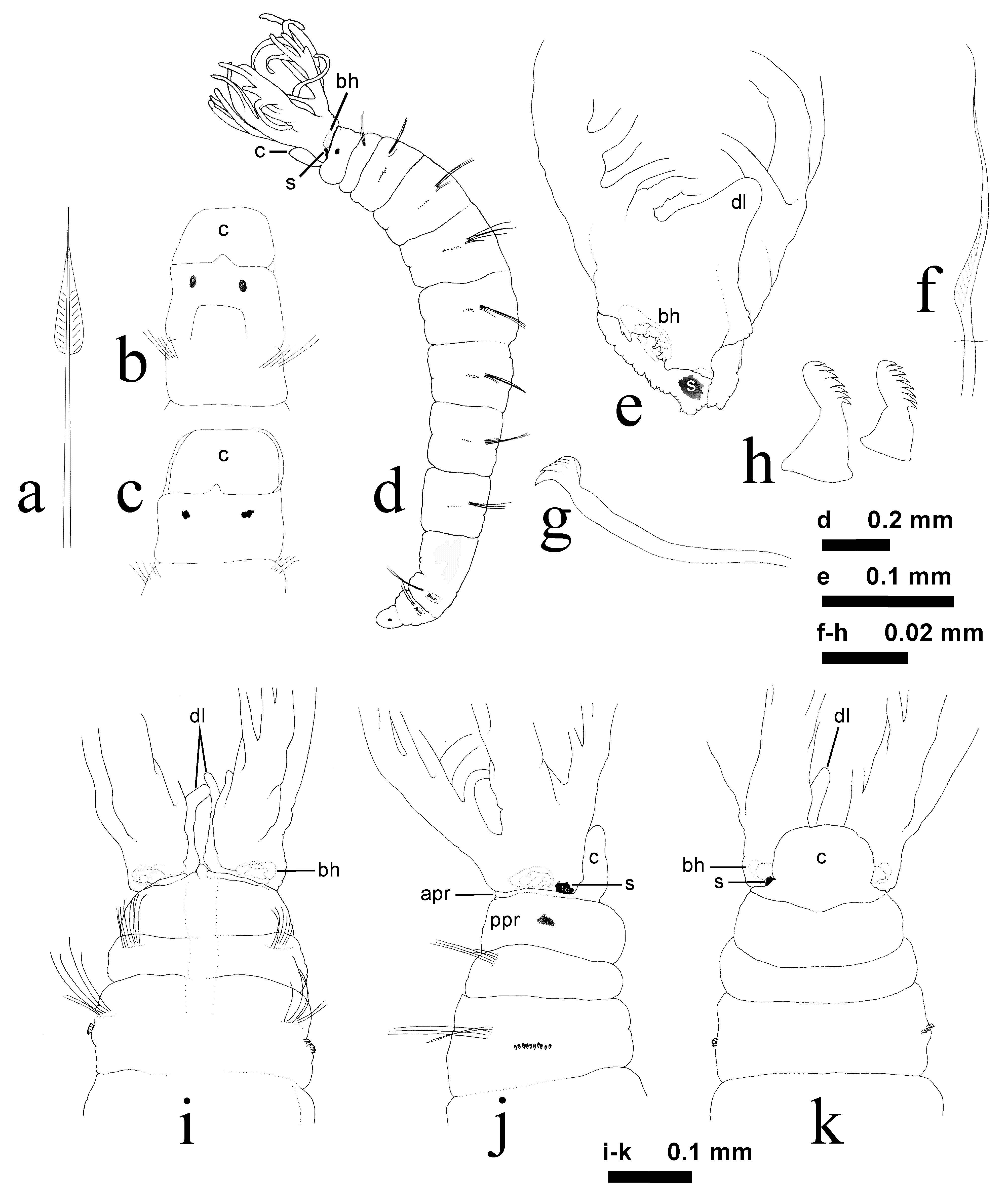
Remarks. Members of Bansella oregonica are generally similar to those of Fabricia stellaris in that both have prominent dorsal lips and the ventral lobe extension of the anterior peristomial ring. Much of the confusion in the past as to whether B. oregonica was part of the F. stellaris - subspecies group or a separate species was probably due to the incomplete comparison of individuals, as suggested by the vague descriptions presented by Hartman (1951) and Banse (1956, 1963, 1979). For instance, there is no indication that comparisons of abdominal uncini were ever made. Banse (1963) recognized the distinct differences in ventral collars in specimens belonging to F. stellaris and B. oregonica, but apparently never compared abdominal uncini. The manubrium of abdominal uncini among members of F. stellaris is 1.5 to two times longer than the dentate region (Banse 1956: fig. 3 d; Fitzhugh 1990 a: fig. 1), whereas the manubrium in B. oregonica is considerably shorter (Fig. 1 h). Relative to members of other Fabriciinae species, there are no features uniquely shared by F. stellaris and B. oregonica. It is, however, interesting to note that in both species spermiogenesis occurs in chaetigers 3 – 8, which might at first suggest an exclusive sister-group relationship. As is shown in the next section, this character is not a synapomorphy. Spermiogenesis in chaetigers 3 – 8 also occurs among members of Pseudofabricia aberrans Cantone, 1972 (pers. obs.), several Fabriciola Friedrich, 1939, species (Rouse 1995 b), Novafabricia labrus Fitzhugh, 1998, and one undescribed species in the unnamed ‘ Genus A’ (sensu Fitzhugh 1989; Rouse 1995 b). The present description does confirm the observations of Hartman (1951), Banse (1956, 1963), and Fitzhugh (1990 a) that the inferior thoracic notochaetae are narrowly hooded in all chaetigers. Banse’s (1956: fig. 8; Fig. 1 a) depiction of an inferior chaeta as having a somewhat “ subspatulate ” appearance is, however, not accurate; these chaetae have a very narrow, elongate hood (Fig. 1 f). The illustrations of the ventral collar lobe presented by Banse (1963; Fig. 1 b) and Hobson & Banse (1981; Fig. 1 c) are fairly accurate in depicting the distinct rectangular shape (see Fig. 1 k). None of the previous descriptions of specimens of Bansella oregonica make reference to branchial crown spermathecae (Fig. 1 d, e, j, k). An examination of the original LACM-AHF sample from which Banse (1956) had taken his syntypes (see Fitzhugh 1990 a) revealed that spermathecae are clearly visible, albeit the specimens are in very poor condition. In addition to B. oregonica, crown spermathecae among Fabriciinae are known among members of the following genera and species: Fabricia stellaris (Rouse 1995 a: fig. 7 – 9), Fabriciola cri Rouse, 1996 (Rouse 1996 a: fig. 7 – 8, 10 – 12), F. l i g u ro n i s Rouse, 1993 (Rouse 1993: fig. 31, 33), F. m i n u t a Rouse, 1996 (Rouse 1996 a: fig. 22 – 14, 26), Manayunkia (Zenkevitsch 1925; Rouse 1995 a: fig. 2 – 3, 1996 a: fig. 33, 37 – 38; Rouse pers. comm.; not yet known in M. polaris Zenkevitsch, 1935), Novafabricia tenuiseta Fitzhugh, 1990 (Rouse 1996 b: fig. 1 – 6), and Parafabricia ventricingulata Fitzhugh, 1992 (Rouse 1992).
Revised systematics of Fabricia oregonica Banse, 1956 (Polychaeta: Sabellidae: Fabriciinae): an example of the need for a uninomial nomenclatural system

Material examined. Syntypes (numerous specimens), LACM-AHF POLY 2477 [erroneously listed as AHF 3386 by Fitzhugh (1990 a: 12)]. Pacific Ocean, USA, Oregon, South Bay in Coos Bay, rock washings, coll. D. H. Reish, Aug 1950. Other material examined. Pacific Ocean, USA, Washington State, Olympic Coast National Marine Sanctuary. LACM-AHF POLY 2475 (one female, two males), Olympic Coast National Marine Sanctuary NIS-RAS sta. TB 1 - 2, Third Beach, 47 52.586 ' N, 124 35.163 ' W, scrapings of algal turf off exposed rocks in mid-intertidal zone, coll. L. H. Harris, 23 Aug 2001. LACM-AHF POLY 2476 (3 females, 2 males), Olympic Coast National Marine Sanctuary NIS-RAS sta. NRC- 3, about 0.5 miles north of Hoh River, Diamond Rock, 47 45.357 ' N, 124 26.843 ' W, river outwash of boulders, cobble, gravel between and among sea stacks, sand at bases of rhizomes of Polysiphonia sp. turf, coll. L. H. Harris, M. S. Brancato, 23 Aug 2001. Definition. A specific hypothesis, accounting for the presence of an anterior peristomial ring with a ventral margin as a wide, distinctly rectangular lobe among observed individuals. The rectangular lobe condition originated by an unspecified mechanism (s) in a reproductively isolated population of individuals with triangular lobes, subsequent to which the new character became fixed in the population by an unspecified mechanism (s), leading to individuals observed in the present, all with anterior peristomial rings with rectangular ventral lobes. In addition to the rectangular ventral lobe collar, members of Bansella oregonica do have a distinct combination of characters, i. e., prominent dorsal lips, absence of ventral filamentous appendages, and only narrowly hooded inferior notochaetae. Unfortunately, the phylogenetic analysis (see below) does not suggest that any of these additional characters are autapomorphies that can be accounted for in the hypothesis named B. oregonica. Description based on Washington specimens. All specimens complete, with eight thoracic and three abdominal chaetigers. Largest specimen with branchial crown length 0.4 mm, trunk length 1.7 mm, greatest width 0.3 mm at mid-thorax; smallest specimen with crown 0.2 mm and trunk 1.4 mm. Largest specimen a complete female. Trunk slightly tapered anteriorly and posteriorly (Fig. 1 d). Branchial crown with three pairs of radioles; filamentous distal ends, same width as pinnules; pinnules terminate at about same height as radioles or slightly shorter. Dorsalmost radioles with 4 – 5 pairs of pinnules, median and ventral radioles each with four pairs. Dorsal lips erect, triangular, with distally rounded ends (Fig. 1 e, i, k); no associated pinnular or radiolar appendages (see Fitzhugh 2003); margins of branchial lobes ventral to dorsal lips are truncate (i. e., ventral filamentous appendages absent). Bases of ventralmost radioles with slightly raised surfaces adjacent to ventralmost pair of pinnules, but not interpreted as ventral lip-like structures (see Banse 1956: fig. 6 a; Fitzhugh 1990 a). Branchial hearts present. Branchial lobes not fused together mid-dorsally; lobes attached to entire peristomial margin. Females with dark brown spermatheca in ventral half of each branchial lobe (Fig. 1 d, e, j, k). Anterior margin of anterior peristomial ring as low ridge dorsally and laterally (Fig. 1 d, i – k), with narrow mid-dorsal separation; ventral ring margin as wide, rectangular lobe. Anterior peristomial ring distinctly shorter than posterior ring. Dorso-medial lobe above mouth triangular, extending slightly beyond anterior peristomial ring (Fig. 1 i). Anterior peristomial ring distinctly wider than long. Posterior peristomial ring about 2.5 times wider than long, and about 11 times longer than anterior ring (Fig. 1 d, i – k). Annulation between rings visible ventrally and laterally. Mid-dorsum of posterior peristomial ring with shallow, longitudinal depression, extending into chaetiger 2 (Fig. 1 i). Pair of reniform black eyes in posterior peristomial ring. Chaetiger 1 about one-half length of chaetiger 2, wider than long; chaetiger 2 about same length as posterior peristomial ring; chaetiger 3 about one-third longer than 2, with chaetiger 3 – 6 each about same length, slightly wider than long; chaetiger 7 – 8 slightly longer than preceding segments, as long as wide. chaetiger 9 about one-third length of chaetiger 8, with chaetiger 10 – 11 each successively shorter than 9. Pygidium about same length as chaetiger 11, posterior margin broadly tapered, rounded. Pair of round, black pygidial eyes (Fig. 1 d). Superior thoracic notochaetae narrowly hooded, 3 – 5 per fascicle. Inferior thoracic notochaetae in chaetigers 2 – 8 narrowly hooded (Fig. 1 f), distinctly shorter than superior notochaetae; 2 – 3 per fascicle. Abdominal neuropodia of chaetigers 9 – 11 with very elongate, narrowly hooded chaetae, two per fascicle. Thoracic uncini acicular, main fang slender (Fig. 1 g); large tooth offset from mid-line of main fang present, remaining teeth behind main fang slender and slightly decreasing in size away from fang; hood present; 8 – 13 uncini per fascicle in irregular single rows. Abdominal uncini with seven to eight rows of teeth in profile, three teeth per row (Fig. 1 h); manubrium 1.5 times longer to same length as dentate region, expanded proximally to truncate margin; uncini in chaetigers 9 – 11 number 16, 15, and 13, respectively. Females with oocytes in chaetigers 3 – 4; males with developing sperm in chaetigers 3 – 8, spermatids arranged in groups of more than 100, attached to central cytophore. Some specimens with light brown body wall pigmentation along inner margins of branchial lobes, peristomial rings (including collar) and chaetigers 1 – 2; remainder of body cream colored. Tubes not present (but see description by Fitzhugh 1990 a); brooding of young not observed.
Revised systematics of Fabricia oregonica Banse, 1956 (Polychaeta: Sabellidae: Fabriciinae): an example of the need for a uninomial nomenclatural system

Export occurrence data

Darwin Core Archive (ZIP)

CLASSIFICATION

Taxonomic Classification Tree

MULTIMEDIA

Media Files(1)

FIGURE 1. Bansella oregonica, comb. nov. a, inferior thoracic notochaeta (redrawn from Banse 1956: fig. 8); b – c, anterior end, dorsal view (branchial crown removed), showing rectangular shape of ventral, anterior peristomial ring collar (redrawn from Banse 1963: fig. 3 c, and Hobson & Banse 1981: fig. 25 n, respectively); d, entire specimen, lateral view (left side); e, left half of branchial crown, inner margin; f, inferior thoracic notochaeta, chaetiger 4; g, thoracic uncinus, chaetiger 5; h, abdominal uncini from lower (left) and median (right) region of torus, chaetiger 9; i – k, dorsal, lateral (right side), and ventral views of anterior end, respectively. Abbreviations: apr, anterior peristomial ring; bh, branchial heart; c, anterior peristomial ring collar; dl, dorsal lip; ppr, posterior peristomial ring; s, spermatheca.

Imageimage/png© Fitzhugh, KirkRevised systematics of Fabricia oregonica Banse, 1956 (Polychaeta: Sabellidae: Fabriciinae): an example of the need for a uninomial nomenclatural system

IMAGES

Gallery(1)

See Gallery

Occurrences with images

CITATIONS

References(1)

  • 1

    Fitzhugh, Kirk. (2010). Revised systematics of <i>Fabricia oregonica</i> Banse, 1956 (Polychaeta: Sabellidae: Fabriciinae): an example of the need for a uninomial nomenclatural system. <em>Zootaxa.</em> 2647(1): 35-50.

    new combination referenceWorld Register of Marine Species
  • Source Information

    GBIF Backbone Taxonomy

    GBIF Backbone Taxonomy

    checklist

    The GBIF Backbone Taxonomy is a single, synthetic management classification with the goal of covering all names GBIF is dealing with. It's the taxonomic backbone that allows GBIF to integrate name based information from different resources, no matter if these are occurrence datasets, species pages, names from nomenclators or external sources like EOL, Genbank or IUCN. This backbone allows taxonomic search, browse and reporting operations across all those resources in a consistent way and to provide means to crosswalk names from one source to another.

    It is updated regulary through an automated process in which the Catalogue of Life acts as a starting point also providing the complete higher classification above families. Additional scientific names only found in other authoritative nomenclatural and taxonomic datasets are then merged into the tree, thus extending the original catalogue and broadening the backbones name coverage. The GBIF Backbone taxonomy also includes identifiers for Operational Taxonomic Units (OTUs) drawn from the barcoding resources iBOL and UNITE.

    International Barcode of Life project (iBOL), Barcode Index Numbers (BINs). BINs are connected to a taxon name and its classification by taking into account all names applied to the BIN and picking names with at least 80% consensus. If there is no consensus of name at the species level, the selection process is repeated moving up the major Linnaean ranks until consensus is achieved.

    UNITE - Unified system for the DNA based fungal species, Species Hypotheses (SHs). SHs are connected to a taxon name and its classification based on the determination of the RefS (reference sequence) if present or the RepS (representative sequence). In the latter case, if there is no match in the UNITE taxonomy, the lowest rank with 100% consensus within the SH will be used.

    The GBIF Backbone Taxonomy is available for download at https://hosted-datasets.gbif.org/datasets/backbone/ in different formats together with an archive of all previous versions.

    The following 105 sources have been used to assemble the GBIF backbone with number of names given in brackets:

    • Catalogue of Life Checklist - 4766428 names
    • International Barcode of Life project (iBOL) Barcode Index Numbers (BINs) - 635951 names
    • UNITE - Unified system for the DNA based fungal species linked to the classification - 611208 names
    • The Paleobiology Database - 212054 names
    • World Register of Marine Species - 188857 names
    • The Interim Register of Marine and Nonmarine Genera - 183894 names
    • The World Checklist of Vascular Plants (WCVP) - 131891 names
    • GBIF Backbone Taxonomy - 114350 names
    • TAXREF - 109374 names
    • The Leipzig catalogue of vascular plants - 75380 names
    • ZooBank - 73549 names
    • Integrated Taxonomic Information System (ITIS) - 68377 names
    • Plazi.org taxonomic treatments database - 61346 names
    • Genome Taxonomy Database r207 - 60545 names
    • International Plant Names Index - 52329 names
    • Fauna Europaea - 45077 names
    • The National Checklist of Taiwan (Catalogue of Life in Taiwan, TaiCoL) - 36193 names
    • Dyntaxa. Svensk taxonomisk databas - 35892 names
    • The Plant List with literature - 32692 names
    • United Kingdom Species Inventory (UKSI) - 29643 names
    • Artsnavnebasen - 29208 names
    • The IUCN Red List of Threatened Species - 21221 names
    • Afromoths, online database of Afrotropical moth species (Lepidoptera) - 13961 names
    • Brazilian Flora 2020 project - Projeto Flora do Brasil 2020 - 13829 names
    • Prokaryotic Nomenclature Up-to-Date (PNU) - 10079 names
    • Checklist Dutch Species Register - Nederlands Soortenregister - 8814 names
    • ICTV Master Species List (MSL) - 7852 names
    • Cockroach Species File - 6020 names
    • GRIN Taxonomy - 5882 names
    • Taxon list of fungi and fungal-like organisms from Germany compiled by the DGfM - 4570 names
    • Catalogue of Afrotropical Bees - 3623 names
    • Catalogue of Tenebrionidae (Coleoptera) of North America - 3327 names
    • Checklist of Beetles (Coleoptera) of Canada and Alaska. Second Edition. - 3312 names
    • Systema Dipterorum - 2850 names
    • Catalogue of the Pterophoroidea of the World - 2807 names
    • The Clements Checklist - 2675 names
    • Taxon list of Hymenoptera from Germany compiled in the context of the GBOL project - 2496 names
    • IOC World Bird List, v13.2 - 2366 names
    • Official Lists and Indexes of Names in Zoology - 2310 names
    • National checklist of all species occurring in Denmark - 1922 names
    • Myriatrix - 1876 names
    • Database of Vascular Plants of Canada (VASCAN) - 1822 names
    • Taxon list of vascular plants from Bavaria, Germany compiled in the context of the BFL project - 1771 names
    • Orthoptera Species File - 1742 names
    • A list of the terrestrial fungi, flora and fauna of Madeira and Selvagens archipelagos - 1602 names
    • Aphid Species File - 1565 names
    • World Spider Catalog - 1561 names
    • Taxon list of Jurassic Pisces of the Tethys Palaeo-Environment compiled at the SNSB-JME - 1270 names
    • Backbone Family Classification Patch - 1143 names
    • GBIF Algae Classification - 1100 names
    • International Cichorieae Network (ICN): Cichorieae Portal - 975 names
    • Psocodea Species File - 803 names
    • New Zealand Marine Macroalgae Species Checklist - 787 names
    • Annotated checklist of endemic species from the Western Balkans - 754 names
    • Taxon list of animals with German names (worldwide) compiled at the SMNS - 503 names
    • Catalogue of the Alucitoidea of the World - 472 names
    • Lygaeoidea Species File - 462 names
    • Catálogo de Plantas y Líquenes de Colombia - 422 names
    • GBIF Backbone Patch - 317 names
    • Phasmida Species File - 259 names
    • Cortinariaceae fetched from the Index Fungorum API - 234 names
    • Coreoidea Species File - 233 names
    • GTDB supplement - 139 names
    • Mantodea Species File - 119 names
    • Endemic species in Taiwan - 93 names
    • Taxon list of Araneae from Germany compiled in the context of the GBOL project - 88 names
    • Species of Hominidae - 78 names
    • Taxon list of Sternorrhyncha from Germany compiled in the context of the GBOL project - 77 names
    • Taxon list of mosses from Germany compiled in the context of the GBOL project - 75 names
    • Mammal Species of the World - 73 names
    • Plecoptera Species File - 71 names
    • Species Fungorum Plus - 64 names
    • Catalogue of the type specimens of Cosmopterigidae (Lepidoptera: Gelechioidea) from research collections of the Zoological Institute, Russian Academy of Sciences - 47 names
    • Species named after famous people - 41 names
    • Dermaptera Species File - 36 names
    • Taxon list of Trichoptera from Germany compiled in the context of the GBOL project - 34 names
    • True Fruit Flies (Diptera, Tephritidae) of the Afrotropical Region - 33 names
    • Range and Regularities in the Distribution of Earthworms of the Earthworms of the USSR Fauna. Perel, 1979 - 32 names
    • Taxon list of Diplura from Germany compiled in the context of the GBOL project - 30 names
    • Lista de referencia de especies de aves de Colombia - 2022 - 24 names
    • Taxon list of Auchenorrhyncha from Germany compiled in the context of the GBOL project - 20 names
    • Catalogue of the type specimens of Polycestinae (Coleoptera: Buprestidae) from research collections of the Zoological Institute, Russian Academy of Sciences - 19 names
    • Taxon list of Thysanoptera from Germany compiled in the context of the GBOL project - 19 names
    • Lista de especies de vertebrados registrados en jurisdicción del Departamento del Huila - 18 names
    • Taxon list of Microcoryphia (Archaeognatha) from Germany compiled in the context of the GBOL project - 15 names
    • Catalogue of the type specimens of Bufonidae and Megophryidae (Amphibia: Anura) from research collections of the Zoological Institute, Russian Academy of Sciences - 12 names
    • Grylloblattodea Species File - 11 names
    • Coleorrhyncha Species File - 9 names
    • Taxon list of liverworts from Germany compiled in the context of the GBOL project - 9 names
    • Embioptera Species File - 7 names
    • Taxon list of Pisces and Cyclostoma from Germany compiled in the context of the GBOL project - 6 names
    • Taxon list of Pteridophyta from Germany compiled in the context of the GBOL project - 6 names
    • Taxon list of Siphonaptera from Germany compiled in the context of the GBOL project - 5 names
    • The Earthworms of the Fauna of Russia. Perel, 1997 - 5 names
    • Taxon list of Zygentoma from Germany compiled in the context of the GBOL project - 4 names
    • Asiloid Flies: new taxa of Diptera: Apioceridae, Asilidae, and Mydidae - 3 names
    • Taxon list of Protura from Germany compiled in the context of the GBOL project - 3 names
    • Taxon list of hornworts from Germany compiled in the context of the GBOL project - 2 names
    • Chrysididae Species File - 1 names
    • Taxon list of Dermaptera from Germany compiled in the context of the GBOL project - 1 names
    • Taxon list of Diplopoda from Germany in the context of the GBOL project - 1 names
    • Taxon list of Orthoptera (Grashoppers) from Germany compiled at the SNSB - 1 names
    • Taxon list of Pscoptera from Germany compiled in the context of the GBOL project - 1 names
    • Taxon list of Pseudoscorpiones from Germany compiled in the context of the GBOL project - 1 names
    • Taxon list of Raphidioptera from Germany compiled in the context of the GBOL project - 1 names

    GBIF Secretariat (2023). GBIF Backbone Taxonomy. Checklist dataset https://doi.org/10.15468/39omei accessed via GBIF.org on 2026-06-14.

    CC BYPublished 8/28/2023View dataset
    GBIF Usage Key
    2328987
    Dataset Key
    d7dddbf4-2cf0-4f39-9b2a-bb099caae36c
    Origin
    source
    Backbone Key
    2328987
    Taxon ID
    gbif:2328987
    Last Crawled
    8/22/2023
    Last Interpreted
    8/22/2023